

Fig. 1
Research model
Table 1
Exploratory factor analysis and Cronbach’s Alpha
| Extraction Method: Principal Component Analysis, Rotation Method: Varimax. (*reverse question) | Factor 1 | Factor 2 | Alpha | |
|---|---|---|---|---|
| Risk perception | I would not feel safe shopping on an online website/social media/social network. | 0.723 | 0.711 | |
| There is too much uncertainty associated with shopping on an online website/social media/social networks. | 0.838 | |||
| You can face some losses when you make purchases on an online website/social media/social networks. | 0.813 | |||
| Purchase intention | I would never consider shopping on an online website/social media/social networks again.* | 0.913 | 0.938 | |
| I would probably shop again via an online website/social media/social networks. | 0.944 | |||
| I cannot shop online/on social media/social networks again.* | 0.945 | |||
Table 2
Digital platform and products purchased
| Which online website/social media/social network did you shop on last? | f | % | What was the last textile product you bought on an online website/social media/social network? | f | % |
|---|---|---|---|---|---|
| Trendyol | 92 | 25.7 | Shoes | 52 | 14.3 |
| Hepsiburada | 54 | 15.0 | Clothing | 15 | 4.2 |
| N11 | 31 | 8.7 | T-Shirt | 13 | 3.6 |
| 11 | 3.1 | Sweater | 10 | 2.8 | |
| f: frequency | Dress | 10 | 2.8 | ||
| Others (sweatpants, shorts, shirt, coat, jersey, pants, pajamas, sweatshirt, shawl, shorts, suit, trench coat, Jumpsuit) | 41 | 12 | |||
Table 3
Descriptive statistics of online shopping motives in the cluster/segments identified
| Online shopping motives | Cluster 1 N=96 | Cluster 2 N=45 | Cluster 3 N=218 | |||
|---|---|---|---|---|---|---|
| Mean | SD | Mean | SD | Mean | SD | |
| 1. I use an online website/social media/social network to discover and research popular or new products. | −0.39 | 1.248 | −0.09 | 1.362 | 1.26 | 0.651 |
| 2. I use an online website/social media/social network to conduct price research on the product and brand. | 0.25 | 1.163 | 1.31 | 0.848 | 1.40 | 0.815 |
| 3. I use an online website/social media/social network to follow fashion. | −0.38 | 1.172 | −0.87 | 1.198 | 1.06 | 0.898 |
| 4. I use an online website/social media/social network to make shopping faster and easier. | −0.18 | 1.363 | 0.58 | 1.485 | 1.21 | 1.011 |
| 5. I use an online website/social media/social network to participate in competitions (such as travel, food, and holidays) that the brand organises outside of its products. | −0.64 | 1.085 | −1.18 | 0.934 | 0.35 | 1.344 |
| 6. I use an online website/social media/social network to follow bloggers who promote the brand. | −0.47 | 1.130 | −1.76 | 0.435 | −0.05 | 1.390 |
| 7. I use an online website/social media/social network to get information about brand campaigns (promotion, discount, etc.) | 0.30 | 1.185 | −1.40 | 0.915 | 1.06 | 0.867 |
| 8. I use an online website /social media/social network to see alternative brands. | 0.62 | 1.119 | 1.09 | 1.083 | 1.34 | 0.871 |
| 9. I use an online website/social media/social network to read reviews about the brand or its products. | 0.23 | 1.198 | 0.02 | 1.600 | 1.20 | 0.816 |
| 10. I use an online website/social media/social network to access easily the brands I want. | 0.28 | 1.166 | 1.40 | 0.654 | 1.14 | 0.892 |
| 11. I use an online website/social media/social network because I can benefit from customer service. | −0.45 | 1.085 | −0.46 | 1.146 | 1.03 | 1.007 |
| 12. I use an online website/social media/social network because I can find the product I want at a more affordable price. | −0.34 | 1.143 | 0.93 | 1.031 | 1.32 | 0.691 |
| 13. I use an online website/social media/social network because I can find a product that I cannot find anywhere else. | −0.47 | 1.168 | 0.97 | 0.867 | 1.19 | 0.868 |
| 14. I use an online website/social media/social network because I do not have time to go shopping. | −0.39 | 1.105 | 0.32 | 1.144 | 0.66 | 1.126 |
Table 4
Dendrogram using Ward Linkage for online shopping motives
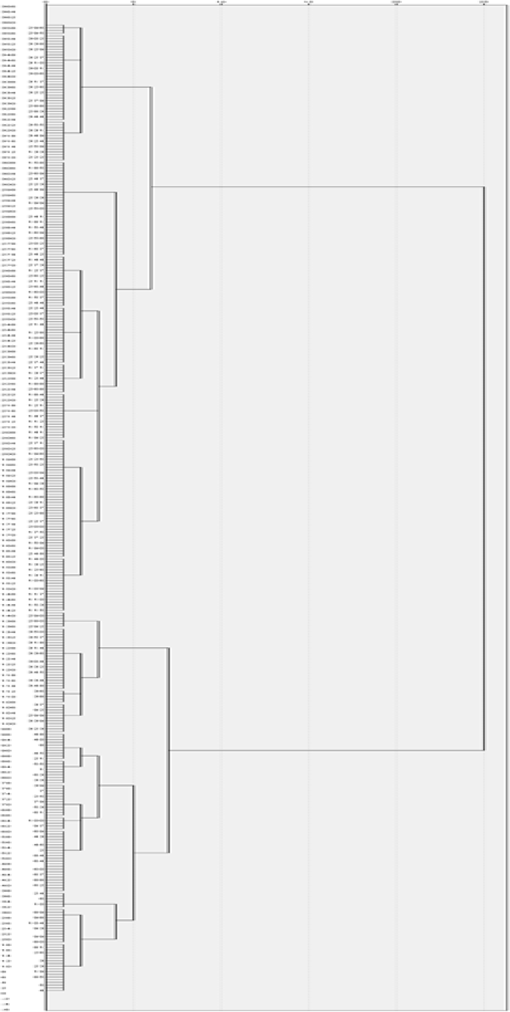 | In the dendrogram on the left side, it is seen that there are three separate clusters according to the values observed. According to the evaluations made about the motivation criteria in online shopping, different segments were formed by dividing consumers into three separate clusters. The fact that there are three separate clusters shows that there are three separate evaluation levels for each of the online shopping motives, and these evaluations occur in three clusters at three separate levels from highest to lowest. Regardless of the standard deviation, the highest value that it can get according to the measurement scale will be 2, the average value will be 0, and the lowest value −2. For example, for motivation criterion 1, the evaluations of the individuals who make up cluster 3 are above zero by 1.26 and have a higher value than the evaluations of the individuals in other clusters. The resulting value for cluster 2 is below zero by −.09. The value that cluster 1 receives is below zero by −.39 and is lower than the assessments of individuals in other clusters. In this way, the evaluations of the individuals who make up the three clusters that arise as shown in the dendrogram for each motivation criterion can be interpreted as follows. (See Table 3) Cluster/Segment (1): Among the motivation criteria leading to online shopping, evaluation levels of criteria 3, 5, 6, 7, 9 and 11 are observed as relatively high for individuals in cluster 1 compared with those in cluster 2, but lower than those involved in cluster 3. Although, based on these criteria mentioned. they have a relatively high level of motivation compared to those in cluster 2, all but a few criteria are below zero. Although a few of them are above zero, they cannot exceed the level of 1. Therefore, in terms of all motivation criteria, cluster 1 individuals are a segment whose motivation for online shopping is at a low level. Cluster/Segment (2): Among the motivation criteria leading to online shopping, evaluation levels of criteria 1, 2, 4, 8, 10, 12, 13 and 14 are observed as relatively high for individuals in cluster 1 compared with those in cluster 2, but lower than those involved in cluster 3 (except for criterion 10). In online shopping, some motivational criteria evaluations are close to 1 or up from 1 (2, 8, 10, 12, 13) and some are close to −1 or lower than −1 (3, 5, 6, 7). Therefore, the motives that cause people in cluster 2 to make purchases online are just some of the 14 motives studied. Cluster/Segment (3): For each of the motivation criterion examined, the motivation levels of the individuals in cluster 3 are higher than the levels of those in the other two clusters. All other motivation criteria, except criteria 5, 6 and 14, are above 1. Therefore, cluster 3 individuals are a segment whose motivation for online shopping is high. |
Table 5
ANOVA analysis and Levene statistics
| Descriptive statistics | Test of homogeneity of variances | ANOVA | ||||||||||
|---|---|---|---|---|---|---|---|---|---|---|---|---|
| N | Mean | Std. deviation | Std. error | Levene statistic | Sum of squares | df | Mean square | F | Sig. | |||
| Risk perception | 1 | 96 | −0.320 | 0.804 | 0.082 | 2.211 | Between groups | 6.455 | 2 | 3.228 | 3.990 | 0.019 |
| 2 | 45 | −0.180 | 0.886 | 0.132 | df1=2, df2=356 | Within groups | 288.013 | 356 | 0.809 | |||
| 3 | 218 | −0.014 | 0.941 | 0.064 | Sig.= 0.111 | Total | 358 | |||||
| Total | 359 | −0.117 | 0.907 | 0.048 | ||||||||
| Purchase intention | 1 | 96 | 0.650 | 0.880 | 0.090 | 6.610 | Between groups | 7.228 | 2 | 3.614 | 3.488 | 0.032 |
| 2 | 45 | 1.133 | 0.882 | 0.131 | df1= 2, df2= 356 | Within groups | 368.816 | 356 | 1.036 | |||
| 3 | 218 | 0.771 | 1.097 | 0.074 | Sig.= 0.002 | Total | 376.044 | 358 | ||||
| Total | 359 | 0.784 | 1.025 | 0.054 | ||||||||
[i] Sig.: Significance, Std.: Standardizsd, df: degree of freedom
Table 6
Post-hoc analysis: Multiple comparisons via Games Howell test
| Dependent variable | (I) Ward method | (J) Ward method | (I-J) Mean difference | Std. error | Sig. |
|---|---|---|---|---|---|
| Risk perception | Cluster/Segment 1 | Cluster/Segment 2 | −0.140 | 0.155 | 0.641 |
| Cluster/Segment 3 | −0.306* | 0.104 | 0.010 | ||
| Cluster/Segment 2 | Cluster/Segment 1 | 0.140 | 0.155 | 0.641 | |
| Cluster/Segment 3 | −0.166 | 0.147 | 0.498 | ||
| Cluster/Segment 3 | Cluster/Segment 1 | 0.306* | 0.104 | 0.010 | |
| Cluster/Segment 2 | 0.166 | 0.147 | 0.498 | ||
| Purchase intention | Cluster/Segment 1 | Cluster/Segment 2 | −0.482* | 0.159 | 0.009 |
| Cluster/Segment 3 | −0.120 | 0.117 | 0.559 | ||
| Cluster/Segment 2 | Cluster/Segment 1 | 0.482* | 0.159 | 0.009 | |
| Cluster/Segment 3 | 0.362* | 0.151 | 0.049 | ||
| Cluster/Segment 3 | Cluster/Segment 1 | 0.120 | 0.117 | 0.559 | |
| Cluster/Segment 2 | −0.362* | 0.151 | 0.049 |