
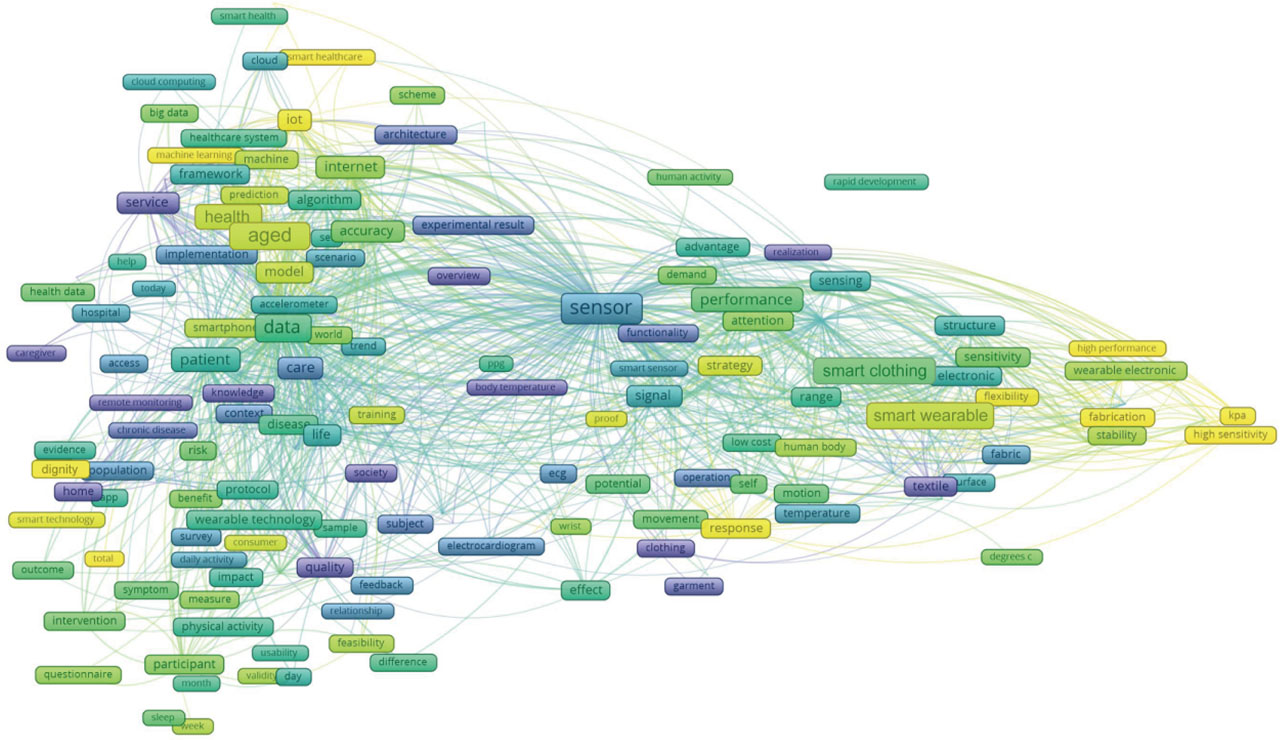
Fig. 1
Knowledge map of time frame subject keywords
Table 1
Top 15 high-frequency words from social media
| Rank | Word | Frequency |
|---|---|---|
| 1 | Function | 476 |
| 2 | Monitor | 443 |
| 3 | Smart | 378 |
| 4 | Protect | 281 |
| 5 | Home | 264 |
| 6 | Fall | 259 |
| 7 | IOT | 213 |
| 8 | Fever | 185 |
| 9 | AI | 177 |
| 10 | Bed | 143 |
| 11 | Graphene | 99 |
| 12 | Wash | 90 |
| 13 | Safe | 86 |
| 14 | Sensor | 82 |
| 15 | Lost | 81 |
Table 2
Top 15 negative emotion high-frequency words from social media
| Rank | Word | Frequency |
|---|---|---|
| 1 | Inaccurate | 31 |
| 2 | Inconvenient | 30 |
| 3 | Ugly | 30 |
| 4 | Unsafe | 28 |
| 5 | Low endurance | 25 |
| 6 | Tight | 21 |
| 7 | Heavy | 21 |
| 8 | Expensive | 19 |
| 9 | Not smooth | 17 |
| 10 | Difficult | 16 |
| 11 | Lag | 12 |
| 12 | Strange | 11 |
| 13 | Redundant | 11 |
| 14 | Outdated | 10 |
| 15 | Not practical | 10 |
Table 3
Open-ended questions for expert interview
| No. | Interview questions or conversation contents |
|---|---|
| 1 | Introduce the purpose, content, steps and time of this interview. |
| 2 | Have you ever presided over, participated in or known research on smart care-giving clothing for the disabled elderly or other related topics? Please say about your experience. |
| 3 | Are there disabled elderly or their caregivers around you? Please put forward some helpful design schemes or ideas for the disabled elderly or their caregivers from your professional perspective. |
| 4 | What categories do you think the users of smart care-giving clothing products for the disabled elderly can be divided into? |
| 5 | In what scenarios do you think smart care-giving clothing products can serve disabled elderly users? |
| 6 | Imagine you are a disabled elderly person now, what would you like to receive through smart care-giving clothing products? |
| 7 | Imagine you are a caregiver of a disabled elderly person, what would you like to receive through smart care-giving clothing ? |
| 8 | What would we do if you worked with us to design smart care-giving clothing for the disabled elderly? |
Table 4
Coding analysis of target users and usage scenarios
| User category coding | Usage scene coding | ||
|---|---|---|---|
| Number/name | Word frequency [times] | Number/name | Word frequency [times] |
| A1 Elderly with perceptual disabilities | 201 | B11 Painless | 12 |
| B12 Blindness and visual impairment | 5 | ||
| B13 Alzheimer's disease | 19 | ||
| B14 Tactile deficit | 11 | ||
| B15 Autism | 8 | ||
| A2 Elderly with expression disabilities | 245 | B21 Narrative disorder | 6 |
| B22 Communication barriers | 20 | ||
| B23 Patients who have lost their voices | 5 | ||
| B24 Disorganisation of language | 14 | ||
| B25 Intellectual disability | 27 | ||
| A3 Elderly with movement disabilities | 118 | B31 Bedridden | 31 |
| B32 Urine bag aid | 9 | ||
| B33 Incontinence | 22 | ||
| B35 Impaired mobility of the limbs | 9 | ||
| B34 Hemiplegic patients | 6 | ||
| B35 Wheelchair users | 5 | ||
Table 5
System of demand elements for smart care-giving clothing for the disabled elderly
| Second level elements | Third level elements |
|---|---|
| B1 Perceptual understanding (instinctive layer) | C11 Continuous monitoring C12 Exception alarm C13 Mobile terminals C14 Comfort C15 Danger tips |
| B2 Use in scenarios (behavioural layer) | C21 Fashion sense C22 Sense of value C23 Familiarity with semantics C24 Daily mimesis C25 Behavioural guidance |
| B3 Lifestyle (reflective layer) | C31 Dignity of independence C32 Care-giving knowledge C33 Science and wellness C34 Community exchange |
Table 6
Composite weight analysis of questionnaire
| Indicator layer | Guideline level | Weighting of the overall objective | Ranking of indicator weights | ||
|---|---|---|---|---|---|
| B1 | B2 | B3 | |||
| C11 | 1952 | 985 | 4 | ||
| C12 | 2321 | 1171 | 2 | ||
| C13 | 1871 | 944 | 5 | ||
| C14 | 2632 | 1328 | 1 | ||
| C15 | 1223 | 617 | 8 | ||
| C21 | 895 | 238 | 13 | ||
| C22 | 1053 | 280 | 12 | ||
| C23 | 2511 | 668 | 7 | ||
| C24 | 3395 | 903 | 6 | ||
| C25 | 2147 | 571 | 9 | ||
| C31 | 4911 | 1127 | 3 | ||
| C32 | 2436 | 559 | 10 | ||
| C33 | 2244 | 515 | 11 | ||
| C34 | 410 | 94 | 14 | ||
| Impact factors | 5045 | 2660 | 2295 | ||
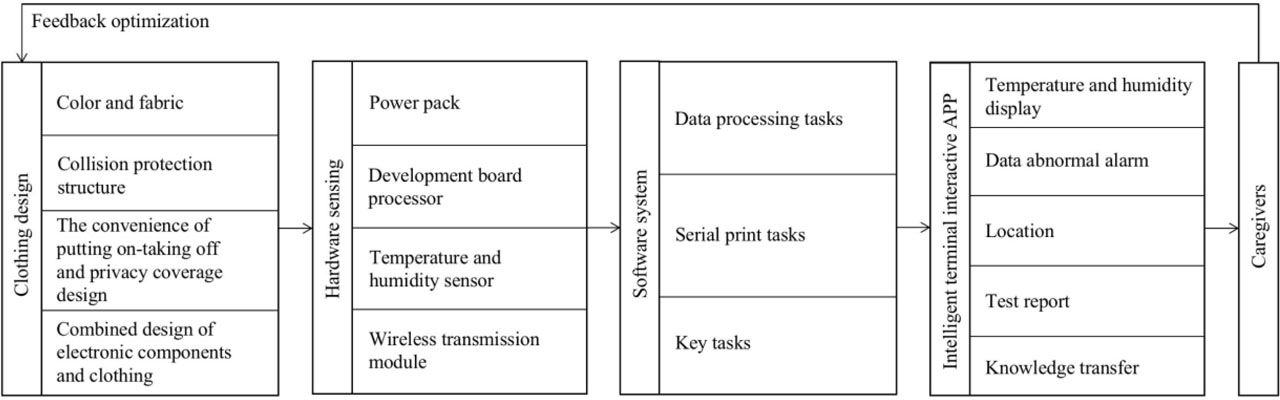
Fig. 2
Frame diagram of overall design scheme
Table 7
Description of smart clothing sensor device
| Device | Type | Property | Capacity | Work environment | Supplier |
|---|---|---|---|---|---|
| Battery | LG BL-S6 | 3.85Vcc/570mAh | - | −20°C–60°C | LG corp. |
| Microcontroller | STM32F103C8T6 | 72MHz/64KB | ≤26mA | 2V–3.6V | ST Microelectronics |
| Temperature and humidity sensor | SHT21 | ±0.3°C@−20–80°C ±2%RH@0–100%RH | ≤5.5mA | <5mA | SENSIRION corp. |
| GPS | ATGM336H-5N-7X | ±2.5m | ≤25mA | <525mA,3.3V | Zhongkewei corp. |
| Bluetooth | BT08B | Bluetooth 3.0 | ≤15mA | 3.3V–5v | Risym corp. |
| Cable | KTFB275/2 | 14.7Ω/m | - | −100°C–800°C | Qianglun corp. |
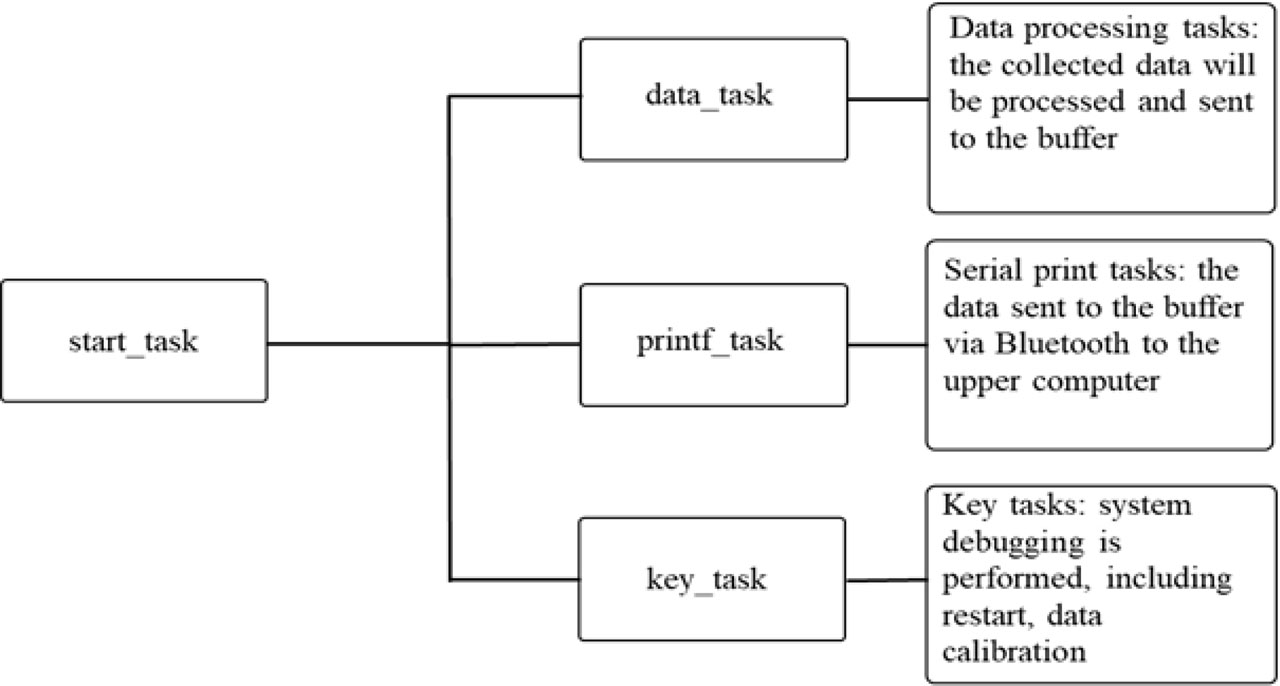
Fig. 3
Lower computer software system
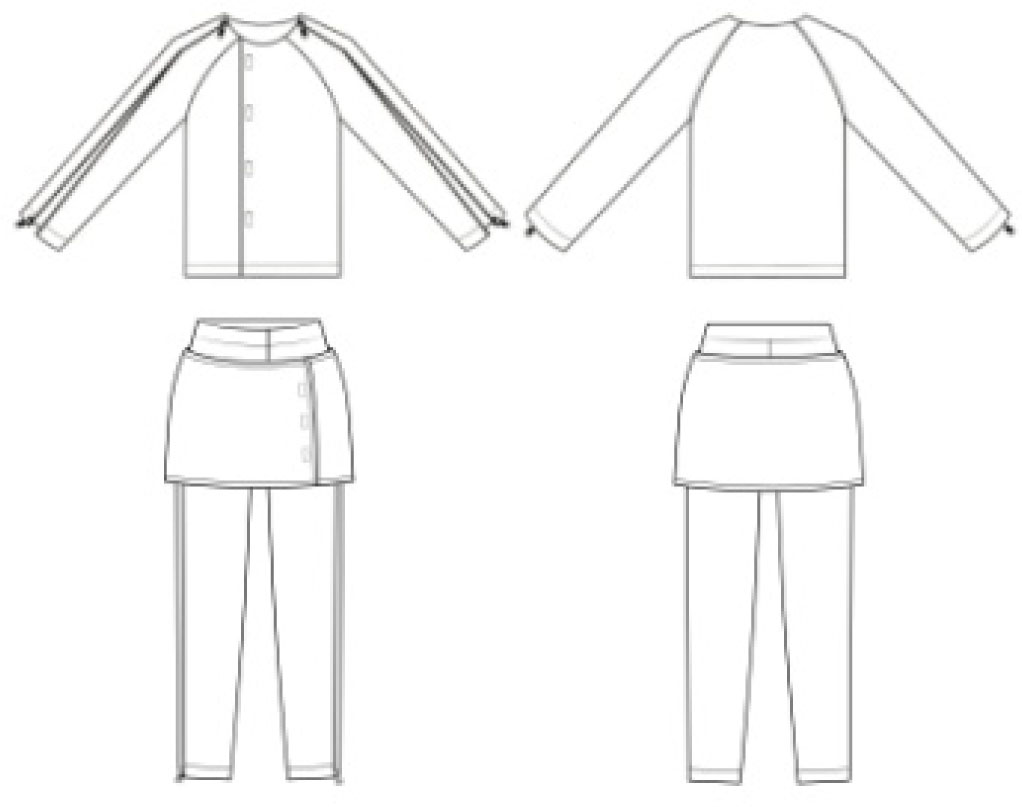
Fig. 4
Convenience of putting on-taking off design

Fig. 5
Privacy coverage design
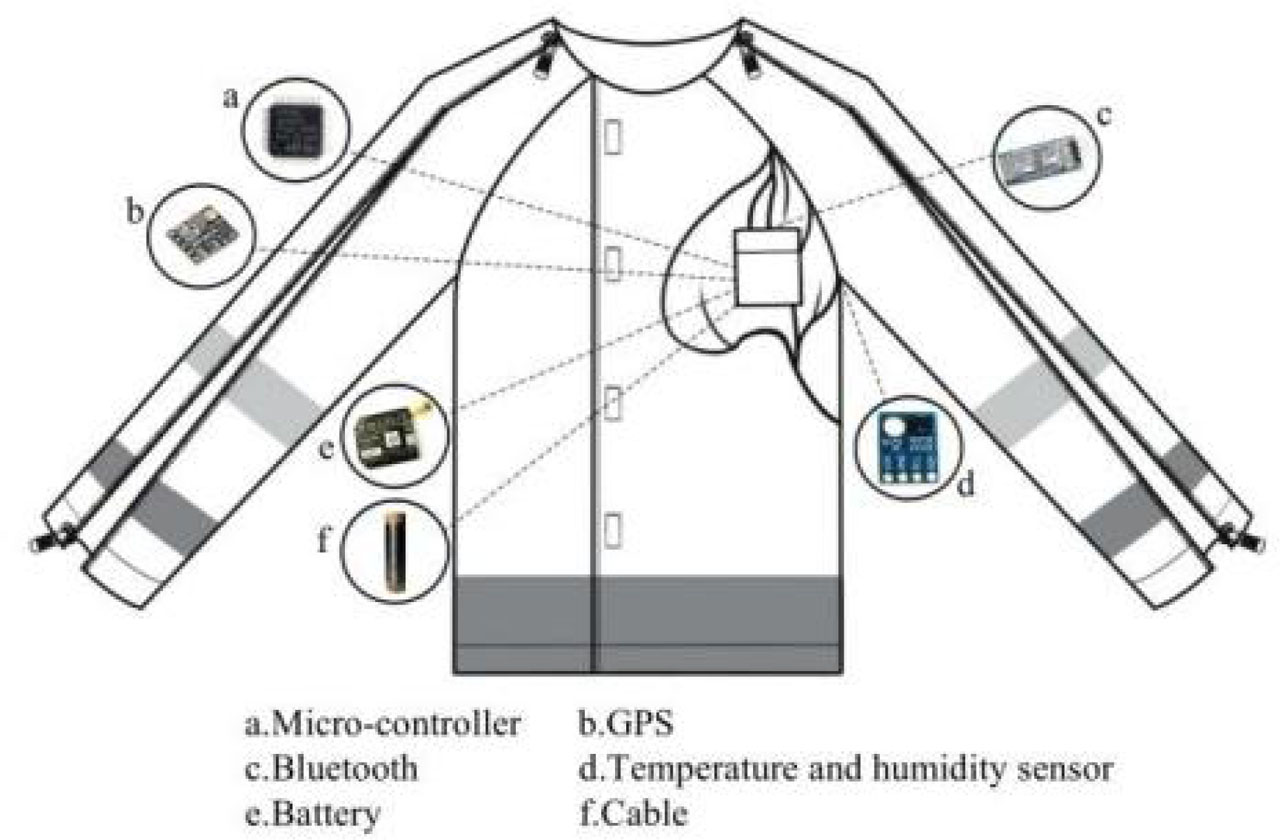
Fig. 6
Combination of electronic components and clothing
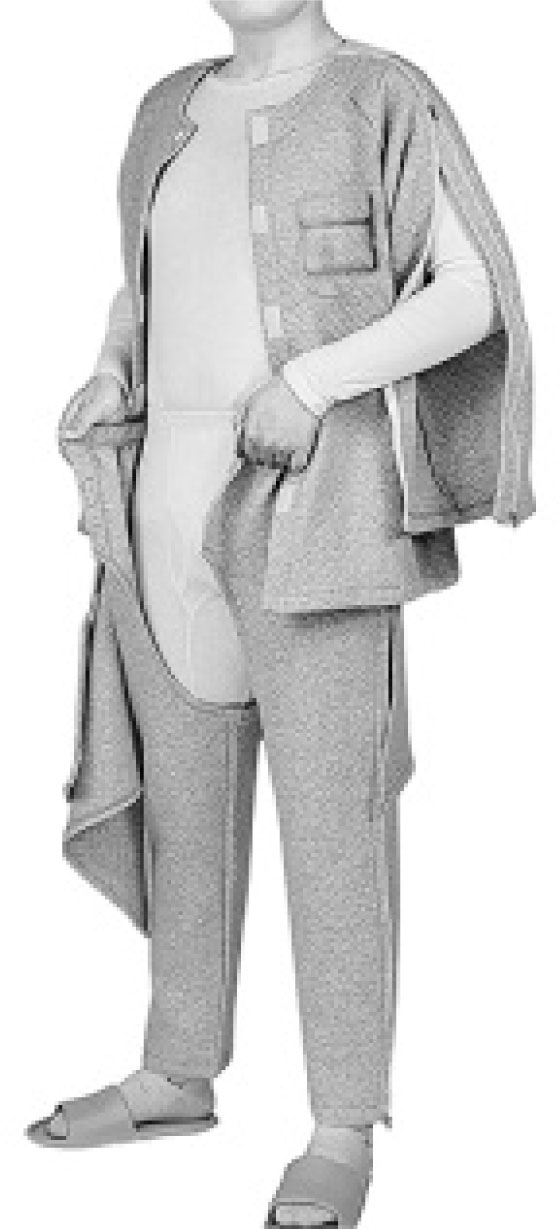
Fig. 7
Wearing appearance of design prototype
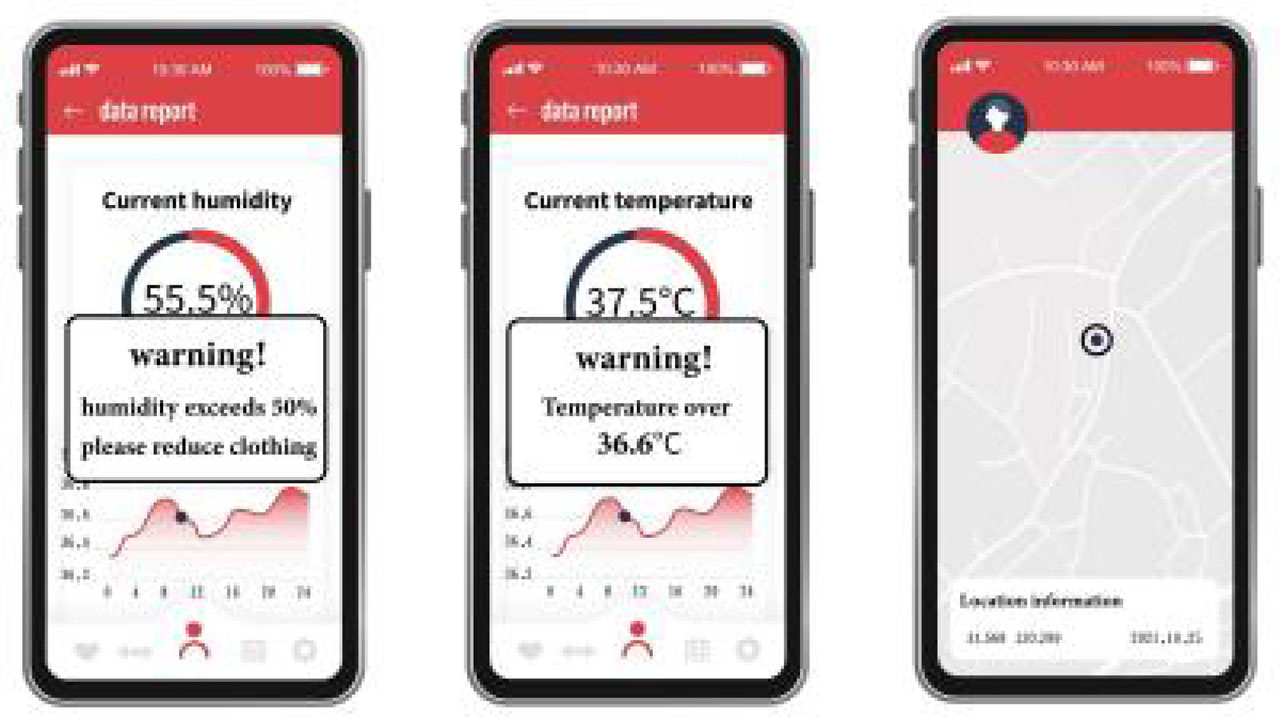
Fig. 8
Intelligent terminal app operation interface
Table 8
Experimental results of the utility of body surface temperature and humidity monitoring
| Subject number | Average temperature [°C] | Average humidity [%] | ||||
|---|---|---|---|---|---|---|
| Sensors | Thermometer | Error | Sensors | Moisture meter | Error | |
| 1 | 36.2 | 36.4 | −0.2 | 56 | 51 | +5 |
| 2 | 36.1 | 36.1 | +0.0 | 47 | 44 | +3 |
| 3 | 36.3 | 36.4 | −0.1 | 58 | 59 | −1 |
| 4 | 36.1 | 36.3 | −0.2 | 40 | 36 | +4 |
| 5 | 35.8 | 35.9 | −0.1 | 44 | 45 | −1 |
| 6 | 35.5 | 35.8 | −0.3 | 45 | 47 | −2 |
| 7 | 36.4 | 36.8 | −0.4 | 41 | 39 | +2 |
| 8 | 35.9 | 36.2 | −0.3 | 50 | 45 | +5 |
Table 9
Comparison of the frequency of body checks
| Group number | Times of body check per day with ordinary clothing [times] | Times of body check per day with care-giving clothing [times] |
|---|---|---|
| 1 | 3 | 2 |
| 2 | 5 | 3 |
| 3 | 4 | 2 |
| 4 | 2 | 2 |
| 5 | 2 | 1 |
| 6 | 4 | 2 |
| 7 | 3 | 1 |
| 8 | 3 | 2 |
| Average | 3.25 | 1.875 |
Table 10
Comparison of putting on and taking off time in six representative daily scenarios
| Scene | Part | Smart clothing [s] | Normal clothing [s] | Reduction [%] |
|---|---|---|---|---|
| Standing | Upper clothing | 19.21 | 46.12 | 58.35 |
| Standing | Trousers | 16.13 | 51.44 | 68.64 |
| Lying in bed | Upper clothing | 41.57 | 77.67 | 46.48 |
| Lying in bed | Trousers | 35.23 | 54.43 | 35.27 |
| Toilet | Trousers or crotch unit | 14.10 | 22.67 | 37.80 |
| Arm injections | Upper clothing or sleeves | 12.76 | 35.25 | 63.80 |
| Total | 139.00 | 287.58 | 51.67 |
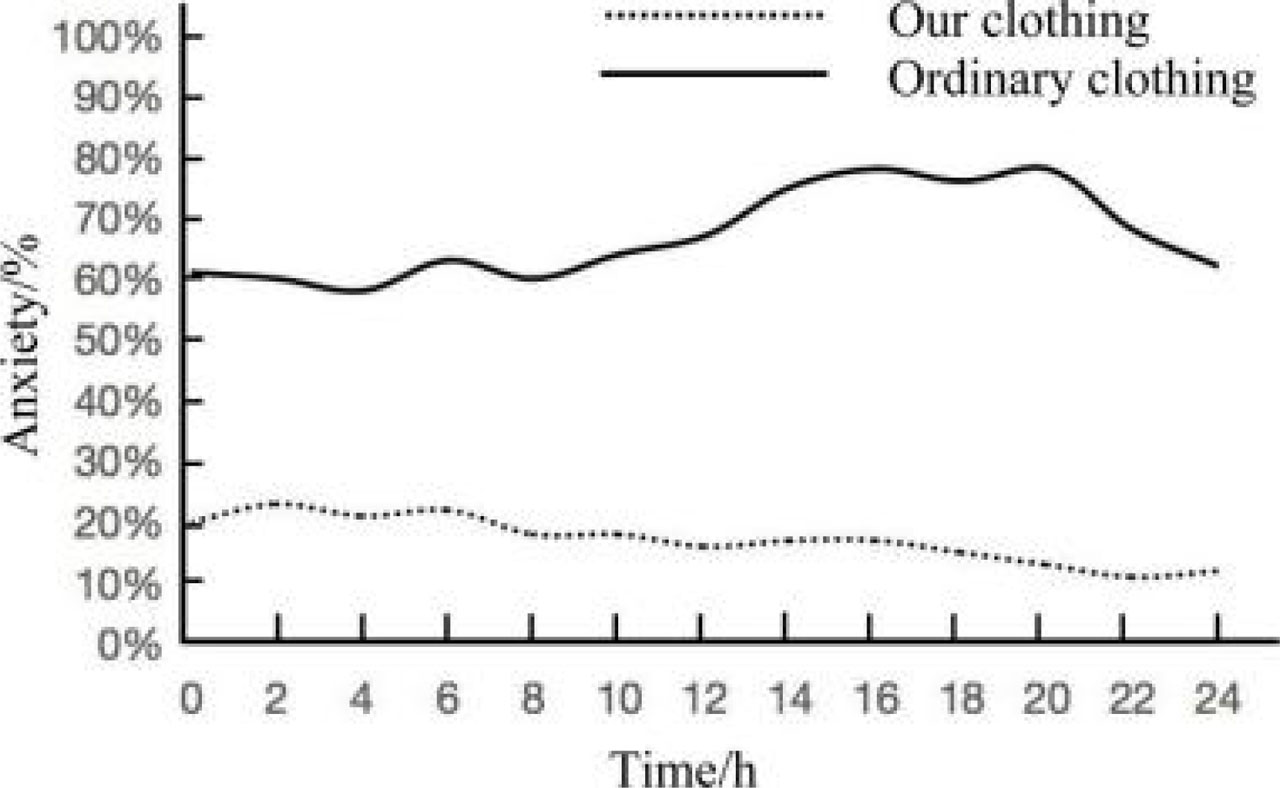
Fig. 9
Comparative experiment result of caregiver's anxiety
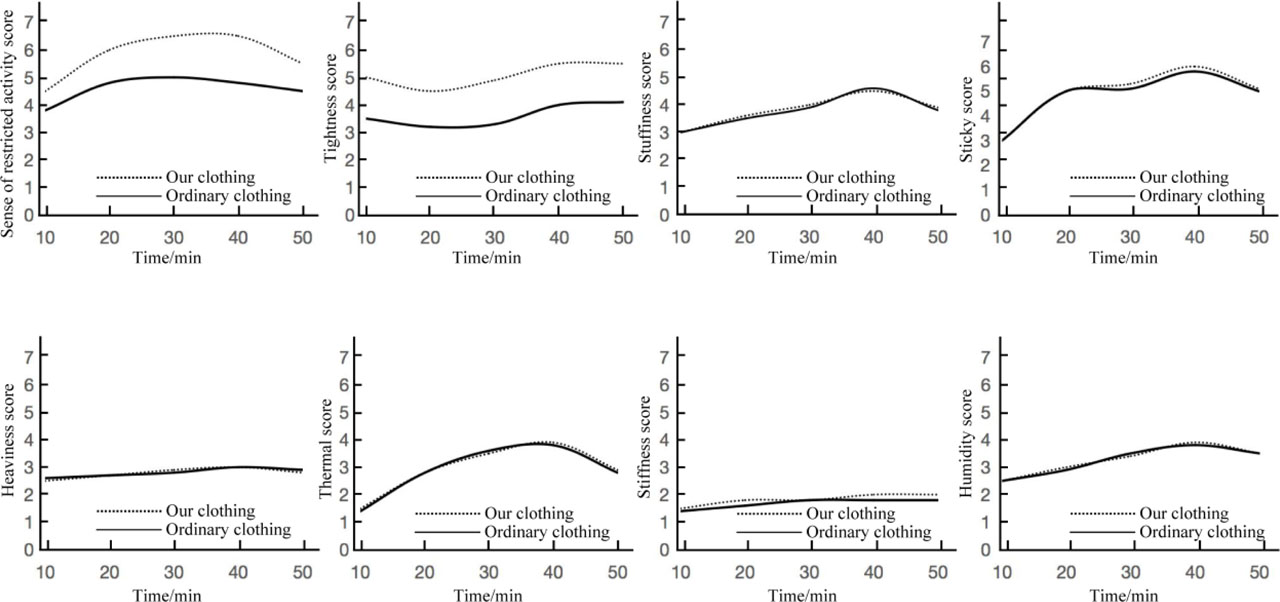
Fig. 10
Subjective rating scores for clothing comfort