
1. Introduction
With the advent of the digital, intelligent and networked era, the old business model has been reversed and new business models have emerged [1]. Consumers’ life, work, study and entertainment behaviours are becoming more and more digital [2, 3]. At the same time, the limitation of consumption in consumer behaviour is basically ending, and consumer behaviour tends to be varied. The digital transformation of the garment customisation industry has become an inevitable trend. In recent years, the consumer’s perceived value has received widespread attention [4]. It plays an important role in predicting purchasing behaviour, achieving sustainable competitive advantage, and influencing relationship management [5]. Consumer perceived value was the strategic priority of producers and retailers in the 1990s, and continues to be of great significance in the 21st century. It refers to the consumer’s evaluation of product (or service) utility, which is based on consumers’ perception of the “gain” and “give” of products [6]. Consumers’ perceived value is not unilateral: it is a multi-dimensional concept. Therefore, most scholars use multi-dimensional methods to divide it [7]. Sheth et al. put forward a theory to explain why consumers make choices [8], and divided consumer perceived value into five dimensions, including social value, emotional value, functional value, cognitive value and conditional value. Wan et al. examined the perceived value of online customisation experience from the perspective of customer experience [9], and believe that perceived value includes service value, product quality, currency price and time cost. Petrick established a multi-dimensional service perceived value measurement scale [10]. According to its structure and dimensions, perceived value includes emotional value, quality value, price value and social value. The existing references for research on online consumer perceived value are limited. Sullivan et al. revealed how to strengthen the online trading relationship by considering the perception of product quality and product value, so as to increase the trust perception of online buyers [2]. Pham et al. believe that access convenience, search convenience, evaluation convenience, transaction convenience and ownership/post-purchase convenience are important factors affecting customer perceived value [3]. Jiang et al. concluded through research that holding brand marketing communication activities in the pre-consumption stage will trigger positive emotional reactions of consumers, thereby enhancing brand preference, which directly contributes to perceived value and indirectly to brand loyalty [11].
At present, there are few studies on consumers’ perceived value of online garment customisation, but the market for online garment customisation is growing. Obviously, for different consumers, the perceived value of online garment customisation consumption behaviour is different. With the prevalence of online garment customisation, consumer demand tends to be varied. Therefore, research on consumers’ perceived value is more urgent. Based on the consumption behaviour of different consumers as the breakthrough point, in this paper a research model of perceived value was constructed and comprehensively analyses conducted of the perceived value of online custom garment consumers. Moreover, the literature analysis and data collection methods were used to obtain the constituent elements of the customer perceived value of online garment customisation, then a consumer questionnaire survey was conducted, and next the customer value dimension was extracted through statistical analysis of the survey data. Different perceived value dimensions as reference factors for online garment customisation are put forward, helping to improve consumers’ purchasing efficiency, and supplementing existing online clothing customisation theories. Also, it can enrich research data on online clothing customisation, and understand consumer needs more clearly to improve the experience of the consumption process. It also provides a reference theoretical basis for enterprises conducting online garment customisation business.
2. Method
2.1. Theoretical Model Design
Through a literature review, the factors affecting consumers’ perceived value of online garment customisation are summarised, which are divided into eight dimensions: quality value, price value, service performance, website function, personalised demand, emotional value, social value and supply chain factors. In order to explore the influence of each dimension on consumers’ purchasing behaviour, this paper puts forward a research model framework (Figure 1).
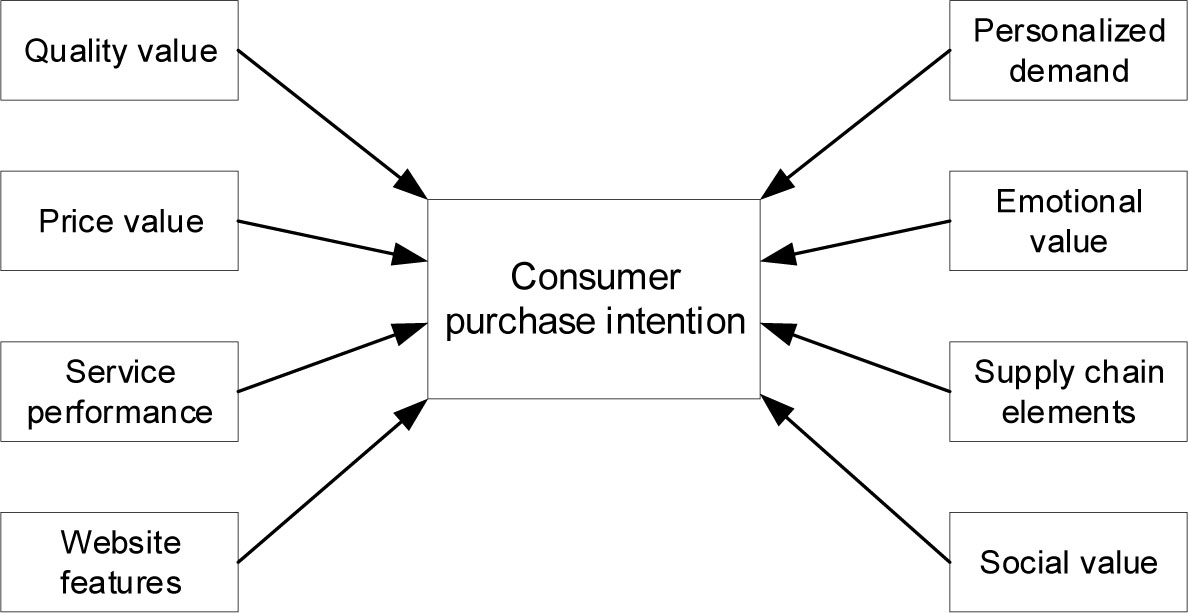
Fig. 1
Research theoretical model
2.2. Scale Construction and Optimisation
Before the questionnaire was formally issued, interviews were conducted with professional teachers and custom consumers in garment related fields. Inaccurate expressions and semantic duplication were eliminated, and the study finally set 34 measurement elements. The final measurement elements and codes are shown in Table 1.
Table 1
Corresponding indicators of the scale
| Construct | Items | Code | Reference |
|---|---|---|---|
| Quality value | Craftsmanship | QUA1 | [6,12] |
| Quality of accessories | QUA2 | ||
| Comfort | QUA3 | ||
| Easy to take care of | QUA4 | ||
| Wear resistance | QUA5 | ||
| Price value | Reasonable price | PRI1 | [3] |
| Good value for money | PRI2 | ||
| Discount intensity | PRI3 | ||
| Service performance | Service attitude | SER1 | [13] |
| Online one-to-one customer service | SER2 | ||
| Measure body size at home | SER3 | ||
| Intelligent measurement service (3D anthropometry, etc.) | SER4 | ||
| Style recommendation service | SER5 | ||
| Exclusive after-sales service | SER6 | ||
| Personalised demand | Fitness | IND1 | [14] |
| Dress for your body type | IND2 | ||
| Participation (experience design, production, etc.) | IND3 | ||
| Have exclusive identification (initials, etc.) | IND4 | ||
| Self-selection of accessories | IND5 | ||
| Website features | Interface aesthetics | WEB1 | [2,3] |
| Convenient operation | WEB2 | ||
| Provide comprehensive information | WEB3 | ||
| Payment security | WEB4 | ||
| Emotional value | Pursue individuality | EMO1 | [15] |
| Curiosity driven | EMO2 | ||
| Bring happiness | EMO3 | ||
| Easy experience process | EMO4 | ||
| Supply chain elements | Production cycle | SUP1 | [11] |
| Merchant reputation | SUP2 | ||
| Logistics speed | SUP3 | ||
| Logistics networking | SUP4 | ||
| Social value | Dress occasion needs | SOC1 | [16] |
| Symbolic status | SOC2 | ||
| Obtain social recognition | SOC3 |
2.3. Questionnaire Design
Based on the theoretical model constructed in this paper, a questionnaire was designed. The survey questionnaire included the elements of all dimensions in Table 1. According to the respondents’ recognition of each element of each dimension and the degree to which they consider them important, each element was analysed to extract the dimension of customer perceived value.
The questionnaire was issued online to the target consumer and potential consumer groups customised online. Therefore, the research method adopted in this paper was the online issuance of questionnaires. The questionnaires were distributed and collected through a website called “Questionnaire Star”. The survey was conducted in Xi’an, Shaanxi, China, and adopted intentional sampling in non-conceptual sampling close to the target customers of online customisation. The interviewees were 20–55 year-old consumers with a college degree or above, and the survey time was from October 15, 2021, to October 19, 2021.
The questionnaire was evaluated by the Likert 5 scale method, where 1 represents very insignificant, 5 represents very important, with 1–5 representing the degree of importance in turn. A total of 362 questionnaires were collected. The questionnaires were screened through the answer time and answer situation. After removing 41 invalid questionnaires that did not meet the requirements of the questionnaire, 321 valid ones were obtained. The effective recovery rate was 88.67%.
3. Results
3.1. Descriptive analysis
The final data collected were imported into SPSS statistical software, and 321 valid questionnaires were statistically analysed. First, descriptive analysis was carried out, the results of which are shown in Table 2. All the mean values in the table are greater than 3, indicating that the 34 elements have a certain influence on consumers’ purchase behaviour towards online customised garments.
Table 2
Descriptive analysis
| Code | Proportion, % | Mean | Standard deviation | Variance | ||||
|---|---|---|---|---|---|---|---|---|
| Very unimportant | Unimportant | Normal | Important | Very important | ||||
| QUA1 | 0.9 | 1.6 | 11.2 | 48.6 | 37.7 | 4.21 | 0.771 | 0.595 |
| QUA2 | 0.6 | 1.2 | 7.8 | 44.9 | 45.5 | 4.33 | 0.727 | 0.529 |
| QUA3 | 0.6 | 1.2 | 3.7 | 32.7 | 61.7 | 4.54 | 0.689 | 0.474 |
| QUA4 | 0.6 | 1.6 | 14.3 | 43.6 | 39.9 | 4.21 | 0.787 | 0.620 |
| QUA5 | 0.6 | 1.6 | 15.0 | 44.2 | 38.6 | 4.19 | 0.788 | 0.621 |
| PRI1 | 0.3 | 0.9 | 11.5 | 46.7 | 40.5 | 4.26 | 0.720 | 0.519 |
| PRI2 | 0.3 | 2.2 | 22.1 | 43.9 | 31.5 | 4.04 | 0.807 | 0.651 |
| PRI3 | 0.3 | 2.8 | 32.7 | 38.6 | 25.5 | 3.86 | 0.840 | 0.706 |
| SER1 | 0 | 0.6 | 13.1 | 49.2 | 37.1 | 4.23 | 0.690 | 0.476 |
| SER2 | 1.6 | 5.3 | 30.5 | 40.8 | 21.8 | 3.76 | 0.906 | 0.820 |
| SER3 | 1.2 | 14.0 | 38.0 | 30.8 | 15.9 | 3.46 | 0.961 | 0.924 |
| SER4 | 1.6 | 9.3 | 35.5 | 35.8 | 17.8 | 3.59 | 0.938 | 0.880 |
| SER5 | 0.6 | 4.4 | 30.5 | 42.7 | 21.8 | 3.81 | 0.848 | 0.719 |
| SER6 | 0.3 | 3.1 | 15.6 | 40.5 | 40.5 | 4.18 | 0.827 | 0.684 |
| IND1 | 0.3 | 0.6 | 9.7 | 46.7 | 42.7 | 4.31 | 0.695 | 0.483 |
| IND2 | 3.1 | 12.5 | 42.1 | 26.2 | 16.2 | 3.40 | 1.001 | 1.003 |
| IND3 | 2.2 | 15.3 | 35.2 | 31.5 | 15.9 | 3.44 | 1.001 | 1.003 |
| IND4 | 5.0 | 14.3 | 36.1 | 27.1 | 17.4 | 3.38 | 1.083 | 1.173 |
| IND5 | 0.9 | 10.6 | 28.0 | 37.7 | 22.7 | 3.71 | 0.966 | 0.933 |
| WEB1 | 0.3 | 3.1 | 25.9 | 44.5 | 26.2 | 3.93 | 0.819 | 0.670 |
| WEB2 | 0 | 1.6 | 11.5 | 47.0 | 39.9 | 4.25 | 0.717 | 0.514 |
| WEB3 | 0 | 1.9 | 12.8 | 42.1 | 43.3 | 4.27 | 0.752 | 0.565 |
| WEB4 | 0 | 0.9 | 7.2 | 29.6 | 62.3 | 4.53 | 0.671 | 0.450 |
| EMO1 | 0.3 | 3.1 | 32.1 | 41.7 | 22.7 | 3.83 | 0.822 | 0.676 |
| EMO2 | 0.6 | 8.1 | 42.1 | 33.0 | 16.2 | 3.56 | 0.879 | 0.772 |
| EMO3 | 0.3 | 2.5 | 19.0 | 43.6 | 34.6 | 4.10 | 0.810 | 0.656 |
| EMO4 | 0.3 | 1.9 | 14.3 | 44.2 | 39.3 | 4.20 | 0.774 | 0.599 |
| SUP1 | 0.3 | 3.7 | 24.9 | 46.4 | 24.6 | 3.91 | 0.817 | 0.667 |
| SUP2 | 0 | 0.9 | 10.3 | 32.1 | 56.7 | 4.45 | 0.714 | 0.510 |
| SUP3 | 0 | 1.2 | 20.2 | 43.6 | 34.9 | 4.12 | 0.767 | 0.588 |
| SUP4 | 0 | 0.9 | 14.3 | 44.5 | 40.2 | 4.24 | 0.726 | 0.527 |
| SOC1 | 0 | 0.9 | 14.3 | 49.2 | 35.5 | 4.19 | 0.707 | 0.500 |
| SOC2 | 0 | 6.5 | 33.0 | 36.1 | 24.3 | 3.78 | 0.889 | 0.790 |
| SOC3 | 0 | 5.9 | 29.9 | 38.9 | 25.2 | 3.83 | 0.874 | 0.763 |
3.2. Factor analysis
In order to clarify the impact of each element on consumers’ perceived value, factor analysis was conducted on the data. Using SPSS software for reliability analysis, the Cronbach Alpha coefficient was found to be 0.932, and the result was greater than 0.8. This indicates that the reliability of the questionnaire is good. Kaiser-Meyer-Olkin (KMO) and Bartlett tests were performed on the data. The KMO value was 0.906, which was greater than 0.5. The Bartlett test chi-square value was 5620.012, the degrees of freedom were 561, and P was 0.000, indicating that the data were suitable for factor analysis.
Common factors were extracted by principal component analysis, and 5 common factors with characteristic values greater than 1 were extracted. The cumulative explanatory variable was 68.225%, as shown in Table 3. In order to understand the components of the five common factors, this paper used the maximum variance method to perform Kaiser normalised orthogonal rotation on the factors. The factor loading after rotation reflects the relationship between the factor and each element. The higher the load, the greater the correlation. The rotation converges after 9 iterations.
Table 3
Total variance explained
| Factor | Eigenvalue | % of Variance | Cumulative % |
|---|---|---|---|
| 1 | 10.898 | 43.891 | 43.891 |
| 2 | 3.083 | 9.069 | 52.960 |
| 3 | 2.186 | 6.429 | 59.389 |
| 4 | 1.655 | 4.867 | 64.256 |
| 5 | 1.174 | 3.969 | 68.225 |
In the process of factor analysis, when the load is greater than or equal to 0.5, it can be considered that the factor can represent the indicator variable. The loads of PRI2, SER1, IND5, PRI3 and SUP1 are less than 0.5, which means that these five elements cannot dominate the indicator variables. Therefore, the good value for money, service attitude, self-selection of accessories, discount intensity and production cycle were excluded from the scale. The final rotation component matrix is shown in Table 4.
Table 4
Rotated component matrix
| Code | Definition | Website comprehensive function | Personalised service | Product quality | Emotional demand | Social value |
|---|---|---|---|---|---|---|
| WEB3 | Provide comprehensive information | 0.769 | ||||
| WEB2 | Convenient operation | 0.744 | ||||
| WEB4 | Payment security | 0.738 | ||||
| SUP2 | Merchant reputation | 0.703 | ||||
| SUP4 | Logistics networking | 0.622 | ||||
| IND1 | Fitness | 0.586 | ||||
| PRI1 | Reasonable price | 0.575 | ||||
| EMO4 | Easy experience process | 0.566 | ||||
| WEB1 | Interface aesthetics | 0.515 | ||||
| SUP3 | Logistics speed | 0.504 | ||||
| SER3 | Measure body size at home | 0.805 | ||||
| SER4 | Intelligent measurement services | 0.795 | ||||
| SER2 | Online one-to-one customer service | 0.654 | ||||
| SER5 | Style recommendation service | 0.648 | ||||
| IND3 | Participation | 0.562 | ||||
| IND2 | Dress for your body type | 0.552 | ||||
| SER6 | Exclusive after-sales service | 0.528 | ||||
| QUA2 | Quality of accessories | 0.797 | ||||
| QUA3 | Comfort | 0.773 | ||||
| QUA1 | Craftsmanship | 0.739 | ||||
| QUA5 | Wear resistance | 0.712 | ||||
| QUA4 | Easy to take care of | 0.698 | ||||
| EMO2 | Curiosity driven | 0.749 | ||||
| EMO1 | Pursue individuality | 0.622 | ||||
| EMO3 | Bring happiness | 0.599 | ||||
| IND4 | Have exclusive identification | 0.538 | ||||
| SOC2 | Symbolic status | 0.764 | ||||
| SOC3 | Obtain social recognition | 0.713 | ||||
| SOC1 | Address occasion needs | 0.540 |
Names of the five common factors:
The first factor: website comprehensive function (F1). This factor has a large load in providing comprehensive information, convenient operation, payment security, merchant reputation, logistics networking, interface aesthetics, logistics speed, etc. In comprehensive consideration, the first factor is defined as the website comprehensive function.
The second factor: personalized service (F2). This factor has a large load in providing measure body size at home, online one-to-one customer service, style recommendation service, exclusive after-sales service, participation and dress for your body type is available. Therefore, this factor is defined as personalised service.
The third factor: product quality (F3). The load of this factor is mainly in the quality of accessories, comfort, craftsmanship, wear resistance and ease to take care of. This factor is defined as product quality.
The fourth factor: emotional demand (F4). The load of the commodity attribute factor is mainly on the following four variables: curiosity driven, pursuing individuality, bringing happiness and having exclusive identification. This factor is defined as emotional demand.
The fifth factor: social value (F5). This factor reflects information on the following three variables: symbolising status, obtaining social recognition and addressing occasion needs. It has a large load on these three variables. Therefore, this factor is defined as social value.
In summary, factor analysis removed the original 34 measurement variables, retained 29 measurement variables, and extracted five common factors. According to the results of factor analysis, five common factors were redefined, which are website comprehensive function, personalised service, product quality, emotional demand and social value.
3.3. Fuzzy comprehensive evaluation
With the help of some concepts of fuzzy mathematics, fuzzy comprehensive evaluation allows to evaluate the actual comprehensive evaluation problems.
Based on fuzzy mathematics, it quantifies some fuzzy factors and makes a comprehensive evaluation [17]. In order to test consumers’ comprehensive attitude towards the research results of the evaluation scale proposed, the fuzzy comprehensive evaluation method was used to make a reasonable evaluation.
First, set the universe of discourse:
Sort the elements in U and publish m comments as:
Where VI is the i-th evaluation sequence, that is, a sorting of elements in U.
Let A be the fuzzy subset of the importance of factors in U, and R the fuzzy relation matrix from U to V derived from fuzzy value mapping f. Through the fuzzy linear transformation of R, A can be converted into a comprehensive evaluation subset for V
According to the comprehensive score of each evaluation object calculated, the comprehensive attitude of consumers can be obtained.
There are many factors involved in this paper. Factor set U can be divided into n subsets according to the number of factors obtained by factor analysis, which are recorded as U1, U2, ..., Un, where n = 5, Ui={F1, F2, F3, F4, F5}. In this study, the weight of each subset is equal, that is, A is the same.
Analyze the results of the factor analysis in the previous chapter. Taking the first factor as an example, the weight judgment matrix R1 is constructed according to the above data, and the judgment result B1 is obtained.
thenThe results show that 0.12% of consumers think that the comprehensive function of the website is very unimportant for perceived value, 1.39% that it is not important, 13.77% that it is general, 42.1% that it is important, and 42.6% that it is very important. According to the principle of maximum subordination, the comprehensive function of the network is “very important”.
Similarly, fuzzy comprehensive evaluation was carried out for the other four factors, the results of which are shown in Table 5.
Table 5
Fuzzy comprehensive evaluation result
| Factor | Proportion, % | Conclusion | ||||
|---|---|---|---|---|---|---|
| Very unimportant | Unimportant | Normal | Important | Very important | ||
| F1 | 0.12 | 1.39 | 13.77 | 42.10 | 42.60 | Very important |
| F2 | 1.51 | 9.13 | 32.49 | 35.47 | 21.41 | Important |
| F3 | 0.66 | 1.44 | 10.40 | 42.80 | 44.68 | Very important |
| F4 | 1.55 | 7.00 | 32.33 | 36.35 | 22.73 | Important |
| F5 | 0.00 | 4.43 | 25.73 | 41.40 | 28.33 | Important |
The results show that consumers generally believe that the comprehensive function of the network is very important, and the data ratio of the comprehensive function of the website is 84.70%. These data fully illustrate that the comprehensive function of the website is an important part of consumers’ perceived value. In the investigation of the quality value, the important data ratio of product quality reached 87.48%. Among the other three factors, according to the principle of maximum subordination, it is considered that these three factors are important. The important proportions are personalized service 35.47%, emotional demand 36.35% and social value 41.40%, respectively. It shows that consumer recognition of these three factors is an integral part of their perceived value. This research results can be used to evaluate the perceived value of online garment customisation consumers.
4. Discussion
At present, as the epidemic continues, consumer entertainment and shopping activities are largely affected, and online shopping is the main way of shopping. For customised consumers, their shopping behaviour has been severely affected. When shopping offline, customised consumers can measure and select models in the store, and actually touch the fabrics, accessories, etc. of the clothing. And garment customisation companies have also suffered greatly from the epidemic. In this case, consumers and enterprises are turn to online at the same time. For online customisation enterprises, the perceived value of consumers has a great influence on them. Fully understanding and being familiar with consumers’ perceived value can bring a unique and good shopping experience to customers as well as great benefits to enterprises. This study aimed to understand the perceived value of consumers, and give reference opinions for garment enterprises when it is difficult to judge the needs of customised consumers.
Through factor analysis and fuzzy comprehensive analysis, the factors affecting the perceived value of online customisation consumers were obtained. Five factors were proposed. It can be seen that the three factors of product quality, emotional demand and social value are roughly the same as those in the establishment of the research model, indicating that these factors were properly considered in the establishment of the research model. In the fuzzy comprehensive evaluation, the website comprehensive function accounts for the highest proportion among the five factors, indicating that consumers think the website comprehensive function has the most important impact on their perceived value. Online garment customisation enterprises should pay attention to website functions. Personalised or simple interfaces should be designed for consumers to choose. Clothing displays should provide a comprehensive and intuitive display method, so that customers can easily understand the information they want to know. For the payment method and website security, enterprises should take the convenience of consumer payment and the protection of consumers’ property security as the main requirements for website design.
5. Conclusion
This paper studied the perceived value of online garment customisation consumers and constructed eight measurement dimensions, which are product quality, price value, service performance, website function, personalised demand, emotional value, social value and supply chain elements. Then, a theoretical model was established. Based on the analysis of 321 valid questionnaires collected in the form of a questionnaire, the following conclusions are drawn:
1) Five key dimensions affecting consumers’ perceived value were extracted: integrated website functionality, personalised service, product quality, emotional demand and social value.
2) Through the cumulative contribution rate, it can be seen that each dimension has a great influence on consumers’ perceived value, among which the comprehensive function of the website has the highest degree of influence. Garment customisation enterprises should focus on the dimension of the website function when building online platforms.
3) To test consumers’ comprehensive attitude towards the research results, a fuzzy comprehensive evaluation was conducted. The results show that consumers have a high degree of recognition of the research results. Among them, consumers believe that product quality and the website comprehensive function have the highest impact on their perceived value. However, this study has some limitations, in view of which, there are also further prospects for future research. The specific performance of the study is as follows:
(1) Due to the limited manpower and material resources, this study had a small sample size and was only aimed at the population of Xi’an, Shaanxi, China. The geographical distribution was relatively concentrated, which is bound to ignore the fact that the perceived value of network consumers in different regions may be varied. In the future, we can target more and wider research samples.
(2) This study adopted the questionnaire survey method. The respondents may have felt bored with more questionnaire items, which affected the quality of the answer. Moreover, the questionnaire survey may have been affected by the emotions and attitudes of the respondents, and may not fully reflect the true answers in the minds of the respondents.
(3) This study lacks in-depth analysis on the demographic characteristics of online consumers. The perceived value of consumers of different ages, gender, income level and social status may be different. In future research, the demographic characteristics can be used as control variables to study the perceived value of the online garment customisation consumption behaviour of different consumers.
(4) This study does not focus on specific garment categories. In the future, we can more accurately study consumers’ perceived value of online customised consumption of a specific garment category (such as shirts, dresses, etc.).
Acknowledgements
The work was financially supported by The National Natural Science Foundation of China, China (No. 61806161), China National Endowment for the Arts, China (No. 2018-A-05-(263)-0928), Social Science Fund Project of Shaanxi Province, China (No. 2018K32), Natural Science Basic Research Program of Shaanxi Province, China (No. 2019JQ-848), Innovation Ability Support Plan of Shaanxi Province-Young Science and Technology Star Project, China (No. 2020KJXX-083), Science and Technology Guidance Project of China Textile Industry Federation, China (No. 2019049) and The Youth Innovation Team of Shaanxi Universities, China (No. 21JP048).