
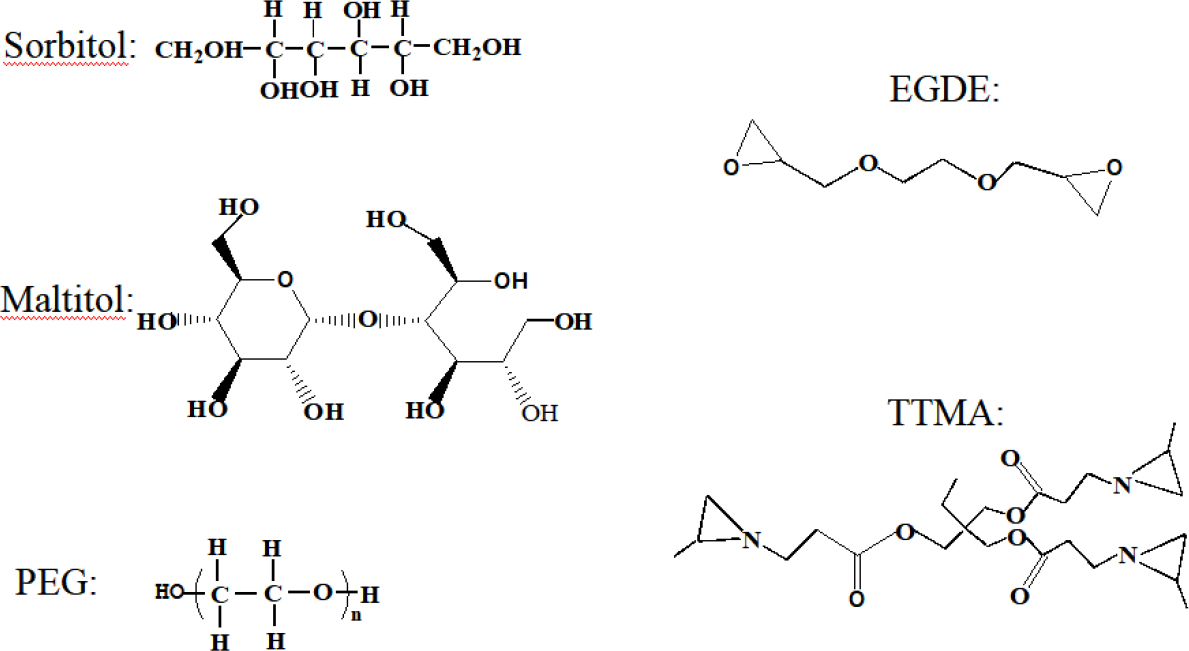
Fig. 1
Structure diagram of polyols (sorbitol, maltitol, PEG) and crosslinkers (EGDE, TTMA)
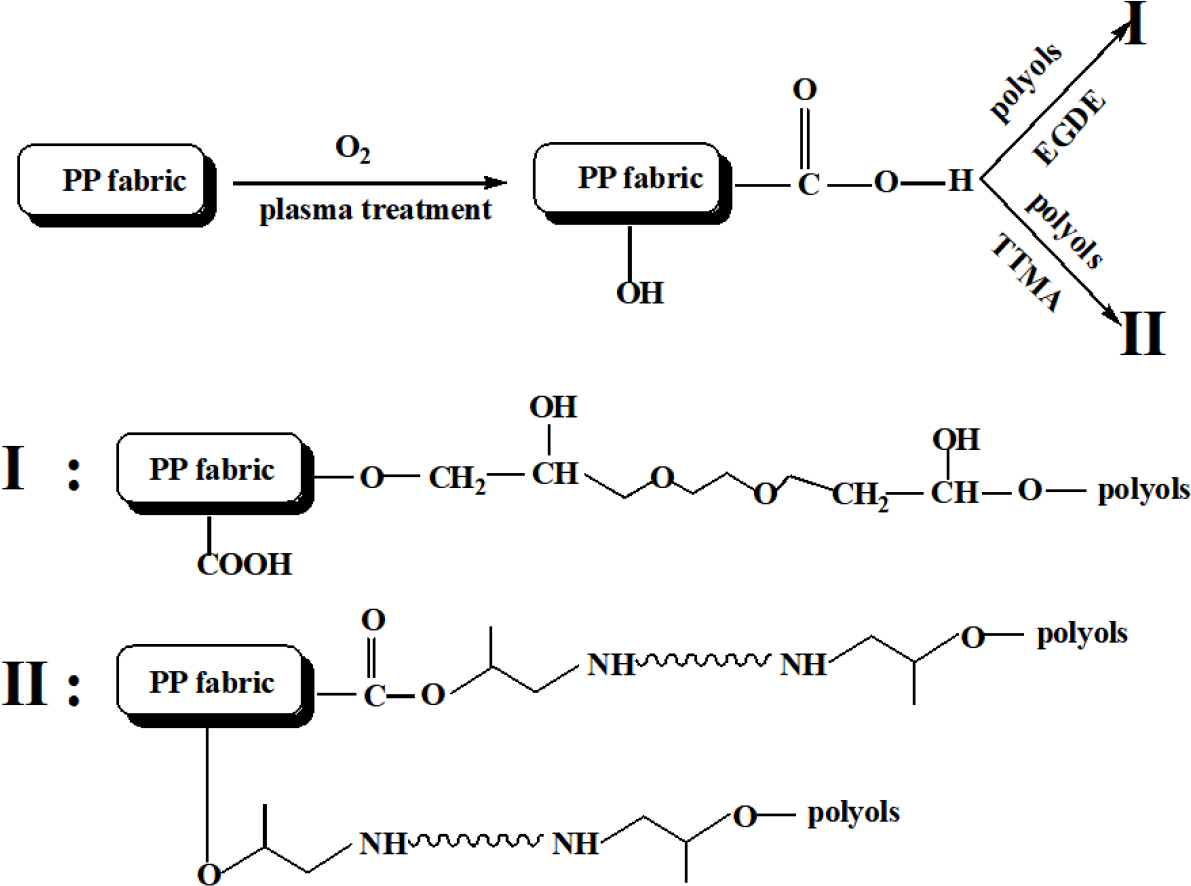
Fig. 2
Flow chart of plasma treatment and polyol modification
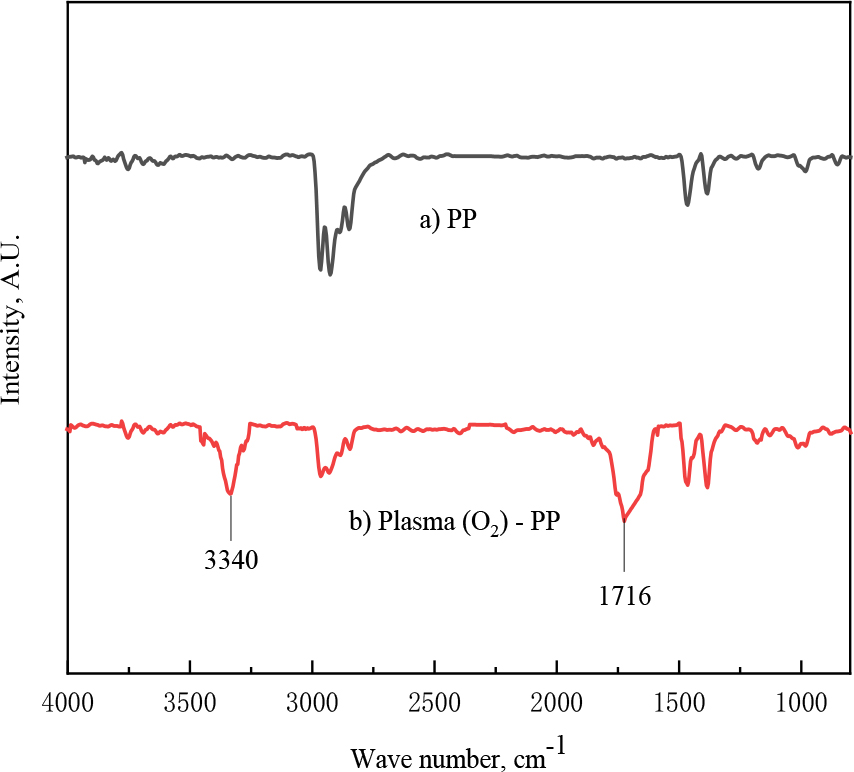
Fig. 3
Infrared spectra of PP before and after O2 plasma
Table 1
Absorption intensity of the characteristic peak and colouring performance of PP fabric after plasma treatment
| Factors | 1 | 2 | 3 | 4 | 5 | 6 | 7 | 8 | 9 | 10 | 11 | 12 | 13 |
|---|---|---|---|---|---|---|---|---|---|---|---|---|---|
| Power (W) | 50 | 100 | 150 | 200 | 250 | 300 | 250 | 250 | 250 | 250 | 250 | 250 | 250 |
| Time (s) | 90 | 90 | 90 | 90 | 90 | 90 | 120 | 150 | 180 | 210 | 240 | 180 | 180 |
| Flow (sccm) | 300 | 300 | 300 | 300 | 300 | 300 | 300 | 300 | 300 | 300 | 300 | 250 | 200 |
| O-H (3340 cm−1) | 0.10 | 0.10 | 0.10 | 0.11 | 0.20 | 0.14 | 0.26 | 0.32 | 0.42 | 0.28 | 0.22 | 0.23 | 0.15 |
| C=O (1716 cm−1) | 0.13 | 0.13 | 0.13 | 0.18 | 0.28 | 0.22 | 0.37 | 0.41 | 0.50 | 0.39 | 0.24 | 0.31 | 0.19 |
| Dye uptake (%) | 12 | 15 | 18 | 25 | 30 | 28 | 32 | 33 | 37 | 29 | 27 | 26 | 21 |
| K/S value | 0.24 | 0.37 | 0.51 | 0.68 | 0.65 | 0.72 | 0.84 | 0.89 | 1.03 | 0.88 | 0.77 | 0.63 | 0.49 |
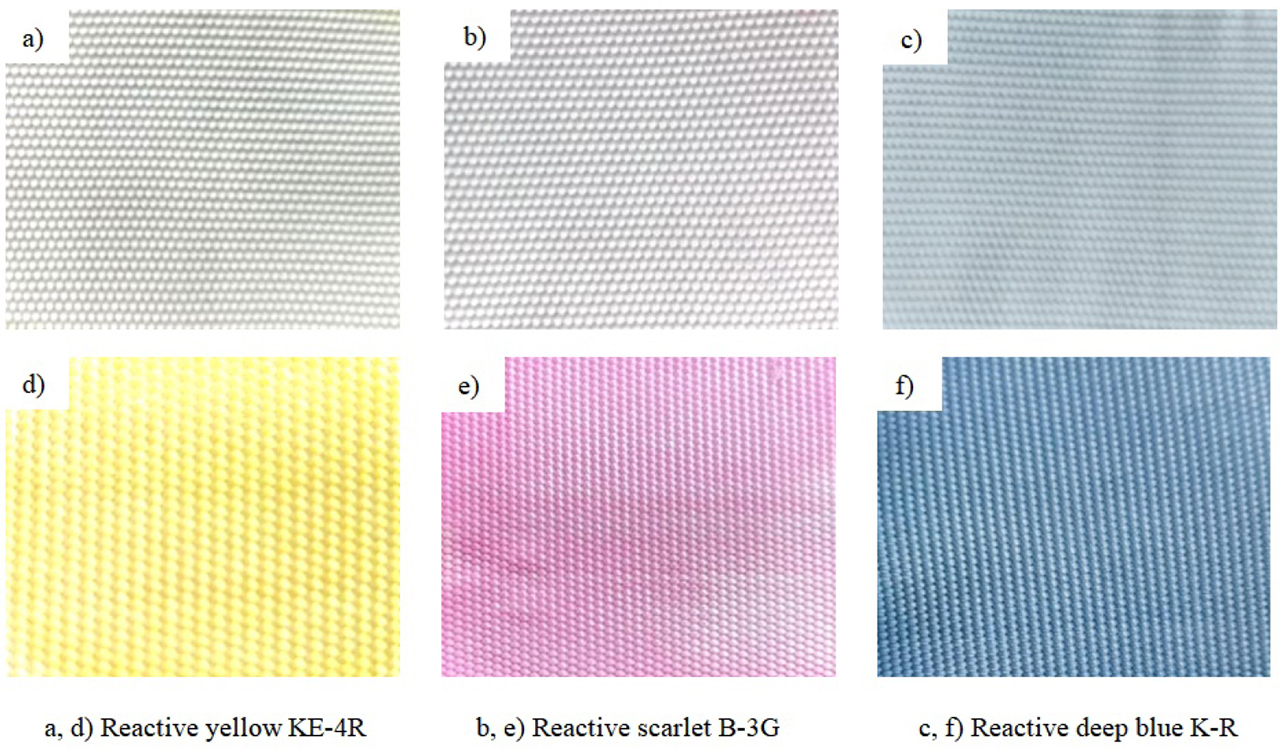
Fig. 4
Colouring photos of PP fabric before and after O2 plasma treatment: a-c) original PP fabric, d-f) plasma (O2)-PP fabric
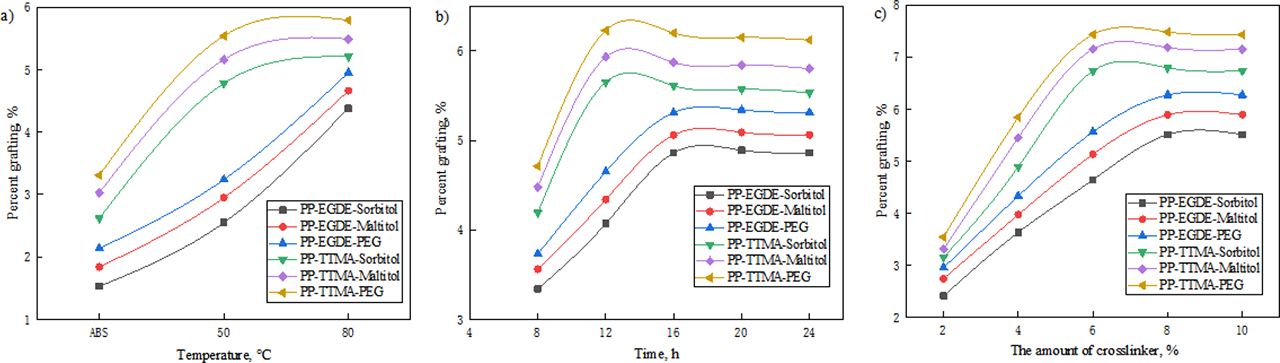
Fig. 5
Influence of different factor levels on the grafting rate: a) the influence of temperature on the grafting rate (12h, 4% crosslinker), b) the influence of time on the grafting rate (EGDE: 80°C, 4% crosslinker. TTMA:50°C, 4% crosslinker.), and c) the influence of the amount of crosslinker (EGDE: 80°C, 16h. TTMA:50°C, 12h.)
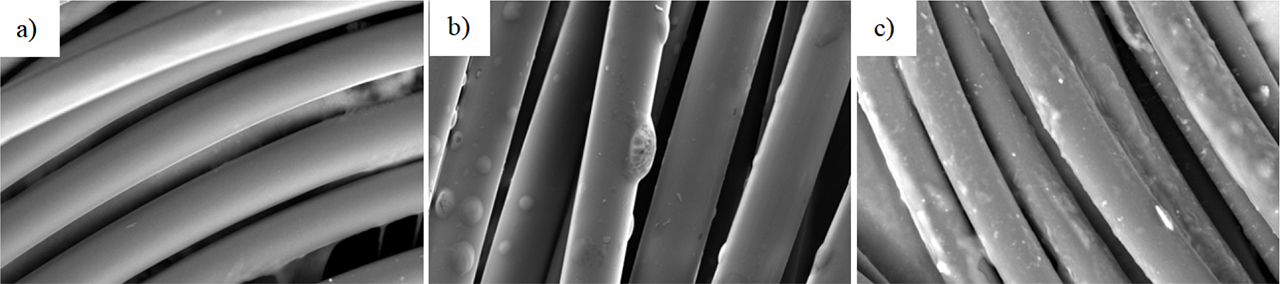
Fig. 6
SEM images of the three finishing stages of PP fabric: a) untreated PP, b) PP treated by oxygen plasma, and c) PP grafted with PEG
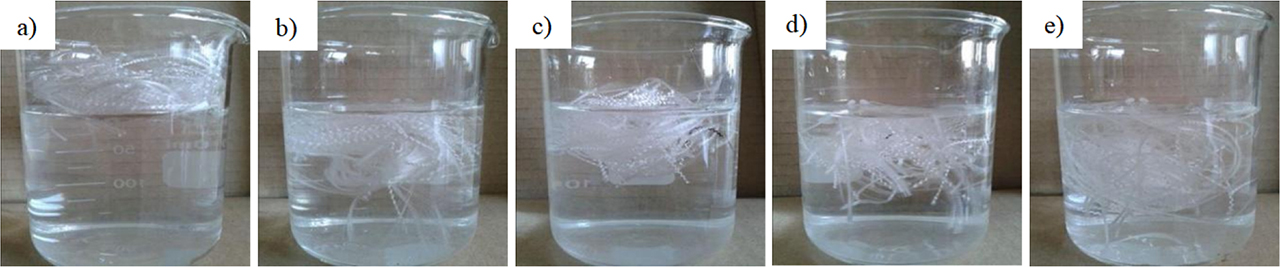
Fig. 7
Loose fiber suspension picture with different finishing methods: a) untreated PP, b) PP treated by oxygen plasma, c) PP grafted with sorbitol, d) PP grafted with maltitol, and e) PP grafted with PEG.
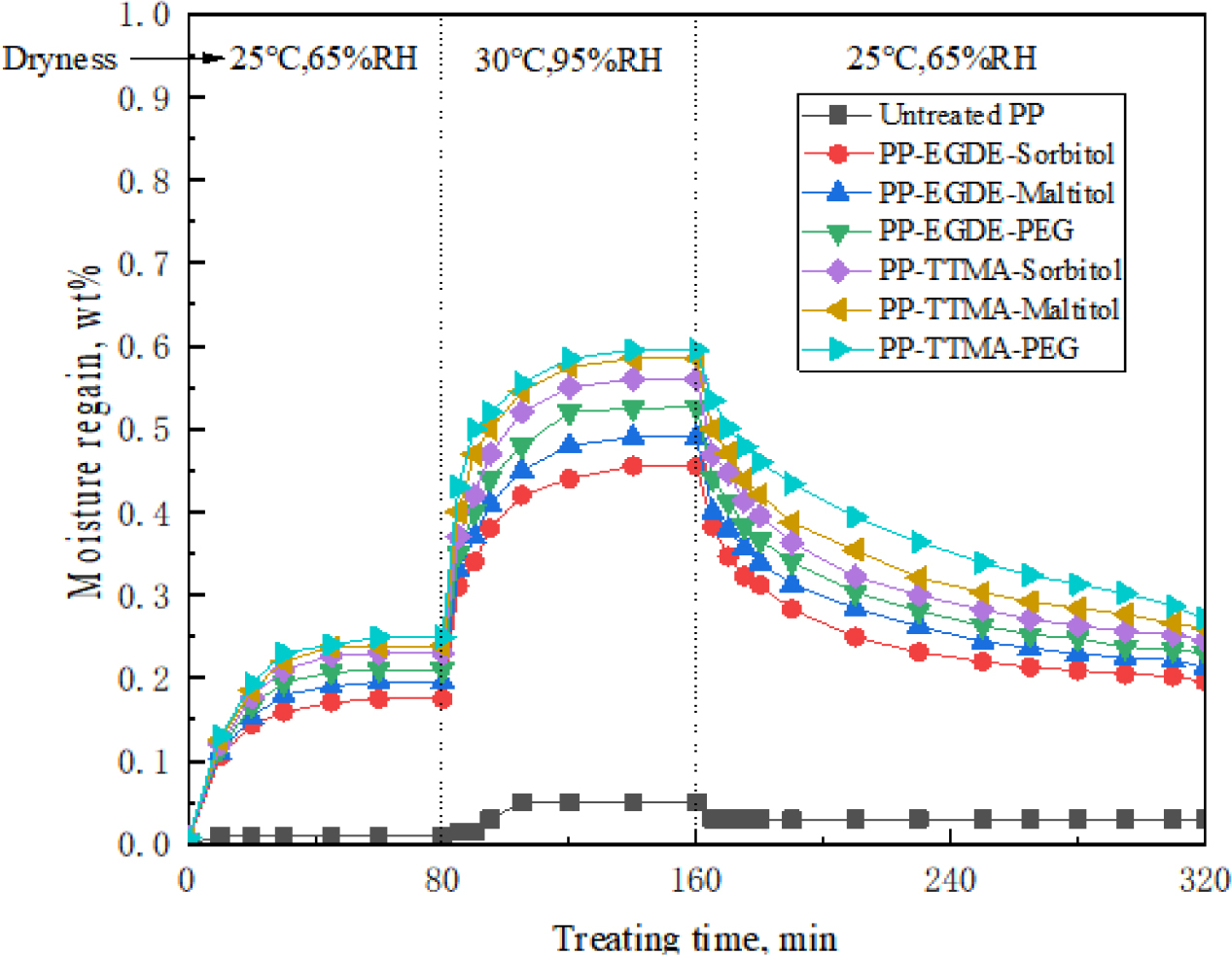
Fig. 8
Changes in moisture absorption and desorption of untreated PP and grafted PP
Table 2
Electrostatic pressure peak value and half-life period of PP fabric with different finishing methods
| Samples | Electrostatic pressure peak value [V] | Half-life period [s] |
|---|---|---|
| Untreated | 1102 | >99 |
| PP-EGDE-Sorbitol | 507 | 25 |
| PP-EGDE-Maltitol | 485 | 22 |
| PP-EGDE-PEG | 463 | 17 |
| PP-TTMA-Sorbitol | 405 | 14 |
| PP-TTMA-Maltitol | 389 | 13 |
| PP-TTMA-PEG | 342 | 9s |