
Table 1
Questionnaire items
| Question | Description |
|---|---|
| Company size | Small: 10 – 80 employees Medium: 80 – 300 employees |
| Company sector | Technical article companies Knitted article companies Denim article companies Mixed article companies |
| Certification standard | ISO 9001 Other |
| LSS tools and methodologies implemented | Installation of balancing production line; calculation of the cycle time; visual management; 5S; training; just in time; LSS Culture acceptance; Kanban; SMED (single minute exchange of die); VSM (Value Stream Mapping); TPM (total productive maintenance); Kaizen; VOC (voice of the customer); DMAIC (dene, measure, analyse, improve, control); FMEA (failure mode and effect analysis); PDCA (plan, do, check, act); Pareto; CTQ (critical to quality); Kano; Identification of bottlenecks. |
| Critical success factors | The involvement and commitment of top management Performance measurement Communication Organisational culture Availability of resources Training and education Organisational infrastructure Project selection and periodisation Linking LSS to HR reward system Linking LSS to customer |
| LSS tools improve ISO 9OO1? | None Marginally Significantly A lot |
| Main improvements with ISO 9001 certification, LSS tools and methods | Reduction of quality problem Cost reduction Waiting reduction Waste reduction Increase of productivity Improvement of problem solving |
Table 2
Sample characterization
| Variable | Percent | |
|---|---|---|
| Company size | Small: 10 – 80 employees Medium: 80 – 300 employees Total: 77 | 76,1 % 23,9 % 100 % |
| Company sector | Technical article companies Knitted article companies Denim article companies Mixed article companies Total: 77 | 9,9 % 14,1 % 10,9 % 64,9 % 100 % |
| Certification standard | ISO 9001 Other | 20,7 % 10,3 % |
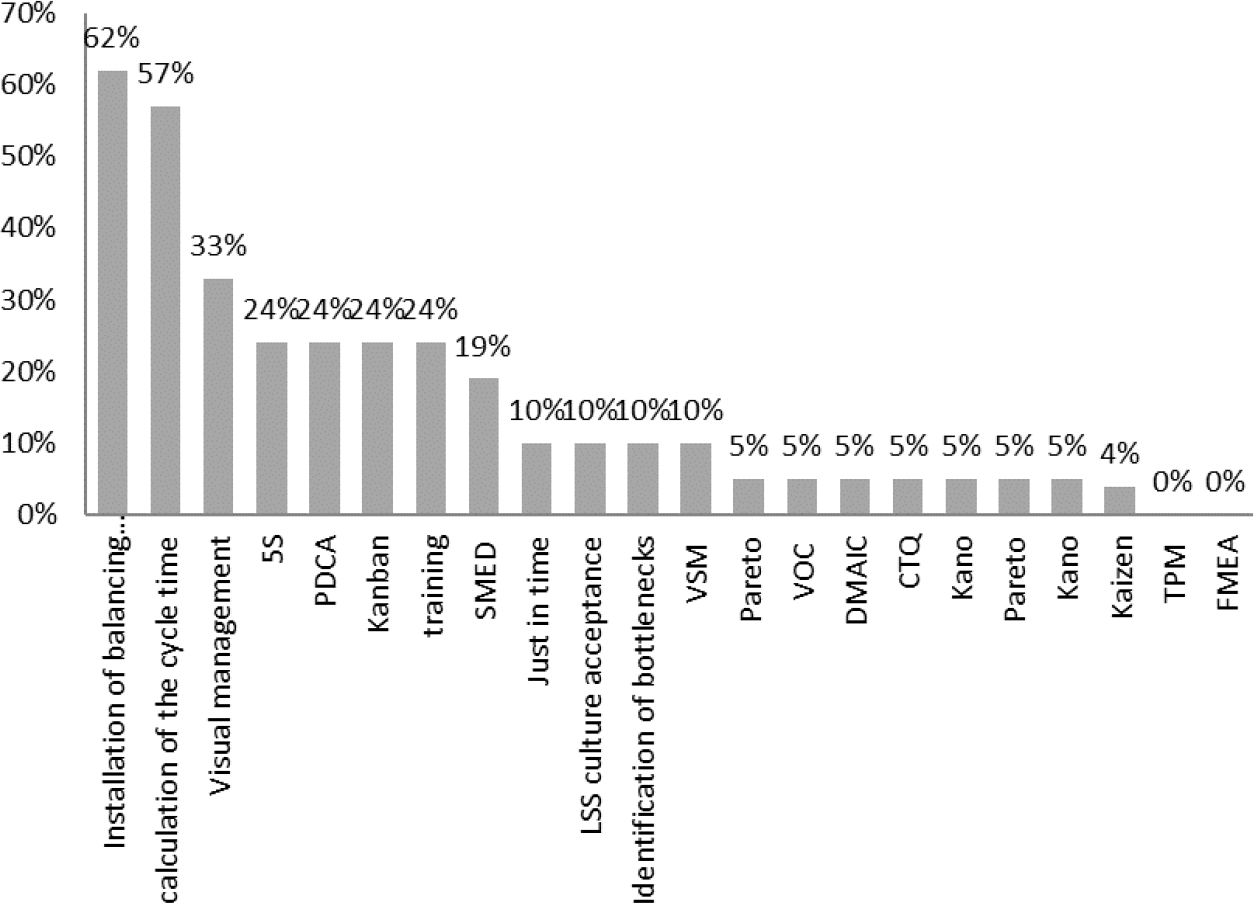
Fig. 1
Main LSS tools and methods applied in the participating textile enterprises
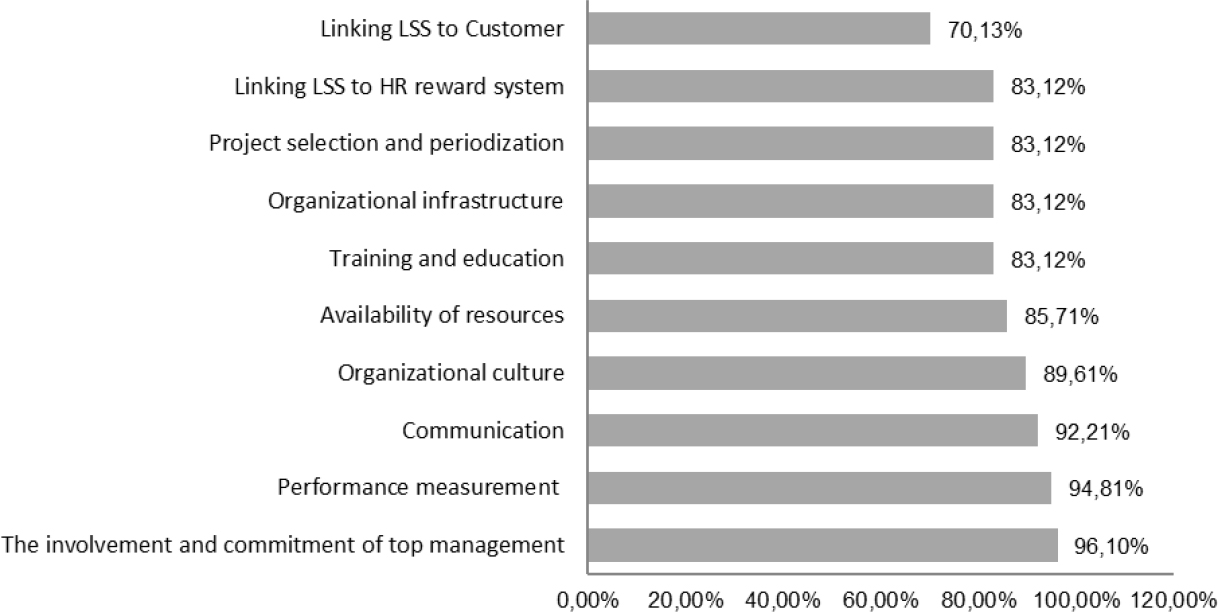
Fig. 2
Main çritical success factors for implementation of LSS

Fig. 3
ISO 9001 standard improves the success of LSS implementation in textile companies
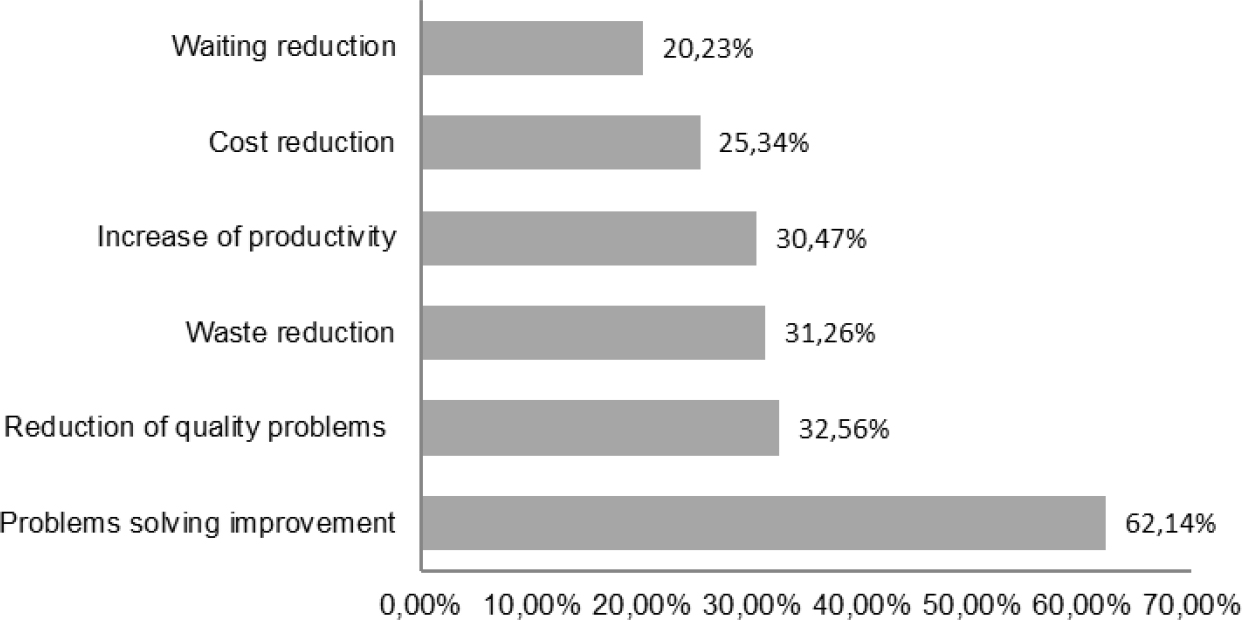
Fig. 4
Main improvements with ISO 9001 certification, LSS tools and methods
Table 3
List of textile SMEs
| SME | Workforce | Sector | Certification |
|---|---|---|---|
| A | 35 | Technical article (automotive articles) | ISO 9001: 2008 |
| B | 75 | Technical article (paramedical and orthopaedic articles) | ISO 9001: 2008 |
| C | 200 | Mixed articles | None |
| D | 201 | Mixed article companies | None |
Table 4
Comparison of the impact of the certification on the success of LSS project implementation in the different textile SMEs
| Key metrics used | A | B | C | D | ||||
|---|---|---|---|---|---|---|---|---|
| Before improvement | After improvement | Before improvement | After improvement | Before improvement | After improvement | Before improvement | After improvement | |
| Z-Sigma | 2.9 | 4.15 | 2 | 4,68 | 1.35 | 2.2 | 0.7 | 2 |
| Cp | 0.69 | 1.38 | 1.47 | 1.56 | 0.45 | 0.96 | 0.2 | 1.47 |
| DPMO | 80762 | 4661 | 308770 | 967 | 581814 | 242071 | 780000 | 308538 |
| Cycle time(min) | 19.92 | 19.2 | 32.4 | 31 | 12.78 | 12.5 | 10.34 | 10 |
| non-value added time(min) | 18916 | 15900 | 17280 | 13440 | 16080 | 16000 | 10000 | 9980 |