
Introduction
Cities are extremely powerful centers of environmental impact and demand for ecosystem services which lack self-regulation and self-regeneration (Elmqvist et al., 2015). In the era of accelerated urbanization, an important area of research is the ecological balance of cities (Wu, 2014). Currently, signs of environmental problems are intensifying in cities against the background of climate change and degradation of natural resources (Dizdaroglu et al., 2009). Under the changed circumstances, the principles of urban planning should be revised (Tîrlă et al., 2014). The analysis of complex greening systems of small cities shows the inefficiency of the used practices of their planning (Yukhnovskyi & Zibtseva, 2020). Towns need science-based decisions regarding the long-term development of their territories and, in particular, green space, but priorities are often neglected in countries with underdeveloped economies (Ives et al., 2017).
Urban greening strategies are an important part of climate change adaptation and mitigation strategies (Reynolds et al., 2020). Adapting to climate change and ensuring urban resilience is an important issue (Tuğaç, 2023), so disaster management and climate change efforts must be integrated. Accordingly, master plans should be sensitive to climate, take into account local climatic conditions and require implementation of climate-sustainable development. At the same time, traditional models of land use planning proved to be unsuitable for solving modern problems of sustainable development (Pereira et al., 2024).
Green infrastructure as a planning tool contributes to social and economic benefits, creating sustainable, inclusive and competitive cities. Among the main principles of green infrastructure planning aimed at providing a defined model of sustainable landscape management are connectivity and continuity (Monteiro et al., 2020).
How exactly the types of tree cover are changing globally in cities is currently unknown (Nowak & Greenfield, 2020), but it has been found out that the global urban wood cover in 2012–2017 decreased statistically significantly on all continents except Europe. Currently, the EU aims to become the world’s first climate-neutral continent (Matos et al., 2023).
Land cover data obtained through remote land zoning (RLZ) are the most important indicators contributing to ecologically balanced urban planning and management (Kopecká et al., 2017). However, a fundamental challenge to obtaining accurate satellite data is the variability of the urban environment (Powell et al., 2007), as well as the rigid classifier of urban vegetation that identifies it only as present or absent. However, the integration of several methods on a database of medium-resolution satellite images allows accurate modelling of the proportion of vegetation cover, regardless of the complex mosaic of different types of urban cover (Gan et al., 2014).
It is noted that the expansion of land for development and reservoirs, the reduction of arable land is characteristic of land use/land cover (LULC) in all periods (Li et al., 2019). The change in LULC types, namely the loss of lands with high ecological value, is the main reason for the reduction of ecosystem services (Liu et al., 2022). Urban forests are becoming increasingly important as climate disasters tend to increase and affect cities. Therefore, the national forest policy should give priority attention to urban interaction with forests in order to increase the effectiveness of climate policy in the regions (Çeler et al., 2023).
Monitoring LULC is an important tool for assessing the causes of ecological change in ecologically sensitive landscapes (Ersoy Mirici et al., 2020). LULC allows the evaluation of different options for making decisions about urban development taking into account likely climate changes (Chen et al., 2021).
In the limited urban space, it is extremely important to build an efficient urban green infrastructure, for which new concepts of modelling and analysis are used, in particular the morphological spatial pattern analysis combined with the landscape connectivity index (Dong, 2020). Landscape connectivity is believed to be critical for ecosystem health and biodiversity conservation, but urbanization increases habitat fragmentation (Zhang et al., 2019). The level of connectivity between elements of green infrastructure is considered as an indicator of achieving the goals of sustainable spatial development (Zölch et al., 2019). However, landscape connectivity has rarely been studied in urban environments (Sun et al., 2022).
It is estimated that two-thirds of the world’s research is done in big cities, and small-town issues are still neglected (Almaaitah et al., 2021). Ukrainian small cities (cities with a population of 10,000 to 50,000) were practically not studied. Intensive urbanization, an unprecedented rate of residential construction and a strategic course for ecologically balanced development make the study of the current state of the territories of small towns and their green spaces against the background of climate change extremely relevant.
The purpose of the work is to determine trends in the dynamics of the land cover of the town of Kaharlyk for the period from 1991 to 2021 using GIS technologies and search for measures to prevent the increase in negative anthropogenic impact against the background of global climate change.
Material and Methods
Study area description
The leading factor in choosing a small town for our case study was the safety of conducting research during military operations in Ukraine. Therefore, a town was chosen that has not been subjected to occupation and rocket attacks, does not have powerful energy facilities on its territory, and, at the same time, is located closer to the capital, occupies a relatively small area, has an up-to-date master plan and defined characteristics of the landscaping system. According to these requirements, the city of Kaharlyk with a population of 13,800, an area of 2130.7 hectares, located 77 km from the capital, was chosen. Due to the presence of a large town park, the town has a fairly high provision of green spaces for public use, but at the same time, it does not have a formed suburban green zone at all (Yukhnovskyi et al., 2022).
Kaharlyk is the center of the Kaharlyk United Territorial Community of Obukhiv District, Kyiv Oblast. The town has a long history. The first written mention of a settlement on this territory dates back to 1003, and the year of its foundation is 1142. In 1866, Kaharlyk became the center of a parish, and in 1923, received the status of the center of an administrative district.
According to physical and geographical zoning, Kaharlyk is located in the Kyiv Upland Region of the Podilsk-Dnieper Region of the Forest-Steppe Zone (Figure 1). In terms of economic efficiency, Kaharlyk is moderately efficient.
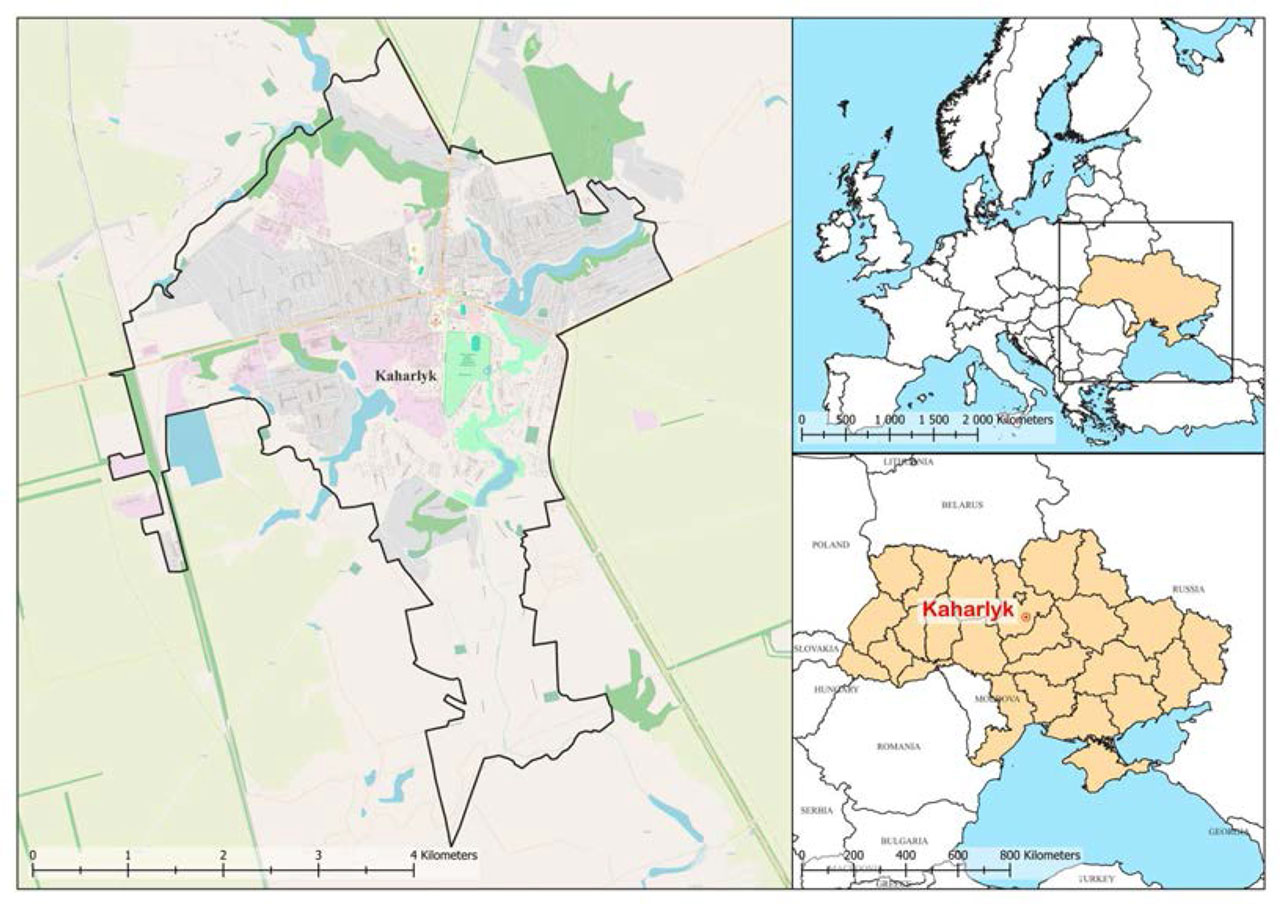
Figure 1.
The scheme of the location of Kaharlyk on the territory of the Kyiv region, Ukraine.
The town is compact, with a radial planning structure. Residential buildings are represented by blocks of manor houses, low-rise buildings and medium-rise buildings. In the west, the development area is bounded by a railway line and an industrial zone, the treatment facilities of a sugar factory with a sanitary protection zone, and in the east by a highway of state importance, a gas pipeline and a power transmission line, which results in an elongated meridional planning structure. There are three industrial zones in the town plan: in the western, northwestern and central part, and there is a wedge of industrial zones in the residential zone of the town.
The placement of green areas is determined not only by landscape resources, but also by the historically developed planning structure of cities and their modern economic development. The level of greenery in Kaharlyk is 18.3% (and taking into account the entire green infrastructure – 77%). The provision of green spaces is 283 m2/person, and the provision of green spaces for public use is 73.0 m2/person (Zibtseva & Silenko, 2016; Yukhnovskyi & Zibtseva, 2019, 2020; Zibtseva, 2021), which fully corresponds to the norm (no less than 10 m2 per capita). There is a park-monument of horticultural art of national importance «Kaharlytskyi» on the territory of the town. Its area encompasses 35.5 hectares at the time of adoption of the resolution. There are 219.9 hectares of flooded land in the southern part of the town. The town has no suburban green zone in the form of forests, and is mostly surrounded by plowed fields. Currently, the territory of the town is occupied by agricultural enterprises, residential buildings, industrial areas, green areas, water, wetlands in the proportion of 51, 14.9, 12.1, 11.1, 4.1, 3.5%, respectively, and 0.1% of the area is under open land without vegetation cover (Table 1).
Table 1.
The main indicators of Kaharlyk according to the master plan data.
| 2013 | 2036 | |
|---|---|---|
| Residential buildings, including: | 316.9 | 461.0 |
| homestead | 306.2 | 447.5 |
| Landscape recreation area, including: | 237.2 | 256.7 |
| public use | 100.8 | 179.8 |
| forests | 136.4 | 76.9 |
| Special purpose green spaces | – | 105.5 |
| Agricultural enterprises | 1087.7 | 865.7 |
| Water | 87.6 | 87.6 |
| Wetlands | 74.5 | – |
| Open lands without vegetation cover | 1.2 | 38.5 |
| The area of the whole town | 2130.7 | 2280.0 |
| Population, thousands | 13.8 | 16.0 |
According to the master plan of the town, in the future, significant areas of agricultural land will be replaced by production and warehouse areas and residential construction, which will expand from the central part in the western, northern and southern directions. A more than two-fold increase in the area of public construction (from 3.2 to 7.1%) and a decrease in the area of agricultural land from 51.0 to 37.7% are foreseen. In particular, 176.8 hectares of agricultural land, 59.5 hectares of forests, and 0.7 hectares of vacant land are planned to be used for development. It is planned to use 12.5 hectares of agricultural land, 59.5 hectares of forests (including 7.0 hectares outside the city) to create 79.0 hectares of public green areas. In general, by 2036, it is planned to increase the area of green spaces for public use from 100.8 ha to 179.8 ha (up to 112.3 m2/person). It is planned to use 42.9 hectares of agricultural land, 23.6 hectares of free territories (of which 46.0 hectares are outside the city) to create other green spaces.
Methodology
Time series of Landsat satellite images were used to monitor land cover dynamics within the territory of Kaharlyk. Images of the Landsat collection 2 (surface reflectance) were selected from January 1, 1986 to November 1, 2023. The study used data from Landsat 5 TM, Landsat 7 ETM+, Landsat 8 OLI and Landsat 9 OLI-2 sensors. Clouds, cloud shadows, and snow were masked using pixel quality attributes generated using the CFMask algorithm (Foga et al., 2017). The Continuous Change Detection and Classification (CCDC) algorithm (Zhu & Woodcock, 2014) was used for temporal “smoothing” of spectral data obtained by Landsat sensors, as well as for land cover classification. It is worth noting that the CCDC uses all available high-quality (i.e. screened from clouds, shadows, and snow) satellite observations to capture inter- and intra-annual cyclic variations in vegetation phenology at the pixel level. The CCDC fits a set of linear harmonic regression models consisting of independent temporal segments and breaks which correspond to abrupt changes. Thus, the CCDC eliminates noise in time series of satellite observations and provides a large set of new features (harmonic regression coefficients) for classification of temporal segments (Pasquarella et al., 2022). The algorithm requires at least six consecutive observations to build a model. Thus, there may not be enough observations of good quality at the beginning of the study period, which could be the cause of missed observations. Therefore, we used an extended time frame to cover our study period between 1991 and 2021.
Temporal segmentation of satellite images was performed using six original Landsat spectral bands, which were combined with tasseled cap transformation (TCT) brightness, greenness, and wetness, as well as the normalized burn ratio (NBR) (Key et al., 2006). The CCDC algorithm was used with default settings for probability thresholds to detect changes, the minimum number of observations to flag changes, etc. The result was a temporally fitted image in which each pixel contained sequences of temporal segments representing stable land cover and breaks associated with discrete change events (e.g. logging).
Study sample
A training sample of 750 sample units, randomly distributed over the study area, was used to classify the land cover. The coordinates of the sampling units were obtained using QGIS 3.20 tools. Google Earth Pro satellite imagery was used to interpret the sampling units. A user-friendly interface for the interpretation was provided by the Collect Earth plugin (Bey et al., 2016). Each sampling unit was considered as a sample of 50 × 50 m (i.e. with an area of 0.25 ha). Preference was given to the land cover class occupying more than 50% of the sample unit area and did not exhibit any change. In addition to the land cover type, we also assigned the date of the image used for interpretation. These dates were linked to the corresponding CCDC segments to extract spectral variables for the classification.
As a result of the interpretation, the distribution of sample units by classes and subclasses of the developed scheme was obtained (Table 2).
Table 2.
Distribution of sampling units by land cover types.
| Land cover class | Land cover subclass | Sampling volume |
|---|---|---|
| Forest | Forest stands | 60 |
| Reforestation | 42 | |
| Parks | 14 | |
| Homestead wood vegetation | 38 | |
| Grassland | Meadows | 8 |
| Grassland with shrubs | 39 | |
| Grassland with single trees | 63 | |
| Cropland | Arable land | 97 |
| Orchards | 158 | |
| Urban (Buildings) | Multi-storey buildings | 21 |
| Private building | 150 | |
| Infrastructure | 44 | |
| Wetland | Rivers, lakes, ponds, swamps | 16 |
| Total | – | 750 |
Classification
A Random Forest model (Breiman, 2001) was used for the classification of all CCDC temporal segments. Similarly to Myroniuk et al. (2023), the coefficients of the harmonic model for TCT, NBR, as well as original spectral bands (red, NIR, SWIR1) were used as predictors. This list is supplemented by the mean square error of the model for the corresponding segment, the derivate of the harmonic model (phase and amplitude), and the density of observations for the corresponding segment.
Classification accuracy was evaluated based on the error matrix (Table 3). The error matrix was constructed using the leave-one-out cross-validation procedure. This procedure involved repeatedly (750 times) training the model on a sample of n-1 observations and checking its accuracy on one observation not used in training. This allowed us to obtain unbiased estimates of classification accuracy.
Table 3.
Errors matrix in fractions of the total number of observations.
| Classification | Reference class | Total | Accuracy | |||||
|---|---|---|---|---|---|---|---|---|
| 1 | 2 | 3 | 4 | 5 | User’s | Producer’s | ||
| 1 – Forest | 0.146 | 0.019 | 0.008 | 0.015 | 0.188 | 0.777 | 0.711 | |
| 2 – Grassland | 0.011 | 0.067 | 0.016 | 0.003 | 0.003 | 0.100 | 0.676 | 0.455 |
| 3 – Cropland | 0.011 | 0.039 | 0.287 | 0.031 | 0.368 | 0.780 | 0.859 | |
| 4 – Urban | 0.038 | 0.019 | 0.020 | 0.240 | 0.004 | 0.321 | 0.748 | 0.828 |
| 5 – Wetland | 0.004 | 0.003 | 0.001 | 0.015 | 0.023 | 0.647 | 0.688 | |
| Together | 0.205 | 0.148 | 0.335 | 0.290 | 0.022 | 1.000 | – | – |
The overall accuracy of land cover classification according to the error matrix was approximately 75%.
Life Cycle Assessment (LCA) connectivity determination was based on collected field data according to the environmental classification system and the results of the LULC analysis.
To assess the configuration, fragmentation and spatial structure of the urban area, we used Morphological Spatial Pattern Analysis (MSPA) which produces maps and statistics relevant to different morphological classes (Soille & Vogt, 2009, 2022).
Morphological Spatial Pattern Analysis is a customized sequence of mathematical morphological operators designed to describe the geometry and connectivity of image components. MSPA analysis is based on the principle of connectivity of green infrastructure elements. It consists of assessing the ability of green infrastructure to preserve the habitat of fauna and provide species with the opportunity to migrate. Therefore, most of such studies are not related to urban areas. The MSPA method, using a raster image of the studied area as input, focuses on the geometry and connectivity of the components and can automatically determine the existing ecological corridors between the cores of the image. For its use, the foreground area of the binary image is divided into seven MSPA classes: Core, Islet, Perforation, Edge, Loop, Bridge, and Branch. The background area of the image is divided into three classes: Background, Core Opening and Border Opening. At the same time, urban forest in our study refers to wood plantations in the urban area.
Spatial characteristics of foreground and background classes are as follows. Core – green infrastructure pixels, surrounded on all sides by foreground pixels at a distance exceeding the specified distance. Islet – pixels of green infrastructure that do not surround the core. This is the only unrelated class. Perforation – green infrastructure pixels forming a transition zone between the foreground and background for interior areas. That is, it is the surroundings of the hole in the foreground. Edge – green infrastructure pixels that form a transition zone between the foreground and background for external areas. Loop – green infrastructure pixels that connect the core area to itself. Bridge – green infrastructure pixels that connect two or more non-intersecting cores. Branch – green infrastructure pixels that extend from the core area, but do not connect to another core area. Background – background pixels, surrounded on all sides by background pixels at a distance exceeding the specified distance. Core Opening – background pixels that form the inner zone of the opening. Border Opening – background pixels that form the transition zone between the edge and the background.
Results
LULC research
The analysis of the perspective planning of the town territory proved that from the point of view of the stability of urboecosystems, the perspective expansion of the city area by 150 hectares, the decision to transfer half of all the forests within the town limits to green spaces for public use, the complete drainage of wetlands and the significant growth of open lands without vegetation cover. In the total area of urban territories, a significant place is occupied by agricultural land, the decrease in which is accompanied by an increase in the area of built-up land, which also contradicts the principles of ecologically balanced development. On the other hand, the decision to create special purpose green spaces (at the level of 4.5% of the town territory) is positive.
The CCDC classification made it possible to develop a series of thematic maps (1991–2021) that distinguish between the main types of ground cover (Figures 2 and 3, Table 4). It turned out that during the investigated thirty-year period, Kaharlyk did not undergo significant changes in land use and in the distribution by types of land cover, which, in particular, may be related to the limited resources and financial potential of a small town and its certain distance from the capital.
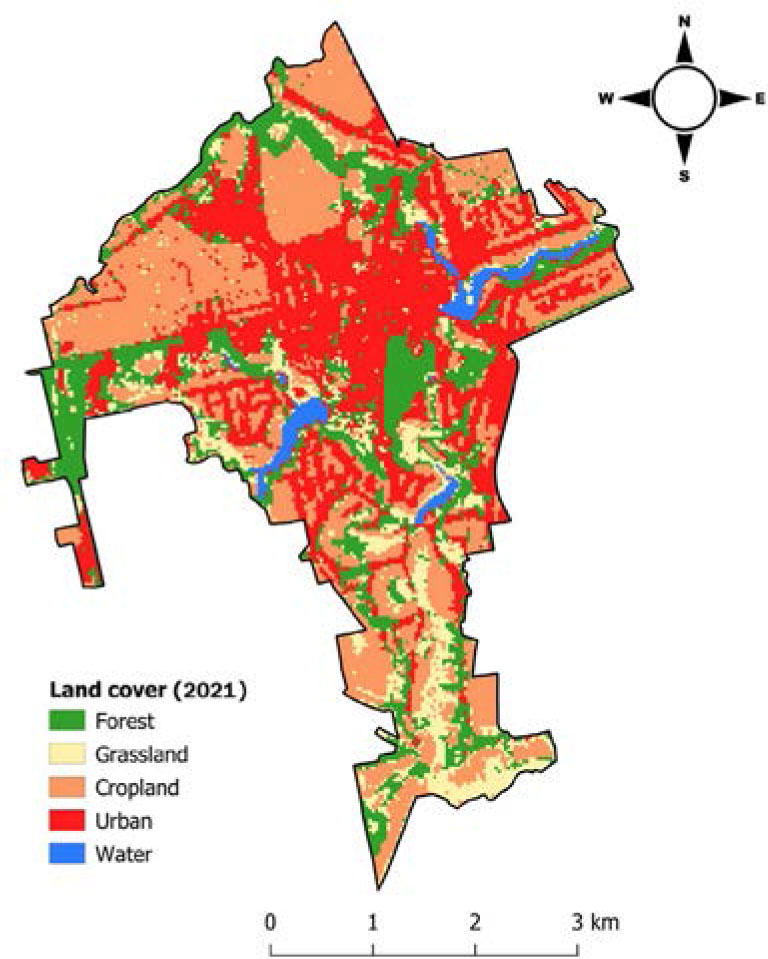
Figure 2.
Map of land cover types of Kaharlyk as of 2021.
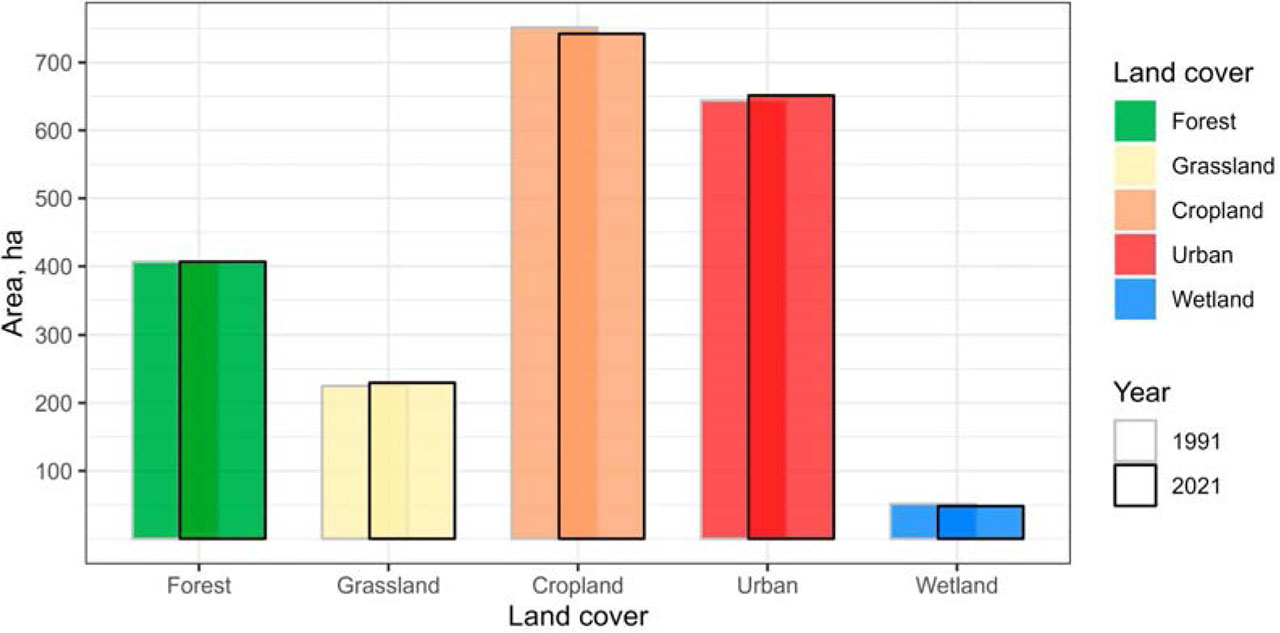
Figure 3.
Dynamics of land cover in Kaharlyk from 1991 to 2021 (%).
Table 4.
Elements of green areas of Kaharlyk by 10-year intervals (%).
| Categories | 1991 | 2001 | 2011 | 2021 |
|---|---|---|---|---|
| Core | 4.73 | 4.74 | 4.98 | 4.85 |
| Islet | 2.93 | 2.79 | 2.55 | 2.58 |
| Perforation | 0.03 | 0.12 | 0.10 | 0.11 |
| Edge | 6.94 | 7.25 | 7.12 | 6.80 |
| Loop | 0.27 | 0.36 | 0.39 | 0.43 |
| Bridge | 1.44 | 1.39 | 1.25 | 1.36 |
| Branch | 3.22 | 3.25 | 3.34 | 3.44 |
| Background | 80.44 | 80.10 | 80.28 | 80.43 |
| Core Opening | 0 | 0.03 | 0.01 | 0.03 |
| Border Opening | 0.52 | 0.60 | 0.56 | 0.64 |
According to the obtained distribution, the total area of agricultural use (arable land) has a tendency to decrease, and during the studied period it decreased by 9.3 hectares (0.4% of the total area of the town). The built-up area increased from 643.95 ha (31.0%) in 1991 to 651.42 ha (31.3%) in 2021, with a temporary spike in 2011, which is probably related to the temporary expansion of construction sites.
The area of urban forests (wooden urban cover) almost did not change and fluctuated during the studied period within 406.53 to 413.55 ha (from 19.6 to 19.9%) and reached the maximum in 2001. Despite the logical increase over time due to the growth of trees in the urban area, the forest cover has been on a downward trend since 2001. The area of grass cover (meadows) increased by 4.77 hectares (0.3%) with fluctuations within the period from 648.54 hectares (10.1%) in 2001 to 229.68 hectares (11.1%) in in 2021.
A decrease in the area of water bodies from 51.39 hectares (2.5%) in 1991 and 2001 to 48.15 hectares (or 2.3%) in 2021 was revealed. Probably, such a negative dynamic is observed as a result of a combination of both climate change and a long-term unjustified policy of draining wetlands in the urban area, primarily in its southern part with gradual replacement by natural grass cover (meadows). The town had relatively better indicators in terms of land cover types in 2001 and 1991, and the most unfavorable current phenomenon is the decrease in the area of water surfaces over the last ten years.
Connectivity of urban forest
The result of the morphological spatial analysis was the division of the town into categories of spatial classes, where in the context of the connectivity of tree stands, the cores are of greatest interest. The digital data of the software processing of the results are summarized in Table 4 and Figures 4, 5.
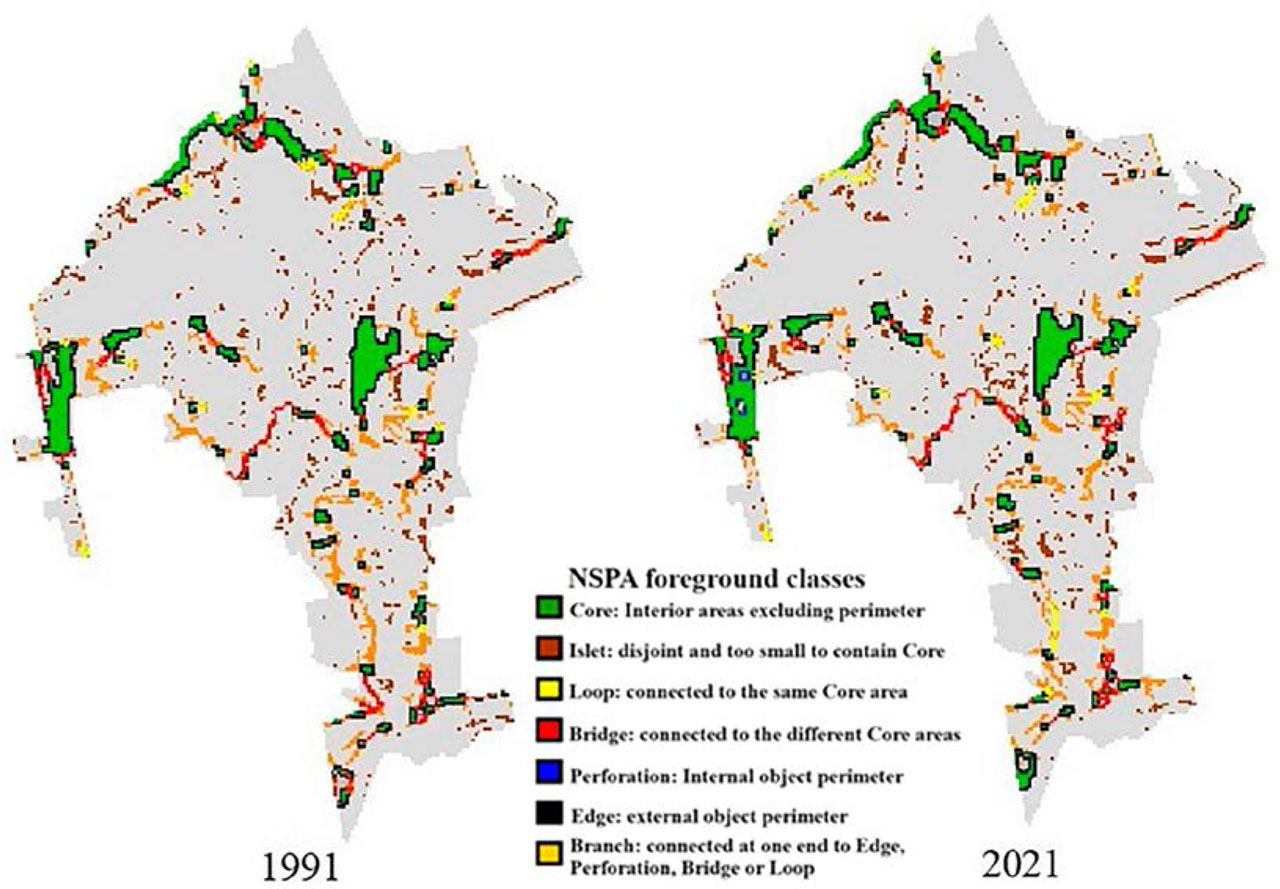
Figure 4.
Dynamics of urban forest connectivity on the territory of Kaharlyk.
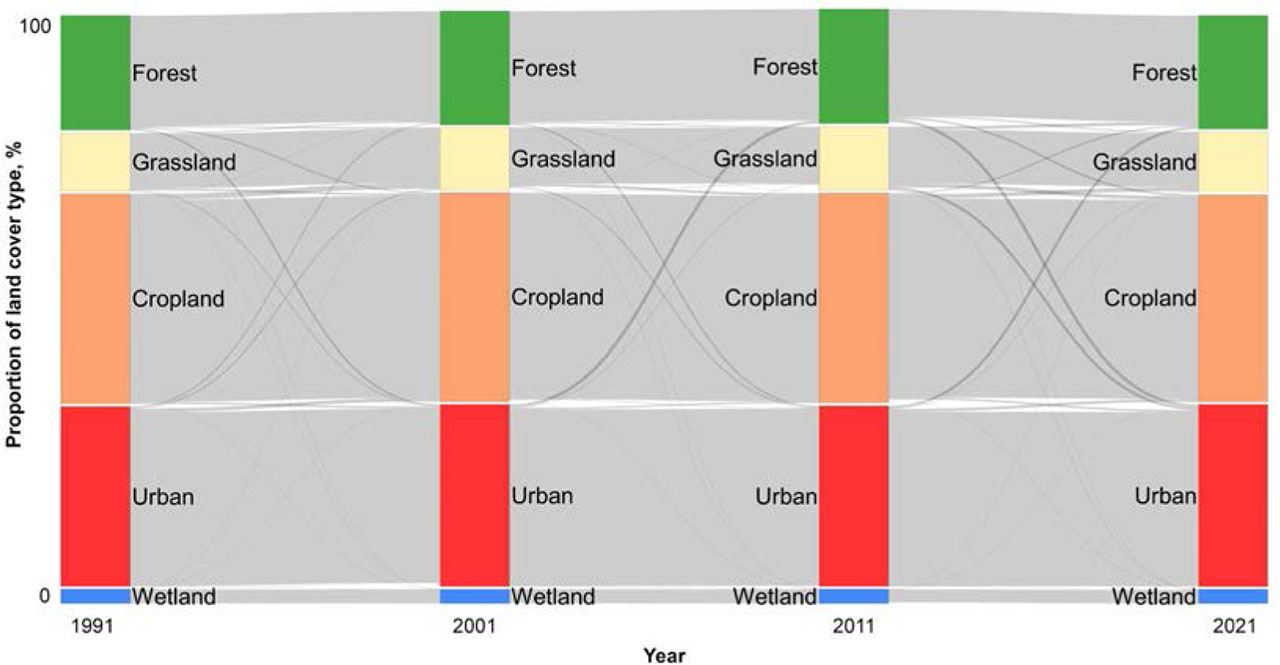
Figure 5.
Sankey plot showing the transition of land cover types in Kaharlyk during 1991–2021. Colored bars represent the proportion of land cover for a given year. The width of the gray connecting bands visualizes the redistribution of land cover area between other classes.
In the context of green infrastructure connectivity, Cores, Islands and Bridges are of greatest interest. Kaharlytskyi Park, which currently occupies an area of 29.5 hectares and is located in the central part of the town, is a large core. The dynamics of the total area of urban cores are variable with a maximum in 2011, and during the last decade it has undergone certain negative changes. During the decade from 1991 to 2021, the cores were, respectively, 4.43 – 4.74 – 4.98 – 4.85 % of the total urban area.
Island tree plantations are characterized by a greater degree of spatial fragmentation and in the dynamics from 1991 to 2021 occupied 2.93 – 2.79 – 2.55 – 2.58%, respectively. The total area of the islands is almost half as much as the area of the cores. Most of the islands are concentrated in the central part of the town, around the downtown, as well as on the outskirts, in particular in the southeast of the town, where they are represented in particular by natural vegetation. Positionally, the location of the islands and their concentration have changed over thirty years. The overall dynamics of the areas of cores and islands were 7.66 – 7.53 – 7.53 – 7.43%, and taking into account the Bridges these were 9.18 – 8.92 – 8.78 – 8.79%, that is, negative.
A significant negative correlation was found between the dynamics of Core and Islet (r = −0.8839), as well as between Core and Bridge (r = −0.9656): obviously, Cores are primarily transformed into precisely such elements, there is a non-linear increase in tree core opening (from 0 in 1991 to 0.03% in 2021) and an associated increase in porosity (from 0 in 1991 to 0.29 in 2021). Currently, there is a certain tendency towards the worsening of the situation: the Edge area is minimal for the period under study (6.80% against 7.25% in 2001). Bridges area was maximum at the beginning of observations – in 1991 (1.44%), and minimum – in 2011 (1.25%). However, in 2021, the maximum values of the Loop and Branch areas were observed – 0.43% and 3.44%, respectively.
The cartographic material does not reveal any significant dynamics of the Bridges lying, however, in places, in particular, South of the Central-Eastern part, on the very Southwestern outskirts of the town, the replacement of the Cores with Bridges and the replacement of Bridges with Loops are observed which is a negative phenomenon. In general, there are clearly not enough Bridges at the moment, and this category needs to be expanded as a priority, since without them the cores and islands of the northern part of the city are disconnected from the central part and do not sufficiently connect the western and eastern parts of the town.
A sharp increase in windows occurred in 2001 (mainly in the central-western part of the town). Probably, this is explained by the implementation of plans for the transformation of former extensive agricultural enterprises. However, the accompanying destruction of the green spaces of these enterprises and their sanitary protection zones is ecologically wrong.
Thus, within the main urban development of the agricultural zone, several clear cores of the urban forest, which are characterized by minimal fragmentation, were identified. First of all, among the most pronounced cores are the town park and the cores in the western part of the town as well as the location of the “Balans Agro” agricultural enterprise. Cores are also being formed near the “Your Bod” sports club, along the lake along the Enthusiasts street, east of the park between Shevchenko str. and Chapaev str. (along the Rossava River) and to the north of the Kaharlyk Forestry.
There are numerous island elements of the urban forest on the territory of the town, which are mostly gardens on the territory of private estates. As a rule, such islands are disconnected, not connected by corridors and have a small area of influence.
The most «broken» urban forest is to the northwest of the urban area, in the area of the cricket field, where there are few trees. The main reason for the high degree of fragmentation of the urban forest is the relatively recent (over the last two decades) active expansion of residential development and the accompanying decrease in connectivity between isolated areas of green infrastructure.
Discussion
Land use and land cover change are among the driving forces of environmental change in urban areas. Studies show that the most intensive urbanization is taking place in the countries of the Global South. Rapid urban growth and threats to urban green spaces have been studied in African countries (Namwinbown et al., 2024), India (Das et al., 2024), and in small cities in China (Sun et al., 2022; Fan et al., 2023; Jiayu et al., 2024). However, most of the knowledge about urban ecosystems has been obtained as a result of the study of cities in the USA and Europe (McHale et al., 2015). On the other hand, there are few studies of the ecosystems of Ukrainian cities. Currently, there is a limited amount of research on the development of green infrastructure in small cities and the ecological consequences of current land use in their territories.
Usually, due to urbanization, the main LULC changes in urban areas are the expansion of built-up land and the reduction of agricultural land. It is clear that LULC changes are a growing trend not only in big cities but also in small towns. Moreover, the increase in the built-up area in small towns is not only in the outskirts, but also in the downtowns. Such changes in the downtowns of small Ukrainian towns actively began to take place with the acquisition of independence, that is, after 1991, which was taken by us as the starting point of the study.
Kaharlyk is one of the greenest small towns in the Kyiv region. This is one of the few small towns of the Kyiv region, where the provision of green areas for public use (i.e. parks) many times exceeds the so-called “greening norm”, which is a reference point for urban planning. For comparison, according to the results of studies of Slovak cities (Kopecká et al., 2017), in Bratislava, urban vegetation occupies 46.5% of the territory, of which trees make up about 54%. In Trnava, the forest cover was 22.1%, and in Žilina – only 9%. The area of green spaces per capita was 121 m2 in Bratislava, 112 m2 in Trnava and 136 m2 in Žilina. Taking into account the entire green infrastructure, Kaharlyk is characterized by relatively better green indicators (77% and 283 m2 per capita, respectively).
It is believed that spatial planning should strengthen the resilience of cities to climate change and contribute to the effective implementation of green infrastructure. Adaptation plans for cities such as Katowice and Ruda-Slonsk foresee such measures (Janiszek & Krzysztofik, 2023). Unfortunately, similar plans are not being developed for Ukrainian cities. Currently, there are no forest areas in the form of a protective and recreational ring around Kaharlyk, which is common for small Ukrainian towns. The towns are mostly surrounded by fields.
The prospective development plan of Kaharlyk for a twenty-year perspective (until 2036) envisages an increase in the population from 13.8 thousand to 16.0 thousand (that is, by 16%) and at the same time an expansion of the town’s area by 149.3 hectares (or by 7%) and an increase in the area of residential development from 316.9 hectares to 461.0 hectares (by 144 hectares or by 45%) mainly due to manor buildings, which still account for 92% of all residential areas. In the context of the ecological stability of the urban area, the planned decrease in the area of urban forests is negative. Also, from the point of view of the stability of urban ecosystems, the prospective expansion of the city area is a negative solution. In addition, the planned complete destruction of wetlands by draining is also a negative phenomenon. In the total area of urban territories, a significant proportion is occupied by agricultural land, the decrease in which is accompanied by an increase in the area of built-up land, which also contradicts the principles of ecologically balanced development. The measures planned for the future will not lead to a decrease in the population’s provision of green spaces (m2 per capita). However, these planned indicators do not take into account the peculiarities of the qualitative characteristics of the spatial location of green infrastructure elements, to which the results of our study draw attention.
The MSPA analysis made it possible to identify the most important indicators of the quality of the urban environment, which makes it possible to get a clearer picture of the existing environmental problems and will contribute to the optimization of the urban environment. Despite the relatively high rates of provision of the population with green infrastructure and large areas of plantations, most of the green plantations have an insular (fragmentary) nature and low connectivity of the elements of the urban forest, which does not contribute to the creation of a single network and ecological framework of the city.
According to the results of the MSPA analysis for the thirty-year period (1991–2021), Kaharlyk did not undergo significant changes in land cover, but certain negative trends regarding the preservation of green infrastructure and increased fragmentation of the urban forest were outlined in the urban area, which will reduce the ecological stability of the urban area. Thus, the area of arable land and wetlands decreased slightly within the city limits (in separate categories within 0.4% of the total area of the city), while the area of built-up areas and meadows increased.
The total area of urban cores in Kaharlyk decreased somewhat and underwent certain negative changes compared to 2011. Windows have appeared in some nuclei and they have a pronounced tendency to increase. Similarly, the urban forest was also characterized by better connectivity indicators in 2011, and currently there is a tendency for the situation to worsen.
On the territory of the town there are numerous island elements of urban forest, which are mostly gardens on the territory of private estates. Private gardens occupy significant areas, which is characteristic of small cities, and play a leading role in the formation of a favorable urban environment. These island elements have a greater degree of spatial fragmentation and their area has slightly decreased compared to 1991. However, since the long-term development plan of the town envisages a significant expansion of the area for residential estate construction, it is precisely such island elements that will obviously grow on the outskirts in the next twenty years. As a rule, such islands are currently not connected by corridors. The total area of the corridors is insignificant, and no significant dynamics have been detected in relation to it. Currently, there are clearly not enough corridors, and it is this category that primarily needs to be expanded and united with the help of cores and islands. In the future, a single green space should be created, which connects all elements of green infrastructure with green corridors – row plantings of trees and bushes along the streets, creating the effect of a continuous green space.
Evaluation of the urban territory using the materials of master plans and available satellite data and modern GIS technologies allows to increase the objectivity of the data and, potentially, the scientific level of the master planning of small cities by following the strategy of ecologically balanced development of urban territories, which corresponds to modern world trends.
Conclusion
The Kaharlyk town is one of the few small towns where the provision of green spaces for public use meets the standard established by the state – the so-called greening norm. Currently, there are no forest areas in the form of a protective and recreational ring around the city, which is common for small Ukrainian towns.
It was established that over the thirty-year period (1991–2021), the town of Kaharlyk did not undergo significant changes in land cover, however, certain negative trends regarding the preservation of green infrastructure and, above all, water bodies and the city forest were outlined in the city territory.
The method of spatial morphological analysis applied to the territory of the town gave unequivocal results: 3 larger and about 5–6 medium-sized cores of green infrastructure were identified, which are not connected to each other. Despite the relatively high rates of provision of the population with green infrastructure and large areas of plantations, most of the green plantations have an insular (fragmentary) nature and low connectivity of the elements of urban forest, which does not contribute to the creation of a single network and ecological framework of the town. The application of connectivity analysis methods is useful for more efficient planning of urban development and mitigation of future problems caused by climate change.
The negative ecological phenomena on the territory of Kaharlyk are the destruction of wetlands, the prospective halving of the area of urban forests (with their conversion into green spaces for public use), and the increase in the fragmentation of urban forest, which will reduce the ecological stability of the urban area.
The measures proposed by the master plans for the long-term development of cities must be a compromise, the development of the territory must be accompanied by ecologically balanced solutions and ensure the strengthening of the natural basis of cities and the improvement of environmental sustainability.
Evaluation of the urban area using the materials of master plans and available satellite data and modern GIS technologies allows to increase the objectivity of the data and, potentially, the scientific level of the master planning of small towns by following the strategy of eco-balanced development of urban areas, which corresponds to modern world trends.
Acknowledgements
The research was carried out as part of the implementation of the joint Ukrainian-Turkish project «Development of greening systems in small cities with the aim of optimizing habitat connections and resilience to climate change» (2023–2024).