
Introduction
During previous centuries, the human impact on nature has been steadily increasing. The result is a high degree of intervention in previously undisturbed ecosystems, bearing with it significant alterations of natural processes (Jackson & Jackson, 2000; Marsh, 2003; Goudie, 2018). It is often impossible to revert these ecosystems back to their near-natural state, and it is increasingly important to safeguard their remaining natural features and to ensure that they support the ecosystem processes in the best possible way (Jackson et al., 2009). For that, a profound understanding of the functioning of these novel ecosystems is of crucial importance.
In countries with a developed forest industry, linear forest infrastructure objects, such as forest roads and ditches constructed primarily to increase forest productivity and improve accessibility, are among the most widespread examples of human-altered ecosystems (Avon et al., 2013; Lõhmus et al., 2015), and drainage networks are common linear elements in forest landscapes all over Europe (Paavilainen & Päivänen, 1995; Rydin & Jeglum, 2006; Päivänen & Hånell, 2012). These anthropogenically created and maintained features may cause significant changes in forest ecosystem functions, for example, by disrupting population connectivity, acting as a barrier to dispersal, altering ecological community composition and decreasing community diversity at landscape level, and acting as pathways for the spread of invasive alien species (Smart et al., 2006; Flory & Clay, 2009).
At the same time, due to more varied micro-site conditions, ditches and ditch edges support higher species diversity, providing habitats for plants with different ecological requirements (Zielińska, 2007; Zielińska et al., 2017; Karim & Mallik, 2008). They are of a special importance for hygrophilous bryophytes and may help to preserve rare species in a managed forest landscape (Staniaszek-Kik et al., 2016). Zielińska et al. (2017) highlight the importance of forest ditch edges in increasing the habitat diversification for vascular plants and bryophytes at meso- and microscales. In landscapes heavily influenced by human activity ditch networks may enhance the functional connectivity of populations (Favre-Bac et al., 2016).
To address the decline of pollinator populations, measures resulting in the establishment of flowering plant communities with the primary aim of improving the nutrition basis for larvae and adult insects have been implemented in Europe and North America (Wratten et al., 2012). Ditch slopes and verges may positively contribute to this objective, as they provide habitats for a variety of flowering vascular plants (Rasran & Vogt, 2018), in this regard being more suitable for pollinator communities (especially bees, flies and butterflies) than closed forests and woodlands, moreover, linear forest structures are facilitating the dispersal of pollinators across the landscape (Hanula et al., 2016; Phillips et al., 2020). Thus, they may serve as ecological corridors and stepping-stones for pollinator communities: a significant aspect in the light of the increasing importance of pollination as essential ecosystem service with a declining tendency due to the intensification of agriculture practices, expansion of parasites, more frequent biological invasions, habitat loss and fragmentation (Liss et al., 2013; Porto et al., 2020). At the same time, linear infrastructure elements may promote the dispersal of invasive alien species, potentially acting as competitors for pollination services (Hanula et al., 2016). Knowledge about the specific effects that the creation and management of linear forest infrastructure elements have on vascular species’ composition and its role in providing habitats and as food base for pollinating insects is still scarce.
It is hypothesized that ditch reconstruction could increase the plant species diversity on forest ditch edges, in turn affecting the abundance of flowering plant species. The aim of our study was to monitor changes in plant species composition on drainage forest ditches and ditch edges, with emphasis on quantifying the amount of insect-pollinated plants, potentially beneficial to pollinator communities. This paper reflects the results of the analysis of flora along managed forest drainage ditches 3–5 years after reconstruction works, when the plant communities have re-established.
Materials and Methods
Study area
The study was conducted in the forested catchment of Zalve stream (Figure 1), located in the central part of Latvia (hemi-boreal vegetation zone) and actively managed by JSC (Latvia’s State Forests). The catchment is dominated by conifer stands, with an admixture of deciduous trees, mainly on mesotrophic mineral soils. The dominating tree species are Picea abies (L.) H. Karst., Pinus sylvestris L., Betula pendula Roth and Betula pubescens Ehrh. Part of the studied area has been drained for forestry in the second half of the 20th century. The stands are growing in lowland conditions (30–100 m a.s.l.). The mean annual temperature in the study area during the study period (2016–2020) was +8.3 °C (slightly higher than the mean value in Latvia) and the mean annual precipitation was 638 mm (slightly lower than the mean value in Latvia) (local meteorological station data, compared to the Latvian Environment, Geology and Meteorology Centre (2023) data).
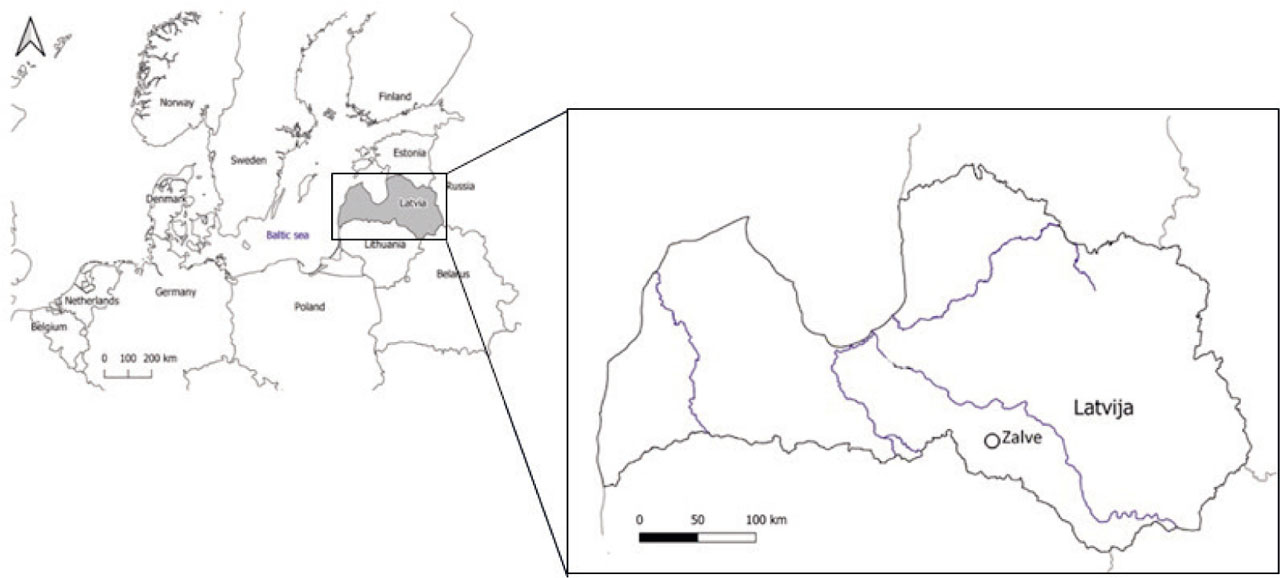
Figure 1.
The location of the research area.
Data collection
In 2016, vegetation monitoring plots were established along four forest ditch edges with a different management history. Plant species were inventoried along two recently reconstructed forest ditches (reconstruction year 2015) and two unmanaged forest ditches (left unattended for at least 20 years). At each site, a vegetation survey was performed along a 1-km-long section of the ditch, with ten 3 m × 10 m plots positioned with the long side perpendicular to the ditch on the left and right sides of the ditch, 100 m plots were located immediately adjacent to the ditch (Matisone et al., 2018). In total, 80 plots (4 transects × 20 plots) were established. In each plot, the cover of each vascular plant species and bryophyte species was recorded according to a 5-point scale (Braun-Blanquet, 1964). The tree and shrub species with a height of up to 1 m were also recorded and their cover estimated. The nomenclature of Gavrilova & Šulcs (1999) was followed for vascular plants and by Bambe et al. (2023) for bryophytes. The first vegetation survey was conducted from June to July 2016 and the repeated assessment during the same months in 2020. Insect-pollinated plants were identified combining all vascular plant species that are pollinated by different taxonomic groups of insects and/or those plant species with insects as one of pollen vectors. The values were extracted from the BiolFlor Database (2023).
Data analysis
Ellenberg indicator values (nitrogen, moisture, light, soil reaction) were used to describe the environmental conditions of each studied plot (Simmel et al., 2021; Tichý et al., 2023; Düll, 2001). Community-weighted means (by species cover) were calculated for Ellenberg values within a plot.
Generalized linear mixed-effects models were used to assess the differences between survey years, the effects of the object type (managed or unmanaged) and of Ellenberg variables on species richness. The residuals were adjusted according to the Poisson distribution (log link function). The predictors were checked for co-linearity using the variance inflation factor; variables showing values >5 were discarded.
The plant species composition was analyzed using the detrended correspondence analysis (DCA) based on species cover data. The relationship between two canonical axes and species community characteristics (total species richness, richness of insect-pollinated flowers, species diversity index (H’)) and Ellenberg variables were calculated with Pearson’s correlation analysis. Canonical axes were rescaled and rare species were downweighed. Successional vectors were drawn to assess changes in plant species communities between the studied ditches according to the survey year. Data analysis was conducted in R v. 4.2.0 (R Core Team, 2020), using the libraries “lme4” (Bates et al., 2015). Ordination was conducted in PC-ORD 6 package (Peck, 2010).
Results and Discussion
In total, 254 plant taxa were recorded along the studied ditches: 34 bryophytes and 220 vascular plants – some individuals could be identified only down to genera. The species community represented the local pool of common species. The most common vascular plant species were Athyrium filix-femina (L.) Roth, Calamagrostis canescens (Weber) Roth, Cirsium oleraceum (L.) Scop., Dryopteris carthusiana (Vill.) H.P. Fuchs, Lysimachia vulgaris L., Rubus idaeus L. and Urtica dioica L. and the most common bryophytes were Brachythecium rutabulum (Hedw.) Schimp., Plagiomnium ellipticum (Brid.) T.J. Kop., Calliergonella cuspidata (Hedw.) Loeske (Appendix 1). For the second survey in 2020, 44 new taxa had emerged and 43 taxa had disappeared (Appendix 1). In the studied plots one protected orchid species Platanthera bifolia (L.) Rich. (Cabinet Regulation No. 396, 2000) was found once in the studied time period, but this species is rather common along forest edges. The majority of the species were forbs and graminoids. More than half of all identified species were insect-pollinated flowering plant species (135 species) and made up around 60% of all recorded vascular plant species (Appendix 1).
The results showed that during the 4-year-period the richness of insect-pollinated plant species and the richness of total species had significantly increased, from 22 to 25 species and from 38 to 43 species per studied plot, respectively (Table 1). According to glmer models, the object type was the main predictor of the insect-pollinated plant species richness and total species richness as indicated by the highest χ2 values (Table 1). The highest insect-pollinated flower species richness was associated with managed ditches, and it was significantly higher than along unmanaged ditches (Table 1). The highest total species richness was identified along both reconstructed ditches, and the differences were significant for the strongest contrasts (compared to unmanaged ditch C) (Table 1). This confirms previously drawn conclusions that ditches as anthropogenic structures impact the plant species biodiversity in a managed forest landscape by increasing floristic richness (Zielińska et al., 2013; Zielińska et al., 2017). They do not, however, support endangered plant species. The explained factors for higher species richness were associated with higher Ellenberg light and nitrogen values (Table 1) that generally increase after the forest infrastructure reconstruction (Godefroid & Koedam, 2004). Our results showed that Ellenberg light values were significantly higher on the studied managed ditches (Appendix 2), indicating that management was improving the light conditions, while Ellenberg nitrogen values showed significantly strongest contrasts only between both managed ditches (Appendix 2).
Table 1.
Strength (χ2-value) and significance (p-value) of effects of year, object and Ellenberg light and nitrogen on species total richness and richness of insect-pollinated plant species. Similar letters indicate a lack of significant differences at α=0.05.
| Richness of species | Insect-pollinated plant species | ||||||||
|---|---|---|---|---|---|---|---|---|---|
| Effects | Variable | Chi-Square (χ2) | p-value | Mean | Group | Chi-Square (χ2) | p-value | Mean | Group |
| Year | 2016 | 16.77 | <0.001 | 38 ± 7.5 | a | 14.35 | <0.001 | 22 ± 6.2 | a |
| 2020 | 43 ± 8.2 | b | 25 ± 5.3 | b | |||||
| Object | Reconstructed (A) | 31.77 | <0.001 | 47 ± 7.7 | a | 41.07 | <0.001 | 27 ± 5.1 | a |
| Reconstructed (B) | 43 ± 6.9 | ab | 27 ± 5.4 | a | |||||
| Old (C) | 34 ± 6.8 | c | 19 ± 5 | b | |||||
| Old (D) | 39 ± 6.2 | b | 22 ± 4.1 | b | |||||
| Light | 3.81 | 0.05 | 0.17 | 0.68 | |||||
| Nitrogen | 4.8 | 0.03 | 1.09 | 0.3 | |||||
According to our results, especially reconstructed diches provide important habitats for insect-pollinated plant species and thus could be favorable for groups of pollinators. Our results did not show the Ellenberg nutrient value as a significant factor for higher insect-pollinated species richness. According to the literature, it is possible that nitrogen enrichment benefits the growth of grasses more than that of forbs (Bråthen et al., 2021). While light availability could be a limiting factor for flowering plant species, our results did not show Ellenberg light values as a significant factor for higher insect-pollinator species richness as well. We hypothesize that pollinator species richness could be affected also by other factors, such as microtopography, features of soil and forest type and management in the studied area (Zielińska et al., 2017), which were not analyzed in this study.
The DCA ordination of the studied plots indicated an influence of management on the species composition. The higher number of insect-pollinated plants were more strongly associated with plots on reconstructed ditches (located on the left part of the DCA ordination) (Figure 2). Richness of insect-pollinated flowers were related to the first gradient (r=0.672), which accounted for 35% of the total variation (eigenvalue=0.348). According to the results, the species composition of managed forest ditches was associated with higher Ellenberg light values (the Pearson’s correlation coefficient between Ellenberg light and the first axis was 0.672 and second axis – 0.478, respectively) (Figure 2). Our results indicate that light could be related to higher richness of flowering plants.
The studied old ditches were characterized by lower light availability (Figure 2). The second gradient that accounted for 17% of the total variation (eigenvalue=0.165) and was explained by moisture, was most likely related to local specific conditions (Figure 2). The results confirm earlier findings that ditches could provide higher variability of microsite conditions resulting in high species richness (Bergès et al., 2013; Zielińska et al., 2013; Staniaszek-Kik et al., 2016). Several previous studies, e.g. Smith et al. (2007) and Baltzinger et al. (2011), mention especially roadsides with ditches as one of the most species-rich habitats in managed forests. The preliminary results obtained after the first survey in 2016 demonstrated that the species composition and species richness significantly differed between managed and unmanaged ditches, with Ellenberg nitrogen values as the main predictor of the differences (Matisone et al., 2018). Four years later, the differences were still significant, but the importance of nitrogen had decreased. After the second survey, light was the main environmental factor impacting the species composition.
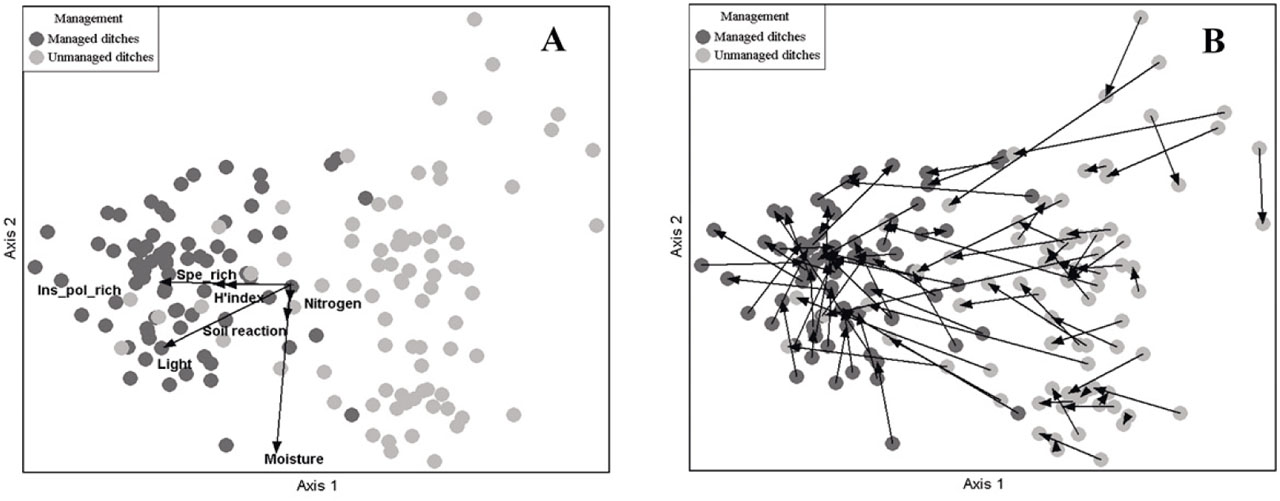
Figure 2.
DCA ordination of studied plots in survey years 2016 and 2020. The first two canonical axes are shown. (A) shows plot ordination according to management intensity. The vectors show correlation between calculated Ellenberg indicator values (light, soil reaction, moisture, nitrogen) and between species communities metrics. Abbreviations: Spe_rich – species richness, Ins_pol_rich – insect-pollinated species richness. (B) shows species ordination with successional changes on studied plots. The successional changes in the species composition among the observations in 2016 and 2020 are indicated with black vectors.
The DCA ordination indicated also successional changes in species communities over a 4-year period (Figure 2). The changes in species composition were specific to the studied plot and most explicit according to the first gradient. According to the main gradient, successional changes on the unmanaged ditches were small as indicated by the relative length of successional vectors. The changes in species communities could be related to light conditions, showing that successional changes along reconstructed ditches were expressed as an increase in species richness, including insect-pollinated species richness and diversity. Successional changes on the unmanaged ditches were less pronounced, except for some individual plots where the increase in species richness was high (Figure 2). Such changes could be explained by management of forest stands along the studied old ditches promoting better light availability and resulting in higher species richness in the second assessment.
Conclusions
Our research confirms that intensive forest management (ditch reconstruction) promotes higher plant species richness along ditch edges in comparison with unmanaged forest ditches. Ditch reconstruction changes species composition, promoting more light and nitrogen demanding species, including flowering plants important for pollinators, thus providing nutrition sources for pollinator communities. Anthropogenically created or altered ecosystems should be evaluated in a complex way, considering both the ecosystem services and disservices they deliver.
Acknowledgments
This study was supported by the projects “Climate change mitigation potential of trees in shelter belts of drainage ditches in cropland and grassland” under the European Regional Development fund agreement No. 1.1.1.1/21/A/030 and “The impact of forest management on forest and related ecosystem services” No. 5-5.9.1_007n_101_21_76.
Appendices
Appendix 1.
The list of recorded vascular plant and bryophyte taxa along the studied ditches (in 2016 and 2020). The number of plots (n=40) where each species was recorded are shown. Insect-pollinated plant species are marked with*.
| Managed ditches | Unmanaged ditches | |||
|---|---|---|---|---|
| Species | 2016 | 2020 | 2016 | 2020 |
| Acer platanoides L.* | 0 | 1 | 0 | 0 |
| Aegopodium podagraria L.* | 4 | 3 | 0 | 1 |
| Agrostis stolonifera L. | 1 | 0 | 0 | 1 |
| Agrostis tenuis Sibth. | 7 | 6 | 0 | 1 |
| Alisma plantago-aquatica L.* | 15 | 20 | 4 | 8 |
| Alnus glutinosa (L.) Gaertn. | 9 | 25 | 9 | 19 |
| Alnus incana (L.) Moench | 6 | 0 | 0 | 1 |
| Alopecurus aequalis Sobol. | 26 | 11 | 0 | 0 |
| Anemone nemorosa L.* | 1 | 0 | 1 | 0 |
| Angelica sylvestris L.* | 17 | 26 | 24 | 23 |
| Anthriscus sylvestris (L.) Hoffm.* | 2 | 0 | 0 | 1 |
| Artemisia vulgaris L. | 7 | 11 | 0 | 0 |
| Athyrium filix-femina (L.) Roth | 29 | 32 | 36 | 34 |
| Betula pendula Roth | 5 | 26 | 0 | 5 |
| Betula pubescens Ehrh. | 12 | 0 | 7 | 3 |
| Bidens tripartita L.* | 2 | 2 | 0 | 2 |
| Brachypodium pinnatum (L.) P.Beauv. | 6 | 0 | 0 | 0 |
| Bromus arvensis L. | 1 | 0 | 0 | 0 |
| Calamagrostis arundinacea (L.) Roth | 3 | 2 | 5 | 5 |
| Calamagrostis canescens (Weber) Roth | 32 | 38 | 24 | 31 |
| Calamagrostis epigeios (L.) Roth | 6 | 16 | 2 | 3 |
| Calla palustris L.* | 0 | 0 | 11 | 13 |
| Caltha palustris L.* | 3 | 1 | 14 | 15 |
| Campanula patula L* | 0 | 1 | 0 | 0 |
| Cardamine spp.* | 0 | 6 | 0 | 4 |
| Carex acuta L. | 0 | 4 | 0 | 0 |
| Carex appropinquata Schumach. | 3 | 2 | 2 | 0 |
| Carex cinerea Pollich | 1 | 1 | 0 | 5 |
| Carex digitata L. | 0 | 2 | 0 | 0 |
| Carex echinata Murray | 0 | 0 | 0 | 1 |
| Carex elongata L. | 2 | 3 | 26 | 32 |
| Carex flacca Schreb. | 0 | 0 | 2 | 0 |
| Carex flava L. s.str. | 1 | 6 | 0 | 0 |
| Carex hirta L. | 0 | 2 | 0 | 0 |
| Carex leporina L. | 1 | 3 | 0 | 1 |
| Carex nigra (L.) Reichard | 5 | 2 | 0 | 1 |
| Carex pseudocyperus L. | 4 | 19 | 5 | 19 |
| Carex remota L. | 0 | 0 | 3 | 4 |
| Carex rostrata Stokes | 16 | 6 | 6 | 0 |
| Carex spp. | 1 | 18 | 0 | 5 |
| Carex sylvatica Huds. | 0 | 0 | 2 | 0 |
| Carex vaginata Tausch | 0 | 1 | 0 | 0 |
| Carex vesicaria L. | 10 | 11 | 0 | 4 |
| Cerastium arvense L.* | 1 | 0 | 0 | 0 |
| Cerastium holosteoides Fr.* | 1 | 3 | 0 | 0 |
| Cerastium spp.* | 0 | 7 | 0 | 0 |
| Ceratophyllum demersum L. | 5 | 5 | 0 | 2 |
| Chamaenerion angustifolium (L.) Scop.* | 2 | 4 | 0 | 0 |
| Chenopodium album L. | 2 | 0 | 0 | 0 |
| Chrysosplenium alternifolium L.* | 12 | 16 | 21 | 22 |
| Cicuta virosa L.* | 16 | 21 | 15 | 16 |
| Circaea alpina L.* | 3 | 5 | 12 | 19 |
| Cirsium arvense (L.) Scop.* | 21 | 24 | 0 | 5 |
| Cirsium heterophyllum (L.) Hill* | 0 | 1 | 0 | 0 |
| Cirsium oleraceum (L.) Scop.* | 28 | 30 | 22 | 30 |
| Cirsium palustre (L.) Scop.* | 12 | 18 | 3 | 3 |
| Cirsium vulgare (Savi) Ten.* | 2 | 3 | 0 | 1 |
| Comarum palustre L.* | 1 | 2 | 4 | 3 |
| Convolvulus arvensis L.* | 2 | 0 | 0 | 0 |
| Crepis paludosa (L.) Moench* | 1 | 0 | 12 | 9 |
| Dactylis glomerata L. | 4 | 0 | 0 | 0 |
| Daphne mezereum L.* | 1 | 0 | 0 | 0 |
| Deschampsia caespitosa (L.) P.Beauv. | 33 | 31 | 11 | 5 |
| Dryopteris carthusiana (Vill.) H.P.Fuchs | 19 | 28 | 34 | 35 |
| Dryopteris filix-mas (L.) Schott | 4 | 0 | 0 | 0 |
| Elymus caninus (L.) L. | 0 | 11 | 0 | 0 |
| Elytrigia repens (L.) Nevski | 0 | 3 | 0 | 0 |
| Epilobium spp.* | 27 | 35 | 5 | 11 |
| Equisetum arvense L. | 13 | 17 | 0 | 0 |
| Equisetum fluviatile L. | 1 | 6 | 8 | 6 |
| Equisetum hyemale L. | 0 | 0 | 1 | 0 |
| Equisetum palustre L. | 0 | 5 | 0 | 5 |
| Equisetum pratense Ehrh. | 17 | 11 | 6 | 0 |
| Equisetum sylvaticum L. | 17 | 17 | 10 | 13 |
| Erigeron annuus (L.) Pers.* | 1 | 4 | 0 | 0 |
| Erigeron canadensis L.* | 3 | 12 | 0 | 2 |
| Euonymus europaea L.* | 1 | 2 | 0 | 0 |
| Eupatorium cannabinum L.* | 1 | 0 | 2 | 2 |
| Fagopyrum esculentum Moench* | 0 | 1 | 0 | 0 |
| Festuca gigantea (L.) Vill. | 0 | 2 | 0 | 0 |
| Festuca rubra L. s.l. | 0 | 3 | 0 | 0 |
| Festuca spp. | 0 | 3 | 0 | 0 |
| Filipendula ulmaria (L.) Maxim.* | 32 | 31 | 13 | 10 |
| Fragaria moschata Duchesne* | 6 | 0 | 1 | 0 |
| Fragaria vesca L.* | 5 | 8 | 0 | 1 |
| Frangula alnus Mill.* | 19 | 27 | 14 | 19 |
| Galeobdolon luteum Huds.* | 5 | 4 | 6 | 9 |
| Galeopsis spp.* | 16 | 17 | 0 | 5 |
| Galium album Mill.* | 1 | 3 | 0 | 1 |
| Galium aparine L.* | 32 | 2 | 26 | 12 |
| Galium elongatum C.Presl* | 1 | 36 | 0 | 18 |
| Galium palustre L.* | 15 | 26 | 22 | 31 |
| Galium uliginosum L.* | 1 | 0 | 0 | 1 |
| Geranium robertianum L.* | 2 | 6 | 0 | 2 |
| Geum rivale L.* | 16 | 16 | 17 | 16 |
| Glyceria fluitans (L.) R.Br. | 32 | 34 | 8 | 16 |
| Gnaphalium uliginosum L.* | 2 | 4 | 0 | 0 |
| Gymnocarpium dryopteris (L.) Newman | 10 | 8 | 14 | 9 |
| Hepatica nobilis Mill.* | 0 | 0 | 1 | 0 |
| Hieracium spp.* | 0 | 0 | 0 | 1 |
| Hottonia palustris L. | 0 | 0 | 0 | 1 |
| Hypericum maculatum Crantz* | 10 | 13 | 0 | 0 |
| Impatiens noli-tangere L.* | 9 | 8 | 22 | 21 |
| Impatiens parviflora DC.* | 13 | 7 | 0 | 3 |
| Iris pseudacorus L.* | 20 | 11 | 4 | 4 |
| Juncus alpino-articulatus Chaix | 4 | 0 | 0 | 0 |
| Juncus articulatus L. | 6 | 17 | 0 | 0 |
| Juncus compressus Jacq. | 0 | 1 | 0 | 0 |
| Juncus filiformis L. | 34 | 38 | 3 | 13 |
| Lathyrus pratensis L.* | 1 | 1 | 0 | 0 |
| Lathyrus vernus (L.) Bernh.* | 0 | 0 | 1 | 0 |
| Lemna minor L. | 2 | 11 | 0 | 5 |
| Chamomilla suaveolens (Pursh) Rydb.* | 1 | 0 | 0 | 0 |
| Leucanthemum vulgare Lam.* | 1 | 0 | 0 | 0 |
| Lolium multiflorum Lam. | 2 | 0 | 0 | 0 |
| Lolium perenne L. | 0 | 1 | 0 | 0 |
| Lupinus polyphyllus Lindl.* | 0 | 1 | 0 | 0 |
| Luzula multiflora (Ehrh.) Lej. | 0 | 4 | 0 | 0 |
| Luzula pilosa (L.) Willd. | 11 | 12 | 17 | 17 |
| Coronaria flos-cuculi (L.) A.Braun* | 23 | 27 | 3 | 4 |
| Lycopus europaeus L.* | 18 | 30 | 18 | 34 |
| Lysimachia nummularia L.* | 1 | 2 | 0 | 0 |
| Lysimachia vulgaris L.* | 33 | 27 | 30 | 32 |
| Lythrum salicaria L.* | 0 | 2 | 0 | 0 |
| Maianthemum bifolium (L.) F.W.Schmidt* | 19 | 20 | 29 | 29 |
| Mentha arvensis L.* | 15 | 23 | 1 | 8 |
| Mercurialis perennis L. | 2 | 2 | 1 | 1 |
| Milium effusum L. | 2 | 9 | 6 | 7 |
| Moehringia trinervia (L.) Clairv.* | 17 | 20 | 4 | 2 |
| Mycelis muralis (L.) Dumort.* | 12 | 15 | 6 | 6 |
| Myosostis arvensis (L.) Hill* | 1 | 0 | 0 | 2 |
| Myosotis palustris (L.) L.* | 25 | 10 | 12 | 22 |
| Myosotis sylvatica Ehrh. ex Hoffm.* | 12 | 1 | 0 | 0 |
| Myosoton aquaticum (L.) Moench * | 22 | 0 | 1 | 0 |
| Naumburgia thyrsiflora (L.) Rchb.* | 3 | 5 | 3 | 18 |
| Oenothera biennis L.* | 0 | 0 | 1 | 0 |
| Orthilia secunda (L.) House* | 1 | 0 | 1 | 4 |
| Oxalis acetosella L.* | 18 | 15 | 33 | 33 |
| Padus avium Mill.* | 1 | 1 | 1 | 1 |
| Paris quadrifolia L.* | 12 | 10 | 14 | 17 |
| Polygonum hydropiper L.* | 0 | 3 | 0 | 2 |
| Peucedanum palustre (L.) Moench* | 8 | 8 | 21 | 15 |
| Phegopteris connectilis (Michx.) Watt | 1 | 1 | 0 | 0 |
| Phragmites australis (Cav.) Trin. ex Steud. | 11 | 15 | 3 | 4 |
| Picea abies (L.) H.Karst. | 16 | 24 | 20 | 27 |
| Pimpinella saxifraga L.* | 1 | 0 | 0 | 0 |
| Pinus sylvestris L. | 2 | 3 | 1 | 1 |
| Plantago major L.* | 5 | 1 | 0 | 0 |
| Platanthera bifolia (L.) Rich.* | 1 | 0 | 0 | 0 |
| Poa compressa L. | 1 | 1 | 0 | 0 |
| Poa nemoralis L. | 0 | 3 | 0 | 0 |
| Poa palustris L. | 17 | 22 | 12 | 22 |
| Poa pratensis L. | 4 | 5 | 0 | 1 |
| Poa spp. | 0 | 8 | 0 | 3 |
| Polygonum hydropiper L.* | 18 | 16 | 2 | 15 |
| Populus tremula L. | 7 | 5 | 0 | 0 |
| Potentilla erecta (L.) Raeusch.* | 1 | 1 | 0 | 1 |
| Prunella vulgaris L.* | 0 | 1 | 0 | 0 |
| Pyrola minor L.* | 1 | 0 | 3 | 0 |
| Quercus robur L. | 0 | 0 | 0 | 1 |
| Ranunculus acris L.* | 5 | 2 | 3 | 0 |
| Ranunculus flammula L.* | 11 | 9 | 0 | 1 |
| Ranunculus lingua L.* | 2 | 7 | 0 | 0 |
| Ranunculus polyanthemos L.* | 17 | 0 | 11 | 2 |
| Ranunculus repens L.* | 22 | 33 | 13 | 25 |
| Ribes alpinum L.* | 1 | 0 | 0 | 0 |
| Ribes nigrum L.* | 0 | 2 | 1 | 2 |
| Rorippa sylvestris (L.) Besser* | 2 | 0 | 0 | 0 |
| Rubus idaeus L.* | 35 | 37 | 20 | 24 |
| Rubus saxatilis L.* | 15 | 14 | 15 | 16 |
| Rumex acetosa L. | 0 | 1 | 0 | 0 |
| Rumex acetosella L. | 4 | 1 | 0 | 4 |
| Rumex aquaticus L. | 0 | 1 | 0 | 0 |
| Rumex confertus Willd. | 4 | 0 | 4 | 0 |
| Rumex obtusifolius L. | 0 | 3 | 0 | 5 |
| Rumex sp. | 0 | 0 | 0 | 2 |
| Sagina procumbens L.* | 4 | 0 | 0 | 0 |
| Salix spp.* | 19 | 32 | 3 | 4 |
| Scirpus sylvaticus L. | 17 | 28 | 11 | 11 |
| Scleranthus perennis L.* | 1 | 0 | 0 | 0 |
| Scrophularia nodosa L.* | 1 | 3 | 0 | 0 |
| Scutellaria galericulata L.* | 28 | 22 | 23 | 31 |
| Senecio spp.* | 0 | 1 | 0 | 1 |
| Senecio sylvaticus L.* | 0 | 0 | 0 | 1 |
| Senecio vulgaris L.* | 5 | 0 | 1 | 0 |
| Solanum dulcamara L.* | 19 | 6 | 28 | 28 |
| Solidago canadensis L. s.l. * | 4 | 2 | 0 | 0 |
| Solidago virgaurea L.* | 3 | 7 | 6 | 3 |
| Sonchus arvensis L.* | 2 | 1 | 0 | 2 |
| Sonchus oleraceus L.* | 9 | 14 | 0 | 2 |
| Sorbus aucuparia L.* | 5 | 5 | 7 | 7 |
| Spergularia rubra (L.) J. et C.Presl* | 1 | 0 | 0 | 0 |
| Stellaria graminea L.* | 0 | 4 | 0 | 1 |
| Stellaria holostea L.* | 4 | 9 | 0 | 3 |
| Stellaria longifolia Muhl. ex Willd.* | 1 | 0 | 0 | 0 |
| Stellaria media (L.) Vill.* | 1 | 2 | 0 | 1 |
| Stellaria nemorum L.* | 0 | 20 | 23 | 18 |
| Stellaria palustris Retz.* | 4 | 1 | 3 | 4 |
| Stellaria spp.* | 0 | 0 | 0 | 3 |
| Stellaria uliginosa Murray* | 1 | 0 | 0 | 0 |
| Taraxacum officinale F.H.Wigg. s.l.* | 25 | 25 | 0 | 3 |
| Thelypteris palustris Schott | 15 | 9 | 16 | 20 |
| Tilia cordata Mill.* | 3 | 2 | 0 | 0 |
| Trientalis europaea L.* | 2 | 4 | 10 | 12 |
| Trifolium repens L.* | 3 | 0 | 0 | 0 |
| Tussilago farfara L.* | 21 | 29 | 0 | 0 |
| Typha latifolia L. | 0 | 4 | 0 | 4 |
| Typha sp. | 0 | 0 | 2 | 0 |
| Urtica dioica L.* | 32 | 33 | 31 | 33 |
| Vaccinium myrtillus L.* | 1 | 2 | 14 | 11 |
| Vaccinium vitis-idaea L.* | 0 | 0 | 3 | 4 |
| Valeriana officinalis L.* | 0 | 4 | 4 | 1 |
| Veronica beccabunga L.* | 0 | 0 | 1 | 0 |
| Veronica chamaedrys L.* | 16 | 25 | 4 | 3 |
| Veronica officinalis L.* | 1 | 5 | 0 | 0 |
| Veronica serpyllifolia L.* | 2 | 0 | 0 | 0 |
| Veronica spp.* | 0 | 2 | 0 | 4 |
| Viburnum opulus L.* | 2 | 1 | 0 | 0 |
| Vicia cracca L.* | 1 | 0 | 0 | 0 |
| Viola spp.* | 27 | 25 | 27 | 35 |
| Atrichum undulatum (Hedw.) P.Beauv. | 8 | 9 | 1 | 3 |
| Aulacomnium palustre (Hedw.) Schwägr. | 0 | 0 | 0 | 1 |
| Brachythecium rutabulum (Hedw.) Schimp. | 8 | 19 | 34 | 22 |
| Calliergon cordifolium (Hedw.) Kindb. | 1 | 7 | 30 | 23 |
| Calliergonella cuspidata (Hedw.) Loeske | 7 | 6 | 32 | 20 |
| Ceratodon purpureus (Hedw.) Brid. | 0 | 5 | 0 | 0 |
| Climacium dendroides (Hedw.) F.Weber & D.Mohr | 4 | 2 | 31 | 21 |
| Conocephalum conicum (L.) Dumort | 2 | 0 | 4 | 0 |
| Dicranum polysetum Sw. ex anon. | 6 | 2 | 9 | 5 |
| Dicranum scoparium Hedw. | 1 | 3 | 21 | 11 |
| Plagiochila asplenoides (L.) Dumort. | 0 | 0 | 1 | 1 |
| Plagiomnium affine (Blandow ex Funck) T.J.Kop. | 3 | 15 | 20 | 21 |
| Plagiomnium cuspidatum (Hedw.) T.J.Kop. | 13 | 10 | 12 | 17 |
| Plagiomnium ellipticum (Brid.) T.J.Kop. | 9 | 5 | 28 | 19 |
| Plagiomnium undulatum (Hedw.) T.J.Kop. | 1 | 1 | 1 | 2 |
| Plagiothecium spp. | 0 | 0 | 8 | 0 |
| Eurhynchium angustirete T.Koponen | 8 | 1 | 13 | 3 |
| Oxyrrhynchium hians (Hedw.) Loeske | 16 | 3 | 7 | 0 |
| Fissidens taxifolius Hedw. | 1 | 0 | 2 | 1 |
| Funaria hygrometrica Hedw. | 14 | 2 | 0 | 0 |
| Hylocomium splendens (Hedw.) Schimp. | 5 | 5 | 17 | 16 |
| Marchantia polymoropha L. | 4 | 26 | 0 | 2 |
| Pleurozium schreberi (Willd. ex Brid.) Mitt. | 9 | 4 | 22 | 17 |
| Pohlia nutans (Hedw.) Lindb. | 0 | 1 | 0 | 0 |
| Polytrichum commune Hedw. | 0 | 2 | 0 | 3 |
| Polytrichum juniperinum Hedw. | 0 | 2 | 14 | 0 |
| Ptilium crista-castrensis (Hedw.) De Not. | 1 | 0 | 0 | 0 |
| Sphagnum angustifolium (Russow) C.E.O.Jensen | 0 | 0 | 3 | 1 |
| Sphagnum girgensonii Russow | 0 | 0 | 0 | 3 |
| Sphagnum squarrosum Crome | 0 | 0 | 11 | 7 |
| Thuidium tamariscinum (Hedw.) Bruch, Schimp. & W.Guembel | 0 | 0 | 2 | 0 |
| Rhodobryum roseum (Hedw.) Limpr. | 2 | 0 | 8 | 0 |
| Rhytidiadelphus squarrosus (Hedw.) Warnst. | 0 | 1 | 2 | 2 |
| Rhytidiadelphus triquetrus (Hedw.) Ochyra & | 5 | 4 | 14 | 13 |