
Table 1.
Basic input parameters and definitions for the Kljun et al. (2004) FFP model.
| Input | Description |
|---|---|
| zm | measurement height above ground (m) |
| z0 | roughness length (m) |
| d | displacement height (m) |
| u_mean | mean wind speed at zm (m/s) |
| L | Obukhov length (m) |
| sigma_v | standard deviation of lateral velocity fluctuations after rotation (m/s) |
| u* | friction velocity (m/s) |
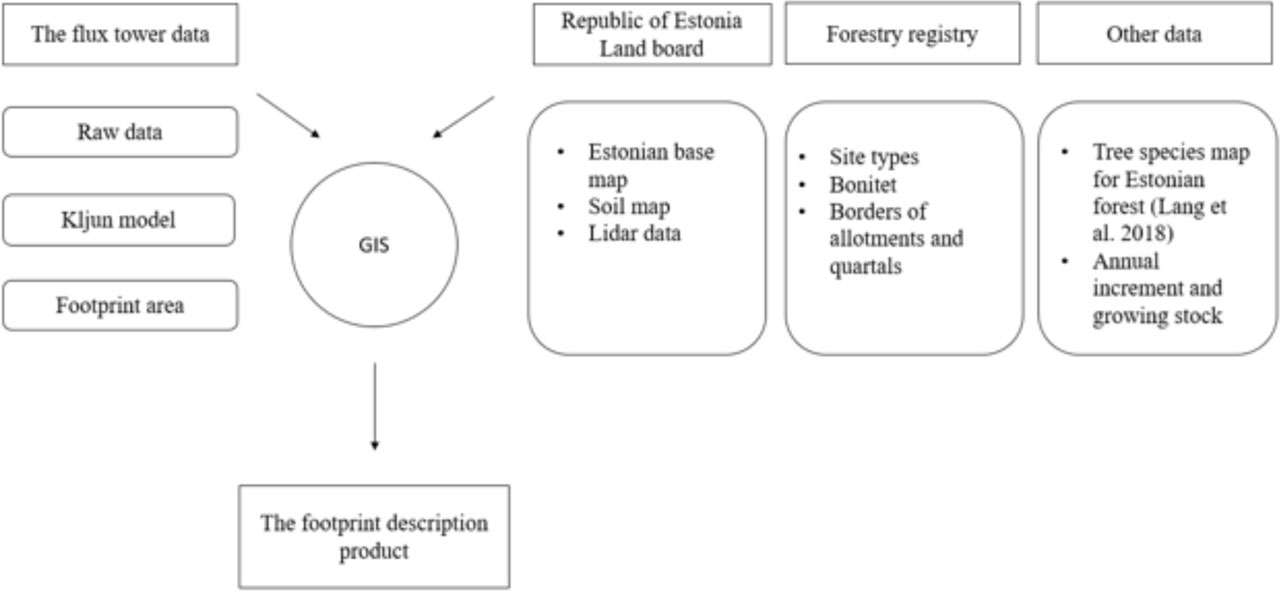
Figure 1.
Scheme of the workflow to reach from flux tower raw data to the FFP description product.
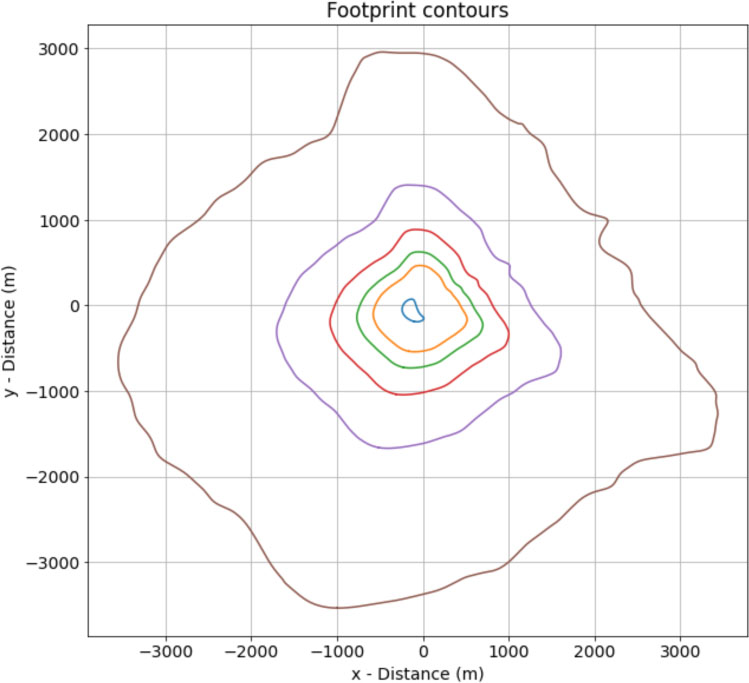
Figure 2.
A representation of the cumulative FFP contours at the 10%, 50%, 60%, 70%, 80% and 90% contours of source weights for each year at the height of 70 m.
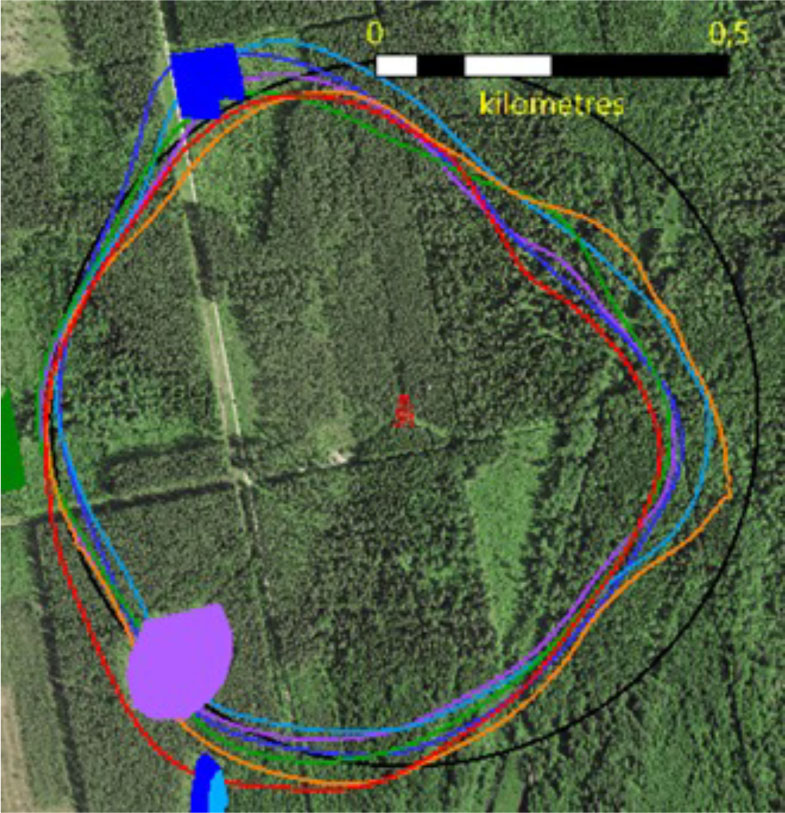
Figure 3.
The contours of the FFP area for the years 2015–2020. It is visible that the change in the FFP area differs year to year and that these changes introduce also changes in the fraction of the land cover elements (e.g. clear-cut, road) or tree species. Coloured areas stand for clear-cuts. Blue, dark blue and purple colours show areas that were clear-cut in 2018, 2019 and 2020, respectively. The red sign in the middle indicates the location of the flux tower.
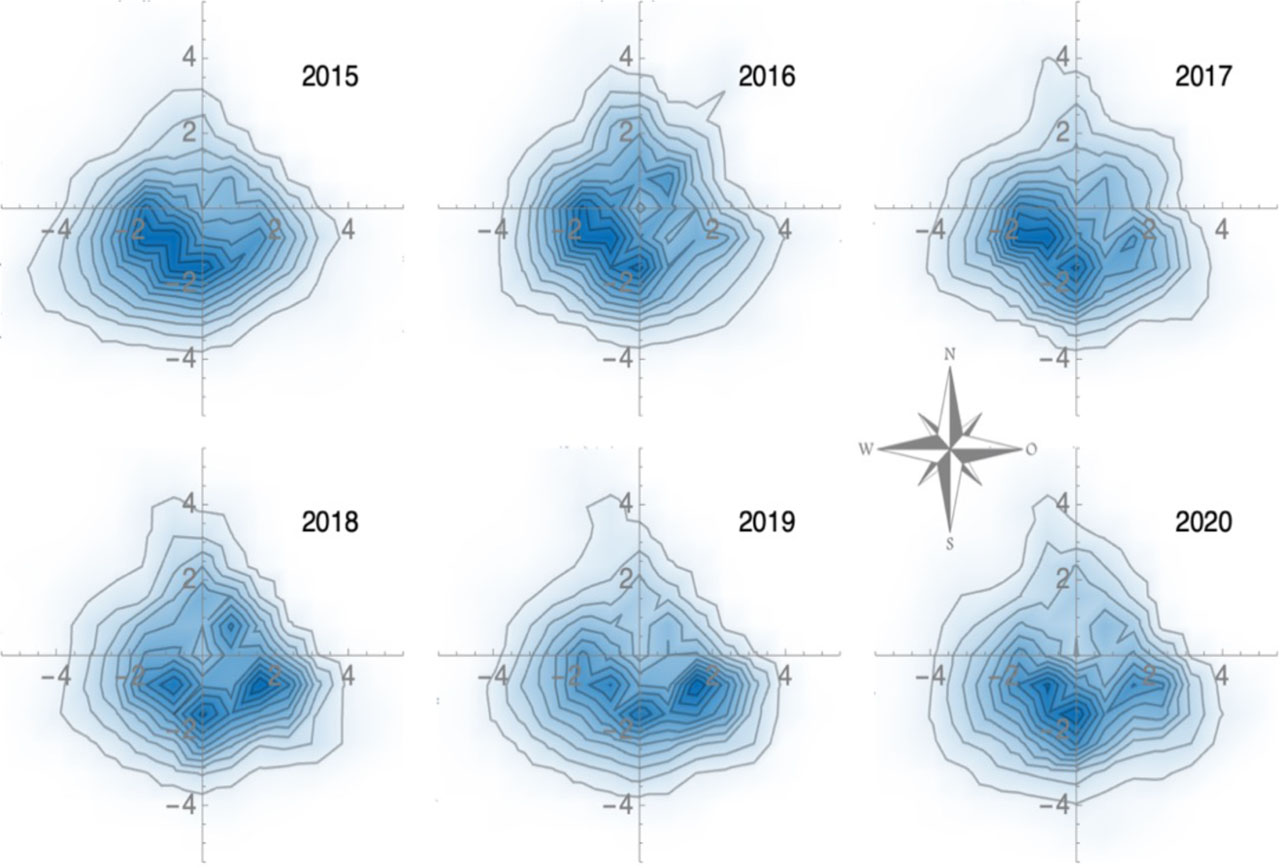
Figure 4.
Heterogeneity in the annual wind direction and speed (m s−1) measured at the SMEAR Estonia atmospheric tower at 30 m. The dominant wind directions ranged from the west to the south in 2015 to 2017 and in the more recent years from southwest to southeast. The darker colour on the figure denotes a higher density in wind direction and speed which means a higher contribution from those directions to the overall FFP.
Table 2.
Land categories of the FFP area over the period of 2015–2020 at a height of 30 m.
| Land type | Species | Area (ha) | Increment (m3/ha/y) | Growing stock (m3) | % of the FFP |
|---|---|---|---|---|---|
| Forest land | Alnus incana | 0.1 | 0.5 | 7.6 | 0.2 |
| Forest land | Alnus glutinosa | 0.2 | 0.8 | 22.7 | 0.4 |
| Forest land | Populus tremula | 4.3 | 8.9 | 368.6 | 6.9 |
| Forest land | Betula spp. | 6.8 | 34.1 | 1179.5 | 11.1 |
| Forest land | Picea abies | 15.4 | 99.6 | 4234.5 | 25.0 |
| Forest land | Pinus sylvestris | 28.2 | 100.2 | 8448.0 | 45.8 |
| Forest land | Unknown | 2.8 | |||
| Isle in the forest | - | 0.4 | 0.6 | ||
| Buildings | - | 0.0 | 0.0 | ||
| Electric power lines | - | 1.4 | 2.4 | ||
| Roads | - | 0.2 | 0.4 | ||
| Ditches | - | 0.6 | 1.0 | ||
| Clear area | Clear-cut | 1.0 | 1.6 | ||
| Total | - | 61.5 | 100.0 | ||
| Total forest area | - | 55.0 | 89.4 |
Table 3.
Forest site types in the FFP measured at a height of 30 m.
| Forest site type | 2015 | 2016 | 2017 | 2018 | 2019 | 2020 | Average area (ha) | % of FFP area | Average increment (m3/ha/a) | % of FFP area | Average stock (m3) | % of FFP area |
|---|---|---|---|---|---|---|---|---|---|---|---|---|
| Mineral dump | 3.5 | 3.9 | 3.6 | 3.9 | 3.8 | 3.5 | 3.7 | 6.0 | ||||
| Filipendula | 8.4 | 8.6 | 9.1 | 8.8 | 9.0 | 8.8 | 8.8 | 14.3 | 35.9 | 14.7 | 1560.1 | 10.9 |
| Oxalis | 1.9 | 2.0 | 1.8 | 1.7 | 1.9 | 1.6 | 1.8 | 2.9 | 4.6 | 1.9 | 282.4 | 2.0 |
| Oxalis-Myrtillus | 1.5 | 3.2 | 2.6 | 2.8 | 1.9 | 2.1 | 2.3 | 3.8 | 16.0 | 6.5 | 660.0 | 4.6 |
| Oxalis drained swamp | 3.9 | 6.4 | 4.0 | 5.4 | 4.5 | 3.9 | 4.7 | 7.6 | 26.2 | 10.7 | 925.9 | 6.5 |
| Myrtillus | 22.8 | 22.9 | 22.0 | 22.3 | 22.8 | 21.2 | 22.3 | 36.3 | 99.8 | 40.9 | 6622.5 | 46.4 |
| Uliginosum | 14.2 | 13.1 | 11.7 | 12.7 | 12.4 | 12.2 | 12.7 | 20.7 | 45.9 | 18.8 | 2916.4 | 20.5 |
| Oxycoccus | 5.4 | 5.4 | 5.3 | 4.8 | 5.1 | 5.0 | 5.2 | 8.4 | 15.6 | 6.4 | 1293.5 | 9.1 |
| Total | 61.6 | 65.4 | 60.2 | 62.3 | 61.4 | 58.3 | 61.5 | 100.0 | 244.0 | 100.0 | 14260.9 | 100.0 |
Table 4.
Growing stock (m3/ha) and increment (m3/ha/y) changes during the six-year period.
| Characteristic | Unit | Year | |||||
|---|---|---|---|---|---|---|---|
| 2015 | 2016 | 2017 | 2018 | 2019 | 2020 | ||
| Area | ha | 58.05 | 61.54 | 56.59 | 58.40 | 57.61 | 54.77 |
| Stock in summer | m3 | 13988 | 14732 | 14058 | 14558 | 14430 | 13799 |
| Thinning & harvesting | m3 | 0 | 0 | 0 | 273 | 501 | |
| Increment | m3 | 240 | 266 | 237 | 248 | 242 | 232 |
| Stock in summer | m3 | 14228 | 14998 | 14295 | 14533 | 14170 | |
| Stock in summer | m3/ha | 240.98 | 239.39 | 248.40 | 249.29 | 250.45 | 251.91 |
| Thinning | m3/ha | 0.00 | 0.00 | 0.00 | 4.68 | 8.70 | |
| Increment | m3/ha | 4.13 | 4.32 | 4.18 | 4.24 | 4.19 | 4.24 |
| Stock in next summer | m3/ha | 245.11 | 243.71 | 252.59 | 248.86 | 245.94 | |
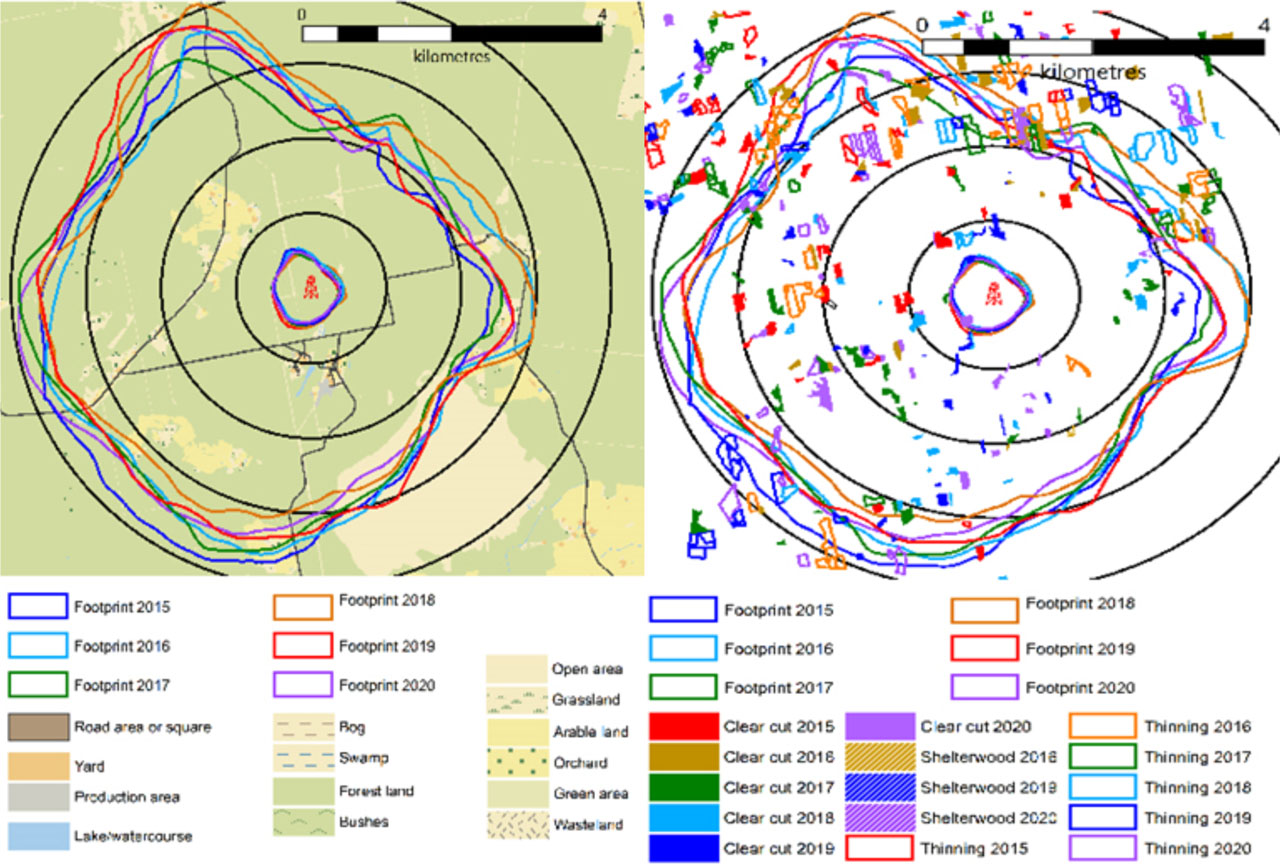
Figure 5.
The contours of the FFP area in 2015–2020. It is visible that the change in the FFP area differs year to year and that these changes introduce also changes in the fraction of the land cover elements (e.g. clear-cut, road, forest area) or tree species. Different colours and filling patterns mark thinning and clear-cut areas in different years.
Table 5.
Land categories of the FFP area over the period of 2015–2020 at a height of 70 m.
| Land type | Species | Area (ha) | Increment (m3/ha/y) | Growing stock (m3) | % of FFP |
|---|---|---|---|---|---|
| Forest | Alnus incana | 37.2 | 186.9 | 3251.9 | 1.1 |
| Forest | Alnus glutinosa | 464.5 | 1693.0 | 76381.2 | 14.1 |
| Forest | Populus tremula | 242.7 | 786.6 | 20652.5 | 7.4 |
| Forest | Betula spp. | 1007.9 | 3449.5 | 224027.0 | 30.6 |
| Forest | Picea abies | 450.0 | 2205.8 | 135347.7 | 13.7 |
| Forest | Pinus sylvestris | 470.5 | 1027.0 | 145716.4 | 14.3 |
| Forest | Other species | 0.1 | 0.1 | 58.0 | 0.0 |
| Forest (bog) | Pinus sylvestris | 40.7 | 52.5 | 1004.7 | 1.2 |
| Forest | Clear-cut | 183.6 | 5.6 | ||
| Bog | Without forest | 35.5 | 1.1 | ||
| Fen | Without forest | 9.8 | 0.3 | ||
| Agricultural land | - | 120.4 | 3.7 | ||
| Clear area | - | 83.8 | 2.5 | ||
| Buildings | - | 2.3 | 0.1 | ||
| Standing water | - | 3.8 | 0.1 | ||
| Isle in the forest | - | 30.4 | 0.9 | ||
| Roads | - | 37.1 | 1.1 | ||
| Watercourse | - | 40.1 | 1.2 | ||
| Yard | - | 11.8 | 0.4 | ||
| Other land | - | 0.3 | 0.0 | ||
| Power lines | - | 23.5 | 0.7 | ||
| Total forest land | - | 2897.3 | 87.9 | ||
| Total area | - | 3296.0 | 100.0 |
Table 6.
Forest site types in the FFP measured at a height of 70 m.
| Forest site type | 2015 | 2016 | 2017 | 2018 | 2019 | 2020 | Average area (ha) | % of FFP | Average increment (m3/ha/a) | % of FFP | Average stock (m3) | % of FFP |
|---|---|---|---|---|---|---|---|---|---|---|---|---|
| Mineral dump | 418.0 | 445.5 | 397.4 | 415.5 | 429.0 | 406.6 | 418.7 | 12.703 | ||||
| Myrtillus | 564.2 | 567.9 | 553.1 | 578.1 | 576.1 | 554.3 | 565.6 | 17.161 | 848.4 | 18.0 | 77460.9 | 25.4 |
| Vaccinium | 36.4 | 34.1 | 36.6 | 36.5 | 39.3 | 36.8 | 36.6 | 1.111 | 39.6 | 0.8 | 6332.8 | 2.1 |
| Raised bog | 42.9 | 45.7 | 36.2 | 25.3 | 52.6 | 18.0 | 36.8 | 1.116 | 19.5 | 0.4 | 414.8 | 0.1 |
| Uliginosum | 73.2 | 75.7 | 73.3 | 74.5 | 75.4 | 73.6 | 74.3 | 2.253 | 71.9 | 1.5 | 9110.2 | 3.0 |
| Transitional bog | 87.0 | 95.0 | 85.0 | 93.0 | 89.8 | 85.3 | 89.2 | 2.706 | 63.0 | 1.3 | 10211.7 | 3.3 |
| Filipendula | 1233.1 | 1254.7 | 1205.3 | 1296.9 | 1236.7 | 1231.0 | 1242.9 | 37.711 | 2024.0 | 42.9 | 122544.0 | 40.1 |
| Oxalis | 160.4 | 133.1 | 129.4 | 109.5 | 129.1 | 134.1 | 132.6 | 4.024 | 364.6 | 7.7 | 12762.4 | 4.2 |
| Oxalis-Myrtillus | 172.0 | 207.5 | 198.4 | 206.6 | 180.1 | 222.9 | 197.9 | 6.005 | 488.1 | 10.3 | 19911.9 | 6.5 |
| Oxalis drained swamp | 489.7 | 448.3 | 517.3 | 487.7 | 506.7 | 499.7 | 491.6 | 14.914 | 759.6 | 16.1 | 44217.1 | 14.5 |
| Aegopodium | 7.769 | 6.710 | 6.730 | 5.983 | 5.995 | 6.990 | 6.7 | 0.203 | 21.2 | 0.4 | 1866.7 | 0.6 |
| Hepatica | 2.982 | 2.982 | 2.982 | 2.982 | 2.982 | 2.982 | 3.0 | 0.090 | 21.2 | 0.4 | 414.6 | 0.1 |
| Cladonia | 0.280 | 0.000 | 0.222 | 0.000 | 0.000 | 0.000 | 0.1 | 0.003 | 0.1 | 0.0 | 21.9 | 0.0 |
| Total | 3296.0 | 100.0 | 4721.2 | 100.0 | 305268.8 | 100.0 |
Table 7.
Growing stock (m3/ha) and increment (m3/ha/y) changes during the six-year period.
| Characteristic | Unit | Year | |||||
|---|---|---|---|---|---|---|---|
| 2015 | 2016 | 2017 | 2018 | 2019 | 2020 | ||
| Area | ha | 2888.86 | 2891.82 | 2864.11 | 2938.29 | 2914.90 | 2886.02 |
| Stock in summer | m3 | 605713 | 603467 | 592571 | 618805 | 607847 | 610235 |
| Thinning & harvesting | m3 | 8481 | 10666 | 5577 | 9394 | 5943 | |
| Increment | m3 | 9187 | 9335 | 9134 | 9500 | 9551 | 9701 |
| Stock in next summer | m3 | 606418 | 602136 | 596127 | 618910 | 611455 | |
| Stock in summer | m3/ha | 209.67 | 208.68 | 206.90 | 210.60 | 208.53 | 211.44 |
| Thinning & harvesting | m3/ha | 2.94 | 3.69 | 1.95 | 3.20 | 2.04 | |
| Increment | m3/ha | 3.18 | 3.23 | 3.19 | 3.23 | 3.28 | 3.36 |
| Stock in next summer | m3/ha | 209.92 | 208.22 | 208.14 | 210.64 | 209.77 | |
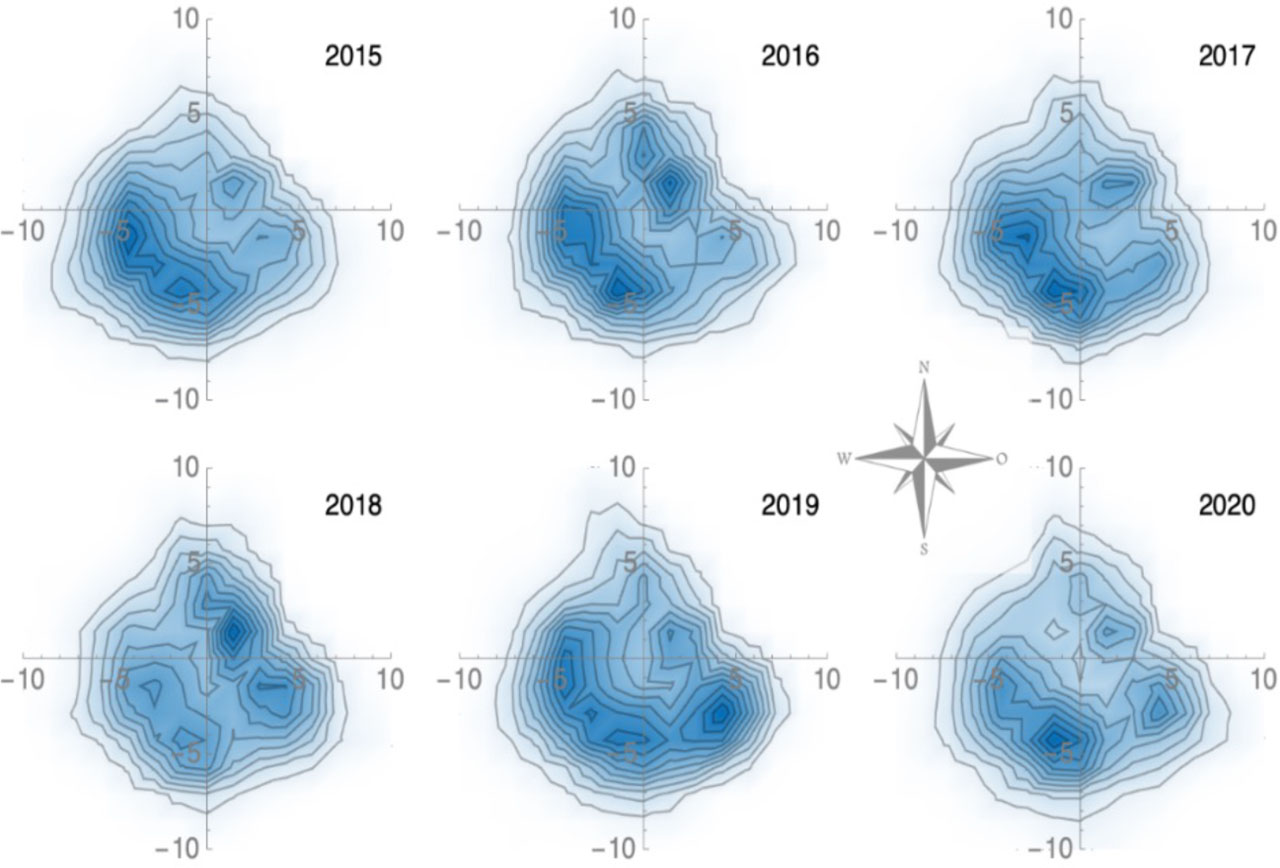
Figure 6.
Heterogeneity in the annual wind direction and speed (m s−1) measured at the SMEAR Estonia atmospheric tower at 70 m. The dominant wind directions ranged from the west to the south in 2015 to 2017 and in the more recent years from the southwest to the southeast. The darker colour on the figure denotes a higher density in wind direction and speed, which means a higher contribution from those directions to the overall FFP.