
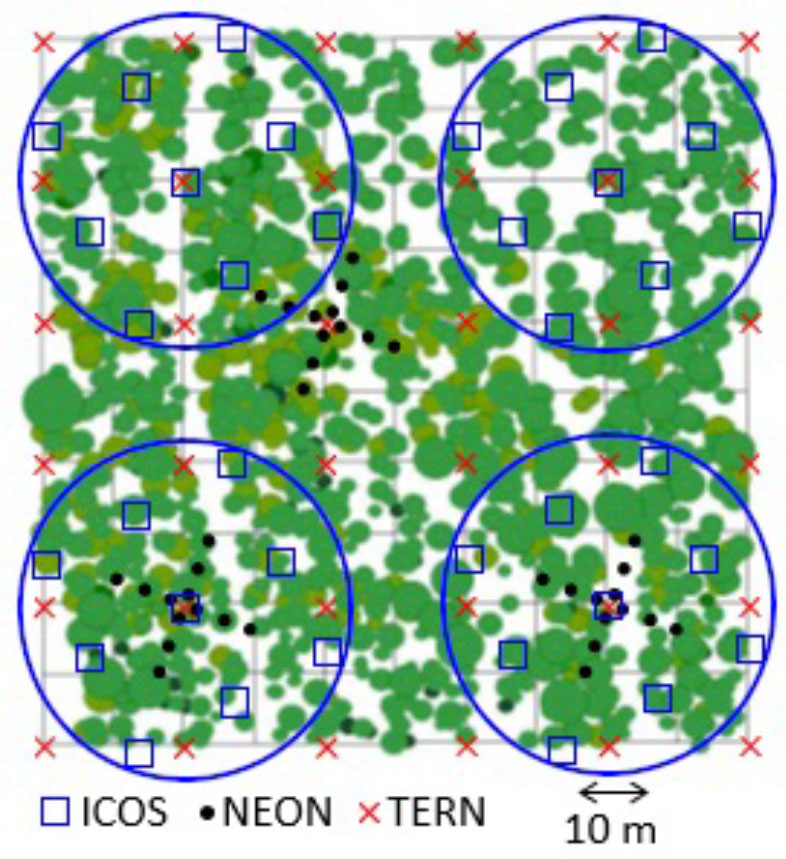
Figure 1.
Positions for digital hemispherical photography within the test site of Järvselja RAMI birch stand.
Joonis 1. Mõõtmispunktide asukohad Järvseljal RAMI kaasikus vastavalt erinevatele skeemidele.
Table 1.
Camera setup specifications.
Tabel 1. Mõõtmisteks kasutatud kaamerad.
| Variable | Camera setup | ||
|---|---|---|---|
| I | II | III | |
| Camera model | Canon EOS 5D | Canon EOS 600D | Canon EOS 2000D |
| Fisheye Lens | Sigma 8 mm F3.5 EX DG | Sigma 4.5 mm F2.8 EX | Sigma 4.5 mm F2.8 EX |
| Camera height | 1.3 m | 1.3 m | 1.3 m |
| Camera orientation | magnetic north | magnetic north | magnetic north |
| Initial ISO | 640 | 400 | 100 |
| Initial exposure compensation | 0 | 0 | −1 |
| Initial shutter speed | 1/32 | 1/60 | Aperture priority |
| Image aquisition | single | single | auto-bracketing |
| F-stop | f/8 | f/8 | f/8 |
| Light metering | Spot | Evaluative | Evaluative |
| Sensor size, pixels | 12.8×10⁶ | 18.0×10⁶ | 24.1×10⁶ |
| Raw image radius* | 1386 | 1450 | 1730 |
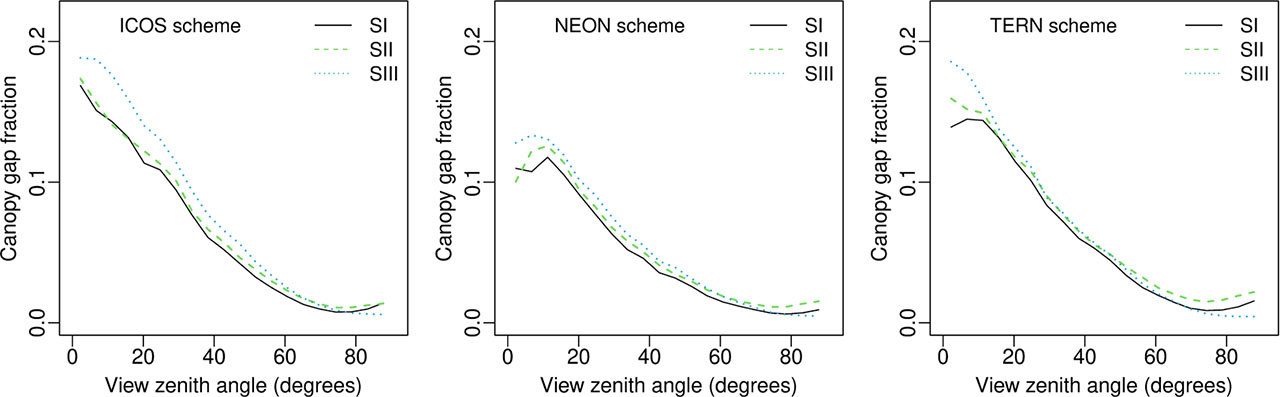
Figure 2.
Comparison of the average gap fraction of the test stand with different camera setups (SI, SII, SIII) using ICOS, NEON and TERN sampling schemes.
Joonis 2. ICOS, NEON ja TERN võrgustikel kolme erineva kaameraga (SI, SII, SIII) tehtud mõõtmis-test arvutatud keskmised võrastiku läbipaistvused sõltuvalt vaatesuuna seniitnurgast.
Table 2.
Estimations of effective plant area index PAIe for each sampling scheme taken with each setup and their corresponding standard errors (SE).
Tabel 2. Mõõtmisvõrgustike (ICOS, NEON, TERN) ja kaamerate (Setup I, II ja III) kaupa võrastiku läbipaistvusest arvutatud efektiivne taimkatteindeks PAIe ja selle standardviga (SE).
| Camera | Sampling network | |||||
|---|---|---|---|---|---|---|
| ICOS | NEON | TERN | ||||
| PAIe | SE | PAIe | SE | PAIe | SE | |
| Setup I | 3.11 | 0.06 | 3.38 | 0.05 | 3.11 | 0.06 |
| Setup II | 2.99 | 0.06 | 3.22 | 0.05 | 2.94 | 0.05 |
| Setup III | 2.90 | 0.05 | 3.21 | 0.04 | 3.08 | 0.06 |
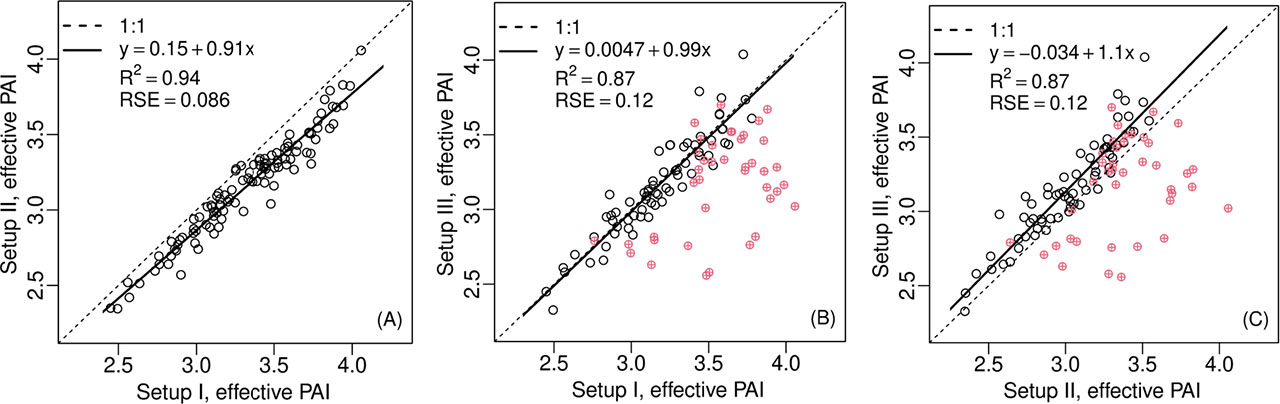
Figure 3.
Effective plant area index PAIe calculated from the data of three camera setups. RSE is the linear regression residual error. Overexposed measurements with Setup III are marked with red crossed circles and excluded from the regression.
Joonis 3. Mõõtmispunktides saadud efektiivse taimkatteindeksi PAIe võrdlus erinevate kaamerate (Setup I, II ja III) kaupa. Kaamera III ülevalgustatud mõõtmised on tähistatud punaste ringristidega ja regressioonimudelist välja jäetud. RSE on mudeli jääkviga.
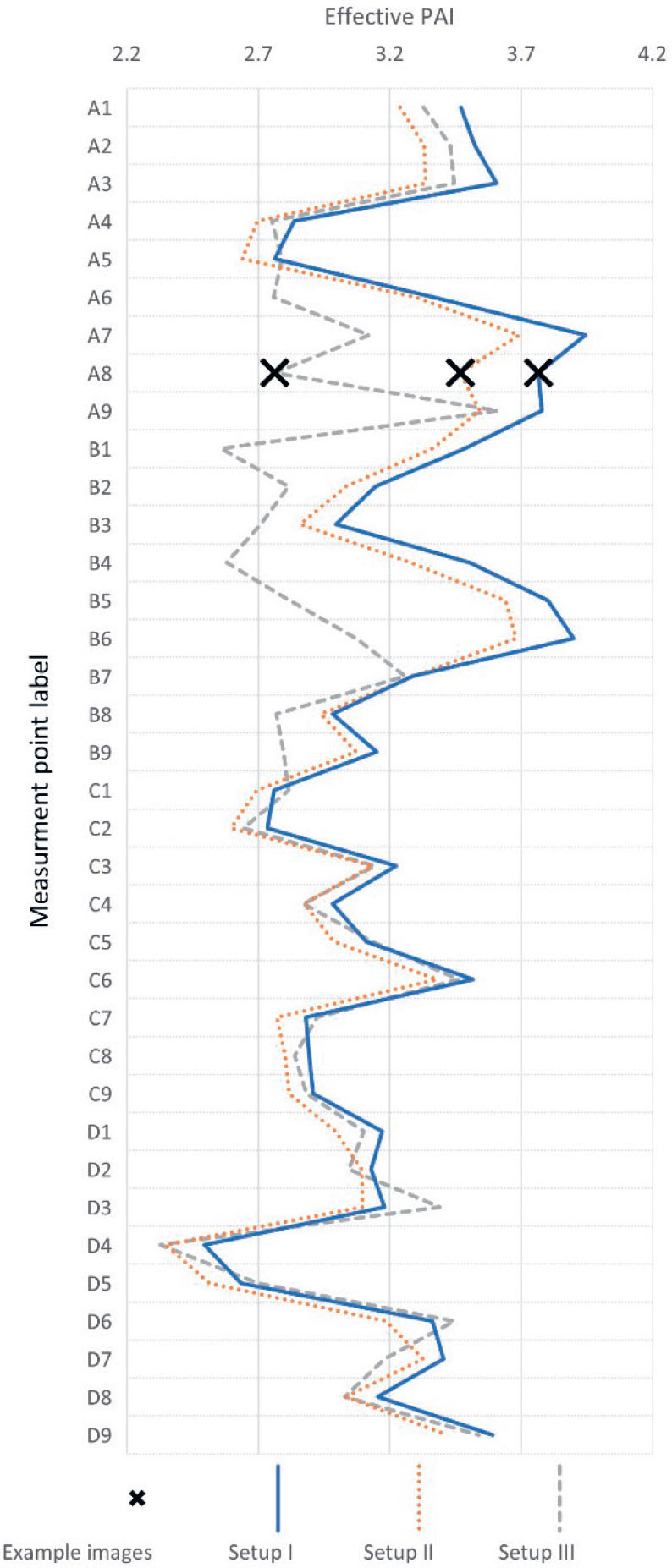
Figure 4.
PAIe values from three camera measurements for the ICOS scheme and the locations of the sample images shown in Figure 7.
Joonis 4. Efektiivse taimkatteindeksi PAIe väärtused mõõtmiste jadas ICOS võrgustiku punktides. Ristiga on näidatud joonisel (8) toodud näidispildi mõõtmispunkt.
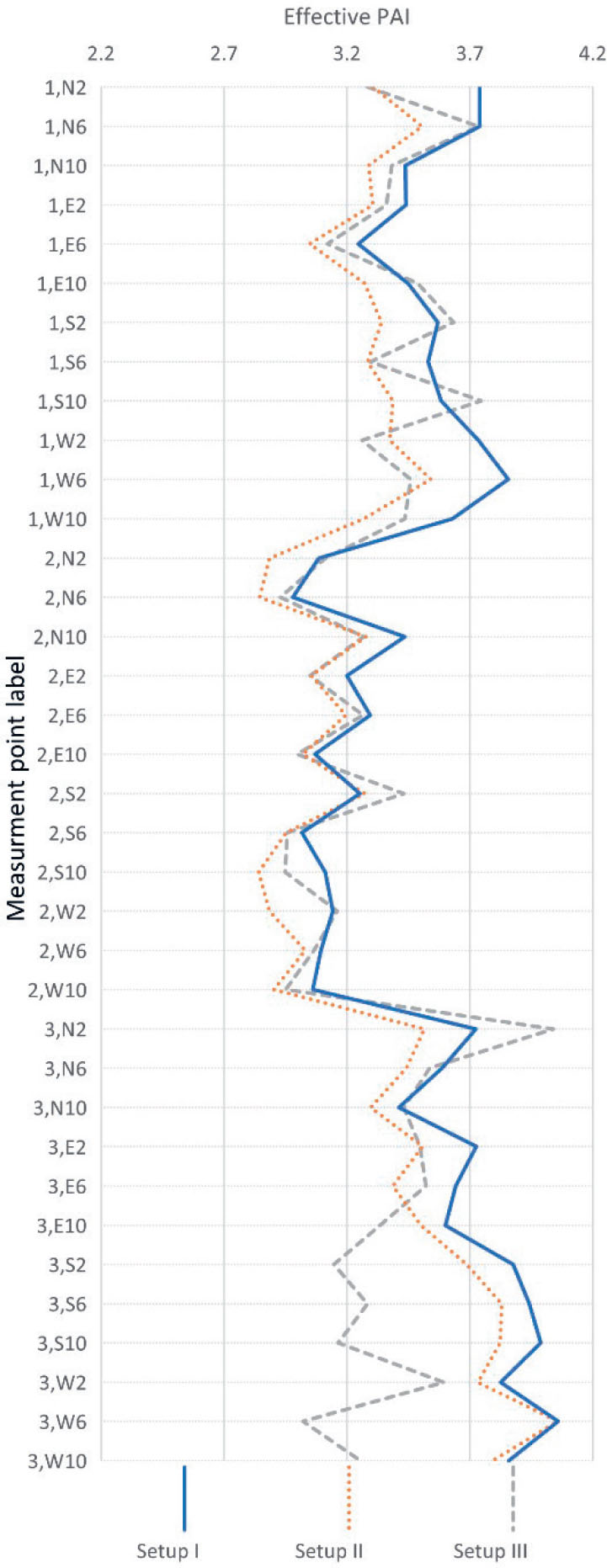
Figure 5.
PAIe values from three camera measurements for the NEON scheme.
Joonis 5. Efektiivse taimkatteindeksi PAIe väärtused mõõtmiste jadas NEON võrgustiku punktides.
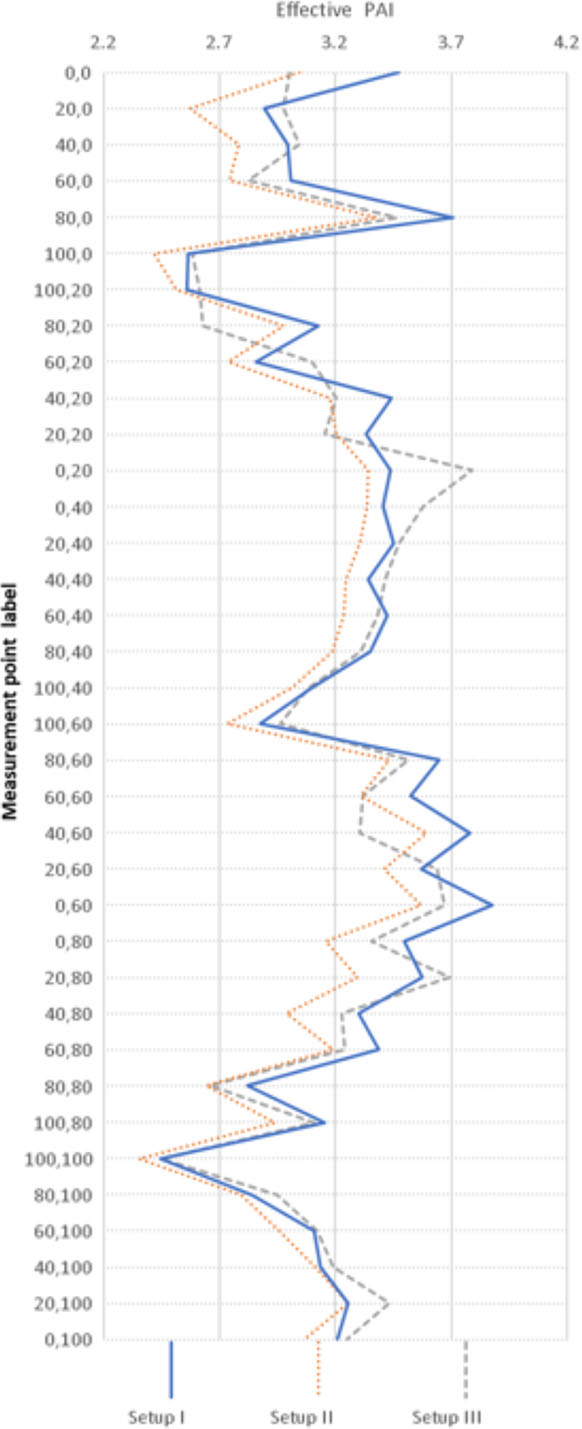
Figure 6.
PAIe values from three camera measurements for the TERN scheme.
Joonis 6. Efektiivse taimkatteindeksi PAIe väärtused mõõtmiste jadas TERN võrgustiku punktides.
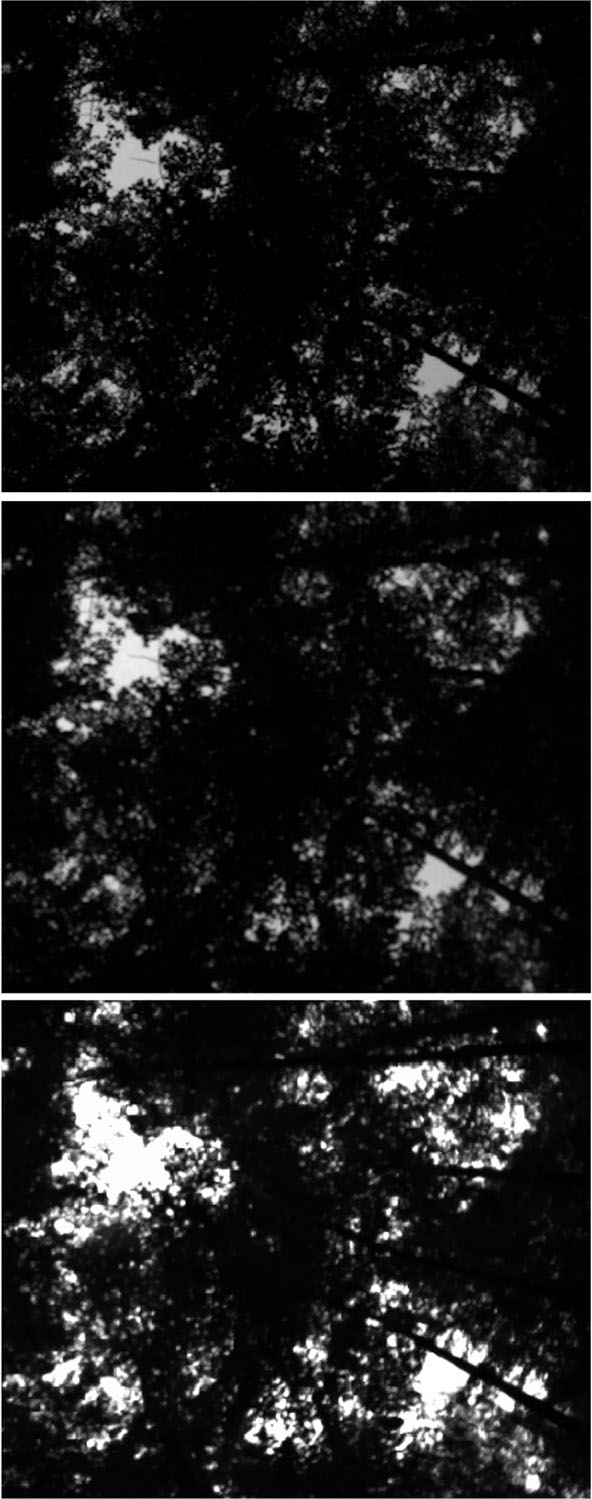
Figure 7.
Zoomed-in central parts of the blue channel of the photos taken from ICOS point A8 with setup I (A), setup II (B), and setup III (C).
Joonis 7. Suurendus kaameratega (I, II ja III) ICOS võrgustiku punktis A8 tehtud ülesvõtte keskosast. Kaamera III pildil on näha tugeva ülevalgustatuse ilminguid.
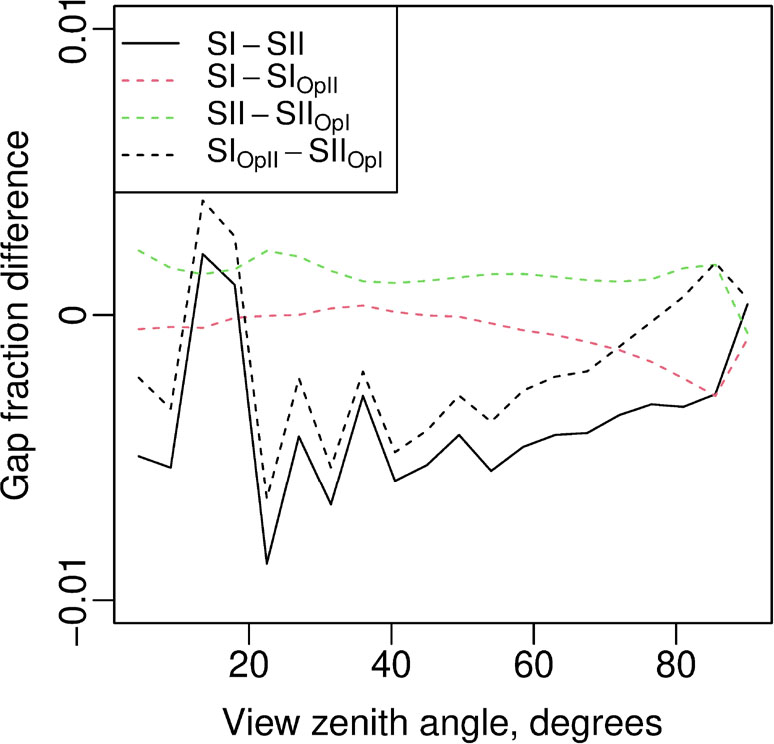
Figure 8.
Comparison of differences in average gap fractions in the ICOS scheme calculated from measurements with setup I and setup II and processed by the camera operators OpI or OpII. The influence of the image analyst is small compared to the camera factor.
Joonis 8. ICOS mõõtmisvõrgu andmetel saadud võrastiku keskmise läbipaistvuse erinevus kaamerate I ja II andmetel. Sama kaamera piltide töötlemisel on operaatori mõju (OpI, OpII) väike võrreldes kaamera faktoriga.
Table 3.
Linear relationships between effective plant area index between three camera setups by sampling schemes and using only correct (C) i.e. non-overexposed images of setup III or all (A). RSE is model residual error and N is the number of observations.
Tabel 3. Lineaarsed regressioonmudelid kaamerate ning mõõtmisskeemide kaupa. Kaamera III mudelid on antud kõikide (A) või ainult korrektsete mõõtmiste ehk ülevalgustamata piltide andmete (C) järgi. RSE on mudeli jääkviga ning N on vaatluste arv.
| Camera setup | Sampling | Linear regression Sy = a + bSx | ||||||
|---|---|---|---|---|---|---|---|---|
| Sx | Sy | Network | Subset | R2 | a | b | RSE | N |
| I | II | ICOS | A | 0.97 | 0.21 | 0.89 | 0.06 | 36 |
| I | II | NEON | A | 0.90 | 0.05 | 0.94 | 0.10 | 36 |
| I | II | TERN | A | 0.92 | 0.21 | 0.88 | 0.09 | 36 |
| I | III | ICOS | A | 0.28 | 1.55 | 0.45 | 0.27 | 36 |
| I | III | ICOS | C | 0.92 | 0.10 | 0.96 | 0.10 | 21 |
| I | III | NEON | A | 0.23 | 1.90 | 0.40 | 0.23 | 36 |
| I | III | NEON | C | 0.84 | −0.52 | 1.15 | 0.12 | 23 |
| I | III | TERN | A | 0.71 | 0.55 | 0.81 | 0.18 | 36 |
| I | III | TERN | C | 0.84 | 0.10 | 0.97 | 0.13 | 24 |
| II | III | ICOS | A | 0.29 | 1.44 | 0.50 | 0.27 | 36 |
| II | III | ICOS | C | 0.93 | 0.02 | 1.02 | 0.09 | 21 |
| II | III | NEON | A | 0.17 | 2.15 | 0.35 | 0.24 | 36 |
| II | III | NEON | C | 0.85 | −0.73 | 1.28 | 0.12 | 23 |
| II | III | TERN | A | 0.77 | 0.36 | 0.92 | 0.16 | 36 |
| II | III | TERN | C | 0.87 | 0.16 | 1.01 | 0.12 | 24 |