
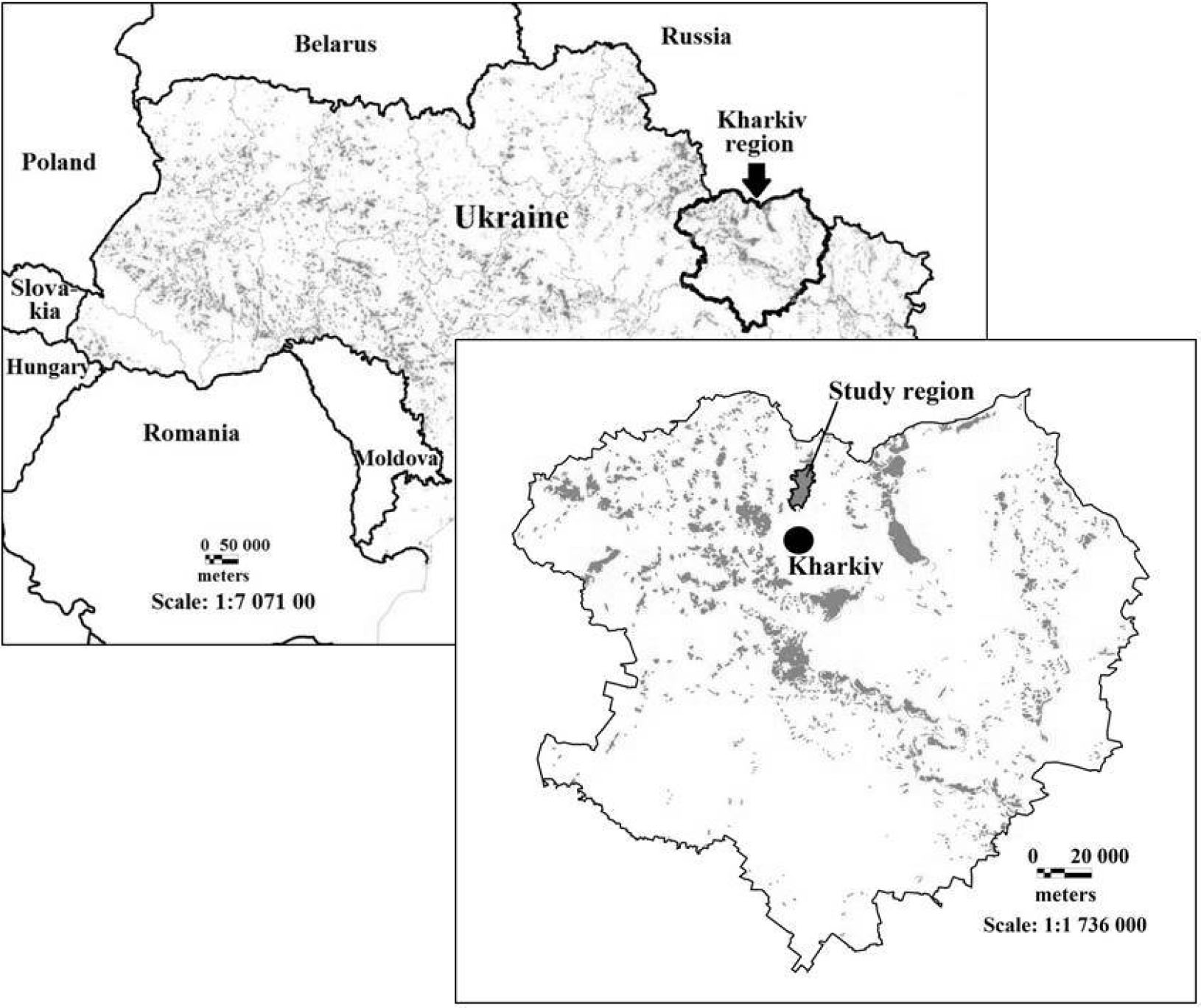
Figure 1.
Map of oak forests (grey) in the Kharkiv region and location of the study area.
Table 1.
Mensuration characteristics of the studied oak stands and their coordinates.
| Research plot | Characteristics of shelterwood | Location of plot | ||||
|---|---|---|---|---|---|---|
| Composition [%] | Age [year] | Stock density | Stock [m3 · ha-1] | Latitude | Longitude | |
| Stands aged 101–120 | ||||||
| 1 | Oak 90%–N-Maple 10% | 115 | 0.6 | 260 | 36°16′44″ | 50°06′04″ |
| 2 | Oak 90%–F-Maple 10%–Ash | 110 | 0.7 | 240 | 36°20′31″ | 50°06′27″ |
| 3 | Oak 80%–N-Maple 20% | 103 | 0.8 | 290 | 36°18′56″ | 50°10′48″ |
| 4 | Oak 90%–F-Maple 10% | 105 | 0.9 | 330 | 36°19′33″ | 50°10′45″ |
| Stands aged 121–150 | ||||||
| 5 | Oak 90%–N-Maple 10% | 135 | 0.5 | 230 | 36°17′53″ | 50°05′51″ |
| 6 | Oak 90%–N-Maple 10%–Ash | 145 | 0.6 | 270 | 36°18′59″ | 50°11′06″ |
| 7 | Oak 90%–N-Maple 10% | 130 | 0.7 | 320 | 36°18′57″ | 50°11′08ȃ |
| 8 | Oak 80%–Lime 10%–N-Maple 10% | 125 | 0.8 | 325 | 36°17′29″ | 50°05′54″ |
Table 2.
Scale of rough estimation of flowering and fructification of oak stands according to V. Kapper (Kapper, 1930).
| Points of flowering and fructification | Description |
|---|---|
| 0 | Flowering and fructification are absent |
| 1 | Very poor flowering or very poor fructification (few flowers or fruits on trees growing on the edges or outside stands and very few on those growing within stands) |
| 2 | Poor flowering and poor fructification (very satisfactory and even flowering or fructification of trees growing on the edges or outside stands and poor flowering or fructification within stands) |
| 3 | Normal flowering or normal fructification (substantial flowering or fructification of trees growing on the edges or outside stands and good flowering or fructification in middle-aged and mature stands) |
| 4 | Good flowering or good fructification (abundant flowering or fructification of trees growing on the edges or outside stands and good flowering or fructification in middleaged and mature stands) |
| 5 | Very good flowering or very good fructification (abundant flowering or fructification of trees growing on the edges or outside stands as well as in middle-aged and mature stands) |
Table 3.
The quantity and weight of oak acorns under the canopy of the studied oak stands.
| Research plot | Characteristics | 2020 | 2021 | ||||
|---|---|---|---|---|---|---|---|
| Healthy acorns | Damaged acorns | Total | Healthy acorns | Damaged acorns | Total | ||
| 1 | Number of acorns per hectare | 3,200 | 7,100 | 10,300 | 3,100 | 7,400 | 10,500 |
| (numerator)/Percent (denominator) | 31 | 69 | 100 | 30 | 70 | 100 | |
| Kg of acorns per hectare | 8.6 | 18.2 | 26.8 | 8.4 | 18.6 | 27.0 | |
| Weight of 1,000 oaks [kg] | 2.68 | 2.57 | 5.25 | 2.71 | 2.51 | 5.22 | |
| 2 | Number of acorns per hectare | 4,700 | 8,300 | 13,000 | 4,200 | 9,300 | 13,500 |
| (numerator)/Percent (denominator) | 36 | 64 | 100 | 31 | 69 | 100 | |
| Kg of acorns per hectare | 13.1 | 20.6 | 33.7 | 12.1 | 25.8 | 37.9 | |
| Weight of 1,000 oaks [kg] | 2.78 | 2.48 | 5.26 | 2.87 | 2.77 | 5.64 | |
| 3 | Number of acorns per hectare | 3,400 | 7,200 | 10,600 | 4,300 | 7,300 | 11,600 |
| (numerator)/Percent (denominator) | 32 | 68 | 100 | 37 | 63 | 100 | |
| Kg of acorns per hectare | 10.1 | 19.4 | 29.5 | 11.3 | 18.8 | 30.1 | |
| Weight of 1,000 oaks [kg] | 2.98 | 2.69 | 5.67 | 2.62 | 2.57 | 5.19 | |
| 4 | Number of acorns per hectare | 3,100 | 6,800 | 9,900 | 3,200 | 6,600 | 9,800 |
| (numerator)/Percent (denominator) | 31 | 69 | 100 | 33 | 67 | 100 | |
| Kg of acorns per hectare | 8.9 | 18.8 | 27.7 | 8.9 | 18.2 | 27.1 | |
| Weight of 1,000 oaks [kg] | 2.88 | 2.77 | 5.65 | 2.79 | 2.76 | 5.55 | |
| 5 | Number of acorns per hectare | 4,400 | 10,700 | 15,100 | 3,500 | 9,400 | 12,900 |
| (numerator) / Percent (denominator) | 29 | 71 | 100 | 27 | 73 | 100 | |
| Kg of acorns per hectare | 13.1 | 30.7 | 43.8 | 9.3 | 24.3 | 33.6 | |
| Weight of 1,000 oaks [kg] | 2.98 | 2.87 | 5.85 | 2.67 | 2.59 | 5.26 | |
| 6 | Number of acorns per hectare | 5,400 | 13,600 | 19,000 | 4,300 | 12,900 | 17,200 |
| (numerator)/Percent (denominator) | 28 | 72 | 100 | 25 | 75 | 100 | |
| Kg of acorns per hectare | 15.6 | 38.5 | 54.1 | 12.3 | 36.1 | 48.4 | |
| Weight of 1,000 oaks [kg] | 2.89 | 2.83 | 5.72 | 2.87 | 2.80 | 5.67 | |
| 7 | Number of acorns per hectare | 3,700 | 9,200 | 12,900 | 3,500 | 8,100 | 11,600 |
| (numerator)/Percent (denominator) | 29 | 71 | 100 | 30 | 70 | 100 | |
| Kg of acorns per hectare | 10.6 | 25.6 | 36.2 | 9.9 | 22.2 | 32.1 | |
| Weight of 1,000 oaks [kg] | 2.86 | 2.78 | 5.64 | 2.84 | 2.74 | 5.58 | |
| 8 | Number of acorns per hectare | 2,700 | 7,900 | 10,600 | 2,200 | 6,400 | 8,600 |
| (numerator)/Percent (denominator) | 25 | 75 | 100 | 26 | 74 | 100 | |
| Kg of acorns per hectare | 7.7 | 21.1 | 28.8 | 5.9 | 16.8 | 22.7 | |
| Weight of 1,000 oaks [kg] | 2.87 | 2.67 | 5.54 | 2.67 | 2.62 | 5.29 | |
Table 4.
Number of acorns per hectare in oak stands by study years.
| Statistical value | Study year | |
|---|---|---|
| 2020 | 2021 | |
| Stands aged 101–120 | ||
| Minimum | 9,900 | 9,800 |
| Maximum | 13,000 | 13,500 |
| Average | 11,000 | 11,400 |
| Standard error | 1,400 | 1,610 |
| Coefficient of variation (CV) [%] | 13 | 14 |
| Stands aged 121–150 | ||
| Minimum | 10,600 | 8,600 |
| Maximum | 19,000 | 17,200 |
| Average | 14,400 | 12,600 |
| Standard error | 3,570 | 3,570 |
| Coefficient of variation (CV) [%] | 25 | 28 |
Table 5.
Number of acorns per m2 on research plots by study years.
| Research plot | Study year | Statistical value | ||||
|---|---|---|---|---|---|---|
| Minimum | Maximum | Average | Standard error | Coefficient of variation (CV) [%] | ||
| 1 | 2020 | 0 | 4 | 1.0 | 1.11 | 106 |
| 2021 | 0 | 6 | 1.1 | 1.20 | 113 | |
| 2 | 2020 | 0 | 5 | 1.3 | 1.22 | 94 |
| 2021 | 0 | 6 | 1.3 | 1.15 | 86 | |
| 3 | 2020 | 0 | 3 | 1.1 | 1.00 | 94 |
| 2021 | 0 | 3 | 1.2 | 0.93 | 80 | |
| 4 | 2020 | 0 | 3 | 1.0 | 0.88 | 88 |
| 2021 | 0 | 3 | 1.0 | 0.80 | 81 | |
| 5 | 2020 | 0 | 6 | 1.5 | 1.25 | 82 |
| 2021 | 0 | 3 | 1.3 | 0.78 | 61 | |
| 6 | 2020 | 0 | 5 | 1.9 | 1.27 | 67 |
| 2021 | 0 | 5 | 1.7 | 0.99 | 58 | |
| 7 | 2020 | 0 | 5 | 1.3 | 1.23 | 95 |
| 2021 | 0 | 3 | 1.2 | 1.00 | 86 | |
| 8 | 2020 | 0 | 4 | 1.1 | 0.91 | 86 |
| 2021 | 0 | 3 | 0.9 | 0.73 | 85 | |
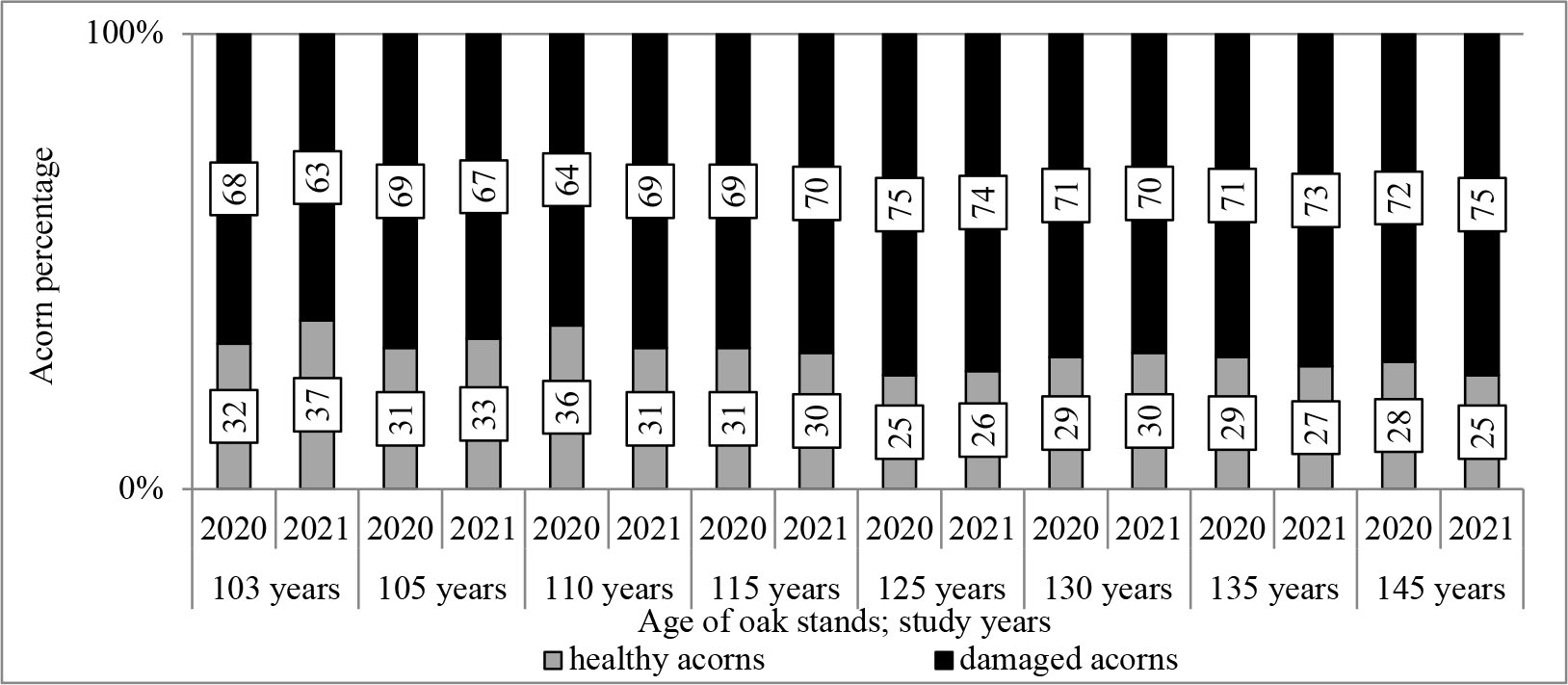
Figure 2.
Proportion of healthy and damaged acorns in oak stands in 2020 and 2021.
Table 6.
Weight (kg per hectare) of 1,000 acorns in oak stands by study years.
| Statistical value | Study year | |||
|---|---|---|---|---|
| 2020 | 2021 | |||
| Healthy acorns | Damaged acorns | Healthy acorns | Damaged acorns | |
| Stands aged 101–120 | ||||
| Minimum | 2.68 | 2.48 | 2.62 | 2.51 |
| Maximum | 2.98 | 2.77 | 2.87 | 2.77 |
| Average | 2.83 | 2.63 | 2.75 | 2.73 |
| Standard error | 0.13 | 0.13 | 0.11 | 0.13 |
| Coefficient of variation [%] | 5 | 5 | 4 | 5 |
| Stands aged 121–150 | ||||
| Minimum | 2.86 | 2.67 | 2.67 | 2.59 |
| Maximum | 2.98 | 2.87 | 2.87 | 2.80 |
| Average | 2.90 | 2.79 | 2.76 | 2.75 |
| Standard error | 0.05 | 0.09 | 0.11 | 0.10 |
| Coefficient of variation [%] | 2 | 3 | 4 | 4 |
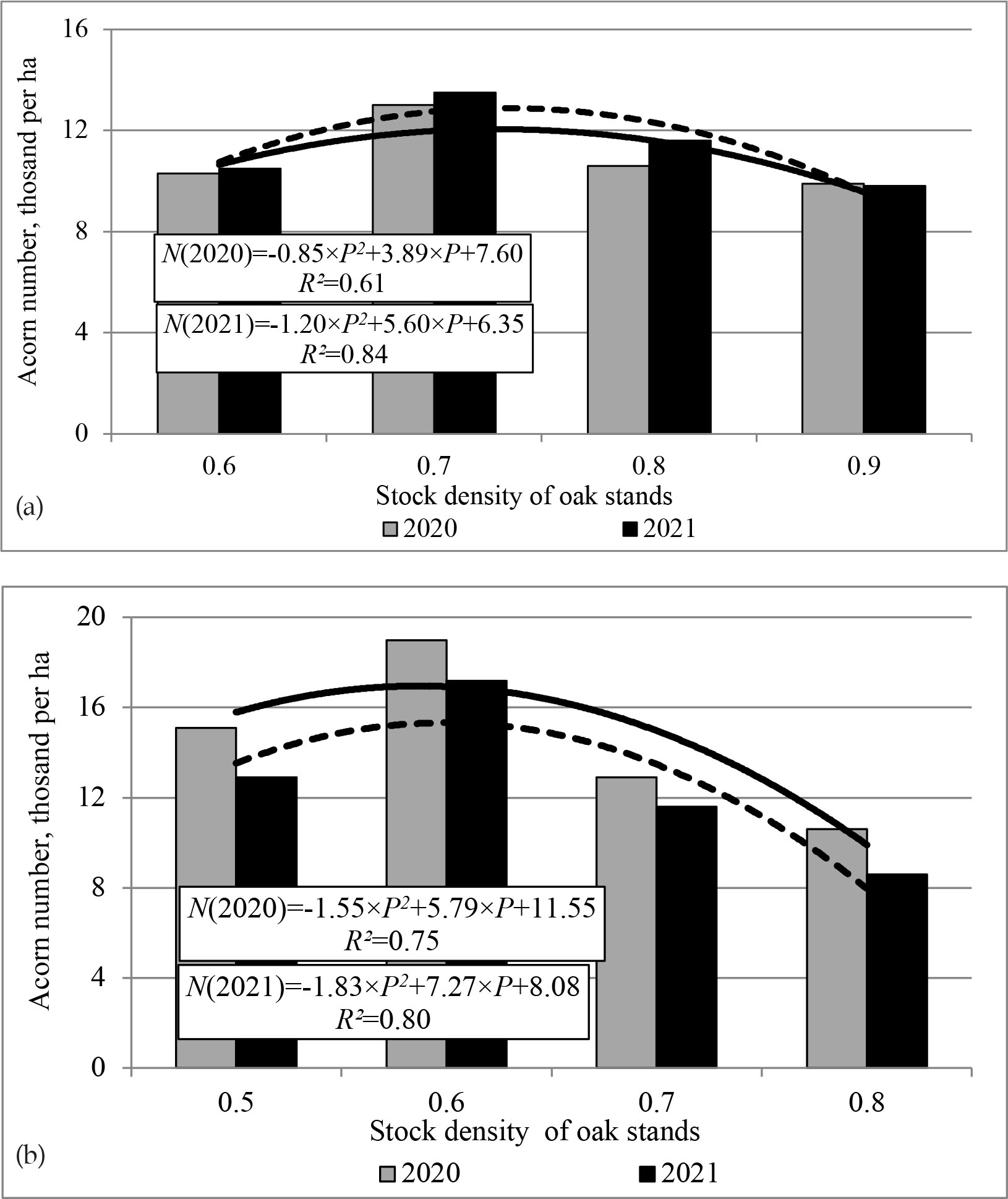
Figure 3.
Quantity of acorns in oak stands with different stock densities by study years: (a) – stands aged 101–120; (b) – stands aged 121–150 (N – number of acorns per hectare, P – stock density, solid line – 2020, dashed line – 2021).