
Introduction
The tropical and subtropical forest ecosystems are often referred to have high species diversity that provides a variety of benefits to the local communities which help to endure the maintenance and their livelihood. However, many of these forests are under excessive anthropogenic pressure and necessitate proper management activities to maintain overall biodiversity, productivity, and sustainability. Globally, concerns are raised over the rapid loss of biodiversity in all its forms and at all levels.
Invasive species are considered as the second major threat to the loss of species diversity worldwide (Vitousek et al., 1996). Invasive plant species have been introduced (intentionally/unintentionally) to the areas where they were not present before, but after establishment may perform better than resident native plants and may decrease in their abundance and dominance in the invaded habitats (Mack et al., 2000; D’Antonio & Meyerson, 2002). In recent years, extensive research has been performed on biological invasion, reflecting that the problem of alien species is increasing globally. The question of which mechanisms allow the invasive plants to flourish in a wide range of environments has been asked many times (Parker et al., 2003; van Kleunen et al., 2010). And it has been seen that in comparison to native species, the invasive plant species are phenotypically plastic which enhances their ecological niche breadth and thus confers a fitness advantage to dwell such an extensive range of environmental conditions (Kühn et al., 2004; Drenovsky et al., 2012; Oduor et al., 2016).
The study of floristic diversity acts as a baseline for the exploration, management, and conservation of the biodiversity of an area and also monitors changes with time (Stork & Samways, 1995). Consequently, the life form spectrum reflects the prevailing ecological conditions (Badshah et al., 2013) and thereby can be used as an indicator for understanding the ecological health of the area under study. The dominant life form shows how the plants of that region have evolved (Zarezade et al., 2007). Other than this, the climate of an area has been seen to regulate/affect the flowering periods of plant species, thus causing phenological shifts. These shifts are global and may act as an indicator of climate change. Thereby, climate change may be one of the highly significant determining factors for the distribution and composition of invasive plants. In this way, the study of invasive alien plant species may help to understand the shift in patterns of plant diversity and phenological shifts on the present study site.
The invasive plant species are seen to impact the forest biodiversity by influencing the richness and diversity of native species (Wilcove et al., 1998), soil nutrient availability, ecosystem productivity, ecosystem services, etc. (Dukes & Mooney, 2004; Reshi et al., 2008; Vilà et al., 2010; Huddle et al., 2011). They can also proliferate and create variations at the genetic level in the native species by hybridization (Vilà et al., 2000). In this way, the spread of invasive plant species is a matter of concern, as it poses serious intimidation to the structure and dynamics of natural ecosystems.
Morni Hills constitute the offshoots of the Shiwalik Hills range of the north-western Himalayas and one of the affluent reservoirs of plant diversity in Haryana. In the last few decades, the upsurge of tourism leading to development as well as anthropic disturbances have resulted in the introduction and spread of invasive alien plant species in these forests. Thus, the present study was carried out to understand the biological spectrum, phenology, and the pattern of species diversity of invasive alien plants growing in the forests of Morni Hills, Panchkula. This would be helpful to understand the ecology of these forests more righteously to conserve their integrity which is at risk due to the spread of invasive plant species.
Materials and Methods
Study site
Morni Hills lie in the Panchkula district of Haryana, India (Figure 1) and are a part of the lower Shiwalik range – the outer Himalayas with the highest peak elevation of 1220 m AMSL. They are composed of alluvial detritus obtained from subaerial mountain waste (Wadia, 1961) and harbor the tropical dry deciduous forests. The formation of the Shiwalik Hills occurred by the accretion of molasses depositions in the Himalayan foreland basin and late deformation via tectonic events (Lavé & Avouac, 2000; Kothyari et al., 2010; Jayangondaperumal et al., 2018). The rocks of the lower Shiwaliks are mainly composed of medium to fine-grained, hard sandstone interbedded with clay and mudstones (Krishnan, 2009). The climate of the area is the subtropical monsoon type, and a major portion of rainfall occurs from June to September (Figure 2).
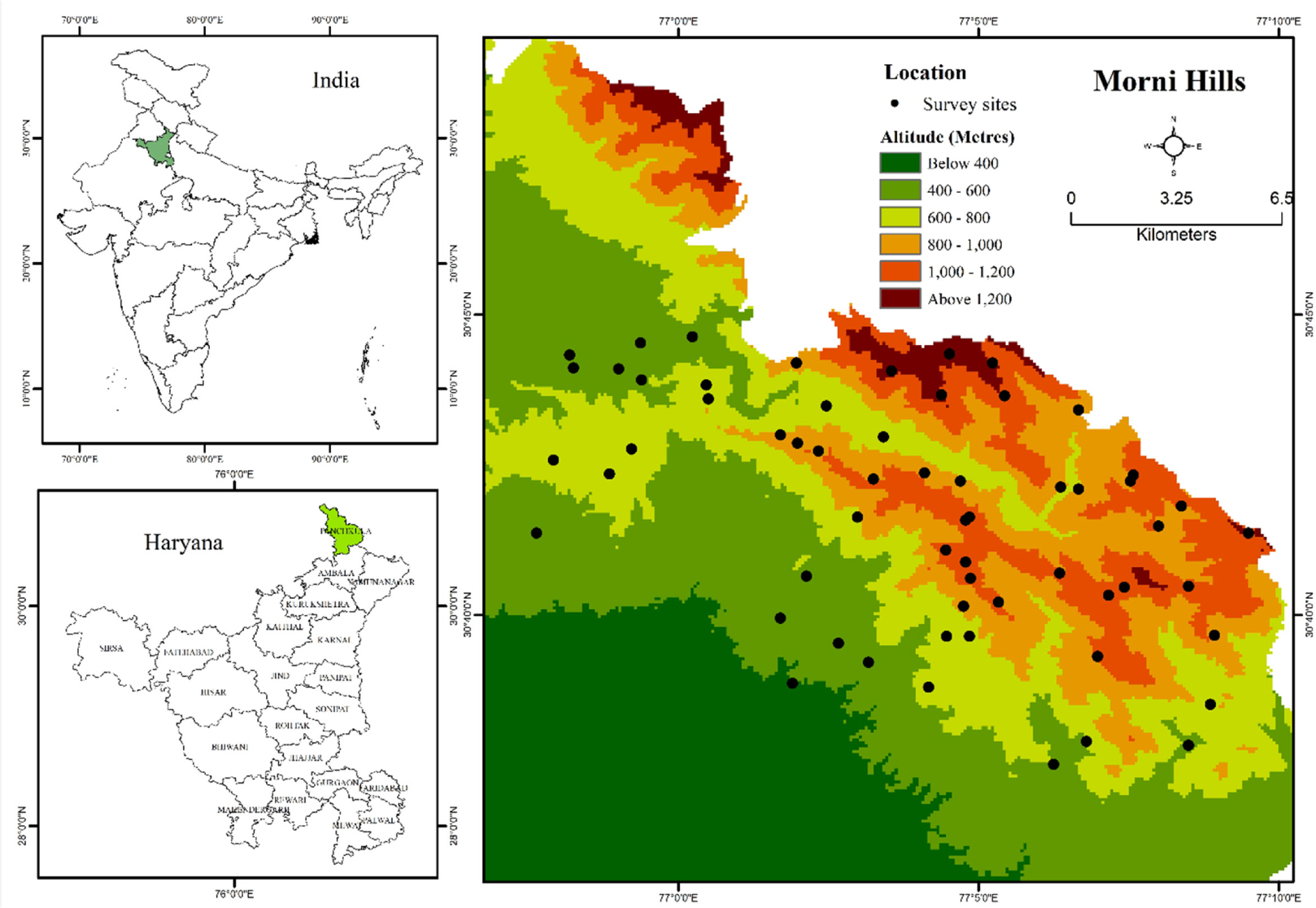
Figure 1.
Location of plots studied in the forests of Morni Hills, Haryana (India).
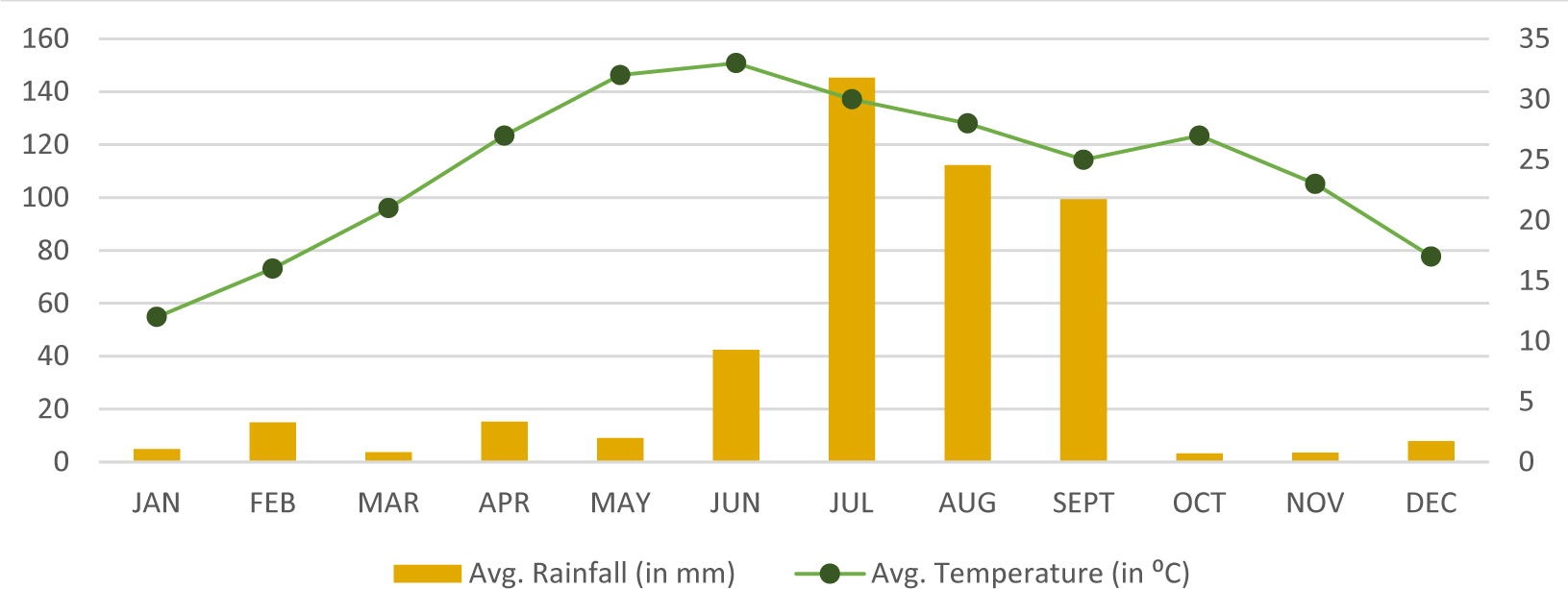
Figure 2.
Climograph showing the monthly average temperature and rainfall of Morni Hills, Panchkula (Source: www.worldweatheronline.com).
Sampling of data
Vegetation analysis was done by setting 15 plots with five quadrats (10 × 10 m) within each plot selected randomly in each of the 4 altitudinal ranges (Range 1 – 400 to 600 m, Range 2 – 600 to 800 m, Range 3 – 800 to 1000 m and Range 4 – >1000 m AMSL). Thus, a total of 60 plots with 300 quadrats were studied and the vegetational data was collected to analyze the frequency, density, and basal area (Misra, 1968). After that, relative values of the above parameters and the IVI value was calculated following Phillips (1959) and Curtis (1959), respectively. Other than this, diversity indices such as the Shannon-Wiener Diversity Index (Shannon & Wiener, 1963) and Simpson’s Index of dominance (Simpson, 1949) were also calculated for the four altitudinal ranges. During vegetation sampling, thorough observations were made on ecological traits like habit, flowering time, and life forms for all the species as per Raunkiaer (1934).
Results
A total of 31 invasive plant species (1 tree, 4 shrubs, 25 herbs, and 1 climber) belonging to 16 families have been recorded from the present study site (Table 1). The life form pattern distribution showed that 81% of the plant species were herbs, followed by 13% shrubs and 3% of trees and climbers both. As per the longevity of the plants, 64.5% of the plant species were annuals while 35.4% were perennials. Furthermore, the encountered plant species predominantly belonged to American origin; only a few plant species were of African and European origin. The floristic analysis revealed that the dominant life form was therophytes (22) followed by phanerophytes (5), hemicryptophytes (2), chamaephytes (1), and geophytes (1). The species distribution across 16 families was found to be disproportionate as half of the species belong to 5 families, whilst the remaining half were represented by 11 families with single species only (Figure 4). Asteraceae was found to be dominant among the invasive plant species on the present site, followed by Malvaceae, Convolvulaceae, Euphorbiaceae, and others. The study of invasive flora also showed a significant variation in flowering phenology as shown in Table 1. Of the total invasive flora encountered during the study, 8 plant species were found to flower throughout the year while others were blooming at different periods. A hierarchical cluster analysis was also performed on the flowering phenology of the invasive plants and a dendrogram was prepared using R Studio with the package ‘‘Complex Heatmap’’ as shown in Figure 5. During the phytosociological study, it was detected that some plant species were persistent in all the four altitudinal ranges, i.e., Ageratum conyzoides L., Lantana camara L., Oxalis corniculata L., and Parthenium hysterophorus L. Besides that, Leucanea leucocephala (Lam.) de Wit was the only tree species and Ipomoea quamoclit L. was the only climber species encountered during the study.
Table 1.
Summary of invasive alien plant species encountered during the study.
| S.N. | Name | Family | Habit | Nativity | Longevity | Flowering Phenology |
|---|---|---|---|---|---|---|
| 1 | Ageratum conyzoides L. | Asteraceae | Herb | Tropical America | Annual | Dec-May |
| 2 | Ageratum houstonianum Mill. | Asteraceae | Herb | Tropical America | Annual | May-Nov |
| 3 | Alternanthera pungens Kunth | Amaranthaceae | Herb | Tropical America | Perennial | Mar-Oct |
| 4 | Argemone mexicana L. | Papaveraceae | Herb | Tropical south America | Annual | Jan-Dec |
| 5 | Bidena pilosa L. | Asteraceae | Herb | Tropical America | Annual | Jan-Dec |
| 6 | Cardamine hirsuta L. | Asteraceae | Herb | Tropical America | Annual | Mar-Sept |
| 7 | Cassia occidentalis L. | Caesalpiniaceae | Shrub | Tropical south America | Annual | Jan-Dec |
| 8 | Calotropis procera (Ait.) R.Br. | Asclepiadaceae | Shrub | Tropical Africa | Perennial | Jan-Dec |
| 9 | Celosia argentea L. | Amaranthaceae | Herb | Tropical Africa | Annual | Sept-Jan |
| 10 | Chromolaena odorata (L.) R.M. King & H. Rob. | Asteraceae | Herb | Tropical America | Perennial | Dec-Mar |
| 11 | Cirsium arvense (L.) Scop. | Asteraceae | Herb | Europe | Annual | Mar-Aug |
| 12 | Croton bonplandianum Baill. | Euphorbiaceae | Herb | Temperate south America | Annual | Jan-Dec |
| 13 | Echinochloa colona (L.) Link. | Poaceae | Herb | Tropical south America | Annual | Jun-Sept |
| 14 | Emilia sonchifolia (L.) | Asteraceae | Herb | Tropical America | Annual | Jul-Oct |
| 15 | Euphorbia heterophylla L. | Euphorbiaceae | Herb | Tropical America | Annual | Sept-Mar |
| 16 | Indigofera linnifolia (L.f.) Retz. | Paplionaceae | Herb | Tropical Africa | Perennial | May-Oct |
| 17 | Ipomoea carnea Jacq. | Convolvulaceae | Shrub | Tropical America | Perennial | Jan-Dec |
| 18 | Ipomoea quamoclit L. | Convolvulaceae | Climber | Tropical America | Annual | Jun-Oct |
| 19 | Lantana camara L. | Verbenaceae | Herb | Tropical America | Perennial | Jan-Dec |
| 20 | Leonotis nepetifolia (L.) R. Br. | Lamiaceae | Herb | Tropical America | Annual | Sept-Nov |
| 21 | Leucaena leucocephala (Lam.) de Wit | Mimosaceae | Tree | Tropical America | Perennial | Apr-Jul |
| 22 | Malvastrum coromandelianum (L.) Garcke | Malvaceae | Herb | Tropical America | Annual | Oct-Apr |
| 23 | Martynia annua L. | Pedaliaceae | Herb | Tropical America | Annual | Jul-Oct |
| 24 | Oxalis corniculata L. | Oxalidaceae | Herb | Europe | Perennial | Feb-Oct |
| 25 | Parthenium hysterophorus L. | Asteraceae | Herb | Tropical north America | Annual | Oct-Mar |
| 26 | Peristrophe bicalyculata (Retz.) Nees | Acanthaceae | Herb | Tropical Africa | Perennial | Sept-Jan |
| 27 | Sida acuta Burm f. | Malvaceae | Herb | Tropical America | Perennial | Sept-May |
| 28 | Sonchus oleraceous L. | Asteraceae | Herb | Mediterranean | Annual | Mar-Nov |
| 29 | Tridax procumbens L. | Asteraceae | Herb | Tropical central America | Annual | Jan-Dec |
| 30 | Urena lobata L. | Malvaceae | Shrub | Tropical America | Perennial | Feb-Oct |
| 31 | Xanthium strumarium L. | Asteraceae | Herb | Tropical America | Annual | Aug-Sept |
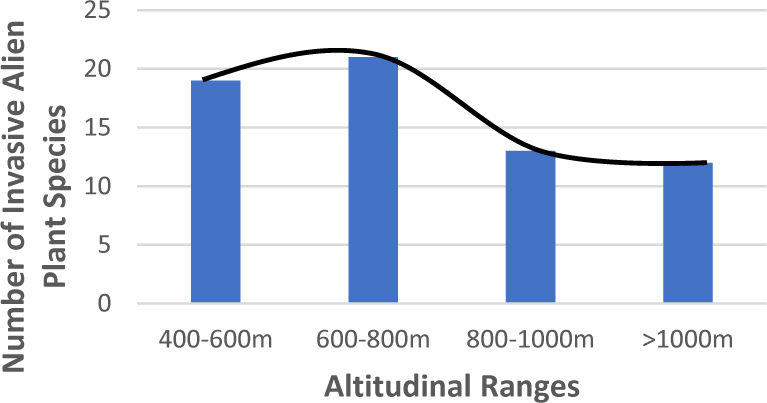
Figure 3.
Variation of invasive alien plant species along an altitudinal gradient in the forests of Morni Hills, Panchkula.
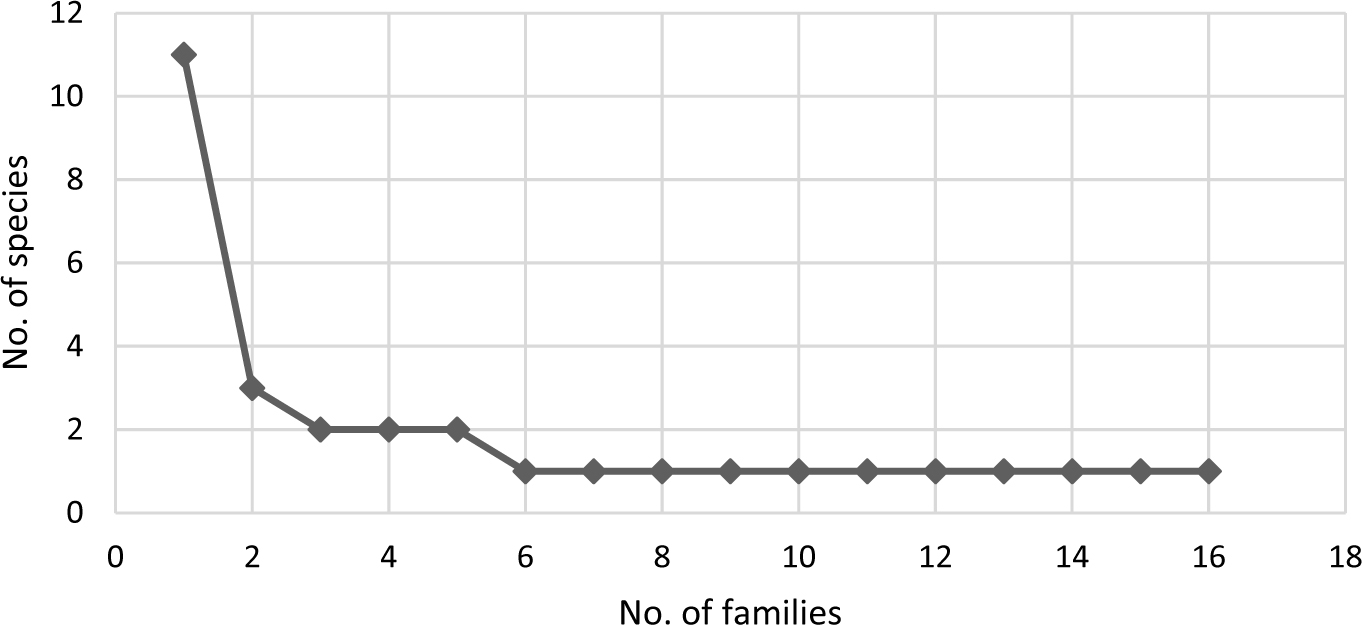
Figure 4.
Species–family relationship of Invasive alien flora encountered during the study.
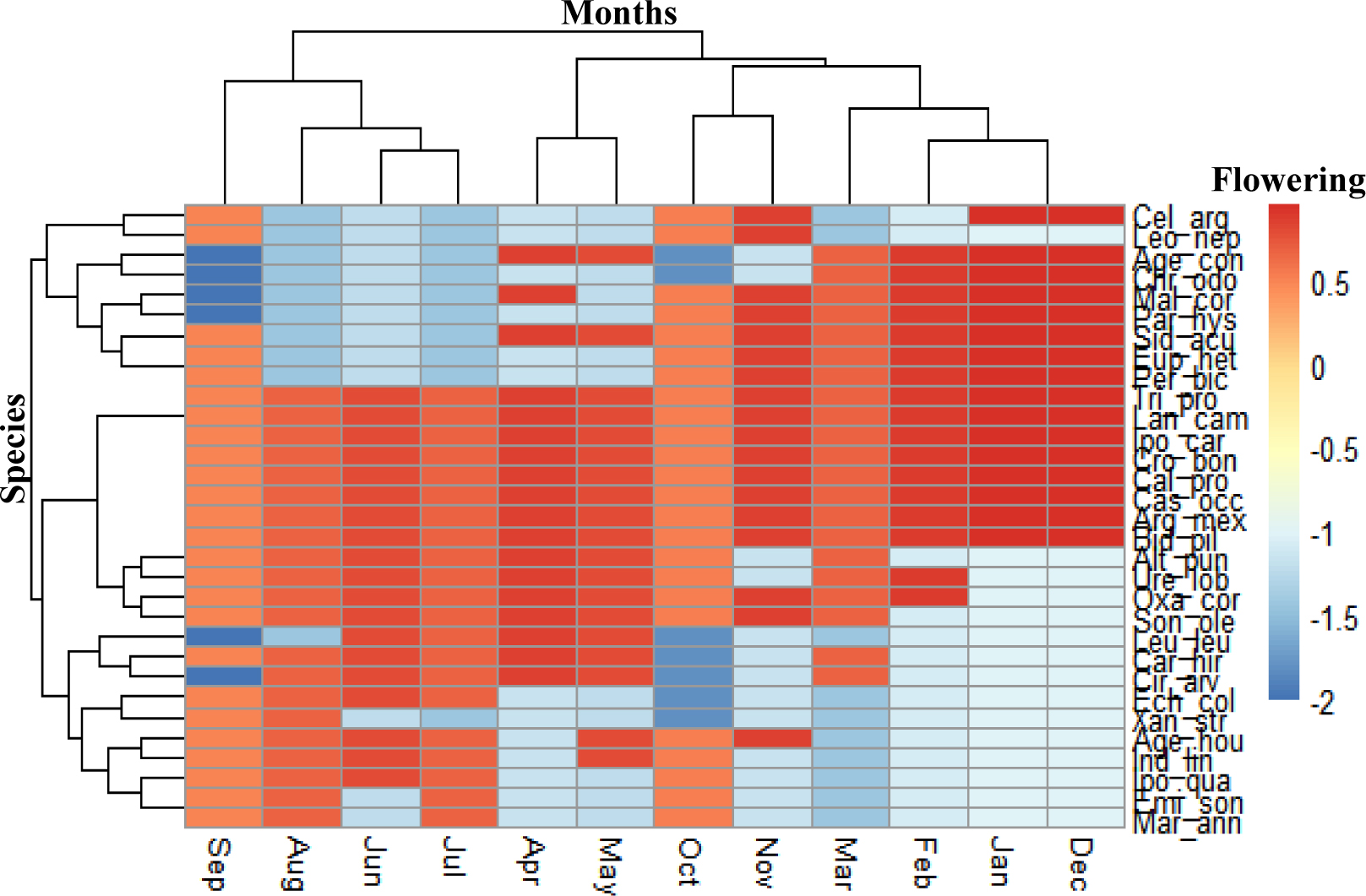
Figure 5.
Dendrogram showing the hierarchical clustering of flowering phenology of invasive alien plant species documented on the present study site.
Apart from this, the floristic composition of the invasive plant species was seen to be changing along with the altitude (Table 2–5). As the altitude increases in the four ranges, the diversity of the invasive plant species varied. The value of the Shannon-Wiener Diversity Index increased first from Range 1 to Range 2 and then it further decreased in the subsequent ranges i.e., Range 3 and Range 4 (H’ – 3.5331<3.6605>3.1186>2.9162). Other than this, species dominance calculated by Simpson’s Index first decreased from Range 1 to Range 2 and then increased for the upper altitudinal ranges i.e., Range 3 and Range 4 (Cd – 0.26108>0.2483<0.3275<0.4019).
Table 2.
Phytosociology of invasive plant species encountered from 400–600m AMSL (Range 1).
| S.N. | NAME | F | D | BA | IVI | H’ | Cd |
|---|---|---|---|---|---|---|---|
| 1 | Ageratum conyzoides L. | 33.3 | 32.32 | 0.00394 | 10.1166 | 0.15448 | 0.00115 |
| 2 | Argemone mexicana L. | 8.3 | 4 | 0.00046 | 2.07456 | 0.04168 | 0.00004 |
| 3 | Calotropis procera (Ait.) R.Br. | 16.6 | 12.32 | 0.04708 | 5.81129 | 0.10980 | 0.00045 |
| 4 | Celosia argentea L. | 8.3 | 2.64 | 0.00022 | 1.92299 | 0.03721 | 0.00004 |
| 5 | Croton bonpandlianum Baill. | 16.6 | 68.32 | 0.00355 | 10.6636 | 0.20085 | 0.00127 |
| 6 | Echinocloa colona (L.) Link. | 25 | 12.32 | 0.00019 | 6.24665 | 0.09767 | 0.00043 |
| 7 | Euphorbia heterophylla L. | 16.6 | 8.32 | 0.00113 | 4.18879 | 0.07271 | 0.00019 |
| 8 | Indigofera linnifolia (L.f.) Retz. | 16.6 | 39.32 | 0.00053 | 7.48600 | 0.14396 | 0.00062 |
| 9 | Ipomoea carnea Jacq. | 16.6 | 13 | 0.01592 | 5.07357 | 0.09351 | 0.00031 |
| 10 | Lantana camara L. | 83.3 | 102.64 | 2.51676 | 92.8332 | 0.66177 | 0.16358 |
| 11 | Lucaenea leucocephala (Lam.) de Wit | 33.3 | 3.32 | 0.53093 | 20.7231 | 0.31077 | 0.00796 |
| 12 | Martynia annua L. | 16.6 | 23.64 | 0.00513 | 5.92999 | 0.11234 | 0.00040 |
| 13 | Oxalis corniculata L. | 25 | 51.32 | 0.00046 | 10.4214 | 0.17827 | 0.00121 |
| 14 | Parthenium hysterophorus L. | 91.6 | 366.32 | 0.69915 | 75.3754 | 0.61101 | 0.07856 |
| 15 | Peristrophe bicalyculata (Retz.) Nees | 25 | 34 | 0.00392 | 8.66049 | 0.14647 | 0.00084 |
| 16 | Cassia occidentalis L. | 25 | 9 | 0.00415 | 5.99485 | 0.09214 | 0.00040 |
| 17 | Sida acuta L. | 16.6 | 105 | 0.00162 | 14.5332 | 0.26031 | 0.00236 |
| 18 | Urena lobata L. | 8.3 | 2.32 | 0.00044 | 1.89451 | 0.03636 | 0.00004 |
| 19 | Xanthium strumarium L. | 25 | 45.64 | 0.0095 | 10.0495 | 0.17178 | 0.00115 |
| Total | 507.6 | 935.76 | 3.84508 | 300 | 3.53318 | 0.26108 |
Table 3.
Phytosociology of invasive plant species encountered from 600–800m AMSL (Range 2).
| S.N. | NAME | F | D | BA | IVI | H’ | Cd |
|---|---|---|---|---|---|---|---|
| 1 | Ageratum conyzoides L. | 66.6 | 84.32 | 0.0103 | 17.4961 | 0.24433 | 0.00344 |
| 2 | Ageratum houstonianum Mill. | 58.3 | 76.32 | 0.00691 | 15.5278 | 0.22705 | 0.00270 |
| 3 | Alternanthera pungens Kunth | 16.6 | 5.32 | 0.00006 | 2.80783 | 0.05174 | 0.00008 |
| 4 | Bidena pilosa L. | 41.6 | 49 | 0.00533 | 10.5581 | 0.17147 | 0.00125 |
| 5 | Celosia argentea L. | 8.3 | 5.32 | 0.00028 | 1.66458 | 0.03779 | 0.00003 |
| 6 | Croton bonpandlianum Baill. | 16.6 | 10.64 | 0.00029 | 3.32528 | 0.06539 | 0.00012 |
| 7 | Euphorbia heterophylla L. | 16.6 | 12 | 0.00099 | 3.46679 | 0.06900 | 0.00013 |
| 8 | Ipomoea carnea Jacq. | 16.6 | 9.32 | 0.01143 | 3.35802 | 0.06623 | 0.00013 |
| 9 | Ipomoea quamoclit L. | 16.6 | 1.32 | 0.00008 | 2.42154 | 0.04096 | 0.00006 |
| 10 | Indigofera linnifolia (L.f.) Retz. | 25 | 5.64 | 0.00006 | 3.99897 | 0.06541 | 0.00017 |
| 11 | Leucaena leucocephala (Lam.) de Wit | 25 | 3.32 | 1.6503 | 27.5216 | 0.41079 | 0.01570 |
| 12 | Lantana camara L. | 100 | 189.64 | 4.8336 | 101.695 | 0.68362 | 0.19388 |
| 13 | Leonotis nepetifolia (L.) R. Br. | 50 | 23 | 0.3643 | 14.3711 | 0.22116 | 0.00314 |
| 14 | Malvastrum coromandelianum (L.) Garcke | 41.6 | 60 | 0.00261 | 11.5820 | 0.18894 | 0.0015 |
| 15 | Oxalis corniculata L. | 41.6 | 112.64 | 0.00084 | 16.6439 | 0.26548 | 0.00309 |
| 16 | Parthenium hysterophorus L. | 91.6 | 312 | 0.05954 | 43.6618 | 0.47971 | 0.02166 |
| 17 | Peristrophe bicalyculata | 16.6 | 6.64 | 0.00011 | 2.93612 | 0.05520 | 0.00009 |
| 18 | Sida acuta L. | 25 | 53 | 0.00075 | 8.58599 | 0.16250 | 0.00082 |
| 19 | Cassia occidentalis L. | 16.6 | 5.32 | 0.00076 | 2.81790 | 0.05201 | 0.00008 |
| 20 | Urena lobata L. | 16.6 | 7.64 | 0.00038 | 3.03665 | 0.05788 | 0.00010 |
| 21 | Xanthium strumarium L. | 16.6 | 2.32 | 0.00036 | 2.52221 | 0.04383 | 0.00007 |
| Total | 724 | 1034.72 | 6.94928 | 300 | 3.66058 | 0.24832 |
Table 4.
Phytosociology of invasive plant species encountered from 800–1000m AMSL (Range 3).
| S.N. | NAME | F | D | BA | IVI | H’ | Cd |
|---|---|---|---|---|---|---|---|
| 1 | Ageratum conyzoides L. | 16 | 13 | 0.00078 | 6.09844 | 0.10686 | 0.00041 |
| 2 | Ageratum houstonianum Mill. | 16 | 51.64 | 0.00145 | 12.3487 | 0.22044 | 0.00171 |
| 3 | Bidena pilosa L. | 16 | 10.64 | 0.00072 | 5.71551 | 0.09853 | 0.00036 |
| 4 | Boehmeria macrophylla (Thunb.) Hornem. | 16 | 2.32 | 0.21657 | 15.2191 | 0.26305 | 0.00442 |
| 5 | Chromolaena odorata (L.) R.M. King & H. Rob. | 16 | 89.32 | 0.00678 | 18.6790 | 0.30901 | 0.00396 |
| 6 | Cirsium arvense (L.) Scop. | 25 | 15 | 0.00093 | 8.65901 | 0.13139 | 0.00084 |
| 7 | Ipomoea carnea Jacq. | 16 | 16 | 0.04195 | 8.64880 | 0.15758 | 0.00103 |
| 8 | Lantana camara L. | 83 | 73.64 | 1.70715 | 118.181 | 0.67004 | 0.26830 |
| 9 | Malvastrum coromandelianum (L.) Garcke | 33 | 20.32 | 0.00103 | 11.5036 | 0.16115 | 0.00148 |
| 10 | Oxalis corniculata L. | 75 | 240.32 | 0.00528 | 57.5282 | 0.53101 | 0.03706 |
| 11 | Parthenium hysterophorus L. | 83 | 82.32 | 0.00806 | 34.2300 | 0.34643 | 0.01321 |
| 12 | Sonchus oleraceous L. | 8.3 | 7 | 0.00008 | 3.18831 | 0.06541 | 0.00011 |
| 13 | Urena lobata L. | 16 | 4.54 | 0.0006 | 4.57218 | 0.07431 | 0.00023 |
| Total | 419.3 | 626.06 | 1.9914 | 300 | 3.11860 | 0.32753 |
Table 5.
Phytosociology of invasive plant species encountered at >1000m AMSL (Range 4).
| S.N. | NAME | F | D | BA | IVI | H’ | Cd |
|---|---|---|---|---|---|---|---|
| 1 | Ageratum conyzoides L. | 41 | 11.64 | 0.00107 | 10.33411 | 0.15129 | 0.001193 |
| 2 | Ageratum houstonianum Mill. | 50 | 22.32 | 0.00066 | 14.76674 | 0.20840 | 0.002433 |
| 3 | Bidena pilosa L. | 50 | 34 | 0.00335 | 17.95162 | 0.25468 | 0.003606 |
| 4 | Cardamine hirsuta L. | 16 | 7.64 | 0.00018 | 4.858068 | 0.09495 | 0.000263 |
| 5 | Chromolaena odorata (L.) R.M. King & H. Rob. | 50 | 84.32 | 0.01354 | 31.64427 | 0.40873 | 0.01126 |
| 6 | Cirsium arvense (L.) Scop. | 25 | 5.32 | 0.00081 | 5.828146 | 0.09551 | 0.00038 |
| 7 | Lantana camara L. | 91 | 86.64 | 4.87483 | 138.601 | 0.67241 | 0.367264 |
| 8 | Malvastrum coromandelianum (L.) Garcke | 58 | 23 | 0.00079 | 16.35513 | 0.21853 | 0.002985 |
| 9 | Oxalis corniculata L. | 66 | 22 | 0.00262 | 17.52797 | 0.22224 | 0.003435 |
| 10 | Parthenium hysterophorus L. | 66 | 49.64 | 0.00409 | 24.96496 | 0.31784 | 0.00697 |
| 11 | Sonchus oleraceous L. | 41 | 23.32 | 0.00062 | 13.45496 | 0.20403 | 0.00202 |
| 12 | Urena lobata L. | 16 | 3.32 | 0.0008 | 3.713032 | 0.06762 | 0.000154 |
| Total | 570 | 373.16 | 4.90336 | 300 | 2.91626 | 0.401966 |
The value of IVI was found to be maximum for Lantana camara L. (Range 1 – 92.8332, Range 2 – 101.6952, Range 3 – 116.6604, and Range 4 – 138.601) in all the four altitudinal ranges, followed by Parthenium hysterophorus L. in Range 1 (75.3754) and Range 2 (43.6618), Oxalis corniculata L. in Range 3 (55.5314) and Chromolaena odorata (L.) R.M. King & H. Rob. in Range 4. After the phytosociological analysis, the Pearson Correlation was calculated for the selected parameters and a heatmap was prepared using R studio (Figure 6).
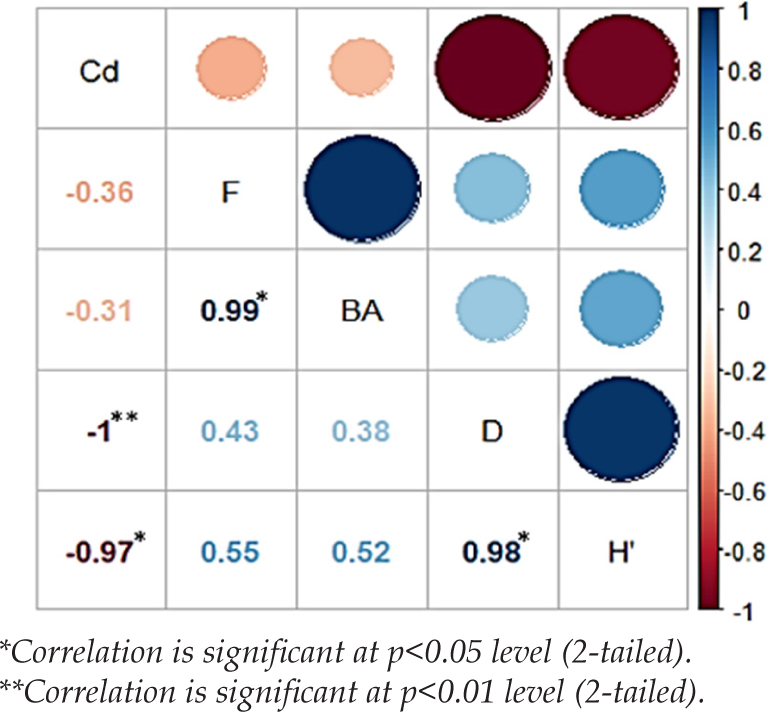
Figure 6.
Heatmap showing the Pearson Correlation of the various ecological parameters taken under study.
Discussion
The world’s flora and fauna are getting homogenized due to the global extent and rapid spread of invasive species (Mooney & Hobbs, 2000). Species invasion or bio-invasion is also regarded as a form of biological pollution and has a conspicuous role in global change; and is also thought to be one of the serious causes of species extinction (Mooney & Drake, 1986; Drake et al., 1989). Due to their remarkable competitive ability and aggressiveness, the invasive species when once enter into a new habitat can modify the whole floristic composition of that area. It has been seen that the more frequently an alien plant species is observed in a natural habitat the more competitive or notorious it is and causes a higher threat to the native elements of that region. The invasive plant species have been seen to show the ecosystem-level effect as they colonize the area, modify plant community structure and composition, nutrient cycles, and invertebrate populations (Vitousek, 1990; Walker & Vitousek, 1991).
The present study site was found to be inhabited by a total of 31 invasive alien plant species. The therophytes were found to be the dominant life form followed by others. It indicates the presence of anthropic disturbances as this life form is seen to be accompanied by dry and unfavorable environmental conditions and is a type of strategy adopted for survival (Manhas et al., 2009). Therophytes have also been reported to dominate in the Himalayas by Singh et al. (2018). The distribution of invasive alien plant species was also found to vary within their families, with Asteraceae being the most dominant one. Some other studies on floristic composition and diversity have also described Asteraceae as a dominant family (Kosaka et al., 2010; Reshi et al., 2017). The plant species belonging to the family Asteraceae can tolerate the anthropic disturbance regimes, hence potentially dominate the perturbed ecosystems.
A considerable variation was seen in the pattern of flowering phenology of invasive flora under study. They were found to bloom in different seasons. This can be attributed to variation in temperature with changing seasons. With the high peaks during hierarchical clustering, the maximum number of species were seen to be flowering during September and October followed by June and July. Minimum flowering was observed during December and January. This can be compared with the results of Malik & Malik (2014) who reported two spells of flowering during their study in the forests of Bagh district. The plants with similar flowering periods are in proximity and are clustered in one limb (Figure 5).
Moreover, the phytosociological analysis revealed that the floristic composition and diversity of invasive plant species changes along with the change in altitude on the present study site. It was found to be increasing from Range 1 to Range 2 and then it further decreased in the subsequent ranges i.e., Range 3 and Range 4 with the increase in altitude. There are two different types of patterns that are commonly observed for species diversity along with the increase in altitude. These are a monotonically decreasing curve along with an increase in altitude and a hump-shaped curve showing maximum diversity at intermediate altitudes (Rahbek, 1995; Rahbek, 2005). The present study does not show the general trend of linear decrease in diversity along with an increase in altitude, such as reported by Kosaka et al. (2010) during their study of invasive plant species in the Arunachal Himalayas. However, a hump-shaped pattern is observed during the study (Figure 3), as the species richness first increased and then decreased with an increase in altitude as reported by Ahmad et al. (2018). According to Rahbek (1997) and Kessler (2000), productivity may sometimes peak at intermediate altitudes. The higher elevations are also stressful for plant establishment, and this is mainly caused by physical factors such as low air temperature and partial pressure of CO2 as well as high UV radiation, inclusive of low nutrient availability and thin soils (Körner, 2007).
The invasive plants like Ageratum conyzoides L., Chromolaena odorata (L.) R.M. King & H. Rob., Lantana camara L., and Parthenium hysterophorus L. were seen to be having high IVI values and thus said to be influencing the given forest ecosystem more effectively. These plant species are also reported to be notoriously present in Indian forest ecosystems by Dogra et al. (2010) and Kohli et al. (2012). Ageratum conyzoides L. causes a decrease in the carrying capacity of grasslands, reduction of floral diversity, and may result in the loss of many threatened and endemic species (Kohli et al., 2004; Kohli et al., 2006). It is also seen to adversely affect the growth as well as yield of the main staple annual and perennial crops of our country (Kohli et al., 2006; Batish et al., 2009a, 2009b).
Parthenium hysterophorous L. is the most invading species of the Indian subcontinent, estimated to infest an area of around 5 million acres. It also replaces the native vegetation, causes a variety of health problems in both humans as well as animals, and is thus considered as the most noxious weed (Kohli et al., 2006). Similarly, Lantana camara L. has also been reported to invade the Himalayan foothill forests. It is reported to cover a large area of forest land, where it nearly replaces the native forest vegetation and also reduces the growth of trees (Kohli et al., 2006; Negi et al., 2013).
From the Pearson Correlation of the studied parameters (Figure 6) it can be depicted that frequency and density positively correlated with each other as well as with the basal area and Shannon-Wiener Index while negatively correlated with Simpson’s Index. Other than this, the Shannon-Wiener Index was positively correlated with frequency, density, and basal area but negatively correlated with Simpson’s Index. Whilst Simpson’s Index was seen to be positively correlated with frequency, density, and basal area but correlated negatively with the Shannon-Wiener Index.
Conclusions
Invasive species affect human wellbeing directly as well as indirectly by threatening biodiversity and ecosystem processes. Subsequently, they suppress native biodiversity, alter wildlife habitats, and can also cause local extinctions. Thus, we need a single policy framework to inventory and document invasive species, and not just list them, but understand their ecology and economic impacts.
The present study reveals that invasive plants have influenced the floristic composition of Range 2 followed by Range 1 in the forests of Morni Hills due to their high diversity in comparison to upper altitudinal ranges (Range 3 and 4). Also, the assessment of flowering phenology will help comprehend the effects of climate change on the flowering of species in the outer Himalayas. The study also suggests the presence of acute anthropogenic pressure on the present study site due to therophytes being the dominant life form. Thus, it can help policymakers in ecosystem management by providing insights into the diversity and ecological characteristics of the invasive alien plant species.
Acknowledgements.
The authors acknowledge the Forest Department of Morni Hills, Panchkula for the cooperation during the field visits for research work. The authors are also thankful to the Council of Scientific and Industrial Research (CSIR) and University Grants Commission (UGC), New Delhi for providing fellowship to Himanshi Dhiman and Harikesh Saharan.