
Table 1
The relation between breast height and age of oaks.
| No | Diameter at breast height of oaks | Age of trees in years | |
|---|---|---|---|
| Russian feet (0.3048 m) | cm | ||
| 1 | 6 1/2 | 198 | 100 |
| 2 | 10 5/6 | 330 | 200 |
| 3 | 15 1/4 | 465 | 300 |
| 4 | 18 1/8 | 552 | 400 |
| 5 | 21 | 640 | 500 |
| 6 | 22 1/2 | 686 | 600 |
| 7 | 24 | 732 | 700 |
| 8 | 27 | 823 | 900 |
| 9 | 28 1/2 | 869 | 1000 |
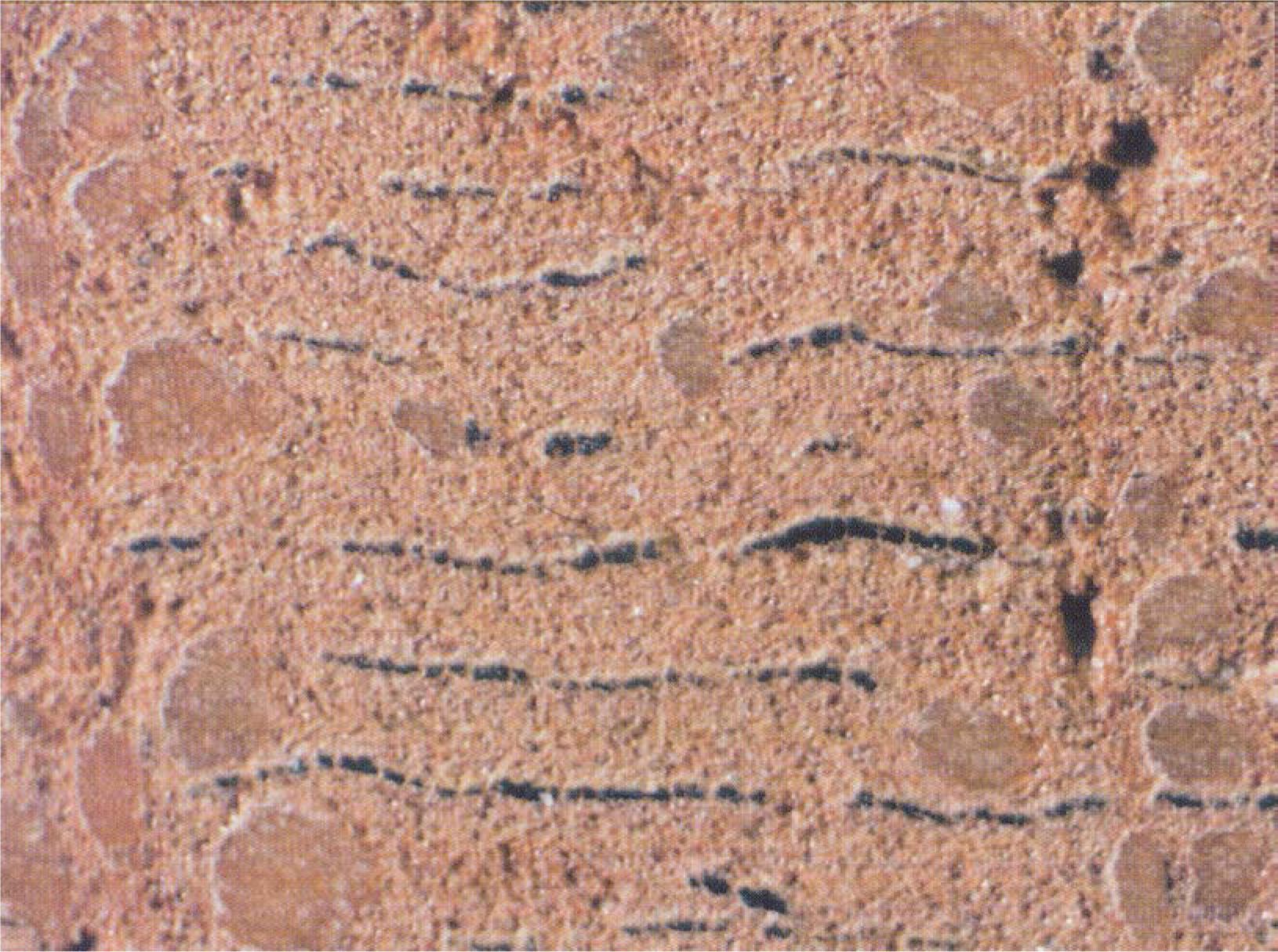
Figure 1
A sandpapered disc of lime outer bark (magnification approximately 15 times). The horizontal discontinuous rows mark the annual increments of the outer bark. Radial channels run through the discontinuation points. The radial channels are almost parallel near the bottom of the outer bark but converge at the top. The point of convergence of the radial channels marks the beginning of the outer bark growth. If the crest (top) of the outer bark is missing, the radial channels do not converge on the image plane (Rohtla, 1998).
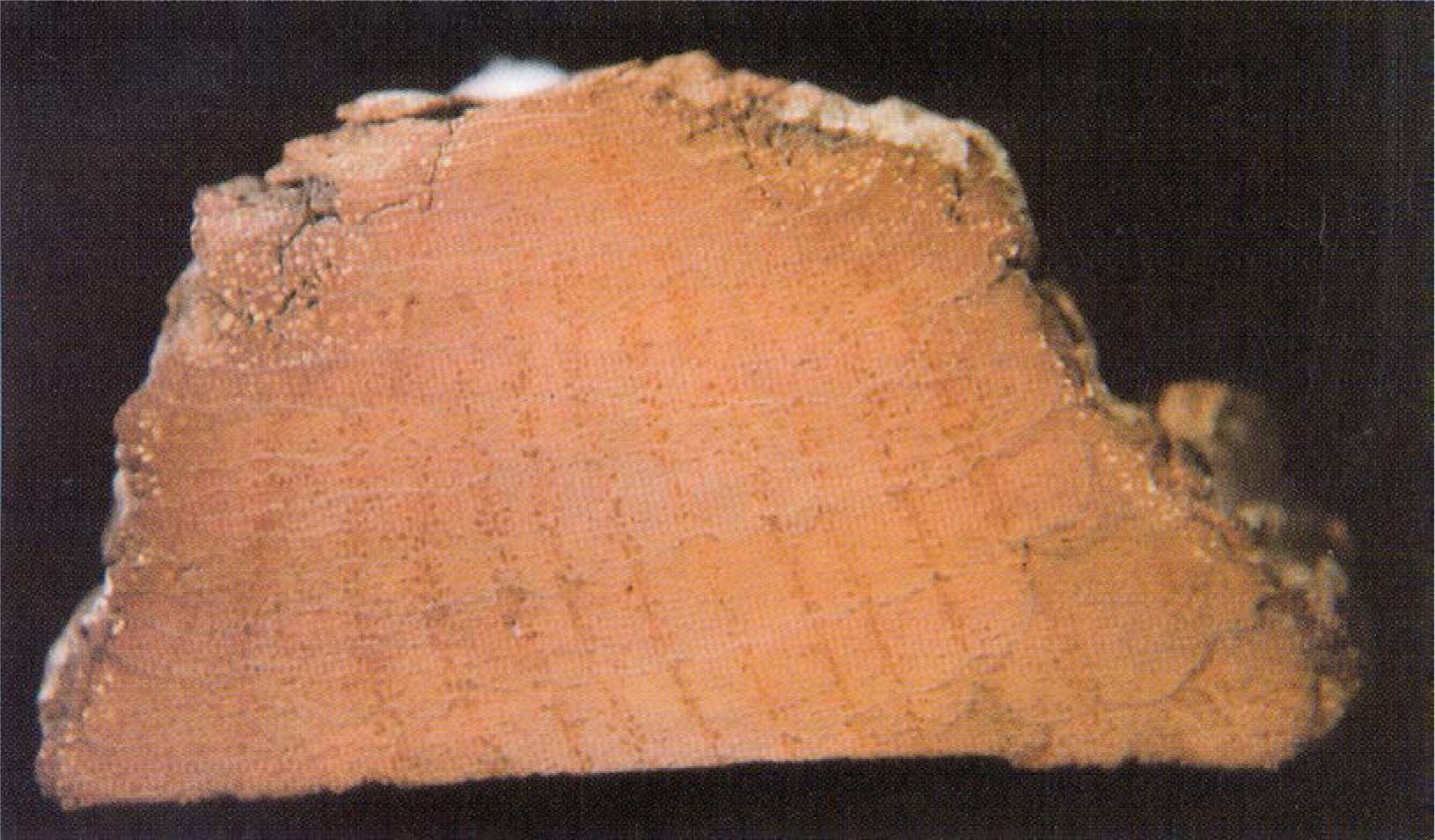
Figure 2
An approximately two-fold magnified image of a sandpapered disc of the outer bark of an oak (Rohtla, 1998).
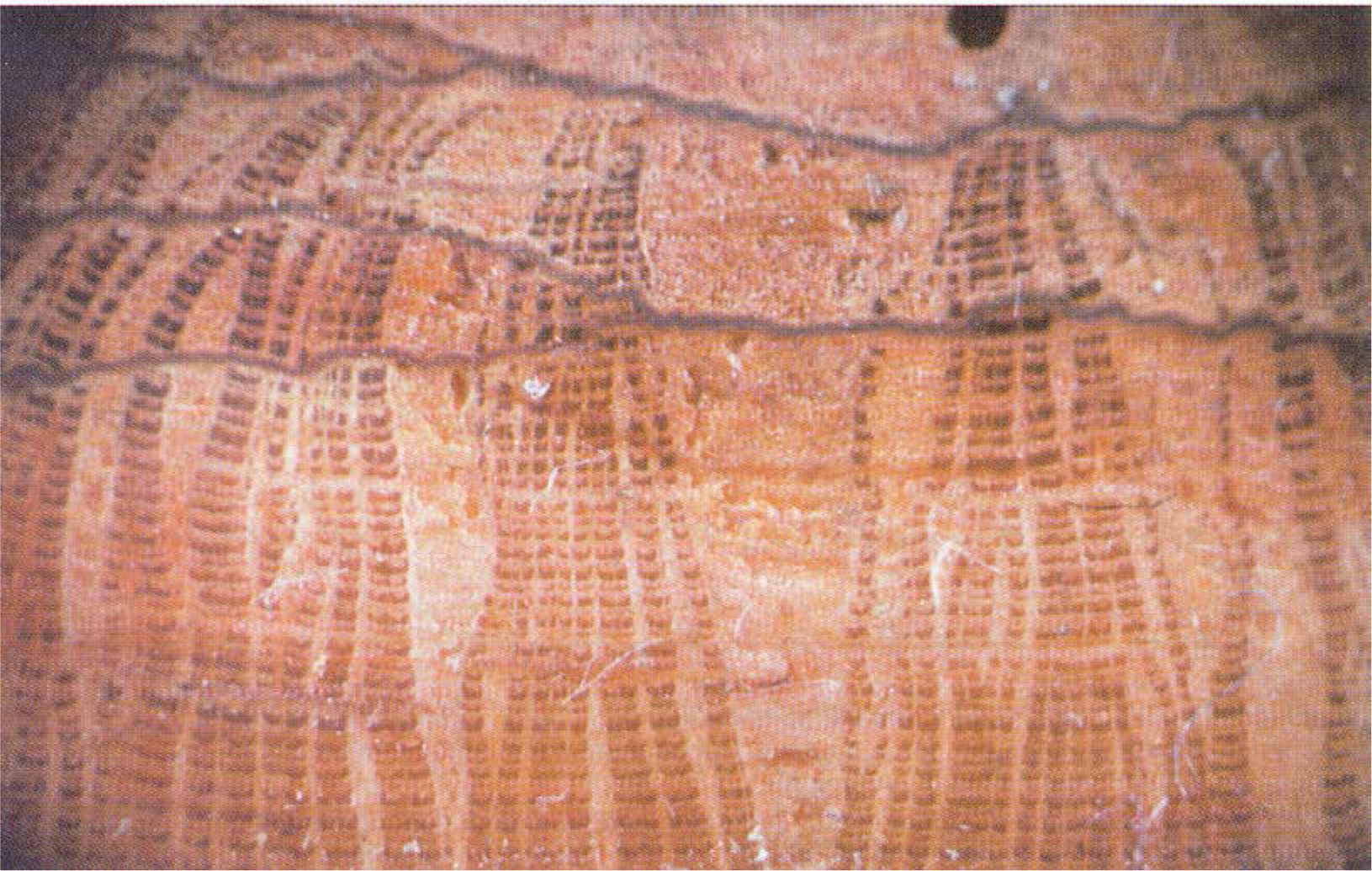
Figure 3
An image of a sandpapered disc of the outer bark of an oak, magnified 30–35 times (Rohtla, 1998).
Table 2
22 oaks from Tallinn in 1999 the ages of which were determined graphically with a dendro-chronological method; in 17 cases, tree age was determined according to bark (Läänelaid et al., 2001; Sander et al., 2008, updated). Oaks no. 3 and 12 had eccentric stems. Nos. 1–10 were situated in Kadriorg Park, 11–17 in the city centre and 18–21 on Kopli Peninsula.
| Sample No., direction and height in trunk, m | Trunk circumference at 1.3 m, mm | Bark thickness, mm | Trunk radius without bark, mm | Length of raw wood core, mm | % of radius without bark | Number of tree rings in the core | Average annual increment, mm | Age graphically/based on average, years | Age determined using the outer bark method |
|---|---|---|---|---|---|---|---|---|---|
| 1 W, 1.3 | 5200 | 74 | 754 | 324 | 43 | 198 | 1801–1999, 1.6 | 370/471 | 290 |
| 2 W, 1.3 | 3530 | 63 | 499 | 348 | 69.7 | 195 | 1804–1999, 1.8 | 270/277 | - |
| 3 W, 1.3; eccentric trunk | 2140 | 41 | 300 | 316 | 105 | 244 | 1755–1999, 1.3 | 250 | 270–290/280 |
| 4 W, 1.3 | 3390 | 54 | 486 | 353 | 72.6 | 196 | 1803–1999, 1.8 | 260/270 | 310–320/315 |
| 5 W, 1.3 | 3880 | 62 | 556 | 352 | 63.3 | 231 | 1768–1999, 1.5 | 340/371 | 280–290/285 |
| 6 E, 1.0 | 3830 | 60 | 550 | 341 | 62 | 238 | 1761–1999, 1.4 | 350/393 | - |
| 7 NE, 1.0 | 3520 | 60 | 501 | 360 | 71.9 | 264 | 1735–1999, 1.4 | 330/358 | 310–330/320 |
| 8 ?, 6.5; trunk fallen | 2700 | 63 | 367 | 366 | 99.7 | 292 | 1707–1999, 1.25 (1.3) | 294/294 | 270–290/280 |
| 9 ?, 1.0 | 2720 | 63 | 370 | 197 | 53.2 | 218 | 1781–1999, 0.9 | 303/411 | - |
| 10 SW, 1.15 | 5050 | 60 | 744 | 348 | 46.8 | 153 | 1846–1999, 2.3 | 310/323 | 260–280/270 |
| 11 SW, 1.0 | 3840 | 60 | 551 | 346 | 62.3 | 198 | 1801–1999, 1.7 | 304/324 | 270–290/280 |
| 12 S, 1.2; eccentric trunk | 2500 | 26 | 372 | 381 | 102.4 | 146 | 1853–1999, 2.6 | 146 | 140–150/145 |
| 13 S, 1.13 | 1980 | 38 | 277 | 267 | 96.4 | 148 | 1851–1999, 1.8 | 151/154 | - |
| 14 E, 1.2 | 4740 | 65 | 690 | 335 | 48.6 | 108 | 1891–1999, 3.1 | 250/223 | 190–220/205 |
| 15 S, 1.2 | 2630 | 20 | 399 | 339 | 85 | 127 | 1872–1999, 2.7 | 155/148 | 137 |
| 16 N, 1.25 | 2680 | 40 | 387 | 359 | 92.8 | 180 | 1819–1999, 2.0 | 193/194 | - |
| 17 W, 1.2 | 2700 | 35 | 395 | 345 | 87.3 | 168 | 1831–1999, 2.1 | 193/188 | 230–250/240 |
| 18 NW, 1.2 | 2070 | 25 | 305 | 274 | 89.8 | 143 | 1856–1999, 1.9 | 152/161 | 146 |
| 19 S, 1.06 | 5070 | 62 | 745 | 371 | 49.8 | 180 | 1819–1999, 2.1 | 322/355 | 210–230/220 |
| 20 S, 1.36 | 4740 | 50 | 705 | 367 | 52.1 | 184 | 1815–1999, 2.0 | 330/353 | 250–280/265 |
| 21 SE, 1.25 | 4050 | 53 | 592 | 286 | 48.3 | 172 | 1827–1999, 1.7 | 337/348 | 270–300/285 |
| 22 S, 1.4 | 4100 | 40 | 613 | 378 | 61.7 | 221 | 1778–1999, 1.7 | 320/361 | 365 |