
Introduction
Financial anxiety is defined as a specific form of generalized anxiety focused on sustained and persistent worry about one’s financial situation (Archuleta et al. 2013). Many Americans report experiencing financial anxiety, with about 62% indicating they were anxious about their bills or expenses (American Psychiatric Association 2026). Financial planning clients are not exempt from experiencing financial anxiety (Anderson et al. 2022). One might hypothesize that financial planning clients would have lower levels of financial anxiety since they tend to have higher net wealth than the general population and their financial planner can provide reassurance that they are financially solvent (Hanna & Lindamood 2010). Yet, Anderson et al. (2022) found that clients of financial planners reported levels of financial anxiety similar to those in the general population. In the same study, they found that financial planners frequently underestimated the extent of financial anxiety their clients experienced (Anderson et al. 2022).
Understanding financial anxiety is particularly relevant within financial planning relationships as financial decisions are often made under conditions of uncertainty or emotional vulnerability. Prior research suggests that emotions influence information processing, decision-making, and risk perception (Lerner et al. 2015; Loewenstein et al. 2001). Research has also found that respondents with anxiety about their finances tend to avoid dealing with situations as a defense mechanism (Porges 2011; Shapiro & Burchell 2012). Taken together, these findings suggest that financial anxiety may influence how clients engage with financial planning and financial planners. For these reasons, recognizing financial anxiety in clients may be an important first step for financial planners.
The level of financial anxiety may be associated with the client’s ability to trust their financial planner’s recommendation and to fully commit to their financial planner. For example, financial anxiety may make it more difficult for clients to implement financial management behaviors or seek financial help and may also be associated with lower generalized trust (Gerrans & Hershey 2017; Grable et al. 2020; Rollins-Koons et al. 2024). When humans’ physiological arousal is stimulated by a potential threat (in this case, fears about their financial future), their systems become flooded with stress hormones (e.g., adrenaline and cortisol), which prevents the ability to use higher-level coping skills to think logically or to take action (Pittman & Karle 2015). Since anxiety creates a state of physiological arousal, which is a natural involuntary hormone reaction to stress stimuli, financial anxiety may inhibit a person’s ability to act.
This study was motivated by McCoy and colleagues’ (2022) conclusions about the antecedents of trust and commitment in the client-planner relationship. Specifically, trust and commitment are theorized to be preceded by the following antecedents: (1) communication abilities, (2) an absence of opportunistic behavior, (3) perceived relationship benefits, (4) the costs of terminating the relationship, and (5) shared values. Given the influence of emotions on information processing, decision-making, and behavioral responses, financial anxiety may represent an additional antecedent of trust and commitment within the client-planner relationship. This study extends the model developed by McCoy et al. (2022) in two ways. First, it adds financial anxiety to a model that previously included only the client’s perceptions of the planner and relationship, and it examines whether anxiety is significant even after accounting for established factors. Second, whereas McCoy et al. (2022) linked relationship benefits solely to commitment as an outcome, this study finds that relationship benefits are associated with both trust and commitment. Together, these extensions broaden the application of the trust and commitment framework by incorporating financial anxiety as an additional client-level antecedent.
Theoretically Informed Literature Review
Trust and commitment are important drivers of outcomes derived from financial planning relationships. According to Cull and Sloan (2016), trust in a financial planning context is the trustor’s (client’s) expectation that the trustee (planner) will be reliable, honest, and competent. The client relies on the practitioner’s advice to achieve an outcome, and trust is required for the client to act on this advice (Alyousif & Kalenkoski 2017; Calcagno & Monticone 2015; Hunt et al. 2011). Clients may feel strong emotions regarding issues addressed in the financial plan. It often requires a high level of trust, similar to that developed with a therapist, to discuss these topics (Pullen & Rizkalla 2003). Trust is key to quality interactions between client and planner and is demonstrated by the reliance required of each other, the vulnerability involved, and the positive expectations established (Hartnett 2010; Sharpe et al. 2007). The broader trust literature suggests that trust reflects more than confidence in another party’s technical competence. Mayer et al. (1995) conceptualized trust as a willingness to be vulnerable to another party based on perceptions of their ability, benevolence, and integrity. Similarly, Rousseau et al. (1998) described trust as a psychological state involving the acceptance of vulnerability under conditions of uncertainty. These conceptualizations are particularly relevant in financial planning, where clients must often disclose sensitive personal information and rely on professional recommendations involving uncertain future outcomes. As such, financial planning relationships represent a context in which trust is both relational and inherently risk based.
Commitment reflects a client’s desire to maintain the professional relationship over time. Client commitment is important because the cost of onboarding a new client is higher than that of maintaining existing clients (McCoy et al. 2022). Cheng et al. (2017) found that client commitment is positively related to client trust, among other aspects such as overall satisfaction, meeting frequency, education-related communication, and the use of personal notes and greeting cards, and negatively related to small talk about hobbies. Trust and commitment act together to contribute to the stability of the client-planner relationship.
The Theory of Trust and Commitment
The theory of trust and commitment (Morgan & Hunt 1994) explains that two key antecedents to building trust are the professional’s communication abilities and an absence of opportunistic behavior, and the two key antecedents of commitment are the cost of terminating the relationship and the perceived relationship benefits the client believes they will receive. Shared values contribute to both trust and commitment, while trust itself fosters commitment (Rather 2019). These antecedents provide the theoretical foundation for the hypotheses examined in this study (Morgan & Hunt 1994; Hashim & Tan 2015; McCoy et al. 2022). Antecedent is Morgan and Hunt’s (1994) term for a factor their theory treats as coming before trust and commitment. The temporal and directional ordering describes what the theory proposes, not what the cross-sectional nature of our data establishes. Since the data for this study were collected at a single point in time, we are not able to confirm which factor comes first.
Opportunistic behavior occurs when a financial planner acts in their own interests instead of those of the client whom they are serving. When clients perceive that their financial planner is self-serving, trust is diminished. Conversely, trust is strengthened when clients believe their planner is acting in their best interests (Morgan & Hunt 1994). Communication also plays an important role in the development of trust. Sharpe et al. (2007) found that communication is not only about sharing information but also serves as evidence for the client that their planner is invested in the relationship.
Morgan and Hunt (1994) identify the costs of terminating a relationship and perceived relationship benefits as key antecedents of commitment. The costs of terminating a relationship include, but are not limited to, the time, money, and energy required to establish a new professional relationship. If the cost of terminating a relationship is high, clients may be more likely to remain committed to the relationship (Brown et al. 2019; Hashim & Tan 2015; Morgan & Hunt 1994). Further, Yeske (2010) suggests that the client’s connection to the relationship is related to the complexity of the client’s circumstances. Clients with more complex financial circumstances may be less likely to leave a financial planner because of the challenges associated with replacing the relationship (Yeske 2010). Finally, Fulk et al. (2018) found that relationship devotion was associated with perceived benefits. These benefits may include both quantitative benefits, such as investment performance, as well as psychological benefits, such as having a trusted professional available during periods of financial uncertainty or life transitions (Cummings & James 2014). While Morgan and Hunt’s (1994) original model did not theorize that perceived relationship benefits were associated with trust, financial planning research has established that this may be an essential link — especially when considering the role of financial anxiety (McCoy & Rollins-Koons 2025). Clients’ confidence in the future benefits of the relationship may reflect their trust in their planner (Kinsman, Rootman, & Antoni 2023).
Shared values also play a role in building both trust and commitment. Morgan and Hunt (1994) suggested that relationships are stronger when people believe they share similar values. In a financial planning context, this may involve a planner understanding a client’s goals, priorities, and beliefs, while demonstrating that these considerations are incorporated in the financial planning process. Sharpe et al. (2007) found that shared values contribute to both trust and commitment when it comes to the client-planner relationship.
Financial Anxiety
Experiencing financial anxiety can have negative implications for one’s well-being. As noted earlier, financial anxiety is defined as a specific form of generalized anxiety that focuses on one’s financial situation (Archuleta et al. 2013). Perceptions of one’s financial situation have been linked to overall well-being, suggesting that financial concerns extend beyond objective financial circumstances and influence psychological outcomes as well (Brüggen et al. 2017; Netemeyer et al. 2018).
It is important to note that financial stress is similar to, and occasionally used as a synonym for, financial anxiety. However, there are noteworthy differences. Financial stress is generally associated with external events or stressors, such as an overdue bill (Britt et al. 2016) or credit card or student loan debt (Lim et al. 2014). Financial anxiety, on the other hand, is characterized as a psychological or internal reflection (Shapiro & Burchell 2012). Taken together, financial stressors are events that trigger physiological or psychological reactions or feelings, resulting in financial anxiety (Britt et al. 2016). Consistent with this distinction, practitioner-oriented financial planning literature characterizes financial stress as a response to external financial stressors and financial anxiety as an internal psychological response (Lurtz 2020).
Financial anxiety has important behavioral consequences beyond conceptual distinctions. Those who experience financial anxiety may avoid financial decision-making, procrastinate, or have challenges processing financial information. Grable et al. (2020) characterize financial anxiety as “holding an unhealthy attitude about one’s financial situation” (p. 1). Financial anxiety can produce many concerning outcomes such as reduced comprehension of financial concepts or unhealthy financial behaviors such as maxing out credit cards and overspending (Shapiro & Burchell 2012; Sages et al. 2013). While some individuals may have generalized financial anxiety, others might specifically find they are anxious to meet with a financial planner. As a metaphor, consider some people’s apprehension about seeking medical advice because they are embarrassed to admit unhealthy behaviors or worried they may be judged (Gerrans & Hershey 2017). A similar phenomenon may occur among those who need financial planning advice. McCoy et al. (2024) had financial planning students meet with a financial planner, and the students described apprehension leading up to the first meeting. One student even described feeling “financially naked” when contemplating sharing their finances with the financial planner.
While neither McCoy et al. (2022) nor the original theory of commitment and trust (Morgan & Hunt 1994) specifically examined financial anxiety as an antecedent to trust and commitment, other researchers have investigated how financial anxiety affects financial planning behaviors, including working with a professional. Rollins-Koons et al. (2024) observed that financial anxiety had a direct negative impact on trust in a financial planner. Grable et al. (2020) found that financial anxiety and physiological arousal (physical reactions that indicate readiness to act) were related to a client’s intention to schedule an appointment with a financial planner. Lim et al. (2014) found that in the face of financial stress, those with high financial self-efficacy may be more motivated to seek financial help than those with low financial self-efficacy. These findings suggest that financial anxiety may be influencing how individuals engage with financial planners and the financial planning process.
Research Gap
Despite this research that has demonstrated that financial anxiety influences financial decision-making, financial help-seeking, and interactions with financial professionals, financial anxiety has not been thoroughly examined as an additional antecedent to trust and commitment within the financial-client relationship. Examining financial anxiety may therefore provide a deeper understanding of how trust and commitment develop between clients and their financial planners. Although Morgan and Hunt’s (1994) trust and commitment framework has been adapted to financial planning (McCoy et al., 2022), little research has examined whether client psychological characteristics, such as financial anxiety, function as additional antecedents within this framework. As a result, our understanding of how clients’ emotional experiences shape the development of trust and commitment remains incomplete. This study builds on McCoy et al. (2022) by examining whether financial anxiety extends the trust and commitment framework within financial planning relationships.
Methods
The data used for this survey were from the Developing and Maintaining Client Trust and Commitment in a Rapidly Changing Environment Study (2021) provided by the Financial Planning Association® (FPA®), the Kansas State University Personal Financial Planning Program, MQ Research & Education, and Allianz Life Insurance Company of North America (Allianz Life), but none of these entities have reviewed or approved of this use. Data were collected in two phases to gather information from a convenience sample of financial planners and their clients. In the first phase, FPA provided its members’ email addresses to the Money Quotient Research Consortium (MQRC). The MQRC team sent emails to FPA members containing a direct link to the survey for financial planners, requesting their participation. MQRC, along with FPA, Michael Kitces, XY Planning Network, and the Financial Therapy Association, posted the direct link to the survey for financial planners on their respective social media platforms.
The second phase focused on reaching financial planning clients. The MQRC team asked each participating financial planner to invite at least five of their clients to take part in the research. Financial planners provided clients with a randomly generated hyperlink to the Qualtrics survey for financial planning clients. The randomly generated hyperlink allowed the data collection team to match the financial planners’ surveys to their clients’ surveys while maintaining anonymity. As an incentive, the first 340 clients who completed the survey were given the option to receive a $50 Amazon gift card or have it donated to a charity of their choosing. Through this process, 435 client surveys were collected. Five responses were excluded due to missingness on exogenous variables, resulting in a final analytic sample size of 430. Both phases and all data collection steps were completed during the first quarter of 2021. Demographic information is presented in Table 1.
Table 1.
Client Survey Demographic Data
| Question | N or M | % or SD |
|---|---|---|
| Age* | 36.53 | 9.06 |
| Gender | ||
| Female | 198 | 46.15 |
| Male | 231 | 53.85 |
| Sexual Identity / Orientation | ||
| Straight | 368 | 85.98 |
| Other | 60 | 14.02 |
| Relationship Status | ||
| Single | 39 | 9.09 |
| Committed Relationship | 390 | 90.91 |
| Religion | ||
| Christianity | 284 | 66.20 |
| Judaism | 40 | 9.32 |
| Muslim | 31 | 7.23 |
| Other | 74 | 17.25 |
| Religious | ||
| No | 74 | 17.25 |
| Yes | 355 | 82.75 |
| Disabled | ||
| No | 399 | 93.01 |
| Yes | 30 | 6.99 |
| Latinx | ||
| No | 333 | 77.80 |
| Yes | 95 | 22.20 |
| Racial Identity | ||
| White/Caucasian | 363 | 84.81 |
| Black / African American | 44 | 10.28 |
| Other | 21 | 4.91 |
| Education | ||
| High School Diploma or Equivalent | 127 | 29.67 |
| Associate’s Degree | 143 | 33.41 |
| Bachelor’s Degree | 125 | 29.21 |
| Graduate or Professional Degree | 33 | 7.71 |
| Annual Household Income | ||
| Less than $50,000 | 16 | 3.73 |
| $50,000 – $99,999 | 100 | 23.31 |
| $100,000 – $149,999 | 215 | 50.12 |
| $150,000 – $249,999 | 83 | 19.35 |
| $250,000 – $499,999 | 14 | 3.26 |
| Greater than $500,000 | 1 | 0.23 |
Data Analysis
Conventions for Variable Coding
Most indicators were measured using 5-point Likert-type response scales; four items used 7-point response scales. A value of 1 represents the strongest disagreement or the most negative view of the question. In contrast, a value of 5 (or 7) represents the strongest agreement or the most positive view of the question. In instances where this convention was reversed due to the wording of the question, the variables were reverse-coded (noted in the variable’s description below). In the financial anxiety scale, higher values represent higher levels of anxiety.
Dependent Variables
The two dependent variables are trust and commitment. The trust scale was designed to measure a client’s level of trust in their financial planner and consists of five items (α = .77). The commitment variable was designed to measure the strength of the connection in the relationship between a client and a financial planner and comprises six items (α = .73). The trust and commitment scales were derived from Sharpe et al. (2007). Both scales were assessed for internal consistency using Cronbach’s alpha. While a range of possible interpretations has been presented, generally, levels of .70 or higher are considered acceptable and internally consistent across items (Taber 2018). Guided by Morgan and Hunt’s (1994) theory of trust and commitment, the trust variable serves as a predictor of commitment. In this way, trust can be viewed as an intermediary outcome or a precursor to commitment.
Independent Variables
A total of six independent variables represent the antecedents of trust and commitment.
IV1 and IV2
Communication abilities are defined as the client’s perceived strength and the effectiveness of communication with their financial planner, and are measured using responses to six items (α = .72). An absence of opportunistic behavior is defined as the client’s feelings about their financial planner’s integrity and is measured using responses to three items (α = .53). Although the internal consistency for opportunistic behavior was below conventional thresholds, the retained items demonstrated acceptable factor loadings and were retained because they best represented the intended construct after refinement. Findings involving this construct should therefore be interpreted with appropriate caution.
IV3 and IV4
Relationship benefits are defined as the client’s perceived benefits of working with their financial planner and are measured using six items (α = .76). Relationship termination costs are defined as the client’s perceived cost of ending the relationship with their financial planner and are assessed by scaled responses to four items (α = .74).
IV5 and IV6
Shared values are defined as the client’s belief that their financial planner shares their underlying values, assessed using scaled responses to nine items (α = .78). Financial anxiety represents the level of anxiety the client experiences because of their financial situation and is measured by the scaled responses to seven components (α = .81).
Analytic Methods
The survey data were coded, and an initial analysis was conducted using Stata Version 17.0. Confirmatory factor analyses (CFA), exploratory factor analyses (EFA), measurement models, and the final path model were estimated using Mplus Version 9.1. The model, along with standardized coefficients, is shown in Figure 1. The final path model was estimated in Mplus using maximum likelihood estimator (ML) with full information maximum likelihood (FIML) to address missing data. Prior to analysis, patterns of missingness were examined. Item-level missingness was low, with fewer than 2% of responses missing across all study variables. Because missingness was minimal and no systematic pattern was identified across constructs, FIML was considered appropriate under the assumption that data were missing at random. To account for the ordinal nature of the individual Likert-type items, confirmatory factor analyses were estimated using the weighted least squares mean- and variance-adjusted estimator (WLSMV).
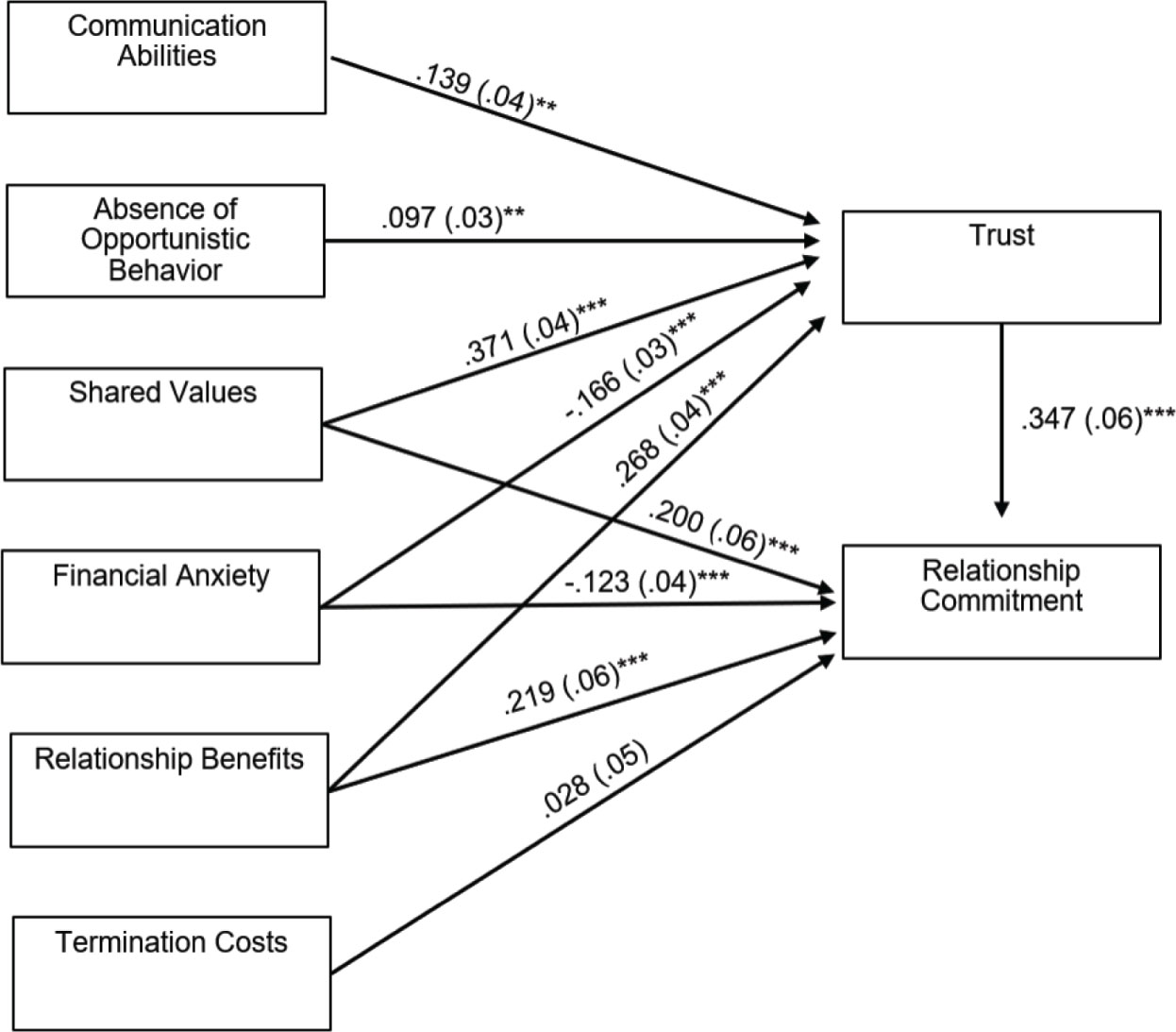
Figure 1.
Path diagram with standardized coefficients (standard errors).
The measurement properties of all study constructs were evaluated using reliability analyses, CFAs, and EFAs. This evaluation was conducted to assess dimensionality, item performance, and construct validity within the financial planning context. Based on these analyses, three items were removed because the measurement evaluation indicated that they were not conceptually aligned with the intended constructs and reduced construct clarity within the financial planning context. Specifically, the items “I do not question my financial planner’s recommendations” and “I’m concerned that my financial planner might withhold information that could sway my decisions” were removed from the opportunistic behavior scale, and the item “My financial planner educates me about a wide range of financial matters” was removed from the relationship termination scale. Composite scores were subsequently calculated by averaging the retained items within each construct. This approach was selected to maintain consistency with the original study design while providing a stable representation of the theoretical constructs.
Results
Descriptive Statistics
Summary statistics are presented in Table 2. With a sample size of 430, the number of observations for each variable is reported to describe the extent of missingness. Mean responses for most items fell between the neutral and positive response categories. Several items nevertheless received less favorable ratings. For example, questions regarding staying with a financial planner indefinitely (M = 2.90, SD = 1.19) and being able to be persuaded to work with a different financial planner (M = 2.87, SD = 1.08) were less favorable. Notably, the last two questions are about commitment to the current financial planner. Financial planners received stronger scores in the domains of satisfaction and relationship termination. Satisfaction received a mean score of 3.74 (SD = .97), while follow-through received a mean score of 4.89 (SD = 1.28) on a 7-point scale. In communications, financial planners received a mean score of 4.90 (SD = 1.37) for asking questions to ensure recommendations were understood.
Table 2.
Descriptive statistics
| Question | N | M | SD | Minimum | Maximum |
|---|---|---|---|---|---|
| Trust | |||||
| I have confidence in my financial planner’s integrity | 429 | 3 | 1.2 | 1 | 5 |
| I have confidence in my financial planner’s financial skills and expertise | 429 | 3.6 | 1 | 1 | 5 |
| I can rely on my financial planner to follow through on his/her commitments | 429 | 3.5 | 1 | 1 | 5 |
| I trust my financial planner | 429 | 3.4 | 1.1 | 1 | 5 |
| I view my financial planner as a sincere person | 429 | 3.3 | 1.2 | 1 | 5 |
| Relationship Commitment | |||||
| I am very committed to maintaining a relationship with my financial planner | 429 | 3.5 | 0.9 | 1 | 5 |
| I intend to stay with my financial planner indefinitely | 429 | 2.9 | 1.2 | 1 | 5 |
| I have a strong sense of loyalty towards my financial planner | 429 | 3.5 | 1 | 1 | 5 |
| I could be persuaded to transfer to a different financial planner* | 429 | 2.9 | 1.1 | 1 | 5 |
| My financial planner is my primary financial advisor | 429 | 3.1 | 1 | 1 | 5 |
| I put maximum effort into maintaining my relationship with my current financial planner | 429 | 3.3 | 1.1 | 1 | 5 |
| Communications | |||||
| My financial planner works hard at asking questions that will encourage me to open up with them | 429 | 3.4 | 0.9 | 1 | 5 |
| My financial planner paraphrases the factual content of our conversation | 428 | 3.3 | 1 | 1 | 5 |
| My financial planner paraphrases the emotional themes of our planning conversations | 428 | 3.4 | 0.8 | 1 | 5 |
| My financial planner communicated to me that it is very important to link their financial planning recommendations to my personal goals, needs, and priorities | 428 | 4.6 | 1.4 | 2 | 7 |
| My financial planner works hard at communicating their recommendations using terms and language that I can easily understand | 428 | 4.5 | 1.6 | 1 | 7 |
| My financial planner asks me questions to make sure I understand their recommendations | 428 | 4.9 | 1.4 | 2 | 7 |
| Absence of Opportunistic Behavior | |||||
| I can trust my financial planner to keep my personal and financial information confidential | 429 | 3.5 | 1 | 1 | 5 |
| My planner provides courteous and friendly service to me | 428 | 3.4 | 1 | 1 | 5 |
| My planner responds promptly to my requests | 429 | 3.3 | 1 | 1 | 5 |
| Relationship Benefits | |||||
| My planner helps me to make good financial decisions | 429 | 3.6 | 0.9 | 1 | 5 |
| My planner offers good investment advice | 429 | 3.2 | 1 | 1 | 5 |
| My planner shows genuine care and interest in each client’s personal circumstances | 429 | 3.1 | 1.1 | 1 | 5 |
| My financial planner has helped me to achieve my financial goals | 429 | 3.7 | 0.8 | 1 | 5 |
| My financial planner has helped me to improve my quality of life | 429 | 3.4 | 0.9 | 1 | 5 |
| My financial planner helps me to identify meaningful personal and financial goals and objectives | 429 | 3.4 | 1 | 1 | 5 |
| Relationship Termination Costs | |||||
| What is your level of satisfaction with the relationship you have with your financial planner? | 429 | 3.7 | 1 | 1 | 5 |
| I fully cooperate with my financial planner by following through on all of the financial planning recommendations they make to me | 428 | 4.9 | 1.3 | 1 | 7 |
| My financial planner keeps in touch with me to see what changes in my life may affect my financial plan | 428 | 3.3 | 1 | 1 | 5 |
| My financial planner uses a goal setting process that helps me identify meaningful personal and financial goals and objectives | 428 | 3.4 | 1 | 1 | 5 |
| Shared Values | |||||
| My financial planner presents their own values to me | 429 | 3.3 | 0.9 | 1 | 5 |
| My financial planner demonstrates knowledge about my culture | 429 | 3.1 | 1 | 1 | 5 |
| My financial planner recognizes limits that cultural differences can place on our relationship | 429 | 3.5 | 0.9 | 1 | 5 |
| My financial planner is aware of institutional barriers that affect me as their client | 429 | 3.4 | 0.9 | 1 | 5 |
| Planner makes effort to understand clients’ cultural values | 429 | 3.4 | 0.9 | 1 | 5 |
| Planner makes effort to understand clients’ personality | 429 | 3 | 1.2 | 1 | 5 |
| Planner makes effort to understand clients’ spending patterns | 429 | 3.5 | 1 | 1 | 5 |
| Planner makes effort to understand clients’ attitudes and beliefs about money | 429 | 3.5 | 1 | 1 | 5 |
| Planner makes effort to understand clients’ family history and family values | 429 | 3.5 | 0.9 | 1 | 5 |
| Financial Anxiety | |||||
| I feel anxious about my financial situation | 430 | 2.9 | 0.9 | 1 | 5 |
| I have difficulty sleeping because of my financial situation | 430 | 2.4 | 1 | 1 | 5 |
| I have difficulty concentrating on my studies or work because of my financial situation | 430 | 2.9 | 1.1 | 1 | 5 |
| I am irritable because of my financial situation | 430 | 2.8 | 1.1 | 1 | 5 |
| I have difficulty controlling my worry about my financial situation | 430 | 2.7 | 1.1 | 1 | 5 |
| My muscles feel tense because of worries about my financial situation | 430 | 2.7 | 1 | 1 | 5 |
| I feel fatigued because I worry about my financial situation | 430 | 2.9 | 1.2 | 1 | 5 |
Financial anxiety questions were all on a 5-point scale, with higher scores representing higher levels of anxiety. The highest mean score on this scale was the question about general overall financial anxiety (M = 2.92, SD = .88). Losing sleep over finances received the lowest score on the scale (M = 2.39, SD = 1.04). Notably, all of the anxiety questions had mean scores below 3.00, which is the midpoint of the scale, but confidence intervals for general financial anxiety (95% CI = [2.84, 3.01]) and fatigue caused by financial anxiety (95% CI = [2.80, 3.02]) contained the midpoint.
Confirmatory Factor Analyses
Confirmatory factor analyses (CFA) were conducted for the eight constructs in the model: (a) relationship termination costs, (b) relationship benefits, (c) shared values, (d) communications, (e) absence of opportunistic behavior, (f) financial anxiety, (g) trust, and (h) relationship commitment. Complete CFA model fit data, standardized factor loading ranges, and Cronbach’s alpha for each latent variable are summarized in Table 3.
Table 3.
Confirmatory Factor Analyses
| Model | χ2[df] | p | RMSEA | CFI | TLI | SRMR | Std. Factor Loading Range | Cronbach’s Alpha |
|---|---|---|---|---|---|---|---|---|
| Trust | 10.302[3] | 0.016 | 0.075 | 0.996 | 0.986 | 0.015 | .51–.80 | 0.77 |
| Relationship Commitment | 30.017[7] | 0.001 | 0.088 | 0.984 | 0.966 | 0.027 | .37–.83 | 0.73 |
| Communication Abilities | 25.146[8] | 0.002 | 0.071 | 0.988 | 0.977 | 0.021 | .47–.75 | 0.72 |
| Absence of Opportunistic Behavior | Just-Identified | - | - | - | - | - | .42–.60 | 0.53 |
| Relationship Benefits | 26.895[9] | .001 | .068 | .988 | .981 | .024 | .59–.72 | 0.76 |
| Relationship Termination Costs | 5.106[2] | 0.078 | 0.060 | 0.997 | 0.992 | 0.012 | .60–.76 | 0.74 |
| Shared Values | 87.243[26] | < 0.001 | 0.074 | 0.973 | 0.963 | 0.036 | .41–.75 | 0.78 |
| Financial Anxiety | 25.238[11] | 0.008 | 0.055 | 0.993 | 0.986 | 0.018 | .55–.79 | 0.81 |
CFAs were conducted using questions chosen a priori based on the Morgan and Hunt (1994) theory of trust and commitment. The CFAs, along with Cronbach’s alpha scores, helped verify each construct’s internal validity and consistency. Following Kline (2016), model fit was evaluated using multiple indices, including the comparative fit index (CFI), Tucker–Lewis index (TLI), root mean square error of approximation (RMSEA), and standardized root mean square residual (SRMR). CFI and TLI values greater than .90, and RMSEA and SRMR values less than .08, were considered indicative of an acceptable fit.
Overall, the individual constructs demonstrated acceptable measurement properties. All standardized factor loadings were statistically significant (p < .001), and most constructs demonstrated acceptable internal consistency and model fit based on multiple fit indices. The opportunistic behavior construct was just identified after refinement of the measurement scale; therefore, global fit indices are not available for that model.
To improve the fit of several theoretically well-established measures, a limited number of residual covariances were specified between conceptually similar indicators. For the trust construct, residual covariances were permitted between “I have confidence in my financial planner’s financial skills and expertise” and “I can rely on my financial planner to follow through on his/her commitments” as both items capture evidence of the planner’s competence and performance. Additionally, residual covariance was allowed between the planner follow-through item and “I trust my financial planner.” Both items explicitly reference the planner’s trustworthiness or reliability, which may increase the conceptual overlap. When examining the factors measuring communication abilities, two items had substantial overlap: “My financial planner works hard at communicating their recommendations to me using terms and language that I can easily understand,” and “My financial planner asks me questions to make sure I understand their recommendations.” These were allowed to covary. Finally, two items, “My planner makes an effort to understand my attitudes and beliefs about money” and “My planner makes an effort to understand my personality,” demonstrated substantial overlap in the shared values construct. This may be due to the similar wording and close connection between personality, attitudes, and beliefs. Therefore, the residuals of these two variables were allowed to covary.
Measurement Model and Path Model Specification
The individual scales generally demonstrated acceptable reliability and factor loadings, supporting the internal consistency of the measures (Hair et al. 2021). However, when modeled simultaneously as distinct latent variables, several relational constructs exhibited substantial empirical overlap. Trust, commitment, relationship benefits, shared values, and relationship termination demonstrated high latent correlations and limited discriminant validity. EFAs further supported these findings, indicating that respondents tended to evaluate trust, commitment, relationship benefits, relationship termination, and shared values as highly interconnected dimensions of the client-planner relationship, whereas financial anxiety remained comparatively distinct.
These findings are notable given that the measures were adapted from relationship marketing theory and suggest that financial planning clients may experience relational dimensions more holistically than has been observed in other service contexts. Rather than representing entirely separate evaluations, trust, commitment, relationship benefits, shared values, and relationship termination may collectively reflect broader perceptions of relationship quality within client-planner relationships.
Attempts to estimate the full latent measurement model resulted in inadmissible solutions and poor separation among several theoretically related relational dimensions. Given the study’s objective of replicating and extending the original model, and because the latent measurement structure did not clearly support retaining all relational constructs as empirically distinct factors, composite indicators based on the refined item sets were retained for the final analyses. Composite scores were calculated by averaging the retained items within each scale.
Path Model
The path model demonstrated mixed but generally acceptable fit across indices. The chi-square statistic was significant (χ2[3] = 11.310; p = .01), but this is usually the case when sample sizes are above 400 (Kenny, Kaniskan & McCoach 2015). Fit indices suggested variability in model fit, with strong values observed for the CFI (0.993), TLI (0.970), and SRMR (0.014). The RMSEA value (0.08) was acceptable, and it may partially reflect the sensitivity of RMSEA in models with low degrees of freedom and highly constrained path structures. Taken together, the results suggest that the model provides an adequate representation of the observed relationships and is appropriate for examining the pathways. Path coefficients and fit statistics are presented in Table 4.
Table 4.
Path Coefficients
| Path | B | β | SE (β) |
|---|---|---|---|
| Communication Abilities --> Trust | 0.143 | 0.139 | 0.041** |
| Absence of Opportunistic Behavior --> Trust | 0.107 | 0.097 | 0.030** |
| Relationship Benefits --> Trust | 0.323 | 0.268 | 0.041*** |
| Shared Values --> Trust | 0.501 | 0.371 | 0.041*** |
| Financial Anxiety --> Trust | −0.181 | −0.166 | 0.026*** |
| Relationship Benefits --> Relationship Commitment | 0.229 | 0.219 | 0.060*** |
| Termination Costs --> Relationship Commitment | 0.024 | 0.028 | 0.047 |
| Shared Values --> Relationship Commitment | 0.235 | 0.200 | 0.057*** |
| Financial Anxiety --> Relationship Commitment | −0.117 | -0.123 | 0.035*** |
| Trust --> Relationship Commitment | 0.302 | 0.347 | 0.061*** |
The model has ten structural (explanatory) paths, nine of which are statistically significant. The model accounted for a substantial proportion of variance in both trust (R2 = .81) and relationship commitment (R2 = 0.67). These values should be interpreted with caution because the high latent correlations and limited discriminant validity indicate that the predictors and outcomes share substantial common variance. The R2 values reflect both the model’s association with the outcomes and the interconnected nature of these relational constructs. The correlations between variables of interest are presented in Table 5. As shown, several relationship marketing constructs were highly correlated, particularly trust, shared values, relationship benefits, and communication abilities, providing additional evidence of substantial overlap among these relational dimensions.
Table 5.
Correlations Between the Model’s Observed Variables
| Variable | 1 | 2 | 3 | 4 | 5 | 6 | 7 | 8 |
|---|---|---|---|---|---|---|---|---|
| 1. Trust | - | |||||||
| 2. Commitment | .790 | - | ||||||
| 3. Communication Abilities | .803 | .733 | - | |||||
| 4. Absence of Opportunistic Behavior | .680 | .631 | .624 | - | ||||
| 5. Relationship Benefits | .823 | .746 | .782 | .706 | - | |||
| 6. Relationship Termination Costs | .738 | .663 | .720 | .618 | .768 | - | ||
| 7. Shared Values | .844 | .751 | .821 | .632 | .800 | .767 | - | |
| 8. Financial Anxiety | −.601 | −.551 | −.535 | −.435 | −.488 | −.473 | −.501 | - |
The path model largely supported Morgan and Hunt’s (1994) theory of trust and commitment within the financial planning context while also demonstrating the unique role of financial anxiety. All paths specified as predicting trust were statistically significant. Shared values had the largest standardized coefficient predicting trust in the specified model (β = .37, p < .001), although relative coefficient magnitudes should be interpreted cautiously given the substantial construct overlap. Communication abilities (β = .14, p = .001) and an absence of opportunistic behavior (β = .10, p = .001) were also positively associated with trust. Interestingly, relationship benefits (β = .27, p < .001), which was added as a direct pathway to trust, exhibited one of the strongest associations with trust. Financial anxiety was negatively associated with trust (β = −.17, p < .001), indicating that clients with greater financial anxiety may report lower levels of trust in their financial planner.
Several factors were also significantly associated with relationship commitment. Trust showed the strongest association with commitment (β = .35, p < .001), consistent with the central proposition of trust and commitment theory that trust serves as a theoretical precursor to commitment. Relationship benefits were positively associated with commitment (β = .22, p < .001), and shared values were also positively associated with commitment (β = .20, p < .001). Financial anxiety was negatively associated with commitment (β = −.12, p < .001), suggesting that anxious clients may experience greater difficulty developing long-term commitment to their financial planner. Contrary to expectations, relationship termination costs were not significantly associated with commitment (β = .03, p = .560).
Discussion
An unexpected finding of the present study was the degree of empirical overlap observed among several relational constructs adapted from Morgan and Hunt’s (1994) theory of trust and commitment. Although the constructs generally demonstrated acceptable reliability and generally performed well when examined individually, latent measurement analyses revealed substantial overlap among trust, commitment, relationship benefits, shared values, and relationship termination. These findings suggest that financial planning clients may perceive these relational dimensions as highly interconnected aspects of the client-planner relationship. Nevertheless, the results generally support the applicability of Morgan and Hunt’s (1994) theory to financial planning contexts and provide additional insight into the relational processes underlying client-planner relationships.
Overall, the findings provide support for applying Morgan and Hunt’s (1994) theory of trust and commitment within financial planning while also highlighting the interconnected nature of relational constructs in this context. Although the model explained substantial variance in both trust and commitment, the observed construct overlap suggests that financial planning clients may evaluate many aspects of the planner-client relationship as part of a broader perception of relationship quality rather than as completely distinct dimensions. Consequently, the explanatory power of the model should be interpreted alongside these measurement findings. This overlap in latent measurement does not necessarily indicate that the constructs lack conceptual distinction entirely. Rather, it may reflect the unique nature of financial planning relationships. Unlike other forms of consumer service relationships (e.g., marketing), financial planning relationships often involve long-term engagement, significant information asymmetry, emotional disclosure, and ongoing collaboration around highly personal financial goals. As a result, perceptions of trust, commitment, relationship benefits, and shared values may be experienced as closely interconnected dimensions of the relationship.
One of the most notable findings of this study was that financial anxiety exhibited direct negative associations with both trust and relationship commitment. While substantial overlap was observed among several relationship marketing constructs, financial anxiety remained conceptually and empirically distinct. This finding highlights one potential way Morgan and Hunt’s (1994) theory may be refined for financial planning contexts. Within the specified theoretical model, financial anxiety was one of three antecedents, alongside shared values and relationship benefits, that demonstrated direct associations with both trust and commitment. This pattern differs from the original formulation of trust and commitment theory, in which several antecedents are theorized to influence either trust or commitment. That financial anxiety remained significantly associated with both outcomes, even after accounting for established relational antecedents, suggests that psychological factors may play an important role. Since financial planning often involves uncertainty, vulnerability, and emotionally charged decisions, clients who experience greater financial anxiety may find it more difficult to develop trust and maintain long-term commitment to the relationship.
Viewed through broader trust frameworks (Mayer et al. 1995; Rousseau et al. 1998), the negative association between financial anxiety and trust may reflect a reduced willingness among anxious clients to accept vulnerability within the planning relationship. This interpretation complements the psychophysiological pathway discussed earlier, whereby anxiety impairs information processing and reduces clients’ ability to evaluate recommendations or engage confidently in financial decision-making (Grable & Britt 2012). However, these associations are open to several competing explanations, and the nature of this study makes it challenging to distinguish between them. There are several other mechanisms that may explain why financially anxious clients report lower levels of trust and commitment. A second possibility is behavioral avoidance (Dobson & Dobson 2018). Individuals experiencing financial anxiety may avoid financial conversations, delay decision-making, or disengage from the planning process, which could limit opportunities for trust and commitment to develop. A third possibility is that anxious clients project broader concerns about uncertainty and personal financial competence onto the financial planning relationship itself, leading them to be more cautious in placing trust in others. This phenomenon has been found in social anxiety where clients who experience anxiety may be less likely to attend therapy (Warnock-Parkes et al. 2020). Since the present study cannot distinguish among these potential mechanisms, future research should examine whether cognitive processing, avoidance behaviors, perceived self-efficacy, or other psychological mechanisms explain the association between financial anxiety and relationship outcomes within financial planning.
An additional finding of this study was that relationship benefits were positively associated with both trust and relationship commitment. While Morgan and Hunt’s (1994) theory conceptualizes relationship benefits primarily as antecedents to commitment, perceived relationship benefits may also play an important role in the formation of trust within financial planning relationships. This distinction may reflect the unique nature of financial planning, where relationship benefits often extend beyond financial outcomes to include education, emotional support, communication, and guidance through complex financial decisions (Cummings & James 2014). As clients perceive greater value from these interactions, they may not only become more committed to maintaining the relationship but also develop stronger trust in their financial planner’s competence, reliability, and intentions. Thus, in financial planning contexts, relationship benefits may function as a broader relational mechanism that simultaneously strengthens both trust and commitment. Future research should continue examining whether the pathways proposed by trust and commitment theory operate differently in financial planning than in other service and marketing contexts.
Limitations
Several limitations should be considered when interpreting the findings. First, the study relied on a convenience sample and cross-sectional data, which limits generalizability and prevents conclusions regarding causal directionality. Although the sample size was adequate for the analyses conducted, future studies with larger, more diverse samples would strengthen external validity and enable more complex latent modeling approaches. Moreover, the sample may not reflect the typical population of financial planning clients. Expanding recruitment across additional professional organizations and financial planning networks may also improve representativeness of the financial planning profession.
The path model used composite indicators rather than fully latent constructs. Although the individual CFAs and internal consistency measures generally supported the psychometric quality of the scales, the use of summed scores reduces the ability to model item-level measurement error and may obscure some variability within constructs. This decision was made because simultaneous latent modeling produced inadmissible solutions and poor empirical separation among several relational constructs, and because retaining refined composites maintained comparability with the original study. More broadly stated, the modeling evaluates whether an observed covariance structure is consistent with a hypothesized directional model, but it does not establish causal direction. The directional paths reported should therefore be taken as one theoretically motivated specification consistent with the data rather than as demonstrated causal relationships.
Implications
One of the primary implications of this study is that financial anxiety should be addressed early in the planner-client relationship. This finding suggests that reducing client anxiety may simultaneously strengthen multiple dimensions of the planner-client relationship rather than influencing only one relational outcome. For example, some individuals experience financial anxiety as a result of meeting with a financial planner (Gerrans & Hershey 2017). This inherent uneasiness may easily undermine a client-planner relationship. It may be helpful to incorporate financial anxiety screening into client intake processes to understand what level of financial anxiety clients are currently experiencing (Hanlon et al. 2025). Some potential interventions planners can implement include being aware of the use of technology and even the office environment, which can influence clients’ anxiety and physiological responses to stress (Grable & Britt 2012; Rollins-Koons et al. 2024).
Although financial stressors often precipitate financial anxiety, planners should recognize that the objective financial issue is not always the primary source of a client’s anxiety. For example, a planner may identify insufficient retirement savings as a financial concern and recommend increasing retirement contributions. However, that issue may not be what is causing the client the greatest anxiety. Instead, anxiety may stem from employment uncertainty, caregiving responsibilities, debt, family conflict, or other financial concerns that are not immediately apparent. Understanding the source of a client’s anxiety may help planners build trust while tailoring recommendations that better align with the client’s emotional and financial needs.
The present findings also indicated that relationship benefits were associated with both trust and commitment. This finding suggests that planners may strengthen relationships not only by providing technically sound advice but also by ensuring that clients recognize the value they receive throughout the planning process. Educational conversations, proactive communication, goal clarification, and ongoing guidance may reinforce both clients’ trust in their planner and their commitment to maintaining the relationship.
The findings of this study also have implications for future research on financial planning. First, this study found that higher financial anxiety scores were negatively associated with financial planner-client relationships. Researchers and policymakers should continue to investigate how planners should address financial anxiety from a regulatory and compliance perspective. Future studies should examine whether low anxiety levels have a similar impact on trust and commitment in the context of financial planning relationships. Other research would also benefit from collecting longitudinal data to help identify causal direction. Subgroup analyses by socioeconomic status or life stage may also provide additional insights. Finally, research should continue to build on these findings by testing how anxiety reduction interventions can impact trust and commitment outcomes and whether financial planners’ emotional intelligence moderates these observed associations.