
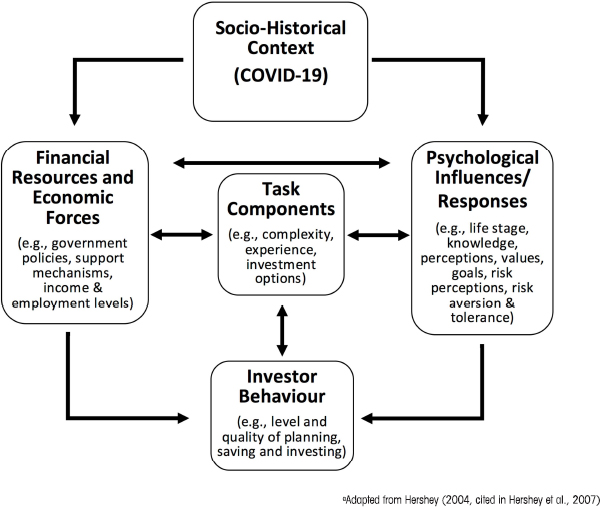
Figure 1:
Factors underlying investor behavioura during COVD-19
aAdapted from Hershey (2004, cited in Hershey et al., 2007)
Table 1:
Australian consumer segment profilesa during COVID-19
| Segment | Percentage | Characteristics | Demographic composition |
|---|---|---|---|
| Income in jeopardy | 24% | Major impact due to job or income loss. Have had a significant change in household income as a result of COVID-19 (61%), with a fear of it worsening (37%). Low to middle to high income. | 40% Gen X 33% Millennials 17% Baby Boomers 10% Gen Z |
| Making ends meet | 20% | Struggling financially pre-COVID-19 and continue to struggle. Government assistance or low wage jobs. Low income. | 56% Baby Boomers 32% Gen X 11% Millennials l% Gen Z |
| Optimistic but cautious | 30% | Worry about health and the economy but are more secure financially. Low to middle income. | 60% Baby Boomers 22% Gen X 17% Millennials l% Gen Z |
| Stable and consistent | 26% | Experienced a small amount of financial impact but remained relatively stable in mindset and behaviour. Highest income segment. | 39% Gen X 31% Baby Boomers 30% Millennials |
1 aSummarised from Bensley et al. (2020, p. 8)
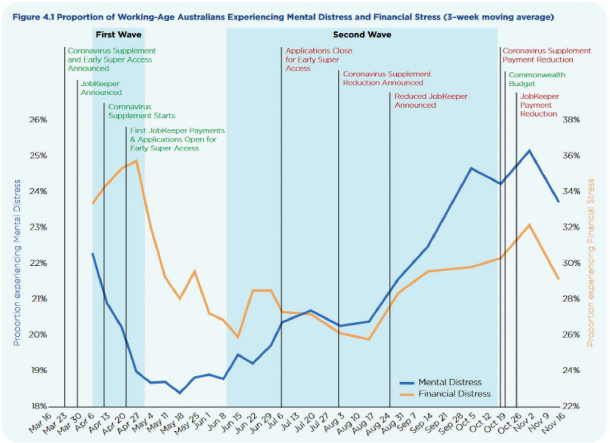
Figure 2:
Mental Distressa and Financial Stressb during COVID-19 in 2020
Source. Taking the Pulse of the Nation (TTPN) survey (Melbourne Institute), Waves 1-23. Sample size is 20,906 working-age adults.
Reproduced with permission from Botha, Butterworth and Wilkins (2020)
aMental distress.’ During the past week about how often did you feel depressed or anxious?’ Response options: “all of the time’, ‘most of the time’, ‘some of the time’, ‘a little of the time’, and ‘none of the time’. Mental distress includes responses ‘all of the time’ and ‘most of the time’
bFinancial stress. ‘How would you describe your current financial conditions, in terms of paying for essential goods and services such as bills, rents, mortgages?’ Response options: ‘very financially stressed’, ‘moderately financially stressed’, ‘making ends meet’, ‘moderately comfortable financially’, very comfortable financially’. Financial stress includes responses very financially stressed’ and ‘moderately financially stressed’.