
Table 1:
Superannuation and housing value and equity*
| Time period and age profile | Superannuation | Housing wealth | Size of cohort |
|---|---|---|---|
| 2011 Retirees 65+ | $267 billion# | $540 billion1 (equity*) | 3.1 milliona |
| 2011 Baby boomers (ages 45-64) | $780 billion## | $1.39 trillion2 | 5.5 millionb |
| 2014 Retirees 65+ | $454 billion^ | $830 billion3 (equity*) | 3.44 millionc |
| 2015 All ages | $2 trillion+ | $5.9 trillion4 | 23.5 millionc |
| 2029-2033 Gen X and Gen Y (will be aged between 47-64) | $4 trillion& (in 2029) | $1.5 trillion5 | 5.49 millionb |
| 2033 Baby boomers + migration (will all be aged over 65 by 2033) | $836 billion& | $2.48 trillion6 | 6.1 milliond |
| 2033 All ages | $7.6 trillion++ | Est. $10 trillion7 | 33 milliond |
1# Author’s own calculations approximated by taking proportion of superannuation assets held by Australians over 65 in 2009-10 (20.4%) (Clare 2011) against total superannuation assets in 2011 of $1.31 trillion (APRA 2012)
1## Author’s own calculations approximated by taking proportion of superannuation assets held by Australians aged 45-64 in 2009-10 (59.6%) (Clare 2011) against total superannuation assets in 2011 of $1.31 trillion (APRA 2012)
1^ ASFA (2015)
1+ APRA (2015)
1++ Deloitte (2015) $7.6 trillion in future nominal dollars
11 Authors’ calculations based on 3.1 million Australians aged over 65 (ABS 2012b), with 56% sharing a household with a spouse (ABS 2012b) resulting in approximately 2.2 million households, 83% of which (1.8 million) are owner occupied (ABS 2013d) by the conservative median house price of $300,000 (HILDA 2011 Median home value of those aged 65+) = $540 billion in retiree housing equity.
12 Authors’ calculations based on 5.5 million Australians aged 45- 64 (ABS 2012b), with 49% sharing a household with a spouse (ABS 2012b) resulting in approximately 3.96 million households, 78 per cent of which (3.0888 million) are owner occupied (ABS 2012d) by the conservative 2011 ‘median’ house price of $450,000 (HILDA 2011 Median home value of those aged 45-64) = $1.39 trillion in retiree housing equity.
13 Authors’ calculations based on 3.44 million Australians aged over 65 in 2014 (ABS 2012b), with 56% cent sharing a household with a spouse (ABS 2012b) resulting in approximately 2.66 million households, 78% of which (2.08 million) are owner occupied (ABS 2012d) by the conservative median house price of $400,000 (HILDA 2011 all those aged 62+ who would then be 65+ in 2014) = $832 billion in retiree housing equity.
14 ABS 2015b
15 Conservative estimate only. Author’s own calculations based on 49% of Gen X and Gen Y living with a spouse (ABS 2012b, 2013e) (49% of 5.49 million = 2.7 million) by 53% homeownership (ABS 2012b, 2013e) = approx. 1.5 million households by the median home value for ages 25-45 of $400,000 (HILDA 2011) = $600 billion (plus 0.5% per annum for growth each year in homeownership rate, including shared households) indexed at 2.5% for inflation, plus 2.5%pa in value growth over the time period 2015-2033 = $1.5 trillion (ignoring intergenerational transfer).
16 Conservative estimate only. Author’s own calculations of $1.39 trillion (2011 baby boomer home equity estimate) indexed at a rate of 2.5% to account for 5% home value increase and 2.5% inflation = $2.28 trillion plus 0.6 million new migrants with home equity $210 billion = $2.48 trillion.
17 Conservative estimate only. Author’s own calculations (excludes new homes) as calculated by $5.9 trillion in home value as at 2015 indexed by 2.5% per annum, compounded monthly until 2033 = $10.2 trillion.
1a ABS 2013a
1b ABS 2006
1c ABS 2015c
Table 2:
Living arrangements for Australians aged over 65 by household composition, 2009-10
| Household composition | Estimated number of households | Homeowner % | Renter % | Other living arrangement % |
|---|---|---|---|---|
| Lone person | 742.0 | 75.9 | 17.6 | 6.5 |
| Couple only | 741.6 | 91.4 | 5.8 | 2.8 |
| All households | 1,767.5 | 84.6 | 11.1 | 4.3 |
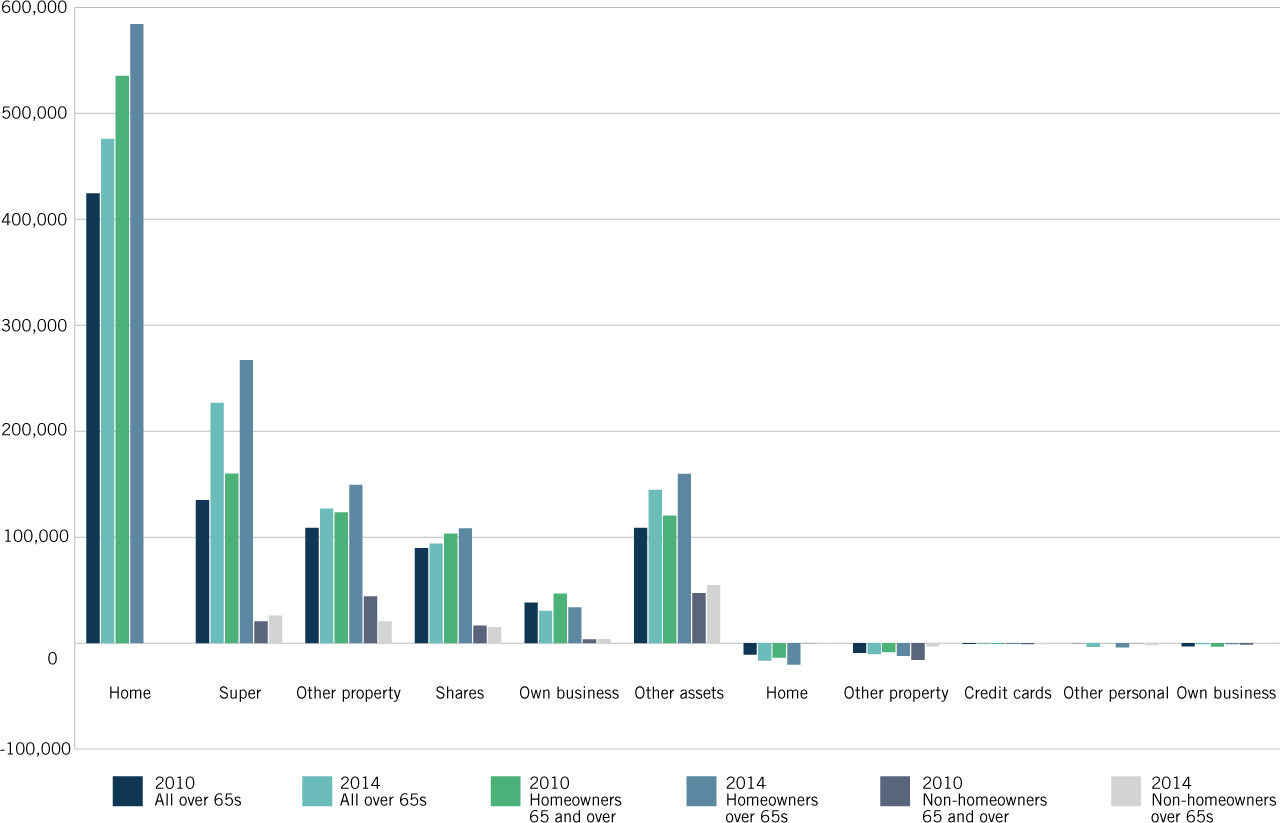
Figure 1:
Mean asset and debt components for those aged 65 years and over, by homeownership status, 2010 and 2014
Source: Authors’ own calculations. HILDA 2010: (N=1624 (all); 1294 (homeowners); 256 (non-homeowners)) 2014: (N= 3112 (all); 2543 (homeowners); 444 (non-homeowners))
Table 3:
Gross income bands for fully retired Australians by homeowner status, 2011
| All households cumulative per cent n=2,477 | Homeowner households cumulative per cent n= 1,957 | Non-homeowner households cumulative per cent n= 442 | |
|---|---|---|---|
| Negative or $0 | .2 | .2 | .5 |
| $1-$9,999 | .8 | .6 | 2.0 |
| $10,000-$19,999 | 17.8 | 13.9 | 33.0 |
| $20,000- $29,999 | 44.5 | 39.1 | 64.3 |
| $30,000-$39,999 | 60.5 | 56.4 | 75.8 |
| $40,000-$49,999 | 72.1 | 69.4 | 82.4 |
| $50,000-$59,999 | 79.3 | 77.5 | 86.0 |
| $60,000-$79,999 | 87.6 | 86.5 | 91.6 |
| $80,000-$99,999 | 91.8 | 90.6 | 95.7 |
| $100,000 and over | 100 | 100 | 100 |
Table 4:
Percentage of retirees (aged +65 years) reporting having to adjust to a major decline in income since retiring, 2011
| Level of Agreement with the statement “I have had to adjust to a big drop in my income since retiring”. | Per cent (n=1,089) |
|---|---|
| Strongly disagree | 4.2 |
| Disagree | 27.4 |
| Neither agree nor disagree | 14.4 |
| Agree | 40.6 |
| Strongly agree | 13.4 |
Table 5:
Financial risk Australian homeowners are prepared to take by age, 2011
| All ages (n=8,335) Per cent | Baby boomers (age 47-64) (n=2,787) Per cent | 65 and over (n=1,598) Per cent | 75 and over (n=628) Per cent | |
|---|---|---|---|---|
| Takes substantial risks expecting substantial returns | 1.4 | 1.1 | .6 | .3 |
| Takes above-average risks expecting above-average returns | 6.1 | 6.2 | 2.4 | 1.1 |
| Takes average financial risks expecting average returns | 38.5 | 43.2 | 34.7 | 27.2 |
| Not willing to take financial risks | 41.4 | 37.5 | 52.1 | 62.1 |
| Never has any spare cash | 12.6 | 11.9 | 10.3 | 9.2 |
| Total | 100.0 | 100.0 | 100.0 | 100.0 |
Table 6:
Reverse mortgage calculation* for starting home value of $950,000, various interest rates, 25-year term
| Loan interest rate (Compounded monthly) | 4% p.a. | 5.25% p.a. | 6.25% p.a. |
| Home value at the start of month, Year 1 | $949,000 | $949,000 | $949,000 |
| Monthly income drawn (Yr 1 to Yr 25) | $1,115 rising to $2,024 by Yr 25 | $1,115 rising to $2,024 by Yr 25 | $1,115 rising to $2,024 by Yr 25 |
| Home value at the end of month, Year 25 | $2,273,635 | $2,273,635 | $2,273,635 |
| Size of loan, compounded at end of Year 25 | $746,331 | $884,934 | $1,019,781 |
| Remaining home equity after 25 years with monthly withdrawals | $1,527,305 | $1,388,701 | $1,253,854 |
| Loan to Value Ratio (LVR) | 33% | 39% | 45% |
Table 7:
Reverse mortgage calculation* for starting home value of $350,000, various interest rates
| Loan interest rate (Compounded monthly) | 4% p.a. | 5.25% p.a. | 6.25% p.a. |
| Home value at the start of month, Year 1 | $349,000 | $349,000 | $349,000 |
| Monthly income drawn (Yr 1 to Yr 25) | $200 rising to $363 by Yr 25 | $200 rising to $363 by Yr 25 | $200 rising to $363 by Yr 25 |
| Home value at the end of month, Year 25 | $836,142 | $836,142 | $836,142 |
| Size of loan, compounded at end of Year 25 | $133,871 | $158,733 | $182,920 |
| Remaining home equity after 25 years with monthly withdrawals | $702,271 | $677,409 | $653,222 |
| Loan to Value Ratio (LVR) | 16% | 19% | 22% |
Table 8:
Percentage of retirees (age +65 years) report wishing they had started to plan for retirement earlier, 2011
| Level of Agreement with the statement “I wish I had started to plan for retirement earlier”. | Per cent (n=1,085) |
|---|---|
| Strongly disagree | 7.2 |
| Disagree | 40.7 |
| Neither agree nor disagree | 22.7 |
| Agree | 22.3 |
| Strongly agree | 7.1 |