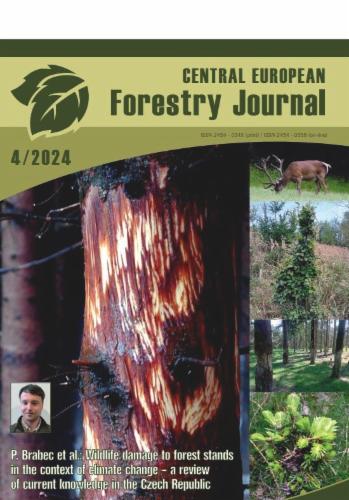
Wildlife damage to forest stands in the context of climate change – a review of current knowledge in the Czech Republic

References
- Amici, A., Serrani, F., Rossi, C. M., Primi, R., 2012: Increase in crop damage caused by wild boar (Sus scrofa L.): the “refuge effect”. Agronomy for Sustainable Development, 32:683–692.
- Ammer, C., 1996: Impact of ungulates on structure and dynamics of natural regeneration of mixed mountain forests in the Bavarian Alps. Forest Ecology and Management, 88:43–53.
- Beguin, J., Tremblay, J. P., Thiffault, N., Pothier, D., Côté, S. D., 2016: Management of forest regeneration in boreal and temperate deer–forest systems: challenges, guidelines, and research gaps. Ecosphere, 7:e01488.
- Biedrzycka, A., Solarz, W., Okarma, H., 2012: Hybridization between native and introduced species of deer in Eastern European. Journal Mammalogy, 93:1331–1341.
- Bödeker, K., Ammer, C., Knoke, T., Heurich, M., 2021: Determining statistically robust changes in ungulate browsing pressure as a basis for adaptive wildlife management. Forests, 12:1030.
- Bolte, A., Ammer, C., Löf, M., Madsen, P., Nabuurs, G. J., Schall, P. et al., 2009: Adaptive forest management in central Europe: climate change impacts, strategies and integrative concept. Scandinavian Journal of Forest Research, 24:473–482.
- Borowski, Z., Gil, W., Bartoń, K., Zajączkowski, G., Łukaszewicz, J., Tittenbrun, A. et al., 2021: Density-related effect of red deer browsing on palatable and unpalatable tree species and forest regeneration dynamics. Forest Ecology and Management, 496:119442.
- Bošeľa, M., Petráš, R., Sitková, Z., Priwitzer, T., Pajtík, J., Hlavatá, H. et al., 2014: Possible causes of the recent rapid increase in the radial increment of silver fir in the Western Carpathians. Environmental Pollution, 184:211–221.
- Brang, P., Spathelf, P., Larsen, J. B., Bauhus, J., Boncčìna, A., Chauvin, C. et al. 2014: Suitability of close-to-nature silviculture for adapting temperate European forests to climate change. Forestry: An International Journal of Forest Research, 87:492–503.
- Bright Ross, J. G., Peters, W., Ossi, F., Moorcroft, P. R., Cordano, E., Eccel, E. et al., 2021: Climate change and anthropogenic food manipulation interact in shifting the distribution of a large herbivore at its altitudinal range limit. Scientific Reports, 11:7600.
- Büntgen, U., Greuter, L., Bollmann, K., Jenny, H., Lieb-hold, A., Galván, J. D. et al., 2017: Elevational range shifts in four mountain ungulate species from the Swiss Alps. Ecosphere, 8:e01761.
- Burschel, P., 1975: Schalenwildbest nde und Leistungsnde und Leistungsf higkeit des Waldes als Problem der Forst- und Holzwirtschaft aus der Sicht des Waldbaus. Allgemeine Forstzeitschrift, 30:214–221. (In German). Burschel, P., Binder, F., El Kateb, H., Mosandl, R., 1990: Erkenntnisse zur Walderneuerung in der Bayerischen Alpen. In: Schuster, E. J. (ed.): Zustand und Gefahrung des Bergwaldes: Ergebnisse eines Rundgespr ches, 21. April 1989. Herausgegeben von der Kommission für Ökologie der Bayerischen Akademie der Wissenschaften, p. 40–49. (In German).
- Carpio, A. J., Apollonio, M., Acevedo, P., 2021: Wild ungulate overabundance in Europe: contexts, causes, onitoring and management recommendations. Mammal Review, 51:95–108.
- Cukor, J., Havránek, F., Rohla, J., Bukovjan, K., 2017: Estimation of red deer density in the west part of the Ore Mts. (Czech Republic). Zprávy Lesníckého Výzkumu, 62:288–295.
- Cukor, J., Vacek, Z., Linda, R., Sharma, R. P., Vacek, S., 2019a: Afforested farmland vs. forestland: effects of bark stripping by Cervus elaphus and climate on production potential and structure of Picea abies forests. PLoS ONE, 14:e0221082.
- Cukor, J., Vacek, Z., Linda, R., Vacek, S., Marada, P., Šimůnek, V. et al., 2019b: Effects of bark stripping on timber production and structure of norway spruce forests in relation to climatic factors. Forests, 10:320.
- Cukor, J., Zeidler, A., Vacek, Z., Vacek, S., Šimůnek, V., Gallo, J., 2020: Comparison of growth and wood quality of Norway spruce and European larch: effect of previous land use. European Journal of Forest Research, 139:459–472.
- Cukor, J., Linda, R., Mahlerová, K., Vacek, Z., Faltusová, M., Marada, P. et al., 2021: Different patterns of human activities in nature during Covid-19 pandemic and African swine fever outbreak confirm direct impact on wildlife disruption. Scientific Reports, 11:20791.
- Cukor, J., Vacek, Z., Linda, R., Vacek, S., Šimůnek, V., Macháček, Z. et al., 2022a: Scots pine (Pinus sylvestris L.) indicates a high resistance against bark stripping damage. Forest Ecology and Management, 513:120182.
- Cukor, J., Vacek, Z., Vacek, S., 2022b: Vliv loupání kůry na růst a zdravotní stav jehličnatých porostů. In: Cukor J., Vacek Z. (eds.): Dopady vlivu zvěře na lesní ekosystémy: Komplexní pohled a možnosti řešení. 19. 5. 2022, Krajský úřad Plzeňského kraje, Škroupova 18, Plzeň, Česká lesnická společnost, z. s., p. 29–39. (In Czech).
- Čermák, P., 2000: Vliv sudokopytníků na dřeviny vybraných lesních ekosystémů Moravy [Dizertační práce.] Brno, MZLU, FLD: 156 p. (In Czech).
- Čermák, P., Jankovsky, L., Glogar, J., 2004: Progress of spreading Stereum sanguinolentum [Alb. et Schw.: Fr.] Fr. wound rot and its impact on the stability of spruce stands. Journal of Forest Science, 50:360–365.
- Čermák, P., Horsak, P., Spirik, M., Mrkva, R., 2009: Relationships between browsing damage and woody species dominance. Journal of Forest Science, 55:23–31.
- Čermák, P., Beranová, P., Oralková, J., Horsák, P., Plsek, J., 2011: Relationships between browsing damage and the species dominance by the highly food-attractive and less food-attractive trees. Acta Universitatis Agriculturae et Silviculturae Mendelianae Brunensis, 59:29–36.
- Černý, M., Beranová, J., Zatloukal, V., Roubalová, M., Málek, P., Blažek, P. et al., 2016: Inventarizace škod zvěří na lesním hospodářství České republiky. IFER – Ústav pro výzkum lesních ekosystémů, s. r. o., Ústav pro hospodářskou úpravu lesů Brandýs nad Labem, 46 p.
- Dănescu, A., Albrecht, A. T., Bauhus, J., 2016: Structural diversity promotes productivity of mixed, unevenaged forests in southwestern Germany. Oecologia, 182:319–333.
- Danell, K., Bergström, R., Duncan, P., Pastor, J., 2006: Large herbivore ecology, ecosystem dynamics and conservation (Vol. 11). Cambridge, Cambridge University Press, 506 p.
- Dvořák, J., Palyzová, L., 2016: Analysis of the development and spatial distribution of sika deer (Cervus nippon) populations on the territory of the Czech Republic. Acta Universitatis Agriculturae et Silviculturae Mendelianae Brunensis, 64:1507–1515.
- Fern, M. P., Armstrong, J. B., Barlow, R. J., Kush, J. S., 2020: Ecological factors influencing wild pig damage to planted pine and hardwood seedlings. Human– Wildlife Interactions, 14:12.
- Finďo, S., Petráš, R., 2011: Ochrana lesa proti škodám zverou. Zvolen, NLC, 283 p. (In Slovak).
- Forrester, D. I., Ammer, C., Annighöfer, P. J., Avdagic, A., Barbeito, I., Bielak, K. et al., 2017: Predicting the spatial and temporal dynamics of species interactions in Fagus sylvatica and Pinus sylvestris forests across Europe. Forest Ecology Managemant, 405:112–133.
- Frauendorf, M., Gethöffer, F., Siebert, U., Keuling, O., 2016: The influence of environmental and physiological factors on the litter size of wild boar (Sus scrofa) in an agriculture dominated area in Germany. Science of the Total Environment, 541:877–882.
- Fuchs, Z., Vacek, Z., Vacek, S., Gallo, J., 2021: Effect of game browsing on natural regeneration of European beech (Fagus sylvatica L.) forests in the Krušné hory Mts. (Czech Republic and Germany). Central European Forestry Journal, 67:166–180.
- Gill, R. M. A., 1992: A review of damage by mammals in north temperate forests. 1. Deer. Forestry: An International Journal of Forest Research, 65:145–169.
- Hahn, C., Vospernik, S., Gollob, C., Ritter, T., 2023: Bark stripping damage by red deer (Cervus elaphus L.): assessing the spatial distribution on the stand level using generalised additive models. European Journal of Forest Research, 142:611–626.
- Hartmann, H., Bastos, A., Das, A. J., Esquivel-Muelbert, A., Hammond, W. M., Martínez-Vilalta, J. et al., 2022: Climate change risks to global forest health: emergence of unexpected events of elevated tree mortality worldwide. Annual Review of Plant Biology, 73:673–702.
- Heinken, T., Schmidt, M., Von Oheimb, G., Kriebitzsch, W. U., Ellenberg, H., 2006: Soil seed banks near rubbing trees indicate dispersal of plant species into forests by wild boar. Basic and Applied Ecology, 7:31–44.
- Heurich, M., Brand, T. T. G., Kaandorp, M. Y., Šustr, P., Müller, J., Reineking, B., 2015: Country, cover or protection: What shapes the distribution of red deer and roe deer in the Bohemian Forest Ecosystem? PLoS ONE, 10:1–17.
- Jarnemo, A., Minderman, J., Bunnefeld, N., Zidar, J., Mansson, J., 2014: Managing landscapes for multiple objectives: Alternative forage can reduce the conflict between deer and forestry. Ecosphere, 5:1–14.
- Kaji, K., Saitoh, T., Uno, H., Matsuda, H., Yamamura, K., 2010: Adaptive management of sika deer populations in Hokkaido, Japan: Theory and practice. Population Ecology, 52:373–387.
- Keenan, R. J., 2015: Climate change impacts and adaptation in forest management: a review. Annals of Forest Science, 72:145–167.
- Kohnle, U., K ndler, G., 2007: Is silver fir (Abies alba) less vulnerable to extraction damage than Norway spruce (Picea abies)? European Journal of Forest Research, 126:121–129.
- Konôpka, J., Kaštier, P., Konôpka, B., 2015: Theoretical bases and practical measures to harmonise the interests of forestry and game management in Slovakia. Lesnícky časopis – Forestry Journal, 61:114–123.
- Konôpka, B., Pajtík, J., 2015: Why was browsing by red deer more frequent but represented less consumed mass in young maple than in ash trees?! Journal of Forest Science, 61:431–438.
- Konôpka, B., Šebeň, V., Pajtík, J., Shipley, L. A., 2022: Influence of tree species and size on bark browsing by large wild herbivores. Plants, 11:2925.
- Konôpka, B., Šebeň, V., Pajtík, J., 2024: Bark Browsing and Recovery: A Comparative Study between Douglas Fir and Silver Fir Species in the Western Carpathians. Sustainability, 16:2293.
- Krisans, O., Saleniece, R., Rust, S., Elferts, D., Kapostins, R., Jansons, A. et al. 2020: Effect of bark-stripping on mechanical stability of Norway spruce. Forests, 11:357.
- Kuijper, D. P. J., de Kleine, C., Churski, M., van Hooft, P., Bubnicki, J., Jedrzejewska, B., 2013: Landscape of fear in Europe: Wolves affect spatial patterns of ungulate browsing in Bialowieza Primeval Forest, Poland. Ecography, 36:1263–1275.
- Lessard, J. P., Reynolds, W. N., Bunn, W. A., Genung, M. A., Cregger, M. A., Felker-Quinn, E. et al., 2012: Equivalence in the strength of deer herbivory an above and below ground communities. Basic and Applied Ecology, 13:59–66.
- Ligot, G., Gheysen, T., Perin, J., Candaele, R., De Coligny, F., Licoppe, A. et al., 2023: From the simulation of forest plantation dynamics to the quantification of bark-stripping damage by ungulates. European Journal of Forest Research, 142:899–916.
- Lindner, M., Maroschek, M., Netherer, S., Kremer, A., Barbati, A., Garcia-Gonzalo, J. et al., 2010: Climate change impacts, adaptive capacity, and vulnerability of European forest ecosystems. Forest Ecology and Management, 259:698–709.
- Lindner, M., Fitzgerald, J. B., Zimmermann, N. E., Reyer, C., Delzon, S., van Der Maaten, E. et al., 2014: Climate change and European forests: what do we know, what are the uncertainties, and what are the implications for forest management? Journal of Environmental Management, 146:69–83.
- Linnell, J. D., Cretois, B., Nilsen, E. B., Rolandsen, C. M., Solberg, E. J., Veiberg, V. et al., 2020: The challenges and opportunities of coexisting with wild ungulates in the human-dominated landscapes of Europe’s Anthropocene. Biological Conservation, 244:108500.
- Lygis, V., Vasiliauskas, R., Stenlid, J., Vasiliauskas, A., 2004: Silvicultural and pathological evaluation of Scots pine afforestations mixed with deciduous trees to reduce the infections by Heterobasidion annosum s.s. Forest Ecology and Management, 201:275–285.
- Macháček, Z., Dvořák, S., Ježek, M., Zahradník, D., 2014: Impact of interspecific relations between native red deer (Cervus elaphus) and introduced sika deer (Cervus nippon) on their rutting season in the Doupovské hory Mts. Journal of Forest Science, 7:272–280.
- Machar, L., Čermák, P., Pechanec, V., 2018: Ungulate browsing limits bird diversity of the Central European hardwood floodplain. Forests, 9:373.
- Månsson, J., Jarnemo, A., 2013: Bark-stripping on Norway spruce by red deer in Sweden: level of damage and relation to tree characteristics. Scandinavian Journal of Forest Research, 28:117–125.
- Månsson, J., Nilsson, L., Felton, A. M., Jarnemo, A., 2021: Habitat and crop selection by red deer in two different landscape types. Agriculture, Ecosystems & Environment, 318:107483.
- Marada, P., Cukor, J., Linda, R., Vacek, Z., Vacek, S., Havránek, F., 2019: Extensive orchards in the agricultural landscape: Effective protection against fraying damage caused by roe deer. Sustainability, 11:3738.
- Marada, P., Cukor, J., Kuběnka, M., Linda, R., Vacek, Z., Vacek, S., 2023: New agri-environmental measures have a direct effect on wildlife and economy on conventional agricultural land. Peer Journal, 11:e15000.
- Markov, N., Pankova, N., Filippov, I. 2019: Wild boar (Sus scrofa L.) in the north of Western Siberia: history of expansion and modern distribution. Mammal Research, 64:99–107.
- Martin, J.-L., Chamaillé-Jammes, S., Waller, D. M., 2020: Deer, wolves, and people: costs, benefits and challenges of living together. Biological Reviews, 95:782–801.
- Massei, G., Kindberg, J., Licoppe, A., Gačić, D., Šprem, N., Kamler, J. et al., 2015: Wild boar populations up, numbers of hunters down? A review of trends and implications for Europe. Pest Management Science, 71:492–500.
- Mayer, J. J., Nelson, E. A., Wike, L. D., 2000: Selective depredation of planted hardwood seedlings by wild pigs in a wetland restoration area. Ecological Engineering, 15:S79–S85.
- Mayer, J., 2009: Wild pig damage: overview of wild pig damage. In: Mayer, J. J. & Brisbin, I. L., Jr. (eds.): Wild pigs: biology, damage, control techniques and management. Aiken, South Carolina, USA, Savannah River National Laboratory, p. 221–246.
- Melis, C., Selva, N., Teurlings, I., Skarpe, C., Linnell, J. D., Andersen, R., 2007: Soil and vegetation nutrient response to bison carcasses in Białowieża Primeval Forest, Poland. Ecological Research, 22:807–813.
- Metslaid, M., Koester, K., Jogiste, K., Randveer, T., Voolma, K., Moser, W. K., 2013: The effect of simulated bark stripping by moose on Scots pine height growth: An experimental treatment. Baltic Forestry, 19:61–66.
- Metzler, B., Hecht, U., Nill, M., Brüchert, F., Fink, S., Kohnle, U., 2012: Comparing Norway spruce and silver fir regarding impact of bark wounds. Forest Ecology and Management, 274:99–107.
- Mikulka, O., Homolka, M., Drimaj, J., Kamler, J., 2020: European beaver (Castor fiber) in open agricultural landscapes: crop grazing and the potential for economic damage. European Journal of Wildlife Research, 66:1–10.
- Modrý, M., Hubený, D., Rejsek, K., 2004: Differential response of naturally regenerated European shade tolerant tree species to soil type and light availability. Forest Ecology and Management, 188:185–195.
- Moser, B., Schütz, M., Hindenlang, K., 2006: Importance of alternative food resources for browsing by roe deer on deciduous trees: The role of food availability and species quality. Forest Ecology and Management, 226:248–255.
- Motta, R., 2003: Ungulate impact on rowan (Sorbus aucuparia L.) and Norway spruce (Picea abies [L.] Karst.) height structure in mountain forests in the eastern Italian Alps. Forest Ecology and Managerment, 181:139–150.
- Motta, R., Nola, P., 1996: Fraying damages in the subal-pine forest of Paneveggio (Trento, Italy): A dendroecological approach. Forest Ecology and Management, 88:81–86.
- Moomaw, W., Law, B., Goetz, S., 2020: Focus on the role of forests and soils in meeting climate change mitigation goals. Environmental Research Letters, 1088:1748–9326.
- Myking, T., Bøhler, F., Austrheim, G., Solberg, E. J., 2011: Life history strategies of aspen (Populus tremula L.) and browsing effects: a literature review. Forestry, 84:61–71.
- Myking, T., Solberg, E. J., Austrheim, G., Speed, J. D., Bøhler, F., Astrup, R. et al., 2013: Browsing of sallow (Salix caprea L.) and rowan (Sorbus aucuparia L.) in the context of life history strategies: a literature review. European Journal of Forest Research, 132:399–409.
- Novák J., Kacálek D., Fulín, M., Čáp, J., Beran, F., Cafourek, J. et al., 2023: Podpora a perspektiva jedle bělokoré v Českých zemích. Lesnická práce. Kostelec nad Černými Lesy, Výzkumný ústav lesního hospodářství a myslivosti, 240 p. (In Czech).
- Oven, P., Torelli, N., 1999: Response of cambial zone in conifers to wounding. Phyton, 39:133–137.
- Pach, M., 2005: Zasięg i dynamika rozprzestrzeniania się zgnilizny wewnątrz pni jodeł w wyniku ich spałowania przez jeleniowate. Sylwan, 149:23–35. (In Polish).
- Pach, M., 2008: Tempo zarastania spał na jodle oraz niektóre czynniki na nie wpływające. Sylwan, 152: 46–57. (In Polish).
- Pajtík, J., Konôpka, B., Bošeľa, M., Šebeň, V., Kaštier, P., 2015: Modelling forage potential for red deer: A case study in post-disturbance young stands of rowan. Annals of Forest Research, 58:91–107.
- Paluch, J., Bartkowicz, L., Moser, W. K., 2019: Inter-specifc efects between overstorey and regeneration in small-scale mixtures of three late-successional species in the Western Carpathians (southern Poland). European Journal of Forest Research, 138:889–905.
- Pardos, M., Del Río, M., Pretzsch, H., Jactel, H., Bielak, K., Bravo, F. et al., 2021: The greater resilience of mixed forests to drought mainly depends on their composition: Analysis along a climate gradient across Europe. Forest Ecology and Management, 481:118–687.
- Peláez, M., San Miguel, A., Rodriguez-Vigal, C., Moreno-Gómez, Á., García del Rincón, A., Perea, R., 2022: Using retrospective life tables to assess the effect of extreme climatic conditions on ungulate demography. Ecology and Evolution, 12:e8218.
- Poleno, Z., Vacek, S., Podrázský, V. et al., 2009: Pěstování lesů III. Praktické postupy pěstování lesů. Kostelec nad Černými lesy, Lesnická práce, s. r. o., 952 p. (In Czech).
- Pretzsch, H., Block, J., Dieler, J., Dong, P. H., Kohnle, U., Nagel, J. et al., 2010: Comparison between the productivity of pure and mixed stands of Norway spruce and European beech along an ecological gradient. Annals of Forest Science, 67:712.
- Pretzsch, H., Schütze, G., Uhl, E., 2013: Resistance of European tree species to drought stress in mixed versus pure forests: evidence of stress release by inter – specific facilitation. Plant Biology, 15:483–495.
- Pretzsch, H., Forrester, D. I., Bauhus, J., 2017: Mixed-species forests. Ecology and management. Berlin, Springer, 653 p.
- Pretzsch, H., Grams, T., H berle, K. H., Pritsch, K., Bauerle, T., Rötzer, T., 2020: Growth and mortality of Norway spruce and European beech in monospecific and mixed-species stands under natural episodic and experimentally extended drought. Results of the KROOF throughfall exclusion experiment. Trees, 34:957–970.
- Pretzsch, H., Poschenrieder, W., Uhl, E., Brazaitis, G., Makrickiene, E., Calama, R., 2021: Silvicultural prescriptions for mixed-species forest stands. A European review and perspective. European Journal of Forest Research, 140:1267–1294.
- Putman, R., Apollonio, M., Andersen, R., 2011: Ungulate management in Europe: problems and practices. New York, Cambridge University Press, p. 376–395.
- Ramirez, J. I., Jansen, P. A., Poorter, L., 2018: Effects of wild ungulates on the regeneration, structure and functioning of temperate forests: A semi-quantitative review. Forest Ecology and Management, 424:406–419.
- Reimoser, F., Armstrong, H., Suchant, R., 1999: Measuring forest damage of ungulates: what should be considered. Forest Ecology and Management, 120:47–58.
- Roshani, Sajjad, H., Kumar, P., Masroor, M., Rahaman, M. H., Rehman, S. et al., 2022: Forest vulnerability to climate change: A review for future research framework. Forests, 13:917.
- Ruprecht, J. S., Koons, D. N., Hersey, K. R., Hobbs, N. T., MacNulty, D. R., 2020: The effect of climate on population growth in a cold-adapted ungulate at its equatorial range limit. Ecosphere, 11:e03058.
- Seidl, R., Thom, D., Kautz, M., Martin-Benito, D., Peltoniemi, M., Vacchiano, G. et al., 2017: Forest disturbances under climate change. Nature climate change, 7:395–402.
- Schulze, E. D., Bouriaud, O., W ldchen, J., Eisenhauer, N., Walentowski, H., Seele, C. et al., 2014: Ungulate browsing causes species loss in deciduous forests independent of community dynamics and silvicultural management in Central and Southeastern Europe. Annals of Forest Research, 57:267–288.
- Skarpe, C., Hester, A., 2008: Plant traits, browsing and grazing herbivores, and vegetation dynamics. In: Gordon, I. J., Prins, H. H. T. (eds.): The ecology of browsing and grazing. Ecological Studies. Berlin, Heidelberg, Springer, 195:217–261.
- Skoták, V., Drimaj, J., Kamler, J., 2021: Evaluation of damage to forest tree plantations by wild boar in the Czech Republic. Human–Wildlife Interactions, 15:13.
- Spake, R., Bellamy, C., Graham, L., Watts, K., Wilson, T., Norton, L. et al., 2019: An analytical framework for spatially targeted management of natural capital. Nature Sustainability, 2:90–97.
- Spittlehouse, D. L., Stewart, R. B., 2003: Adaptation to climate change in forest management. Journal of Ecosystems and Management, 4:1–11.
- Sturrock, R. N., Frankel, S. J., Brown, A. V., Hennon, P. E., Kliejunas, J. T., Lewis, K. J. et al., 2011: Climate change and forest diseases. Plant Pathology, 60:133–149.
- Šimůnek, V., Vacek, Z., Vacek, S., 2020: Solar cycles in salvage logging: National data from the Czech Republic confirm significant correlation. Forests, 11:973.
- Štipl, P., 1999: Lesní kulticenózy. In: Míchal, I., Petříček, V. (eds.): Péče o chráněná území II. Lesní společenstva. Praha, Agentura ochrany přírody a krajiny ČR, p. 577–607. (In Czech).
- Tanentzap, A. J., Burrows, L. E., Lee, W. G., Nugent, G., Maxwell, J. M., Coomes, D. A., 2009: Landscape-level vegetation recovery from herbivory: Progress after four decades of invasive red deer control. Journal of Applied Ecology, 46:1064–1072.
- Thulin, C. G., Malmsten, J., Ericsson, G., 2015: Opportunities and challenges with growing wildlife populations and zoonotic diseases in Sweden. European Journal of Wildlife Research, 61:649–656.
- Turek, K., Křístek, Š., Kubišta, J., Vrobel, J., Strejček, R., Tomeček, P., 2022: Vyhodnocení poškození lesa zvěří pomocí porovnání kontrolních a srovnávacích ploch v ČR v letech 2013–2021. Zpravodaj ochrany lesa, 25:63–67. (In Czech).
- Vacek, Z., Vacek, S., Bílek, L., Král, J., Remeš, J., Bulušek, D. et al., 2014: Ungulate impact on natural regeneration in spruce-beech-fir stands in Černý důl Nature Reserve in the Orlické hory Mountains, Case Study from Central Sudetes. Forests, 5:2929–2946.
- Vacek, S., Bulušek, D., Vacek, Z., Bílek, L., Schwarz, O., Simon, J. et al., 2015: The role of shelterwood cutting and protection against game browsing for the regeneration of silver fir. Austrian Journal of Forest Science, 132:81–102.
- Vacek, S., Černý, T., Vacek, Z., Podrázský V., Mikeska M., Králíček I., 2017: Long-term changes in vegetation and site conditions in beech and spruce forests of lower mountain ranges of Central Europe. Forest Ecology and Management, 398:75–90.
- Vacek, S., Prokůpková, A., Vacek, Z., Bulušek, D., Šimůnek, V., Králíček, I. et al., 2019a: Growth response of mixed beech forests to climate change, various management and game pressure in Central Europe. Journal of Forest Science, 65:331–345.
- Vacek, Z., Vacek, S., Slanař, J., Bílek, L., Bulušek, D., Štefančík, I. et al., 2019b: Adaption of Norway spruce and European beech forests under climate change: from resistance to close-to-nature silviculture. Central European Forestry Journal, 65:129–144.
- Vacek, Z., Cukor, J., Linda, R., Vacek, S., Šimůnek, V., Brichta, J. et al., 2020a: Bark stripping, the crucial factor affecting stem rot development and timber production of Norway spruce forests in Central Europe. Forest Ecology and Management, 474:118–360.
- Vacek, Z., Prokůpková, A., Vacek, S., Cukor, J., Bílek, L., Gallo, J. et al., 2020b: Silviculture as a tool to support stability and diversity of forests under climate change: study from Krkonoše Mountains. Central European Forestry Journal, 66:116–129.
- Vacek, Z., Prokůpková, A., Vacek, S., Bulušek, D., Šimůnek, V., Hájek, V. et al., 2021a: Mixed vs. monospecific mountain forests in response to climate change: structural and growth perspectives of Norway spruce and European beech. Forest Ecology and Management, 488: 119–019.
- Vacek, Z., Cukor, J., Vacek, S., Linda, R., Prokůpková, A., Podrázský, V. et al. 2021b: Production potential, biodiversity and soil properties of forest reclamations: Opportunities or risk of introduced coniferous tree species under climate change? European Journal of Forest Research, 140:1243–1266.
- Vacek, Z., Vacek, S., Cukor, J., Mikulenka, P., 2022a: Struktura, produkce a škody zvěří ve smrkojedlových porostech v genové základně Hochwald. In: Remeš, J., Vacek Z. (eds.): Pěstování jedle bělokoré v podmínkách klimatické změny. 18. 10. 2022, Stará Ves u Rýmařova, Potočná 396, Chata Severka, Česká lesnická společnost, z. s., p. 23–33. (In Czech).
- Vacek, Z., Vacek S., Cukor, J., 2022b: Škody okusem jako klíčový faktor ovlivňující dynamiku lesa. In: Cukor, J., Vacek, Z. (eds.): Dopady vlivu zvěře na lesní ekosystémy: Komplexní pohled a možnosti řešení. 19. 5. 2022, Krajský úřad Plzeňského kraje, Škroupova 18, Plzeň, Česká lesnická společnost, z. s., p. 7–19. (In Czech).
- Vacek, Z., Vacek, S., Cukor, J., 2023: European forests under global climate change: review of tree growth processes, crises and management strategies. Journal of Environmental Management, 332:117–353.
- Vacek, Z., Cukor J., Vacek, S., 2024: Adaptace lesů na kli-024: Adaptace lesů na klimatickou změnu versus škody zvěří. Svět myslivosti, 3:22–23. (In Czech).
- Valente, A. M., Acevedo, P., Figueiredo, A. M., Fonseca, C., Torres, R. T., 2020: Overabundant wild ungulate populations in Europe: management with consideration of socio-ecological consequences. Mammal Review, 50:353–366.
- Vasiliauskas, R., Stenlid, J., 1998: Fungi inhabiting stems of Picea abies in a managed stand in Lithuania. Forest Ecology and Management, 109:119–126.
- Verheyden, H., Ballon, P., Bernard, V., Saint-Andrieux, C., 2006: Variations in bark-stripping by red deer Cervus elaphus across Europe. Mammal Review 36:217–234.
- Vodňanský, M., 1997: Zimní krmení jelení a srnčí zvěře. In: Nové možnosti hospodaření se zvěří. Mariánské Lázně, p. 23–26. (In Czech).
- Welch, D., Staines, B. W., Scott, D., Catt, D. C., 1988: Bark-stripping damage by red deer in Sitka spruce in Western Scotland. II. Qound size and position. Forestry, 61:245–254.
- Wood, G. W., Roark, D. N., 1980: Food habits of feral hogs in coastal South Carolina. The Journal of Wild-life Management, 44:506–511.
- Zatloukal, V., 1995: Lesní hospodářství a myslivost. In: Škody zvěří a jejich řešení. Brno, MZLU, p. 17–23. (In Czech).
- Zeller, L., Pretzsch, H., 2019: Effect of forest structure on stand productivity in Central European forests depends on developmental stage and tree species diversity. Forest Ecology and Management, 434:193–204.
- Zhou, W., Wang, M., Gao, K., Gao, H., Wei, F., Nie, Y., 2022: Behavioural thermoregulation by montane ungulates under climate warming. Diversity and Distributions, 28:2229–2238.
- CHMI, 2023: Czech Hydrometeorological Institute. Available online: Portal.chmi.cz (accessed on 25 December 2023).
- European Commission, 2014: Strategie EU pro přizpůsobení se změně klimatu. COM(2013) 216, Brussels, 11 p. (In Czech).
- ÚHÚL, 2016: Výstupy Národní inventarizace lesů uskutečněné v letech 2011–2015. Škody zvěří na lesních porostech. Brandýs and Labem, Ústav pro hospodářskou úpravu lesů, 11 p. (In Czech).
Language: English
Page range: 207 - 221
Published on: Nov 6, 2024
In partnership with: Paradigm Publishing Services
Keywords:
Related subjects:
© 2024 Pavel Brabec, Jan Cukor, Zdeněk Vacek, Stanislav Vacek, Vlastimil Skoták, Richard Ševčík, Zdeněk Fuchs, published by National Forest Centre and Czech University of Life Sciences in Prague, Faculty of Forestry and Wood Sciences
This work is licensed under the Creative Commons Attribution 4.0 License.