
1. Introduction
Nipah virus (NiV) is a highly pathogenic zoonotic virus belonging to the genus Henipavirus in the family Paramyxoviridae. Since its first recognized outbreak in Malaysia in 1998, NiV has been associated with severe respiratory and neurological disease and high case-fatality rates, often exceeding 40%–70% depending on outbreak conditions.1,2,3 The virus is primarily transmitted from fruit bats of the genus Pteropus, which serve as natural reservoirs, but human infection can also occur through intermediate animal hosts or through direct human-to-human transmission in healthcare and community settings.1,2,3,4 Because of its high mortality and epidemic potential, NiV has been recognized as a priority pathogen for global health preparedness.3
Several outbreaks have been documented across South and Southeast Asia, particularly in Bangladesh and India, where recurrent transmission has highlighted the importance of early detection and strong infection prevention and control (IPC) measures in healthcare settings.2,4 NiV infections commonly present with acute febrile illness, encephalitis, and respiratory symptoms, and the rapid progression of disease combined with the absence of widely available vaccines or specific antiviral treatments makes prevention and early containment essential.2,3 Healthcare workers, especially nurses, are therefore at increased occupational risk during outbreaks because of their close contact with infected patients.4,5,6
The Philippines has also experienced the emergence of henipaviruses. In 2014, a cluster of infections associated with exposure to infected horses was reported in southern Mindanao, resulting in severe encephalitic disease and several fatalities.7,8 Epidemiological investigations suggested zoonotic transmission with possible human-to-human spread among caregivers and healthcare workers.7 Although confirmed outbreaks remain limited, ecological studies indicate that fruit bat reservoirs and environmental conditions in several parts of the Philippines may support potential NiV transmission.3,8
Nurses play a central role in infection prevention and outbreak response. As frontline healthcare providers, they are frequently responsible for patient triage, implementation of isolation precautions, and ongoing bedside care.4 Adequate knowledge of disease transmission, positive attitudes toward infection control, and adherence to recommended preventive practices are therefore critical components of healthcare system preparedness. Previous studies in different settings have demonstrated that healthcare workers may demonstrate positive attitudes toward emerging infectious disease preparedness but may still have gaps in knowledge or inconsistent infection control practices, particularly in resource-limited environments.5,6
Knowledge, attitudes, and practices (KAP) studies provide an important framework for evaluating health-care workers’ preparedness for emerging infectious diseases. By identifying gaps in knowledge and discrepancies between attitudes and actual clinical behaviors, such studies can inform targeted education programs and policy interventions.5,6 However, empirical evidence regarding nurses’ preparedness for NiV IPC in the Philippines remains limited, particularly in rural health-care settings.
Pangasinan, a predominantly agricultural province in northern Luzon, represents a setting where human populations, livestock production, and wildlife habitats intersect. In many rural communities, nurses serve as the primary point of contact for patients presenting with febrile or neurological illness, making their preparedness essential for early detection and infection control. Therefore, this study aimed to assess the KAP of nurses regarding NiV IPC in rural Pangasinan, Philippines.
2. Methods
2.1. Study design
This study used an analytical cross-sectional design to assess the KAP of nurses regarding NiV IPC in rural Pangasinan, Philippines. Cross-sectional surveys are widely employed in emerging infectious disease research because they provide a pragmatic snapshot of preparedness in real-world clinical settings, especially where resources for longitudinal follow-up are limited.4,6,9 In line with similar NiV KAP studies conducted in Bangladesh and community-level studies on outbreak response, the design was chosen to quantify the proportion of nurses with adequate KAP and to explore factors associated with better scores, such as training and clinical experience.4,5,7,9
2.2. Study setting
The study was conducted in selected rural municipalities of Pangasinan, a large agricultural province in northern Luzon, Philippines.3,10 Pangasinan is characterized by a mix of public district hospitals, rural health units (RHUs), barangay health stations, and small private clinics, where nurses often serve as the first professional point of contact for patients presenting with acute febrile or neurologic illness.3,11
Facilities were purposively selected to capture a range of rural service contexts: one district hospital, several municipal RHUs, and selected private clinics located in municipalities classified as rural based on population density and land-use patterns.3 While Pangasinan has not reported confirmed human NiV cases to date, it lies within the broader ecological zone where fruit bats and livestock production coexist, and it has documented challenges in IPC similar to other Philippine provinces.12,13 This setting therefore provided a meaningful context to evaluate nurses’ readiness for NiV and related high-consequence viral threats.
2.3. Study population and eligibility
The target population comprised registered nurses providing direct patient care in rural health facilities in Pangasinan at the time of the survey.3,11 Inclusion criteria were: (1) a valid Philippine nursing license; (2) current employment in a participating facility for at least 6 months; and (3) direct involvement in clinical care (inpatient, outpatient, emergency, or community-based services).
Exclusion criteria included nurses working exclusively in administrative or managerial roles without direct patient contact, those on extended leave during the data collection period, and those who declined or were unable to provide informed consent.6,11
This focus on actively practicing clinical nurses aligns with prior KAP research on NiV and other emerging infections, which has shown that direct care responsibilities and exposure to high-risk procedures are important determinants of both perceived and actual preparedness.4,6,11,14
2.4. Sample size determination
The sample size was initially calculated using the single population proportion formula commonly applied in cross-sectional studies, assuming an expected proportion of good knowledge (p) of 50% to maximize variance, a 95% confidence level, and a 5% margin of error.6,15 Using the standard equation n = Z2p(1 − p)/d2, with Z = 1.96 and d = 0.05, the ideal minimum sample size was estimated at 384 participants.15
However, because the study focused specifically on registered nurses working in selected rural health-care facilities in Pangasinan, the final sample size was determined by the available and eligible nursing work-force within the participating facilities during the data collection period. A total of 250 nurses were successfully recruited, representing a substantial proportion of the accessible nursing population in the selected rural settings.
Facility-based KAP studies commonly balance theoretical sample size calculations with feasibility considerations and the defined source population, particularly when targeting specific professional groups.6,15,16 The final sample size was therefore considered adequate for generating reliable descriptive estimates and for conducting multivariable logistic regression analyses to identify factors associated with knowledge and practice outcomes.
2.5. Sampling procedure
A multi-stage approach was employed. In the first stage, rural municipalities in Pangasinan with functioning district hospitals and RHUs were listed in consultation with provincial health authorities. From this list, municipalities were purposively selected to represent diverse geographic zones and facility types (e.g., lowland versus upland locations, and larger versus smaller catchment areas).3,11
In the second stage, all eligible nurses working in the selected district hospital, RHUs, and identified private clinics were invited to participate. Within each facility, convenience sampling was applied; however, efforts were made to approach nurses across different shifts and service areas (inpatient wards, outpatient departments, emergency units, and community outreach programs) to reduce potential selection bias.4,11 Similar pragmatic sampling strategies have been used in NiV KAP studies among healthcare workers in Bangladesh and in KAP surveys of Filipino nurses on COVID-19 and infection control.4,11,12
No personal identifiers were collected in the final dataset, and all analyses were conducted at the aggregate level to preserve anonymity.17,18
2.6. Instrument development and measures
2.6.1. Overview
Data were collected using a structured, self-administered questionnaire composed of 4 main sections:
socio-demographic and professional characteristics
NiV-related knowledge
attitudes toward NiV IPC
self-reported IPC practices.
The instrument was developed by adapting items from validated KAP tools used in NiV and infectious disease research and was subsequently contextualized for the Philippine rural nursing setting.2,4,6,11,12
2.6.2. Socio-demographic and professional data
The first section collected information on age, sex, highest educational attainment, years of nursing experience, current position (e.g., staff nurse or charge nurse), facility type (district hospital, RHU, or private clinic), primary area of assignment, and prior training in NiV or other emerging infectious diseases.4,6
Additional items assessed whether nurses had previously cared for a suspected or confirmed case of severe viral encephalitis or a patient requiring enhanced isolation precautions.3,4
2.6.3. Knowledge scale
The knowledge section comprised multiple-choice and true/false items covering NiV epidemiology, reservoir hosts, transmission routes, clinical manifestations, case fatality, diagnosis, and key IPC measures.1,3,4 Items were adapted from prior NiV KAP studies among healthcare workers and community populations and were updated using current evidence on outbreaks and transmission patterns.1,3,4,5
Each correct answer was scored as 1 point, while incorrect or “I don’t know” responses were scored as 0, producing a total knowledge score.4,6 A threshold of ≥70% of the maximum possible score was used to define good knowledge, while scores below this threshold were categorized as poor knowledge.4,6 This cut-off has been widely used in infection-related KAP research and provides a practical benchmark for identifying educational needs.4,6,12
2.6.4. Attitudes scale
Attitudes toward NiV IPC were assessed using Likert-type items on a 5-point scale ranging from “strongly disagree” to “strongly agree.”2,4,6 The items explored perceived susceptibility and severity, confidence in institutional capacity, willingness to care for suspected NiV patients, and perceived importance of training and protocols.2,4,15
Some items were adapted from previous KAP surveys on emerging zoonoses in South Asia and from studies on Filipino nurses’ willingness to care for COVID-19 patients, with wording modified to refer specifically to NiV.12,15
Negatively phrased statements were reverse-coded. A composite attitude score was calculated by summing item scores, with higher scores indicating more favorable attitudes.4,6 Based on score distribution and precedent in the literature, mean scores ≥4.0 were categorized as favorable attitudes, while lower scores were classified as less favorable attitudes.4,6
2.6.5. Practices scale
Self-reported practices focused on IPC behaviors critical for NiV and other high-consequence respiratory and neurologic infections.3,11 Items assessed adherence to standard precautions (e.g., hand hygiene and use of gloves and masks), implementation of transmission-based precautions for suspected cases, proper donning and doffing of personal protective equipment (PPE), environmental cleaning, and reporting or escalation procedures.3,11,14
Practice items were informed by existing tools measuring nurses’ compliance with standard precautions and infection control in hospital and community settings, including Philippine research on infection control compliance and international instruments such as the Compliance with Standard Precautions Scale.11,14
Responses were recorded using a 5-point frequency scale ranging from “never” to “always.” Composite practice scores were generated, with higher scores representing better adherence. Consistent with similar studies, overall practice was dichotomized into good practice and poor practice using a threshold of ≥80% of the maximum possible score.6,11,14
2.7. Instrument validation and pilot testing
Content validity was established through expert review by a panel of 5 professionals: two nurse educators with expertise in infectious diseases, one infectious disease physician, one epidemiologist, and one rural health-nursing supervisor. The panel evaluated each item for relevance, clarity, and cultural appropriateness, resulting in minor revisions to wording and question order.6,12
The revised questionnaire was pilot tested among 20 nurses from a rural municipality outside the study sites. Pilot data were not included in the final analysis. Internal consistency was assessed using Cronbach’s alpha, which yielded coefficients above 0.80 for the KAP subscales, indicating acceptable reliability.6,11
2.8. Data collection procedures
Data collection was conducted during a defined period following ethical approval. Trained data collectors—registered nurses not employed at the participating facilities—visited each site and coordinated with nurse managers to schedule sessions that minimized disruption to clinical services.11,18
At each facility, the study was introduced during staff meetings or shift handovers. Data collectors explained the purpose of the study, eligibility criteria, voluntary nature of participation, and measures to ensure anonymity and confidentiality. Information sheets were distributed, and nurses were given time to ask questions before being invited to participate.12,17
Participants who agreed and provided written informed consent received either a paper questionnaire (in sealed envelopes) or a link to a secure web-based form, depending on facility preferences and internet availability.11,16
No names, employee numbers, or directly identifying details were collected. Completed paper questionnaires were placed into sealed envelopes and deposited in a locked drop box in the nursing station, accessible only to the principal investigator. For online responses, the survey platform was configured not to log IP addresses or other personal identifiers.11,16,18
2.9. Data management and analysis
Data from paper questionnaires were double-encoded into a password-protected database and cross-checked for accuracy. Discrepancies were resolved by referring to the original forms. Web-based responses were downloaded and merged with the paper-based dataset.
All analyses were performed using IBM SPSS Statistics version 26.0 (IBM Corporation, Armonk, New York, United States).
Descriptive statistics (frequencies, percentages, means, and standard deviations) were used to summarize socio-demographic characteristics and KAP scores.6,7 The prevalence of good knowledge, favorable attitudes, and good practices was estimated with 95% confidence intervals (95% CI).
Bivariate analyses using chi-square tests (or Fisher’s exact tests where appropriate) examined associations between categorical variables (e.g., good versus poor knowledge) and potential predictors such as age group, years of experience, facility type, and prior training in emerging infectious diseases.4,6
Variables with P < 0.20 in bivariate analyses were entered into multivariable logistic regression models to identify independent predictors of good knowledge and good practices while adjusting for relevant confounders. Adjusted odds ratios (AORs) with 95% CI were reported, and statistical significance was set at P < 0.05.4,7
This analytic approach parallels that used in recent NiV-related KAP studies and in Filipino research on nurses’ infection control practices, allowing meaningful comparison of effect sizes and patterns across studies.4,5,11,12,14
2.10. Ethical considerations
The study complied with the 2022 National Ethical Guidelines for Health and Health-Related Research issued by the Philippine Health Research Ethics Board (PHREB). 14,20 Ethical approval was obtained from the Philippine Region 1 Ethical Review Committee (Protocol No. NURDD827A 2026).
All eligible nurses were informed that participation was entirely voluntary and that they could decline or withdraw at any time without penalty. Their responses would not affect their employment, performance evaluations, or professional relationships with supervisors.17,18
Written informed consent was obtained from all participants before completing the questionnaire. For web-based surveys, consent was documented through an electronic agreement checkbox preceding the first survey item.16,18
To maintain anonymity, no personally identifying information was collected, and data were stored using only study identification codes. All electronic files were kept on encrypted, password-protected devices accessible only to the principal investigator and designated research staff. De-identified data will be retained for a limited period in accordance with institutional policy and national ethical guidance and will subsequently be securely destroyed.17
Given the minimal-risk nature of the survey, no monetary incentives were provided. However, participants received a brief educational handout summarizing evidence-based information on NiV and key IPC principles at the end of data collection in each facility.3,4,10
3. Results
3.1. Participant flow and response
A total of 250 registered nurses completed the survey across selected rural health facilities in Pangasinan, yielding a response rate above 80%. All questionnaires met inclusion and completeness criteria and were retained for analysis. No personally identifying information was collected, and all findings are presented in aggregate to preserve the anonymity of participants and their workplaces.11,17
3.2. Socio-demographic and professional characteristics
The socio-demographic and professional characteristics of the nurses are summarized in Table 1. Overall, 150 (60.0%) participants were female, and 100 (40.0%) were male. The largest age group was 41–50 years (80 nurses; 32.0%), followed by 31–40 years (70; 28.0%), 21–30 years (60; 24.0%), and ≥51 years (40; 16.0%). Exact ages and facility-level distributions are not reported to maintain anonymity; age is presented only in broad bands.
Table 1.
Socio-demographic and professional characteristics of participating nurses (n = 250).
| Variable and category | n | % |
|---|---|---|
| Gender | ||
| Female | 150 | 60.0 |
| Male | 100 | 40.0 |
| Age group (years) | ||
| 21–30 | 60 | 24.0 |
| 31–40 | 70 | 28.0 |
| 41–50 | 80 | 32.0 |
| ≥51 | 40 | 16.0 |
| Years of nursing experience* | ||
| <5 years | 100 | 40.0 |
| 5–10 years | 90 | 36.0 |
| >10 years | 60 | 24.0 |
| Facility type | ||
| Hospital | 100 | 40.0 |
| RHU | 100 | 40.0 |
| Private clinic | 50 | 20.0 |
| NiV-specific training | ||
| Yes | 100 | 40.0 |
| No | 150 | 60.0 |
| IPC/emerging infection training (last 2 years) | ||
| Yes | 100 | 40.0 |
| No | 150 | 60.0 |
With respect to clinical experience, 100 nurses (40.0%) had more than 5 years of experience, 90 (36.0%) had 5–10 years, and 60 (24.0%) had more than 10 years of nursing practice. Regarding facility type, 100 (40.0%) nurses were working in hospitals, 100 (40.0%) in RHUs, and 50 (20.0%) in private clinics, reflecting the mix of rural service contexts in Pangasinan.
In terms of training exposure, 100 nurses (40.0%) reported having received NiV-specific training, whereas 150 (60.0%) had not. Similarly, 100 (40.0%) had participated in IPC or emerging infectious disease training within the previous 2 years, while 150 (60.0%) had not. These figures indicate substantial gaps in structured education on NiV and IPC among rural nurses.4,6,11
3.3. Overall KAP
The distribution of KAP scores is shown in Table 2. Good knowledge of NiV IPC was demonstrated by 110 nurses (44.0%), while 140 (56.0%) were classified as having poor knowledge. The mean knowledge score was 13.2 ± 3.1, based on the study’s scoring system (≥70% of the maximum possible score defined as good knowledge).
Table 2.
Summary of KAP scores among nurses (n = 250).
| Category | n | % | Mean ± SD |
|---|---|---|---|
| Knowledge | 13.2 ± 3.1 | ||
| Good | 110 | 44.0 | |
| Poor | 140 | 56.0 | |
| Attitudes | 4.1 ± 0.6 | ||
| Favorable | 180 | 72.0 | |
| Less favorable | 70 | 28.0 | |
| Practices | 3.9 ± 0.7 | ||
| Good | 120 | 48.0 | |
| Poor | 130 | 52.0 |
Attitudes toward NiV preparedness were generally positive. A total of 180 nurses (72.0%) had favorable attitudes, whereas 70 (28.0%) had less favorable attitudes, with a mean attitude score of 4.1 ± 0.6 on the 5-point scale.
Practices were weaker than attitudes. Good IPC practices related to NiV were reported by 120 nurses (48.0%), while 130 (52.0%) had poor practices, with a mean practice score of 3.9 ± 0.7. Thus, although most nurses held favorable attitudes, fewer than half met the criteria for good knowledge or consistently implemented recommended IPC practices. This pattern reflects the attitude–practice gaps described in other KAP studies on emerging infections.4,6,11,14
3.4. Comparison of KAP domains
Figure 1 provides a visual comparison of the proportions of nurses with good knowledge, favorable attitudes, and good practices. The figure shows that favorable attitudes (72.0%) clearly outnumber good knowledge (44.0%) and good practices (48.0%), underscoring a pronounced attitude–practice gap. This pattern suggests that while rural nurses are generally motivated and positively oriented toward NiV preparedness, they may lack sufficient knowledge and system support to consistently translate these attitudes into practice. 4,6,11
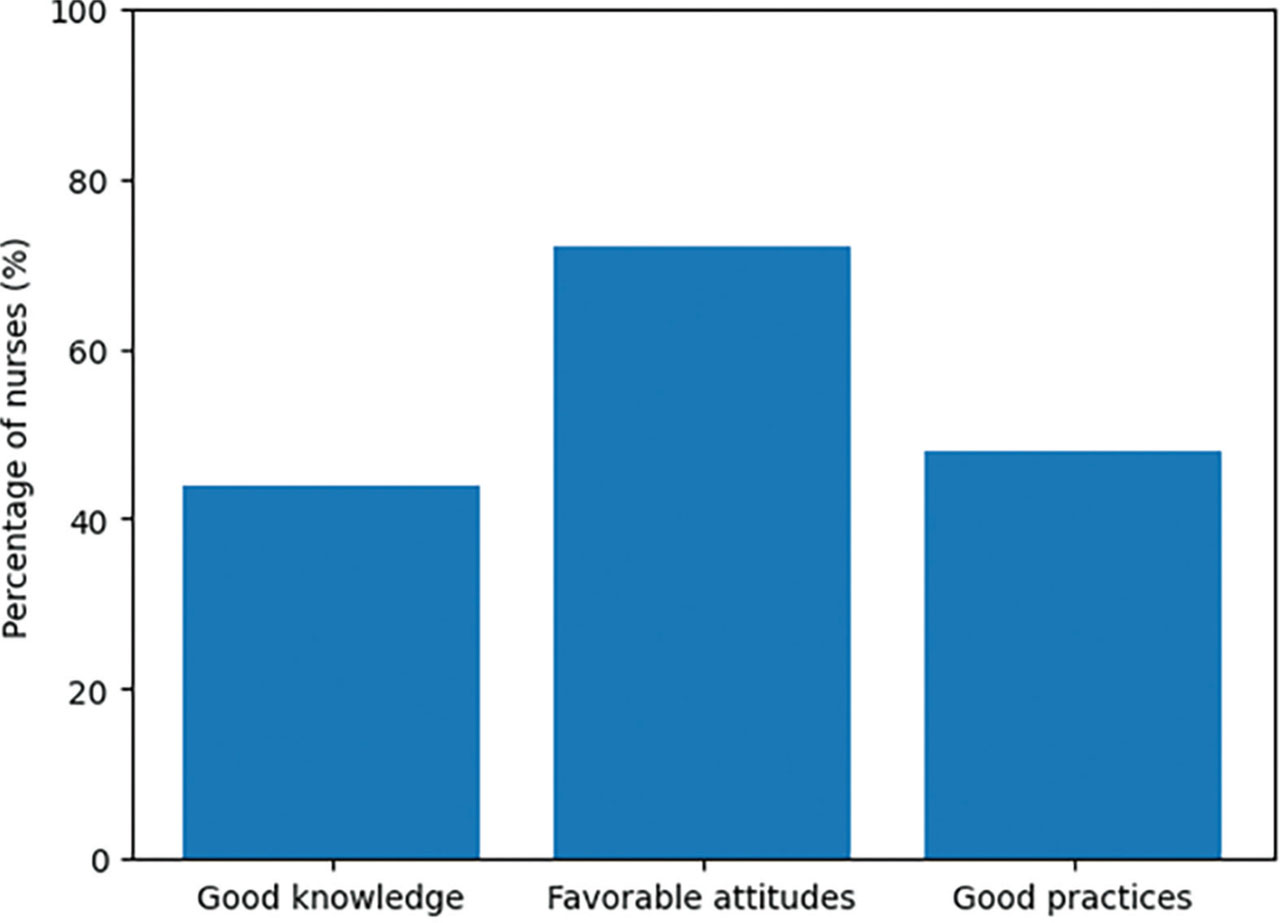
Figure 1.
Proportion of nurses with good knowledge, favorable attitudes, and good practices (n = 250).
3.5. Factors associated with good knowledge
Bivariate analyses indicated that several factors were associated with good NiV knowledge, including longer clinical experience, hospital employment, and exposure to NiV-specific and IPC training. In the multivariable logistic regression model (Table 3), having more than 10 years of nursing experience (versus <5 years) remained significantly associated with good knowledge (AOR 2.1, 95% CI: 1.2–3.7; P = 0.009). Nurses working in hospitals were also more likely to have good knowledge than those in private clinics (AOR 1.9, 95% CI: 1.1–3.3; P = 0.020).
Table 3.
Factors associated with good knowledge of NiV IPC among nurses (n = 250).
| Variable | Category | Crude OR (95% CI) | AOR (95% CI) | P-value |
|---|---|---|---|---|
| Years of experience | >10 years vs <5 years | 2.4 (1.4–4.0) | 2.1 (1.2–3.7) | 0.009* |
| Facility type | Hospital vs private | 2.1 (1.3–3.5) | 1.9 (1.1–3.3) | 0.020* |
| NiV-specific training | Yes vs No | 2.9 (1.8–4.6) | 2.4 (1.4–4.0) | 0.001* |
| IPC/emerging infection training | Yes vs No | 3.2 (2.0–5.1) | 2.8 (1.7–4.6) | <0.001* |
Training variables showed the strongest associations. NiV-specific training was independently associated with good knowledge (AOR 2.4, 95% CI: 1.4–4.0; P = 0.001), and IPC/emerging infection training within the last 2 years was likewise a strong predictor (AOR 2.8, 95% CI: 1.7–4.6; P < 0.001). These findings confirm that targeted education is critical for enhancing nurses’ understanding of NiV, echoing conclusions from earlier KAP studies on emerging infections among health care workers.4,7,15
3.6. Factors associated with good IPC practices
Similar patterns were observed for IPC practices (Table 4). In the adjusted model, more than 10 years of experience (versus <5 years) was associated with higher odds of good practice (AOR 2.3, 95% CI: 1.3–4.1; P = 0.004). Hospital employment (vs private clinics) was also associated with better practices (AOR 1.8, 95% CI: 1.1–3.0; P = 0.021), suggesting that larger facilities may offer more resources and structural support for IPC.
Table 4.
Factors associated with good IPC practices related to NiV among nurses (n = 250).
| Variable | Category | Crude OR (95% CI) | AOR (95% CI) | P-value |
|---|---|---|---|---|
| Years of experience | >10 years vs <5 years | 2.6 (1.6–4.4) | 2.3 (1.3–4.1) | 0.004* |
| Facility type | Hospital vs private | 2.0 (1.2–3.4) | 1.8 (1.1–3.0) | 0.021* |
| NiV-specific training | Yes vs No | 3.1 (1.9–5.0) | 2.6 (1.5–4.4) | <0.001* |
| IPC/emerging infection training | Yes vs No | 3.6 (2.2–5.9) | 3.0 (1.8–5.0) | <0.001* |
| Good knowledge of NiV | Yes vs No | 2.7 (1.6–4.5) | 2.4 (1.4–4.0) | 0.001* |
Training again emerged as a key determinant. NiV-specific training was independently associated with good practices (AOR 2.6, 95% CI: 1.5–4.4; P < 0.001), and IPC/emerging infection training had an even stronger association (AOR 3.0, 95% CI: 1.8–5.0; P < 0.001). Importantly, good knowledge of NiV was itself a significant predictor of good practices (AOR 2.4, 95% CI: 1.4–4.0; P = 0.001), indicating that nurses who understand NiV and its control measures are more likely to translate that knowledge into routine protective behaviors.6,11,14
3.7. Summary of key patterns
Across domains, the findings reveal a consistent profile: rural nurses in Pangasinan hold predominantly favorable attitudes toward NiV preparedness (72.0%), yet fewer than half demonstrate good knowledge (44.0%) or good IPC practices (48.0%). Training in NiV and IPC, greater clinical experience, and hospital-based work are all strongly associated with better knowledge and practices. These patterns highlight a clear attitude–practice gap and point to targeted, context-specific education and institutional support as priority strategies to strengthen NiV preparedness in rural Philippine health settings.3,4,11,10
4. Discussion
This study provides one of the first detailed examinations of nurses’ KAP regarding NiV IPC in a rural Philippine setting. Based on responses from 250 nurses working in hospitals, RHUs, and private clinics in Pangasinan, the findings offer an important snapshot of frontline preparedness for a high-consequence zoonotic pathogen that has previously caused outbreaks in Southeast Asia and the Philippines.1,3,13,19 Overall, the results reveal a mixed pattern of preparedness: although attitudes toward NiV prevention and response are predominantly favorable, fewer than half of nurses demonstrated good knowledge or consistently implemented recommended IPC practices. This combination of positive attitudes and suboptimal practices highlights a clear attitude–practice gap with important implications for training, policy development, and rural health system readiness.4,6,11,14
4.1. Interpretation of key findings
The proportion of nurses with good knowledge of NiV (44.0%) in this rural Philippine sample is broadly comparable to the 46%–50% range reported among health-care workers in recent Bangladeshi studies, where NiV is endemic, and outbreaks occur periodically.4,7 In those settings, targeted NiV-related training was also shown to substantially improve knowledge scores, while regional disparities reflected uneven access to information outside major urban centers.4,5 A similar pattern appears in Pangasinan: despite the absence of recent local NiV outbreaks, nearly half of nurses demonstrated good knowledge, particularly regarding the role of fruit bats as reservoirs and the severe neurological and respiratory manifestations of infection.1,3 Nevertheless, important knowledge gaps remain, especially concerning specific transmission routes in healthcare settings and the correct use of full PPE.1,3,7
Attitudes toward NiV preparedness were more encouraging, with 72.0% of nurses demonstrating favorable attitudes. Most respondents recognized NiV as a serious threat to both patients and healthcare workers, emphasized the importance of clear institutional protocols and adequate PPE, and expressed willingness to care for suspected NiV cases if appropriate protective measures were in place. These findings align with previous research showing that nurses typically maintain strong professional and ethical commitments to patient care even during outbreaks of high-risk pathogens such as Severe Acute Respiratory Syndrome 2 (SARS-CoV-2) and NiV.2,4,8,11 Favorable attitudes therefore represent an important foundation for preparedness because they indicate willingness to engage in outbreak response and openness to additional training and protocols.
However, only 48.0% of nurses reported good IPC practices related to NiV, despite the majority demonstrating favorable attitudes. This discrepancy between attitudes and practices has been reported in multiple studies examining infection control behavior among nurses in the Philippines and other settings, where knowledge and attitudes often exceed consistent adherence to recommended precautions.6,11,12,14 For example, a study in Catanduanes found that nurses had moderate to high knowledge of IPC measures but only moderate compliance, with knowledge explaining only part of the variability in practice.11 Similar patterns have also been observed in global surveys examining healthcare workers’ preparedness for high-risk nosocomial infections.6,12 The present findings therefore reinforce the view that positive attitudes alone are insufficient to ensure safe clinical practice; effective preparedness depends on the combined influence of knowledge, training, experience, and supportive institutional environments.6,11,14
4.2. Role of training and experience
One of the most consistent findings in this study is the strong association between training and both knowledge and practice. In multivariable analyses, nurses who had received NiV-specific training or IPC/emerging infection training within the previous 2 years were substantially more likely to demonstrate good knowledge and good practices, even after adjusting for potential confounders. NiV-specific training was associated with approximately 2.4-fold higher odds of good knowledge and 2.6-fold higher odds of good practice, while IPC/emerging infection training was associated with nearly 2.8-fold higher odds of good knowledge and 3.0-fold higher odds of good practice. These effect sizes are consistent with previous NiV KAP studies in Bangladesh and with broader evidence indicating that structured, disease-specific training can significantly enhance healthcare workers’ understanding and adherence to infection prevention protocols.4,7,14,15
Clinical experience also emerged as an important predictor. Nurses with more than 10 years of professional experience had approximately twice the odds of demonstrating good knowledge and good practices compared with those with fewer than 5 years of experience. This finding aligns with international literature suggesting that experienced nurses develop stronger clinical judgment, greater familiarity with infection patterns, and more consistent adherence to IPC procedures through accumulated exposure to training and clinical practice.2,4,6,11 However, reliance on experience as a determinant of preparedness also raises concerns. Less experienced nurses—who often constitute a large portion of the workforce and may rotate through high-risk units—may be less prepared to respond effectively to NiV without targeted training and mentorship. In rural settings with limited specialist support, this gap could have important implications during emerging infectious disease outbreaks.3,11,10
The association between hospital employment and better KAP outcomes compared with private clinic settings also warrants attention. Hospital-based nurses had significantly higher odds of demonstrating good knowledge and practices, suggesting that larger institutions may provide greater access to training opportunities, resources, and structured IPC programs.11,14 In contrast, nurses working in smaller private clinics may face barriers to continuing professional development and may have limited capacity to implement advanced infection control measures such as isolation areas and full PPE protocols, particularly in resource-constrained rural environments.10,11 These findings are consistent with broader health systems analyses highlighting the vulnerability of primary care and peripheral facilities during emerging infectious disease outbreaks.9,10
4.3. The attitude–practice gap
One of the most striking findings of this study is the clear gap between attitudes and practices. While nearly three-quarters of nurses expressed favorable attitudes toward NiV preparedness, fewer than half reported consistently implementing key IPC behaviors, including full PPE use and strict isolation precautions for undifferentiated severe febrile or neurologic cases. Similar attitude–practice gaps have been documented in numerous KAP studies on infection control and emerging zoonotic diseases.4,6,11,12,14
Several factors may contribute to this pattern. At the individual level, nurses may possess general awareness of emerging infectious disease risks but lack detailed procedural knowledge for managing rare pathogens such as NiV.1,3,6,7 At the organizational level, IPC practices may not be consistently reinforced through supervision, role modeling, or feedback mechanisms.12,15 Structural factors—including shortages of PPE, limited isolation capacity, and high patient workloads—may further constrain adherence to recommended precautions, even among motivated healthcare workers.10,11,14 The present findings suggest that these interacting factors may influence practice in rural Pangasinan, where nurses reported partial adherence to complex IPC measures despite generally positive attitudes and some exposure to training.
Addressing this gap will therefore require interventions that extend beyond knowledge transfer alone. Research on behavior change and implementation science in infection control emphasizes the effectiveness of multimodal strategies combining education, leadership engagement, regular feedback and audits, and system-level improvements in supplies and infrastructure.10,11,14 In the context of NiV preparedness, such strategies may include simulation-based training, scenario-based triage exercises, peer-led reinforcement of donning and doffing procedures, and integration of relevant IPC practices into routine clinical workflows rather than restricting them to outbreak situations.2,4,11
4.4. Comparison with regional and Philippine studies
The present findings are broadly consistent with existing NiV KAP and IPC research conducted in South and Southeast Asia. Studies among healthcare workers in Bangladesh have reported modest NiV knowledge, generally positive attitudes, and variable practice patterns, with training exposure and facility type emerging as important predictors of preparedness—patterns that closely resemble those observed in Pangasinan.4,5,7 Community-level research in Bangladesh has also identified persistent misconceptions regarding NiV transmission and prevention, highlighting the importance of aligning healthcare worker education with broader community risk communication strategies.5
Within the Philippines, empirical research on NiV preparedness among nurses remains limited, but studies examining infection control and emerging infectious diseases offer useful parallels. Research conducted in Catanduanes reported moderate correlations between knowledge and IPC compliance, while also identifying workload, supply limitations, and infrastructure constraints as key barriers to consistent practice.11 Another Philippine study examining nurses’ knowledge, attitudes, and willingness to care for patients with emerging infections found strong ethical commitment among nurses but also identified concerns related to institutional readiness and personal risk.12 Together, these findings suggest that improving preparedness in Pangasinan will require both individual-level training initiatives and broader system-level improvements in infection control infrastructure.2,4,10,11
Beyond describing the current preparedness landscape, this study contributes new empirical evidence regarding NiV preparedness among nurses in rural healthcare settings in the Philippines, a context where published data remain extremely limited. While previous NiV preparedness research has largely focused on healthcare workers in South Asia, particularly Bangladesh and India, this study provides one of the first systematic assessments of NiV-related KAP among nurses in a Philippine rural health system.3,4,7,11 The identification of a clear attitude–practice gap and the recognition of training, clinical experience, and facility type as key determinants of preparedness offer practical insights that can inform targeted training programs and infection prevention policies aimed at strengthening frontline readiness for emerging zoonotic diseases.
Finally, this study provides a baseline against which future interventions and policy initiatives can be evaluated. Repeating similar KAP surveys following training programs, simulation exercises, or policy reforms would allow health authorities to monitor progress and refine preparedness strategies in accordance with global recommendations for managing emerging zoonotic diseases.9,10
5. Conclusions
This study provides important insight into the preparedness of nurses for NiV IPC in rural Pangasinan, a province located within the broader ecological risk zone for henipaviruses in the Philippines. 1,3,10 Although NiV outbreaks have not recently been documented in the area, the presence of bat reservoirs, livestock production systems, and close human–animal interactions underscores the importance of proactive preparedness rather than reactive response.1,3,10
The findings reveal a mixed pattern of preparedness among rural nurses. Encouragingly, most participants demonstrated favorable attitudes toward NiV prevention and outbreak response, reflecting strong professional commitment and willingness to provide care under appropriate protective conditions.2,4,8,11 However, this positive attitudinal foundation contrasts with more modest levels of knowledge and infection prevention practices. Less than half of the nurses achieved good knowledge and practice scores, with gaps particularly evident in understanding transmission risks in health-care settings and the correct use of PPE. Similar patterns have been reported in previous studies of healthcare worker preparedness for emerging infectious diseases.4,5,7,11,12
Importantly, the study identified several factors associated with better preparedness. Training—both NiV-specific and broader IPC education—emerged as a strong predictor of improved knowledge and practice, supporting previous evidence that structured training programs significantly enhance healthcare worker readiness for emerging pathogens.4,7,14,15 Clinical experience and employment in hospital-based settings were also associated with stronger knowledge and practice outcomes, suggesting that institutional resources, mentorship, and repeated exposure to infection control protocols play important roles in strengthening preparedness.2,4,6,11,14
Overall, the findings highlight a clear attitude–practice gap: while rural nurses demonstrate strong motivation to respond to NiV threats, gaps in knowledge and infection control practices may limit their ability to translate this commitment into consistent and safe clinical behaviors. Addressing this gap will require targeted training programs, strengthened infection prevention infrastructure, and institutional support, particularly in smaller rural healthcare facilities. Continued monitoring of preparedness through KAP studies will also be essential to guide policy and ensure that frontline nurses are equipped to respond effectively should NiV or other emerging zoonotic diseases occur in the Philippines.
Acknowledgments
The authors gratefully acknowledge the nurses who participated in this study for generously sharing their time and perspectives, and the management of the participating rural health facilities in Pangasinan for facilitating data collection. The authors also thank the expert panel members—two nurse educators, one infectious disease physician, one epidemiologist, and one rural health-nursing supervisor—for their contributions to questionnaire validation, as well as the data collectors for their diligence and professionalism.
Notes
[9] Availability of data and materials
The datasets generated and analyzed during the current study are not publicly available in order to protect the anonymity of participating nurses and healthcare facilities. Following acceptance of this manuscript, the de-identified dataset and study materials will be deposited as a public data package in Mendeley Data, and a DOI-linked citation will be included in the final published version. Until that time, de-identified data may be obtained from the corresponding author upon reasonable request and subject to approval by the relevant ethics committee and institutional authorities.
[10] Use of artificial intelligence
Artificial intelligence (AI)–assisted tools were used solely for language editing, text refinement, and formatting of this manuscript, including clarification of wording in the abstract and main text. The study design, data collection, statistical analysis, and interpretation of findings were conducted independently by the authors. All numerical results, tables, and figures are based on the authors’ original data analyses. The authors reviewed and edited all AI-generated text and take full responsibility for the content of the final manuscript.
[11] Contributed by Authors’ contributions
Fernan Torreno: Conceptualization of the study; research design; development and validation of the questionnaire; coordination and supervision of data collection; statistical analysis; interpretation of findings; drafting of the manuscript; and critical revision for important intellectual content.
Frincess Flores: Contribution to study conceptualization; contextualization of the research within Philippine rural health and nursing education settings; review and validation of the questionnaire; assistance in interpretation of findings; drafting and revision of selected sections of the manuscript; and critical review of the final manuscript.
All authors read and approved the final manuscript.