
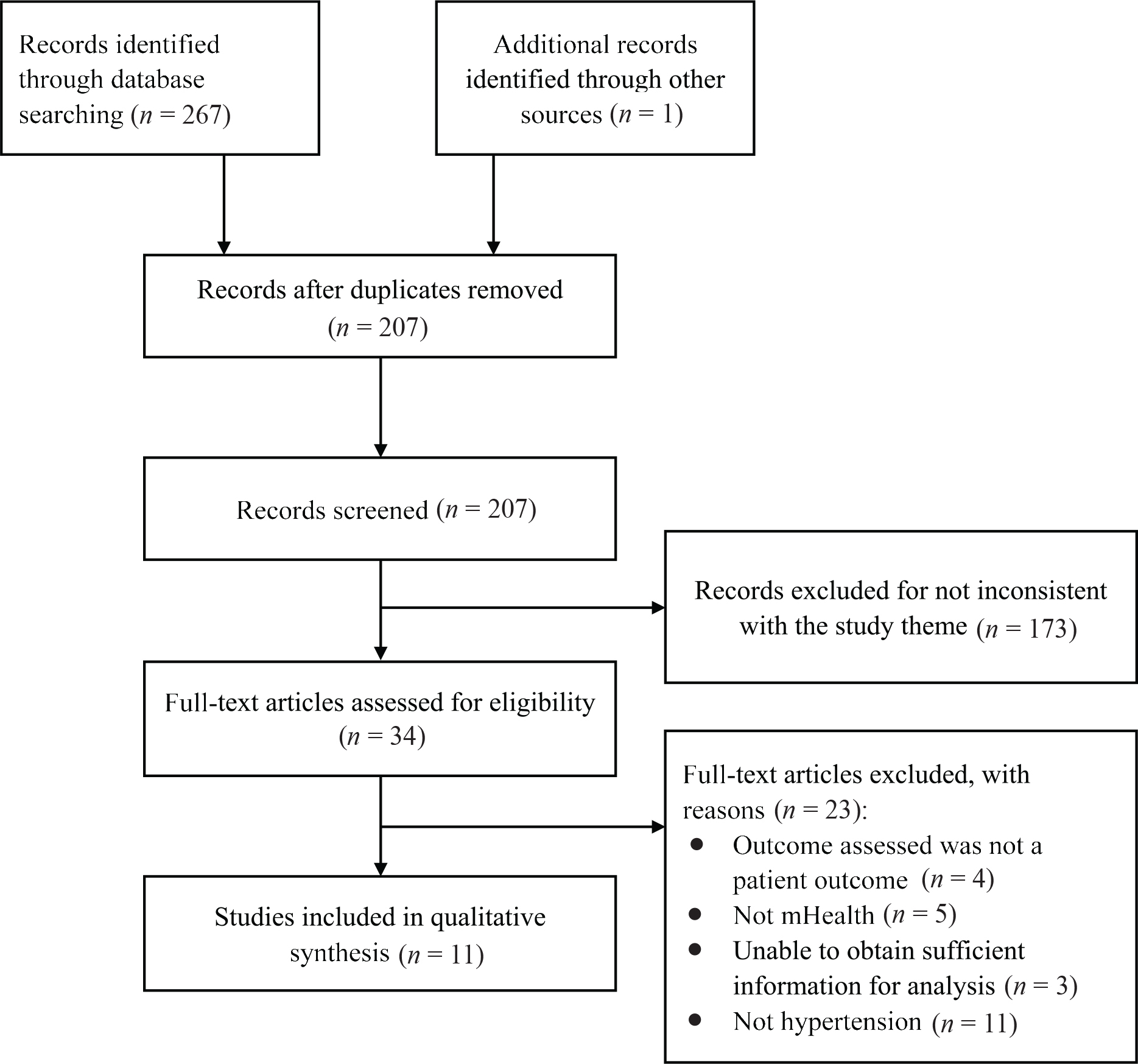
Figure 1.
Flowchart of searching and selection process.
Table 1.
Characteristics of included studies.
| First author (year) | Journal | Country | Databases | Type of study included | No. of included studies | Range of year of publication | No. of patients | Intervention (target function) | Duration (months) | Outcomes measures | Meta-analysis | Quality assessment |
|---|---|---|---|---|---|---|---|---|---|---|---|---|
| Xu and Long (2020)22 | JMIR ml·lealth U health | N/A | MEDLINE, Embase, PubMed, Cochrane Library databases | RCT | 8 | 2012-2020 | 1657 | Mobile phone apps (selfmanagement) | 1.5–18 | SBR DBR MA, physical activity | Y (mHlealth favors) | RoB |
| Li et al. (2020)8 | JMIR mHlealth U health | USA (11), Canada (3), Spain (1), Iran (1), UK (3), Honduras and Mexico (1), Korea (1), China (1), South Africa (1), Chile (1) | PubMed, Embase, Web of Science, Cochrane, Google Scholar | RCT | 24 | 2010–2019 | 8933 | App-based tools that are accessible via mobile phone or tablet (selfmanagement) | 1.5–18 | SBR DBR MA, selfmanagement behavior, cost | Y (mHlealth favors) | RoB |
| Choi et al. (2020)20 | Telemed J E Health | USA (14), Italy (2), Spain (1), Denmark (2), UK(1), South Korea (3), Canada (1), Germany (1), Argentina, Guatemala, Peru (1), Finland (1) | Embase, EBSCOhost, the Cochrane Library, ProQuest, Medline | RCT | 27 | 1996–2017 | 9435 | Telephone, internet, mobile phones, and letters (remote monitoring of BP) | 3–13 | SBR DBR the target BP achievement rate | Y (mHlealth favors) | RoB |
| Jamsh¡dnezhad et al. (2019)21 | Acta Inform Med | USA (3), Sweden (1), Vietnam (1), Spain (1) | The Scopus, PubMed | RCT, Before and after clinical trial | 6 | 2015–2019 | N/A | Mobile phone apps (self-care) | 2–9 | BR MA, high-risk behaviors | N | N/A |
| Wang et al. (2019)24 | Journal of Cardiovascular and Pulmonary Diseases | USA (7), UK (2), Argentina (1), Canada (1), Spain (1) | PubMed, Cochrane library, CNKI, Wanfang database | RCT | 12 | 2008–2017 | 4015 | Internet (selfmanagement) | 1.5–12 | SBR DBP | Y (mHlealth favors) | RoB |
| Yu et al. (2019)25 | Journal of Preventive Medicine | China (11) | PubMed, Cochrane Library, CNKI, Wanfang database, VIP | RCT | 11 | 2015–2018 | 1174 | Smartphone app (selfmanagement) | 3–12 | SBR DBP | Y (mHlealth favors) | RoB |
| Alessa et al. (2018)26 | JMIR mHlealth U health | Spain (2), South Korea (1), USA (9), China (1), South Sweden (2), Sweden (1), Canada (2), France (1), Italy (1) | MEDLINE (OVID), Embase (OVID), PsycINFO (OVID), CINAHL, the Cochrane Central Register of Controlled Trials (CENTRAL, The Cochrane Library), IEEE Xplore ASSIAN, Google Scholar and the main Arabic databases Al Manhal, AskZad, Mandumah | All quantitative, qualitative, and mixed-method studies | 21 | 2012–2017 | 3112 | Mobile phone or a tablet app (monitor, feedback, counseling, selfmanagement) | 3–13 | SBR DBP | N | RoB |
| Xiong et al. (2018)27 | CurrHypertens Rep | UAE (1), Sweden (1), South Africa (1), Austria (1), USA (9), Iran (2), Pakistan (1), South Korea (1), Malaysia (1), Bolivia (1). Chile (1), England (1) | PubMed, Embase, Web of Science | RCT COT, Before and after study | 21 | 2012–2017 | N/A | Smart phone, text message, application (MA) | 1–12 | SBR DBR MA | N | N/A |
| Fei et al. (2018)28 | Chinese Journal of Cardiovascular Medicine | China (33) | CNKI, Wanfang database, VIP | RCT | 33 | 2008–2017 | 8959 | Internet (selfmanagement) | N/A | SBR DBR MA, lifestyle changes | Y (mHlealth favors) | Jadad |
| Chandak and Joshi (2015)29 | Technol Health Care | N/A | PubMed | RCT | 12 | 2009–2013 | N/A | Internet, computer and cell phone (selfmanagement) | 6–24 | SBR DBR MA | N | N/A |
| Verberk et al. (2011)30 | Blood Press Monit | N/A | PubMed, Medline, Embase, the Cochrane databases | RCT | 9 | 1996–2010 | N/A | Telephone, internet, or mail (selfmanagement) | 2–12 | SBR DBP | Y (mHlealth favors) | N/A |
Table 2.
Methodological quality of 11 studies based on AMSTAR 2 criteria.
| Reference | Q1 | Q2 | Q3 | Q4 | Q5 | Q6 | Q7 | Q8 | Q9 | Q10 | Q11 | Q12 | Q13 | Q14 | Q15 | Q16 |
|---|---|---|---|---|---|---|---|---|---|---|---|---|---|---|---|---|
| Xu and Long (2020)22 | Y | Y | NA | Y | Y | N | Y | Y | Y | NA | Y | NA | Y | Y | N | Y |
| Li et al. (2020)6 | Y | Y | N | Y | Y | Y | Y | Y | Y | Y | Y | Y | Y | Y | Y | Y |
| Choi et al. (2020)20 | Y | Y | NA | Y | Y | Y | Y | Y | Y | Y | Y | Y | Y | Y | NA | Y |
| Jamshidnezhad et al. (2019)21 | Y | NA | N | Y | Y | Y | Y | Y | N | Y | NA | NA | N | N | NA | Y |
| Wang et al. (2019)24 | Y | NA | N | Y | NA | NA | Y | Y | Y | N | Y | N | N | N | N | NA |
| Yu et al. (2019)25 | Y | NA | Y | Y | Y | NA | Y | Y | Y | Y | Y | Y | Y | Y | Y | Y |
| Alessa et al. (2018)26 | Y | NA | NA | Y | Y | Y | Y | N | Y | Y | NA | NA | Y | Y | NA | Y |
| Xiong et al. (2018)27 | Y | NA | NA | Y | Y | Y | Y | Y | NA | NA | NA | NA | Y | Y | NA | Y |
| Fei et al. (2018)28 | Y | NA | Y | Y | NA | NA | N | Y | Y | N | Y | Y | N | Y | N | NA |
| Chandak and Joshi (2015)29 | Y | NA | NA | Y | NA | NA | NA | NA | NA | NA | NA | NA | NA | NA | NA | NA |
| Verberk et al. (2011)30 | Y | NA | NA | Y | NA | NA | Y | Y | Y | NA | Y | Y | N | N | Y | Y |
1 Note:
Q1: Did the research questions and inclusion criteria for the review include the components of PICO?
Q2: Did the report of the review contain an explicit statement that the review methods were established prior to the conduct of the review, and did the report justify any significant deviations from the protocol?
Q3: Did the review authors explain their selection of the study designs for inclusion in the review?
Q4: Did the review authors use a comprehensive literature search strategy?
Q5: Did the review authors perform study selection in duplicate?
Q6: Did the review authors perform data extraction in duplicate?
Q7: Did the review authors provide a list of excluded studies and justify the exclusions?
Q8: Did the review authors describe the included studies in adequate detail?
Q9: Did the review authors use a satisfactory technique for assessing the RoB in individual studies that were included in the review?
Q10: Did the review authors report on the sources of funding for the studies included in the review?
Q11: If meta-analysis was performed, did the review authors use appropriate methods for statistical combination of results?
Q12: If meta-analysis was performed, did the review authors assess the potential impact of RoB in individual studies on the results of the metaanalysis or other evidence synthesis?
Q13: Did the review authors account for RoB in individual studies when interpreting/discussing the results of the review?
Q14: Did the review authors provide a satisfactory explanation for, and discussion of, any heterogeneity observed in the results of the review?
Q15: If they performed quantitative synthesis, did the review authors carry out an adequate investigation of publication bias (small study bias) and discuss its likely impact on the results of the review?
Q16: Did the review authors report any potential sources of conflict of interest, including any funding they received for conducting the review?
Table 3.
Summary of results of the 11 reviews on the effectiveness of mHealth for hypertension management.
| Study | Outcomes and main results | Conclusions | Limitations | ||||
|---|---|---|---|---|---|---|---|
| SBP reduction | DBP reduction | BP normalization rate | MA | Self-management behaviors | |||
| Xu and Long (2020)22 | –2.28 mmHg (95%¤CI: –3.90 to –0.66; I2 40%) | –1.84 mmHg (95%CI: –3.49 to –0.19; I2 = 54%) | N/A | SMD = 0.38 (95%CI: 0.26– 0.50; I2 = 0%) | No difference between groups was demonstrated with respect to physical activity. One study showed a significant effect of reducing smoking and one study showed a significant effect of confidence in controlling BP | A smartphone intervention leads to a reduction in BP and an increase in MA for people with hypertension | Few studies included in this meta–analys¡s, included trials were mainly conducted in North America and East Asia |
| Li et al. (2020)8 | SBP: –3.78 mmHg (P < 0.001; 95%CI –4.67 to –2.89) | DBP: –1.57 mmHg (P < 0.001; 95%CI –2.28 to –0.86) | N/A | 7 articles reported statistically significant improvement in intervention groups | Of the 9 articles that focused on the behavioral change of self–management, all reported positive effects either through physical activities or through a healthier diet | mHealth self–management interventions were effective in BP control. The outcomes of this review showed improvements in selfmanagement behavior and medication adherence | Observed heterogeneities, only recruited RCTs, restricted to English |
| Choi et al. (2020)20 | SBP: –3.482 mmHg (P < 0.001; 95%CI 2.459–1.505) | DBP: –1.638 mmHg (P < 0.001; 95%CI 1.084– 2.192) | The RBPM group showed a significantly larger improvement (45.05% vs. 38.42%) | N/A | N/A | RBPM performed on urban hypertensive patients has limited value and seems not to be superior to ordinary care in avoidance of cardio vascular events | No detail analysis of marginalized areas, not generalizing the achievement rates of target, BP strategy is not perfect |
| Jamshidnezhad et al. (2019)21 | N/A | N/A | 3 of 6 studies confirmed the effect of using mobile applications on lowering BP | 1 of 6 studies reported significant effect | 1 study showed a significant effect on reducing smoking | Mobile apps have positive potential on improving the self–care behavior | The low number of studies, meta–analysis was not possible, non–English studies were not included |
| Wang et al. (2019)24 | –3.41 mmHg (95%CI: –3.49 mmHg to –3.32 mmHg; I2 = 100%, P < 0. 001) | –1.5 mmHg (95%CI: –2.2 mmHg to –0.8 mmHg; I2 = 62%, P < 0. 001) | N/A | N/A | N/A | The internet intervention group significantly lowered the BP | Included only English studies |
| Yu et al. (2019)25 | 14.77 mmHg (95%CI: 11.76– 17.77 mmHg; I2 = 89.7%, P < 0. 001) | 8.17 mmHg (95%CI: 5.67– 10.67 mmHg; I2 = 85.6%, P < 0. 001) | N/A | N/A | N/A | The intervention based on WeChat is more helpful than traditional health intervention for BP control of patients with hypertension | Only include Chinese literatures, quality of the included literature is low heterogeneity |
| Alessa et al. (2018)26 | 6 of 9 studies demonstrated positive effects showed a significant decrease in SBP from 8.7 mmHg to 34.8 mmHg | Significant decreases in DBP were reported in 2/6 studies, ranging from 4.9 mmHg to 12 mm Hg | N/A | N/A | N/A | Most of the studies reported that apps might be effective in lowering BP | Restricted to English, meta–analysis was not possible, the inclusion of controlled and non–controlled studies might yield inconclusive results |
| Xiong et al. (2018)27 | SBP reduction from 2.06 mmHg to 47.2 mmHg | DBP reduction from 1.28 mmHg to 19.91 mmHg | 12 of 16 studies reported significantly better BP reduction in the intervention groups | All 21 studies included in the review indicated a higher level of MA after the intervention, and 12 studies were able to report significantly better MA outcomes for their mHlealth intervention groups | N/A | mHealth interventions improved MA and BP control | Included only published trials, included only English studies, meta-analysis was not possible |
| Fei et al. (2018)28 | –12.73 mmHg (95%CI: –15.80 mmHg to –9.66 mmHg; P < 0.01) | –8.05 mmHg (95%CI: –10.51 mmHg to –5.59 mmHg; P < 0.01) | N/A | RD = 0.29 (95%CI: 0.24– 0.34, P < 0.01) | Regular exercise (RD = 0.29, 95%CI: 0.22–0.36, P < 0.01), Regular monitoring (RD = 0.30, 95%CI: 0.21–0.39, P < 0.01), Better diet (RD = 0.32, 95%CI: 0.26–0.38, P < 0.01) | Mobile network–based health education can effectively improve BP levels and lifestyles | Observed heterogeneities, the methodology quality of the included studies is low |
| Chandak and Joshi (2015)29 | Two telemonitoring interventions showed significant reductions in mean SBP for the intervention group | One telemonitoring study showed significant reduction in mean DBP for the intervention group | N/A | N/A | N/A | N/A | Included only English studies, strategy is not perfect |
| Verberk et al. (2011)30 | SBP: 5.2 ± 1.5 mmHg; P < 0.001 | BP: 2.1 ± 0.8 mmHg; P < 0.01 | N/A | N/A | N/A | TC led to a greater decrease in SBP and DBP than UC | |
1 Note: BR =blood pressure; DBR = diastolic blood pressure; MA, medication adherence; N/A,= not available; RCTs, randomized controlled trials; SBR = systolic blood pressure; RBPM, remote blood pressure monitoring; TC, telecare; UC, usual care; Cl, confidence interval; RD, risk difference; SMD, standardized mean difference.