
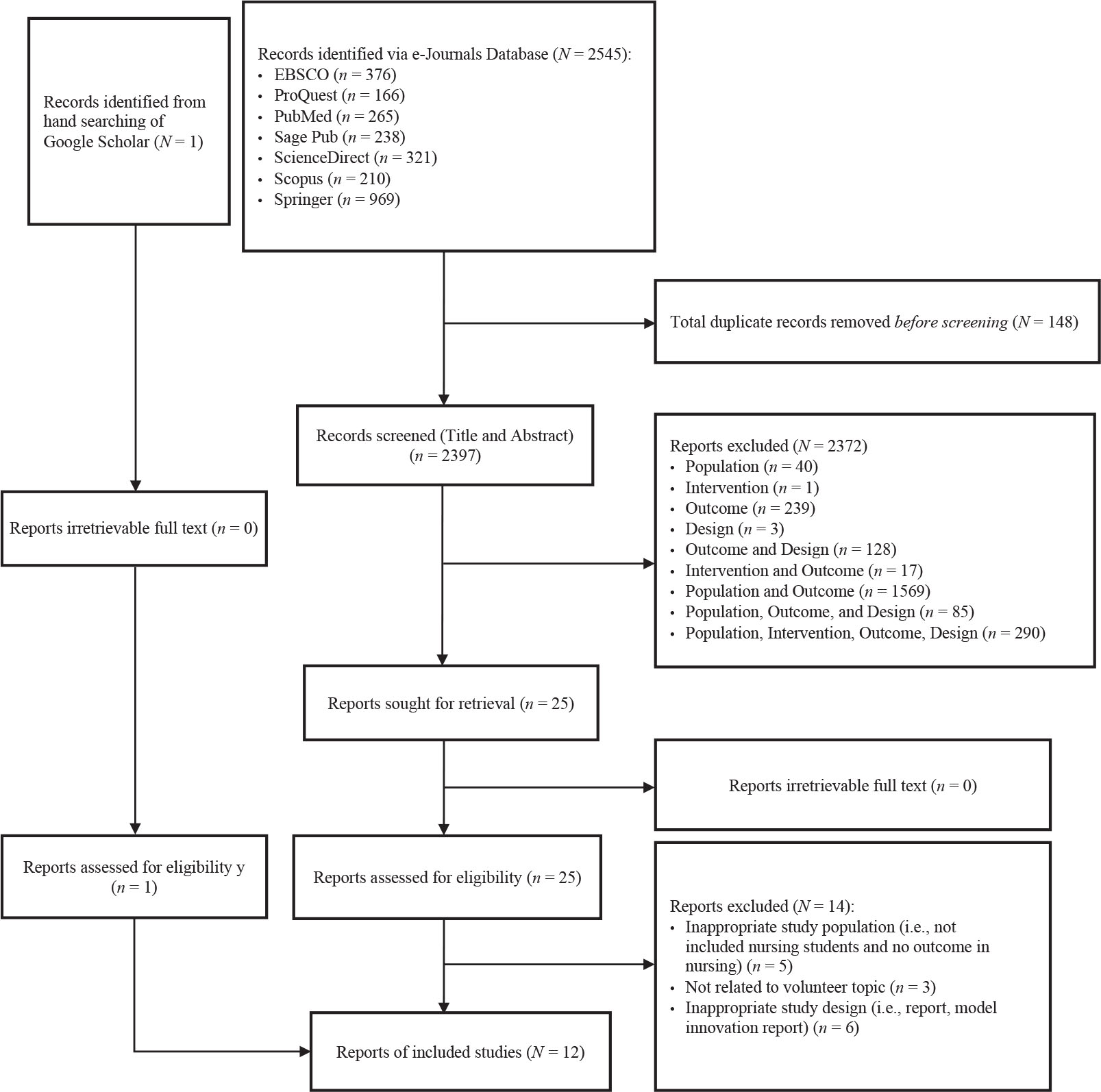
Figure 1.
PRISMA flow diagram used in selecting studies.
Table 1.
Characteristics of included studies.
| Characteristics of studies | Number of studies | % |
|---|---|---|
| Publication Year | ||
| 2020 | 1 | 8.3 |
| 2021 | 11 | 91.7 |
| Country | ||
| Saudi Arabia | 1 | 8.3 |
| Spain | 5 | 41.7 |
| Poland | 3 | 25.0 |
| Malaysia | 1 | 8.3 |
| Singapore | 1 | 8.3 |
| Brunei Darussalam | 1 | 8.3 |
| Health care setting | ||
| MOH services | 1 | 8.3 |
| Hospital/nursing home/ quarantine facility | 3 | 25.0 |
| Hospital and Medicalized hotel | 1 | 8.3 |
| Hospital and local call centers | 2 | 16.7 |
| Hospital | 3 | 25.0 |
| Not mentioned | 2 | 16.7 |
| Design Study | ||
| Cross-sectional study | 3 | 25.0 |
| Qualitative study | 6 | 50.0 |
| Survey study | 3 | 25.0 |
| Participants and field of study | ||
| Health students, including nursing students (n = 6591) | 4 | 33.3 |
| Medical students and nursing students (n = 304) | 1 | 8.3 |
| Nursing students (n =224) | 7 | 58.3 |
| Sex | ||
| Female (n = 4355) | 12 | 61.2 |
| Male (n = 2764) | 38.8 | |
| Age (mean) | ||
| 18–22 | 3 | 25.0 |
| 23–25 | 7 | 58.3 |
| N/A | 2 | 16.7 |
| Marital status | ||
| Single (n = 5739) | 3 | 25.0 |
| Married (n = 367) | ||
| N/A | 9 | 75.0 |
| Previous volunteering experience | ||
| Yes (n = 2566) | 9 | 75.0 |
| No (n = 4186) | ||
| N/A | 3 | 25.0 |
| Volunteers contribution | ||
| Patient care or support | 5 | 41.7 |
| Phlebotomists | 1 | 8.3 |
| N/A | 6 | 50.0 |
Table 2.
A summary of the characteristics of the studies.
| Authors year and country | Objective | Number of participants | Previous volunteering experience | Marital status | Age (mean) and sex (M/F) | Design | Volunteer in a health care setting | The contribution of volunteers | Outcome (s) and measure (s) | Key findings | |
|---|---|---|---|---|---|---|---|---|---|---|---|
| Alomar et al.29 Saudi Arabia | To assess motivational, barrier factors, and risk perceptions of volunteering for COVID-19 | Volunteered (1824): 1628 health student, 196 nursing No volunteered (4192): 3888 health student, 304 nursing | One or more experience in sports, hospitals, schools, religious events, social and others | Volunteers: 1712 single, 100 married, 8 Divorced, 4 Widowed; Non-volunteers: 3978 Single, 204 Married, 10 Divorced | Volunteers: Mean 22.56 M: 936 F: 888 Non-volunteers: Mean 21.87 M:1574 F: 2618 | Cross-sectional study | MOH services | N/A | Questionnaire (demographics, volunteering, risk perception). | (1) 39.20% were nursing students. Men older (P < 0.0001) and in good health were more likely to volunteer. (2) Motivation: 21.05% patriotism, 20.85%gaining experience, 19.03%helping when able, and 16.19%religious awards. (3) Barriers: Lack of interest, protocol, knowledge, and personal issues: transportation health, especially in women than men (58.13% and 41.87%, respectively). 68.42% of participants were afraid. | |
| Canet-Vélez et al.30 Spain | To explore students’ perception and professional development during the COVID-19 | 22 final-year nursing students | 8 students in the health field | N/A | Mean 23 M: 3 F: 19 | Qualitative study | Hospital (20/91%) and nursing homes (2/9%) | N/A | Semi-structured interview: (academic preparation, professional development, patient care) | Four themes: (a) Professional preparation, (b) Education received: effective learning and training, (c) Nurses in the face of COVID-19, d) Patients treated with COVID-19: emotional control, family isolation, and lack of communication. Final-year students positively assess competency, and professional values are significant for patient care. | |
| Chawłowska et al.25 Poland | To examine students’ perceptions of their participation in a COVID-19 volunteer program. | 158 health student volunteers: 112 Medicine, 10 Nursing, 10 Medical laboratory, 6 Dentistry, 5 Public health, 4 Midwifery, 11 Other fields | 117 students | N/A | Mean 23.3 M: 43 F: 115 | Survey | Hospital/ nursing home/ quarantine facility | Patient care or support: 51.27%temperature,46.84% medical history, 19.62% 36.07%, transport, 35.44% triage, 27.85%documentation, 16.45%educational, 10.13% Supporting, 8.86% laboratories, | 1. Questionnaire (demographic, experience, safety, costs, benefits, and incentives). 2. Interviews: benefits, costs, safety and internship, curricular activity. | (1) Student perception: conditions and safety: 89.24% personal protective equipment, 88.61% technical support, 79.11% training, 38.61% psychological support, 65.82% received good learning engaging, soft skills development experience (social 86.08%; organization 78.48%, stress management 68.99%), 40.51% development of their medical skills. (2) Interviews: insight into treatment systems, psychological support, met opportunities for mentoring. | |
| Cheah et al.26 Malaysia | To determine the commitment, willingness, and factors related to students treating COVID-19 patients. | 304 medical students and nursing students | N/A | N/A | Mean 21.5 M: 56 F: 248 | Cross-sectional study | N/A | Patient care or support: 91.1%a medical history and physical examination 83.6% Throat swabbing, 82.2% Drawing blood, 76.6% IV drip insertion, 46.4% Performing surgery | Questionnaire (sociodemographic, willingness, and commitment) | Nursing students’ overall willingness and commitment to COVID-19 is relatively high. Students’ willingness to perform medical procedures was moderate to high. 92.4% are passionate about fighting COVID-19, 94.4% agree with a monthly salary increase, and 88.2% agree that their families receive compensation. Universities need clinical teaching for future preparation in the pandemic. | |
| Domaradzki and Walkowiak27 Poland | To learn more about health professional student volunteers during the COVID-19 | 417 Students: 256 Medicine, 42 Nursing, 23 Pharmacy, 20 Electroradiology, 19 Medical analytics, 14 Dentistry, 11 Midwifery, 10 Medical, Rescue, 22 Other | 300 students | N/A | N/A M: 116 F: 301 | Survey | Hospital and local call centers | Patient care or support: 39.8%Administrative, 33.3% emergency, 21.3%, patients’ medical history, 18% hospital ward, 7% telephone advice. | Questionnaire: student volunteer’s experiences. | (1) 59.2% of students consulted parents and 51.3%friends, 3.6% had a little regret as a volunteer, 85% volunteer is not as difficult as expected. (2) Reasons to volunteer: 58.8% help others, 46.5% benefit society, 4.1% professional resumes, 23.5%role of medical personnel, and 12.7% have experience. The primary role is to support the health care system, helping learn practically. Ethical dilemmas reinforce essentials. Student volunteers are integrated into education. | |
| Domaradzki and Walkowiak28 Poland | To determine the relationship between religion and motivation to volunteer for students during the COVID-19 | 417 Students, 256 Medicine, 42 Nursing, 23 Pharmacy, 20 Electroradiology, 19 Medical analytics, 14 Dentistry, 11 Midwifery, 10 Medical rescue, 22 Other | 300 students | N/A | N/A M: 116 F: 301 | Survey | Hospital and local call centers | N/A | The questionnaire: (demographic, reactions, and anxieties related to voluntary service, motivations) | (1) Volunteerism is high in second and final-year students (56.1% vs. 43.9%). (2) Religion played an essential role in students from the smallest cities (P = 0.021), while ambivalent/non-religious students lived in large cities (P = 0.03). It did not differ in gender, faculty, and year of study. (3) Non-religious students were more anxious about the possible collapse of health services (P = 0.002) and economic (P = 0.014). Religion is not the primary predictor of student volunteerism but determines motivation. | |
| Seah et al.31 Singapore | This study explores the factors that influence students’ willingness to volunteer during the COVID-19 | 30 Final-year Nursing Students: Volunteers (15) Non-volunteers (15) Lecturers (3) provided supervision to the student volunteers | Volunteers: 14 students Non-Volunteers: 9 students | N/A | Volunteers: Mean 23.5 M: 9, F: 24 Non-Volunteers: Mean 22.6 M: 2, F: 13 Lecturers (n = 3) M: 1 F: 2 | Qualitative study | Hospital | Phlebotomists | Interview: willingness, consideration factors, professional identity, areas of improvement to voluntary participation | Three themes: (1) indecisive thoughts about volunteerism, (2) bring up “nurses” in students through volunteerism, and (3) prepare to volunteer. Factors were affecting priority-protecting family safety, health care system, remuneration, professional functioning, and identity. The sense of profession is strengthened by gathering clinical experience. However, some participants expressed fear. Findings need a volunteer management team for preparedness. | |
| Martin-Delgado et al.32 Spain | Describe the direct experience of student volunteers during the first wave of COVID-19. | 40 final-year nursing students (80%) | N/A | N/A | Mean 24.65 M: 5 F: 135 | Qualitative study | Hospital: 25 different health care settings | Patient care or support: Perform patient care under the supervision of a registered nurse | Reflective journal: student experiences as frontline staff. | Four main themes: (a) Willingness to help and moral obligation, regardless of fear and risk of being infected, (b) Security and protection measures, (c) Amazing experience, (d) Learning and growth roles from students to professionals and learning opportunities. Reflective journaling strategies, online mentoring, and professional personal growth can significantly respond to future health crises. | |
| Gómez-Ibáñez et al.35 Spain | To clarify the experience of nursing student volunteers in providing nursing care during the COVID-19 | 20 final-year students | N/A | 20 Single | Mean 23 M: 3 F: 17 | Qualitative study | Hospital and Medicalized hotel: 20%COVID, 20%Emergency, 5% Intensive Care Unit (ICU), 10%Convalescence, 10% pavilion, 35%Medicalized | N/A | Semi-structured online interviews to explore the experiences of volunteers. | (1) Feelings of commitment: the individual to society, the profession. The feeling of responsibility is formed from the interaction of2 categories: (a) “facing the unknown” and “being and feeling like a nurse,” and (b) 5 subcategories: emotional situation. (2) Anxiety because of uncertain situations, psychological difficulties but positive emotions. Fear is related to the effects of working during the study period. There needs to be a unique nursing education program for complex situations that includes coping strategies and skills development. | |
| Roca et al.33 Spain | To explore students’ experiences and emotional responses in assistance tasks during the peak of the COVID-19 | 22 final-year students | 8 Students | N/A | Mean 23 M: 3 F: 19 | Qualitative study | 91% Hospital and Nursing 9%homes | N/A | Semi-structured online interview via Skype: experiences, emotional responses, and coping strategies | (1) Emotional experience and response: Emotions that arise are related to helplessness, anxiety, uncertainty, distress, feelings of sadness about suffering and death, risk of self-contamination, and disease transmission. It requires an adaptive capacity to face reality. (2) Coping strategies: teamwork, psychological care from health institutions, information on COVID-19 care, family support, and peers, primarily through social networks, recreational activities, independence, humor, and religion. | |
| Velarde-García et al.34 Spain | To explore student experiences, and perspectives as students and novices during the COVID-19 | 18 final-year nursing students | a mean as nurse assistant of 1.95 years (SD 2.82). | N/A | Mean 23.7 M: 1 F: 17 | Qualitative study | Hospital: 38% Emergency services, 27%ICU, 33%hospitalization: internal medicine | Patient care | Semi-structured interview: experience, roles, interdisciplinary team, learning process, and combining study with work. | Four themes emerged: (a) The role of the student during the aid contract; (b) The learning process during the pandemic; (c) Learning barriers; and (d) Unique learning opportunities. Students do not have assigned roles with little support and supervision and learn quickly under pressure. Important to optimize the curriculum and training needs of students. | |
| Aziz et al.36 Brunei Darussalam | To investigate the willingness of university nursing students to volunteer during the COVID-19 | 72 nursing students | N/A | Willingness to volunteer: 40 Single 6 Married Willingness to volunteer: 23 Single 1 Married | Willingness to volunteer: M: 7, F: 39 Willingness to volunteer: M: 9, F: 15 | Cross-sectional study | N/A | N/A | The questionnaire measures the willingness to volunteer during disasters or public health emergencies. | (1) 85.7% of married and 72.4% of participants in the first year were more willing to volunteer (P < 0.001). There is no difference in age and gender. (2) There is a significant relationship between motivation and willingness to volunteer (P < 0.001). Motivational: 75.0% safety, 74.1%helping others, and 73.% was getting a salary. (3) Inhibiting factors: 53.6% have children, 57.5% are afraid of safety, 60.0% types of disasters, 65.6% lack training, and 67.7% are still students, a significant obstacle to volunteering (P < 0.001). (4) Empowerment Factors: 76.3% have access to child care, 71.7% vaccines, 70.5% salary, 70.5% disaster response, 69.8% family safety, and 47.2% of respondents agree to encourage nursing students to volunteer. | |
Table 3.
The quality appraisal for analytical cross-sectional studies.