
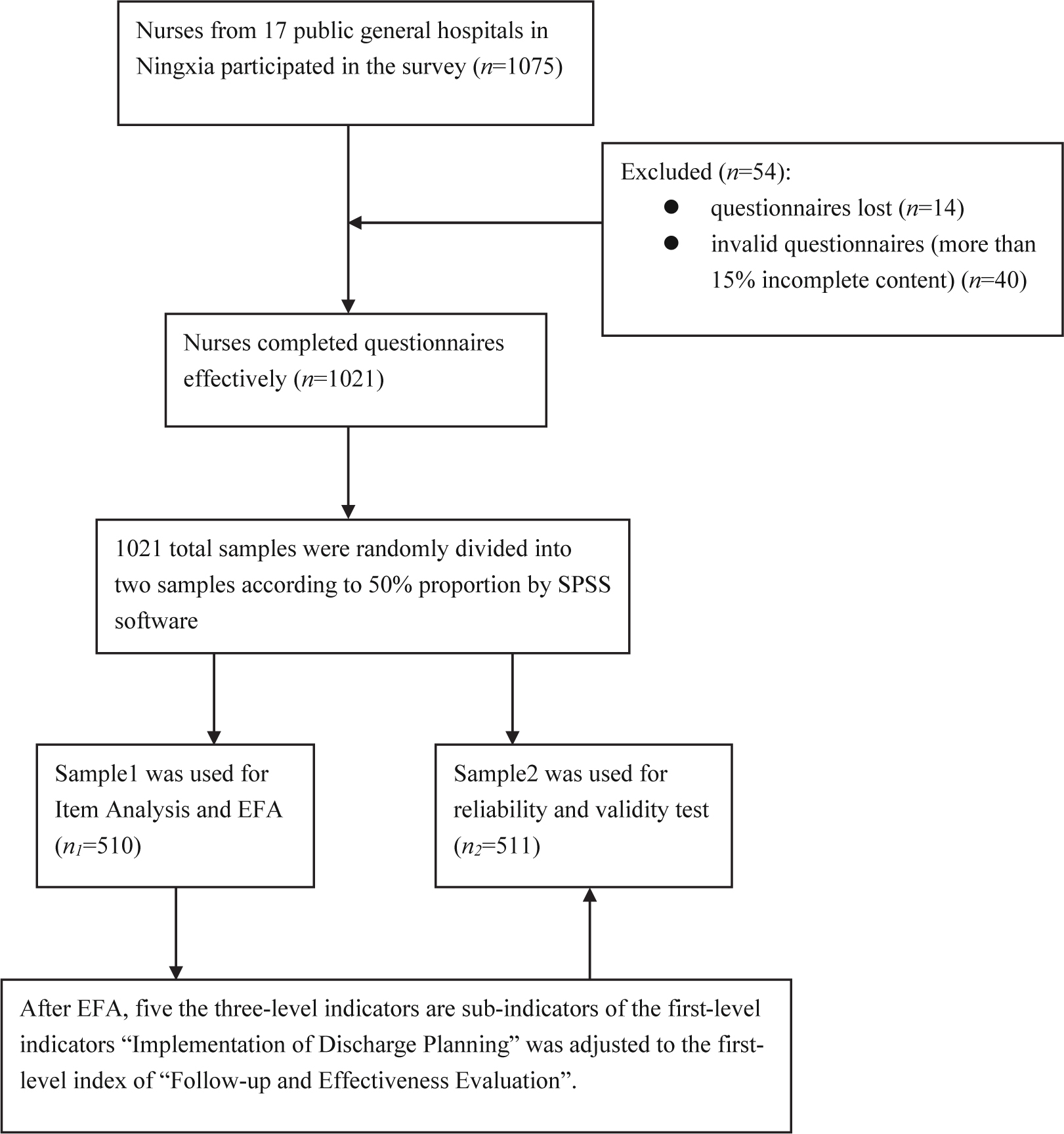
Figure 1.
Research flow chart.
Table 1.
General characteristics of nurses, n (%).
| Characteristics | Database 1 (n1 = 510) | Database 2 (n2 = 511) | Total sample (n = 1021) |
|---|---|---|---|
| Sex | |||
| Female | 498 (97.65) | 501 (98.04) | 999 (97.85) |
| Male | 12 (2.35) | 10 (1.96) | 22 (2.15) |
| Nationality | |||
| Han nationality | 396 (77.65) | 404 (79.06) | 800 (78.35) |
| Ethnic minority | 114 (22.35) | 107 (21.94) | 221 (21.64) |
| Marital status | |||
| Married | 374 (73.33) | 370 (72.42) | 744 (72.87) |
| Other | 136 (26.67) | 141 (27.58) | 277 (27.13) |
| Education level | |||
| Polytechnic school | 24 (4.71) | 19 (3.72) | 43 (4.21) |
| Junior college | 260 (50.98) | 255 (49.90) | 515 (50.44) |
| Undergraduate | 226 (44.31) | 237 (46.38) | 463 (45.35) |
| Hospital level | |||
| Grade III-A | 172 (33.73) | 184 (36.01) | 356 (34.87) |
| Grade III-B | 102 (20.00) | 85 (16.63) | 187 (18.31) |
| Grade II-A | 218 (42.75) | 224 (43.84) | 442 (43.29) |
| Grade II-B | 18 (3.53) | 18 (3.52) | 36 (3.53) |
| Department | |||
| Internal medicine | 326 (63.92) | 346 (67.71) | 672 (65.82) |
| Surgery | 184 (36.08) | 165 (32.29) | 349 (34.18) |
| Technical title | |||
| Nurse | 232 (45.49) | 236 (46.19) | 468 (45.84) |
| Primary nurse | 193 (37.84) | 174 (34.05) | 367 (35.95) |
| Nurse in charge | 57 (11.18) | 81 (15.85) | 138 (13.52) |
| Post | |||
| Deputy director nurse and above | 28 (5.49) | 20 (3.91) | 48 (4.70) |
| No job | 403 (79.02) | 404 (79.06) | 807 (79.04) |
| Head of responsible section | 64 (12.55) | 70 (13.70) | 134 (13.12) |
| Head nurse | 43 (8.43) | 37 (7.24) | 80 (7.84) |
| Instructor for nursing students? | |||
| Yes | 258 (50.59) | 252 (49.32) | 510 (50.00) |
| No | 252 (49.41) | 259 (50.68) | 511 (50.00) |
Table 2.
Eigenvalue and variance contribution rate of each component of the index.
| Component | Eigenvalue | Variance (%) | Cumulative variance (%) |
|---|---|---|---|
| Factor 1 (Follow-up and effectiveness evaluation) | 34.89 | 23.59 | 23.59 |
| Factor 2 (Assessment of discharge planning) | 3.40 | 18.18 | 41.77 |
| Factor 3 (Implementation of discharge planning) | 1.65 | 18.16 | 59.93 |
| Factor 4 (Formulation of discharge planning) | 1.55 | 12.87 | 72.79 |
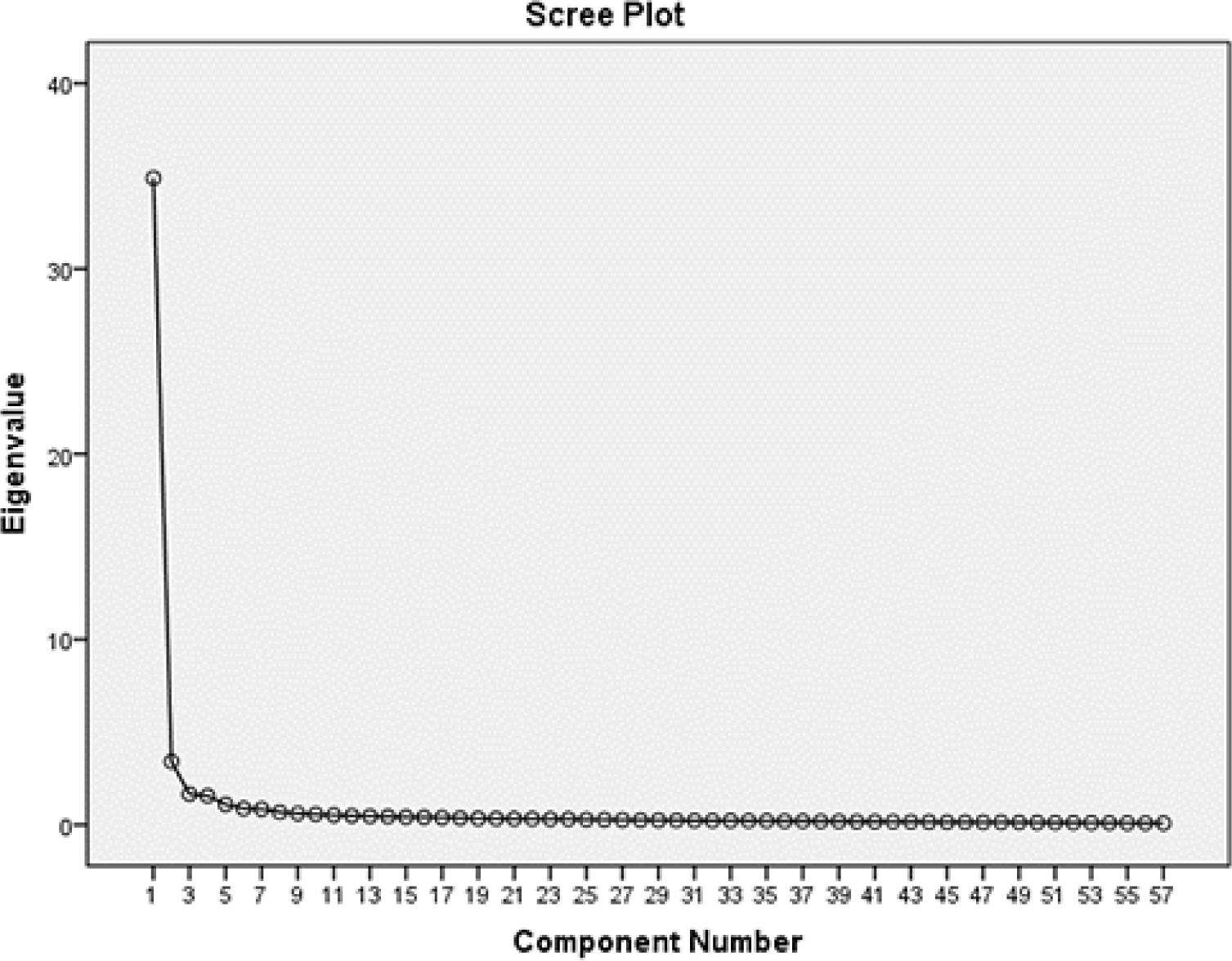
Figure 2.
Scree plot for the EFA. EFA, exploratory factor analysis.
Table 3.
Factor loadings after varimax rotation based on the EFA (n = 510).
| Three-level indicator | Factor 1 | Factor 2 | Factor 3 | Factor 4 | |
|---|---|---|---|---|---|
| 4.1.2 | Assesses the rehabilitation of older patients at each home visit. | 0.808 | 0.228 | 0.142 | 0.296 |
| 3.3.4 | Coordinates beds and other resources for older patients when referring to lower medical institutions. | 0.772 | 0.225 | 0.184 | 0.264 |
| 4.1.6 | Judges whether to end the discharge planning according to the results of family visits. | 0.769 | 0.242 | 0.188 | 0.279 |
| 4.2.1 | Tracks and evaluates the rehabilitation and living conditions of older patients after discharge from hospital. | 0.767 | 0.225 | 0.217 | 0.308 |
| 4.2.4 | Evaluates and analyzes the whole process after the discharge planning is completed. | 0.760 | 0.273 | 0.307 | 0.178 |
| 3.3.5 | Provides technical guidance and training for lower medical service centers. | 0.758 | 0.309 | 0.207 | 0.140 |
| 4.1.1 | Provides multiple forms of follow-up for older patients. | 0.749 | 0.251 | 0.275 | 0.212 |
| 4.1.5 | Records the follow-up progress of older patients in a timely and accurate manner. | 0.749 | 0.221 | 0.339 | 0.228 |
| 3.3.3 | Coordinates nursing clinics to provide follow-up services and nursing specialist guidance for older patients. | 0.745 | 0.183 | 0.268 | 0.262 |
| 4.2.2 | Assesses the psychological status of older patients before and after discharge. | 0.728 | 0.286 | 0.364 | 0.119 |
| 4.2.3 | Investigates older patients’ satisfaction with discharge planning and analyze results. | 0.722 | 0.278 | 0.343 | 0.146 |
| 4.1.4 | Coordinates or resolve issues raised by older patients and their families at the time of follow-up. | 0.685 | 0.309 | 0.445 | 0.089 |
| 4.1.3 | Adjusts the discharge planning in a timely manner based on the rehabilitation of older patients. | 0.656 | 0.364 | 0.368 | 0.197 |
| 3.3.2 | Coordinates the implementation of discharge planning between community health service centers and other medical institutions. | 0.648 | 0.208 | 0.165 | 0.495 |
| 3.3.1 | collaborates with community health service centers and other medical institutions to ensure the smooth referral of older patients. | 0.647 | 0.254 | 0.211 | 0.446 |
| 3.1.6 | Works with community health care professionals to ensure the smooth discharge of older patients. | 0.603 | 0.138 | 0.250 | 0.530 |
| 3.1.2 | Assists rehabilitation teachers in providing rehabilitation guidance to older patients with low self-esteem and their families. | 0.562 | 0.218 | 0.366 | 0.439 |
| 3.1.4 | Assists nutritionists to implement individualized dietary guidance according to the nutritional status of older patients. | 0.524 | 0.230 | 0.292 | 0.493 |
| 1.3.1 | Makes a preliminary judgment on whether older patients need discharge planning services. | 0.202 | 0.750 | 0.330 | 0.220 |
| 1.4.1 | Understands and records the concerns and expectations of older patients and their families about disease treatment and out-of-hospital life. | 0.307 | 0.715 | 0.253 | 0.277 |
| 1.3.2 | Discusses with the attending physician the necessity of improving discharge planning for older patients. | 0.325 | 0.704 | 0.284 | 0.271 |
| 1.4.2 | Understands and documents the thoughts of older patients and their families about dying problems and home care. | 0.401 | 0.691 | 0.182 | 0.330 |
| 1.2.5 | Assesses the self-care ability of older patients and the care capacity of primary caregivers. | 0.190 | 0.688 | 0.476 | 0.148 |
| 1.2.2 | Assesses the physical function, cognition, and mental psychology of older patients. | 0.241 | 0.680 | 0.426 | 0.142 |
| 1.2.4 | Assesses the understanding of disease treatment and knowledge of disease in older patients. | 0.209 | 0.677 | 0.474 | 0.140 |
| 1.2.1 | Assesses disease status, progression and prognosis in older patients. | 0.291 | 0.662 | 0.440 | 0.175 |
| 1.2.3 | Assesses the nursing problems of older patients, such as falls, falling into bed, skin integrity, etc. | 0.126 | 0.655 | 0.556 | 0.037 |
| 1.1.2 | Collects family composition of older patients and relevant information of primary caregivers such as relationship with patients, contact information, etc. | 0.314 | 0.627 | 0.188 | 0.302 |
| 1.1.3 | Assesses the safety of older patients’ living environment, including indoor lighting, toilet layout, skid-proof facilities, etc. | 0.282 | 0.612 | 0.436 | 0.182 |
| 1.1.1 | Collects sociodemographic data of older patients. | 0.348 | 0.574 | −0.023 | 0.390 |
| 2.1.1 | Maximizes the self-care ability of older patients as the goal of the discharge planning. | 0.310 | 0.536 | 0.357 | 0.439 |
| 1.4.4 | Uses linguistic and nonverbal communication strategies in the assessment process to address potential sensory and cognitive impairments in older patients. | 0.348 | 0.524 | 0.352 | 0.452 |
| 1.4.3 | Uses interviews to assess the discharge needs of older patients and their families. | 0.407 | 0.500 | 0.305 | 0.412 |
| 2.2.1 | Coordinates or resolve issues of concern to older patients and their families. | 0.362 | 0.488 | 0.403 | 0.425 |
| 2.1.2 | Develops a discharge planning centered on the needs of older patients and their families. | 0.360 | 0.485 | 0.326 | 0.483 |
| 2.2.2 | Discusses emergency plans for developing aggravated or critical moments in older patients. | 0.366 | 0.451 | 0.425 | 0.440 |
| 3.2.7 | Provides guidance on care methods for older patients at risk of falls, pipe falls and pressure sores. | 0.286 | 0.375 | 0.741 | 0.032 |
| 3.2.8 | Provides psychologically care for older patients and their families to alleviate their anxiety and anxiety about off-campus life. | 0.384 | 0.351 | 0.666 | 0.136 |
| 3.2.5 | Provides guidance to older patients and their families on the use of relevant medical devices and articles. | 0.374 | 0.258 | 0.661 | 0.321 |
| 3.2.2 | Provides individualized health education according to the understanding of older patients. | 0.373 | 0.380 | 0.659 | 0.199 |
| 3.2.1 | Arranges health education in accordance with the priority of older people’s health knowledge needs. | 0.371 | 0.379 | 0.645 | 0.306 |
| 3.2.4 | Guides the older patients and their families on disease management methods and matters needing attention in daily life. | 0.411 | 0.362 | 0.636 | 0.244 |
| 2.4.2 | Introduces to the older patients and their families what services the hospital can provide after discharge. | 0.332 | 0.284 | 0.633 | 0.398 |
| 3.2.6 | Guides the older patients and their families to identify critical symptoms and signs and emergency measures. | 0.376 | 0.294 | 0.632 | 0.306 |
| 2.3.3 | Introduces reimbursement methods and proportions of medical insurance to older patients and their families. | 0.194 | 0.265 | 0.610 | 0.441 |
| 2.4.1 | Introduces and confirm the contents of the discharge planning to older patients and their families. | 0.240 | 0.263 | 0.587 | 0.517 |
| 3.1.5 | Assists the doctor in determining the patient’s discharge date and return date. | 0.418 | 0.399 | 0.586 | 0.234 |
| 2.4.3 | Maintains the rights of older patients and their families in medical decision-making, such as the informed consent form for signing the discharge planning. | 0.283 | 0.316 | 0.577 | 0.417 |
| 2.2.4 | Discussions can be used to determine the mode of delivery of older patients at discharge. | 0.183 | 0.447 | 0.573 | 0.290 |
| 3.2.3 | Gives full play to the subjective initiative of older patients and help develop programs that change their poor health behaviors. | 0.423 | 0.385 | 0.544 | 0.312 |
| 2.3.4 | Introduces relevant healthcare policies and care resources to older patients and their families. | 0.292 | 0.259 | 0.494 | 0.490 |
| 3.1.3 | Cooperates with physicians and pharmacists to guide drug management for older patients and their families. | 0.460 | 0.222 | 0.492 | 0.448 |
| 2.3.1 | Familiarizes with the social resources available near the home of older patients, such as the location, contacts, services provided by the nearby community health service institutions, etc. | 0.323 | 0.293 | 0.204 | 0.687 |
| 2.3.2 | Fully considers the social resources available in the vicinity of older patients’ housing when formulating the discharge planning, and provide them to older patients and their families in time. | 0.429 | 0.366 | 0.204 | 0.628 |
| 2.2.3 | Judges the need for the use of home medical devices and items and to provide access to them. | 0.375 | 0.329 | 0.365 | 0.588 |
| 2.1.3 | Makes individualized follow-up plan (method, content, time, etc.) according to the disease status of older patients. | 0.378 | 0.409 | 0.311 | 0.554 |
| 3.1.1 | Coordinates multidisciplinary team members to complete preparations for older patients before discharge. | 0.480 | 0.223 | 0.365 | 0.541 |
Table 4.
Reliability of the index system (n = 511).
| First-level indicator | Second-level indicator | Number of items | Cronbach’s α | Retest reliability |
|---|---|---|---|---|
| Assessment of discharge planning | 14 | 0.96 | 0.84 | |
| Collection of general information | 3 | 0.84 | 0.79 | |
| Assessment of medical care issues | 5 | 0.93 | 0.79 | |
| Judgment of the necessity of discharge planning | 2 | 0.88 | 0.74 | |
| Assessment of discharge needs | 4 | 0.91 | 0.83 | |
| Formulation of discharge planning | 14 | 0.97 | 0.85 | |
| Establishment of individualized discharge planning | 3 | 0.90 | 0.75 | |
| Predischarge preparation | 4 | 0.88 | 0.78 | |
| Rational utilization of social resources | 4 | 0.89 | 0.72 | |
| Explanation and adjustment of discharge planning | 3 | 0.89 | 0.73 | |
| Implementation of discharge planning | 14 | 0.97 | 0.85 | |
| Multidisciplinary teamwork | 6 | 0.93 | 0.78 | |
| Health education before discharge | 8 | 0.96 | 0.76 | |
| Follow-up and effectiveness evaluation | 15 | 0.97 | 0.81 | |
| Coordination of health services | 5 | 0.93 | 0.81 | |
| Out-of-hospital follow-up | 6 | 0.95 | 0.79 | |
| Effectiveness evaluation | 4 | 0.94 | 0.77 | |
| The total index system | 57 | 0.98 | 0.86 |
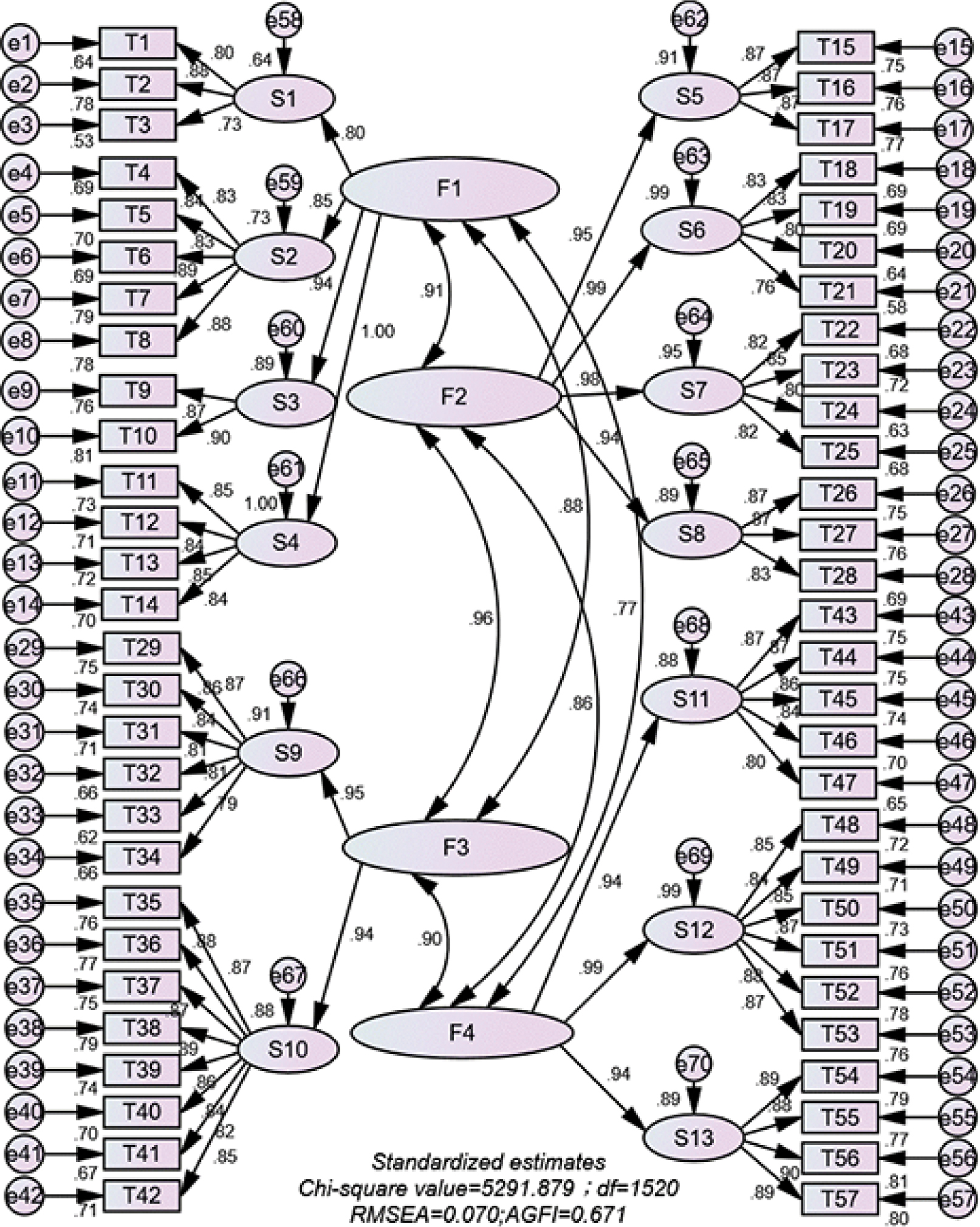
Figure 3.
Second-order CFA structure model.
Note: T1–T57 were the 57 observational internal variables, that is, the 57 three-level indicators of the indicator system; S1–S13 were the 13 potential internal factors (first-order factors), which were the secondary indicators of the index system; e1–e57 were the error variables of the 57 measurement indicators; e58–e57 were the error variables of the 13 first-order factors; and F1–F4 were the 4 primary indicators (second-order construct variables). CFA, confirmatory factor analysis.
Table 5.
Second-order CFA structural model fitting index.
| Index system | Absolute fitness index | Value-added fitness index | Simplified fitness index | ||||||
|---|---|---|---|---|---|---|---|---|---|
| RMR | RMSEA | AGFI | NNFI | CFI | NFI | χ2/df | PNFI | PGFI | |
| Second-order model | 0.047 | 0.07 | 0.671 | 0.879 | 0.885 | 0.846 | 3.481 | 0.806 | 0.642 |
1 Note: AGFI, adjusted goodness-of-fit index; CFA, confirmatory factor analysis; CFI, comparative fit index; NFI, normed fit index; NNFI, non-normed fit index; PGFI, parsimony goodness-of-fit index; PNFI, parsimony-adjusted fit index; RMR, root mean square residual; RMSEA, root mean square error of approximation.