
| #1 | nausea OR vomiting (n = 59058) |
| #2 | chemotherapy (n = 85319) |
| #3 | cancer (n = 193085) |
| #4 | non-pharmacological with Cochrane Library publication date between January 2015 and January 2021 (n = 2829) |
| #5 | #1 AND #2 AND #3 AND #4 with Cochrane Library publication date between January 2015 and January 2021, in Trials (n = 10) |
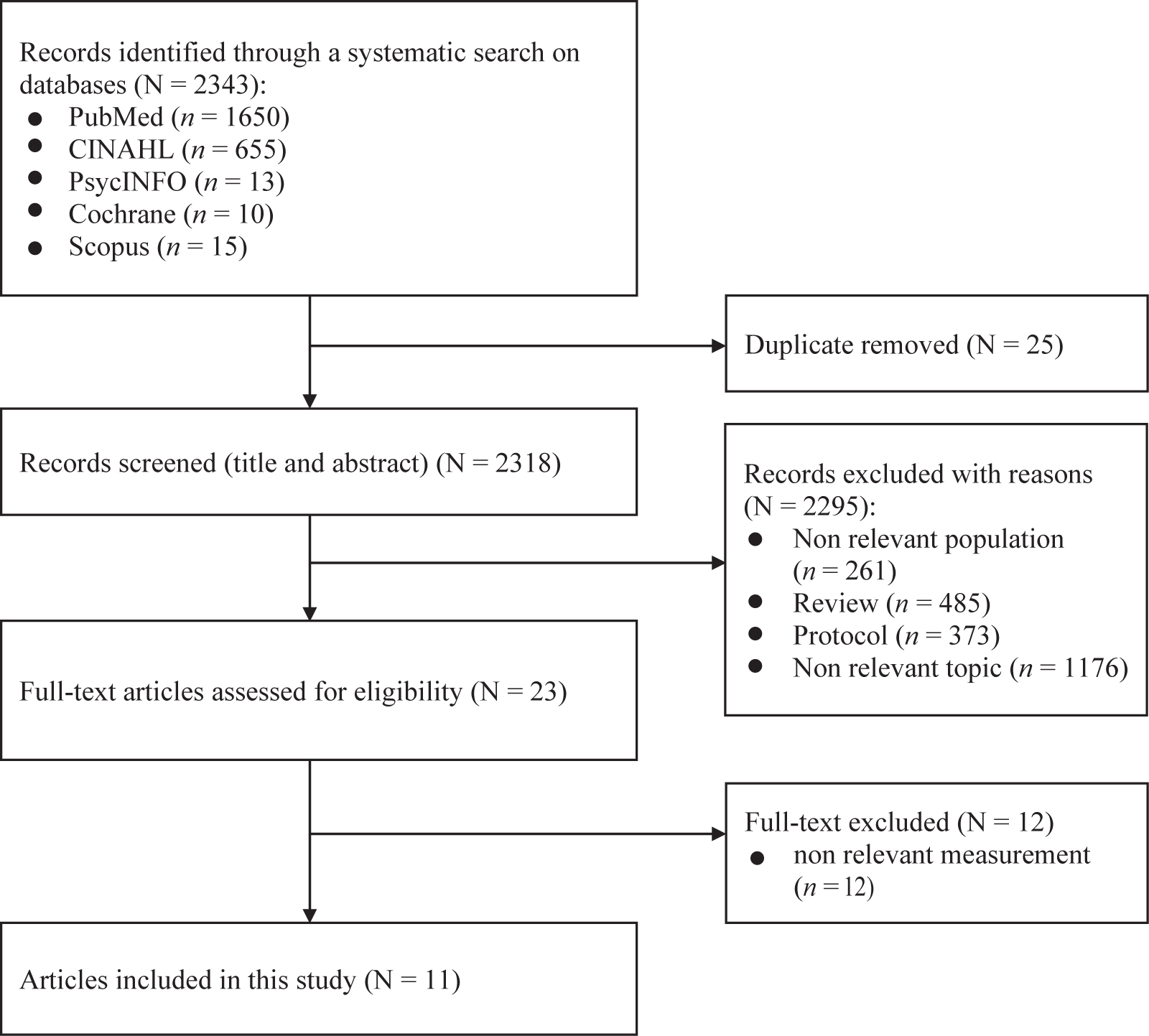
Figure 1.
PRISMA process of the systematic literature search.
Table 1.
Data extraction.
| No. | Author(s) | Aim | Design | Participants | Intervention | Measurement | Results | Category of non-pharmacological therapy |
|---|---|---|---|---|---|---|---|---|
| 1. | Anestin et al.18 | To determine the effects of a standardized yoga program on CINV among breast cancer patients | Randomized controlled trial (single blind) | 82 patients (n = 52 in intervention, n = 30 in control). The mean age is 50.4 (SD = 8.9). The characteristics: be 18 years or older, have a breast cancer diagnosis (stages I–III), receive chemotherapy, consent from medical team, no regular practice of yoga, no current psychotherapy, no psychiatric diagnosis, and no heart failure | 8 weekly group sessions of 90 min with 5 participants per group, led by a trained instructor. Participants were also given a DVD of the intervention with a 20- and 40-min session format Antiemetic still consumed | Morrow Assessment of Nausea and Emesis Scale: frequency, intensity, worst moment, duration | There was no significant difference between the experimental and control groups on CINV after 8 weeks | Manipulative and body-based therapy |
| 2. | Özdelikara and Tan19 | To determine the effect of reflexology on chemotherapy induced nausea, vomiting, and fatigue in breast cancer patients | Pretest and posttests experimental design | 60 patients with breast cancer stages I–III in Ataturk Hospital, Turkey Mean age: 50.93 ± 11.27 in the experimental group and 51.06 ± 10.97 in the control group | Three sessions of reflexology by a trained nurse (one in each of 3 chemotherapy cycles). Each reflexology session took approximately 30–40 min. Antiemetic treatment was still consumed | Rhodes INVR | Reflexology can decrease the experience, development, distress of nausea, vomiting | Manipulative and body-based therapies |
| 3. | Zorba and Ozdemir20 | To evaluate the feasibility and preliminary effects of massage and inhalation aromatherapies on chemotherapy-induced acute nausea/vomiting. | Quasi RCT | 75 patients with breast cancer stages I–III in an oncology polyclinic in Turkey Mean age: 44.96 (SD: 9.91) years | Group 1: receiving 20-min aromatherapy foot massage, Group 3: received 3-min inhalation aromatherapy before their second, third, and fourth chemotherapy cycles | A nausea, vomiting, and retching patient follow-up form was used to evaluate nausea severity by visual analog scale and frequency of vomiting and retching | Nausea severity was significantly lower in the massage and inhalation aromatherapy groups than in the control group. Nausea and retching incidence was reduced in the aromatherapy groups compared with that in the control group | Manipulative and body-based therapy |
| 4. | Peoples et al.21 | To examine the effectiveness of acupressure bands on CINV | Randomized control trial | 226 patients with breast cancer stages I–III at 4 cancer clinics in USA. The total mean age was 57 (SD: 0.07). The age ranged from 24 years to 76 years old. The sample had chemotherapy regimen containing doxorubicin, or docetaxel with carboplatin, or docetaxel with cyclophosphamid | The intervention group 1: Wearing band for 5 d with MP3 enhancing relaxation Group 2: Wearing band with natural relaxation. The control group receive MP3 relaxation only | Self-report 5-d diary | Acupressure bands combined with a relaxation recording were effective in reducing nausea for patient receiving doxorubin | Manipulative and body-based therapy |
| 5. | Eghbali et al.22 | To determine the effect of auricular acupressure in relieving nausea and vomiting among the women who received chemotherapy | Randomized control trial | 48 patients with breast cancer (stages I–III) from 2 hospitals in an urban area of Iran. The total mean age was: 46.02 (SD = 7.23) and the age ranged: 32–65 years old | The researcher placed an ear seed on each point and pasted it with a special non-latex adhesive. The researcher trained the patients to press each point at least 3 times every day (morning, noon, and night) for 3 min. Auricular acupressure for 5 d until started having mild tingling sensation or a slight sense of discomfort | Morrow Assessment of nausea and vomiting | The use of auricular acupressure decreased in the frequency and intensity of nausea and vomiting in both the acute and delayed phases in experimental group | Manipulative and body-based therapy |
| 6. | Efe Ertürk and Ta§ci23 | To evaluate the effects of peppermint oil on the frequency of nausea, vomiting, retching, and the severity of nausea in cancer patients undergoing chemotherapy | A quasi-randomized controlled study | 90 patients from ambulatory chemotherapy unit in Turkey. The mean age of the patients in the intervention group was 49.94 (SD = 10.47) in the control group: 54.63 (SD = 10.15). The participants’ diagnosis include: breast cancer, colon cancer, ovary cancer, lung cancer, rectum cancer, and pancreas cancer | The participants in the intervention group applied one drop of the aromatic mixture on the spot between their upper lip and their nose, 3 times a day for the 5 d following chemotherapy administration, in addition to the routine antiemetic treatment | Visual analog scale for nausea severity. INVR | The VAS nausea score was significantly lower after peppermint oil applying in the patients receiving Folfirinox; Paclitaxel-Trastuzumab; Carboplatin-Paclitaxel and Cyclophosphamide-Adriamycin excluding cisplatin schedule | Mind–body therapy |
| 7. | Hosseini et al.24 | To examine the effect of guided imagery on CINV in breast cancer patients | Quasi experimental study | 55 female patients with breast cancer (stages I–III) in an Iranian hospital. The mean age of 57.5 years (SD = 8.43) | The patients were asked to listen to 2 audio-recorded guided imagery scripts, formatted as 2 separate tracks on 2 CDs. Each track was 10 min in length to elicit imagery response. The first track consisted of soft, slow-tempo, mixed nature sounds. The second track of the intervention included a pleasant scene imagery script. Antiemetic was consumed | Morrow assessment of nausea and vomiting | Mean score of nausea and vomiting severity decrease after the intervention | Mind–body therapy |
| 8. | Aybar et al.25 | To determine the effect of breathing exercise on nausea, vomiting, and functional status in breast cancer patients undergoing chemotherapy | Randomized controlled trial | 60 patients with breast cancer stages I–IV in an ambulatory chemotherapy unit in Turkey. The mean age of the patients in the intervention group was 43.03 (SD = 7.07) in the control group: 51.43 (SD = 9.46). | Trained patients with breathing exercise 15–20 patients. Patients then were asked to do breathing exercise at least 5 min in case of sensation of nausea and vomiting, for 6 d With antiemetic | Visual Analog Scale | The patients in the intervention group had less number of nausea, vomiting, and retching episodes after the breathing exercise (P < 0.05) and experienced lower severity of nausea (P < 0.05) compared with patients in the control group | Mind–body therapy |
| 9. | Li et al.26 | To compare the effectiveness of true acupuncture vs. sham acupuncture in controlling CINV among patients with advanced cancer | Randomized controlled trial | 134 participants from 4 hospitals in China. The mean age of the patients in the intervention group was 60, median 56.84–60.48), and in the control group: 58 median 54.99–60.04 The participants’ diagnosis include: breast cancer, ovary cancer, cervical cancer, endometrial cancer and lung cancer (stages I–IV) The patients received cisplatin, anthracycline, or taxane-based chemotherapy regimens | Participants in both groups received acupuncture session twice (30 min) on the first day of chemotherapy, and once consecutively on the following 4 d. (total 5 d) Patients in the study were randomized in a 1:1 ratio into a TA or SA group receiving the following acupuncture treatment | The primary outcome was using the CTCAE to assess CINV | Compared with the SA group, the TA group did not show significant improvement in complete response rates of CINV (all P > 0.05). However, the True acupuncture group could modestly reduce the severity of nausea (from day 3 to day-21, P < 0.05) or vomiting (from day-4 to day-21, P < 0.05), which is notably superior to the control group | Energy therapy |
| 10. | Akhu-Zaheya et al.27 | To assess the clinical effectiveness of the hologram bracelet in the management of CINV among adult patients with cancer | Experiment double blinded | In a cancer center in Jordan 175 oncology patients were randomly assigned to 3 groups: placebo (n = 53), control (n = 54), and intervention (hologram bracelet) (n = 68). The mean age was 42.3 (SD = 14) years, and ranged from 18 years to 75 years. Types of cancer: Breast cancer, Hematology, Gastrointestinal, Respiratory, Genitourinary, Gynecology and Head and neck Bone. | Hologram bracelet worn for 5 d | The Functioning Living Index Emesis was used to examine the impact of CINV | The mean total Functioning Living Index Emesis score was significantly lower in the intervention group for total vomiting and total nausea | Energy therapy |
| 11. | Li et al.28 | To examine the efficacy of ginger, as an adjuvant drug to standard antiemetic therapy, in ameliorating acute and delayed CINV in patients with lung cancer receiving cisplatin-based regimens | Randomized controlled trial | 140 patients with lung cancer from 3 cancer wards in a Hospital, China. The mean age: 57.52 (SD = 7.24) in intervention group. And 57.46 (SD = 7.82) in placebo group. Chemotherapy regimens are: cisplatin, carboplatin, oxaliplatin | Ginger root powder was administered orally (0.5 g, 2 capsules/d, 0.25 g/ capsule, every 12 h) for 5 d beginning on the first day of chemotherapy | MASCC Antiemesis Tool (MAT) | As an adjuvant drug to standard antiemetic therapy, ginger had no additional efficacy in ameliorating CINV in patients with lung cancer receiving cisplatin-based regimens | Biologically based therapy |
1 Note: CINV, chemotherapy-induced nausea and vomiting; DVD, digital video disc; VAS, Visual Analog Scale; CDs, compact discs; SA, sham acupuncture; TA, true acupuncture; CTCAE, common terminology criteria for adverse events; INVR, index of nausea, vomiting, and retching; MASCC, Multinational Association of Supportive Care in Cancer.