
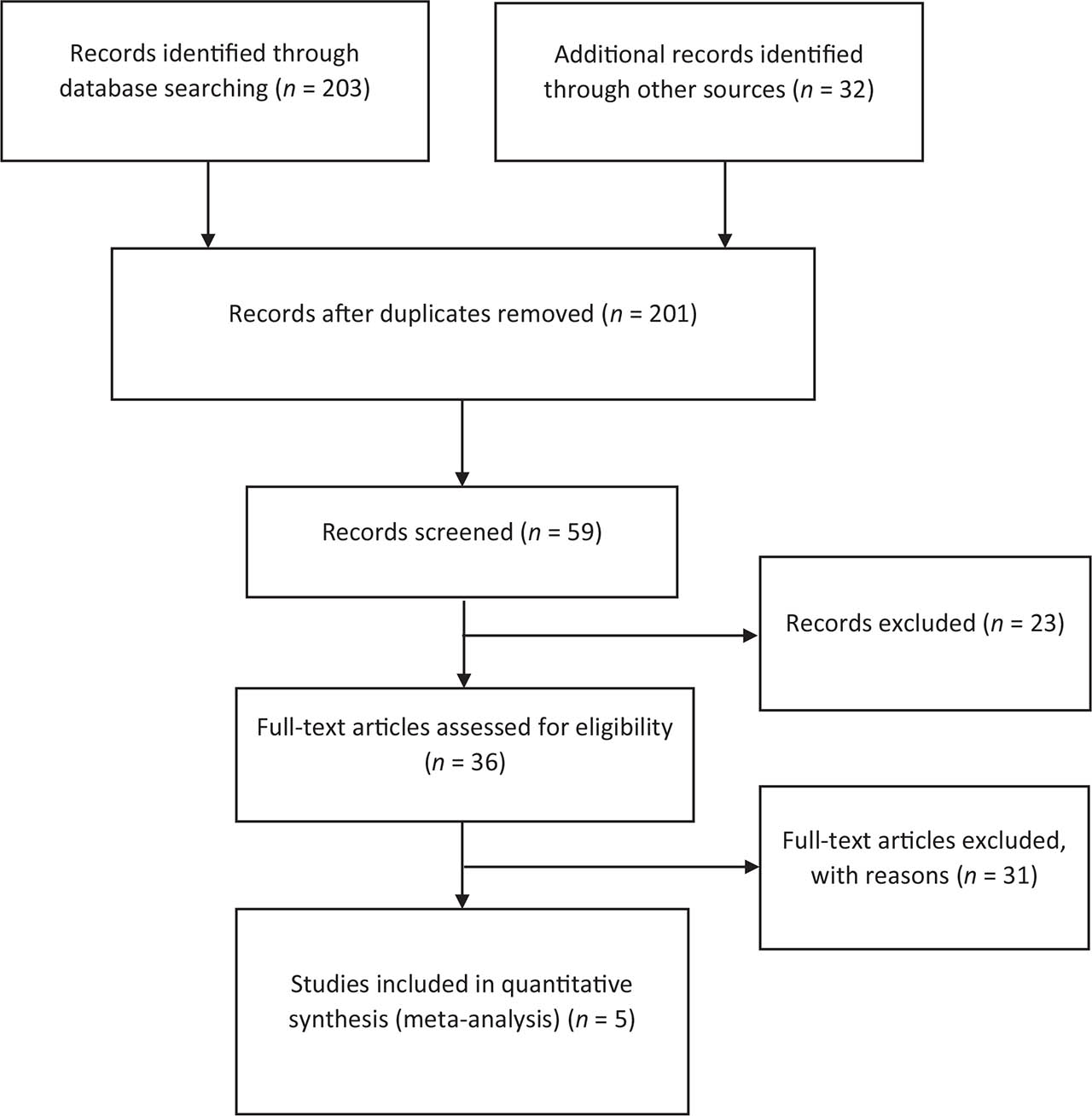
Figure 1
Flow of studies through the review process.
Table 1
Reported mortality rates in each study.
| Authors | 30-d mortality rate | 60-d mortality rate | 1-year mortality rate |
|---|---|---|---|
| Bucholz et al., (2016)8 | No available data | No available data | Mortality risk reduction of 18%, hazard ratio of (0.819, 95%), confidence interval of (0.75–0.895) |
| Brown et al., (2004)16 | Mortality rate risk reduction was 23% hazard ratio (0.774, 95%), confidence interval of (0.621–0.964)16 | No available data | No available data |
| Van Spall et al., (2007)19 | No available data | No available data | Mortality rate risk reduction of 37%, hazard ratio of (0.41, 95%), confidence interval of (0.3–0.56) |
| Houston et al., (2005)17 | The relative 30 d mortality rate risk reduction was reported to be 19%, hazard ratio of (0.81, 95%), confidence interval of (0.65–0.99). | The relative 60 d mortality rate risk reduction was reported to be 19%, hazard ratio of (0.81, 95%), confidence interval of (0.65–0.94) | Mortality rate risk reduction was 14%, hazard ratio of (0.86, 95%), confidence interval of (0.79–0.94) |
Table 2
Reported SCC rates.
| Study | N (%) received SCC | N (%) did not receive SCC |
|---|---|---|
| Bucholz et al. (2016)8 | 5695 (41.2%) | 8120 (58.8%) |
| Brown et al. (2004)16 | 133 (33.9%) | 259 (66.1%) |
| Van Spall et al. (2007)19 | 1830 (52.1%) | 1681 (47.9%) |
| Houston et al. (2005)17 | 6875 (41.0%) | 9868 (59.0%) |
[i] Note: SSC, smoking cessation counseling.
Table 3
Studies of the effectiveness of smoking cessation counseling on mortality rate.
| Author | Site & participants | Demographics | Intervention and objectives | Design | Measure of mortality | Mortality-related results | Conclusion |
|---|---|---|---|---|---|---|---|
| Van Spall, Chong, & Tu, (2007)19 | 83 teaching and community hospitals in Ontario, Canada N = 9041, patients presenting with AMI | Mean age 65 years. Male 67%. History of DM and HTN (69%). Smoker 67% (n = 6094). Smoker counseled 1830 (52.1%). | No intervention; medical record review. Determine the associations between inpatient SCC and survival rate. | Retrospective cohort analysis, recruited from EFFECT study. | Multivariate Cox proportional hazards regression model. | Reduction in mortality was significantly associated with inpatient SCC (hazard ratio 0.63, 95% CI, 0.44–0.90). | The SCC for inpatients post-MI is independently associated with a vital mortality advantage. |
| Mohiuddin et al. (2007)18 | University-affiliated teaching hospital N = 209 | Intervention group: Mean age 54 years Male 69%. White (77%), History of DM and HTN (56%). Control group: Mean age 55.5 years Male 56%. History of DM and HTN (63%). | Counseling weekly for 60 min for a minimum of 3 months, delivered by a trained tobacco cessation counselor. | A randomized controlled trial, un-blind trial | Mortality was computed and compared using the Kaplan–Meier method. | All-cause mortality rate was 2.8% among the intervention group, compared with 12.0% in the usual care group. The absolute risk reduction in mortality was 9.2%. | Smokers recovering from acute coronary syndrome should receive intensive SCC counseling and drugs treatment for at least 3 months. |
| Bucholz, Beckman, Kiefe, & Krumholz, (2017)8 | Acute care, non-governmental hospitals in the US. N = 13,815 smokers with AMI. | Mean age 72 years. Male 57%. White (76.8%). History of DM and HTN (79%). Smoker counseled (41.2%) | Examine the differences in life expectancy after AMI between counseled and non-counseled smokers. | Retrospective study obtained from the Cooperative Cardiovascular Project. | Marginal Cox proportional hazards models. | Counseled smokers had lower crude mortality than non-counseled smokers. | *SCC for elderly patients with AMI is associated with long life expectancy and gains in life years. |
| Houston et al. (2005)17 | Inpatients from 2971 acute care hospitals in the US. N = 16,743 smokers with AMI. | Male 57%. White (92.2%). History of DM (22%). Smoker 100% (n = 16,743). Smoker counseled (41.1%). | No intervention reported. The SCC was attained through medical record review, as if the patient received counseling, was shown a smoking cessation (SC) video, or given brochures on SC. Assess the difference in immediate (30 and 60 d after admission) and late (2-year) mortality rates | Cross-sectional survey, recruited from the Cooperative Cardiovascular Project. | Kaplan–Meier survival curves; Multivariable adjustments using Cox proportion hazards models. | Smokers who received SCC had lower 30-d, 60-d, and 2-year mortality compared to non-counseled smokers. Within 30 d, the maximum decline in relative hazard (19%) was seen. | There is a positive association of SCC with survival. |
| Brown et al. (2004)16 | 117 North Carolina acute care facilities. N = 788 smoker with confirmed AMI. | Mean age 72 years. Male 59.8%. White (85.8%). History of DM and HTN (83.5%). *Smokers 100% (n = 788). *Smokers counseled (40%). | No intervention. Medical record documentation review. Examine the effect of inpatient advice or SCC on the risk of all-cause 5-year mortality among older patients hospitalized with coronary heart disease. | Cross-sectional survey, recruited from the Cooperative Cardiovascular Project. | Cox proportional hazard regression | The 5-years related mortality were lower among patients who were given counseling. All-cause mortality was reduced. After adjusting for socio-demographic variables, improving the survival among inpatients was associated with providing SCC (relative hazard, 0.78; 95% CI, 0.63–0.97). | Implementing SCC that reaches all patients, including the elderly smokers, is required. |
[i] Note: AMI, acute myocardial infarction; SCC, smoking cessation counseling; SC: smoking cessation.