
Table 1
The clinical burning question with Population (P), Intervention (I), Comparison (C), Outcome (O), Timeframe (T) (PICOT).
| Items | PICOT | Keywords |
|---|---|---|
| Population (P) | Dementia people | “Dementia„ “Alzheimer's disease” |
| Intervention (I) | Music intervention or music therapy (listening, singing songs, and playing musical instrument) | “Music therapy,” “Music intervention,” “Musical therapy” |
| Comparison (C) | Without music intervention (usual daily activity or usual care, e.g., reading newspaper, bathing, physical exercise, etc.) | Not available |
| Outcome (O) | Improve cognition or reduce anxiety or depression or agitation and/or improve quality of life | “Cognitive function,” “Cognition function,” “Neuropsychiatric symptoms” |
| Time frame (T) | More than 4 weeks can be included | Not available |
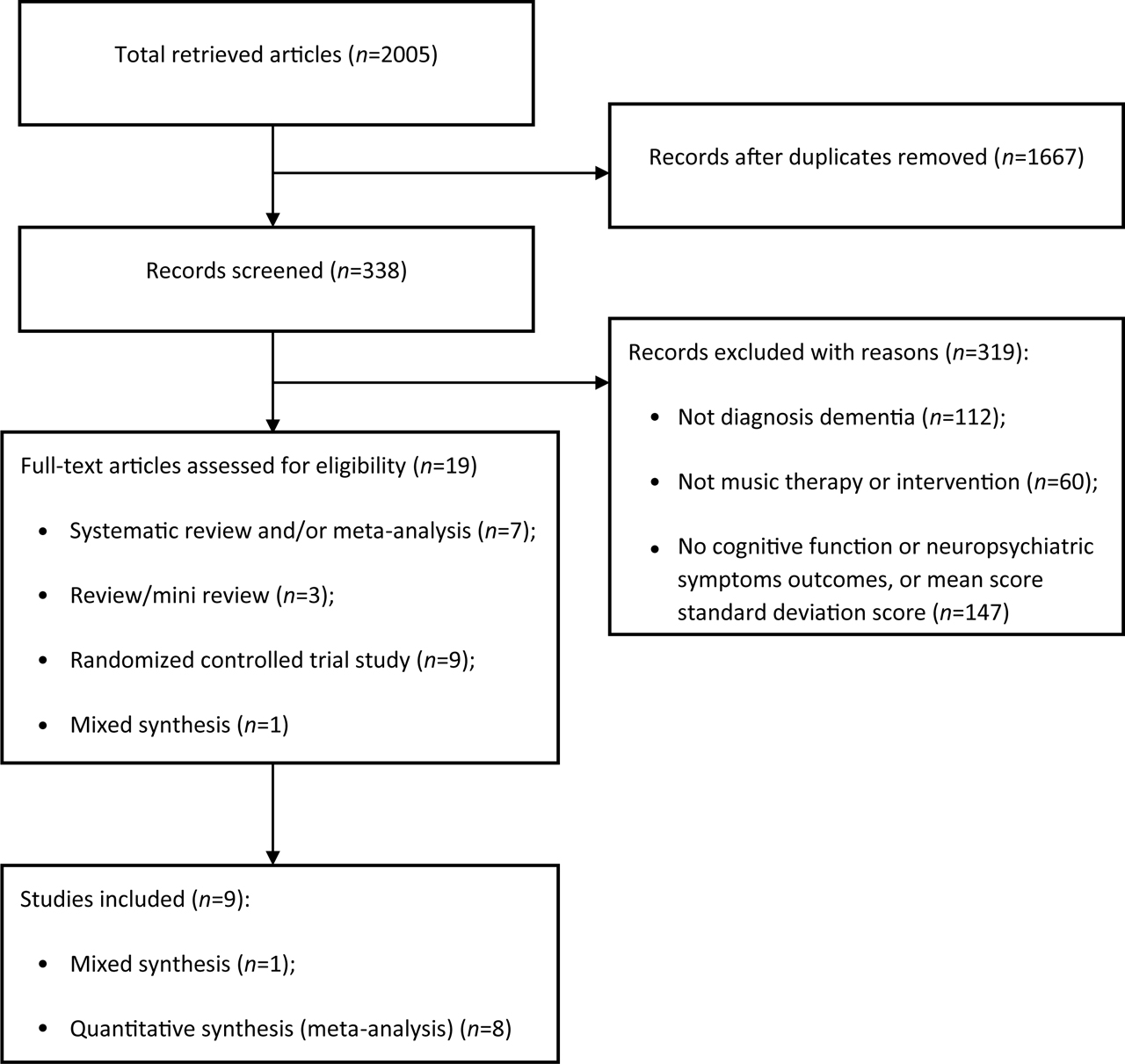
Figure 1
PRISMA flow diagram of the selection procedure. Abbreviations: PRISMA, Preferred Reporting Items for Systematic Reviews and Meta-Analyses.
Table 2
JADAD scale for reporting RCTs.
| Items | Maximum points of included studies | ||
|---|---|---|---|
| Randomization | Blinding | An account of all patients | |
| Chen & Pei 201813 | 2 | 2 | 1 |
| Lyu et al. 201812 | 2 | 2 | 1 |
| Thornley et al. 201618 | 2 | 2 | 1 |
| Hsu et al. 201517 | 2 | 2 | 1 |
| Raglio et al. 201519 | 2 | 2 | 1 |
| Chu et al. 201411 | 2 | 2 | 1 |
| Ridder et al. 201315 | 2 | 2 | 1 |
| Sung et al. 201214 | 2 | 2 | 1 |
| Ceccato et al. 201216 | 2 | 2 | 1 |
[i] Note: RCTs, randomized controlled trials.
Table 3
Characteristics of the included randomized controlled trials of music therapy on the neuropsychiatric symptoms of dementia patients.
| Study/year country | Study design | Patient & characteristic | Description of intervention (type, frequency, time, duration) | Music therapist (Yes/No) | Control group(s) | Measurement tool(s) | Neuro Psychiatric symptom(s) outcome(s) | Neuro psychiatric symptoms results/findings/outcomes |
|---|---|---|---|---|---|---|---|---|
| Chen & Pei, Taiwan, China 201813 | RCTs | Intervention group (n = 15), F:M = 9:6, (mean age = 77.3) Control group (n = 13), F:M = 5:8, (mean age=77.3) | Singing with percussion instrument × 60 min weekly for 8 weeks and follow-up after 8 weeks (with music therapist) | Control group (Yes) | Self-choose activities e.g. chess games, playing cards, reading, writing, mathematical exercise and walking exercises × 60 min for 8 weeks and follow-up after treatment | CMAI-C- to assess agitated behaviors | CMAI-C mean score: Intervention group: Pretest: 44.3 Posttest: 41.9 Control group: Pretest: 34.7 Posttest: 39.0 | The results of the study showed music therapy can improve agitation. The posttest mean score of intervention group is lower pretest mean score. |
| Sung et al., Taiwan, China 201214 | RCTs | Intervention group (n = 27), F:M = no data (mean age = 81.37) Control group (n=28), F:M=no data (mean age=79.5) | Percussion instruments with familiar music × 30 min delivered in the afternoon twice a week × 6 weeks (total 12 sessions) and follow-up at 4th & 6th weeks after treatment (no involvement of music therapist) | Control group (No) | Usual care: e.g., TV watching, family visiting and parties, basic nursing care, meal provision for 6 weeks and follow-up at 4th & 6th weeks after treatment | CMAI-C- to assess agitated behaviors | CMAI-C mean score: Intervention group: Pretest: 36.26 Posttest:33.59 (at 4th week) Posttest: 32.70 (at 6th week) Control group: Pretest: 35.79 Posttest: 33.54 (at 4th week) Posttest: 31.00 (at 6th week) | The results of the study reported the level of anxiety, agitated behaviors can be reduced. The mean score of CMAI-C are consistent with low level of agitated behavior. |
| Thornley, Canada 201618 | RCTs | Intervention group (n = 10), F:M = no data, (mean age = 83.5) Control group (n = 6), F:M=no data, (mean age=68.4) | Singing and playing simple instruments, including maracas and small drums × 30 min biweekly for 4 weeks (total 8 sessions) and follow-up at 1st week of treatment and the end of treatment (no involvement of music therapist) | Control group (No) | Active engagement and attention intervention using “online randomization program” for 4 weeks and follow-up at 1st week of treatment and the end of treatment | CMAI-to assess agitated behaviors | CMAI mean score: Intervention group: Pretest:67.8 Posttest: 54.3 (at 1st week) Posttest: 84.3 (at 4th week) Control group: Pretest: 64.2 Posttest: 56.2 (at 1st week) Posttest: 79.0 (at 4th week) | The results of the study show agitated behavior items with music therapy can improve. The posttest CMAI mean score in intervention group was greater than pretest mean score |
| Ridder et al., 2013 Denmark and Norway15 | RCTs | Intervention group Participants (n = 20) F:M = 14:7, (mean age=82.17) Control group: Participants (n=20) F:M=14:7, (mean age=80.20) | Singing songs, dancing/moving for biweekly × 6 weeks (total 12 sessions) and follow up at 7th & 14th weeks after end of treatment no data on duration of each session. (with music therapist) | Control group (No) | Standard care: Talking, walking for 6 weeks and follow up at 7th & 14th weeks after end of treatment | CMAI-fr -to assess agitated behaviors frequency | CMAI-fr mean score: Intervention group: Pretest: 30.21 Posttest: 29.05 (at 7th week) Posttest: 28.0 (at 14th week) Control group: Pretest:30.98 Posttest:32.12 (at 7th week) Posttest:26.09 (at 14th week) | This study showed that 6 weeks of music therapy can reduce agitation frequency. The mean score of CMAI-fr is consistent with low agitation frequency. |
| Lyu et al., 2018 China12 | RCTs | Intervention groups: (n=32), F:M=17:15 (mean age=68.9) Control group (n = 30), F:M = 17:13, (mean age = 69.9) | Singing song twice daily for 180 sessions × 40 min for 3 months and follow up after the 3rd and 6th months after start of treatment (with music therapist) | Control group (No) | Routine care × 40 min × 180 sessions for 3 months and follow-up at the 3rd and 6th months after start of treatment | NPI -to assess behavioral, mood | NPI mean score: Intervention groups: Pretest:16.37 Posttest:13.52 (at 3rd month) Posttest:13.01 (at 6th month) Control group: Pretest test:15.77 Posttest:15.14 (at 3rd month) Posttest:15.42 (at 6th month) | The results of the study showed improvement over time in behavioral, mood symptoms by the consistent reduction in NPI mean score. The posttest of NPI mean score in intervention is lower than pretest |
| Raglio et al., 2015 Italy19 | RCTs | Intervention group: (n = 40), F:M = 29:11 (mean age = 81.0) Control group (n = 40), F:M = 33:7, (mean age = 82.4) | Listening to music with playing instrument × 30 min twice a week for 10 weeks (total 20 sessions) and follow up after treatment and at 2 months after end of treatment (with music therapist) | Control group (No) | Standard care, e.g. Reading the newspaper, playing cards, personal care and physical activities for 10 weeks and follow-up after treatment and at 2 months after treatment | NPI -to assess behavioral, mood | NPI mean score: Intervention group: Pretest: 33.1 Posttest: 23.7 (after treatment) Posttest: 22.4 (at 2 months) Control group: Pretest: 36.7 Posttest: 28.9 (after treatment) Posttest:26.8 (at 2 months) | The results of the study showed improvement over time in behavioral, mood symptoms by the consistent reduction in NPI mean score of intervention group. |
| Hsu et al., 2015 United Kingdom17 | Mixed method trial design: RCTs, intervein and observation | Intervention group (n = 6), F:M = 5:1 (mean age = 84.56) Control group (n=7), F:M=7:0, (mean age = 82.5) | Singing along with instrument playing and talking × 30mins weekly for 7 months (total 22 sessions), and 15min pre & post resting time at the 3rd, 5th, and 7th months of treatment and no follow-up after end of treatment (with music therapist) | Control group (No) | Standard care, e.g., Chaplaincy service, entertainment and leisure activities × 30 min at 3rd, 5th, and 7th months of treatment and no follow-up after end of treatment | NPI -to assess behavioral, mood | NPI mean score: Intervention group: Pretest: 17.33 Posttest: 10.83 (at 3rd month) Posttest: 12.33 (at 5th month) Posttest: 8.67 (at 7th month) Control group: Pretest: 17.57 Posttest: 24.29 (at 3th month) Posttest: 26.57 (at 5th month) Posttest: 34.43 (at 7th month) | The results of the study showed music therapy can improve neuropsychiatric symptoms of dementia. The mean score of NPI is consistent with low level of neuropsychiatric symptoms. |
| Raglio et al., 2015 Italy | RCTs | Intervention group: (n = 40), F:M = 29:11 (mean age = 81.0) Control group (n=40), F:M=33:7, (mean age=82.4) | Listening to music with playing instrument × 30 min twice a week for 10 weeks (total 20 sessions) and follow up after treatment and at 2 months after end of treatment (with music therapist) | Control group (No) | Standard care e.g. Reading the newspaper, playing cards, personal care and physical activities for 10 weeks and follow-up after treatment and at 2 months after treatment | CSDD -to assess depression symptoms | CSDD mean score: Intervention group: Pretest: 9.0 Posttest: 6.5 (after treatment) Posttest: 7.0 (at 2 months) Control group: Pretest: 8.0 Posttest: 7.0 (after treatment) Posttest: 7.0 (at 2 months) | The results of the study showed improvement in depression symptoms and reduced posttest mean score in intervention group. |
| Chu et al., 2014 Taiwan, China11 | RCTs | Intervention group (n = 49), F:M = 26:23, (mean age=82) Control group (n = 51), F:M = 27:24, (mean age = 82) | Listening, singing with playing instrument ×30mins twice a week for 6 weeks (total 12 sessions) and follow-up at the 6th and 12th sessions and 4 weeks after treatment (with music therapist) | Control group (No) | Usual care: e.g., watching television, afternoon tea and taking walks for 6 weeks and as follow-up at 6th and 12th sessions and 4 weeks after treatment | CSDD -to assess depression symptoms | CSDD mean score: Intervention group: Pretest: 17.39 Posttest: 11.47 (at 6th session) Posttest: 8.22 (at 12th session) Posttest: 11.23 (at 4weeks) Control group: The mean score of CSDD in control group: 15.70, 14.66, 13.78 and 11.43 (at baseline, 6th and 12th sessions & 4 weeks after treatment) | The results of the study showed improved in depression. The mean scores of CSDD in intervention group was consistent low levels of depression. |
[i] Notes: CMAI, Cohen-Mansfield Agitation Inventory scale; CMAI-C, Chinese version of Cohen-Mansfield Agitation Inventory scale; CMAI-fr, Cohen-Mansfield Agitation Inventory scale-frequency; NPI, neuropsychiatric Inventory; CSDD, Cornell Scale for Depression in Dementia; RCTs, randomized controlled trials.
Table 4
Classification of the measurement tools to assess cognitive function included RCT studies.
| Study/year | Use of measurement tool(s) | Outcome measures | ||||
|---|---|---|---|---|---|---|
| MMSE | (CDR) | The WHO-UCLA AVLT | TMT | To assess cognitive function | To assess attention control | |
| Ceccato (2012)16 | √ | √ | ||||
| Thornley (2016)18 | √ | √ | ||||
| Chu et al. (2014)11 | √ | √ | ||||
| Lyu et al. (2018)12 | √ | √ | ||||
| Chen & Pei (2018)13 | √ | √ | ||||
| Ridder et al. (2013)15 | √ | √ | ||||
| Raglio et al. (2015)19 | √ | √ | ||||
| Thornley (2016)18 | √ | √ | ||||
| Chen & Pei (2018)13 | √ | √ | ||||
| Raglio et al. (2015)19 | √ | √ | ||||
| Lyu et al. (2018)12 | √ | √ | ||||
| Chen & Pei (2018)13 | √ | √ | ||||
[i] Notes: CDR, clinical dementia rating; MMSE, mini-mental state examination; RCT, randomized controlled trial; WHO-UCLA, World Health Organization-University of California, Los Angeles; AVLT, Auditory Verbal Learning Test; TMT, trail making test.
Table 5
Classification of the measurement tools to assess neuropsychiatric symptoms included RCT studies.
| Study/year | Use of measurement tool(s) | Outcome measures |
|---|---|---|
| Chen & Pei (2018)13 | CMAI-C/CMAI/CMAI-fr/CMAI-di | To assess agitated behaviors |
| Ridder et al. (2013)15 | CMAI-C/CMAI/CMAI-fr/CMAI-di | To assess agitated behaviors |
| Thornley (2016)18 | CMAI-C/CMAI/CMAI-fr/CMAI-di | To assess agitated behaviors |
| Sung (2012)14 | CMAI-C/CMAI/CMAI-fr/CMAI-di | To assess agitated behaviors |
| Ceccato (2012)16 | CMAI-C/CMAI/CMAI-fr/CMAI-di | To assess agitated behaviors |
| Ceccato (2012)16 | GDS | To assess depression symptoms |
| Ridder et al. (2013)15 | GDS | To assess depression symptoms |
| Raglio et al. (2015)19 | CSDD | To assess depression symptoms |
| Chu et al. (2014)11 | CSDD | To assess depression symptoms |
| Chu et al. (2014)11 | Salivary Cortisol | To assess depression symptoms |
| Sung et al. (2012)14 | RAID scale | To measure anxiety levels |
| Hsu et al. (2015)17 | DCM | To observe behavior, mood, and engagement |
| Hsu et al. (2015)17 | NPI/NPI-NH | To assess behavioral, mood, and quality of life |
| Lyu et al. (2018)12 | NPI/NPI-NH | To assess behavioral, mood, and quality of life |
| Raglio et al. (2015)19 | NPI/NPI-NH | To assess behavioral, mood, and quality of life |
| Thornley (2016)18 | NPI/NPI-NH | To assess behavioral, mood and quality of life |
| Lyu et al. (2018)12 | BI | To assess behavioral, mood, and quality of life |
| Raglio et al. (2015)19 | BI | To assess behavioral, mood, and quality of life |
| Ridder et al. (2013)15 | QOL-AD | To assess quality of life |
| Raglio et al. (2015)19 | CBS-QoL/(CBS) | To assess behavioral and psychological outcomes and quality of life |
[i] Notes: BI, Barthel Index; CBS-QoL, Cornell-Brown Scale for Quality of Life in Dementia; CMAI, Cohen-Mansfield Agitation Inventory; CMAI-C, Chinese version of Cohen-Mansfield Agitation Inventory scale; CMAI-fr, Cohen-Mansfield Agitation Inventory scale-frequency; CSDD, Cornell Scale for Depression in Dementia; DCM. Dementia Care Mapping; GDS, Geriatric Depression Scale; RAID scale, Rating of Anxiety in Dementia scale; NPI, Neuropsychiatric Inventory; NPI-NH, Neuropsychiatric Inventory-Nursing Home; QOL-AD, The Quality of Life-Alzheimer's Disease; RCT, randomized controlled trial.

Figure 2
Forrest plots of the effect of music therapy on cognitive function in patients with dementia. Abbreviation: CI, confidence interval.
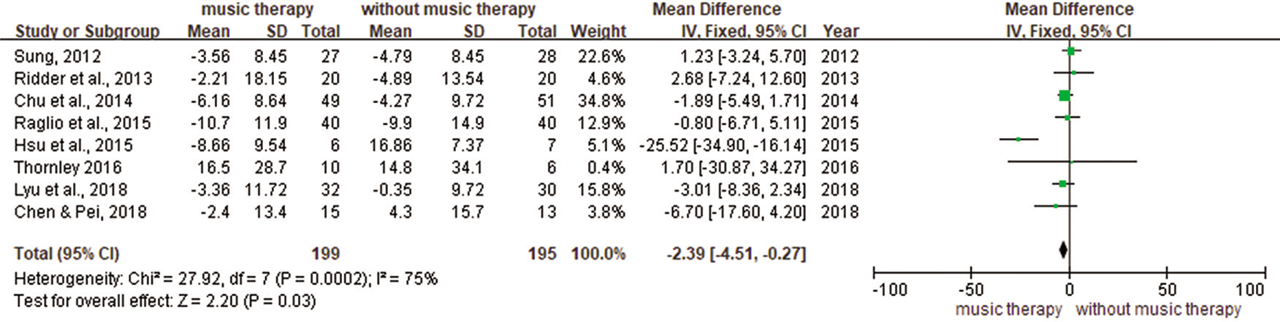
Figure 3
Forrest plots of the effect of music therapy on neuropsychiatric symptoms in patients with dementia. Abbreviation: CI, confidence interval.