
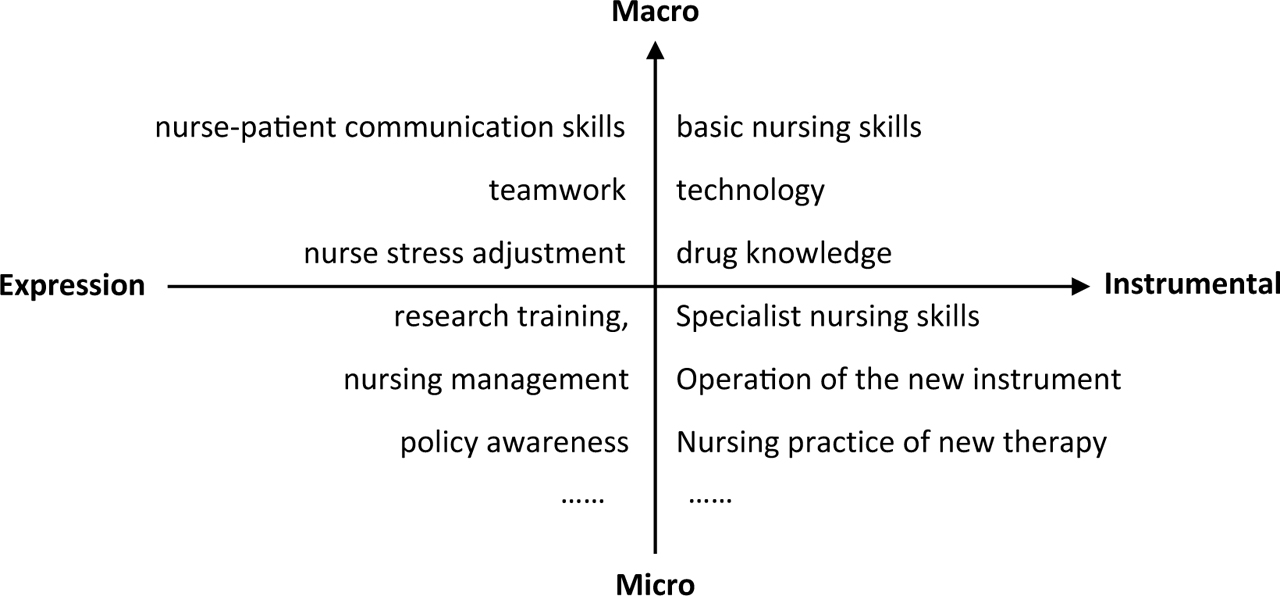
Figure 1
The framework of TNA. TNA, training need analysis.
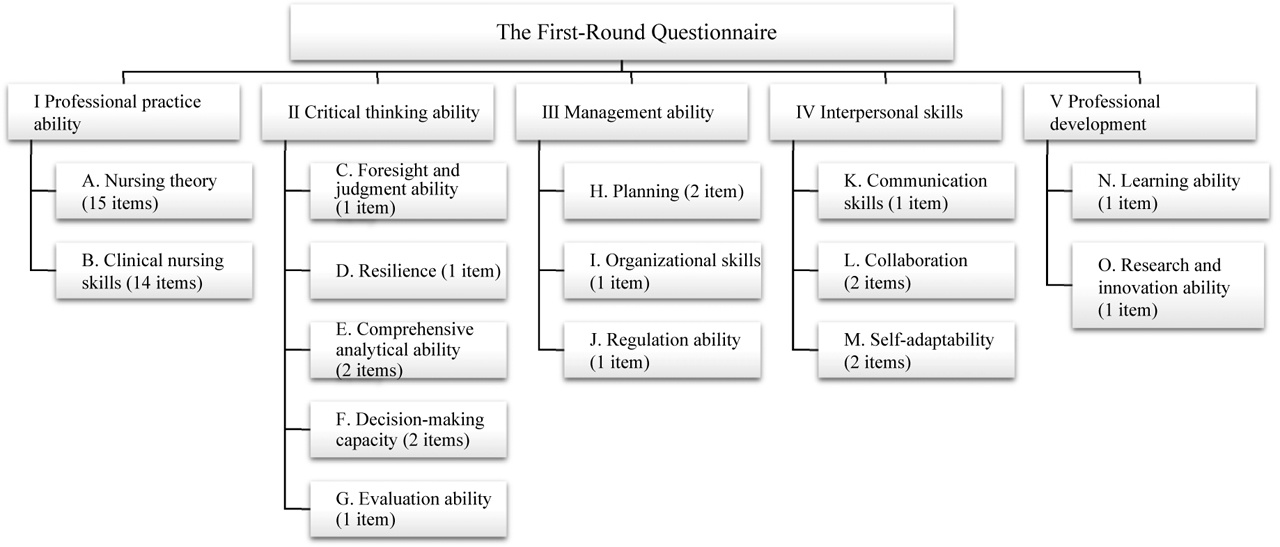
Figure 2
The first-round of modified Delphi questionnaire.
Table 1
The scope of backup nurse training.
| Item | N | Percentage (%) |
|---|---|---|
| The target selection of backup nurses | ||
| 1 year after entry | 6 | 35.29 |
| 2 years after entry | 5 | 29.41 |
| Entry 3-4 years | 4 | 23.53 |
| Entry 5 years and above | 1 | 5.88 |
| New graduate | 1 | 5.88 |
| Department requiring training | ||
| ICU | 17 | 100 |
| Emergency department | 17 | 100 |
| Cardiology | 13 | 76.47 |
| Brain surgery | 10 | 58.82 |
| Trauma | 8 | 47.06 |
| Obstetrics | 2 | 11.76 |
| Pediatrics | 2 | 11.76 |
| Employment period | ||
| 2 years | 9 | 52.94 |
| 1 year | 6 | 35.29 |
| 3 years | 2 | 11.76 |
| Training period | ||
| 1 year | 9 | 52.94 |
| Same as the term of employment | 4 | 23.53 |
| 2 years | 2 | 11.76 |
| Half a year | 2 | 11.76 |
Table 2
Core competencies of backup nurses for professional practice ability.
| Items | Mean ± SD | Coefficient of variation | Theoretical training hours | Practical training hours | Evaluation method |
|---|---|---|---|---|---|
| Nursing theory | |||||
| 1. Nursing care for critically ill patients with respiratory, circulatory, neurological, digestive, urinary and endocrine systems | 4.13 ± 0.83 | 0.20 | 2.33 ± 0.82 | 4.00 ± 3.61 | TE + CE |
| 2. Nursing intervention for acutely transmitted diseases | 4.63 ± 0.74 | 0.16 | 2.86 ± 0.69 | 3.00 ± 0.00 | TE + CE |
| 3. Pain intervention | 4.63 ± 0.74 | 0.16 | 2.14 ± 0.69 | 2.00 ± 1.00 | TE + CE |
| 4. Mechanism of action, dosage, and adverse reactions of common first aid drugs | 5 | 0 | 3.00 ± 1.53 | 2.67 ± 0.58 | TE |
| 5. Clinical significance of common biochemical indicators | 4.63 ± 0.52 | 0.11 | 2.71 ± 1.50 | 3.00 ± 0.00 | CE |
| 6. Identification of common abnormal electrocardiogram | 4.63 ± 0.74 | 0.16 | 3.57 ± 1.81 | 4.75 ± 2.75 | TE + OE |
| Clinical nursing skills | |||||
| 7. Application of monitoring technology | 4.75 ± 0.71 | 0.15 | 3.50 ± 2.35 | 4.29 ± 2.21 | OE |
| 8. Correct use of first aid equipment | 5 | 0 | 2.60 ± 0.89 | 3.83 ± 1.60 | OE |
| 9. Mechanical ventilation knowledge, operating techniques and various simple fault handling | 4.63 ± 0.52 | 0.11 | 2.33 ± 1.03 | 3.29 ± 1.70 | OE |
| 10. First aid technology cooperation | 4.38 ± 0.74 | 0.17 | 3.33 ± 1.63 | 4.57 ± 2.15 | OE |
| 11. Ability to quickly and correctly place various tubes (stomach, urinary, venous access, etc.) | 4.88 ± 0.35 | 0.07 | 2.00 ± 0.71 | 3.86 ± 3.67 | OE |
| 12. Effective treatment of severe multiple injuries | 4.5 ± 0.76 | 0.17 | 2.17 ± 0.75 | 3.43 ± 2.70 | OE |
| 13. Advanced life support technologies | 4.75 ± 0.71 | 0.15 | 4.17 ± 2.99 | 5.86 ± 3.13 | OE |
| 14. Retain various specimens | 4.75 ± 0.71 | 0.15 | 2.00 ± 0.63 | 3.25 ± 1.71 | TE + OE |
| 15. Postoperative care technology for critically ill patients | 4.75 ± 0.46 | 0.10 | 3.60 ± 1.14 | 4.00 ± 1.53 | OE |
| 16. Isolation measures for infectious diseases | 4.38 ± 0.74 | 0.17 | 1.83 ± 0.75 | 3.20 ± 2.17 | TE |
| 17. Reasonable and effective health knowledge mission | 4.25 ± 0.71 | 0.17 | 1.25 ± 0.96 | 3.00 ± 1.79 | CE + SS |
[i] Note: CE, case evaluation; OE, operational evaluation; SD, standard deviation; SS, scenario simulation; TE, theoretical evaluation.
Table 3
Core competencies of backup nurses for critical thinking ability.
| Items | Mean Importance | Coefficient of variation | Theoretical training hours | Practical training hours | Evaluation method |
|---|---|---|---|---|---|
| Foresight and judgment ability | |||||
| 18. Assessment of the impact of disease and trauma on patients | 4.5 ± 0.53 | 0.12 | 3.14 ± 0.69 | 3.00 ± 1.00 | CE |
| 19. Dynamic assessment of the patient's condition | 4.63 ± 0.52 | 0.11 | 2.75 ± 0.96 | 5.20 ± 3.11 | CE + SS |
| Resilience | |||||
| 20. Agile to respond to sudden emergencies and implement effective treatment measures | 4.88 ± 0.35 | 0.07 | 2.50 ± 1.29 | 3.80 ± 1.79 | CE |
| Comprehensive analytical ability | |||||
| 21. Make correct judgments on preset goals and work plans | 4.63 ± 0.52 | 0.11 | 2.50 ± 1.29 | 4.80 ± 3.56 | CE + SS |
| 22. Correctly execute the doctor's advice, and promptly ask if you have any questions. | 4.88 ± 0.35 | 0.07 | 1.80 ± 0.45 | 2.20 ± 0.45 | CE + SS |
| Decision-making capacity | |||||
| 23. Effective and continuous evaluation of care plans and measures for critically ill patients | 4.5 ± 0.76 | 0.17 | 2.50 ± 0.58 | 3.40 ± 1.95 | CE |
[i] Note: CE, case evaluation; OE, operational evaluation; SS, scenario simulation.
Table 4
Core competencies of backup nurses for interpersonal skills.
| Items | Mean importance | Coefficient of variation | Theoretical training hours | Practical training hours | Evaluation method |
|---|---|---|---|---|---|
| Collaboration | |||||
| 24. The medical care team has a good cooperation and team spirit | 4.5 ± 0.76 | 0.17 | 1.20 ± 0.84 | 1.50 ± 0.58 | PR |
| 25. Maintain a harmonious relationship between nurses and patients | 4.5 ± 0.53 | 0.12 | 1.25 ± 0.96 | 2.00 ± 0.82 | SS |
| Self-adaptability | |||||
| 26. Reasonable adjustment of work stress and self-emotion | 4.25 ± 0.71 | 0.17 | 2.20 ± 2.28 | 1.75 ± 0.96 | SE |
[i] Note: PR, peer review; SE, self-evaluation; SS, scenario simulation.