
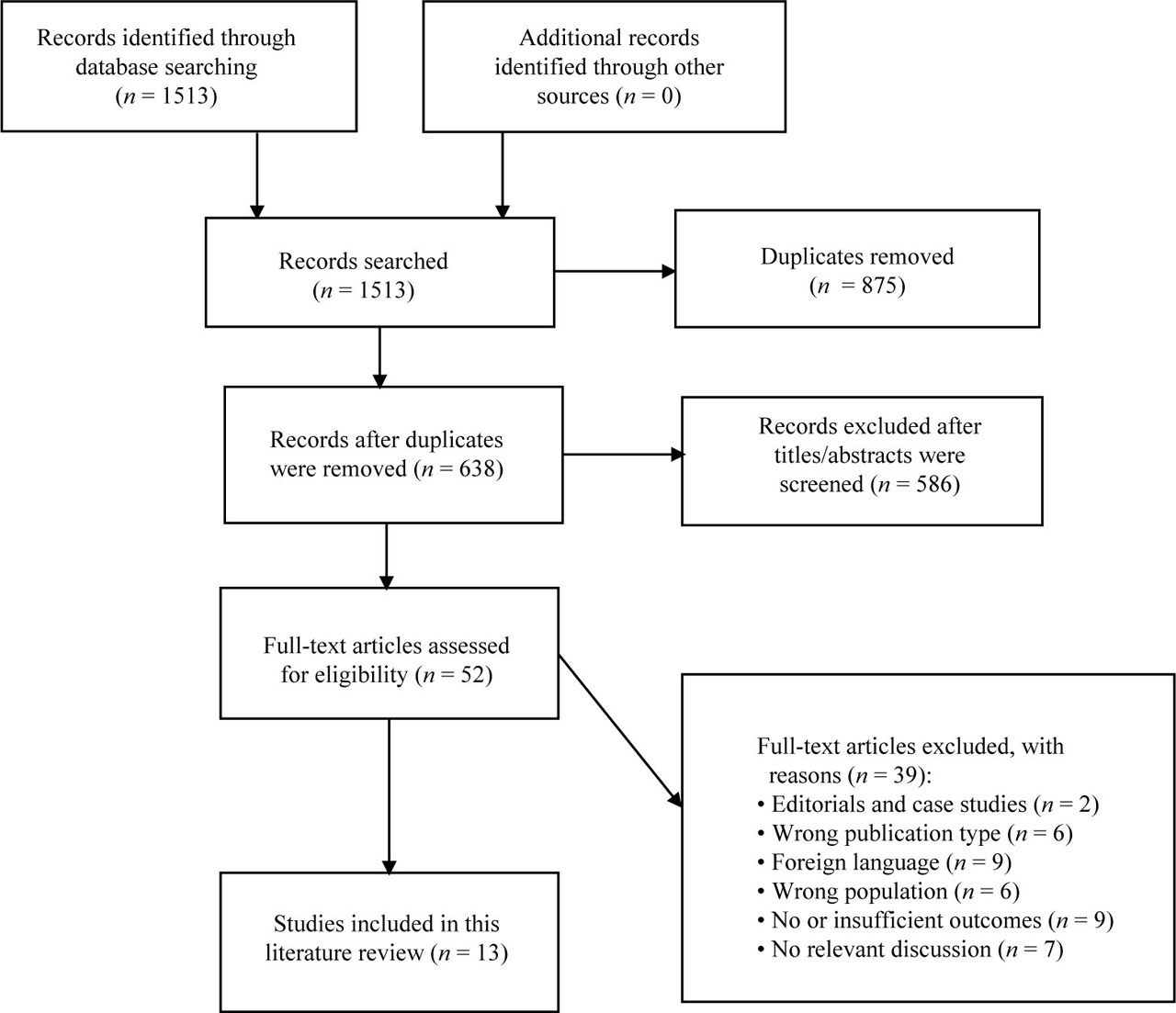
Figure 1
Literature search flowchart.
Table 1
Article review matrix.
| Author/Year | Purpose | Approach | Finding | Predictors of nurse's happiness | Quality assessments (Max 8% and 100%) |
|---|---|---|---|---|---|
| Gurdogan and Uslusoy (2020)28 | To research the relationship between nurses’ happiness and quality of work-life. | Location: Turkey Setting: A hospital in Edirne Design: Descriptive-comparative study Duration: – Sample: 345 nurses Instrument: OHQ. | There was a significant positive relationship found between the quality of work-life and happiness. The study suggested to revise and reorganize work environments and to make the necessary regulations for increasing both happiness and general life satisfaction among nurses working in the hospitals. | Job positions, working units, working styles, and interpersonal relationships. | 6 |
| Duche Pérez & Rivera Galdos, (2019)29 | To describe happiness factors and analyze the existing relationships between these factors among nurses working at various hospitals. | Location: Peru Setting: Alberto Seguín Escobedo EsSalud National Hospital at Arequipa city. Design: Correlational study Duration: November 2017 to April 2018 (6 months) Sample: 83 staff nurses. Instrument: Scale of Happiness by Alarcón (2006). | The study showed that overall 35% of nurses were not happy in terms of “positive sense of life,” “personal fulfillment,” and “joy of living.” The “personal fulfillment” factor is severely affected; >65% were reported that they were not happy in terms of “personal fulfillment.” However, >90% of the nurses said that they are happy in terms of “life satisfaction.” | A positive sense of life, personal fulfillment, and joy of living. | 7 |
| Hwang 2018)30 | To explore the effects of the type of organizational culture, job satisfaction, and job stress on nurses’ happiness. | Location: South Korea Setting: LTC hospitals Design: Cross-sectional study Duration: – Sample: 226 staff nurses Instrument: OHQ | The result showed that nurses working in the LTC hospital were not happy. The study suggested that personal health improvement programs for nurses and autonomy in performing job duties are required to increase happiness among nurses. | Individual subjective estimation of their health status, hierarchy-oriented cultural factors, autonomy in performing job duties, and number of job-related tasks. | 6 |
| Deluga et al. (2018)31 | To evaluate the importance of well-being in the personal hierarchy of the beliefs of the nurse, including socio-demographic factors. | Location: Poland Setting: The Medical University of Lublin and University of Business and Enterprise in Ostrowiec-Świętokrzyski. Design: Cross-sectional study Duration: 2014 to 2015 Sample: 191 nurses Instrument: LPV scale by Z. Juczyński (2001). | The study found that satisfaction of nurses was based on the following factors: effective family life (3.83 points), good health (3.55 points), preferred profession/work performed (2.05 points), and less commonly a good material conditions (1.48 points) (P = 0.010). | Successful family life, good health, and favorite profession/work performed. | 7 |
| Yahya Alhakami and Ghazi Baker (2018)32 | To examine the relationship between nurses’ happiness and the awareness of their work in government and private hospitals. | Location: Saudi Arabia Setting: King Abd El Aziz governmental hospital and Private International Medical Center in Jeddah. Design: Descriptive-comparative study Duration: – Sample: 500 registered nurses Instrument: Happiness subscale, by Warr et al. (1979). | The study demonstrated a positive correlation between nurses’ job awareness of their duties and their happiness and a stronger positive relationship between nurses’ happiness and types of hospitals. Nurses working in private hospitals were happier than the nurses working in government hospitals. | Awareness of job duties, competent in doing the job, job security, types of hospitals, and interpersonal relationships. | 5 |
| Khosrojerdi et al. (2018)33 | To assess the predictors of happiness among working in Iranian hospitals. | Location: Iran Setting: Five teaching hospitals affiliated to Kashan University of Medical Sciences, Kashan. Design: Cross-sectional study Duration: 2016 Sample: 620 registered nurses Instrument: OHQ | The study highlights the level of nurses’ happiness was moderate. The level of nurses’ happiness was significantly correlated with mental health, quality of life, family relationships, and various job-related factors such as salary, working units, work shift, duration of working in the current ward, age, job satisfaction, and satisfaction with physician and supervisor's conduct and performance. | Satisfaction with mental health, monthly salary, quality of life, current hospital ward, the time duration of working in the current ward, work shift, age, job satisfaction, and satisfaction with physicians’ conduct and performance. | 8 |
| Farahnaz et al. (2016)34 | Examining the effects of life skill education on the happiness of nurses. | Location: Iran Setting: Shahid Sadoughi Hospital in Yazd. Design: Quasi-experimental study Duration: June to September 2014 Sample: 16 in the study group and 16 in the control group Instrument: The Happiness Scale by Fordyce (1988). | The nurses’ happiness scores in the control and study groups were low at the baseline, and 1 week after the intervention, the happiness scores were significantly improved (P = 0.038). The results of this study showed that education in life skills could dramatically increase the happiness of nurses, and so it can be used as a beneficial intervention. | Life skills, education work experience, job satisfaction. | 75% |
| Meng et al. (2015)35 | To analyze the factors contributing to nurses’ happiness index in China. | Location: Central China Setting: 12 hospitals in Hanchuan Design: Cross-sectional study Duration: June to July 2011 Sample: 206 registered nurses Instrument: MHQ | The study found that the level of happiness was moderate among hospital nurses. The happiness index was associated positively with variables such as positive emotions, life satisfaction, healthy relationships, stress response, and professional titles, and negatively associated with negative emotions and job pressure. The happiness index had the most significant effect on positive emotions and stress management or coping. | Positive emotions, satisfaction with life, healthy relationships, stress response, and professional titles. | 6 |
| Abdollahi et al. (2014)36 | To explore the correlation in nurses between hardiness, perceived stress, and happiness. | Location: Iran Setting: Six private hospitals in Tehran Design: Correlational study Duration: Sample: 252 nurses Instrument: OHQ | The study demonstrated that hardi-attitude nurses were able to handle the stressful situation very well and experienced a higher level of happiness. Therefore, hardiness is a protective factor for nurses to overcome stress and burnout and a facilitating factor for nurses’ happiness. | Hardiness. | 8 |
| Mirfarhadi et al. (2013)37 | To analyze the level of happiness and its determinants Iranian nurses. | Location: Iran Setting: 8 certified medical centers in Rasht Design: Cross-sectional study Duration: – Sample: 309 nurses Instrument: LSIA, by Neugarten (1961). | Compared to female nurses, the satisfaction rate was higher for male nurses. Poor life satisfaction was reported by nurses working in the emergency department (23.7%) and operating room (23.1%) than those working in surgery and psychiatry wards. There was a positive correlation between the score for life satisfaction and the income of nurses (P = 0.002). Married male gender was also the key determinant of higher scores of life satisfaction (P = 0.027) than married female nurses and unmarried nurses. Single nurses with a second job offer in hand have enjoyed greater satisfaction than the single nurses without a job offer (P < 0.001). | Working units, workload, income, gender, marriage, and having a second job offer. | 5 |
| Appel et al. (2013)38 | To assess the impact of medical-surgical nurses’ happiness and their gratitude toward patient care. | Location: United States of America Setting: Acute care nonteaching Midwestern hospital, Indiana. Design: Quasi-experimental study Duration: Sample: 48 medical-surgical nurses in the intervention group and 43 in the control group Instrument: The Happiness Scale by Fordyce (1988). | The study highlighted that journaling is one of the ways to improve personal life and job satisfaction, for dealing with stressors better, and that positively improves the colleague's interaction and happiness. Therefore, journaling is one of the predictors for nurses’ happiness. | Working wards/units, journaling. | 75% |
| Einarsdóttir (2012)39 | To understand how health workers, working in an ethically responsive ward under challenging circumstances, can mitigate the negative aspects of work to such an extent that they feel happiness. | Location: Iceland Setting: National University Hospital in Reykjavik Design: Qualitative study (ethnographic approach) Duration: – Sample: 40 individuals, including pediatricians, nurses, and nurse assistants Instrument: Semi-structured interviews. | The research found that the satisfaction of nurses with life depends on caring and interacting with children, the desire to support others, maintaining a good social relationship, owning professional pride, and working with individuals with high professional expectations are well-established variables of happiness working in Neonatal Intensive Care Units. | Working with children and opportunities to help others, engage in social relations and experience professional pride, and working unit and interpersonal relationships. | 75% |
| Habib et al. (2012)40 | To analyze the role of emotional intelligence and spiritual well-being in the prediction of nurses’ happiness. | Location: Pakistan Setting: Hospitals in Islamabad. Design: Cross-sectional study Duration: – Sample: 300 nurses Instrument: Life Satisfaction Ladder Scale by Robinson and Strauser (2002). | The results showed that the association between emotional intelligence and spiritual well-being (r = 0.34, P < 0.010) and life satisfaction (r = 0.35, P < 0.010) was substantially positive. Spiritual well-being has an significant positive association (r = 0.34, P < 0.010) with emotional intelligence. | Emotional intelligence and spiritual wellness. | 6 |
[i] LPV, List of Personal Values; LSIA, Life Satisfaction Index A; MHQ, The Multiple Happiness Questionnaire; OHQ, The Oxford Happiness Questionnaire; QNWL, The Quality of Nursing Work Life Scale.