
Table 1
Characteristics of participants in nursing assessment OSCE (N = 54).
| Characteristics | n | % | M ± SD |
|---|---|---|---|
| Age (years) | 22.54 ± 1.55 | ||
| 20–24 | 48 | 88.9 | |
| 25–29 | 6 | 11.1 | |
| Gander | |||
| Female | 40 | 74.1 | |
| Male | 14 | 25.9 | |
| Academic year | |||
| Year 2 | 27 | 50 | |
| Year 3 | 27 | 50 | |
| CP (weeks) | 23.00 ± 7.07 | ||
| 16 | 27 | 50 | |
| 30 | 27 | 50 | |
| PS | |||
| Yes | 27 | 50 | |
| No | 27 | 50 | |
| ISP | |||
| No | 43 | 95.6 | |
| Yes | 11 | 24.4 | |
[i] Note: CP, clinical practice; ISP, interaction with the simulated patients; OSCE, objective structured clinical examination; PS, participation in simulation.
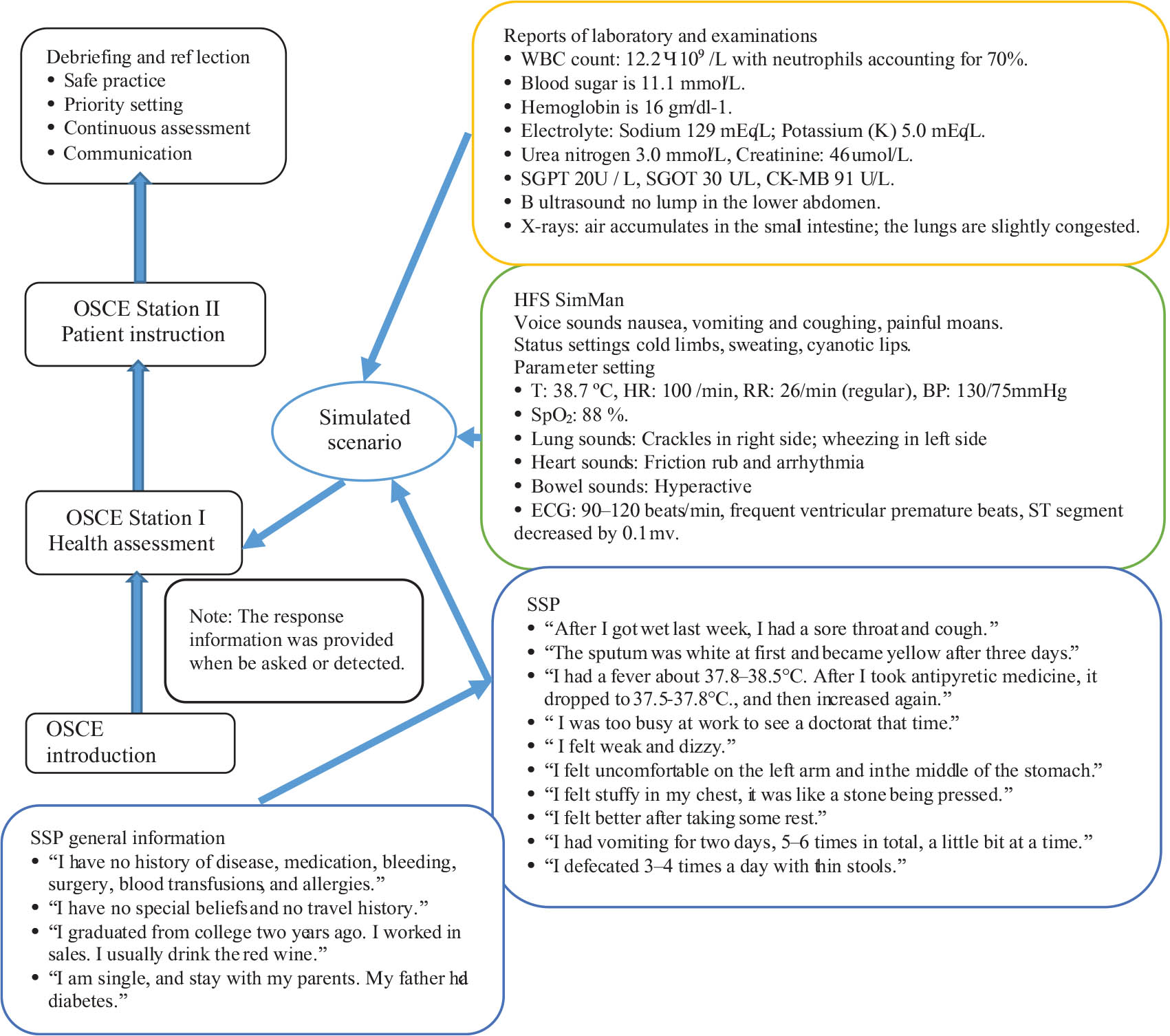
Figure 1
The simulated scenario for OSCE. OSCE, objective structured clinical examination.
Table 2
Communication evaluation rubric.
| Items | A | PA | N/I | |
|---|---|---|---|---|
| (1) | Self-introduction and explanation | Introduce herself/himself to patient; and explain the reason for visiting | Introduce herself/himself to patient; or explain the reason for visiting | Neither introduction nor explanation |
| (2) | Questioning | Start with open-ended questions and continue to use as appropriate | Begin with open-ended questions but no longer used | Closed questions are used |
| (3) | Ordering questions | Guide patient narration by asking the organized questions | Guide the patient to narrate, but ordering questions are illogical | Questioning lacks logic and cannot guide patients to narrate |
| (4) | Communication continuity | Give patients enough time to express themselves without interrupting | Do not disturb, but do not provide enough time for the patient to express | Patient narrative is interrupted |
| (5) | Confirming information | Repeat the information and confirm that it is correct | Repeat the information, but do not confirm it is correct | Do not reconfirm information |
| (6) | Wording expression | The wording is easy to be understood and nursing/medical terms are avoided | Occasional usage of nursing/medical terms without affecting understanding | Using nursing/medical terms is difficult to be understood |
| (7) | Focusing on patient understanding | Respond appropriately to the patient’s doubts and express concern towards the patient’s understanding | Ask the patient’s doubts, but do not concern the patient’s understanding | Neither ask patient’s doubts nor concern patient’s understanding |
| (8) | Explanation | The provided information is clear and understandable | Most of the information provided is clear, but some information is difficult to be understood | The explanation was confusing, and consequently the patient is unable to understand it |
| (9) | Eye contacting and touching | Maintain eye-contact when talking with patient and touch patient appropriately | Maintain eye contacting when talking with patient; OR touch patient appropriately | Nonverbal behavior is negative or interferes with communication |
| (10) | Tone and facial expression | Use appropriate voice and intonation and smile to encourage the interaction | Use appropriate voice and intonation; OR smile to encourage interaction | |
| (11) | Listening | Listening is more than talking; and leaning towards the patient to show listening intently | Listening is more than talking; OR leaning towards the patient to show listening intently | |
| (12) | Empathy | Express empathy to build the relationship with the patient and understand the patient’s feelings | Attempt empathy, partially express the understanding of patient’s feelings | Neither express empathy nor understand the patient’s feelings |
| (13) | Culture assessment | Assess the patients’ beliefs, customs, and hobbies | Assess the patient’s beliefs; OR customs and hobbies | Do not assess patients’ beliefs, customs and hobbies |
| (14) | Assessing patient’s feeling | Inquire about patient’s feelings about disease/injury, and/or treatment | Assess the patient’s feelings about the disease, but not all | Do not assess the patient’s feelings |
[i] Note: A, achieved; PA, partly achieved; N/I, not completed/incorrect.
Table 3
Score description of nursing assessment skills in OSCE (N = 54).
| Items | n (%) | Mean | SD | Difficulty | Discrimination | |||
|---|---|---|---|---|---|---|---|---|
| A | PA | N/I | r (P-value) | Level | ||||
| Self-introduction and patients appease | 9 (6.7) | 45 (83.3) | 0 (0.0) | 1.17 | 0.38 | 0.59 | 0.21 (0.126) | Better |
| Check the patient and doctor’s order | 45 (83.3) | 7 (13.0) | 2 (3.7) | 1.80 | 0.49 | 0.90 | 0.30 (0.027) | Better |
| Causes assessment | 29 (53.7) | 1 (1.9) | 24 (44.4) | 1.09 | 0.99 | 0.55 | 0.37 (0.005) | Better |
| Pain assessment | ||||||||
| Time, location, and radiation | 40 (74.1) | 12 (22.2) | 2 (3.7) | 1.70 | 0.54 | 0.85 | 0.48 (0.000) | Good |
| Nature, degree | 31 (57.4) | 8 (14.8) | 15 (27.8) | 1.30 | 0.88 | 0.65 | 0.47 (0.000) | Good |
| Aggravating and mitigating factors | 26 (48.1) | 2 (3.7) | 26 (48.1) | 1.00 | 0.99 | 0.50 | 0.67 (0.000) | Good |
| Vomiting assessment | ||||||||
| Time, volume, and frequency | 18 (33.3) | 4 (7.4) | 32 (59.3) | 0.74 | 0.94 | 0.37 | 0.64 (0.000) | Good |
| Color, nature | 15 (27.8) | 1 (1.9) | 38 (70.4) | 0.57 | 0.90 | 0.29 | 0.60 (0.000) | Good |
| Diarrhea assessment | ||||||||
| Time, volume, and frequency | 16 (29.6) | 2 (3.7) | 36 (66.7) | 0.63 | 0.92 | 0.32 | 0.45 (0.001) | Good |
| Color, nature | 9 (16.7) | 5 (9.3) | 40 (74.1) | 0.43 | 0.77 | 0.22 | 0.46 (0.000) | Good |
| Hypoxia time, intensity | 20 (37.0) | 14 (25.0) | 20 (37.0) | 1.00 | 0.87 | 0.50 | 0.51 (0.000) | Good |
| Physical examination | ||||||||
| Blood pressure and pulse | 28 (51.9) | 24 (44.4) | 2 (3.7) | 1.48 | 0.57 | 0.74 | 0.45 (0.001) | Good |
| Temperature and respiration | 27 (50.0) | 24 (44.4) | 3 (5.6) | 1.44 | 0.60 | 0.72 | 0.50 (0.000) | Good |
| Blood oxygen saturation, cyanosis | 47 (87.0) | 7 (13.0) | 0 (0.0) | 1.87 | 0.34 | 0.91 | 0.16 (0.255) | Poor |
| Cardiac auscultation | 49 (90.7) | 2 (3.7) | 3 (5.6) | 1.85 | 0.49 | 0.93 | 0.18 (0.206) | Poor |
| Chest palpation: tactile tremor | 29 (53.7) | 3 (5.6) | 22 (40.7) | 1.13 | 0.97 | 0.57 | 0.54 (0.000) | Good |
| Lung auscultation (bilateral) | 50 (92.6) | 1 (1.9) | 3 (5.6) | 1.87 | 0.48 | 0.94 | 0.16 (0.247) | Poor |
| Abdomen palpation | 40 (74.1) | 5 (9.3) | 9 (16.7) | 1.57 | 0.77 | 0.79 | 0.47 (0.000) | Good |
| Abdomen auscultation | 43 (79.6) | 4 (7.4) | 7 (13.0) | 1.67 | 0.70 | 0.84 | 0.36 (0.007) | Better |
| History inquiry | ||||||||
| Disease, medication | 35 (64.8) | 4 (7.4) | 15 (27.8) | 1.37 | 0.90 | 0.69 | 0.59 (0.000) | Good |
| Surgery/trauma, bleeding/transfusion | 24 (44.4) | 5 (99.3) | 25 (46.3) | 0.98 | 0.96 | 0.49 | 0.62 (0.000) | Good |
| Special diet/hobbies, beliefs/family history | 24 (44.4) | 7 (13.0) | 23 (42.6) | 1.02 | 0.94 | 0.51 | 0.54 (0.000) | Good |
| Total | 1.26 | 0.36 | 0.63 | |||||
[i] Note: A, achieved; PA, partly achieved; N/I, not completed/incorrect; OSCE, objective structured clinical examination.
Table 4
Score description of communication skills in OSCE (N = 54).
| Items | n (%) | Mean | SD | Difficulty | Discrimination | |||
|---|---|---|---|---|---|---|---|---|
| A | PA | N/I | r (P-value) | Level | ||||
| Self-introduction and explanation | 5 (9.3) | 7 (13.0) | 42 (77.8) | 0.31 | 0.64 | 0.16 | 0.38 (0.005) | Better |
| Questioning | 12 (22.2) | 38 (70.4) | 4 (7.4) | 1.15 | 0.53 | 0.57 | 0.65 (0.000) | Good |
| Ordering questions | 23 (42.6) | 29 53.7) | 2 (3.7) | 1.39 | 0.56 | 0.69 | 0.68 (0.000) | Good |
| Communication continuity | 26 (48.1) | 27 (50.0) | 26 (48.1) | 1.46 | 0.54 | 0.73 | 0.68 (0.000) | Good |
| Confirming information | 3 (5.6) | 22 (40.7) | 29 (53.7) | 0.52 | 0.61 | 0.26 | 0.42 (0.002) | Good |
| Wording expression | 27 (50.0) | 25 (46.3) | 2 (3.7) | 1.46 | 0.57 | 0.73 | 0.60 (0.000) | Good |
| Focusing on patient understanding | 12 (22.2) | 25 (46.3) | 17 (31.5) | 0.91 | 0.73 | 0.45 | 0.70 (0.000) | Good |
| Explanation | 14 (25.9) | 32 (59.3) | 8 (14.8) | 1.11 | 0.63 | 0.56 | 0.75 (0.000) | Good |
| Eye contacting and touching | 30 (55.6) | 22 (40.7) | 2 (3.7) | 1.52 | 0.57 | 0.76 | 0.84 (0.000) | Good |
| Tone and facial expression | 25 (46.3) | 28 (51.9) | 1 (1.9) | 1.44 | 0.54 | 0.72 | 0.83 (0.000) | Good |
| Listening | 34 (63.0) | 17 (31.5) | 3 (5.6) | 1.57 | 0.60 | 0.79 | 0.82 (0.000) | Good |
| Empathy | 23 (42.6) | 29 (53.7) | 2 (3.7) | 1.39 | 0.56 | 0.69 | 0.60 (0.000) | Good |
| Culture assessment | 6 (11.1) | 11 (20.4) | 37 (68.5) | 0.43 | 0.69 | 0.21 | 0.60 (0.000) | Good |
| Assessing patient’s feeling | 17 (31.5) | 22 (40.7) | 15 (27.8) | 1.03 | 0.78 | 0.52 | 0.70 (0.000) | Good |
| Total | 1.12 | 0.40 | 0.56 | |||||
[i] Note: A, achieved; PA, partly achieved; N/I, not completed/incorrect; OSCE, objective structured clinical examination.
Table 5
Comparison of scores of nursing assessment and communication according to student characteristics.
| Student characteristics | Nursing assessment | Communication | ||||
|---|---|---|---|---|---|---|
| Mean (SD) | Mean difference | Independent t-test t (P-value) | Mean (SD) | Mean difference | Independent t-test t (P-value) | |
| Gender | 0.05 | 0.403 (0.668) | 0.22 | 1.803 (0.077) | ||
| Male | 1.29 (0.39) | 1.29 (0.43) | ||||
| Female | 1.25 (0.35) | 1.06 (0.38) | ||||
| Academic year | −0.37 | −4.384 (0.000) | −0.24 | −2.303 (0.025) | ||
| Year 2 | 1.07 (0.31) | 1.00 (0.34) | ||||
| Year 3 | 1.44 (0.32) | 1.24 (0.43) | ||||
| CP | −0.37 | −4.384 (0.000) | −0.24 | −2.303 (0.025) | ||
| 16 | 1.07 (0.31) | 1.00 (0.34) | ||||
| 30 | 1.44 (0.32) | 1.24 (0.43) | ||||
| PS | 0.78 | 6.507 (0.000) | 0.41 | 4.343 (0.000) | ||
| Yes | 1.50 (0.31) | 1.33 (0.42) | ||||
| No | 1.02 (0.23) | 0.92 (0.25) | ||||
| ISP | 0.37 | 3.253 (0.002) | 0.25 | 1.850 (0.070) | ||
| Yes | 1.55 (0.25) | 1.32 (0.42) | ||||
| No | 1.18 (0.35) | 1.07 (0.39) | ||||
[i] Note: CP, clinical practice; ISP, interaction with the simulated patients; PS, participation in simulation.