
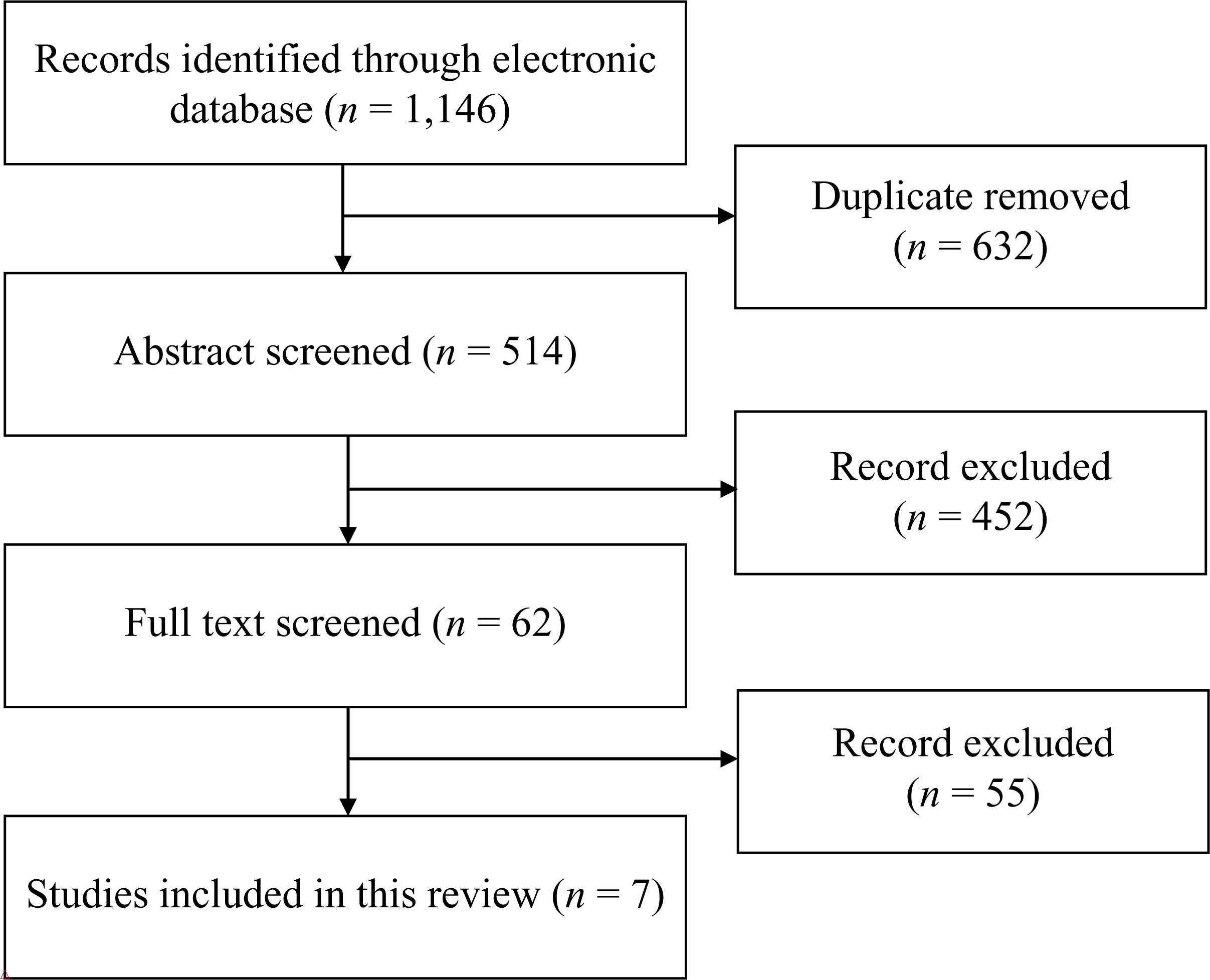
Figure 1
The review process flowchart.
Table 1
Study characteristics.
| Study | Country | Study type | Interventions/study design/study aim | Study setting | Participant | Outcomes | Study limitation |
|---|---|---|---|---|---|---|---|
| Dear et al.38 | Australia | Randomize controlled trial | Online vs. workbook; Identical contents of information given to each group over 8 weeks, 2 psychologists with weekly contact to support their learning; (1) To provide information that helps participants to understand and deconstruct their symptoms and difficulties; (2) To teach a range of self-management skills to help participants manage their symptoms and difficulties; and (3) To reduce pain-related disability and improve emotional well-being by encouraging the practice and adoption of the skills taught within the program. | Clinic & Community | 178 adults with chronic pain | Both groups had similar positive result in level of disability, anxiety, and depression for immediate post treatment, 3 months and 12 months follow ups | The absence of a control group which limits the ability to control for general time effects, spontaneous remission, and the impacts of other treatments |
| Morone et al.39 | U.S.A | Randomize controlled trial | Meditation vs. education; 8 weeks program, group education, one topic 1 week; To determine the impact of an 8-week mindfulness meditation program on disability, psychological function, and pain severity in community-dwelling older adults with chronic low back pain, and to test the education control program for feasibility. | Community | 40 Adults ≥65 years with chronic low back pain | Both groups improved on measures of disability, pain, and psychological function, both at program completion and 4 months follow-up | Small sample size, the sample was also predominantly white and well-educated |
| Chiauzzi et al.40 | U.S.A | Randomize controlled trial | Website vs. text based; Two groups received different information: website group with CBT and self-management as principle; text group had general information of back pain sent by regular email; To determine whether an interactive self-management website for people with chronic back pain would significantly improve emotional management, coping, self-efficacy to manage pain, pain levels, and physical functioning compared with standard text-based materials. | Clinic & Community | 209 adults with chronic back pain | Online interactive group with tailored contents showed effect changes in pain, depression, anxiety, and global rates of improvement compared with text group | Control group does not have same support as from the intervention group in the study; different recruitment ways brought participants with different baseline conditions |
| Van Oosterwijck et al.41 | Belgium | Randomize controlled trial | PN vs. pacing self-management; 2 weeks education, once a week, first session was one-to-one and face-to-face, second session was delivered through telephone contact to ensure participants understanding the information from session one; To examine whether intensive pain physiology education is effective in FM patients, and whether it is able to influence the impaired endogenous pain inhibition of these patients. | Community | 30 patients with FM | Neurophysiology group showed improvement in knowledge of PN, less worrying time, physical function, mental health, general health perception, and lower pain scores compared with self-management group | Small sample, 4 males in the sample |
| Ittersum et al.42 | Belgium | Randomize controlled trial | PN education vs. relaxation education; Both groups use a 15-pages booklet over 6 weeks, read by participants themselves; To determine whether the 12-week, “Pain Education School” program developed at a Midwestern VA medical center benefited veterans who suffer from chronic or persistent, noncancer pain. | Clinic | 105 patients with FM | No differences between two groups and pre–post test, both groups showed no effective changes in pain cognitions, health status in patients with FM | High dropout rates, small sample, not sure how much the participants understand the intervention/education materials |
| Cosio & Lin43 | USA | Quasi experiment study | Pain Education School Pre–Post test; Once a week, one-hour classes for 12 weeks, participants were not required to attend all sessions, they can choose the topics they like, delivered by multidisciplinary health professionals; To determine whether the 12-week, “Pain Education School” program developed at a Midwestern VA medical center benefited veterans who suffer from chronic or persistent, noncancer pain. | Clinic | 206 veterans with chronic pain | Study showed significant difference in pain intensity, readiness for Self-management, experience of pain, and depression by pre–post test | Lack of control group, education sessions are based on patient self-selection, so not all participants finished 12 weeks education |
| Morlion et al.44 | Belgium | Quasi experiment study | Multidisciplinary pain education program Pre-post test; 4 sessions × 2 h over 2 weeks, delivered by multidisciplinary health professionals; A brief intervention to rapid improve core symptoms and complaints for people with chronic noncancer pain; to determine factors associated with improvement defined in terms of change in pain symptoms. | Clinic | 63 adults with chronic pain | Study showed improvement in pain symptoms and action-proneness but not in depression and kinesiophobia | Lack of control group |
[i] CBT, Cognitive behavior therapy; FM, Fibromyalgia; PN, Pain neurophysiology.
Table 2
Education programs—contents.
| Study | Education contents | |||
|---|---|---|---|---|
| General information | CBT as principle | Self-management | PN | |
| Dear et al.38 | ✓ | ✓ | ✓ | |
| Morone et al.39 | ✓ | |||
| Chiauzzi et al.40 | ✓ | ✓ | ✓ | |
| Van Oosterwijck et al.41 | ✓ | ✓ | ||
| Ittersum et al.42 | ✓ | ✓ | ✓ | |
| Cosio & Lin43 | ✓ | ✓ | ||
| Morlion et al.44 | ✓ | ✓ | ✓ | |
[i] Note: General information: symptoms identification, treatment options, complementary treatments, pain medications, working with health professionals, eating and health, weight management, smoking cessation; CBT as principle: thoughts and mood management, motivation enhancement, psychological factors on pain, self-efficacy, pain acceptance & commitment therapy; Self-management: relaxation, physical exercise, activity pacing, graded exposure, activity management strategy, goal setting, sleep management, stress management, relapse prevention, structured problem solving; PN: based on the book Explain Pain by Butler & Moseley45 and theory of central sensitization that nociceptive stimuli sent to the brain are not always reflected in pain experience, depending on patient's psychological state of mind and environment. Difference between nociception and pain, Acute pain vs. chronic pain, How acute pain becomes chronic, Potential sustaining factors of central sensitization.
[ii] CBT, Cognitive behavior therapy; PN, Pain neurophysiology.
Table 3
Education programs —way of delivery.
| Study | Duration | Frequency | Delivered by | Way of delivery | |||
|---|---|---|---|---|---|---|---|
| Face-to-Face one-to-one | Face-to-Face in group | Online | booklet | ||||
| Dear et al.38 | 8 weeks | 7–10 days × a lesson, for 5 lessons | Psychologist × 2 weekly contact for learning support | ✓ | ✓ | ||
| Morone et al.39 | 8 weeks | 1 session × 90 min, once a week | Health professional, not specific | ✓ | ✓ | ||
| Chiauzzi et al.40 | 4 weeks | Website group: 20 min × twice a week Text group: on their own pace | N/A | ✓ | |||
| Van Oosterwijck et al.41 | 2 weeks | 1 session × 30 min, once a week | Physiotherapist | ✓ | ✓ | ||
| Ittersum et al.42 | 6 weeks | Read it several times with 1 or 2 days intermissions | N/A | ✓ | |||
| Cosio & Lin43 | 12 weeks | 1 session × 1 h, once a week | Health professionals from over 20 disciplines | ✓ | |||
| Morlion et al.44 | 2 weeks | 2 sessions × 2 h per week | A physiotherapist, A pain nurse, and a clinical psychologist | ✓ | |||
[i] Note: The duration of the education and the frequency for each session varied between the studies. The duration ranged from 2 weeks to 12 weeks. The frequency of the education sessions varied between twice a week40,44, once a week39,41,43, and 7–10 days for a session at the participants’ pace of self-learning.38
Table 4
Education programs—evaluation tools.
| Study | Pain disability Index: Roland Morris Disability Questionnaire | Pain Self-Efficacy Questionnaire | Kinesiophobia Scale (Fear of Movement/injury) | Chronic Pain Acceptance Questionnaire 8-Item | Pain Catastrophizing Scale (pain negative orientation) | Pain Intensity | Quality of life | Mindfulness | Depression and anxiety | Habitual action proneness questionnaire | Global rating: PGIC patient global impression of change | Chronic pain coping inventory | Spatial summation procedures (SSP) | FM impact questionnaire | Pain vigilance and awareness questionnaire | Neurophysiology of pain test, knowledge test | Illness perception questionnaire for FM | Numeric rating scale for pain | Patient pain questionnaire (focus on knowledge of medication) | |
|---|---|---|---|---|---|---|---|---|---|---|---|---|---|---|---|---|---|---|---|---|
| 1 | Dear et al.38 | ✓ | ✓ | ✓ | ✓ | ✓ | Patient Health Questionnaire (Depression), Generalized Anxiety Disorder✓ | ✓Wisconsin Brief Pain Questionnaire | ||||||||||||
| 2 | Morone et al.39 | ✓ | ✓ | Short-form McGill Pain Questionnaire | ✓, SF-36 Health Status Inventory | ✓ | ||||||||||||||
| 3 | Chiauzzi et al.40 | ✓Oswestry Disability Questionnaire | ✓ | ✓ | ✓ | Brief pain inventory | ✓Depression Anxiety Stress Scales | ✓ | ✓ | |||||||||||
| 4 | Van Oosterwijck et al.41 | ✓ | ✓ | ✓SF-36 Health Status Inventory | ✓ | ✓ | ✓ | ✓ | ✓ | |||||||||||
| 5 | Ittersum et al.42 | ✓ | ✓ | ✓ | ||||||||||||||||
| 6 | Cosio & Lin43 | ✓Patient Health Questionnaire | ✓ | ✓ | ||||||||||||||||
| 7 | Morlion et al.44 | ✓ | ✓ | ✓SF-36 Health Status Inventory | ✓Hospital Anxiety and Depression Scale (HADS) | ✓ |
[i] Note: FM, Fibromyalgia; HADS, Hospital Anxiety and Depression Scale.