Have a personal or library account? Click to login
Psychological problems related to capillary blood glucose testing and insulin injection among diabetes patients Cover

Psychological problems related to capillary blood glucose testing and insulin injection among diabetes patients

Open Access
|Jul 2020

Figures & Tables

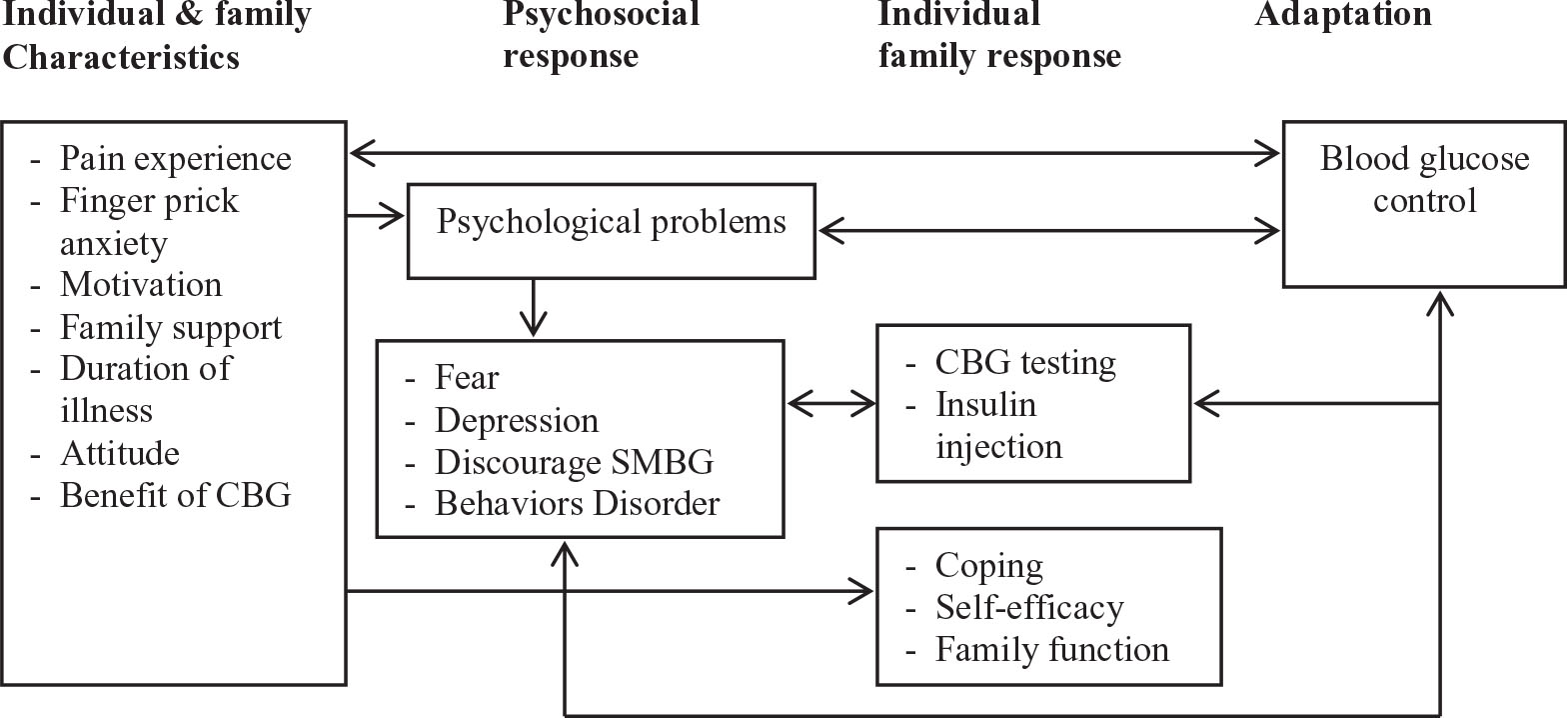
Figure 1

Conceptual model of psychological adaptation for diabetes mellitus.

Factors related to fear and psychological issues of CBG testing_

AuthorsFactors related to psychological problemsImpacts of psychological problems on CBG testing and insulin injection
Ong et al. 201419
  • Patient's emotion

  • Low support and insufficient knowledge

  • Misconception toward glucose monitoring and nonadherence to medication taking

Taylor et al. 201726
  • Insufficient knowledge related to SMBG

  • Unclear communication between health-care providers and patients

  • Misconception related to SMBG, influence of the diabetes-related stigma, and physiological and psychological issues

Nazmi et al. 201330
  • Experience of pain or discomfort while pricking the finger

  • Patients discouraged from monitoring blood glucose

Shlomowitz and Feher 20148
  • Experience of finger prick anxiety

  • Injection pain

  • Avoiding self-monitoring by CBG

Strategies to manage the psychological problems related to CBG monitoring and insulin injection_

AuthorsStrategiesDescription of the strategy
Snoek et al. 200821A 5-step psychosocial model of SMBG
  • Deciding whether or not to perform a test. This choice may be based on routine

  • Deciding whether or not to perform an analysis; this choice is based on the method

  • Behavioral psychology to predict the negative experience with SMBG

  • Diabetes education and sufficient cognitive ability

  • Immediate action of SMBG

  • Appraisal of SMBG outcomes

Welschen et al. 201334Cognitive behavioral therapy (CBT)
  • The CBT explores the negative beliefs that generate a contrary conclusion, anxiety, depression, and guilt. This strategy involves challenging negative thoughts and has been used to alter behaviors and to treat mood disorders

Funnell et al. 200436Confrontation, persistence, and reality (CPR) strategy
  • The CPR focuses on confrontation and assessment of patient's obstacles, including psychological issues

  • Persistence is talking about the interaction and collaboration between patients and health-care provider in diabetes care

  • The reality aspect covers the ongoing monitoring process

Cox et al. 200635Blood glucose awareness training (BGAT)
  • This is a psychoeducational intervention that consists of education on blood glucose and how diabetes management affects blood glucose level

  • Empowering patients with such information and skills is through BGAT

  • Detection of extreme blood glucose, a sequel to excessive blood glucose, and psychological issues such as fear and depressive symptoms

Database search and keywords_

Sources of dataKeywords
PubMed* Fear AND Capillary blood glucose OR Insulin injection AND Diabetes* Psychological problem on capillary blood glucose OR Insulin injection AND Diabetes
Scopus* Fear AND Capillary blood glucose OR Insulin injection AND Diabetes* Psychological problem on capillary blood glucose OR Insulin injection AND Diabetes
CINAHL* Fear AND Capillary blood glucose OR Insulin injection AND Diabetes* Psychological problem on capillary blood glucose OR Insulin injection AND Diabetes
Google Scholar* Fear AND Capillary blood glucose OR Insulin injection AND Diabetes* Psychological problem on capillary blood glucose OR Insulin injection AND Diabetes

Psychological issues related to CBG testing and insulin injection_

AuthorsStudy designsPsychological issues related to CBG testing and insulin injection
Ong et al. 201419Qualitative design
  • Fear of needles and the fingertip pricking being painful

  • Frustration related to high blood glucose reading

  • Lack of motivation of SMBG

Taylor et al. 201726Mixed qualitative and quantitative design
  • Stress and emotions described as shame, laziness, and forgetfulness among patients, family members, and community members

Van Dooren et al. 201627Cohort study
  • High levels of depressive and anxiety symptoms related to diabetes management

  • Personality traits including negative affectivity, the tendency to experience negative emotions across situations and during social interaction

  • The tendency to inhibit the expression of feelings in social interactions to avoid disapproval

Gucciardi et al. 201320Qualitative design
  • Negative emotional responses to unexpected blood glucose readings, burden of SMBG, and lack of self-discipline

Shlomowitz et al. 20148Cross-sectional study
  • 58% of patients presented finger prick anxiety and 30% of patients had general anxiety

Yoshioka 201824Editorial
  • Misconception on effectiveness of insulin injection

  • Fear of and pain during injection by needles

  • Fear of their suffering from hypoglycemic/hyperglycemic symptoms

  • Wrong belief on insulin injection as treatment failure

Bai et al. 201825Meta-analysis
  • Depression on long-term insulin therapy

DOI: https://doi.org/10.2478/fon-2020-0015 | Journal eISSN: 2544-8994 | Journal ISSN: 2097-5368
Language: English
Page range: 87 - 95
Submitted on: Oct 23, 2019
Accepted on: Nov 22, 2019
Published on: Jul 14, 2020
Published by: Shanxi Medical Periodical Press
In partnership with: Paradigm Publishing Services
Publication frequency: 4 issues per year

© 2020 Rian Adi Pamungkas, Kanittha Chamroonsawasdi, published by Shanxi Medical Periodical Press
This work is licensed under the Creative Commons Attribution-NonCommercial-NoDerivatives 4.0 License.