
Table 1
Alternative keywords and search strategy.
| Population | Interventions | Outcome |
|---|---|---|
| 1. Chronic respiratory disease | 5. Nurse specialist | 15. Safe* |
| 2. Discharged | 6. Clinical nurse specialist | 16. Effective |
| 3. Chronic obstructive pulmonary disease | 7. Advance practice nurse | 17. Effectiveness |
| 4. COPD | 8. Special nurse-led | 18. Exercise tolerance |
| 9. Specialist-led | 19. Pulmonary function | |
| 10. RNS-led | 20. Mortality | |
| 11. RNS | 21. Satisfaction | |
| 12. CNS-led | 22. The quality of life | |
| 13. Home-based | 23. Low cost | |
| 14. Outreach nursing | 24. Economic | |
| 25. Cost effectiveness | ||
| 26. Combination of 1–4 using “OR” | 27. Combination of 5–14 using “OR” | 28. Combination of 15–25 using “OR” |
| The last step is to combine 26+27+28 using “AND” |
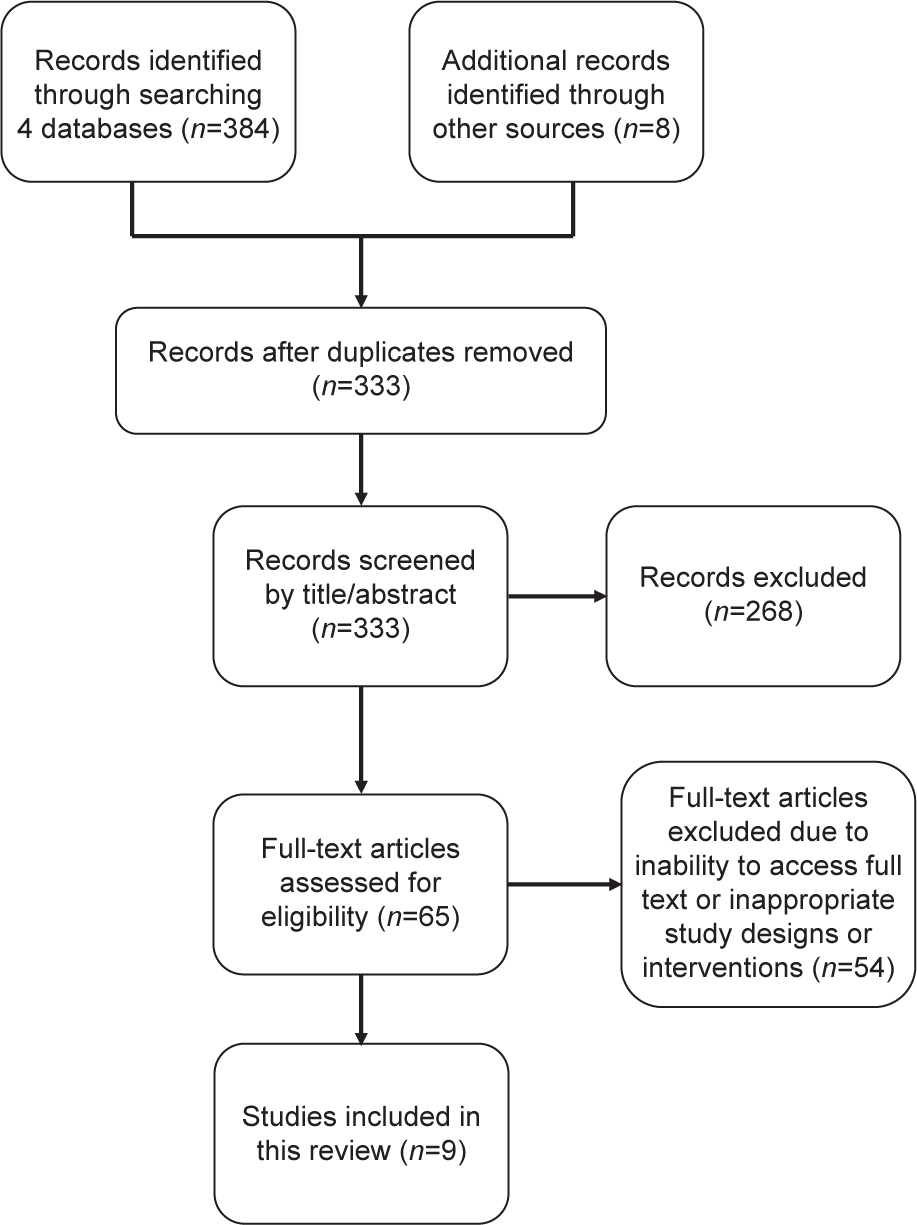
Figure 1
Article search diagram.
Table 2
Characteristics of included studies.
| Author (date published) | Journal | Setting | Sample | Intervention group | Control group | Outcomes | Duration of the study | Notes |
|---|---|---|---|---|---|---|---|---|
| Smith et al. (1999) | Australian and New Zealand Journal of Medicine | Adelaide, Australia | Patients with principal diagnosis of COPD attending The Queen Elizabeth Hospital (N=96) | Patients received home-based nursing interventions including condition monitor, education, and early identification of exacerbations after leaving the hospital | Patients received usual care and education from outpatient clinics and GP services |
| 12 months | Health-related guality of life was improved |
| Cotton et al. (2000) | Thorax | Glasgow, UK | Patients with diagnosis of exacerbation of COPD attending the Royal College of Physicians of London (N=81) | The patients in the intervention group were sent home within 3 days after admitted. These patients were visited by a specialized nurse | Patients received the care of the medical unit and discharge with usual admission duration |
| 14 months | Patients with acute exacerbations of COPD can be discharged home earlier than the current practice |
| Davies et al. (2000) | BMJ | Liverpool, UK | Patients with diagnosis of COPD based on standard criteria (N=150) | Patients were visited morning and evening by nurses for three days after discharge | Patients received inpatient admission as usual |
| 18 months | No difference was found in mortality and FEV1 |
| Griffiths et al. (2000) | The Lancet | Wales, UK | Local hospital and local GP referring (N=200) | The treatment group received a multidisciplinary treatment, including two sessions: a general education session and an individualized physical training session | Patients continued with their usual outpatient or primary care followup for 1 year |
| 12 months | Walking ability and health status were improved |
| Skwarska et al, (2000) | Thorax | Edinburgh, UK | Patients with exacerbation of COPD admitted to the Royal Infirmary of Edinburgh (N=184) | Patients in the supported discharged group were discharged home with an appropriate treatment package and visited at home by a specialist nurse at the following day | Patients received treatment by the hospital team and discharge as usual |
| 18 months | No difference in readmission and health status, satisfaction was good, and the average cost was much lower |
| Hernandez et al. (2003) | European Respiratory Journal | Barcelona, Spain | Patients in the ER of two hospitals in the Barcelona area (N=222) | Patients in the intervention group supported by a skilled specialist nurse called patients regularly and provide consultation service, All of these calls and service were free within eight weeks after discharge. | Patients were evaluated by the attending physician. At discharge, the patient was usually supervised by the primary care physician |
| 12 months | Comprehensive home care is cost effective |
| Vrijhoef et al. (2007) | Chronic Illness | Alkmaar, the Netherlands | Patients from the respiratory outpatient clinic of general and teaching hospital (N=187) | Patients in the intervention group were transferred to respiratory nurses instead of respiratory physicians | Patients assigned to the usual care group received routine respiratory outpatient care provided by the respiratory care physician and follow-up consultations from their respiratory care physician at the outpatient clinic |
| 16 months | Respiratory nurse reported more consultations, worsening in FV2008C, improvements in subjective knowledge, self-assessed rate for coping with COPD, and overall satisfaction |
| Efraimsson et al. (2008) | Scandinavian Journal of Caring Sciences | Sweden | Patients with COPD from a Swedish primary care setting (N=52) | Patients received an education that laid emphasis on self-care ability and supported them according to their specific needs and ability to deal with the disease | The control group received a conventional care, including a first visit to the nurse, spirometry, and a follow-up visit to a physician |
| 10 months | The program can improve patients’ quality of life and have effect on smoking habits |
| Sridhar et al. (2008) | Thorax | West London, UK | Patients with acute exacerbation of COPD admitted to a hospital in London (N=122) | Patients received a care package incorporating initial pulmonary rehabilitation and self-management education and other support by a specialist nurse | Usual treatment from their primary care physician, secondary care physician, and/or the respiratory nursing service as appropriate |
| 24 months | Self-management of patients was improved |
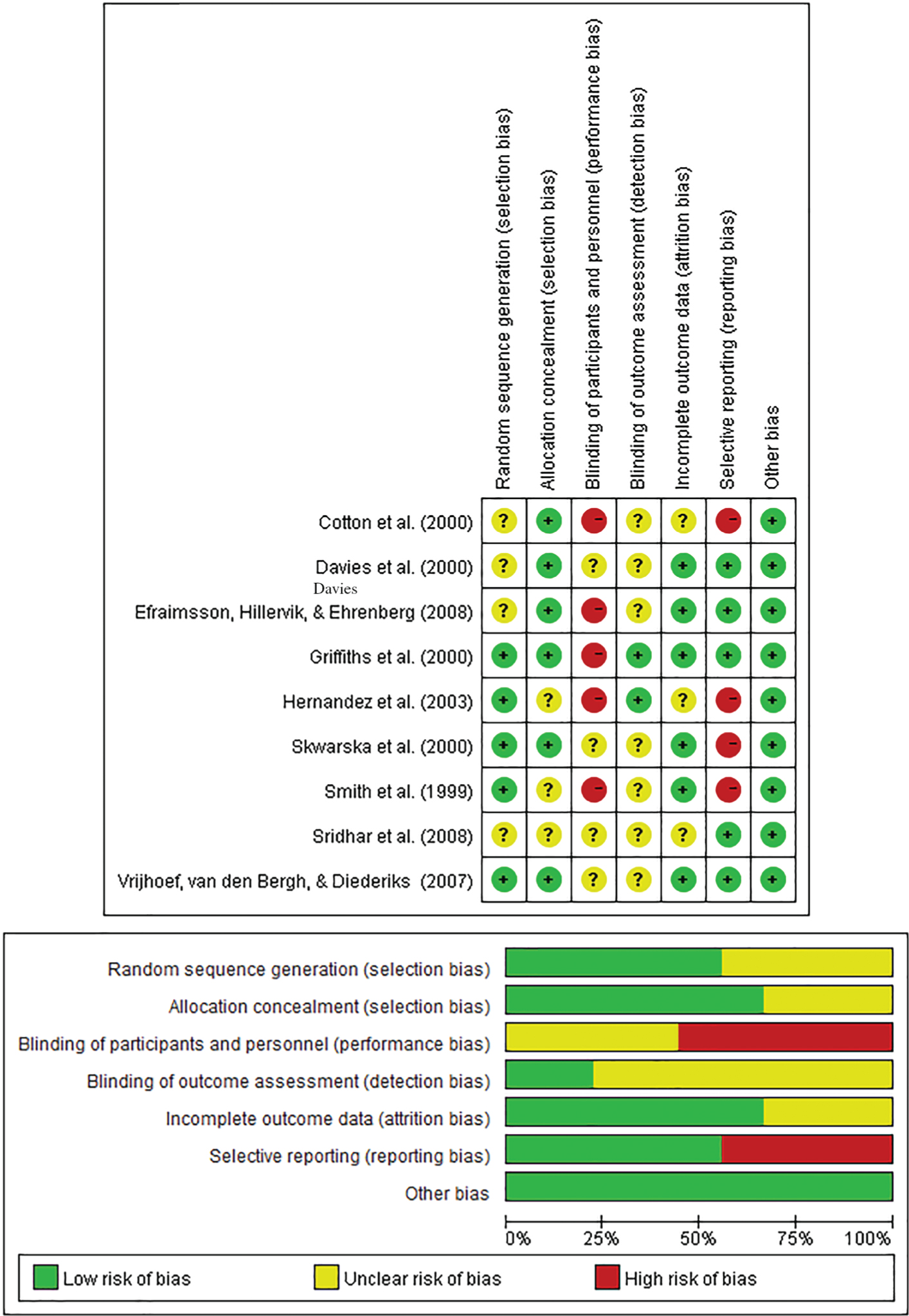
Figure 2
Summary of risk of bias for included trials.