

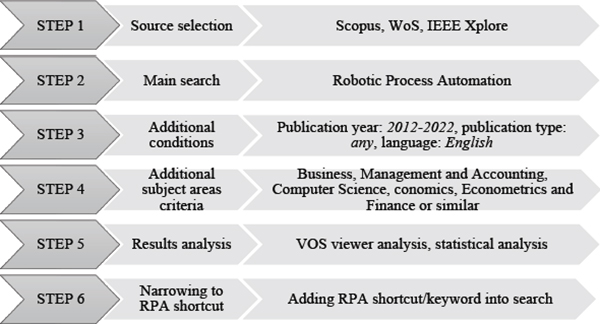
Figure 1.
Research method.
(Source: Author’s own research)
Table 1.
Data for the Polish art market for the first half of 2021
(Source: Author’s own research)
| No. | Steps | Description | Web of Science | Scopus | IEEE Xplore |
|---|---|---|---|---|---|
| 1 | Results of first research | RPA | 2870 | 7428 | 5329 |
| 2 | Results after additional conditions | 2012–2023, language: English, any type of document | 2097 | 4116 | 3441 |
| 3 | Results after subject area | Business, management and accounting, computer science, economics, econometrics and finance or similar | 757 | 2465 | 1697 |
| 4 | Results after narrowing to RPA shortcut | RPA | 161 | 279 | 25 |
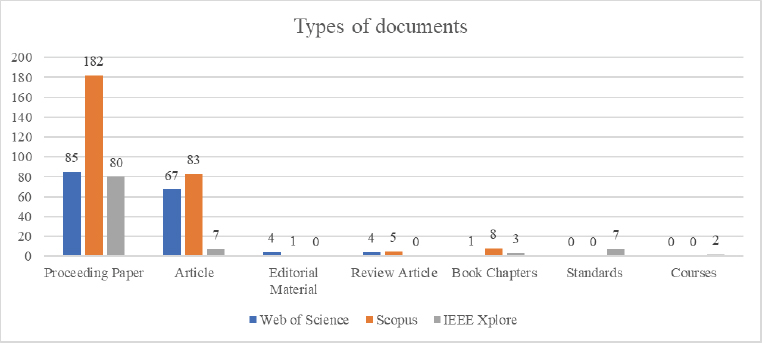
Figure 2.
Types of publications in % – Web of Science.
(Source: Author’s own research)
Table 2.
Results by publication year
(Source: Author’s own research)
| Publication year | Web of Science | SCOPUS | IEEE Xplore |
|---|---|---|---|
| 2016 | 1 | 1 | 0 |
| 2018 | 10 | 10 | 5 |
| 2017 | 3 | 3 | 3 |
| 2019 | 31 | 41 | 15 |
| 2020 | 43 | 62 | 22 |
| 2021 | 41 | 78 | 30 |
| 2022 | 31 | 82 | 24 |
| Sum | 161 | 279 | 99 |
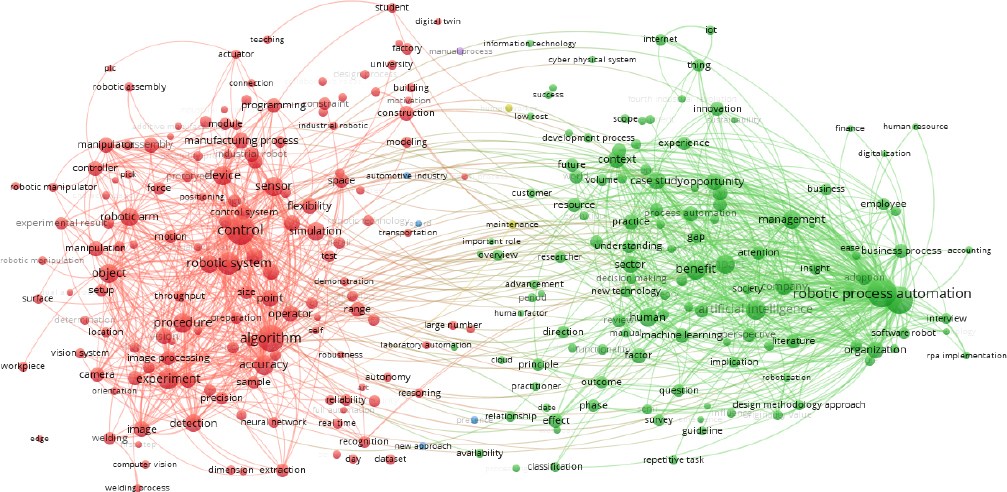
Figure 3.
Results of search in Web of Science.
(Source: Author’s own research)
Table 3.
Types of documents
(Source: Author’s own research)
| Type of document | Web of Science | Scopus | IEEE Xplore |
|---|---|---|---|
| Proceeding paper | 85 | 182 | 80 |
| Article | 67 | 83 | 7 |
| Editorial material | 4 | 1 | 0 |
| Review article | 4 | 5 | 0 |
| Book chapters | 1 | 8 | 3 |
Table 4.
RPA cluster analysis
(Source: Author’s own research)
| No | Cluster name | Keywords |
|---|---|---|
| 1 | Artificial intelligence | Internet, integration, robotic, perspective, machine learning, process automation, fourth industrial revolution |
| 2 | Digital transformation | Impact, challenge, future, design methodology approach, management |
| 3 | Business process | Business, employee, finance, human resource, accounting |
| 4 | Method/model | Evaluation, detection, simulations, concept |
Table 5.
Citation and year of publication analysis
(Source: Author’s own research)
| No. | Web of Science | Scopus | Publication |
|---|---|---|---|
| 1 | 82 | 90 | Aguirre, S., Rodriguez, A., Automation of a Business Process Using Robotic Process Automation (RPA): A Case, 4th Workshop on Engineering Applications (WEA), 2017, APPLIED COMPUTER SCIENCES IN ENGINEERING 742, pp. 65-71 |
| 2 | 69 | 117 | Syed, R., Suriadi, S., Reijers, H. A., Robotic Process Automation: Contemporary themes and challenges, 2020, Computers in industry, p. 115 |
| 3 | 67 | 96 | Moffitt, K. C., Rozario, A. M., Vasarhelyi, M. A., Robotic Process Automation for Auditing, 2018, Journal of emerging technologies in accounting, 15 (1), pp. 1-10 |
| 4 | 57 | 71 | Mendling, J., Decker, G., Reijers, H. A., Hull, R., Weber, I., How do machine learning, robotic process automation, and blockchains affect the human factor in business process management? 2018, Communications of the Association for Information Systems, 43(1), 19, pp. 297-320 |
| 5 | 52 | 68 | Hofmann, P., Samp, C., Urbach, N., Robotic process automation, 2020, Electronic Markets, 30(1), pp. 99-106 |
| 6 | 51 | 64 | Cooper, L. A., Holderness, D. K., Sorensen, T. L., Wood, D. A., Robotic process automation in public accounting, 2019, Accounting Horizons, 33(4), pp. 15-35 |
| 7 | 38 | 46 | Kokina, J., Blanchette, S., Early evidence of digital labour in accounting: Innovation with Robotic Process Automation, 2019, International Journal of Accounting Information Systems, 35 |
| 8 | 35 | 48 | Leshob, A., Bourgouin, A., Renard, L., Towards a Process Analysis Approach to Adopt Robotic Process Automation, 2018, IEEE 15th International Conference on e-Business Engineering, ICEBE 2018, 8592629, pp. 46-53 |
| 9 | 35 | 49 | Enriquez, J. G., Jimenez-Ramirez, A., Dominguez-Mayo, F. J., Garcia-Garcia, J. A., Robotic Process Automation: A Scientific and Industrial Systematic Mapping Study, 2020, IEEE Access, pp. 39113-39129 |
| 10 | NA | 29 | Siderska, J. Robotic Process Automation-a driver of digital transformation? 2020, Engineering Management in Production and Services, 12(2), pp. 21-31 |
| 11 | NA | NA | Sobczak A., Analysis of the Conditions Influencing the Assimilation of the Robotic Process Automation by Enterprises. 2022, Human Technology, 18(2), 143–190 |
| 12 | NA | NA | Eulerich M., Pawlowski J., Waddoups N. J., Wood D. A., A Framework for Using Robotic Process Automation for Audit Tasks. 2022, Contemporary Accounting Research, 691-720 |
| 13 | NA | NA | Plattfaut R., Borghoff V., Godefroid M., Koch J., Trampler M., Coners A., The Critical Success Factors for Robotic Process Automation, 2022, Computers in Industry, Volume 138 |
| 14 | NA | NA | Williams O. C., Olajide F., Towards the Design of an Intelligent Automation Framework for Business Processes, 2022, 5th International Conference on Information and Computer Technologies (ICICT), New York, NY, USA, 2022, pp. 13-17 |
Table 6.
Discussion of results based on RPA definition and clusters
(Source: Author’s own research)
| Publication | RPA definition | Cluster 1 – AI | Cluster 2 – digital transformation | Cluster 3 – business process | Cluster 4 – method/model |
|---|---|---|---|---|---|
| Aguirre, 2017 | RPA is the technological imitation of a human worker with the goal of automating structured tasks in a fast and cost-efficient manner | No connection described | No connection described | RPA applications have been reported over the last 5 years in business process | In the article, a case study was presented and the results were described |
| Syed, 2020 | RPA is a modern technology comprising software agents called “bots” that mimic the manual path taken by a human through a range of computer applications when performing certain tasks in a business process | General idea described | No connection described | General idea described | RPA is easier and cheaper to implement, configure, and maintain |
| Moffitt, 2018 | RPA robots conduct work the same way that humans do, through the software presentation layer. Logins, emails, analyses, report building, data entry, and other functions are still completed. RPA robots can be compared to the recorded macros in Excel that automate specific tasks | No connection described | No connection described | General idea described | RPA was described as a method implemented in audit process |
| Mendling, 2018 | RPA is mostly associated with the task level. The robots can gather data from systems and update them by imitating manual screen-based manipulations | General idea described | No connection described | General idea described | RPA was mentioned as an emerging technology |
| Hofmann, 2020 | In contrast to RPA automating processes in a more or less unattended way, RDA focuses on attending humans in tasks such as front office functions | General idea described | General idea described | General idea described | General idea described |
| Cooper, 2019 | RPA ranges from a simple to an overly complex computer program that can automate the input, processing, and/or output of data across computer applications or systems without altering a firm’s existing infrastructure | General idea described | No connection described | RPA is an innovative technology that accounting firms use to perform internal business processes | RPA was described a method to improve efficiency in taxation, assurance, and advisory professional services processes |
| Kokina, 2019 | RPA bots can interact with multiple systems, work autonomously, and perform routine tasks consisting of binary decisions that do not require intelligence | General idea described | General idea described | Review of accounting process that might be accountable for RPA | No connection described |
| Leshob, 2018 | RPA is an emerging approach that uses software-based robots to perform tasks that require manual labor | No connection described | No connection described | RPA works well in any industry such as banking, health care, and insurance industries | Four-step model of RPA was proposed in the article: Validate evaluate the RPA potential, evaluate the relevance, classify |
| Enriquez, 2020 | RPA, a “robot,” corresponds to a software program. For business processes, the term RPA means the technological extrapolation of a human worker, whose objective is to tackle structured and repetitive tasks (quite common in Enterprise Resources Planning – ERP systems or productivity tools), quickly and profitably | AI is described as a separated method form RPA | No connection described | General idea described | Proposal of RPA model: analysis, design, construction, deployment, control and monitoring, and evaluation and performance phases |
| Siderska, 2020 | RPA, which is an emerging and innovative conception of business processes automation, is based on the notion of software robots or AI workers | AI described as a future method to RPA | RPA described as a digital transformation method | Criteria for business processes were described | RPA was described as a technology for digitalization |
| Sobczak, 2022 | The robot is not regarded as a technical device and does not have the locomotive abilities of a human being. Software robots usually operate based on the set algorithm | AI is a tool to enrich RPA to make increasingly complex decisions | RPA described as a digital transformation method | General idea described | Many different technical models of RPA implementation described |
| Eulerich, 2022 | RPA is the use of bots (autonomous computer programs) to automate repetitive, routine business processes | AI described as a future method to RPA | No connection described | Audit processes described | Framework for technical RPA implementation described |
| Plattfaut, 2022 | RPA is a low-code way of automating business processes using the graphical user interface of underlying applications | No connection described | No connection described | Connection to many different processes shown | Detailed analysis of success factors described |
| Williams, 2022 | RPA can be described as an approach toward routine performance for business processes | IA is the integration of RPA | Digital transformation aids RPA | Adaptation of RPA enables digitization of business processes | Service request business process described |