

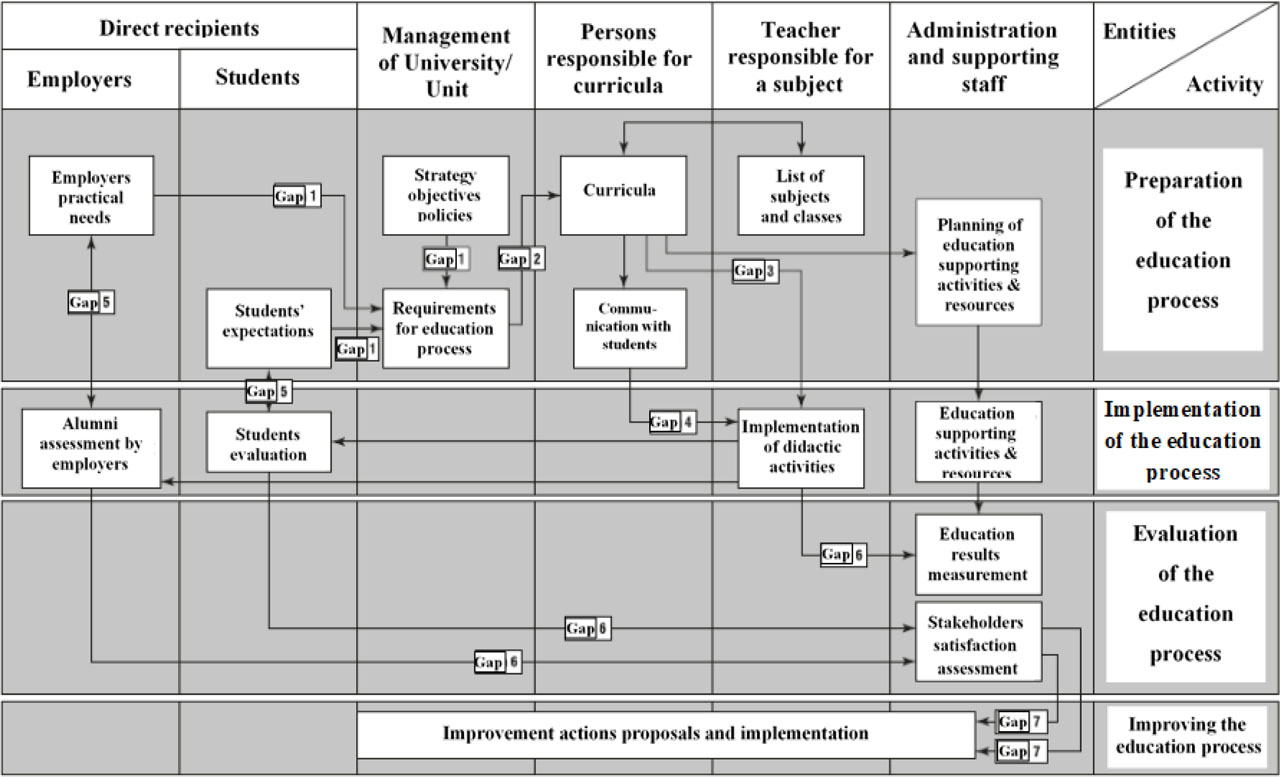
Figure 1
The SERVQUAL, gap model for educational services (Source: Hrnciar and Madzík, 2013, pp.75–88)
Table 1
Quality principles for higher education institutions according to CIQG (Source: CHEA, 2018)
| Principle | Description |
|---|---|
| Quality and higher education institutions | Quality assurance and achievement in higher education are the core responsibilities of higher education service providers and their staff |
| Quality and students | The education of students should always meet high-quality standards, regardless of the learning outcomes realized |
| Quality and society | The quality of tertiary education is judged by how well it responds to society's needs, and builds and maintains public trust |
| Quality and government | Local and central governments play a significant role in encouraging and supporting high-quality higher education |
| Quality and responsibility | It is the responsibility of higher education institutions and assurance and accreditation bodies to strongly commit to and regularly reaffirm responsibility for the quality |
| Quality and role of quality assurance and accreditation bodies | Quality assurance and accreditation bodies, working with higher education institutions and their management, staff, and students, are responsible for implementing processes, tools, and learning outcomes measures that help to build a common understanding of quality |
| Quality and change | High-quality higher education must be flexible, creative, and innovative; development and evolution are essential to meet the needs of students, to establish public confidence, and to preserve diversity |
Table 2
ESG criteria for internal quality assurance (Source: ESG, 2015, pp.11–15)
| No. | Criterion | Description |
|---|---|---|
| 1 | Policy for quality assurance | Institutions should have a policy for quality assurance that is made public and forms part of their strategic management. Internal stakeholders should develop and implement this policy through appropriate structures and processes while involving external stakeholders. |
| 2 | Design and approval of programs | Institutions should have processes for the design and approval of their programs. The programs should be designed so that they meet the objectives set for them, including the intended learning outcomes. The qualification resulting from a program should be specified and communicated, and refer to the correct level of the national qualifications framework for higher education and, consequently, to the Framework for Qualifications of the European Higher Education Area. |
| 3 | Student-centered learning, teaching, and assessment | Institutions should ensure that the programs are delivered in a way that encourages students to take an active role in creating the learning process, and that the assessment of students reflects this approach. |
| 4 | Student admission, progression, recognition, and certification | Institutions should consistently apply predefined and published regulations covering all phases of the student “life cycle,” e.g., student admission, progression, recognition, and certification. |
| 5 | Teaching staff | Institutions should assure themselves of the competence of their teachers. They should apply fair and transparent processes for the recruitment and development of the staff. |
| 6 | Learning resources and student support | Institutions should have appropriate funding for learning and teaching activities and ensure that adequate and readily accessible learning resources and student support are provided |
| 7 | Information management | Institutions should ensure that they collect, analyze, and use relevant information for the effective management of their programs and other activities |
| 8 | Public information | Institutions should publish information about their activities, including clear, accurate programs, up-to-date, and readily accessible |
| 9 | On-going monitoring and periodic review of programs | Institutions should monitor and periodically review their programs to ensure that they achieve the objectives set for them and respond to the needs of students and society. These reviews should lead to the continuous improvement of the program. Any action planned or taken as a result should be communicated to all those concerned. |
| 10 | Cyclical external quality assurance | Institutions should undergo external quality assurance in line with the ESG on a cyclical basis. |
Table 3
PKA criteria for internal quality assurance of education (Source: PKA, 2019)
| No. | Criterion | Description |
|---|---|---|
| 1 | Design of the study program: concept, learning objectives, and learning outcomes | 1.1 The concept and objectives of education are in line with the university's strategy, fit into the discipline or disciplines to which the course is assigned, are related to the academic activity conducted at the university in this discipline or disciplines, and are oriented toward the needs of the socioeconomic environment, including especially the professional labor market. 1.2 The learning outcomes are consistent with the concept and objectives of education and the discipline or disciplines to which the course is assigned, describe, in an accurate, specific, realistic manner and allowing for a verification system, the knowledge, skills, and social competences achieved by students, as well as correspond to the appropriate level of the Polish Qualifications Framework and the general academic profile. |
| 2 | Implementation of the study program: program content, schedule for the implementation of the study program, forms and organization of classes, teaching methods, apprenticeships, organization of the teaching and learning process | 2.1 The curriculum contents are consistent with the learning outcomes and take into account, in particular, the current state of knowledge and research methodology in the discipline or disciplines to which the course is assigned, as well as the results of the university's research activity in this discipline or disciplines. 2.2 The schedule for the implementation of the study program and the forms and organization of classes, as well as the number of semesters, the number of hours of classes conducted with the direct participation of academic teachers or other persons conducting classes, and the estimated workload of students, measured by the number of ECTS points, enable students to achieve all learning outcomes. 2.3 The teaching methods are student-oriented, motivate them to actively participate in the teaching and learning process, and enable students to achieve learning outcomes, including, in particular, preparation for or participation in scientific activities 2.4 If the study program includes apprenticeships, their program, organization and supervision, the selection of places and the environment in which they take place, including the infrastructure, as well as the competences of the tutors, ensure the proper implementation of the apprenticeship and the achievement of learning outcomes by students, in particular those related to the acquisition of research competences. 2.5 The organization of the teaching process ensures effective use of the time devoted to teaching and learning as well as the verification and assessment of learning outcomes. |
| 3 | Admission to studies, verification of students' achievement of learning outcomes, completing individual semesters and years, and diploma process | 3.1 Formally adopted and published, consistent and transparent conditions for admitting candidates to studies are applied, enabling the proper selection of candidates, rules for student progression and crediting individual semesters and years of study, including the diploma process, recognition of learning outcomes and periods, and qualifications obtained in higher education as well as confirming the learning outcomes achieved in the learning process outside the study system. 3.2 The learning outcomes verification system enables the monitoring of learning progress and a reliable and credible assessment of the degree of achievement by students of the learning outcomes, and the applied verification and assessment methods are student-oriented, enable feedback on the degree of achievement of the learning outcomes, and motivate students to active participation in the teaching and learning process, as well as allow for the verification and assessment of all learning outcomes, including, in particular, preparation for conducting research activity or participation in this activity. 3.3 Stage and examination work, student projects, internship diaries (if internships are included in the study program), diploma theses, student scientific/artistic, or other achievements related to the field of study, as well as the documented position of graduates on the labor market or their further education, confirm achieving learning outcomes. |
| 4 | Competences, experience, qualifications, and number of staff involved in education, as well as staff development and improvement | 4.1 Competences and experience, qualifications, and the number of academic teachers and other persons conducting classes with students ensure the proper implementation of classes and the achievement of learning outcomes by students. 4.2 The HR policy ensures the selection of academic teachers and other persons conducting classes, based on transparent rules and enabling the correct implementation of classes; takes into account the systematic evaluation of the teaching staff, carried out with the participation of students, whose results are used in the improvement of the staff; and creates conditions stimulating the staff to continuous development. |
| 5 | Infrastructure and educational resources used in the implementation of the study program and their improvement | 5.1 Teaching, research, library and IT infrastructure, technical equipment of rooms, teaching resources and aids, library, information, educational resources, and research equipment, as well as the infrastructure of other entities where classes are held are modern, enable the proper implementation of the classes and the achievement of students of learning outcomes, including preparation for a scientific activity or participation in this activity, as well as are adapted to the needs of people with disabilities, in a way that ensures that these people fully participate in education and scientific activity. 5.2 Teaching, research, library and IT infrastructure, technical equipment of rooms, teaching resources and aids, library, information, educational resources, and research equipment are subject to systematic reviews in which students participate, and the results of these reviews are used in improvement activities. |
| 6 | Cooperation with the socioeconomic environment in the construction, implementation, and improvement of the study program and its impact on the development of the field of study | 6.1 There is cooperation with the social and economic environment, including employers, in the design of the study program, its implementation, and improvement. Education quality standard. 6.2 Relationships with the socioeconomic environment concerning the study program and the impact of this environment on the program and its implementation are systematically assessed with the participation of students, and the results of these assessments are used in improvement activities. |
| 7 | Conditions and methods of increasing the degree of internationalization of the education process in the field | 7.1 The conditions conducive to the internationalization of education in the field of study have been created, following the adopted concept of education, i.e., academic teachers are prepared to teach and students to learn in foreign languages, the international mobility of students and academic teachers are supported, and an offer of education in foreign languages, which results in a systematic increase in the degree of internationalization and exchange of students and staff. 7.2 The internationalization of education is systematically assessed with the participation of students, and the results of these assessments are used in improvement activities. |
| 8 | Supporting students in learning, social, scientific, or professional development and entering the labor market, as well as developing and improving forms of support | 8.1 Support for students in the learning process is comprehensive, takes various forms, adequate to the learning outcomes, takes into account the diverse needs of students, fosters the scientific, social, and professional development of students by ensuring the availability of academic teachers, assisting in the learning process and achieving learning outcomes, and in preparation for conducting a scientific activity or participating in this activity, motivates students to achieve very good learning results, and provides competent assistance of administrative staff in solving student matters. 8.2 Student support in the learning process is subject to systematic reviews in which students participate and the results of these reviews are used in improvement activities. |
| 9 | Public access to information about the study program, the conditions for its implementation, and the results achieved | 9.1 Public access to current, comprehensive, understandable, and consistent with the needs of various groups of recipients of information about the curriculum and implementation of the teaching and learning process in the field as well as about the awarded qualifications, admission conditions, and further education opportunities, as well as employment of graduates is ensured. 9.2 The scope and quality of information about studies are subject to systematic assessments, in which students and other recipients of information participate, and the results of these assessments are used in improvement activities. |
| 10 | Quality policy, design, approval, monitoring, review, and improvement of study programs | 10.1 The principles of designing, approving, and modifying the study program have been formally adopted and applied, and systematic evaluations of the study program are carried out based on the results of the analysis of reliable data and information, with the participation of internal stakeholders, including students and external stakeholders, aimed at improving the quality of education. 10.2 The quality of education in the field of study is subject to cyclical external assessments of the quality of education, the results of which are publicly available and used in quality improvement. |
Table 4
The number of votes and the point value depending on the number of factors reported in the Nominal Group Method (Source: Own study based on: Delbecq, van de Ven and Gustavson, 1975)
| Number of factors on the list | Number of ballots (voting cards) at the disposal of the participant | Score (points) for selected key factors (e.g., 1 point, least important; 4 points, most important) |
|---|---|---|
| 1 to 20 | 4 | 1; 2; 3; 4 |
| 21 to 35 | 6 | 1; 2; 3; 4; 5; 6 |
| More than 35 | 8 | 1; 2; 3; 4; 5; 6; 7; 8 |
Table 5
Education quality determinants included and not included in the education quality standards (Source: Based on own work)
| Determinant | SERVQAL | ESG | PKA |
|---|---|---|---|
| The ability to transfer knowledge by academic teachers | Assurance | No | No |
| Avoiding repeating content in different subjects | No | No | |
| University contact with employers and their active participation in education | Yes | Yes | |
| The friendliness of the lecturers | No | No | |
| Lecturers “with passion” | No | No | |
| Selection of candidates for studies ensuring the appropriate level of groups | No | No | |
| Taking into account the opinions of students in improvement activities implemented at the faculty | Empathy | No | No |
| Justice in assessing students | No | Yes | |
| Strong emphasis on practical aspects during the classes | Reliability | No | No |
| A wide range of study program choices | Responsiveness | Yes | Yes |
| The quality of the dean's office's work | No | No | |
| A diversified offer of special profiles | Yes | Yes | |
| Adapting the timetable to the students' expectations | Yes | No | |
| IT system adapted to the needs of students | No | Yes | |
| Efficient information flow system between teachers and students | Tangibility | No | No |