

Table 1
Examples of real-time (or near-real-time) processes in various industries and IT solutions applied for their servicing (Source: Kisielnicki and Markowski, 2021)
| No. | Industry | Example of real-time or near-real-time business process RTE | Short description of procedures / main points | Examples of applied IT systems |
|---|---|---|---|---|
| 1 | Finance | Credit card payment | Purchasing a product or service from an acceptant Authorization Transaction provision Payment to acceptant | Card servicing systems, fraud detection, BI,... |
| 2 | Telecommunication | New client (technical servicing) | Selection of service, entering the agreement, SIM card activation, Propagation of card recognition | Call Center, CRM, Billing Systems, RMCA and rating, OSS (network layer), BI |
| 3 | Retail | Selling the product in the internet | Selection of product from the internet shop, choice of delivery and payment options | Internet Sales app, ERP, BI |
| 4 | Utilities, energy sector | Malfunctions reporting | Information about the network malfunction, reporting affected individuals, sending a repairs team | SCADA, call center, billing/customer service system, Workforce Management Systems, ERP, BI |
| 5 | Industry/Sale | Sale of a vehicle | Initial vehicle configuration, Final vehicle configuration, pricing, entering the agreement, date of receipt confirmation | CRM, sale support systems, ERP, SCM, BI |
| 6 | Pharma - manufacture and sale of pharmaceuticals | Stock level reporting | Up-to-date, detailed information on stock levels and their status | ERP, SCM, WMS, BI |
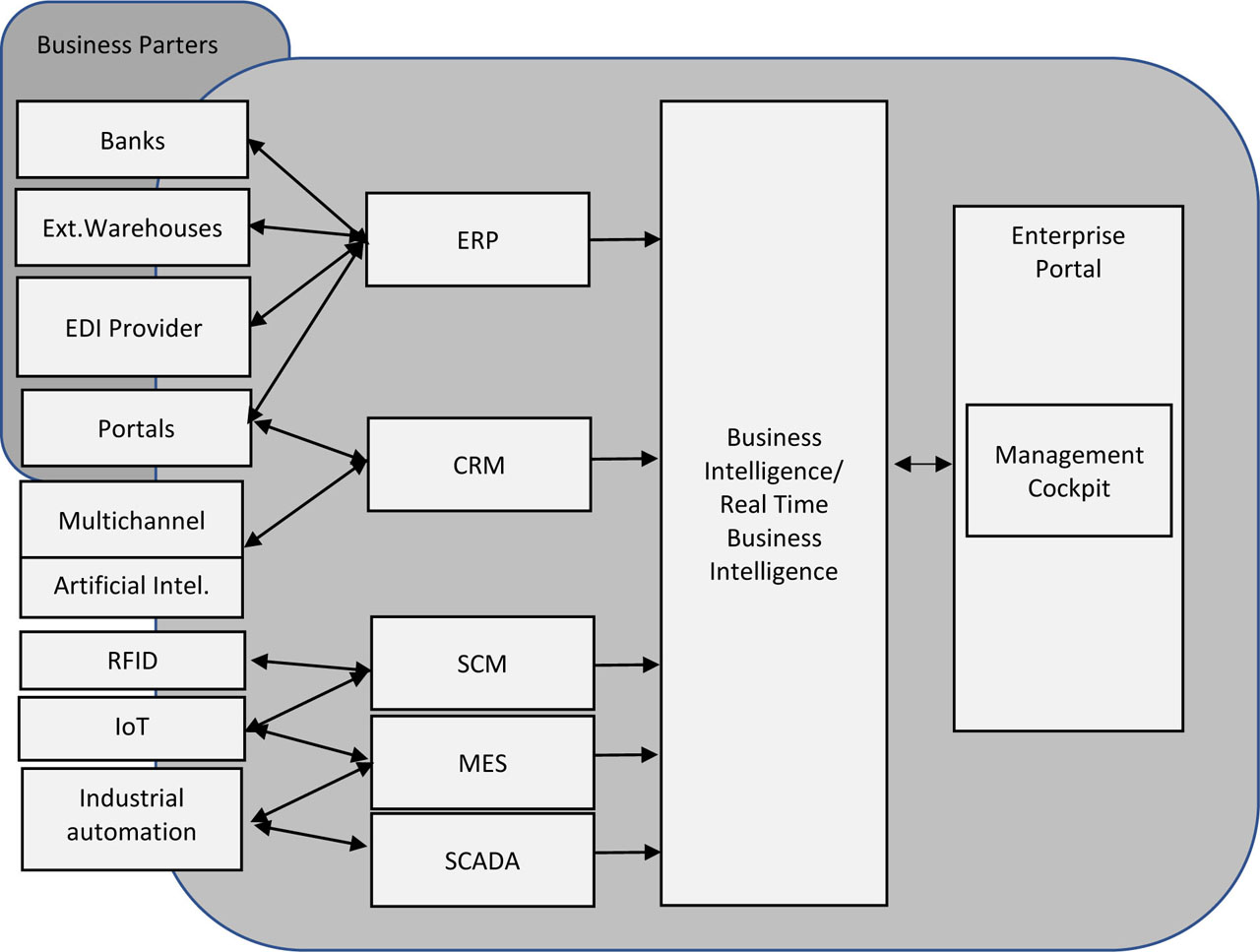
Figure 1
Proposal to use the management cockpit as a central element of RTE monitoring (Source: own research)
Table 2
Exemplary determinants of IT system for RTE (Source: Kisielnicki and Markowski, 2021)
| No. | Determinants of IT System for RTE | IT System / Solution |
|---|---|---|
| Implementation & Development of IT systems being the prime information sources | ||
| 1 | Improved functionalities or implementation of new functionalities of IT systems used by enterprise | CRM, ERP, MES, SCADA, SCM,… |
| 2 | Implementation of new IT systems | |
| Integration of people, information and business processes | ||
| 3 | Securing the customers access to services&products via numerous communication channels. | Multichannel service |
| 4 | Combining communication channels with the view of providing employees with proper info. | |
| 5 | Collective single window access to data and information. | Portal |
| 6 | Portal based automated work and documents flow | |
| 7 | Options for parallel work of people in various locations and time zones | Co-operation |
| 8 | Providing information about the status of co-workers’ activities and awareness of their activities. | |
| 9 | Data provision to the user in the form and time favored by him/her. | Business Intelligence |
| 10 | Integration of a multitude of data coming from various sources. | |
| 11 | Securing the organization's ability to obtain, manage and provide customer, product or service information in real time | Knowledge Management |
| 12 | Support for the organization's continues learning process and application of knowledge at hand | |
| 13 | Creating a standard model for the enterprise key information objects integration and management | Master Data Management |
| 14 | Securing high quality of data | |
| 15 | Data translation from one format to another (easy and agile translation between systems) | Integration Broker |
| 16 | Securing easy access of applications to data exchange mechanisms | |
| 17 | Configuration, execution, monitoring and adjustment of business processes with IT systems | Business Process Management |
| 18 | Business events management (e.g. Complex Event Processing), performing analyses and studying relationships between numerous events and triggers | |
| Change management (ChM) and business processes continuous improvement (BPCI) | ||
| 19 | Managing the processes of obtaining permits and documentation regarding changes | Ability for ChM and BPCI |
| 20 | Securing ergonomics, proper training and comfort work of systems users | |
Table 3
Proposed activities of IT design project for RTE, based on MUST methodology (Source: Own research based on: Bødker, et al., 2009)
| No. | Proposed activities of IT design project for RTE, based on MUST methodology |
|---|---|
| 1 | Performance of works on clarification:
|
| 2 | Analysis of the company's environment, including factors such as the overall market situation of the company; legislation to which the company and its products and services are subject; customers and suppliers; competitors; as well as known and new technologies (not only in the field of IT). |
| 3 | Analysis of the company's business strategy, related business areas and processes to identify problems, bottlenecks and other weak relationships. Identifying areas that need to be strengthened and identifying general IT needs that are measures for this purpose. |
| 4 | Analysis of existing IT strategies for business or setting priorities in IT systems planned in the company. Assessment whether the company's IT strategy extends to the design project objectives. Review the IT strategy to locate the job domains to be supported by IT systems and how the IT strategy supports the business strategy. |
| 5 | An analysis of how a new technological potential can radically influence and change a business strategy, possibly creating entirely new business ventures. |
| 6 | Research, study of selected fields of work and understanding of the rationale determining current practices. Prioritizing the goals, problems and needs for which the project team will develop design visions in the innovation phase. |
| 7 | Gaining specific experience in a selected field of work, for example, through interviews and document analysis. |
| 8 | Preparation:
|
| 9 | Determining whether there are standard systems for the disclosed needs of the company to meet them. Gathering and systematizing experiences concerning the use and application of these systems. |
| 10 | Collect and further develop ideas for new IT systems and work organization previously discovered during the process or during job interviews, with a particular focus on management and employee requirements for the future use of technology. |
| 11 | Complementing the design vision by making one or more prototypes illustrating the functionality of the proposed IT systems |
| 12 | Ensuring that future users acquire the qualifications and skills necessary to use the new technology in the proposed work organization. |
| 13 | Determining the predictable positive and negative consequences of implementing project visions: consequences for the entire company, for individual groups of employees, for relations between departments, as well as for relationships with customers and suppliers. |
| 14 | Strategic plan for technical and organizational implementation of project visions. |
| 15 | Presentation of a vision of the overall change and a proposal of priorities. |