
INTRODUCTION
The black apricot Prunus × dasycarpa Ehrh. was described by Jakob Friedrich Ehrhart (1791). Its transitional characteristics between apricot and plum have been noticed later by Duhamel (1812), who traced its origins to the Orient and described in detail its characteristics and variability. According to Kostina (1936), Prunus × dasycarpa is a spontaneous natural hybrid of Prunus armeniaca L. and P. cerasifera Ehrh. Its hybridisation has been likely facilitated by the concurrent cultivation of these species, marked by synchronised flowering phases and practised by seed propagation of fruit trees in the areas of origin (Kostina, 1936). Furthermore, Kostina suggested that black apricot hybrids could have appeared independently in Western China, Central Asia, Iran and Western Asia, grouping them into two main groups, namely, Armeniaca × leiocarpa Kostina with glabrous fruits (‘Zarolu’ and ‘Uryuk-Plum’ varieties) and Armeniaca × dasycarpa (Ehrh.) Borkh. with pubescent fruits, including eight cultivars – ‘Kizil-Olkhrod’, ‘Kara-Olkhrod’, ‘Olkhrod-Mali’, ‘Irani-Olu’, ‘Alexandria Black’ (Arabian), ‘Shlor-Tsiran’ (literally called ‘Plum-Apricot’ and erroneously called ‘Tlor-Tsiran’ by Michurin), purple large-fruited and purple small-fruited, as well as several sterile forms (Michurin, 1908; Kostina, 1936, 1941, 1964). Being a natural hybrid, Prunus × dasycarpa is known only from cultivation from the areas of origin, including Xinjiang, Central Asia, Afghanistan, Kashmir, Balochistan, Iran, Armenia and Eastern Europe (Kostina, 1936, 1964). Although Kostina described the different forms of Prunus × dasycarpa from natural hybridisation and folk selection as varieties, it is not really known if after their appearance these forms have been ever propagated from seeds and no wild or feral populations of black apricot seem to exist. As all these forms are grafted in their areas of origin, hereafter we mention them as cultivars. It is, however, to mention that these are not cultivars obtained through selection, but rather a pattern of different phenotypes/genotypes spread through the ancient area of apricot and cherry plum cultivation.
The black apricot cv. ‘Shlor-Tsiran’, a spontaneous hybrid of apricot and cherry plum (P. armeniaca × P. cerasifera) cultivated in Armenia, occupies an intermediate position between apricot and cherry plum by its morphological and biological features. It is characterised by late flowering and fruiting, a medium-late ripening period and high frost and disease resistance compared with other cultivated apricots and is of great interest for the breeding of late flowering and frost-resistant apricot cultivars (Vermishyan et al., 1958). It has low seed viability and is mainly propagated by grafting (Vermishyan et al., 1958). Its first description was given by Michurin (1908). He noted the frost resistance of trees, the taste qualities of fruits and the possibility of using them in raw and processed form. Subsequently, this cultivar was included in studies on breeding of adaptive apricot cultivars by the method of distant hybridisation (Eremin, 1985). The different cultivars of Prunus × dasycarpa are insufficiently studied. In fact, information on these cultivars is very scanty and almost no pomological data do exist.
Currently, ‘Shlor-Tsiran’ is very rare in Armenia. It is still preserved in the form of single trees in old home orchards of the Ararat Valley in the Ararat and Armavir provinces. According to current trends, some cultivars of apricots may disappear due to their replacement with cultivars with higher market suitability. Consequently, the study of genetic diversity of the ancient resources of apricot is highly important to plan proper measures of their protection and use.
Given its rarity, up to date ‘Shlor-Tsiran’ has not been phenotyped. Phenotyping is defined as a set of methodologies and protocols used to accurately measure plant growth, morphology, architecture, function and composition at different scales (Fiorani and Schurr, 2013) and as a process of systematically determining, analysing and predicting all or a part of an organism’s phenotype as well as for identifying traits such as yield and quality (Carvalho et al., 2021).
This study aims to perform phenotyping of the black apricot cv. ‘Shlor-Tsiran’ using morphological, phenological, palynological and biochemical characteristics that have not been previously carried out.
MATERIALS AND METHODS
Sampling and field observation localities
Sampling and field observations of the black apricot cv. ‘Shlor-Tsiran’ were carried out in Armavir Province of the Republic of Armenia, at the orchard with local apricot cultivars collection of the Echmiadzin Scientific Center of Agriculture and at a fruit plants nursery in the village Lenughi, located in the Ararat Valley semi-desert zone, at an altitude of 800–855 m above the sea level. The climate of the Ararat Valley is sharply continental. During the year, the mean daily temperature ranges from −3°C to 26°C. The average annual temperature is +11°C, the annual precipitation is about 300 mm and the average annual relative air humidity is 59%. Tree planting density in the collection garden is 5 m × 4 m, and the trees are 10-year-old at the time of research. The conditions are favourable for the cultivation of apricot. Samplings and measurements have been performed in triple; in each repetition, samples were collected and measurements were taken from five trees. Sampling and field observations of P. armeniaca and P. cerasifera were carried out in the Yerevan Botanical Garden NAS RA at the ‘Flora and Vegetation of Armenia’ exhibition plot with fruit plants living collection. The climatic indicators in the Ararat Valley are close to those in the Yerevan Botanical Garden located in the zone of stony wormwood semi-desert at an altitude of 1200–1250 m above the sea level. The absolute minimum temperature in the Yerevan Botanical Garden is 2°C–3°C which is lower than that in the Ararat Valley.
Phenotyping
Phenotyping of cv. ‘Shlor-Tsiran’ was performed according to UPOV (2016) (Tables 1 and 2). Tree habitus, growth and shoot characteristics, shoot growth dynamics, phenophase changes, leaves, flowers, fruits and harvest counting, depending on the crown formation, was evaluated according to the programme and methodology for studying cultivars of fruit, berry and nut crops (Sedov and Ogoltsova, 1999). Visual and measurement observation types were used. The onset of fruit ripening was assessed on trees in the orchard. The degree of separation of the kernel from the pulp and the volume of the fruit and kernel were evaluated in the laboratory. The kernel bitterness was assessed by tasting. Harvest time is based on changes in fruits shape, flavour and colour. The harvest amount data were analysed statistically using the dispersion analysis method, and the quantitative characteristics of the fruit and leaf were analysed according to qualitative and quantitative change methodology (Khachatryan, 2002; Mamajanyan, 2018).
Table 1.
Leaf characteristics for the description of apricot Prunus armeniaca L. cultivars by UPOV (2016).
| No. | Character | Unit | Min | Max | Mean |
|---|---|---|---|---|---|
| 1. | Leaf length | cm | 6.17 | 8.92 | 7.46 |
| 2. | Leaf width | cm | 3.52 | 7.9 | 6.35 |
| 3. | Ratio of leaf length to width | code | 3 | 7 | 3.68 |
| 4. | Shape of the leaf base | code | 2 | 4 | 3.08 |
| 5. | Green colour intensity of the leaf surface | code | 3 | 7 | 5.75 |
| 6. | Leaf apex angle | code | 1 | 3 | 2.39 |
| 7. | Leaf apex length | mm | 1.66 | 7 | 4.25 |
| 8. | Cut edge of leaves | code | 2 | 4 | 3.19 |
| 9. | Unevenness of the leaf edge | code | 3 | 5 | 4.26 |
| 10. | Petiole length | cm | 2.5 | 5.17 | 3.73 |
| 11. | Leaf-to-petiole length ratio | code | 5 | 7 | 5.73 |
| 12. | Petiole thickness | mm | 3 | 7 | 5 |
| 13. | Number of glands in the petiole | number | 1 | 2 | 1.25 |
| 14. | Average weight of 10 leaves | g | 4.31 | 12.65 | 7.66 |
Table 2.
Fruit characteristics for the description of apricot Prunus armeniaca L. cultivars by UPOV (2016).
| No. | Character | Unit | Min | Max | Mean |
|---|---|---|---|---|---|
| 1. | Fruit size | code | 3 | 9 | 6.31 |
| 2. | Shape from the belly | code | 1 | 6 | 2.48 |
| 3. | Shape from the back | code | 2 | 5 | 3.02 |
| 4. | Height | mm | 31.11 | 49.72 | 39.61 |
| 5. | Width at the belly | code | 3 | 5 | 3.55 |
| 6. | Width at the back | code | 3 | 3 | 3.36 |
| 7. | Back width and fruit height ratio | code | 5 | 7 | 5.57 |
| 8. | Belly and back width ratio | code | 5 | 7 | 5.28 |
| 9. | Symmetry at the back | code | 1 | 3 | 2.46 |
| 10. | Abdominal length | code | 1 | 4 | 2.47 |
| 11. | Depth of the funnel | code | 3 | 7 | 5.17 |
| 12. | Apex shape | code | 1 | 3 | 1.36 |
| 13. | Presence of apex | code | 3 | 3 | 3 |
| 14. | Planeness of the skin | code | 1 | 1 | 1 |
| 15. | Softness of the skin | code | 9 | 9 | 9 |
| 16. | Shine of the skin | code | 1 | 3 | 2.3 |
| 17. | Colour of the skin | code | 1 | 3 | 1.88 |
| 18. | Prevalence of subcutaneous points | code | 1 | 5 | 2.58 |
| 19. | Colour of subcutaneous spots | code | 1 | 4 | 3.03 |
| 20. | Degree of colour intensity of subcutaneous points | code | 3 | 5 | 4.6 |
| 21. | Colour of the fruit flesh | code | 1 | 6 | 3.4 |
| 22. | Structure of the fruit flesh | code | 1 | 3 | 2.5 |
| 23. | Degree of separation of the kernel from the pulp | code | 1 | 3 | 1.36 |
| 24. | Shape of the cornice is from the belly | code | 3 | 3 | 3 |
| 25. | Presence of bitterness of the kernel | code | 1 | 1 | 1.05 |
| 26. | Beginning of fruit ripening | code | 1 | 9 | 4.85 |
| 27. | Fruit weight | g | 14.19 | 50.92 | 30.57 |
| 28. | Kernel weight | g | 1.01 | 3.36 | 1.9 |
| 29. | Kernel volume | mm3 | 1.50 | 4.20 | 2.58 |
| 30. | Fruit volume | mm3 | 13.50 | 52.10 | 32.59 |
| 31. | Ratio of kernel to fruit weight | (%) | 4.22 | 12.05 | 6.46 |
Pollen fertility and viability
The measurements were carried out during the beginning of flowering in the end of March. Friable closed flowers were used to determine pollen fertility, from which the pollen was easily shaken off onto a glass slide. Pollen fertility was determined on temporary preparations stained with acetocarmine. On each preparation, 100 pollen grains were counted in three repetitions. The number of fertile (well-coloured) and sterile (not coloured or partially coloured) pollen grains was determined. To determine the germination of pollen grains, large buds were covered with paper bags and placed in a desiccator with silica gel in a refrigerator. Pollen germination was performed using a drop of an aqueous solution of sucrose at a concentration of 20%. The glass slide with pollen grains was placed in a Petri dish with highly moistened filter paper. Germinated pollen grains were counted and the length of pollen tubes was measured after 24 hr of germination. The work was carried out with a PZO Warszawa microscope using an eyepiece micrometre at a magnification of 250×. The obtained data were processed using the Excel program.
Biochemical analysis
The biochemical analysis of the fruit samples was performed using the following methods: high-performance liquid chromatography, quantitative and qualitative identification of compounds (Fratianni et al., 2018; Forcada et al., 2019; Su et al., 2020; Tsaturyan, 2021; Petruccell et al., 2023) and physical and chemical methods of analysis (Kafkaletou et al., 2019; Zhou et al., 2020; Fratianni et al., 2022; Ulikhanyan et al., 2022). The determination of antioxidant activity was performed using the titration method of potassium permanganate in sulphuric acid solution at room temperature (Djenidi et al., 2020; Butkeviciute et al., 2022). The resulting value indicates the antioxidant activity of all biologically active substances.
Economic costs
The investment costs for planting and maintenance and the income and profit from the sale of the crop were calculated. By subtracting the investment costs from the total cash income, profit was calculated. By dividing the profit received by the invested amount and expressing it as a percentage, we obtained the economic efficiency. The cost was calculated by dividing production costs by the amount of planting material obtained per hectare (Davtyan and Voskanyan, 2004; Davtyan and Danielyan, 2007; Melqumyan, 2014; Harutunyan, 2021).
RESULTS AND DISCUSSION
Prospects for the cultivation of cv. ‘Shlor-Tsiran’, along with economic factors, are determined by its biological, morphological and phenological characteristics. To characterise the complex of traits of the studied crop plants and to identify valuable ones for use in fruit growing and breeding, it is important to carry out their phenotyping. Phenotyping of black apricot cv. ‘Shlor-Tsiran’ was carried out in the present study, using morphological, phenological, palynological and biochemical characteristics. Sixty-seven traits of black apricot ‘Shlor-Tsiran’ including trees growth, phenological phases of budding, flowering, fruiting and qualitative and quantitative parameters of vegetative and generative organs are presented in Table 3.
Table 3.
Phenotypic characteristics of ‘Shlor-Tsiran’.
| Growth characteristics of black apricot cv. ‘Shlor-Tsiran’ 10-year-old trees | |
|---|---|
| Crown shape | Cup shaped |
| Tree average height | 2.5 m |
| Degree of branching | Strong |
| Leaf and shoot characteristics | |
| Length of shoots/average of 10 | 40 cm |
| Number of shoots | 150 |
| Number of skeletal branches | 5 |
| Number of leaves/shoot | 15 |
| Leaf surface area | 26 cm2 |
| Leaf length | 6 cm |
| Leaf width | 3 cm |
| Ratio of leaf length to width | 2.7 |
| Leaf green colour intensity | Middle |
| The shape of the leaf base | Rounded |
| The shape of the leaf apex | Suddenly shortly acuminate |
| Leaf apex length | 7 mm |
| Leaf blade: profile in cross section. Edge cut | Moderately concave |
| Leaf blade: undulation of margin edge roughness | Week |
| Petiole length | 2.75 cm |
| Leaf-to-petiole length ratio | Large |
| Petiole thickness | Thin |
| Number of glands | 1–3 |
| Average weight of 10 leaves | 5.71 g |
| Changes in vegetative buds. Timing of defoliation and duration of vegetation with average data | |
| Date of beginning of swelling of vegetative buds and separation of scales | 20 April |
| Date of beginning of vegetative shoots emergence (1–5 cm) | 25 April |
| Period of vigorous vegetative growth | 5 May–10 June |
| Period of organisation of apical buds | 01 June–20 June |
| Leaf fall (start/mass leaf fall/end) | 10 October/20 October/29 October |
| Vegetation duration (days) | 225 |
| Changes in generative (fruit) buds/2019–2021 | |
| Date of buds swelling | 14 March |
| Date of buds opening | 18 March |
| Flowering (start/mass flowering/ end) | 25 March/04 April/11 April |
| Date of beginning of fruit formation | 25 May |
| Date of beginning of fruit ripening | 24 June |
| Morphological characteristics of fruit | |
| Size | Medium |
| Shape in ventral view | Ovate |
| Form of the fruit shape in lateral view | Oblong |
| Height | 42.0 mm |
| Ventral width | Medium |
| Lateral width | Medium |
| Ratio of lateral width/ventral width | 5.0 |
| Ratio of height/ventral width | Medium |
| Fruit: symmetry in ventral view | Clearly asymmetric |
| Fruit: suture | Slightly sunken |
| Fruit: depth of stalk cavity | Medium |
| Shape of the apex | Flat |
| Fruit: shape of tip (except mucron) | Weakly depressed |
| Fruit: surface | Smooth |
| Fruit: pubescence | Present |
| Fruit: hue of over colour | Red |
| Fruit: relative area of colour | Large |
| Fruit: pattern of over colour | Solid flush |
| Fruit: intensity of over colour | Medium |
| Fruit: colour of flesh | Medium orange |
| Start of fruit ripening | Middle term ripening |
| Glow of the skin | No shining |
| Fruit: texture of flesh | Fibrous |
| Adherence of stone to flesh | Absent or very weak |
| Kernel: shape in lateral view | Ovate |
| Kernel: bitterness | Medium |
| Average fruit weight | 40 g |
| Average fruit weight with stone | 92.9/30.97 g |
| Average weight of kernels | 5.01/1.67 g |
| Average weight of fruit without seed | 293 g |
| Average content of zoles in fruit | 0.5 g |
| Volume of juice | 3 mL |
According to quantitative data, the tree crown width of trees planted in rows in a cup-shaped form should correspond to 1.3 m. As a result of studying the indicators of growth and development of the leaf surface area during the growing season, it was revealed that ‘Shlor-Tsiran’ has a large assimilation surface. The length of 10 leaves of the cv. ‘Shlor-Tsiran’ is 40 cm, the number of shoots on one tree is about 150, the number of skeletal branches is 5 and the area of one leaf is about 26 cm2. Thus, the leaf area of one tree of the cv. ‘Shlor-Tsiran’ is about 58.500 cm2. Phenotyping data revealed that ‘Shlor-Tsiran’ ends the vegetative growth period later than other local apricot cultivars. The duration of the growing season is about 225 days. Mass flowering is observed from 29 March to 4 April. ‘Shlor-Tsiran’ is a late ripening cultivar, and the fruits ripen in the first 10 days of July.
‘Shlor-Tsiran’ morphological description
‘Shlor-Tsiran’ is a tall tree with a length of 2.5–4 m with a spherical crown and greyish-brown branches (Figure 1). The number of lateral branches is up to 17. Based on the nature of growth, which is determined by the degree of deviation of the trunk from the vertical direction and curvature around its axis, it belongs to the group of cultivars with a strongly curved trunk. Branchlets are numerous, glabrous, yellowish-light-brown colour. The leaf blade is ovate to elliptic ovate, 4–8 cm × 2.5–5 cm, abaxially pubescent along veins, adaxially yellowish-green, glabrous, shortly acuminate apex, broadly cuneate to rounded basely, irregularly serrate margin and petioles of 2.5–2.8 cm thickness. Flowers are usually solitary, opening before leaves, white or pall pink, small, 1.5–1.7 cm in diameter, peduncle finely pubescent and 3–6 mm long (Figure 2A).
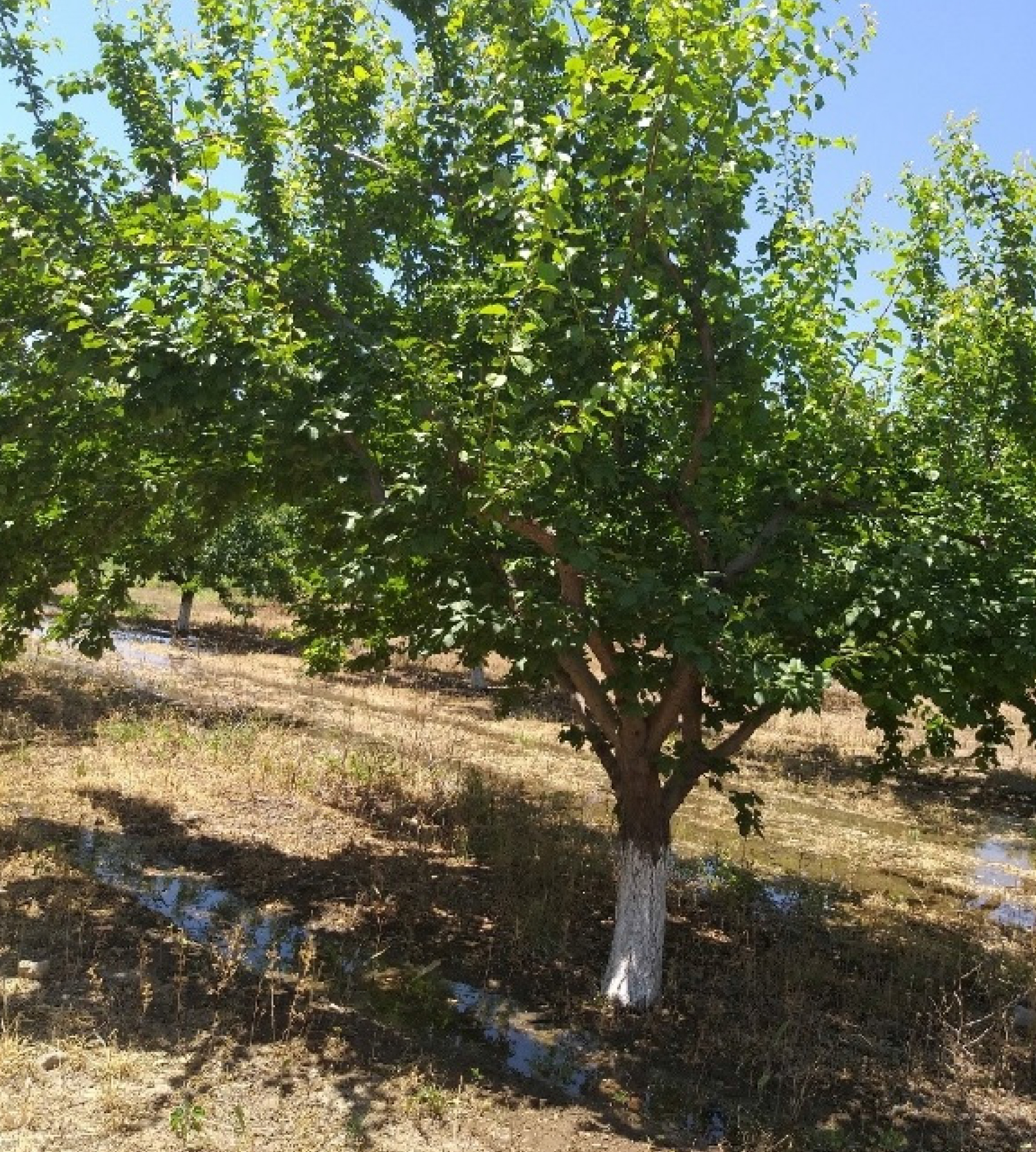
Figure 1.
‘Shlor-Tsiran’ trees at the orchard of the Echmiadzin Scientific Center of Agriculture.
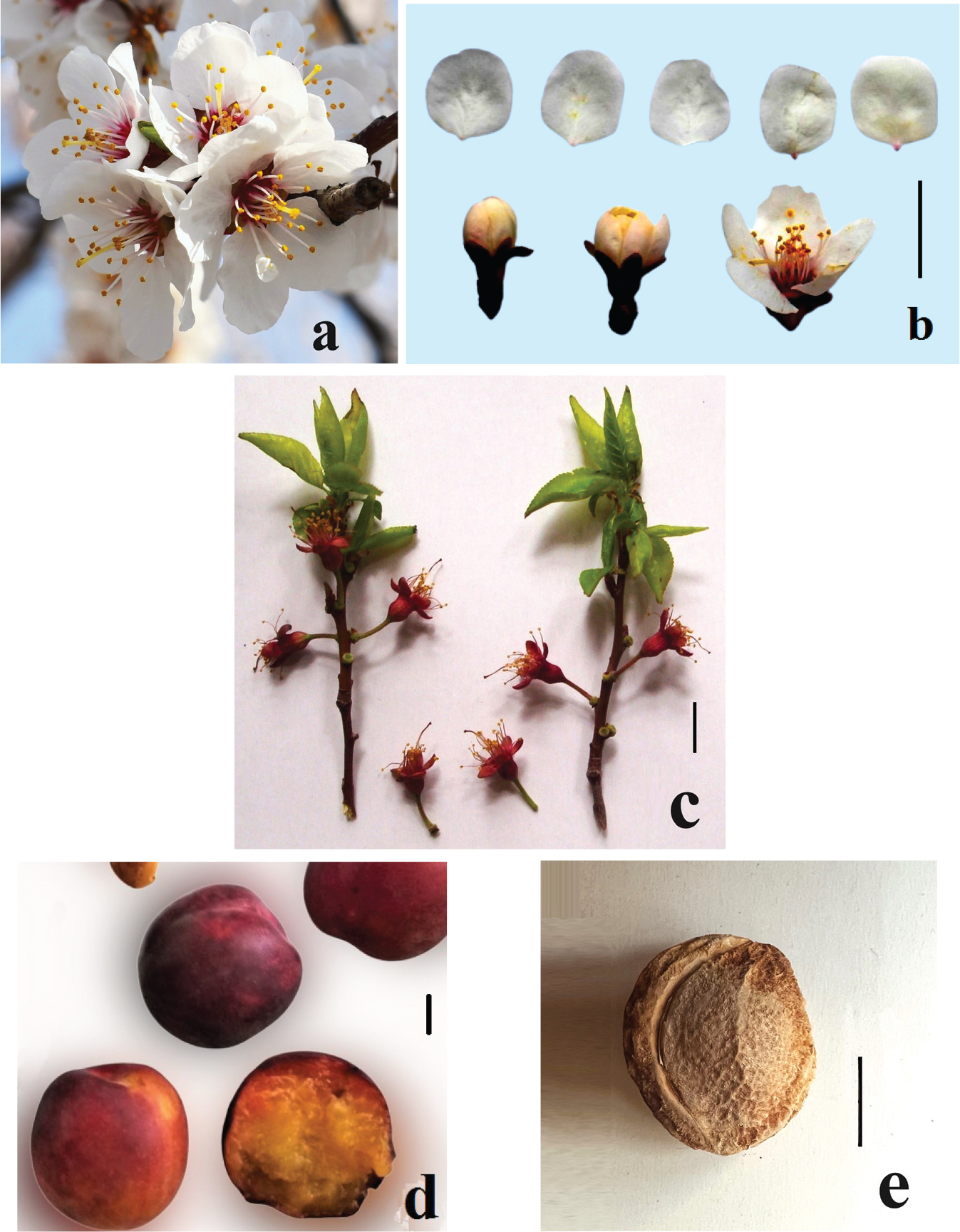
Figure 2.
‘Shlor-Tsiran’: (A) flowers; (B) petals, flower buds; (C) shoot fragments with hypanthium on elongated peduncles; (D) fruits and (E) stone (scale bar = 10 mm).
Corolla of 5, sometimes 6–7, petals is white, up to 8–9 mm × 6 mm, broadly elliptic to spatulate, with a short claw; hypanthium is 6 mm long, reddish, campanulate, glabrous, sepals 3.5–4.0 mm × 2.2 (2.3) mm, reddish, elliptic, glabrous, with glandular hairs along the margin, apex obtuse and peduncles of 7–12 mm length after flowering ends (Figures 2B and 2C) and stamens are 25–35 in number, 5–6 mm long, style length of 10–12 mm and thinly pubescent ovary. Fruits are small, 38 mm × 40 mm × 40 mm, weighing about 25–40 g, almost spherical in shape, slightly compressed from the sides, with a rounded base and a flat top (Figure 2D). The groove is shallow, slightly deepening at the base and the funnel is spacious. The fruit peduncle is green and up to 12 mm long. The fruit skin is dense, dark purple in colour, glaucous and covered with thin velvety pubescence. The pulp is friable, somewhat mealy, low juicy, adnate to the stone, yellowish red, sweet and sour, with a slight aroma. Stone is of 2–2.6 cm × 1.4–1.7 cm × 0.8–0.9 cm, ovoid in shape with a strongly protruding keel-shaped central rib; surface is longitudinally furrowed, scabrous, slightly wrinkled and pitted (Figure 2E).
The kernel is bitter and rarely sweet. Flowering is observed in the end of March and the beginning of April, and fruit ripening is observed in July.
A comparative study of the morphological characteristics of black apricot cv. ‘Shlor-Tsiran’ confirms the intermediate position in most morphological characteristics of black apricot ‘Shlor-Tsiran’ between parent species of apricot and cherry plum (Table 4).
Table 4.
Comparative characteristics of Prunus armeniaca, P. cerasifera and Prunus × dasycarpa cv. ‘Shlor-Tsiran’.
| Character | Prunus armeniaca | Prunus cerasifera | Prunus × dasycarpa cv. ‘Shlor-Tsiran’ |
|---|---|---|---|
| Leaf size (cm) | 6–12 × 5–11 | (2)3–6 × (1)2–4 | (6)6.5 × (4)4.5 |
| Leaf shape | Ovate-rounded or broadly ovate, almost cordate at base | Oblong-elliptic or ovate-elliptic, cuneate to sub-rounded at base | Ovate to elliptic-ovate, broadly cuneate to rounded at base |
| Leaf apex | Suddenly shortly acuminate | Acute | Suddenly shortly acuminate |
| Leaf margin | Finely crenate or obtusely serrate | Finely serrated or finely blunt-serrated, rarely twice serrated | Irregularly densely finely crenate |
| Leaf surface | Adaxially glabrous green, abaxially matte, rarely slightly pubescent in the vein axils | Adaxially dark green, glabrous, abaxially pale green, pubescent on mid-vein | Adaxially dark green, glabrous, abaxially pubescent along veins |
| Petioles length (cm) | 3–3.5 | 0.6–1.2 (2.3) | 2.5–2.8 |
| Flowers number | Usually solitary, rarely by 2 | Solitary or by 2–4 | Usually solitary |
| Sepal length (mm) | 4–6 | 2–4 | 3.5–4.0 |
| Sepals shape | Ovate to ovate oblong, acute to obtuse, glandular along the margin | Ovate, oblong-ovate, obtuse, glandular along the margin | Elliptic, obtuse, glandular along the margin |
| Flower peduncle length (mm) | Nearly absent to very short (1–3) | (4) 10–16 (22) | 7–12 |
| Flower colour | White or pale rose, with pink veins or pink in bud | White, sometimes pinkish at the end of flowering | White or pale rose |
| Corolla diameter (mm) | 25–45 | 20–25 | 15–20 |
| Hypanthium length | 4–6 | 2–4 | 6 |
| Petals shape | Elliptic or obovate, broadly elliptic | Ovate, spatulate, wavy along the edge | Elliptic or obovate |
| Petals size (mm) | 8–12 × 6–7 | 7–15 × 5–10 | 8–9 × 6 |
| Number of stamens | 27–36 | 20–30 | 25–27(35) |
| Stamen length | 6–10 | 3–6 | 5–6 |
| Style length | 11–15 | 6–7 | 10–12 |
| Fruit colour | Orange, often tinged with red | Yellow, rose, red, dark violet or blackish violet | Dark violet or blackish violet |
| Fruit shape | Oval or sub-globose | Globose or sub-globose | Globose, slightly compressed from the sides |
| Fruit surface | Velvety pubescent or glabrous | Glabrous | Velvety pubescent |
| Fruit stalk length (mm) | Almost absent or 1–2.5 | Up to 22 | Up to 12 |
| Stone shape | Ellipsoid to sub-globose, flattened, smooth, separated from the pulp | Ovoid or ellipsoidal-ovoid, wrinkled or smooth, usually not separated from the pulp | Ovoid, pitted, some wrinkled, not separated from the pulp |
‘Shlor-Tsiran’ leaf blade shape is an intermediate between apricot P. armeniaca and cherry plum P. cerasifera, but the top of the leaf suddenly shortly acuminated looks like in apricot leaf; the length of the petiole almost coincides with the length of the apricot petiole. Flower stalk length is one of the main distinguishing features of Prunus × dasycarpa cv. ‘Shlor-Tsiran’ (7–12 mm) and approaches with that of cherry plum, whereas in apricot flower stalk is almost absent or very short (1–2.5 mm). With bright pink colour of the sepals, it looks similar to an apricot and differs in colour from the green sepals of the cherry plum. The fruit of ‘Shlor-Tsiran’ is smaller than that of an apricot, which is usually pubescent. Skin colour is dark purple, pulp fibrous, juicy, sweet and sour, reminiscent of large-fruited cherry plum cultivars, but it has an apricot flavour. The stone is not separated from the pulp, which is usually observed in cherry plum. Like cherry plum, black apricot ‘Shlor-Tiran’ is characterised by the qualities such as winter hardiness. It tolerates spring frosts better than P. armeniaca, and much less often than apricots it is affected by fungal diseases such as moniliosis and clasterosporiosis, which makes this crop promising.
Pollen fertility and viability characteristics
The results of our pollen study show that, compared with its parent species, the pollen of Prunus × dasycarpa is characterised by smaller pollen grains, low fertility (38%), high sterility (60%) and very low germination (only 3.4%). The length of germinated pollen tubes of Prunus × dasycarpa after 24 hr of germination mainly ranges from 70 to 270 μm, reaching 500 μm in rare cases. In P. armeniaca, along with high germination, pollen tubes reach 1500–1750 μm, which makes it very difficult to measure them. The viability of P. cerasifera pollen is also very high. After 6 hr of germination, it reaches 86.5% and the length of the pollen tubes is 210–840 μm. Table 5 presents some pollen characteristics of Prunus × dasycarpa, P. armeniaca and P. cerasifera. A decrease in pollen fertility is a characteristic of many interspecific hybrids of fruit crops of Rosaceae family (Kostina and Ryabov, 1960; Papikhin et al., 2011; Eremin, 2016, 2018). It has been established that a very low percentage of normally developed pollen grains in distant hybrids is the result of meiotic anomalies in reduction and equation divisions during microsporogenesis (Papikhin et al., 2011). In our studies, all studied accessions of P. armeniaca and P. cerasifera are characterised by a high level of fertility and viability of pollen (Table 5).
Table 5.
Prunus × dasycarpa cv. ‘Shlor-Tsiran’, Prunus armeniaca and P. ceratifera pollen size, fertility and viability parameters.
| Pollen parameters | Prunus × dasycarpa cv. ‘Shlor-Tsiran’ | Prunus armeniaca | Prunus cerasifera |
|---|---|---|---|
| Size (μm) | 42.5 ± 1.1 | 50.4 ± 0.61 | 45.3 ± 0.93 |
| Fertile (%) | 38.0 ± 0.79 | 92.9 ± 0.79 | 92.9 ± 0.39 |
| Sterile (%) | 58.9 ± 1.17 | 6.2 ± 0.43 | 4.5 ± 0.26 |
| Semi-sterile (%) | 3.9 ± 0.69 | 0.9 ± 0.15 | 2.7 ± 0.24 |
| Viability (%) | 3.4 ± 0.55 | 80.5 ± 0.5 | 86.5 ± 8.5 |
The low percentage of abortiveness and high germination of pollen of wild-growing forms of apricot in Armenia are also noted in the study by Hambartsumyan et al. (1977). The hybrid cv. ‘Shlor-Tsiran’ is, however, characterised by a significant decrease in the fertility and viability of pollen (Table 5 and Figures 3A and 3B). According to Eremin (2016, 2018), who identified four levels of incompatibility of interspecific hybrids, black apricot Prunus × dasycarpa (P. cerasifera × P. armeniaca) belongs to the second level of incompatibility of parental species. There is a decrease in pollen fertility in hybrids from crossing species at the intersectional level within one subgenus, which is confirmed by the low fertility revealed by our studies in Prunus × dasycarpa cv. ‘Shlor-Tsiran’.
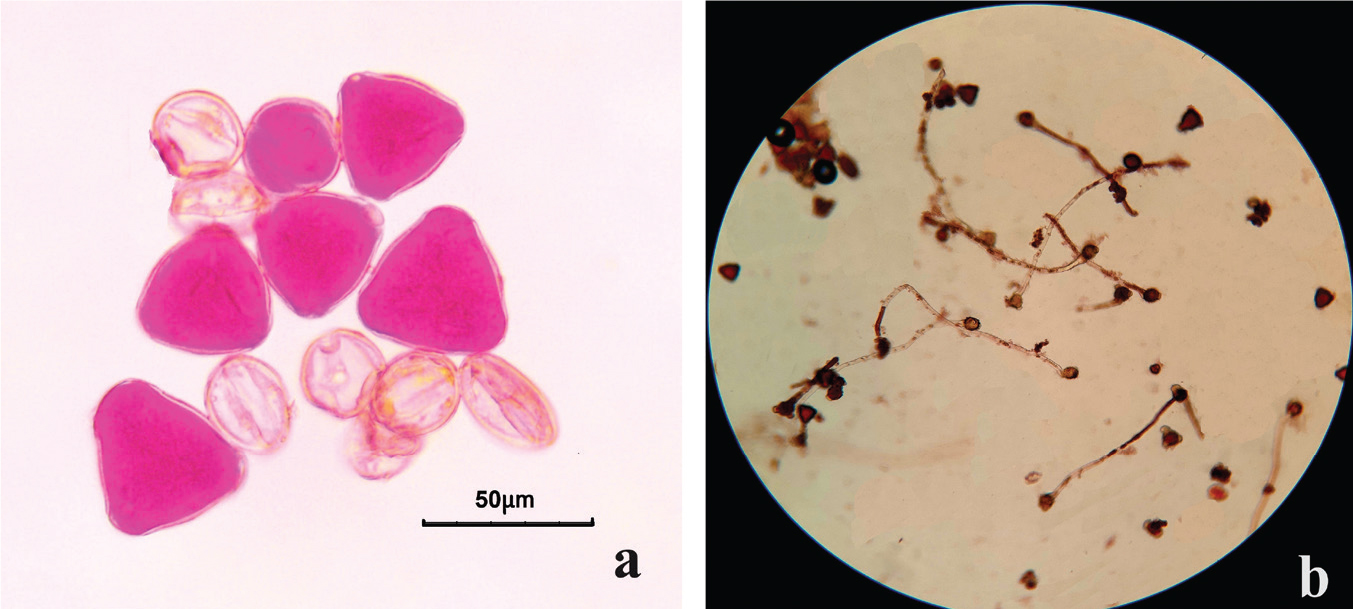
Figure 3.
(a) Fertile (pink) and sterile (transparent) pollen grain of Prunus × dasycarpa var. ‘Shlor-Tsiran’. (b) Pollen germination.
Phytochemical characteristics
The phytochemical characteristics of ‘Shlor-Tsiran’ ripe fruits are reassumed in Table 6. The cultivar has some interesting phytochemical characteristics, one of which is the absence of sucrose (hence disaccharides) in the fruit pulp. Sucrose levels usually drop during fruit ripening with the resulting increase in fructose and glucose (Borsani et al., 2009). ‘Shlor-Tsiran’ seems to contain mainly glucose. Although unusual, it somehow may reflect its hybrid nature. P. cerasifera is usually low in sucrose and has a higher glucose/fructose ratio (Božović et al., 2017; Murathan et al., 2020), which is however not usually the case for P. armeniaca (Asma and Ozturk, 2005; Alajil et al., 2021). Compared with commercial apricot cultivars, black apricot cv. ‘Shlor-Tsiran’ has a low-medium antioxidant potential and relatively low-medium sugar and organic acid content (Alajil et al., 2021; Tareen et al., 2021; Saeed et al., 2021).
Table 6.
Phytochemical analysis of black apricot cv. ‘Shlor-Tsiran’.
| Tartaric acid (mg · mL−1) | 0.001 |
| Malic acid (mg · mL−1) | 0.01 |
| Citric acid (mg · mL−1) | 0.011 |
| Succinic acid (mg · mL−1) | 0.005 |
| Oxalic acid (mg · mL−1) | not detected |
| Fructose (% w/v) | 1.935 |
| Glucose (% w/v) | 3.368 |
| Sucrose (% w/v) | not detected |
| Vitamin C (% w/v) | 0.0182 |
| Antioxidant activity corresponding to the concentration of biologically active substances with reductive potential in relation to quercetin (mg/g) | 4.615 |
‘Shlor-Tsiran’ is thus a lower-calorie, refreshing alternative to modern cultivars having lower nutritional values and thus presenting a good snack for a low-calorie diet with an adequate intake of antioxidants and vitamin C. Its fruit has higher water and mineral content and, due to its lower preservative characteristics (lower content of sugars and organic acids), a shorter shelf life. This may be due to its relative rarity, as it gained mainly the place of a seasonal short storage fruit for the local market.
Justification of the economic efficiency of black apricot cv. ‘Shlor-Tsiran’
Before implementing agronomic measures in production, their technical and economic substantiation must be completed. In this regard, it is necessary to find out that these measures respond to vital problems from the point of view of individual and national interests and correspond to market demands, and what will be the market and socio-economic consequences of increasing production and increasing efficiency. Black apricot stands out for its high yield, which provides a yield of 13.3 trees per hectare.
The justification of the economic efficiency of the black apricot cultivar was obtained for about 10-year-old trees with an average data of 3 years/SD = 63.88) (Table 7). Black apricot stands out for its high yield, which provides a yield of 13.3 trees per hectare. Taking into account the costs of garden care, a high level of profit and profitability is recorded, which is evident when evaluating the economic efficiency of growing the cultivar. Ten-year-old trees in the garden, which is the object of the study, are considered productive, and the yield was high. Depending on this, we had a production cost of 225 drams = 0.5829 $ · kg−1. It was found that cv. ‘Shlor-Tsiran’ is a relatively profitable fruit type and fully compensates the costs of garden establishment and care. The profitability level is 77.3%. Profitability levels are even higher in subsequent years of cultivation.
Table 7.
Justification of the economic efficiency of the black apricot cv. ‘Shlor-Tsiran’ in about 10-year-old trees with an average data of 3 years/SD = 63.88.
| Yield per tree | 20 kg/tree |
| Yield per hectare | 13.3 trees · ha−1 |
| Production cost | 225 AMD = 0.5829 $ · kg−1 |
| Fruit market value | 400 AMD = 1.0363 $ · kg−1 |
| Income | 5320.000 AMD · ha−1 = 13.7831 $ · ha−1 |
| Profit | 2320.000 AMD · ha−1 = 6.0107 $ · ha−1 |
| Profitability level | 77.3% |
Perspectives of conservation and cultivation
Although there is growing interest in the breeding of new interspecific stone fruit cultivars, the artificial hybridisation in the genus Prunus has shown to be rather complicated (Soldatov and Salaš, 2007; Nicolás-Almansa et al., 2023). However, a number of artificial hybrids of black apricot are known (Soldatov and Salaš, 2007; Eremin et al., 2021). Although these have been selected for commercial fruit production, it must be noted that their fruit yield is comparable to ‘Shlor-Tsiran’, which is a natural hybrid. The disease and frost resistance of ‘Shlor-Tsiran’ make it an interesting candidate for breeding programmes to develop better grafting rootstocks and promising new fruit cultivars (Eremin et al., 2021). Unfortunately, old local cultivars like ‘Shlor-Tsiran’ are underrepresented in germplasm collections and the decline of its cultivation is a serious threat to the conservation of this black apricot cultivar. In fact, while at least three phenotypic cultivars of ‘Shlor-Tsiran’ (black, pink and yellow) have been mentioned (Vermishyan et al., 1958), we could collect only one cultivar during our extensive fieldwork. The re-establishment of living collections of old native fruit cultivars and phenotypes is definitely a priority to conserve the rich heritage of folk selection in Armenia and apricots in this sense should receive special attention, including the cultivar forms of ‘Shlor-Tsiran’. Also, modern micropropagation methods, established and developed for apricot propagation, should be applied on ‘Shlor-Tsiran’ to achieve efficient amplification of the propagation of rare phenotypes and to conserve and cultivate this nowadays rare natural hybrid (Kovalchuk et al., 2017, 2018).
CONCLUSIONS
Prunus × dasycarpa Ehrh. is a spontaneous hybrid that originated independently in old gardening areas of West and Central Asia. In the article, we provided detailed phenotypic, reproductive and biochemical characteristics of the cv. ‘Shlor-Tsiran’ of Prunus × dasycarpa, native to Armenia. Although our results clearly demonstrate that ‘Shlor-Tsiran’ could bear a bigger economic importance, than it has now, its cultivation in Armenia tends to decline and, together with other native apricot cultivars, it gets mainly marginalised to home orchard gardening for family use and small local markets. Its biochemical profile shows a lower organic content than widespread commercial apricot and plum cultivars, and its delayed flowering and fruiting make it an interesting alternative for market diversification and the expansion of the fruit season. The data obtained can contribute to wider use in fruit growing and conservation of the black apricot cv. ‘Shlor-Tsiran’ gene pool and can be used for breeding purposes.
ACKNOWLEDGEMENTS
We are thankful to Dr. V. Goginyan (“Armbiotechnology” Scientific and Production Center NAS RA, SNPO) for his kind assistance in conducting biochemical analysis of Prunus × dasycarpa cv. ‘Shlor-Tsiran’ fruit samples.
Notes
[1] Contributed by AUTHOR CONTRIBUTIONS
J.A. – fieldwork, conceptualization, phenotypification, first manuscript draft and edition. Y.N. – Pollen study, manuscript contribution. A.R. – manuscript first draft and edition, fieldwork, interpretation of analytical data. L.S. – biochemical analysis. G.Z. – fieldwork. G.G. – phenotypification, conceptualization, fieldwork, manuscript contribution.
[2] Conflicts of interest CONFLICT OF INTEREST
There are no conflicts of interest.