
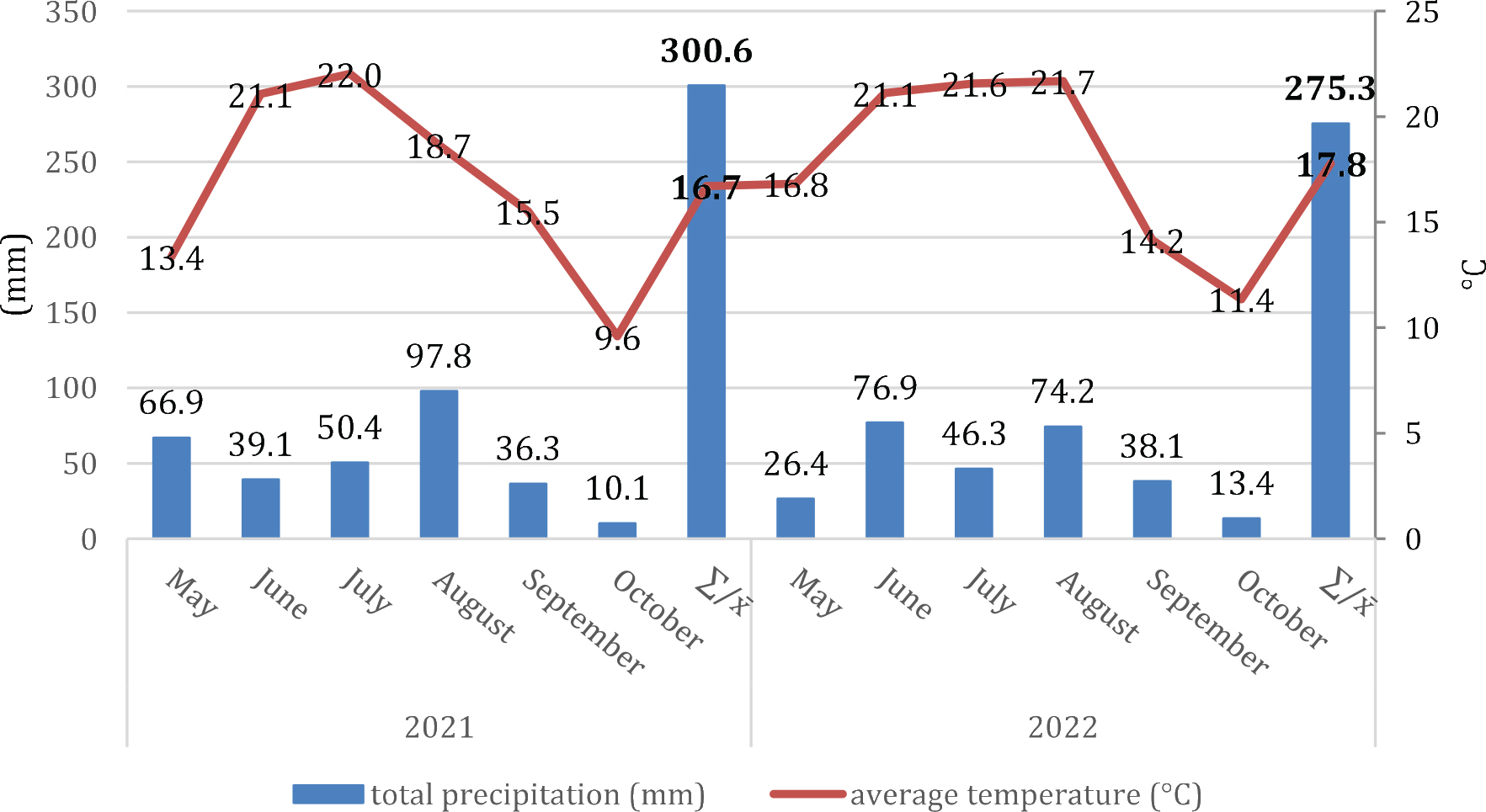
Figure 1.
Meteorological conditions of the experimental site.
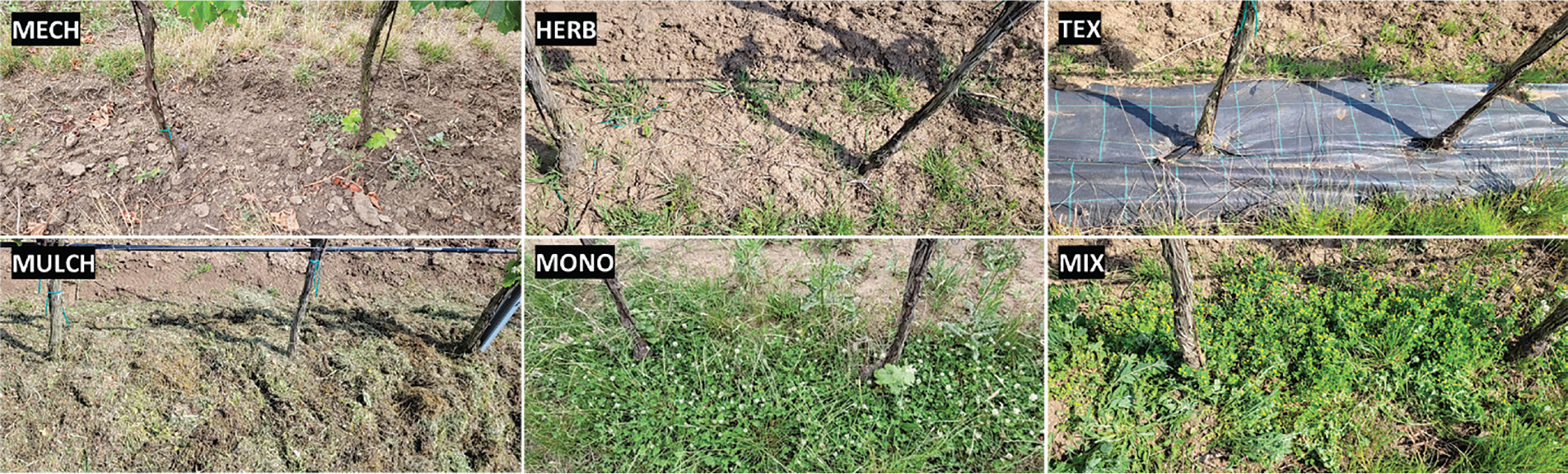
Figure 2.
Different under-vine treatments. (MECH, bare soil cultivated mechanically; HERB, bare soil with herbicide application; TEX, under-vine belt covered by black woven agrotextile; MULCH, green mulch – mowed grass; MONO, cover crop – monoculture; MIX, cover crop – mixture of plants).
Table 1.
Treatment description.
| Abbreviation | Treatment | Description |
|---|---|---|
| MECH | Bare soil cultivated mechanically | Weed control in the under-vine area was carried out by using a mechanical blade weeder (three times per year) |
| HERB | Bare soil with herbicide application | Weed control in the under-vine area was carried out by applying herbicide (Glyphosate) at a rate of 4 L · ha−1 on the following dates: 31/04, 17/06, 12/08 in 2021 and 13/04, 29/06, 4/08 in 2022 |
| TEX | Textile mulch | The under-vine belt was covered by black woven agrotextile (90 g) made of polypropylene with UV stabilisation with a width of 60 cm |
| MULCH | Green mulch – mowed grass | Under-vine area with a width of 60 cm was covered with a layer of cut grass at a height of 30 cm during June every year |
| MONO | Cover crop – monoculture | Microclover (Trifolium repens ‘Pipolina’) were sown manually on 07/04 2021 at a seed rate of 15 kg · ha−1 on a 60 cm-wide strip in the under-vine area |
| MIX | Cover crop – a mixture of plants | Plants from the Fabaceae family were sown manually on 07/04 2021 on a 60 cm-wide strip in the under-vine area, as shown in Table 2 |
Table 2.
Species composition of treatment MIX.
| Species | Variety | Seed rate kg · ha−1 | % share in mixture | Final seed rate kg · ha−1 |
|---|---|---|---|---|
| Trifolium repens L. f. silvestre | Luke | 15 | 35 | 5.25 |
| Lotus corniculatus L. | Leo | 15 | 10 | 1.5 |
| Medicago lupulina L. | Ekola | 15 | 50 | 7.5 |
| Anthyllis vulneraria L. | Pamír | 15 | 5 | 0.75 |
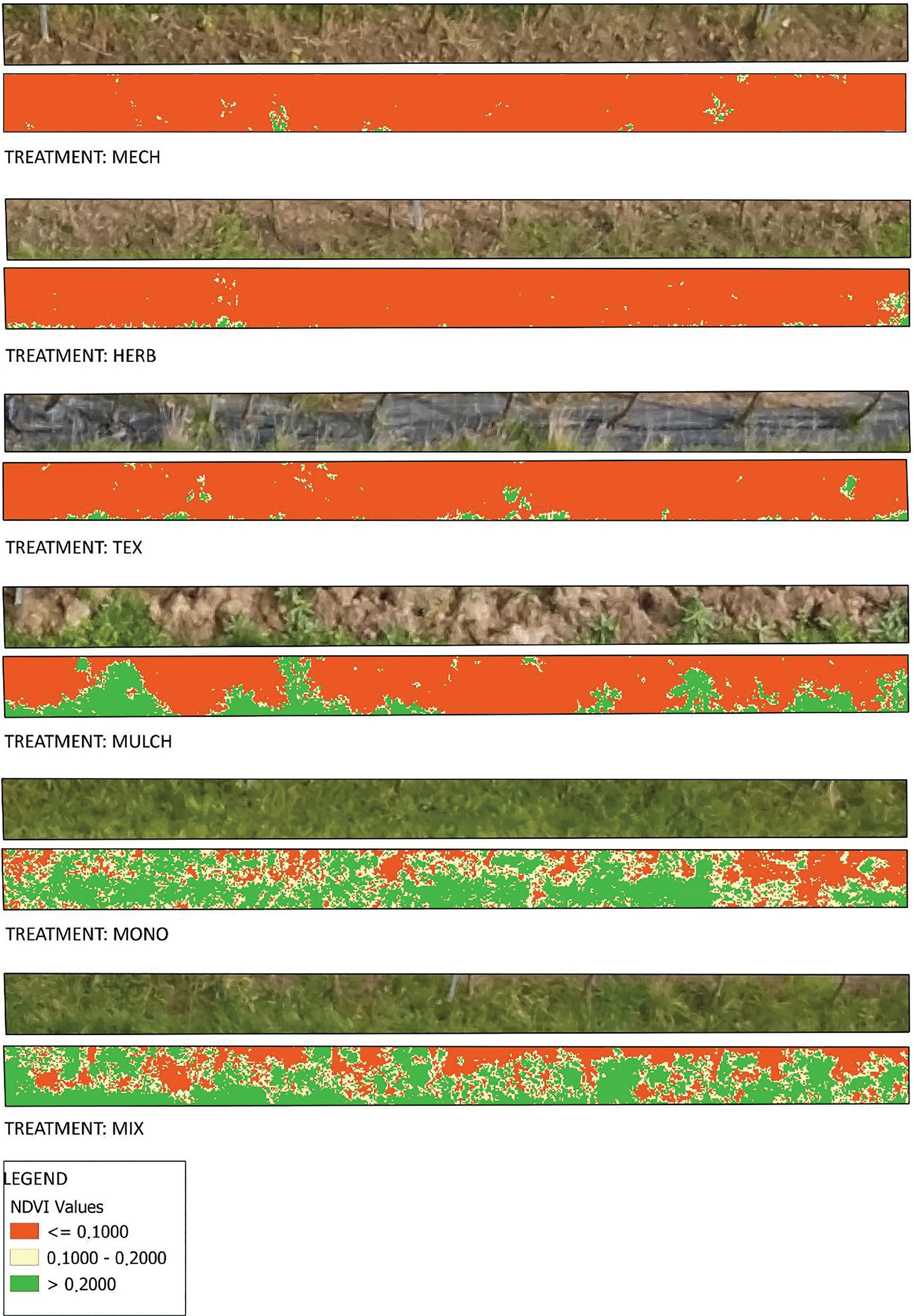
Figure 3.
Graphical evaluation of NDVI in different treatments. NDVI, normalized difference vegetation index.
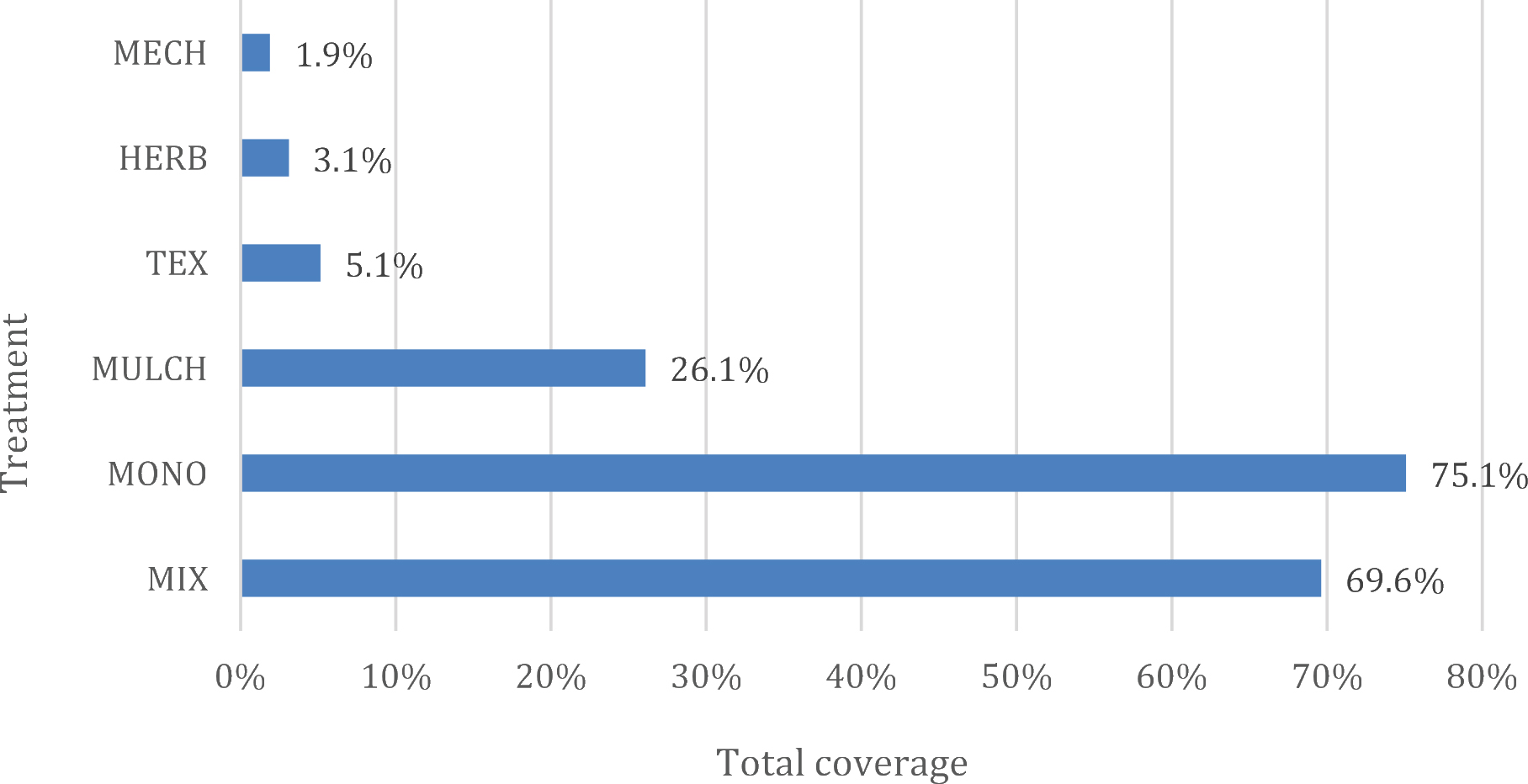
Figure 4.
Under-vine area covered by green vegetation (2022).
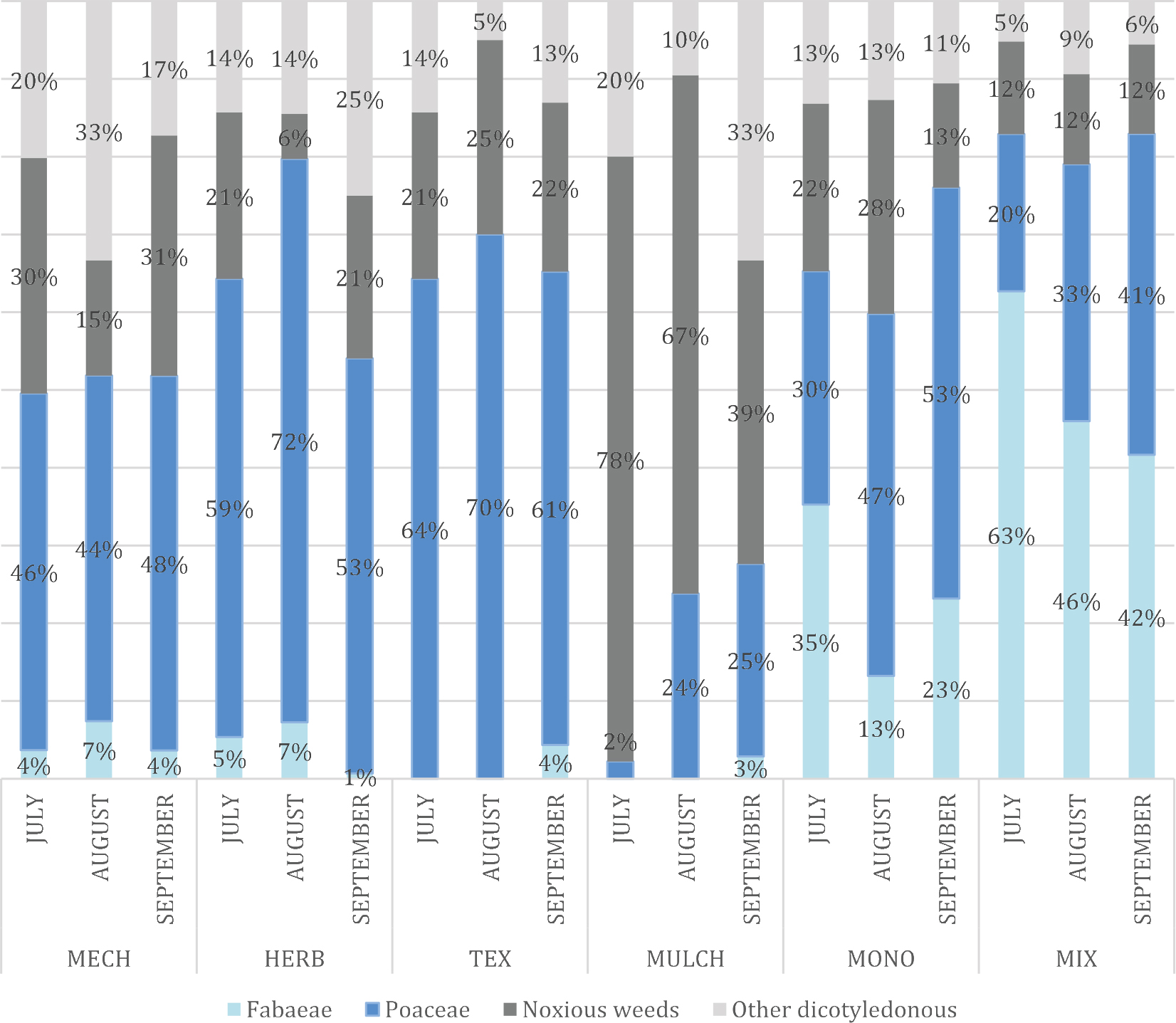
Figure 5.
Ratio (2-year average) of selected plant groups coverage (Fabaceae, Poaceae, noxious weeds and the rest of dicotyledonous) per three evaluation terms.
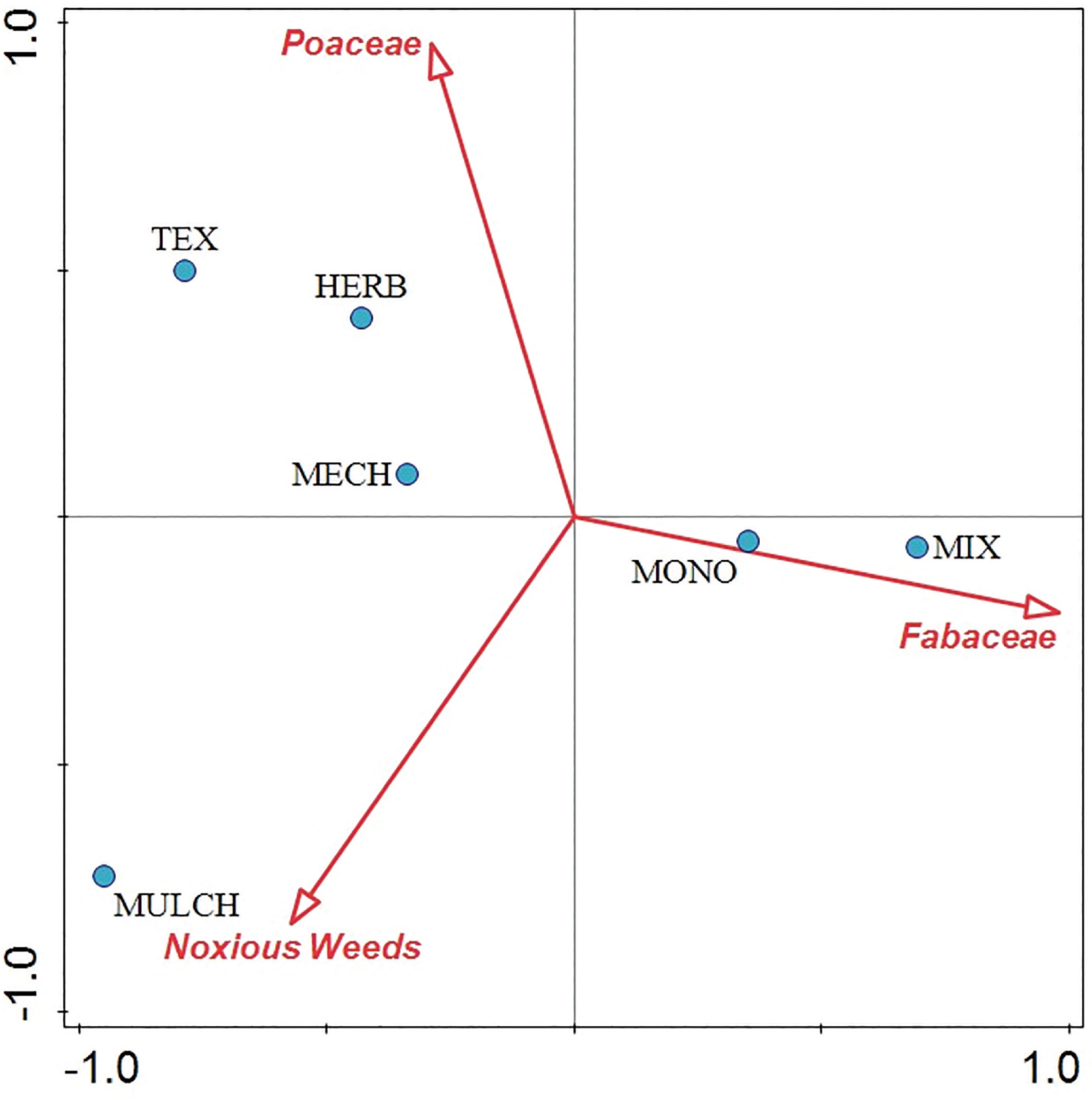
Figure 6.
Ordination diagram of CCA, describing the distribution of three categories of plant species and their coverage in the six different treatments (pseudo-F = 10.1, p = 0.002). CCA, canonical correlation analysis.
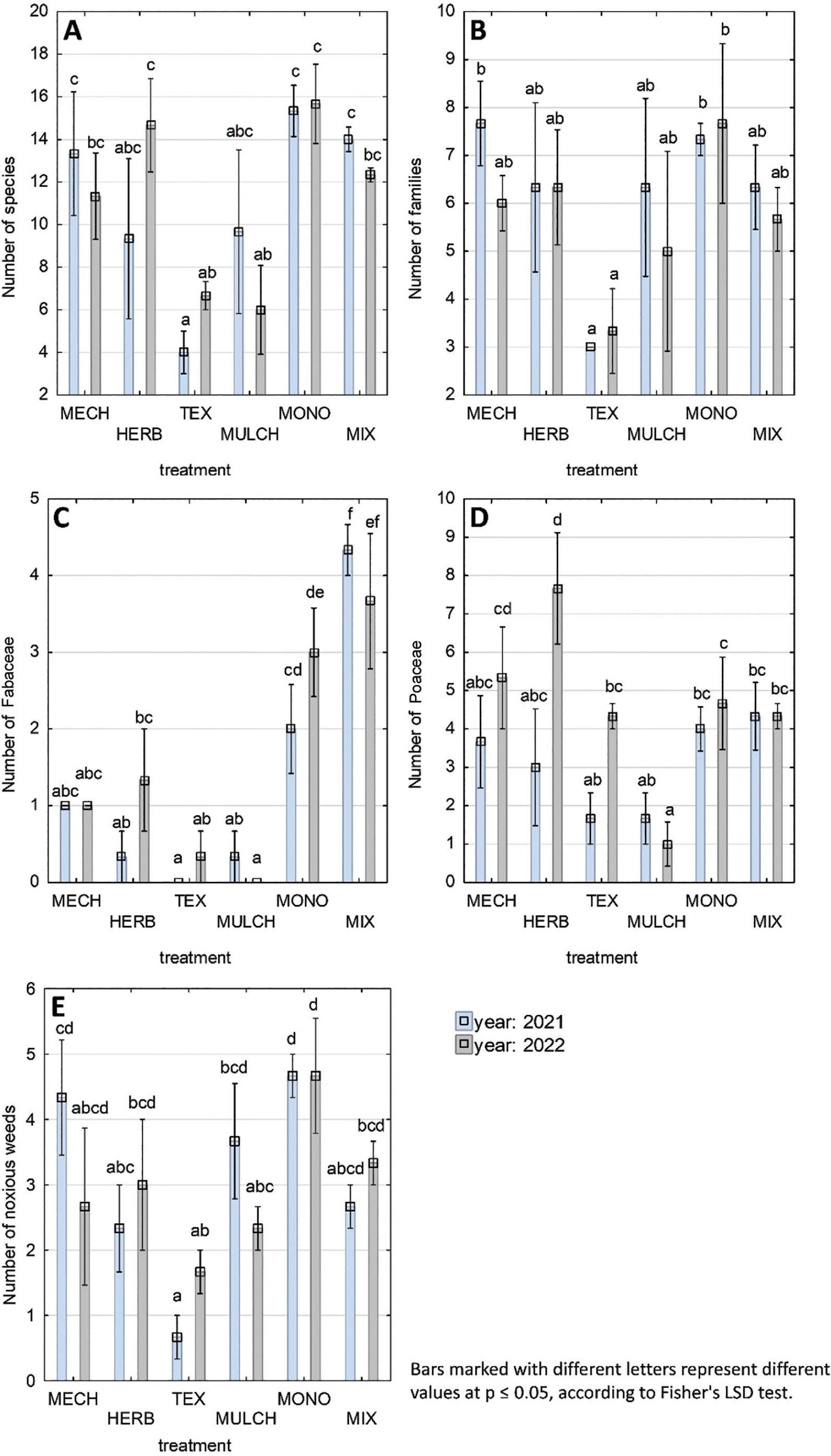
Figure 7.
Botanical assessment of vegetation (A – number of species; B – number of families; C – number of Fabaceae; D – number of Poaceae; E – number of noxious weeds). LSD, least significant difference.
Table 3.
Species identification in different treatments.
| Treatment | Predominant species in the vegetation cover |
|---|---|
| MECH | Bromus hordeaceus L., Convolvulus arvensis L., Amaranthus retroflexus L., Taraxacum sect. Taraxacum, Lolium perenne L., Setaria pumila, Cirsium arvense (L.) Scop., Hordeum murinum L., Chenopodium album L. |
| HERB | Bromus hordeaceus L., Setaria verticilata (L.) P. Beauv., Lolium perenne L., Setaria pumila (Poir)Roem. et Schult., Convolvulus arvensis L., Portulaca oleracea L., Setaria viridis (L.) P. Beauv., Digitaria sanguinalis (L.) Scop., Echinochloa crus-galli (L.) P. Beauv., Amaranthus retroflexus L, Cirsium arvense (L.) Scop., Taraxacum sect. Taraxacum. |
| TEX | Lolium perenne L., Convolvulus arvensis L., Bromus hordeaceus L. |
| MULCH | Cirsium arvense (L.) Scop., Convolvulus arvensis L., Bromus hordeaceus L., Amaranthus retroflexus L, Stellaria media (L.) Vill. |
| MONO | Lolium perenne L, Trifolium repens L., Cirsium arvense (L.) Scop., Amaranthus retroflexus L., Setaria viridis (L.) P. Beauv., Chenopodium album L., Bromus hordeaceus L., Medicago lupulina L., Taraxacum sect. Taraxacum, Convolvulus arvensis L., Setaria verticilata (L.) P. Beauv., Lotus corniculatus L. |
| MIX | Trifolium repens L., Lolium perenne L., Anthyllis vulneraria L., Medicago lupulina L., Lotus corniculatus L., Amaranthus retroflexus L., Bromus hordeaceus L., Chenopodium album, Setaria viridis, Setaria verticilata, Taraxacum sect. Taraxacum, Convolvulus arvensis L. |
Table 4.
Selected yield and uvological parameters.
| Year | Treatment | Number of bunches per vine (pcs) | Weight of bunches per vine (kg) | Bunch weight (g) | Berry weight (g) | Number of berries in a cluster (pcs) | Rachis weight (g) |
|---|---|---|---|---|---|---|---|
| 2021 | MECH | 16.4 ± 1.5 abc | 1.7 ± 0.1 a | 103.0 ± 12.5 ab | 1.7 ± 0.3 d | 66.6 ± 13.7 a | 4.0 ± 0.1 a |
| HERB | 19.8 ± 1.9 d | 2.1 ± 0.1 bc | 115.2 ± 8.3 ab | 1.1 ± 0.1 abc | 95.8 ± 6.8 cd | 6.0 ± 0.7 b | |
| TEX | 18.8 ± 0.8 cd | 1.9 ± 0.04 ab | 97 ± 6.3 a | 1.4 ± 0.4 bc | 76.4 ± 12.4 ab | 4.1 ± 0.3 a | |
| MULCH | 18.8 ± 2.5 cd | 2 ± 0.2 ab | 110.1 ± 4.3 ab | 1.2 ± 0.4 abc | 84 ± 18.9 bc | 4.6 ± 0.1 a | |
| MONO | 20.2 ± 1.8 d | 2.4 ± 0.1 d | 120.9 ± 3.7 ab | 1.0 ± 0.2 ab | 117.0 ± 3.1 e | 6.3 ± 0.2 bc | |
| MIX | 19.2 ± 3.1 d | 2.3 ± 0.1 cd | 119.2 ± 12.2 ab | 1.1 ± 0.1 abc | 107.0 ± 3.9 de | 7.0 ± 0.1 c | |
| 2022 | MECH | 15.0 ± 2.3 a | 1.8 ± 0.2 a | 112.8 ± 7.3 ab | 1.0 ± 0.1 a | 121.6 ± 10.4 e | 6.8 ± 0.5 bc |
| HERB | 15.2 ± 2.8 a | 2.5 ± 0.3 d | 162.6 ± 23.1 c | 1.3 ± 0.2 abc | 154.2 ± 12.5 f | 6.8 ± 0.5 c | |
| TEX | 16.0 ± 2.3 ab | 2.3 ± 0.3 cd | 139.5 ± 25.6 bc | 1.0 ± 0.4 a | 188.0 ± 14.6 h | 9.2 ± 0.7 d | |
| MULCH | 14.0 ± 0.7 a | 2.5 ± 0.04 d | 173.8 ± 45.3 c | 1.4 ± 0.2 cd | 161.0 ± 13.3 fg | 9.4 ± 0.5 d | |
| MONO | 19.8 ± 2.9 d | 2.4 ± 0.3 d | 122.3 ± 29.3 ab | 1.0 ± 0.2 ab | 117.0 ± 11.5 e | 6.0 ± 0.5 b | |
| MIX | 18.4 ± 1.8 bcd | 3.2 ± 0.3 e | 215.9 ± 84.2 d | 1.4 ± 0.3 c | 173.0 ± 16.3 gh | 9.7 ± 1.8 d |
Table 5.
Analytical parameters of grapes.
| Year | Treatment | YAN (mg · L−1) | Sugar content (glucose + fructose) (g · L−1) | Acid content (g · L−1) | Malic acid (g · L−1) | Tartaric acid (g · L−1) | Citric acid (g · L−1) | PH |
|---|---|---|---|---|---|---|---|---|
| 2021 | MECH | 211.7 ±4.3 cd | 240.6 ± 4.0 fg | 7.2 ±0.1 c | 3.6 ± 0.1g | 7.6 ± 0.03 ef | 0.25 ±0.01 f | 3.5 ±0.03 be |
| HERB | 150.4 ± 3.5 b | 243.7 ± 1.0 g | 6.9 ± 0.7 c | 3.1 ± 0.2 f | 7.4 ± 0.5 de | 0.18 ± 0.02 c | 3.6 ±0.1 c | |
| TEX | 221.8 ± 4.7 d | 238.0 ± 2.9 fg | 8.2 ± 0.2 d | 3.7 ± 0.05 h | 8.2 ± 0.01 h | 0.22 ±0.01 de | 3.5 ± 0.02 abc | |
| MULCH | 344.4 ± 14.2 f | 204.6 ±8.9 a | 9.3 ± 0.7 e | 5.9 ±0.1 k | 8.3 ±0.1 h | 0.24 ± 0.02 ef | 3.4 ±0.1 a | |
| MONO | 268.9 ± 2.0 e | 207.8 ±3.1 ab | 8.5 ± 0.4 d | 4.8 ± 0.02 j | 7.9 ± 0.01 fg | 0.23 ± 0.01 def | 3.5 ±0.01 abc | |
| MIX | 278.7 ± 1.1 e | 208.9 ± 2.3 ab | 8.7 ± 0.2 d | 4.3 ± 0.03 i | 8.1 ±0.1 gh | 0.21 ±0.01 d | 3.4 ± 0.03 ab | |
| 2022 | MECH | H9±l.8a | 227.9 ± 1.8 de | 4.2 ±0.1 ab | 0.6 ± 0.04 a | 7.5 ±0.04 de | 0.10 ±0.01 a | 3.8 ± 0.2 ef |
| HERB | 162.1 ± 5.4 b | 221.06 ±3.4 cd | 4.6 ± 0.4 ab | 1.1 ± 0.03 c | 6.7 ± 0.3 b | 0.15 ± 0.01b | 3.6 ±0.1 c | |
| TEX | 152.4 ± 6.5 b | 232.5 ± 10.2 ef | 4.7 ±0.1 b | 0.8 ±0.01 b | 7.3 ± 0.01 cd | 0.10 ±0.01 a | 3.5 ±0.01 abc | |
| MULCH | 218 ± 12.8 d | 210.7 ± 2.0 ab | 4.2 ± 0.02 a | 1.7 ±0.01 e | 7 ± 0.02 c | 0.15 ± 0.01b | 3.9 ± 0.02 f | |
| MONO | 201 ± 4.6 c | 216.1 ±3.0 be | 4.2 ± 0.01 ab | 0.8 ± 0.03 ab | 7.5 ±0.02 de | 0.10 ±0.01 a | 3.6 ± 0.02 cd | |
| MIX | 214.1 ± 11.4 d | 220.9 ± 7.8 cd | 4.7 ±0.1 ab | 1.3 ± 0.02 d | 6.3 ±0.1 a | 0.11 ±0.01 a | 3.7 ± 0.01 de |
Supplementary Table 1.
Coverage rate of each plant species in six under-vine treatments during three evaluation terms (July, August and September) in years 2021 and 2022.
| Family | Species | Category* | JULY 2021 | AUGUST 2021 | SEPTEMBER 2021 | |||||||||||||||
|---|---|---|---|---|---|---|---|---|---|---|---|---|---|---|---|---|---|---|---|---|
| MECH | HERB | TEX | MULCH | MONO | MIX | MECH | HERB | TEX | MULCH | MONO | MIX | MECH | HERB | TEX | MULCH | MONO | MIX | |||
| Amaranthaceae | Amaranthus blitoides S. Watson | 1 | ||||||||||||||||||
| Amaranthus retroflexus L. | 2 | 10 | 7 | 15 | 4 | 2 | 1 | 15 | 20 | 4 | 3 | 1 | 3 | 10 | 7 | |||||
| Atriplex patula L. | 2 | |||||||||||||||||||
| Chenopodium album L. | 3 | 6 | 1 | 2 | 6 | 5 | 1 | 1 | 15 | 15 | 4 | 1 | 3 | 15 | 10 | |||||
| Chenopodium hybridum L. | 2 | |||||||||||||||||||
| Apiaceae | Daucus carota L. | 2 | ||||||||||||||||||
| Asteraceae | Artemisia vulgaris L. | 3 | 1 | |||||||||||||||||
| Cirsium arvense (L.) Scop. | 3 | 1 | 10 | 12 | 1 | 5 | 5 | 15 | 5 | |||||||||||
| Conyza canadensis (L.) Cronq. | 2 | 1 | ||||||||||||||||||
| Crepis biennis L. | 2 | |||||||||||||||||||
| Crepis tectorum L. | 2 | |||||||||||||||||||
| Erigeron annuus (L.) Pers. | 3 | |||||||||||||||||||
| Senecio vulgaris L. | 1 | 1 | 1 | 1 | ||||||||||||||||
| Sonchus oleraceus L. | 1 | 1 | ||||||||||||||||||
| Taraxacum officinale (L.) Weber ex F. H. Wigg. | 3 | 5 | 5 | 3 | 7 | 1 | 1 | 4 | 2 | 4 | 1 | 1 | 1 | 4 | ||||||
| Tragopogon pratensis L. | 2 | 1 | ||||||||||||||||||
| Tripleurospermum inodorum (L.) Sch.Bip. | 3 | 1 | 2 | 1 | 1 | |||||||||||||||
| Brassicaceae | Capsella bursa-pastoris L. | 1 | 1 | 2 | 1 | 1 | 1 | 3 | 4 | 3 | ||||||||||
| Sinapis alba L. | 1 | |||||||||||||||||||
| Thlaspi arvense L. | 1 | |||||||||||||||||||
| Caryophylaceae | Arenaria serpyllifolia L. | 1 | 1 | 1 | 2 | |||||||||||||||
| Stellaria media (L.) Vill. | 1 | 1 | 6 | |||||||||||||||||
| Convolvulaceae | Convolvulus arvensis L. | 3 | 1 | 2 | 2 | 1 | 1 | 1 | 1 | 2 | 1 | 8 | 3 | 2 | 8 | 4 | ||||
| Fabaceae | Anthyllis vulneraria L. | 1 | 5 | 10 | 10 | |||||||||||||||
| Lotus corniculatus L. | 2 | 3 | 5 | 7 | ||||||||||||||||
| Medicago lupulina L. | 2 | 1 | 5 | 1 | 4 | 8 | 1 | 1 | 5 | |||||||||||
| Onobrychis viciifolia Scop. | 1 | |||||||||||||||||||
| Trifolium pratense L. | 1 | 1 | ||||||||||||||||||
| Trifolium repens L. | 1 | 10 | 40 | 8 | 40 | 1 | 3 | 20 | 70 | |||||||||||
| Vicia tetrasperma (L.) Schreb. | 1 | 1 | ||||||||||||||||||
| Geraniaceae | Erodium cicutarium (L.) L’Hér. | 2 | 1 | |||||||||||||||||
| Geranium pusillum Brum. fil. | 2 | 1 | 1 | 1 | 1 | 1 | ||||||||||||||
| Lamiaceae | Lamium amplexicaule L. | 1 | ||||||||||||||||||
| Lamium purpureum L. | 1 | 1 | ||||||||||||||||||
| Plantaginaceae | Plantago major L. | 1 | 1 | |||||||||||||||||
| Veronica polita Fries. | 1 | 1 | 1 | |||||||||||||||||
| Poaceae | Bromus hordeaceus L. | 2 | 2 | 3 | 6 | 1 | 1 | 2 | 3 | 10 | 11 | 3 | 18 | 5 | ||||||
| Bromus japonicus Thnub. | 2 | |||||||||||||||||||
| Bromus tectorum L. | 2 | |||||||||||||||||||
| Digitaria sanguinalis (L.) Scop. | 2 | 2 | 5 | 3 | 2 | 2 | 4 | |||||||||||||
| Echinochloa crus-galli (L.) P. Beauv. | 2 | 1 | 1 | |||||||||||||||||
| Elytrigia repens (L.) Nevski | 3 | 1 | ||||||||||||||||||
| Festuca rubra L. | 2 | 10 | ||||||||||||||||||
| Hordeum murinum L. | 2 | 1 | ||||||||||||||||||
| Lolium perenne L. | 2 | 3 | 3 | 4 | 3 | 3 | 3 | 6 | 6 | |||||||||||
| Panicum miliaceum L. | 3 | |||||||||||||||||||
| Poa annua L. | 1 | 1 | ||||||||||||||||||
| Setaria pumila (Poir.) Roem. et Schult. | 2 | 6 | 1 | 4 | 5 | 55 | 15 | |||||||||||||
| Setaria verticilata (L.) P. Beauv. | 2 | 1 | 5 | 10 | 12 | 6 | 12 | 2 | 4 | |||||||||||
| Setaria viridis L. | 2 | 1 | 1 | 8 | 4 | 2 | 12 | 10 | 4 | 1 | ||||||||||
| Polygonaceae | Polygonum vulgare L. | 2 | 5 | 1 | 3 | 3 | 1 | 2 | 2 | 2 | 1 | 7 | 4 | |||||||
| Portulacaceae | Portulaca oleracea L. | 2 | 1 | 1 | 4 | 1 | 8 | 1 | 3 | |||||||||||
| Resedaceae | Reseda lutea L. | 1 | ||||||||||||||||||
| Rosaceae | Rosa canina L. | 3 | ||||||||||||||||||
| Solanaceae | Datura stramonium L. | 3 | ||||||||||||||||||
| Solanum nigrum L. | 2 | 1 | 1 | 1 | ||||||||||||||||
| Violaceae | Viola arvensis Murray | 1 | ||||||||||||||||||
| Amaranthaceae | Amaranthus blitoides S. Watson | 1 | ||||||||||||||||||
| Amaranthus retroflexus L. | 2 | 5 | 1 | 6 | 1 | |||||||||||||||
| Atriplex patula L. | 2 | |||||||||||||||||||
| Chenopodium album L. | 3 | 1 | 2 | 2 | 2 | |||||||||||||||
| Chenopodium hybridum L. | 2 | |||||||||||||||||||
| Apiaceae | Daucus carota L. | 2 | 1 | |||||||||||||||||
| Asteraceae | Artemisia vulgaris L. | 3 | ||||||||||||||||||
| Cirsium arvense (L.) Scop. | 3 | 8 | 1 | 1 | 8 | 8 | 1 | 8 | 8 | 2 | 10 | 1 | 10 | 4 | ||||||
| Conyza canadensis (L.) Cronq. | 2 | |||||||||||||||||||
| Crepis biennis L. | 2 | |||||||||||||||||||
| Crepis tectorum L. | 2 | |||||||||||||||||||
| Erigeron annuus (L.) Pers. | 3 | |||||||||||||||||||
| Senecio vulgaris L. | 1 | 1 | ||||||||||||||||||
| Sonchus oleraceus L. | 1 | |||||||||||||||||||
| Taraxacum officinale (L.) Weber ex F. H. Wigg. | 3 | 2 | 4 | 3 | 5 | 6 | 3 | 7 | 4 | 4 | 3 | |||||||||
| Tragopogon pratensis L. | 2 | |||||||||||||||||||
| Tripleurospermum inodorum (L.) Sch.Bip. | 3 | 1 | 2 | 3 | ||||||||||||||||
| Brassicaceae | Capsella bursa-pastoris L. | 1 | 1 | 1 | 1 | 3 | 3 | 2 | ||||||||||||
| Sinapis alba L. | 1 | |||||||||||||||||||
| Thlaspi arvense L. | 1 | 3 | 1 | |||||||||||||||||
| Caryophylaceae | Arenaria serpyllifolia L. | 1 | 1 | 2 | 2 | |||||||||||||||
| Stellaria media (L.) Vill. | 1 | 2 | 7 | 6 | 1 | 2 | ||||||||||||||
| Convolvulaceae | Convolvulus arvensis L. | 3 | 5 | 4 | 2 | 5 | 3 | 2 | 1 | 1 | 4 | 4 | 7 | 4 | 4 | 8 | 2 | 3 | 1 | 7 |
| Fabaceae | Anthyllis vulneraria L. | 1 | 15 | 15 | 6 | |||||||||||||||
| Lotus corniculatus L. | 2 | 8 | 11 | 12 | ||||||||||||||||
| Medicago lupulina L. | 2 | 3 | 2 | 10 | 25 | 2 | 3 | 7 | 7 | |||||||||||
| Onobrychis viciifolia Scop. | 1 | 1 | ||||||||||||||||||
| Trifolium pratense L. | 1 | |||||||||||||||||||
| Trifolium repens L. | 1 | 1 | 45 | 20 | 1 | 3 | 10 | 6 | 10 | 10 | ||||||||||
| Vicia tetrasperma (L.) Schreb. | 1 | 2 | 3 | 1 | 2 | |||||||||||||||
| Geraniaceae | Erodium cicutarium (L.) L’Hér. | 2 | 2 | |||||||||||||||||
| Geranium pusillum Brum. fil. | 2 | 2 | 3 | 1 | 1 | 1 | 1 | 1 | 2 | 1 | ||||||||||
| Lamiaceae | Lamium amplexicaule L. | 1 | 1 | 2 | 1 | |||||||||||||||
| Lamium purpureum L. | 1 | |||||||||||||||||||
| Plantaginaceae | Plantago major L. | 1 | ||||||||||||||||||
| Veronica polita Fries. | 1 | 1 | ||||||||||||||||||
| Poaceae | Bromus hordeaceus L. | 2 | 15 | 10 | 3 | 15 | 10 | 2 | 2 | 2 | 1 | 4 | 1 | 12 | 12 | 1 | 2 | |||
| Bromus japonicus Thnub. | 2 | 1 | 1 | 1 | ||||||||||||||||
| Bromus sterilis L. | 2 | |||||||||||||||||||
| Bromus tectorum L. | 2 | 3 | 2 | 1 | 5 | |||||||||||||||
| Digitaria sanguinalis (L) Scop. | 2 | 2 | 1 | 2 | 5 | 4 | ||||||||||||||
| Echinochloa crus-galli (L.) P. Beauv. | 2 | 2 | 1 | 1 | 1 | 2 | 10 | |||||||||||||
| Elytrigia repens (L.) Nevski | 3 | 4 | 4 | |||||||||||||||||
| Festuca rubra L. | 2 | |||||||||||||||||||
| Hordeum murinum L. | 2 | 2 | 2 | 3 | 1 | 10 | 1 | |||||||||||||
| Lolium perenne L. | 2 | 8 | 4 | 3 | 20 | 13 | 4 | 5 | 6 | 3 | 55 | 35 | 15 | 4 | 3 | 40 | 55 | |||
| Panicum miliaceum L. | 3 | 2 | ||||||||||||||||||
| Poa annua L. | 1 | 1 | ||||||||||||||||||
| Setaria pumila (Poir.) Roem. et Schult. | 2 | 5 | 4 | 1 | 10 | 2 | 6 | |||||||||||||
| Setaria verticilata (L.) P. Beauv. | 2 | 2 | 2 | 5 | 2 | 8 | 2 | 3 | 7 | |||||||||||
| Setaria viridis L. | 2 | 1 | 2 | 1 | 8 | 2 | 2 | 2 | 7 | 4 | ||||||||||
| Polygonaceae | Polygonum vulgare L. | 2 | 1 | 1 | ||||||||||||||||
| Portulacaceae | Portulaca oleracea L. | 2 | 2 | |||||||||||||||||
| Resedaceae | Reseda lutea L. | 1 | ||||||||||||||||||
| Rosaceae | Rosa canina L. | 3 | 1 | 1 | ||||||||||||||||
| Solanaceae | Datura stramonium L. | 3 | ||||||||||||||||||
| Solanum nigrum L. | 2 | |||||||||||||||||||
| Violaceae | Viola arvensis Murray | 1 | 2 | |||||||||||||||||