
Table 1
Some climatic characteristics of the experimental site.
| Year | Average monthly air temperature (°C) | Humidity (mm) | Maximum soil temperature (°C) | |||
|---|---|---|---|---|---|---|
| May | July | May | July | May | July | |
| 2014 | 16 | 19.1 | 37.1 | 20 | 46.6 | 53 |
| 2015 | 19.5 | 20.8 | 44.2 | 79.1 | 56 | 46 |
| 2016 | 17.7 | 21.2 | 47.2 | 66.5 | 34.5 | 31 |
| 2017 | 16.3 | 22.2 | 56.3 | 85.5 | 38.5 | 41 |
| 2018 | 17.7 | 21.2 | 31.4 | 120 | 42 | 29 |
| Long-term average | 13 | 18.5 | 36.3 | 88.8 | N/A | N/A |
Table 2
Hydrothermal coefficient of the experimental site during the study period.
| Period | 2014 | 2015 | 2016 | 2017 | 2018 |
|---|---|---|---|---|---|
| May | 0.27 | 0.81 | 1.21 | 1.11 | 0.62 |
| July | 0.34 | 0.98 | 1.05 | 1.25 | 0.94 |
[i] К > 1.3 represents excessive hydration; К = 1.0–1.3 represents optimal hydration; К < 1.0 represents insufficient hydration
Table 3
Introduced and Russian red currant genotypes of the present study.
| Genotype | Origin | |
|---|---|---|
| Genetic | Geographic | |
| Jonkheer van Tets | Faya Plodorodnaya × London Market | The Netherlands |
| Natali | Ribes vulgare × R. rubrum × Ribes petraeum | Russia |
| Hollandische Rote | R. rubrum × Ribes petraeum | The Netherlands |
| Viksne | Ribes warscewiczii Jancz. | Latvia |
| Shchedraya | Faya Plodorodnaya × Houghton Castle | Russia |
| 129-21-61 | Jonkheer van Tets × Hollandische Rote | Russia |
| 261-65-19 | Jonkheer van Tets × Ribes atropurpureum | Russia |
| 111-19-81 | Jonkheer van Tets - free pollination | Russia |
| 271-58-24 | Jonkheer van Tets × Ribes meyeri | Russia |
Table 4
Disease scores followed for the observation of Sphaerotheca mors-uvae and Pseudopeziza ribis.
| Disease score | Sphaerotheca mors-uvae | Pseudopeziza ribis |
|---|---|---|
| 0 | No infection (healthy plant) | No infection (healthy plant) |
| 1.0 | Very weak disease damage (up to 10% of leaves and up to 1% of berries are affected) | Very weak damage (up to 5% leaves are affected) |
| 2.0 | Weak plant disease (up to ¼ of the shrub shoots, up to 25% of leaves and up to 3% of berries are affected) | Weak plant damage (up to 10% of the leaves are damaged) |
| 3.0 | Average plant disease (up to ⅓ of the shrub shoots, 26–50% of the leaves and up to 10% of the berries are affected) | Average plant damage (up to 30% of leaves are damaged) |
| 4.0 | Severe plant disease (⅓ to ¼ of the shrub shoots, 51–70% of the leaves and up to 20% of the berries are affected) | Severe plant damage (up to 50% of the leaves are damaged) |
| 5.0 | Very severe disease (more than ½ of the shrub shoots, more than 70% of the leaves and more than 20% of the berries are affected) | Very severe damage (more than 50% of the leaves are damaged) |
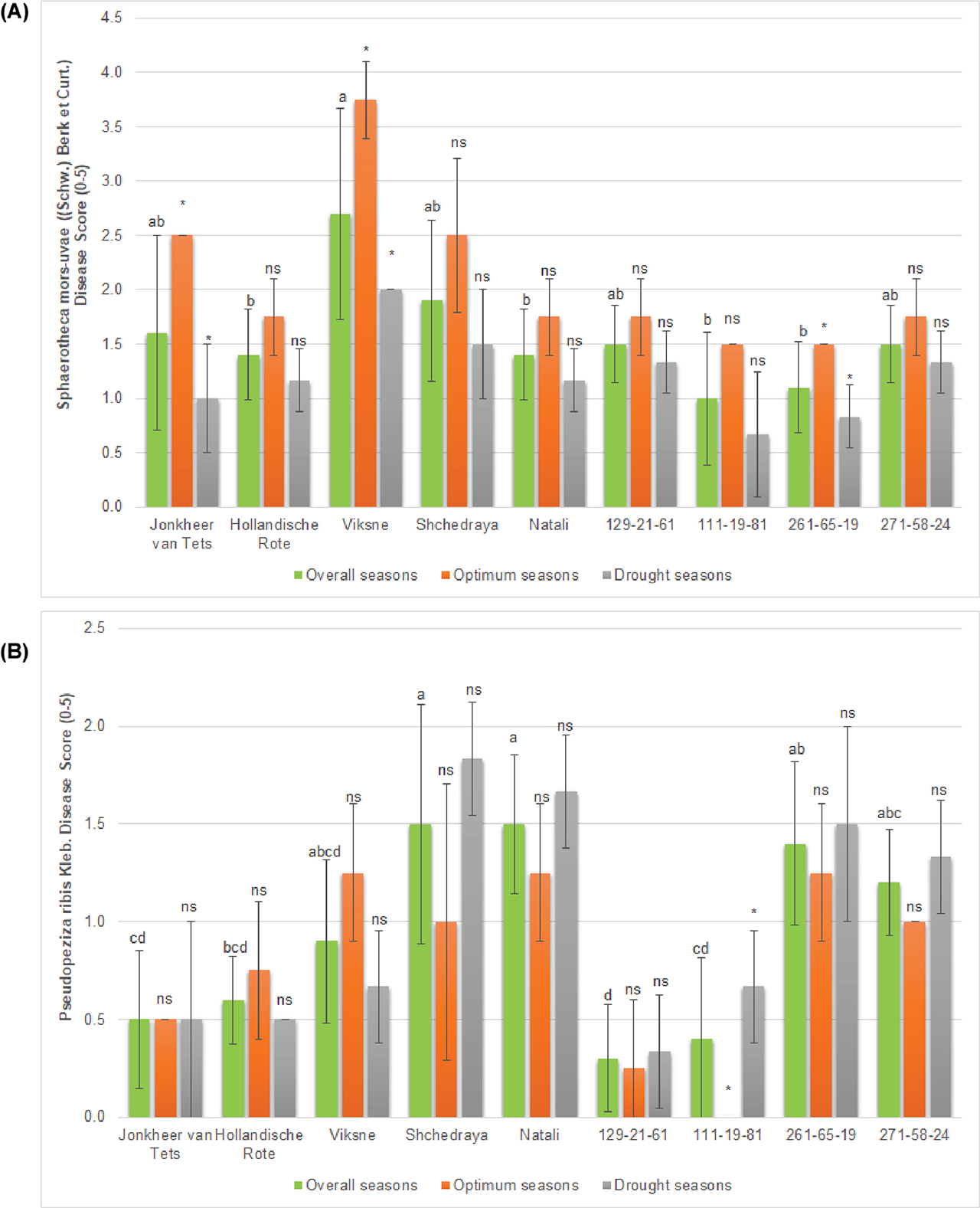
Figure 1
Disease scores of S. mors-uvae (A) and P. ribis (B) on the test genotypes in optimum and drought seasons. Averages of overall seasons that were compared for genotypes and different letters over the green columns were used to represent significant differences among the genotypes according to Tukey's test. Independent samples t-test was used to compare optimum and drought seasons separately for each genotype, *Represents significant difference and ns means non-significant.
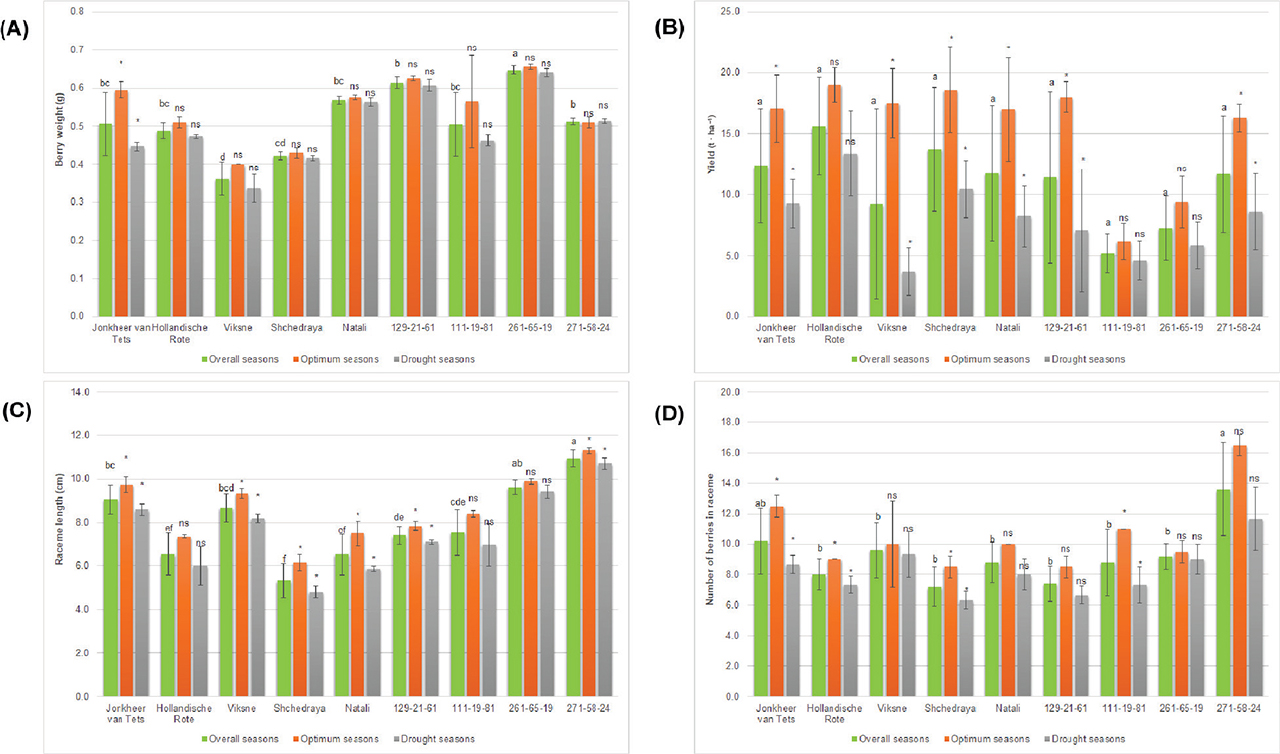
Figure 2
Berry weight (A), yield (B), raceme length (C) and the number of berries in a raceme (D) of test genotypes in optimum and drought seasons. Averages of overall seasons that were compared for genotypes and different letters over the green columns were used to represent significant differences among the genotypes according to Tukey's test. Independent samples t-test was used to compare optimum and drought seasons separately for each genotype, *Represents significant difference and ns means non-significant.
Table 5
Biometric indicators of productivity components.
| Genotypes | Raceme length | Number of berries in a raceme | Berry weight | ||||||
|---|---|---|---|---|---|---|---|---|---|
| Short (5.1–8.0) | Medium (8.1–10.0) | Long (10.1–12.0) | Little (7–10) | Average (11–14) | Large (15–20) | Small (0.3–0.45) | Medium (0.46–0.65) | Large (0.66–0.85) | |
| Jonkheer van Tets | + | + | + | ||||||
| Natali | + | + | + | ||||||
| Hollandische Rote | + | + | + | ||||||
| Viksne | + | + | + | ||||||
| Shchedraya | + | + | + | ||||||
| 129-21-61 | + | + | + | ||||||
| 261-65-19 | + | + | + | ||||||
| 111-19-81 | + | + | + | ||||||
| 271-58-24 | + | + | + | ||||||
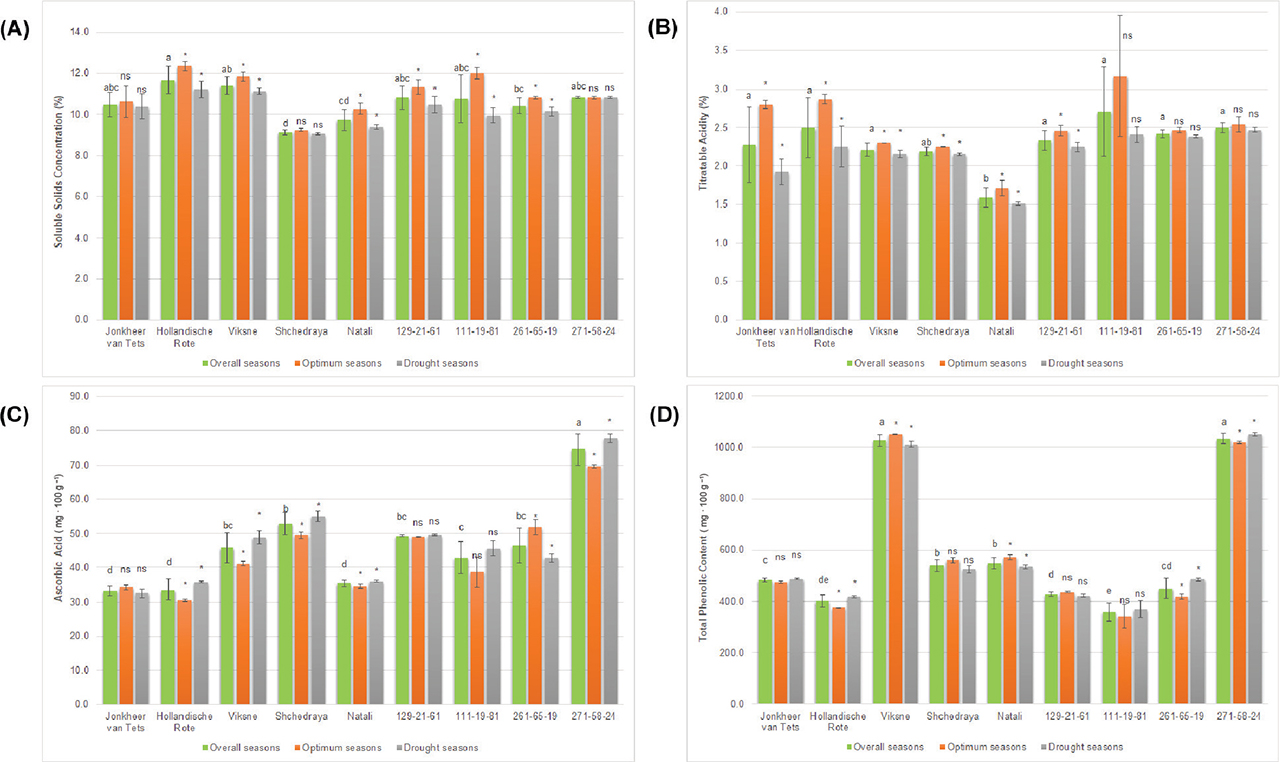
Figure 3
Soluble solid concentration (A), titratable acidity (B), ascorbic acid content (C) and total phenolic content (D) of test genotypes in optimum and drought seasons. Averages of overall seasons that were compared for genotypes and different letters over the green columns were used to represent significant differences among the genotypes according to Tukey's test. Independent samples t-test was used to compare optimum and drought seasons separately for each genotype, *Represents significant difference and ns means non-significant.
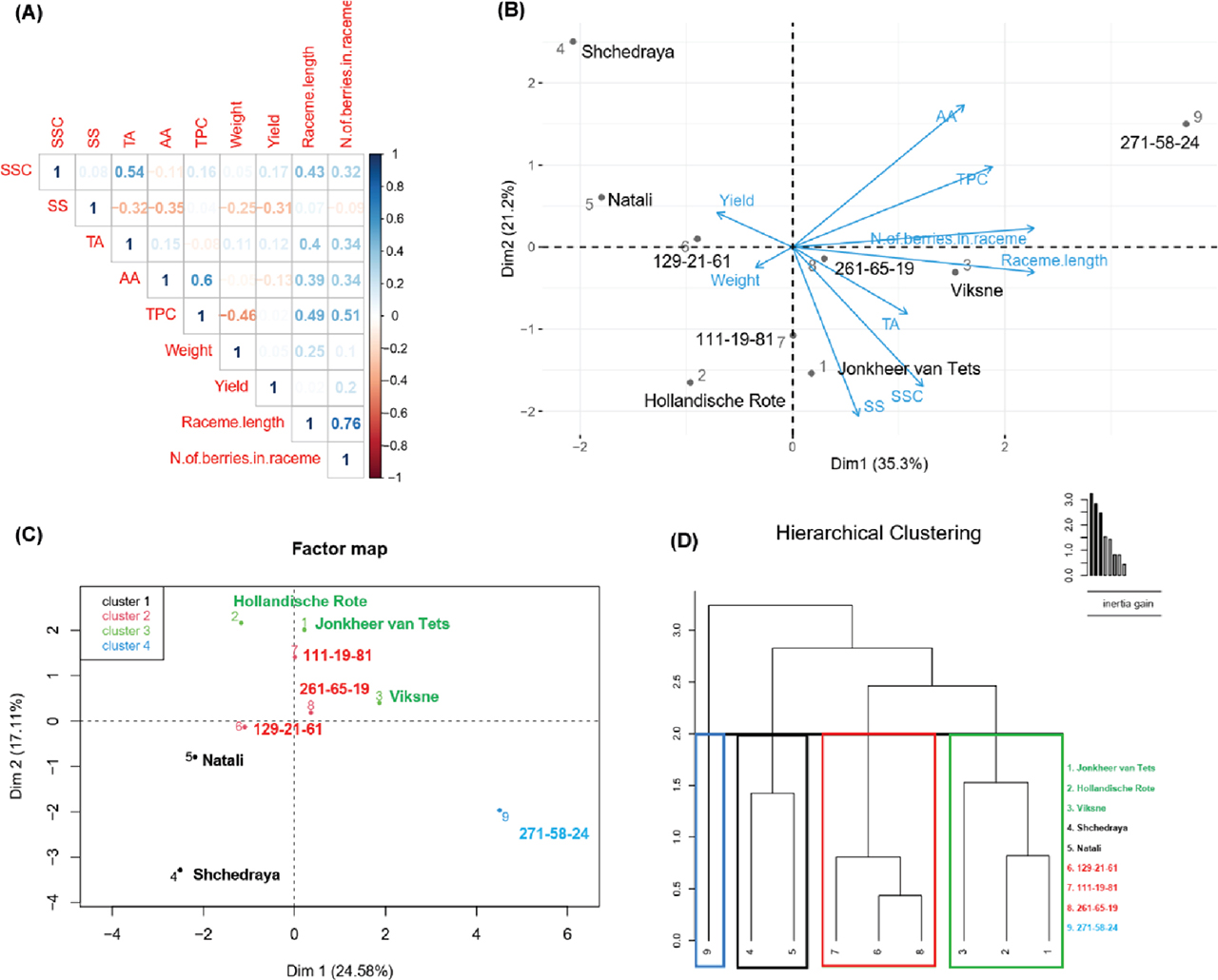
Figure 4
Correlation among selected traits (A), PCA – biplot with loadings (B), factor map (C) and hierarchical cluster (D) analysis of red currant genotypes.(1) ‘Jonkheer van Tets’; (2) ‘Hollandische Rote’; (3) ‘Viksne’; (4) ‘Shchedraya’; (5) ‘Natali’; (6) 129-21-61; (7) 111-19-81; (8) 261-65-19 and (9) 271-58-24. PCA, principal component analysis.
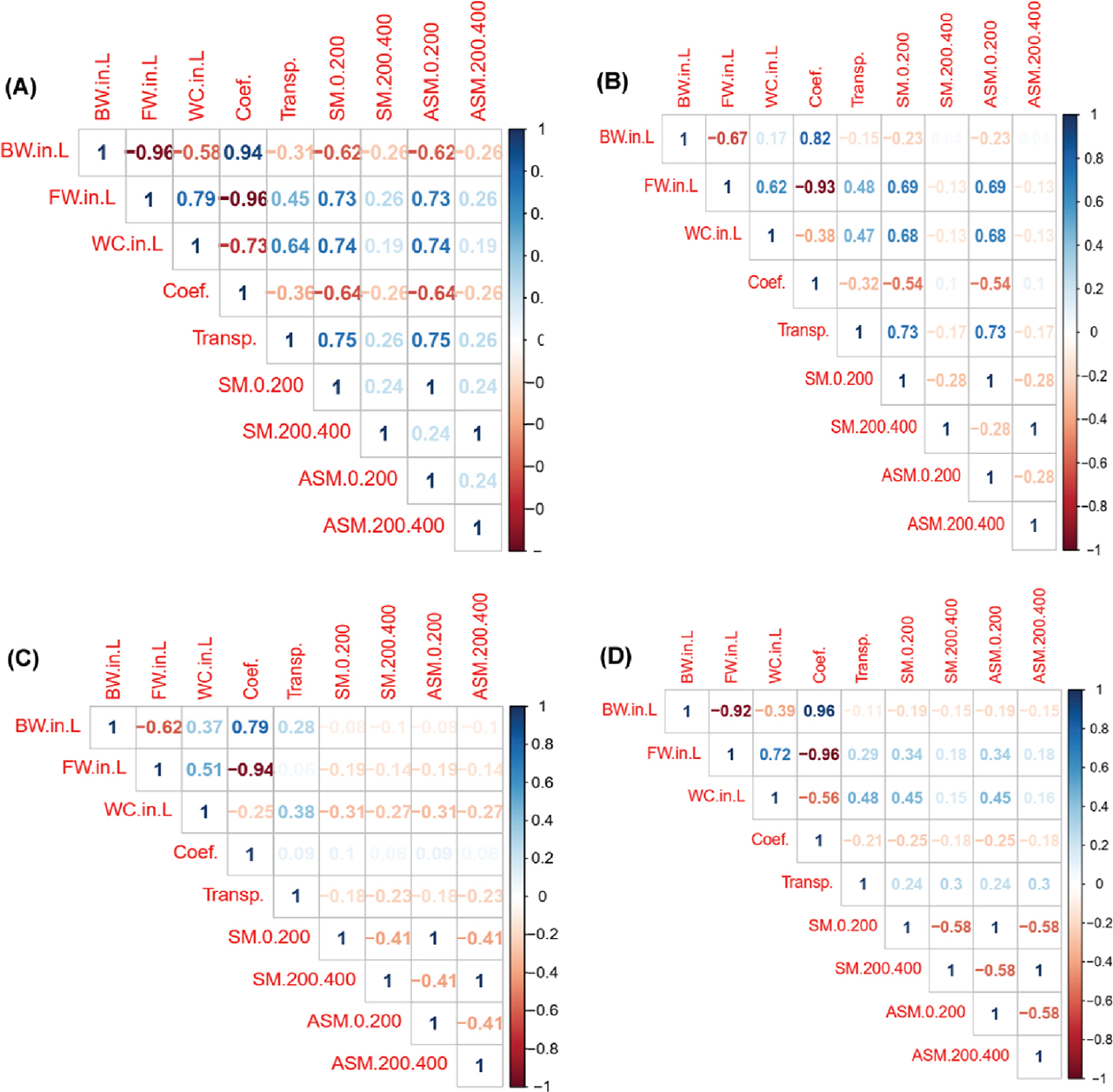
Figure 5
Correlation among selected water regime traits in soil and plant leaves of red currant plants in May (A), July (B), drought season (C) and optimum season (D). ASM.0–200, absolute soil moisture (%) at 0–200 mm; ASM.200–400, absolute soil moisture (%) at 200–400 mm; BW.in.L, bound water in leaves (%); Coef., coefficient of bound/free water (%); FW.in.L, free water in leaves (%); SM.0–200, soil moisture (%) in 0–200 mm; SM.200–400, soil moisture (%) in 200–400 mm; Transp., transpiration (mg · m−2 · h−1); WC.in.L, water content (%).
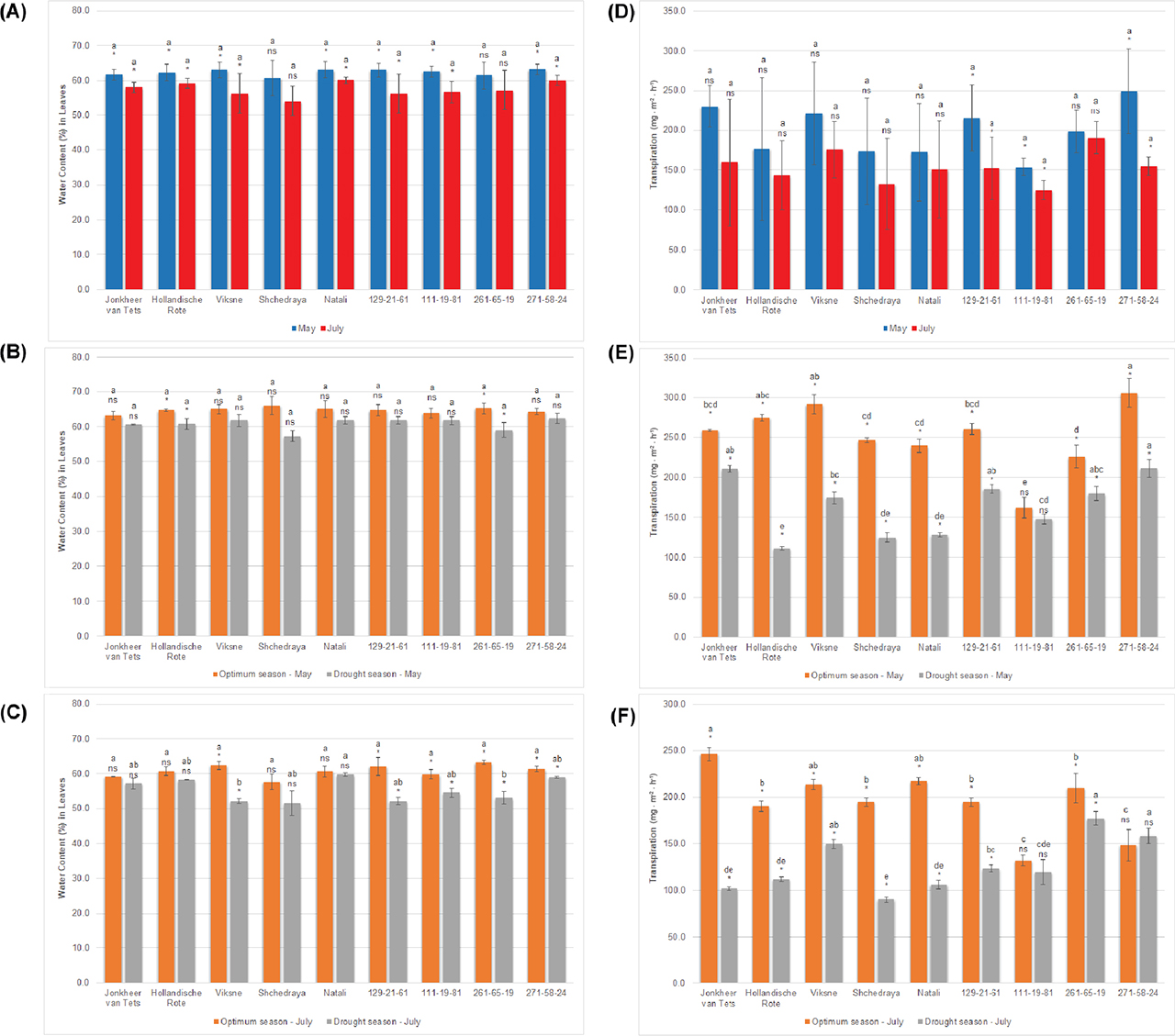
Figure 6
Comparison of the water content of leaves in May and July (A), optimum and drought seasons in May (B) and optimum and drought seasons in July (C); and comparison of transpiration of genotypes in May and July (D), optimum and drought seasons in May (E) and optimum and drought seasons in July (F). Averages of overall seasons that were compared for genotypes and different letters over the columns were used to represent significant differences among the genotypes according to Tukey's test. Independent samples t-test was used to compare May and July or optimum and drought seasons separately for each genotype, *Represents significant difference and ns means non-significant.