
Introduction
In contemporary forestry, the focus extends beyond the rational utilization of forest resources to include their high-quality and accelerated regeneration, which is a cornerstone of sustainable forest management. Over the past few decades, reforestation methods in Ukraine have undergone significant advancements, increasingly tailored to the ecological, economic and climatic conditions of specific regions. Modern reforestation strategies not only aim to establish productive forest stands but also prioritize biodiversity conservation, landscape structure optimization, water resource protection, improvement of timber quality and the overall economic efficiency of forest management activities. One of the principal determinants of successful forest regeneration is the quality of planting material, as its morphological and physiological attributes directly influence growth performance and seedling survival rates.
In Ukraine, current technologies for producing planting material require modernization to align with international best practices. In particular, the cultivation of containerized seedlings with a closed-root system – widely adopted in European countries, especially in Scandinavia – has demonstrated clear advantages over traditional bare – root methods, including an extended planting window and significantly higher survival rates (Maurer 2011).
Researchers (Hua et al. 2025) propose a novel stereoscopic model for plant cultivation aimed at enhancing the productivity and resilience of agroecosystems. The study focuses on the technological aspects of adaptive plant arrangement in multi-level structures, considering optimal light regimes that promote accelerated growth and efficient spatial utilization in urban and industrial environments.
Given the current state of forest nursery production, the implementation of scientifically grounded industrialscale technologies for growing containerized seedlings is of particular relevance. This approach entails substantial modifications to the agrotechnology of seedling cultivation, thereby improving both seedling quality and costeffectiveness. The efficiency of this process is largely determined by a range of factors, among which the composition of the substrate and the water-physical and agrochemical properties of its components are considered key (Lialin 2012).
The use of planting material with a closed-root system is regarded as a modern, high-tech and highly efficient method for both reforestation and afforestation. This method significantly reduces the time required for the establishment of forest plantations.
Despite the advantages of this approach, forest nurseries in Ukraine face a number of persistent challenges, including limited funding, outdated technologies, a low output of standard planting material per unit area, a restricted range of species, the absence of effective monitoring systems and a shortage of qualified specialists. In response, the following priority tasks have been identified:
– optimization of the nursery production capacities within forest sector enterprises (Vedmid and Mateichyk 2002);
– modernization of the industrial nursery base through the expanded adoption of modern methods of woody plant propagation and advanced agrotechnologies for cultivating promising species of planting material (Bazan and Oleksìjčenko 2013; Tkač 2012);
– diversification of the species assortment to meet the specific needs of forest management;
– government support for forest districts that independently grow containerized planting material;
– development of a domestic and international market for nursery products;
– consideration of global trends and best practices in the supply of planting material for forest regeneration in leading countries (Popov 2008);
– high-quality training of professional personnel.
Since the late 1950s, the industrial-scale production of container-grown planting material (i.e., with a closed-root system, CRS) has been actively developed and adopted in various countries. The method has been successfully implemented in Germany, Austria, Switzerland, Poland, Finland, France, the United Kingdom and the United States (Nosenko 2019; Barnett and Brissette 1986; Berry 1982; Rotowa et al. 2025).
Currently, two main approaches to industrial CRS seedling production are recognized:
– cultivation of seedlings in containers made of peat, paper, plastic, or other materials;
– transplantation of pre-grown seedlings into specialized substrates or substrate-filled containers.
In Poland and Latvia, research on the development of CRS-based cultivation methods began in the late 1960s. Notably, Latvia developed the so-called Brika method of seedling production. Its originality lies in the fact that seedlings are grown in rolls containing 50 units each. These rolls can be stored for extended periods and planted at optimal times for production needs (Danylenko et al. 2021).
CRS planting material offers a range of advantages (Maurer 2006), including:
– potential for automation of the production process;
– efficient use of seeds;
– earlier sowing dates and an extended vegetation period;
– shortened cultivation cycle;
– more intensive plant growth and development;
– nearly 100% survival rate on reforestation sites;
– the possibility of planting throughout the entire growing season;
– significantly higher yield of planting material per unit area compared to open-ground cultivation.
A minor drawback of CRS seedling production is the increased weight of the substrate that must be transported along with the planting material (Maurer et al. 2019a).
Promising Directions for the Use of Container-Grown Planting Material (Closed-Root System):
– industrial methods of plantation forestry;
– microclonal propagation;
– cultivation of planting material for the establishment of protective forest plantations;
– creation of forest stands on land contaminated with radionuclides;
– afforestation of disturbed and degraded lands;
– establishment and supplementary planting of forest crops throughout the entire growing season.
The effective use of container-grown planting material requires adequate material and technical infrastructure. Consequently, the main drawbacks of container-based cultivation technology include the following (Maurer et al. 2019b):
– high initial investment costs and the necessity of a well-developed transportation network for delivering seedlings to forest planting sites;
– the production process demands greater attention to detail and strict adherence to the prescribed technological protocols;
– the need for disposal of used materials and treatment of irrigation water (Maurer et al. 2019a).
A study by Zavistanovicz et al. (2025) focuses on the survival and initial growth of forest seedlings cultivated in different types of containers (trays), as well as the effect of mulching on these indicators when planting on degraded (anthropogenically altered) sites. In addition, the researchers compare various container types in terms of root system development efficiency, evaluate the role of mulching (organic ground cover) in moisture retention, weed competition reduction and increased seedling survival. The study emphasizes the critical importance of selecting appropriate containers and using mulching techniques to enhance early seedling adaptation under unfavourable conditions – particularly in the context of increasing drought frequency and climate change.
In recent years, a downward trend in the survival rate of forest plantations has been observed, which highlights the need to improve planting material production technologies and underscores the relevance of this study. Optimizing this process involves the automation of production, enhancement of plant nutrition systems and the implementation of energy-efficient technologies.
The aim of the study is to analyse the impact of substrate composition on seed germination dynamics, seedling condition and the development of container-grown planting material (closed-root system), with a particular focus on seedling height growth. The research also seeks to develop scientifically grounded recommendations for optimizing the substrate composition used to fill seedling trays.
Object of the study: the process of cultivating Pinus sylvestris seedlings with a closed-root system in a green house environment.
Subject of the study: specific effects of substrate components on seed germination dynamics, seedling condition, growth and development of Pinus sylvestris in container cultivation.
Material and methods
The development of modified soil mixture compositions for testing in experimental studies was based on the synthesis of conclusions drawn from long-term experience in cultivating seedlings with a closed-root system, as well as analysis of substrate component properties and their ratios. Accordingly, five substrate composition modifications were designed, three of which were two components and two were three components.
The two-component substrate modifications involved varying ratios of bark and peat, as follows:
Variant 1 – bark:peat (2:1) (Modification 1);
Variant 2 – bark:peat (1:1) (Modification 2);
Variant 3 – bark:peat (1:2) (Modification 3).
The three-component substrate modifications included the following combinations of bark and peat with either forest soil or sawdust compost:
Variant 4 – bark:peat:forest soil (1:1:1) (Modification 4);
Variant 5 – bark:peat:sawdust compost (1:1:1) (Modification 5).
Both traditional components (peat and shredded pine bark) and locally available materials (humus layer of grey forest soil and sawdust compost) were used in the preparation of the substrates. The inclusion of local materials aimed to explore the possibility of reducing substrate costs, which represent the primary expense in the production of container-grown planting material.
The experiment, initiated on May 13, 2023, tested five substrate composition modifications. Substrates were prepared in advance according to the specified component ratios. Seed trays (model R9) from VCC were filled with the respective substrates, and each cell was sown with 30 Pinus sylvestris seeds. The seeds had been pre-treated by soaking in water for 24 hours, followed by surface sterilization in a 0.2% potassium permanganate solution and subsequent drying. After sowing, the surface of the substrate was mulched with bark to conserve moisture, prevent overheating and weed growth and protect young seedlings from sun scorch.
Experimental data were collected monthly. Germination energy and seed viability were determined by counting the emerged seedlings. To assess growth performance, biometric parameters of container-grown planting stock were measured. The height of the aboveground part of the seedlings was measured from the root collar to the apical bud with 1 mm accuracy. In parallel, the condition of the P. sylvestris seedlings was visually evaluated using a three-grade scale based on needle discoloration:
– excellent condition (up to 15% needle yellowing);
– satisfactory condition (up to 50% needle yellowing);
– poor condition (more than 50% needle yellowing).
The root system of P. sylvestris was visually assessed by analysing the ratio of three types of roots: horizontal, taproots and vertical branches from horizontal roots. Roots were classified into skeletal and fine roots (less than 3 mm in diameter) depending on their functional role.
Throughout the summer evaluation period, no mortality or non-viable seedlings were observed. During the final autumn assessment, a minor proportion of seedling mortality was recorded. This was attributed to the reduction in daylight hours and, consequently insufficient light availability.
For ease of seedling condition assessment, we proposed the following evaluation scale: excellent condition – 1 point, satisfactory condition – 2 points, poor condition – 3 points.
The assessment of seedling condition and height measurements was carried out every 3–4 weeks depending on weather conditions.
In the process of developing and justifying substrate composition modifications for suitability testing in container seedling production, more than 20 potential components were analysed. These were evaluated based on origin, availability, water-physical properties and agrochemical characteristics.
A total of 48 l of substrate were used in the experiment, including 20.8 l each of bark and peat and 3.2 l each of forest soil and sawdust compost. From these components, five substrate modifications were prepared and tested in the experiment. The prepared substrates filled 400 cells in 30 seed trays (cassette type) produced by the Swedish company VCC (two trays per variant). Each tray contained 1,200 seeds (Pinus sylvestris), sown one seed per cell.
From the onset of germination to the beginning of the first autumn frosts, seven observations were conducted: three focused on assessing germination energy and seed viability, while four were dedicated to evaluating seedling condition and measuring height. At the end of March 2023–2024, an inventory assessment revealed that over all, the seedlings overwintered successfully. However, substrate variants 1 and 2 demonstrated notable deterioration and exhibited increased seedling mortality.
In the experiment, seeds were sown at a rate of 1 seed per cell.
The experiment included five substrate treatments, each with two replicates (two trays each). A total of 400 cells were used (n = 400), that is, 80 cells per treatment. P. sylvestris seeds were sown in each tray (a total of 1,200 seeds in the experiment).
Data were collected for all plants in each treatment: germination was determined by counting seedlings, and for biometric parameters (height, seedling condition), a complete or representative survey was used with repeated measurements throughout the growing season.
A critical element in container cultivation of P. sylvestris is the seed itself, as both the quality and quantity of planting stock depend heavily on it. In this study, a total of 1,200 seeds were sown (400 per year) with a laboratory germination rate of 86%. Seed preparation prior to sowing included soaking for 24 hours and disinfection in a 0.5% potassium permanganate (KMnO4) solution for 30 minutes. Soaking helped overcome seed dormancy and enhanced germination energy, while disinfection provided protection against pests and pathogens.
Given the aforementioned characteristics, the primary components used in the preparation of substrate mixtures for growing containerized seedlings include raised (sphagnum) peat and fen (lowland) peat, sand, vermiculite, the humus-rich topsoil of forest soils, sawdust compost and bark. These ingredients, in appropriate proportions, produce an optimal substrate that fully meets all cultivation criteria.
Sawdust compost serves both as a component of the substrate and as a universal organic fertilizer that enhances seedling growth and development.
Pine bark and raised peat are among the most frequently used substrate components due to their positive effects on plant growth and development. This type of substrate promotes aeration and, under the influence of moisture, provides the plant roots with essential microelements crucial for early development. For this reason, the substrates tested in the experiment were based on these two components. Substrate variations 1, 2 and 3 included only bark and peat in different ratios. Substrate 4 also included forest soil (a semi-decomposed layer of forest litter collected under coniferous stands) to enrich the mixture with mycorrhiza, while substrate 5 contained sawdust compost.
For the cultivation of one-year-old conifer seedlings, the container height should be at least 6–10 cm, with a cell volume of 90–120 cm3 (Maurer et al. 2019b). The container cells should have a conical shape, drainage holes at the bottom, vertical slits and inner ridges to facilitate root pruning. Additionally, the interior walls of the containers should be chemically coated with CuCO3 (copper carbonate) to prevent primary root deformation.
Determination of peat mixture moisture content in trays by weight (without specialized equipment) was carried out in the following sequence:
– the empty tray was weighed;
– the tray filled with dry peat was weighed;
– the tray was then saturated with water and allowed to drain;
– the tray containing the 100% moistened substrate was weighed.
These measurements were repeated several times to obtain three nearly constant average values.
The optimal moisture content of the peat mixture for growing Scots pine (Pinus sylvestris) seedlings is 50–60%. It is critically important to ensure that all trays are moistened evenly, taking into account their location in the greenhouse or on the hardening-off site. Achieving uniform moisture distribution is challenging, as even with maximally even irrigation, edge trays will always be relatively drier. When designing the irrigation equipment, the VSS company accounted for this characteristic of edgepositioned seedlings.
Analysis of foreign practices and long-term studies in the field of container seedling cultivation indicates that, to date, Swedish VCC trays are considered among the most efficient systems available. These containers offer a number of advantages, including vertical slits and guiding ribs along the inner walls of the cells that promote natural root development. The design encourages extensive lateral root branching, while the vertical air slits act as ‘air knives’ that stimulate further root growth and prevent root spiraling within the cells. In addition, the side slits also serve as effective drainage channels in the event of excessive watering.
The experiment was conducted in a greenhouse located on the grounds of the base forest nursery of the Bila Tserkva Forestry Branch, SE ‘Forests of Ukraine’ (currently Bila Tserkva Forest District, ‘Capital Forest Office’ of SE ‘Forests of Ukraine’). For the experimental trials, the following plant growth regulators were applied in manufacturer-recommended dosages: Epin Extra, Humate Ultra, Megafol and Stimpo.
Characteristics of the studied plant growth regulators: Stimpo is a plant biostimulant containing polyunsaturated fatty acids, phytohormones, vitamins, amino acids, chitosan, oligosaccharides and essential trace elements (K2O, Na, Fe, Zn, Mn, Cu, Mg, Ca, Co, K).
Epin Extra is a synthetic analogue of a natural phytohormone with broad-spectrum anti-stress and adaptogenic properties. Its active compound is epibrassinolide.
Humate Ultra is an organic product derived from seaweed extract. Its main components include potassium (30%) and micronized Laminaria.
Megafol is a plant biostimulant designed to mitigate stress conditions. It contains plant-derived amino acids, nitrogen, potassium, betaine, polysaccharides and pro-hormonal compounds.
The effect of plant growth regulators (PGRs) on seed germination of Pinus sylvestris L. was evaluated by presoaking seeds in aqueous solutions of each preparation for 18 hours. Concentrations were applied according to manufacturer recommendations: Epin Extra – 1 ml/L, Humate Ultra – 0.2 ml/L, Megafol – 3 ml/L and Stimpo – 0.2 ml/L. The control variant consisted of seeds soaked in distilled water for the same duration.
Germination energy was assessed by counting germinated seeds on the 7th day of germination, and laboratory germination was determined on the 15th day (Yashchuk and Shlonchak 2019).
Following PGR treatment, the seeds were air-dried to a free-flowing state, treated with the fungicide Fundazol and then sown into container trays. Each treatment variant involved 50 g of seeds. Subsequent seedling care was carried out in accordance with standard nursery cultivation practices.
In addition to seed treatment, growth regulators were applied during the seedling cultivation process. In June, during the phase of intensive growth, seedlings were both foliar-sprayed and irrigated with the same PGR solutions: Epin Extra – 1 ml·l-1, Humate Ultra – 0.2 ml·l-1, Megafol – 3.0 ml·l-1 and Stimpo – 0.2 ml·l-1.
Application rates were 0.2 l per linear meter for foliar spraying and 2.0 l/m2 for irrigation.
To assess biometric parameters, 30 seedlings from each treatment variant were randomly selected. The following characteristics were measured: seedling height (cm); root collar diameter (mm); root system length (cm); dry mass of roots and aerial parts (g), including needles; and the number of lateral shoots.
Surveys were conducted in stages throughout the growing season. Seed germination was assessed on May 13, May 27, June 3, June 22 and July 6. Biometric parameters of seedlings (height) were evaluated on March 24, September 2 and October 1. Seed quality, morphometric parameters (height, root length, root collar diameter, number of shoots) and biomass were determined at the end of the growing season, taking into account the effect of growth regulators.
Air-dry biomass was determined after drying the samples in a laboratory oven at 105°C for 24 hours until constant weight was achieved (Savuschyk et al. 2020).
The coefficient of variation (CV) of seedling height is an important statistical indicator reflecting the uniformity of plant growth across different substrate treatments. Lower CV values indicate more uniform seedling development, which is a desirable trait in forest nursery production (Aracelly-López et al. 2020; Lopes et al. 2021).
The interpretation of CV values was performed according to the classification by Pimentel-Gomes (2009): CV< 10% – high experimental accuracy;
10% ≤ CV < 20% – moderate accuracy;
20% ≤ CV < 30% – low accuracy;
CV ≥ 30% – very low accuracy.
where σ is the standard deviation and H is the average height.The preparation of root systems for morphological analysis involved their careful extraction from soil samples, thorough removal of substrate residues by washing and subsequent scanning using an EPSON Perfection V700 photo scanner (Hrynyk et al. 2024).
The collected data were statistically processed using standard mathematical methods (Fang 2021) with the Microsoft Excel software package.
Results
Germination energy and seed viability are key indicators of the vitality and potential productivity of future plantings. The choice of substrate affects water-holding capacity, aeration and the availability of essential nutrients, which directly influences the uniformity and speed of seed germination.
One of the key indicators of substrate quality is its effect on seed germination energy and viability. Uniform environmental parameters (temperature, air humidity, greenhouse humidity and lighting) were maintained across all substrate modifications. Under these controlled conditions, any extreme factors more clearly revealed the differences among the tested experimental variants. The temperature regime ranged between 25 and 30°C. Full moisture capacity was maintained at 70–80%, and light intensity ranged from 8,000 to 15,000 lux.
Table 1 presents the results of seed germination dynamics.
Table 1.
Dynamics of Scots Pine (Pinus sylvestris L.) Seed Germination Depending on Substrate Composition Modifications
| Date of germinated seed recording | Modifications of substrate composition / number of germinated seeds, pcs. | p-value | ||||
|---|---|---|---|---|---|---|
| Bark:peat 2:1 (1) | Bark:peat 1:1 (2) | Bark:peat 1:2 (3) | Bark:peat:forest soil 1:1:1 (4) | Bark:peat:sawdust compost 1:1:1 (5) | ||
| May 13 | 0.0±0.0 a | 0.0±0.0 a | 0.0±0.0 a | 0.0±0.0 a | 0.0±0.0 a | – |
| May 27 | 31.0±1.0 ab | 22.0±1.0 bc | 26.0±1.5 ab | 15.0±1.0 c | 20.0±1.5 bc | < 0.05 |
| June 3 | 42.0±2.0 b | 43.0±2.0 b | 55.5±1.5 a | 40.0±2.0 b | 39.0±2.0 b | < 0.01 |
| June 22 | 55.0±2.0 ab | 56.5±2.0 ab | 63.0±2.0 a | 48.0±2.5 bc | 42.0±2.0 c | < 0.05 |
| July 6 | 58.5±1.5 ab | 57.0±2.0 ab | 63.5±1.5 a | 50.5±1.0 bc | 42.5±1.5 c | < 0.05 |
Based on the data presented in Table 1, it is evident that the first seedlings emerged simultaneously across all substrate variants – 15 days after sowing. The average interval between the observations was approximately 16 days. In total, 400 seeds were sown into the trays, with a laboratory germination rate of 86%, yet only 279 seeds germinated. Germination occurred over 54 days from the sowing date, which indicates low germination energy.
A higher proportion of germinated Scots pine seeds was observed in the two-component substrates composed of bark and peat (variants 1, 2 and 3). Notably, the proportion of germinated seeds (soil germination rate) and germination energy (uniformity of emergence) were highest in the substrate with a predominance of peat (variant 3). Therefore, germination intensity is largely influenced by the genetic seed quality, the nutrient reserves within the seed and the environmental conditions favourable for germination – namely, moisture and temperature.
Substrate quality is a key factor determining the biometric characteristics of container-grown seedlings, influencing root development, water and nutrient supply and plant stability (Maurer et al. 2019a). In greenhouse conditions, peat-based mixtures with organic and inorganic components are widely used, combining high waterholding capacity and aeration; high-moor peat (pH 5.2–6.0) is considered optimal despite its low nutrient content (Nosenko 2019). The addition of materials such as bark, perlite or clay improves physical and chemical properties, while substrate homogeneity is essential for uniform plant growth. Composted bark is particularly effective due to its porosity and role in enhancing root zone conditions.
The technology of growing planting material with a container root system used in the study involved the following stages:
Preparation of the substrate from weakly decomposed sphagnum peat of the upland type, with a sphagnum moss content of at least 90% and a decomposition degree not exceeding 15%.
Production of peat substrate slabs through pressing, drying and heat treatment. The dimensions of the slabs were 53 × 107 × 1.5 cm. They were required to absorb at least 400% of water (relative to absolutely dry weight) within 30 minutes at a water temperature of 20°C, and at a moisture content up to 30%, the weight of the slabs had to be no more than 250 kg/m3 (Maurer et al. 2019a).
An important property of peat slabs is the retention of strength and shape after soaking in solution. The swelling occurs primarily in thickness, which promotes tight filling of the entire container casing with the substrate and firm bonding of the briquette halves.
Research has shown (Growing Systems 2025) that container-grown seedlings are not sensitive to planting time and can be planted throughout the entire frost-free period. They are suitable for afforestation under extremely unfavourable conditions, where seedlings with an open-root system usually yield unsatisfactory results.
The condition of Scots pine seedlings is strongly influenced by biotic, abiotic and anthropogenic factors, particularly at early ontogenetic stages. In greenhouse conditions, their vulnerability to phytopathogens increases due to depleted seed reserves and an underdeveloped assimilation apparatus. This necessitates continuous monitoring and the application of integrated protective measures (Lialin et al. 2020).
According to the research program, a systematic visual assessment of the condition of seedlings and sprouts was carried out. The condition of Scots pine (Pinus sylvestris L.) seedlings was analysed across five substrate compositions: 3 two-component and 2 three-component mixtures. The assessment was performed using a three-point scale (3 points – excellent condition, 2 points – satisfactory, 1 point – unsatisfactory).
The evaluation of seedling condition was first conducted after complete seed germination and the development of a well-formed aboveground part of the seedling. Figure 1 presents the grading of Scots pine seedling condition depending on the substrate composition modifications tested in the experiment.
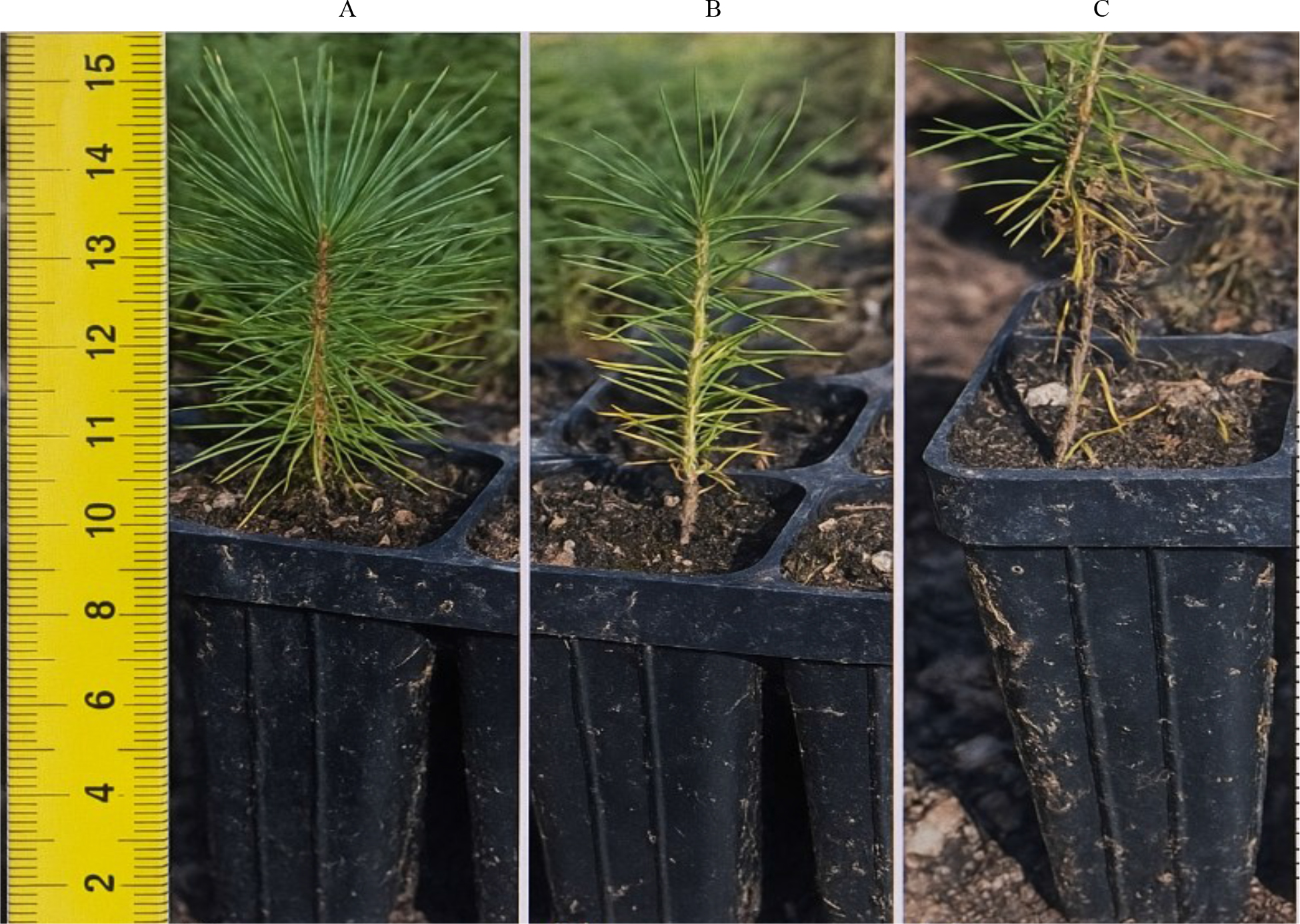
Figure 1.
General appearance of Scots pine seedlings in excellent (A), satisfactory (B) and unsatisfactory (C) condition in the experimental container culture
The assessment of seedling condition began after the complete germination of seeds and the emergence of a developed aboveground part of the seedling. Figure 2 shows the dynamics of Scots pine seedling condition depending on the modifications of substrate compositions tested in the experiment.
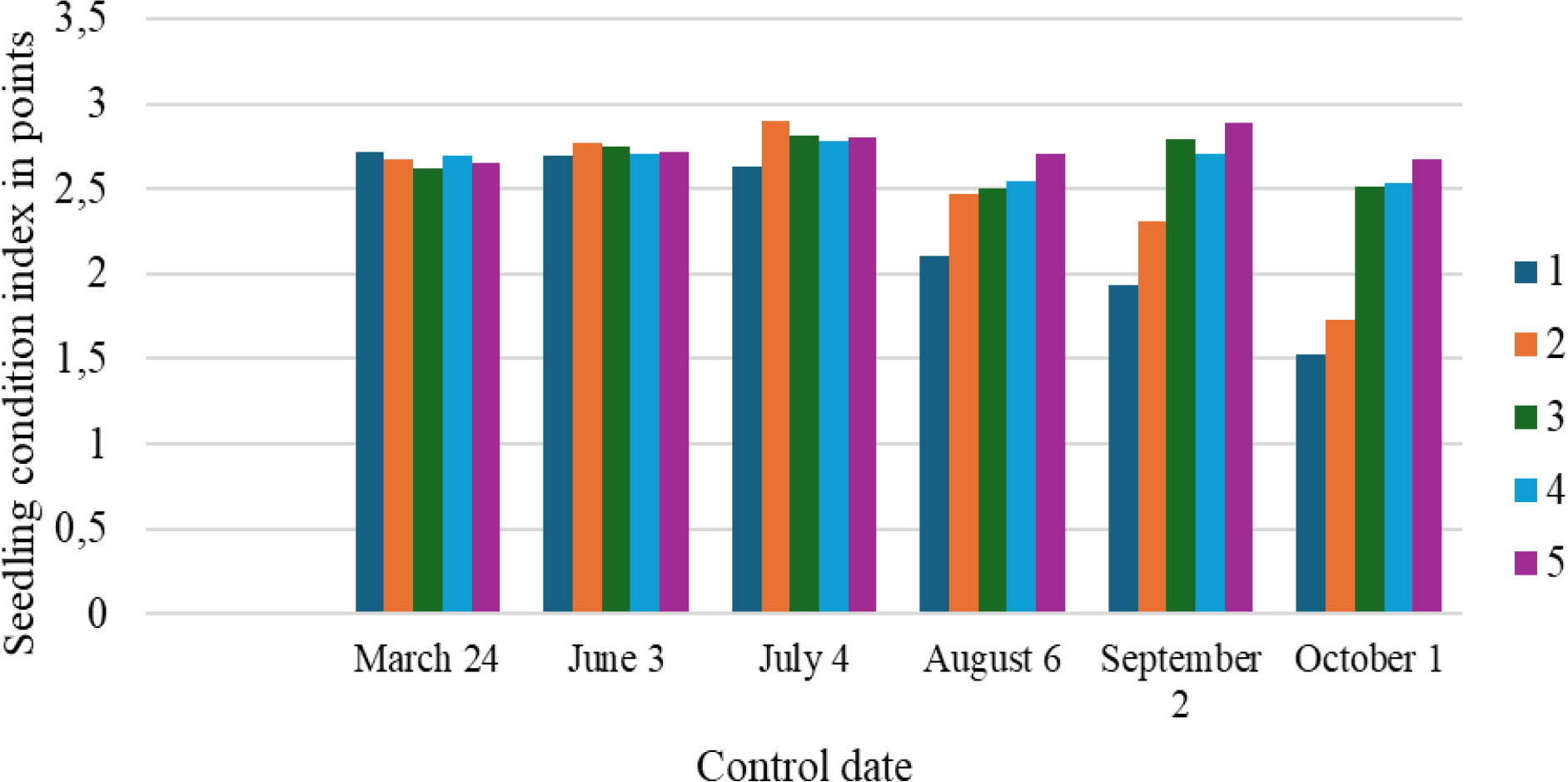
Figure 2.
Dynamics of Scots pine seedling condition depending on the tested substrate composition modifications as of 2024
The histogram shows that based on the results of the final assessment, the seedlings grown on the three-component substrates (variants 4 and 5) and on substrate variant 3 demonstrated the best condition. Among them, the seedlings that grew on the substrate modified with sawdust compost stood out in terms of overall health. During the autumn monitoring period, no significant seedling mortality was observed. Only during the last assessment, minor seedling loss occurred: one seedling each in substrates 1 and 3, and two seedlings each in substrates 2 and 4. No loss was recorded in substrate variant 5.
The inventory of seedlings conducted on March 24, 2024, revealed a deterioration in their general condition after the winter period, especially in substrate variants 1 and 2, with 7 and 6 seedlings lost, respectively. The morphological changes in the plants were caused by late autumn frosts and a prolonged period of low temperatures. During the winter season, the trays were covered with a mesh that, under heavy snow load, exerted mechanical pressure on the seedlings, restricting their growth and causing deformation, including leaning towards the substrate surface.
A favourable soil environment is a crucial factor affecting the growth and development of young plants. A key growth indicator for 1- to 2-year-old seedlings is their height, which was measured during the formation of the apical bud (Tab. 2).
Table 2.
Dynamics of the Average Height of Scots Pine Seedlings Depending on the Tested Substrate Composition Modifications in the Experiment
| Control date | Biometric indicators | Modifications of the tested substrate compositions | ||||
|---|---|---|---|---|---|---|
| Bark:peat 2:1 (1) | Bark:peat 1:1 (2) | Bark:peat 1:2 (3) | Bark:peat:forest soil 1:1:1 (4) | Bark:peat:sawdust compost 1:1:1 (5) | ||
| March 24 | H | 4.3±0.9/5.1±1.0 | 4.4±1.0/5.4±1.1 | 4.6±1.0/5.5±1.1 | 3.8±0.8/4.7±0.9 | 4.2±0.9/5.4±1.1 |
| σ | 0.7±0.08/0.8±0.08 | 0.8±0.10/1.0±0.12 | 0.8±0.10/0.9±0.10 | 0.8±0.10/0.9±0.10 | 1.3±0.20/1.6±0.22 | |
| September 2 | H | 4.1±0.7/4.9±0.9 | 3.7±0.7/4.5±0.8 | 4.4±0.7/5.2±0.8 | 3.6±0.8/4.5±0.9 | 3.6±1.3/5.2±1.6 |
| σ | 0.7±0.05/0.8±0.05 | 0.70.05/0.80.05 | 0.70.05/0.80.05 | 0.80.05/0.9±0.05 | 1.3±0.15/1.6±0.15 | |
| October 1 | H | 4.3±0.8/5.1±0.8 | 4.4±1.0/5.4±0.9 | 4.6±0.9/5.5±0.9 | 3.8±0.9/4.7±0.7 | 4.2±1.2/5.4±0.9 |
| σ | 0.7±0.05/0.8±0.15 | 0.8±0.05/1.0±0.12 | 0.8±0.05/0.9±0.12 | 0.8±0.05/0.9±0.12 | 1.3±0.15/1.6±0.25 | |
According to the classification by Pimentel-Gomes (2009), the coefficient of variation (CV) was determined for all five tested substrate compositions (Tab. 3).
Table 3.
Determination of the Variation Index of Seedling Height
| Modification | CV by years, % | |||
|---|---|---|---|---|
| 2023 | Accuracy | 2024 | Accuracy | |
| Modification 1 (bark:peat 2:1) | 17.07 | Good | 18.37 | Good |
| Modification 2 (bark:peat 1:1) | 18.92 | Good | 17.78 | Good |
| Modification 3 (bark:peat 1:2) | 15.91 | Good | 15.38 | Good |
| Modification 4 (bark:peat:forest soil 1:1:1) | 22.22 | Medium | 20.00 | Transition zone between good and moderate |
| Modification 5 (bark:peat:sawdust compost 1:1:1) | 36.11 | Low | 30.77 | Low |
Thus, in 2023, the accuracy ranged from good (16%) to low (36%), while in 2024, the accuracy was slightly better – the maximum CV was lower (31%), but overall, it still ranged from moderate to low.
The optimal temperature for the growth of coniferous tree seedlings in greenhouses is +25°C (Maurer et al. 2019a), which ensures maximum photosynthetic activity. At temperatures below +15°C and above +30°C, seedling growth slows down, while at +40 to +45°C, seedlings die.
The research was conducted during different stages of the peak growth period of Scots pine during the first year of cultivation:
– seedling formation period (needle emergence);
– period of accelerated needle growth (stem elongation and rapid formation of new needles);
– period of slowed needle growth (formation of the terminal bud).
Measurements were taken three times throughout the study period: the first – in the fourth month after the experiment began, when the aerial part of the seedling was fully developed and the terminal bud had appeared; the second – before the onset of autumn frosts; and the third – during the spring inventory.
Showed that at the initial assessment stage, the best height growth was observed in substrate variant 3, which had the highest peat content, and in variant 5, which contained sawdust compost. During the second assessment, a positive growth dynamic was recorded in variants 2, 3 and 5. Both assessments revealed slightly lower height growth rates in seedlings grown on substrates 1 and 4. At the same time, the greatest variation in seedling height was observed in substrate 5. The spring inventory indicated no significant changes in height, which is attributed to the seedlings being in a state of physiological dormancy.
Pinus sylvestris (Scots pine) demonstrates high adaptability to varying environmental conditions by developing either deep or shallow root systems. Understanding the structure and development of the root system is crucial for improving the effectiveness of silvicultural, hydrotechnical and agrotechnological practices in seedling production.
The final stage of the study on container-grown seed lings with closed-root systems involved assessing root system development depending on substrate modification. Under container cultivation with sufficient water availability, pine seedlings develop a less pronounced taproot system but significantly increase vertical branches from horizontal roots, allowing for more efficient substrate utilization throughout the container depth.
For comparative analysis, seedlings of average height were selected to examine and evaluate root systems across each substrate variant (Fig. 3). Measurements of average root length were conducted on May 14, when the average daily temperature exceeded 5°C – the threshold at which root systems begin active development.
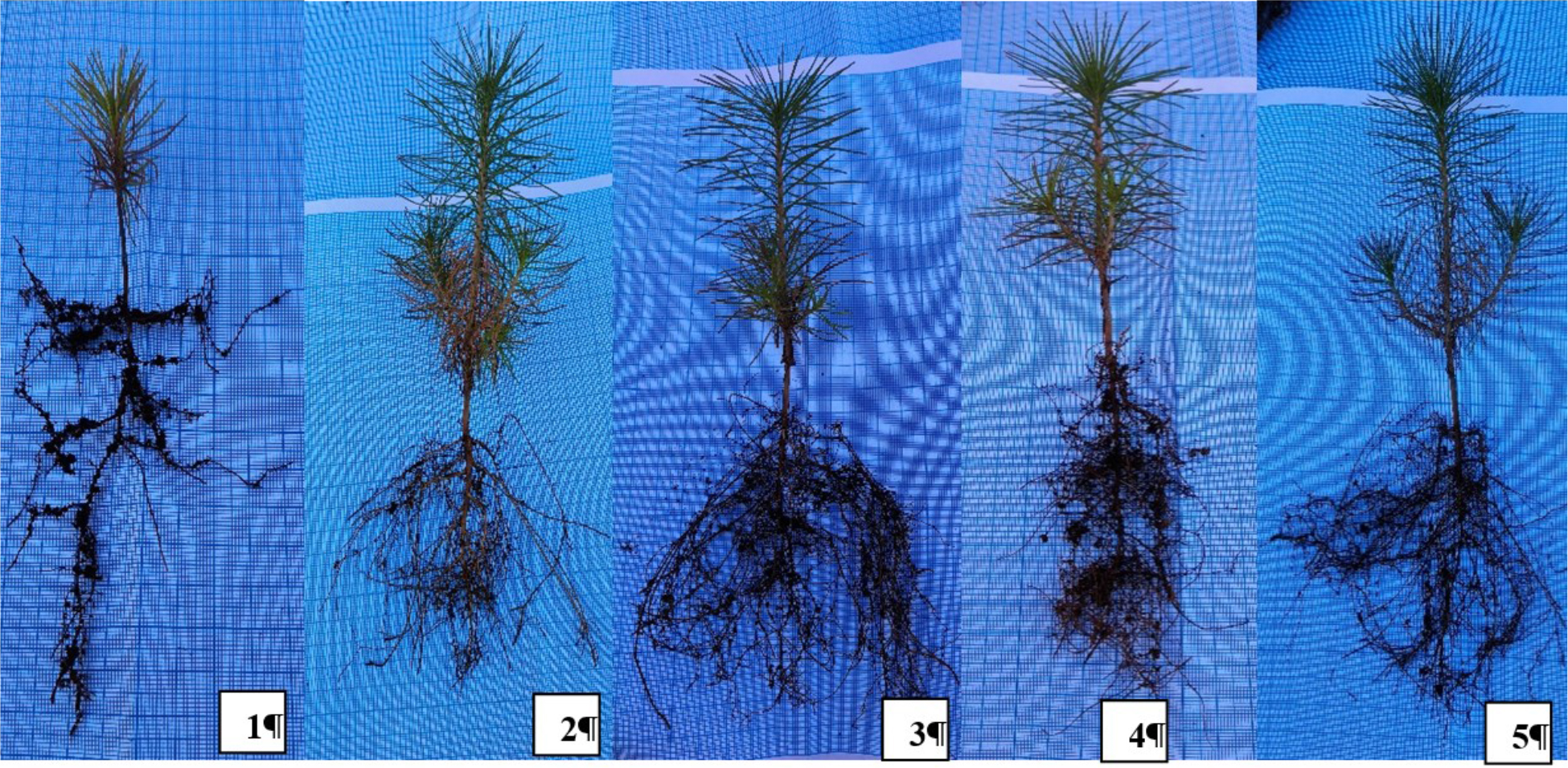
Figure 3.
Condition of the root system of container-grown Scots pine (Pinus sylvestris L.) seedlings in BCC containers
The study revealed that seedlings demonstrated positive results in substrates composed of bark and peat in a 1:2 ratio (variant 3), as well as bark–peat–peat compost in a 1:1:1 ratio (variant 5). Other substrate variants exhibited significantly lower performance. Figure 3 presents the average root length of the studied seedlings depending on the substrate composition.
Among the two-component substrates, the variant with a higher proportion of peat (variant 3) demonstrated improved root system development. In the case of three-component mixtures, the combination of bark, peat and sawdust compost (variant 5) provided optimal root length and overall development. In contrast, the inclusion of forest soil (variant 4) in the substrate led to compaction, which negatively affected aeration and thus root growth.
Seed germination energy is an indicator of seed viability and physiological potential. In the studied samples, this parameter demonstrated a high level, reaching 58 (56)x0025; (Tab. 4). It was found that pre-sowing treatment of Scots pine seeds with growth regulators positively influenced seed quality traits. Among the tested treatments, Epin Extra and Stimpo significantly improved germination energy, with the most pronounced effect observed from Stimpo, which increased germination energy by 38 (32)% compared to the control.
Table 4.
Effect of pre-sowing treatment with plant growth regulators on the seed quality of Scots pine (Pinus sylvestris L.)
| Treatment | Germination energy | Germination capacity | ||
|---|---|---|---|---|
| % | % relative to control | % | % relative to control | |
| Stimpo | 80/78 | 138/132 | 86/84 | 113/109 |
| Epin Extra | 64/62 | 110/106 | 80/78 | 105/101 |
| Humat Ultra | 44/40 | 76/75 | 60/58 | 79/73 |
| Megafol | 54/52 | 93/91 | 70/68 | 92/93 |
| Control | 58/56 | – | 76/74 | – |
According to the obtained data, the pre-sowing treatment of Scots pine seeds with various plant growth regulators (PGRs) exhibited differentiated effects on germination energy and seed viability.
The best results were observed with the treatments using Stimpo and Epin Extra. Application of Stimpo resulted in a germination energy of 80% in 2024 and 78% in 2023, exceeding the control by 38% and 32%, respectively. Seed germination in this variant was also the highest – 86% in 2024 and 84% in 2023 – surpassing the control by 13% and 9%.
Treatment with Epin Extra increased germination energy to 64% (2024) and 62% (2023), corresponding to 110% and 106% relative to the control. Seed germination in this group reached 80% in 2024 and 78% in 2023, 5% and 1% higher than the control, respectively.
Lower performance was recorded for Megafol and Humate Ultra. Megafol resulted in germination energy of 54% in 2024 and 52% in 2023 (93% and 91% of the control), while seed germination was 70% (2024) and 68% (2023), only 8% and 6% higher than the control.
The poorest results were associated with Humate Ultra, indicating its inhibitory effect. Germination energy dropped to 44% (2024) and 40% (2023), 24% and 25% lower than the control, while germination percentages declined to 60% and 58%, which is 21% and 27% lower, respectively.
Analysis of the effects of PGRs suggests that Epin Extra and Stimpo exerted positive effects on seed germination by stimulating key biochemical processes and enhancing plant immune responses, particularly via the activation of cell division. Conversely, Megafol and Humate Ultra, both containing substantial amounts of potassium, appeared to suppress germination, supporting the hypothesis that potassium is more effectively absorbed during the soil-feeding stage rather than during seed priming.
The tested PGRs also significantly influenced seedling growth performance (Tab. 5). Average seedling height across treatment groups ranged from 9.9 to 13.9 cm, while the control group averaged 8.4 cm. Three experimental variants demonstrated statistically significant height increases over the control.
Table 5.
Results of the study on height and root length of Scots pine (Pinus sylvestris L.) Seedlings Treated with Plant Growth Regulators
| Treatment | Height, cm | Root length, cm | ||||
|---|---|---|---|---|---|---|
| M | m | t | M | m | t | |
| Stimpo | 10.5/10.7 | 0.23/0.33 | 5.0/5.2 | 28.0/27.5 | 0.24/0.31 | 7.0/6.7 |
| Epin Extra | 11.5/11.0 | 0.32/0.34 | 7.0/6.5* | 21.5/21.8 | 0.33/0.44 | -1.5/-1.8 |
| Humat Ultra | 14.0/13.2 | 0.51/0.42 | 12.5/12.0** | 29.0/28.3 | 0.41/0.53 | 8.2/8.0* |
| Megafol | 16.0/14.5 | 0.45/0.43 | 15.0/14.2** | 32.0/31.0 | 0.51/0.55 | 11.5/11.0** |
| Control | 9.0/8.8 | 0.34/0.25 | – | 23.0/23.5 | 0.37/0.36 | – |
The use of Megafol had a significant effect on the growth of Scots pine (Pinus sylvestris L.) seedlings. In this treatment, the seedling height reached 16.0 cm (14.5 cm), which significantly exceeded the control at the 1% level of significance. The seedlings treated with Megafol developed a well-formed and advanced root system. Root length was measured using a water scanning method with an EPSON Perfection V700 Photo Scanner.
The average length of the taproot in the experiment was 32.0 cm (31.0 cm), while in the control group, it was only 23.0 cm (23.5 cm).
In all experimental variants involving the use of plant growth regulators, the average diameter of the root collar of Scots pine seedlings ranged from 1.1 to 2.3 mm and significantly exceeded the control value of 1.2 mm (Tab. 6). The best results were recorded in seedlings treated with Megafol.
Table 6.
Biometric Parameters of Pinus sylvestris Seedlings Under the Application of Plant Growth Regulators
| Treatment | Diameter of the root collar, mm | Number of lateral shoots, pcs. | ||||
|---|---|---|---|---|---|---|
| M | m | t | M | m | t | |
| Stimpo | 2.0/2.1 | 0.05/0.06 | 14.0/13.8** | 1.7/1.8 | 0.14/10.13 | 0/0.2 |
| Epin Extra | 1.6/1.7 | 0.07/0.05 | 9.0/8.5* | 1.5/1.6 | 0.12/0.14 | -0.80/-0.70 |
| Humat Ultra | 1.9/1.9 | 0.06/0.04 | 13.5/14.0** | 1.3/1.4 | 0.17/0.15 | -1.50/-1.40 |
| Megafol | 2.2/2.3 | 0.08/0.06 | 16.0/15.3** | 1.9/1.9 | 0.19/0.18 | 0.75/0.70 |
| Control | 1.1/1.2 | 0.03/0.02 | – | 1.4/1.5 | 0.25/0.22 | – |
In all experimental treatments using plant growth regulators (PGRs), the average root collar diameter of Scots pine seedlings ranged from 1.5 to 2.3 mm, which significantly exceeded the control values (1.1 mm in 2023 and 1.2 mm in 2024).
The highest root collar diameters were recorded in the Megafol variant (2.2 mm in 2023 and 2.3 mm in 2024), which significantly differed from the control at the 1% level of significance. Slightly lower, yet also high results were obtained with the use of Stimpo (2.0 mm in 2023 and 2.1 mm in 2024) and Humate Ultra (1.9 mm in both 2023 and 2024), all of which showed statistically significant differences from the control (p < 0.01).
Seedlings treated with Epin Extra showed comparatively lower values (1.6 mm in 2023 and 1.7 mm in 2024), but they still significantly exceeded the control (p < 0.05).
In all experimental treatments using plant growth regulators (PGRs), the average root collar diameter of Scots pine seedlings ranged from 1.5 to 2.3 mm, which significantly exceeded the control values (1.1 mm in 2023 and 1.2 mm in 2024).
The highest root collar diameters were recorded in the Megafol variant (2.2 mm in 2023 and 2.3 mm in 2024), which significantly differed from the control at the 1% level of significance. Slightly lower, yet also high results were obtained with the use of Stimpo (2.0 mm in 2023 and 2.1 mm in 2024) and Humate Ultra (1.9 mm in both 2023 and 2024), all of which showed statistically significant differences from the control (p < 0.01).
Seedlings treated with Epin Extra showed comparatively lower values (1.6 mm in 2023 and 1.7 mm in 2024), but they still significantly exceeded the control (p < 0.05).
The number of lateral shoots in seedlings also varied depending on the treatment used. The best results were obtained with Megafol, where the number of lateral shoots reached 1.9 in both 2023 and 2024. Slightly lower figures were recorded with Stimpo (1.7 in 2023 and 1.8 in 2024).
In the Epin Extra and Humate Ultra variants, the number of lateral shoots ranged from 1.3 to 1.6, showing no statistically significant differences compared to the control (1.4 in 2023 and 1.5 in 2024).
Thus, the best biometric indicators were observed in seedlings grown with Megafol and Stimpo, confirming their effectiveness in stimulating plant growth and development.
Alongside the evaluation of biometric characteristics, the number of lateral shoots was also recorded. This parameter is important because an increased number of shoots enhances the photosynthetic mass, positively affecting the overall condition of the seedlings. However, based on the research data, statistically significant differences in this parameter between treatments were not detected.
Assessment of seedling growth indicators alone is insufficient to fully determine their quality, as plant viability largely depends on the development of the assimilation apparatus and the root system. Therefore, importantevaluation criteria include not only height and root collar diameter but also the biomass of the aboveground and root systems, which characterize the potential for future growth and adaptive capacity of the seedlings (Tab. 7).
Table 7.
Biomass of P. sylvestris Seedlings under the Use of Plant Growth Regulators
| Treatment | Aboveground biomass, g | Root biomass, g | |||||||
|---|---|---|---|---|---|---|---|---|---|
| M | m | t | Including needles | ||||||
| M | m | t | M | m | t | ||||
| Stimpo | 1.7/1.5 | 0.13/0.12 | 4.20/3.92 | 1.2/1.0 | 0.07/0.08 | 4.20/3.00 | 0.7/0.6 | 0.05/0.04 | 4.00/3.75 |
| Epin Extra | 1.8/1.6 | 0.10/0.11 | 5.00/4.56* | 1.1/1.0 | 0.08/0.08 | 5.00/3.44 | 0.8/0.6 | 0.04/0.04 | 4.00/3.75 |
| Humat Ultra | 1.5/1.6 | 0.18/0.19 | 3.00/2.80 | 0.8/0.9 | 0.06/0.07 | 3.00/2.75 | 0.6/0.5 | 0.06/0.04 | 3.50/3.00 |
| Megafol | 2.5/2.4 | 0.17/0.18 | 7.50/7.42* | 1.5/1.4 | 0.07/0.11 | 7.50/5.75* | 0.9/0.7 | 0.07/0.06 | 5.00/5.33* |
| Control | 1.2/1.0 | 0.07/0.06 | – | 0.6/0.7 | 0.03/0.04 | – | 0.5/0.4 | 0.03/0.02 | – |
The average aboveground biomass of a single seedling ranged from 1.5 g (Stimpo variant in 2024) to 2.4 g (Megafol variant in 2024), while in the control, this value was 1.0 g in both years. Two experimental variants – Megafol and Epin Extra – significantly exceeded the control in this parameter.
In terms of needle mass share within the aboveground biomass, seedlings treated with Megafol also significantly outperformed the control.
The average root mass ranged from 0.5 to 0.7 g in the variants with growth regulators, compared to 0.4 g in the control. The maximum increase in root biomass was recorded in the Megafol treatment in 2024.
Another important quality indicator for seedlings is the air-dry mass, which is presented in Table 8.
Table 8.
Air-dry mass of P. sylvestris seedlings under the use of plant growth regulators
| Treatment | Aboveground biomass, g | Root biomass | Root-to-shoot ratio | ||||
|---|---|---|---|---|---|---|---|
| g | Relative to control, % | Including needles | g | Relative to control, % | |||
| g | Relative to control, % | ||||||
| Stimpo | 48.6/48.1 | 160/159 | 33.7/30.8 | 157/142 | 19.6/18.8 | 172/165 | 0.4/0.7 |
| Epin Extra | 50.0/48.6 | 165/160 | 34.0/33.7 | 159/155 | 18.6/19.6 | 163/172 | 0.4/0.6 |
| Humat Ultra | 48.1/50.0 | 159/165 | 30.8/34.0 | 144/157 | 18.8/18.6 | 165/163 | 0.4/0.5 |
| Megafol | 76.4/76.4 | 252/254 | 47.3/47.5 | 220/219 | 26.0/27.0 | 228/229 | 0.3/0.8 |
| Control | 30.3/30.3 | –/– | 21.5/21.7 | –/– | 11.4/11.5 | –/– | 0.4/0.5 |
The air-dry mass of the aboveground part of one-year-old seedlings varied depending on the experimental treatment and significantly exceeded the control. The maximum value was recorded with the use of Megafol – 76.4 g, while the minimum was observed in the control – 30.3 g.
The proportion of needles in the aboveground biomass ranged from 21.5 to 47.5 g across different treatments. In this parameter, all plants treated with growth regulators outperformed the control. The highest values were observed in the Megafol treatment.
The root system mass of seedlings in the experimental treatments ranged from 18.6 g (Epin Extra in 2023) to 27.0 g (Megafol in 2024), while the control values were 11.4 g (2023) and 11.5 g (2024), respectively.
In the experiment involving the use of growth regulators, seeds were sown in a standard substrate based on high-moor peat with added bark, which provided optimal water and air conditions for germination. Pre-sowing treatment with growth regulators (Stimpo, Epin Extra, Megafol, Humate Ultra) had varying effects on germination rates and seedling growth. Stimpo provided the highest germination energy and germination rate, while the best biometric indicators (height, root collar diameter, biomass) were recorded with the use of Megafol. The results obtained indicate the advisability of using Stimpo to improve seed germination quality and Megafol to stimulate the growth and development of seedlings.
Discussion
Root system development is one of the most critical factors determining the success of container-grown plants. A properly selected substrate ensures high-quality planting material with a well-developed root system and vigorous aboveground plant parts. Substrate formulations typically consist of a mixture of components that complement each other, enhancing the physical and chemical properties of the final substrate mixture. Growing seedlings in trays presents a number of specific challenges that must be considered when selecting substrate components:
– Limited volume: Plants grown in containers have access to a significantly smaller volume of growing medium compared to those grown under natural conditions.
– Perched water table: Containers create a perched water table near the bottom due to the inability of water to drain freely, resulting in water retention caused by capillary forces.
– Instability of soil microflora: The high nutrient content and sustained humidity levels promote rapid seedling growth but also favour the proliferation of pathogenic microorganisms.
– Lack of soil structure formation: Natural processes responsible for soil structuring cannot occur in container environments (Yashchuk and Shlonchak 2019).
The structural properties of the substrate must be carefully selected, and its components must be thoroughly mixed to create a properly porous mixture that remains stable throughout the entire cultivation cycle.
Based on long-term experience and economic considerations, we selected the following substrate components: raised peat, pine bark, forest soil, sawdust compost, agroperlite and forest litter.
Raised peat forms through the decomposition of sphagnum moss, pine or cotton grass under high-moisture conditions. Compared to other substrates, raised peat is relatively resistant to microbial decomposition and silting, making it suitable for long-term use. Its low nutrient content and high acidity allow for the adjustment of plant nutrition levels according to species-specific needs by incorporating liming agents and mineral fertilizers. Thanks to its buffering capacity and high absorbency, mineral nutrients are not easily leached and remain available to plants, reducing the risk of harmful salt accumulation (Maurer et al. 2019a). The organic matter in peat produces carbon dioxide during decomposition, which is essential for plant growth. Unlike many other substrates, peat contains humic substances – humic and fulvic acids – that stimulate plant growth and development while increasing resilience to environmental stresses such as drought, insufficient or excessive light, and temperature fluctuations (Zavistanovicz et al. 2025). Thus, the use of peat as a greenhouse substrate mitigates the negative effects of adverse environmental conditions.
Pine bark is another cost-effective substrate component widely used in the cultivation of trees and shrubs. However, the use of bark in substrate mixtures comes with specific considerations. To be suitable for use as a substrate, the bark must be finely shredded. Unlike fertile soils rich in mineral nutrients, bark contains very low levels of mineral nutrients. Consequently, it is crucial to supplement bark-based substrates with compound fertilizers or combine them with more nutrient-rich components (Gordìênko et al. 1995).
Forest soil contains a wide range of essential nutrients necessary for growing Scots pine seedlings in containers. Due to the natural presence of mycorrhizal fungi in forest soil, young plants benefit from improved adaptation and survival when transplanted into reforested areas (Tinus and McDonald 1979).
Mineral nutrition is a key factor in the successful cultivation of forest seedlings, particularly in closed-root systems where peat-based substrates are inherently nutrient-poor and require fertilization (Nosenko 2019). Plant nutrition depends on macro- and micronutrients, the balance of which determines growth intensity and physiological condition. The cultivation technology of container-grown seedlings includes sequential stages: substrate preparation, sowing, care and protection, aimed at producing high-quality planting material with improved biometric characteristics and survival rates.
The root system of Scots pine is highly plastic (Nosenko 2019), which enables the species to adapt to diverse natural conditions by forming both deep taproots and extensive lateral roots (Yashchuk and Shlonchak 2019).
Absorptive roots form on both long horizontal and vertical roots, but the majority are located on fine (< 1 mm) conductive roots. Most fine absorptive roots are concentrated in the upper soil layers, while primary roots may penetrate to considerable depths. Fine roots (< 3 mm) enhance the efficiency of soil volume utilization and define the plant’s nutrient absorption zone. The majority of fine roots are located in the upper 20 cm of the soil layer (Nosenko 2021).
The increasing use of plant growth regulators (PGRs) is driven by their ability to mitigate the adverse effects of environmental stressors on plants and accelerate the formation of generative organs and root systems (Vêšic'kij et al. 2006). Under the influence of PGRs, essential physiological transformations occur, including the activation of sugar and protein compound hydrolysis and an increase in photosynthetic intensity. Substances with growth regulating properties are widely used in forestry, particularly through seed treatment (Maciel et al. 2021). In forest nursery practice, the use of PGRs is largely motivated by the need to increase the yield of high-quality planting material. The declining fertility of soils, often resulting from long-term anthropogenic impacts – especially excessive herbicide use – presents significant challenges for seedling cultivation. Additionally, the soil biocenosis is highly sensitive to high concentrations of chemical agents, which can negatively affect its ecological balance (Tudi et al. 2021).
A distinct feature of the container-based seedling cultivation method is the diversity of materials with varying structures and properties. One of the main challenges in producing container-grown planting stock lies in selecting containers that meet both technological and economic requirements (Nosenko 2019, 2021).
The relevance of optimizing the composition of the substrate for container-grown seedlings with a closed-root system is determined not only by the species-specific features of the cultivated species but also by the diverse soil and climatic conditions of natural zones. The use of seedlings grown in substrates that are not adapted to zonal soil conditions may lead to the phenomenon of chemotropism.
The cultivation of seedlings with a closed-root system in optimized substrate compositions improves the quality of planting material and contributes to lowering the production cost of container-grown plants by utilizing cheaper local components, thereby increasing production profitability (Vysotska et al. 2022).
The effectiveness of using plant growth regulators (PGRs) during the cultivation of Pinus sylvestris L. planting material is confirmed by research results reported in the works of Yashchuk and Shlonchak (2019) and Grečanik et al. (2014). These studies demonstrated that the use of PGRs yields significant effects at all stages of plant cultivation. However, depending on the active substance and dosage, growth stimulators may exert both positive and negative (including mutagenic) effects (Maurer et al. 2019b). Therefore, studying the influence of different groups of plant growth regulators and their application methods on the growth characteristics of Scots pine planting stock is highly relevant.
Research by Savuschyk et al. (2020) on the impact of plant growth regulators on seed quality and seedling growth parameters of Pinus sylvestris L. confirms the effectiveness of various PGRs. The researchers used the same growth stimulators as in our study: Epin Extra, Humate Ultra, Megafol and Stimpo. Their results indicated that Stimpo demonstrated the highest stimulatory effect on seed germination of Pinus sylvestris. Supplementing seedlings with growth regulators promoted increases in biometric and weight parameters. The most significant improvements in seedling height, root collar diameter, root length and average seedling mass over the control were recorded with the use of Megafol. Thus, it is advisable to use Stimpo for seed pre-treatment and the biostimulator Megafol during seedling cultivation. Notably, these growth stimulators also showed the best results in our study, suggesting that they are particularly suitable for container-grown Scots pine seedlings when these substances are applied.
Bazan and Oleksìjčenko (2013) analysed the effect of biostimulators on the sowing qualities of Pinus sylvestris L. seeds. Their experiment included the use of Epin Extra, Humate Ultra, Megafol and Stimpo for pre-sowing seed treatment and seedling feeding. The results revealed a significant impact of biostimulators on seed germination and seedling development, with Stimpo showing the highest stimulatory efficiency, which correlates with our findings. This supports the assumption that Stimpo and Megafol are the most effective growth regulators for Pinus sylvestris seed treatment prior to sowing under the conditions of the northern Forest-Steppe zone of Ukraine. The researchers concluded that the use of biostimulators is beneficial for improving seed quality and growth characteristics of Scots pine seedlings.
A study on the effects of plant growth regulators on Scots pine (Pinus sylvestris) seedlings showed that Stimpo provided the most significant improvement in seed quality, increasing germination energy by 38% and germination rate by 13%. Epin Extra showed a weaker positive effect, while Humate Ultra and Megafol demonstrated an inhibitory effect on germination.
Regarding seedling growth parameters, Megafol produced the best results: seedling height increased to 16 cm (compared to 9 cm in the control), the root collar diameter doubled and root length increased by 39%. Seedling mass also significantly increased under Megafol treatment – airdry mass rose by 152%, needle mass by 120% and root mass by 135%. Thus, Megafol proved to be the most effective for promoting seedling growth, while Stimpo was best for enhancing seed germination. Megafol provided the highest improvements across all biometric parameters, increasing them 1.5 to 2.5 times compared to the control.
Popov (2008), in the southern conditions of the Left Bank Forest-Steppe, studied ways to intensify the cultivation of Scots pine planting stock, focusing on increasing efficiency and quality through new cultivation methods and innovative technologies. His approach included optimizing irrigation and fertilization regimes, applying growth regulators to stimulate root development and using improved substrates and hardening methods for seedlings. According to his data, these practices resulted in a 15–20% increase in seed germination, a 25–30% increase in average seedling height and a 35% increase in root system mass. These innovative technologies not only accelerated growth but also improved morphological characteristics, enhancing survival and resilience during reforestation.
Savuŝik et al. (2009) focused on modern technologies for growing forest seeds and planting stock, particularly for Scots pine. He introduced improved seed collection and sorting methods, which increased seed germination by 12– 15%. For seed treatment, he used pre-sowing stimulation with growth regulators, which improved germination energy by 10–18%. His research employed optimized substrates with improved air and moisture regimes and applied growth stimulators, especially humates, which increased seedling height by 20–25% and root system mass by 30%. These measures enhanced the quality of Scots pine planting material, improving field survival and seedling vigour.
Nawrot-Chorabik et al. (2021) emphasize the importance of various methods to overcome dormancy and stimulate germination of pelleted Scots pine seeds (P. sylvestris L.) using stratification, scarification and phytohormones. Guerin-Laguette, Plassard and Mousain (2000) studied in vitro conditions for mycelium growth and found that mycorrhization of pine occurred best in low-nutrient media without exogenous glucose. Under sterile conditions, inoculation was stimulated by 10 g/L of glucose, but high phosphorus levels negatively affected seedling growth. In container conditions, pine roots were intensively colonized by Lactarius deliciosus, and one year after inoculation, primordia of fruiting bodies appeared, followed by two mature basidiomata six months later – the first such occurrence without using soil.
It is worth noting that the study by Myers (2025) serves as a practical guide for the cultivation and care of Scots pine. It includes detailed recommendations on optimal sowing timing and depth, watering regimes according to growth phases and appropriate soil conditions – with preference given to light, well-drained loams.
Barnett and McGilvray (2000) conducted a study on growing pine seedlings in container culture, providing a detailed analysis of various container types – from plastic trays to deep pots – ensuring optimal root development. They also examined the effects of different soil mixtures, including sand, peat and perlite, on seedling growth and quality, as well as the effectiveness of cultural practices such as regular irrigation, fertilization and ventilation.
Conclusions
Effective cultivation of Pinus sylvestris L. planting material largely depends on seed quality and the optimal substrate composition, which provides favourable conditions for germination and seedling development.
The first seedlings emerged 15 days after sowing in all experimental variants. The highest germination rates were observed in the two-component substrate dominated by peat (1:2) and the three-component substrate containing sawdust compost (1:1:1). Seedlings grown in peatcontaining substrates demonstrated faster development of the aboveground parts and better morphological quality compared to other variants. The use of sawdust compost had a positive effect on the overall vitality of the seedlings.
Under conditions of late sowing (May 2024) and elevated temperatures, a lower germination energy was recorded. Winter maintenance in trays was associated with the negative impact of snow cover on seedling morphology, leading to partial losses in certain substrate variants.
The composition of the substrate and its components significantly influence the effectiveness of growing seedlings with a closed-root system. Prior to large-scale production of planting material with a closed-root system, it is advisable to conduct research to select the most suitable substrate composition for the specific tree species, taking into account its particular biological characteristics.
The lowest germination rates were observed in seedlings grown in modified three-component substrates 4 and 5. Two-component substrates showed better soil germination and germination energy, which is attributed to the internal energy of the pine seeds, embryo viability, sufficient nutrient reserves in the endosperm, as well as optimal substrate temperature and moisture for germination. Further growth depends on substrate moisture and nutrient content. With an increasing proportion of peat in the substrate, germination, seedling condition and height growth improved significantly. Among the three-component substrates, substrate 5 with sawdust compost yielded better growth and condition, whereas substrate 4 (bark:peat:forest soil 1:1:1) showed significantly poorer results, indicating that forest soil had no positive effect on plant growth.
Spring inventory revealed that the condition of seedlings on two-component substrates had deteriorated significantly, while seedlings on three-component substrates overwintered well. Germination energy and soil germination of Scots pine seeds were greatly influenced by the substrate composition. The highest germination was recorded in the variant dominated by peat (bark:peat 1:2), where by July 6, 2024, 62 out of 65 seeds had germinated, representing 95.4% of the sown seeds. For comparison, other variants showed lower germination rates, ranging from 66.1% to 93.2%. Considering the laboratory germination rate of 86%, actual germination energy in field conditions was reduced, indicating that the substrate is one of the key determining factors.
Substrates with sawdust compost and a higher proportion of peat produced excellent results in terms of root length and growth. Thus, the optimal substrate compositions for growing Scots pine seedlings with a closed-root system are substrate 3 (bark:peat 1:2) and substrate 5 (bark:peat:sawdust compost 1:1:1), which provide better plant biometric parameters.
Soaking seeds in growth regulator solutions had a positive effect on germination energy, seed germination, seedling emergence and quality. Stimpo significantly stimulated germination energy and seed germination by 138% (132%) and 113% (109%) compared to the control, respectively. The most notable positive impact on seedling biometric indicators was recorded with the use of Megafol.
For cultivating Pinus sylvestris planting stock under conditions close to natural, the use of mycorrhizal fungi Lactarius deliciosus and L. sanguifluus is advisable. These fungi can significantly improve seedling growth and development by providing essential nutrients and increasing resilience to stress factors – a crucial aspect for forest regeneration in the context of climate change and the degradation of pine stands.