
Introduction
Fire is a fundamental management tool used by humans to expand the necessary habitat (for agriculture, grazing, beekeeping, etc.) and continues to be one of the main causes of changes in natural fire cycles. In addition to its negative impact on the natural environment, properly used fire can also bring benefits. In many countries (e.g. USA, Canada, South Africa, Australia, Spain, Portugal, France, Germany, Sweden), controlled burning is used for both forest management and active conservation, especially in fire-tolerant ecosystems (Fernandes et al. 2013; Schmithals and Kuhn 2014), which include heathlands.
The use of fire is one of the main causes of changes in natural fire cycles. Controlled burning has been used in forest management and conservation in many countries since the 1960s, and it is an essential element of integrated forest fire management systems. Its main benefits are as follows: burning is often an indispensable factor in shaping the ecosystems that depend on it, ensuring their health and sustainability; it is a component of the ecosystem cycle (some of which even depend on fire) that creates suitable conditions for certain species to thrive; it is a landscape shaping tool; it is an effective and cost-effective prevention method that reduces the amount of flammable biomass and limits the possibility of dangerous, uncontrolled large fires and it is a method for extinguishing forest fires.
Large complexes of lowland heaths in central and southern Poland are of anthropogenic origin and mostly the result of military activities (old military training areas). The succession of vegetation here was restricted using heavy equipment (mechanical destruction) as well as by shelling and fires set during exercises. Once this effect ceased, the factor inhibiting succession disappeared and the heathland ecosystems began to decline. Overgrown and old heathlands began to die back, retaining and accumulating biomass that enriched the substrate. As a result of the secondary succession of woody plants, open areas are transformed into forests or other grassland communities characterised by a lower ecological value are created.
Heathlands harbour numerous plant and animal species, and therefore play an important role in preserving local biodiversity. They are protected in the European Union, including as dry heathlands (code 4030) in the Natura 2000 network (Kujawa and Pawlaczyk 2004). The species richness of dry heathlands is primarily determined by spore-bearing organisms and invertebrates, for which the presence of a habitat mosaic with patches of exposed soil is crucial, while the density of the heathland leads to a decline in the number of organisms living there (Vagts et al. 1995; Bargmann 2015). The fact that detailed studies of invertebrates in these ecosystems have provided data on species that are new to Poland (Kupryjanowicz 2010) shows how little known, yet important, dry heathlands are. They are also home to the black grouse, which is threatened with extinction both nationally and in the European Union.
To preserve the dry heathland ecosystems, it was decided to place them under active protection. Traditionally, heathlands in Europe have been grazed or mown and occasionally burnt (Webb 1998). Experiments have shown that grazing with animals that move outside the heathland at night is a very effective method (Marrs 1993), but this method is costly and difficult to implement on heathlands within large forest complexes. Mowing carried out in many countries has proved insufficient to maintain the ecosystem. A far more effective method is to remove the topsoil of the heathland, which allows the seed bank to regrow and the mosaic structure to be rebuilt. However, this method is also costly. The need for specialised equipment and removal and management of the harvested material increases costs (Britton et al. 2008). Currently, heathland burning is proposed for various reasons, but it is a rarely used method that leads to the regeneration and conservation of heathlands (Ascoli et al. 2007). From an ecological perspective, burning is recommended by many experts for the conservation and ‘rejuvenation’ of heathlands (Goldammer 2016; Rego et al. 2007; Fernandes et al. 2003; Fernandes et al. 2022), as it is a low-cost and effective method of conservation. The accumulation of necromass and biomass contributes not only to a decline in biodiversity, but also to increased fire risk and can consequently lead to catastrophic forest fires and increased CO2 emissions. Deliberate burning can also be a preventative method, as it reduces the combustible biomass and thus reduces the fire load. This can be particularly useful in forest areas used for military purposes. It can also be used in firefighting to create fire breaks without flammable material to limit the spread of fire and facilitate firefighting.
Detailed information in the literature on the impact of burning heath-dominated communities on individual groups of organisms suggests that the impact is either positive or neutral in the long term. For example:
– In the case of macrofungi, the impact of burning and mowing heather is similar, while burning and mowing small areas alone increases the biodiversity of the biota (Amphlett et al. 2006).
– For lichens, it is important to expose the soil and make it available for colonisation, which increases the number of their species (Vagts et al. 1995). For plants, an increase in species diversity has been observed in relation to the succession of burnt heathlands (Vandvik et al. 2005, 2014; Velle and Vandvik 2014).
For invertebrates associated with heathlands, there are fewer such studies, but they too show the positive impact of burning as a factor in restoring the early stages of heathland development and maintaining a mosaic of habitats that are optimal for most invertebrates (Bargmann and Hatteland 2015).
Controlled burning as an active conservation method and as an attempt to support the process of heathland restoration and conservation has been possible in Poland since 2016, when the Nature Conservation Act was amended to allow the use of burning as an active conservation method.
Controlled burn
Controlled burning is the artificially induced, controlled combustion of soil cover that develops against the wind. The burning method is, above all, a very useful, effective and safe method of extinguishing forest fires. It aims to clear the area of combustible materials, thus preventing the fire from spreading further. This method is not only inexpensive and simple, but also does not require special tools, machinery or many personnel.
Controlled burning can also be used as an active heathland protection method by creating favourable conditions for heather regeneration. This method involves reducing combustible material by burning a selected area under specific weather conditions and according to principles that ensure the safe conduct of the burning process in terms of flame height, fire spread rate and intensity.
The rate of spread of controlled burning and its intensity depend on the intended purpose of the operation. Low-intensity burning (flame height up to 1.5 m) is used to burn off the heather cover, while high-intensity burning (flame height 1.5–2.5 m) is used when maximum amount of combustible material is to be burned (old, overgrown heaths with a thick moss layer), to expose the soil and facilitate generative propagation of heather, and when the intention is to limit the expansion of shrubs and trees.
Three methods of burning are recommended:
– line burning,
– comb burning and
– point burning.
Line burning
Line burning is the most commonly used method for burning heather. It is initiated by setting fire to a control line. When the burnt vegetation is several metres wide (3–5 m), another line is initiated at a similar distance, as shown in Figure 1.
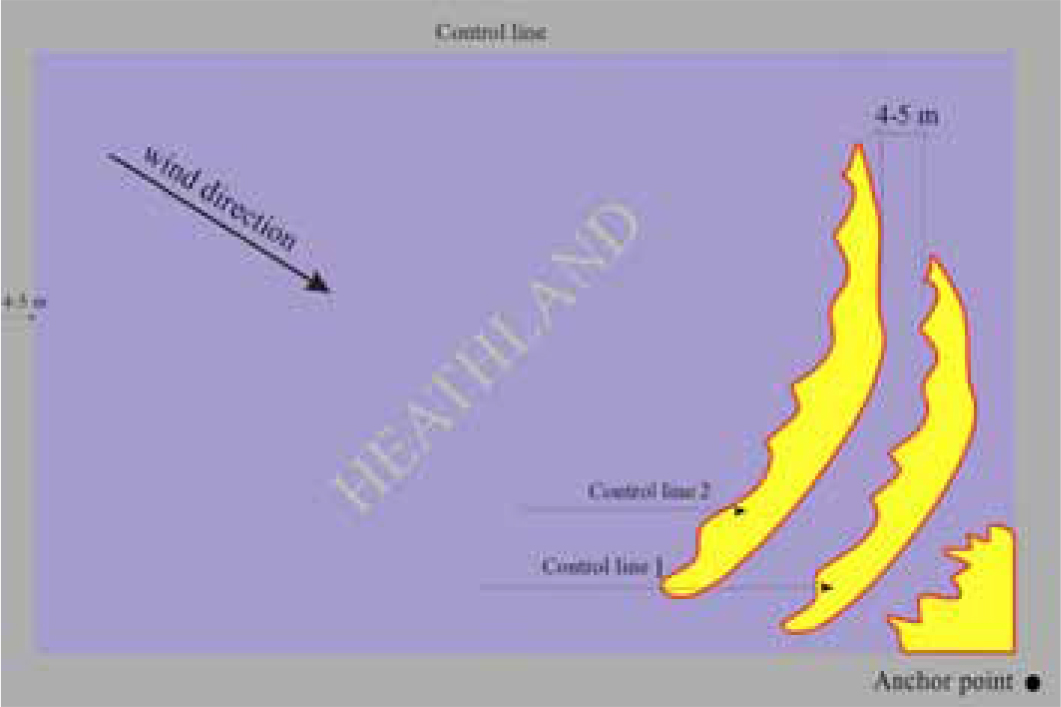
Figure 1.
Line burning (source: Forest Research Institute)
In this case, the fire runs in two directions – against the wind and with the wind. This method of establishing successive fire lines can be repeated several times. Pay attention to the frequency of successive burns, especially if there is a large accumulation of combustible material with low humidity, growing shrubs and trees and favourable weather conditions. If you create successive lines too quickly, especially in the initial phase of this method, this can lead to an increased intensity of the fire developing downwind and pose a risk of the fire spreading as the burnt area is not yet wide enough. However, if we are burning in unfavourable conditions and it is desirable to burn off the moss layer and remove woody plants, we can increase the desired fire intensity by initiating the subsequent burn belts more frequently. The increase in fire intensity and the spread of the fire can also be controlled by the width of the burnt vegetation. The wider the burnt line is compared to the previously burned line, the greater the intensity and rate of combustion.
Comb burning
In comb burning (Fig. 2), the burn is started 2 m from the control line, followed by additional burns perpendicular to the line. The depth of the ‘teeth’ should not exceed 3–5 m, which prevents increased burning intensity. In this method, burning develops with a crosswind (flanking fire), which shortens the time required to complete the burn.
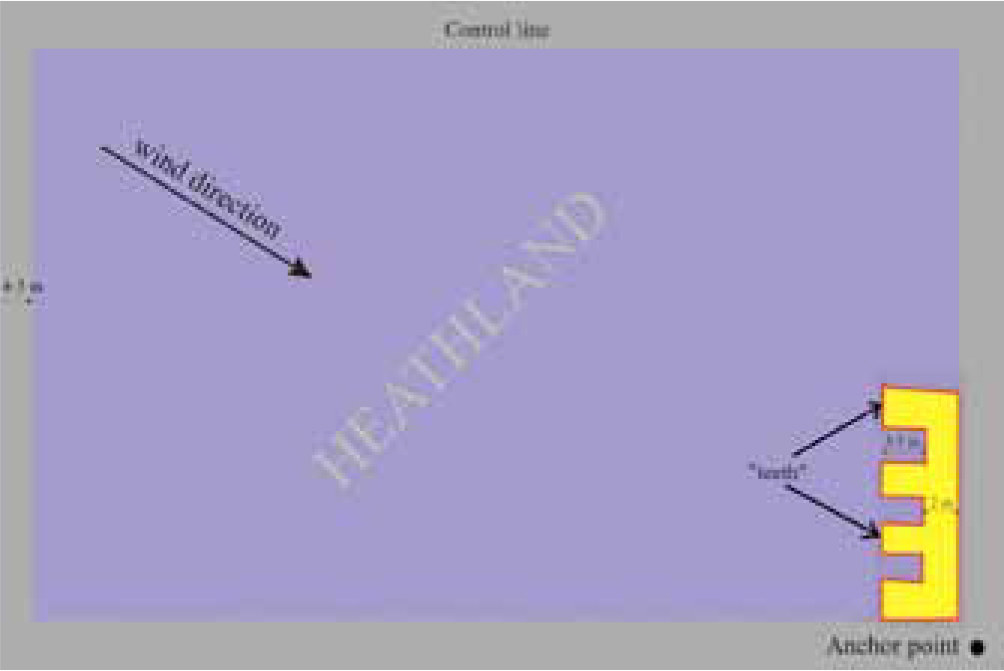
Figure 2.
Comb burning (source: Forest Research Institute)
Point burning
Inpoint burning (Fig. 3), spot ignitions are carried out before the first burn, which should be at least 2 m wide. Spot ignition of the ground cover is carried out about 5 m before the first burn at intervals of 4–6 m. This method of starting the burn causes the fire to spread in all directions –upwind (backing fire), crosswind (flanking fire) and downwind (heading fire).
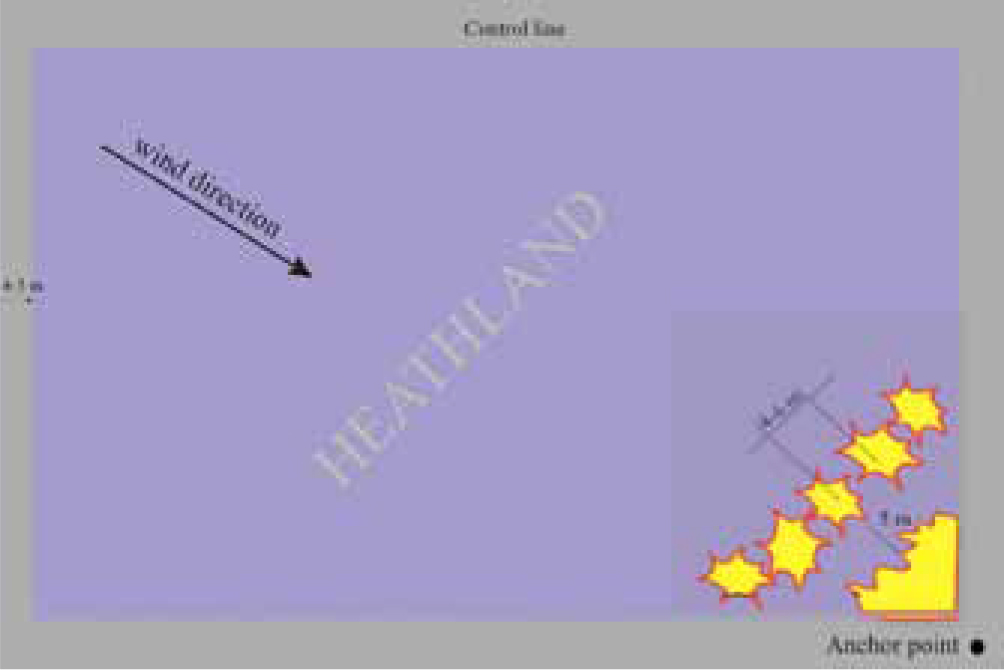
Figure 3.
Point burning (source: Forest Research Institute)
Planning the burning
The implementation of a heathland burn should be planned in advance, both organisationally and technically. The following points should be considered during the planning and preparation phase:
– location of the area to be burned,
– legal and formal restrictions on the use of the burn,
– date of the burn,
– assessment of the fire risk,
– the method of securing the area to be burnt,
– the personnel and equipment required,
– water supply and
– access to the area.
Location of the area to be burned
For ecological reasons and to control the burning process, a single area of heathland to be burned should not exceed 2 ha. The size of the surface allows for the safe movement of animals on the surface and takes into account the possibility of the heather regenerating the surface in a generative way. The exact location of the surface should be specified and a site plan drawn up, for example, with the aid of an orthophoto map, which enables a general assessment of the location in the terrain and information on the type and size of the neighbouring forest areas and other technical infrastructure.
Legal and formal restrictions on the use of the burn
Due to legal and formal restrictions on burning within a nature-protected area, it is necessary to obtain the consent of the area administrators and the competent authorities responsible for monitoring environmentally sensitive areas, such as the Regional Directorate for Environmental Protection.
Date of the burn
Controlled burning should be carried out during the dormant season of the heather, when the potential negative impacts of the fire on the plants and organisms living on the heath are minimised. The most favourable times for burning are therefore February–March or October–November, when weather conditions allow burning, that is, when the moisture content of fuel is low. In heathland areas with dense moss growth and shrubs and trees that are to be removed, burning in the former period is recommended due to the expected higher burning intensity.
Controlled burning is conducted in accordance with the provisions of the Nature Conservation Act (Dz. U. 2004 No. 92, item 880), Article 124, which states: ‘Burning meadows, grazing land, wasteland, ditches, roadside areas, railway tracks, reed beds, and rushes is prohibited. This prohibition does not apply to active conservation measures resulting from conservation tasks or a conservation plan for a national park or nature reserve, or a conservation task plan or a conservation plan for a Natura 2000 site’. Before commencing controlled burning, the area is checked for the presence of animals. It should be noted that controlled burning is not carried out at one time for the entire heathland complex, which takes into account the need for various animals to migrate to adjacent areas.
Assessment of the fire risk
A fire risk analysis should be carried out for the area selected for burning, assessing the threat posed by the heathland to the surrounding area. The analysis should take into account shrubs and trees growing on the edge of the burnt area that may favour spread of the fire. In such cases, the control line around the burnt area should be wider or woody plants should be removed. The fire risk assessment will determine the type of fire protection for the burn and the manpower and resources required.
Method of securing the area to be burnt
The burned area should be surrounded by a control line, preferably created with a shredding machine or by mowing. Avoid ploughing the area in a circle, as excessive mechanical intervention can lead to formation of an undesirable grass cover. The width of the control line should be around 4 m. This line also serves as a line from which you can start burning and prevents the fire from spreading outside. It also facilitates the movement of firefighting vehicles and light vehicle around the burned area.
Personnel and equipment required
The amount of personnel and equipment required depends on the size of the area to be burned, the risk assessment in relation to the potential spread of fire and the fire prevention method used by the burn boss. For a burn area of approximately 2 ha, the following personnel should be provided:
– three or four people in ignition teams,
– two or three light vehicles available from forest districts and
– two firefighting vehicles.
Water supply
The fire protection plan should include a method for securing the water supply. For example, a foldable water tank with a capacity of at least 2,500 l is recommended, which can serve as a water reservoir for light patrol and firefighting vehicles, as well as backpack pumps. After burning out, it can also be used to mop up the area. Nearby water supply points for firefighting vehicles with the required water capacity should also be planned.
Access to the area
Access to the burning site must be guaranteed for firefighting vehicles, space for manoeuvring and the ability to move around the site.
Equipment for the control burn
The following equipment is required to carry out control burns:
– drip torch,
– fire beater,
– backpacks pumps,
– pocket weather station for measuring air temperature, relative air humidity and wind speed and
– a pole with a measuring tape to determine the wind direction.
Drip torch
A is the most popular tool for igniting burning. It consists of three main parts: an ignition tip (the fuel mixture passes through a spout onto a wick and ignites), an outlet tube with a fuel trap loop to prevent reignition and a metal fuel tank. The tank is equipped with an air breather valve and a handle. The fuel used is a mixture of diesel fuel and petrol in a ratio of 4:1 (standard) or 3:1 for wet fuels.
Fire beaters
Fire beaters are tools that consist of a handle with a head (made of metal or rubber) to smother flames by cutting off the air supply. Fire swatters work by lightly ‘tapping’ the burning vegetation with the head. Excessive vertical strikes may cause the flame to ignite or hot materials to spread, which may contribute to the spread of fire. Fire beaters can be used effectively with the help of water from backpack pumps. In this case, the water should be applied just in front of the fire beaters’ line of sight, which reduces the intensity of the fire and makes the use of fire beaters much more effective.
Backpack pumps
Backpack pumps are portable devices with approximately 20-l water tanks connected to a flexible hose with a hand pump to deliver dense or distributed streams of water. They are used to directly extinguish burning vegetation or ground cover with low burning intensity, to support the use of other hand tools or to extinguish flames.
Pocket weather station for measuring air temperature, relative air humidity and wind speed
Pocket weather station for measuring air temperature, relative air humidity and wind speed is used to measure these three important meteorological parameters that influence the combustion process. A hot-wire anemometer is recommended.
A pole with a measuring tape to determine the wind direction
A pole with a measuring tape to determine the wind direction is used to continuously monitor the wind direction on the burnt area. A lightweight tape is attached to a pole about 1.5 m high. The tape can be used to monitor the prevailing wind direction, which, in turn, helps determine the starting point and subsequent burnout.
Conducting controlled burns
Controlled burning can be carried out under the following conditions:
| – air temperature | 0–15°C, |
| – relative air humidity | 30–50%, |
| – average wind speed | up to 5 m/s, |
| – days without precipitation before controlled burning | 3–5, |
| – ground moisture content | 50–100%, |
| – moisture content of combustible material up to | 15%. |
The intensity of heather burning depends on weather conditions. It is more intense the higher the air temperature and wind speed, and the lower the relative humidity. A longer period without precipitation results in a lower moisture content in the combustible material and also affects the intensity of heather burning. Higher ground moisture content neutralises the impact of combustion temperature on the soil environment.
The burn boss is responsible for organising and conducting a controlled burn. This person should present the plan, risk assessment and potential hazards, define staff responsibilities and provide information on communication and safety procedures. All ignition teams should follow his instructions.
Communication should be organised on site. The date, start and end of the burn should be reported to the fire detection and dispatch system of the forest district and neighbouring forest districts (if necessary) and to the appropriate District Command Post of the State Fire Service.
Before starting the burn, determine the prevailing wind direction to determine the starting point for the controlled burn, which should spread against the wind.
The wind direction is determined using a pole with a strip of material that is driven into the ground on or near the burnt area and can be gradually moved to other locations during the controlled burn. According to the line burning method, drip torch fires begin close to the control line surrounding the surface. Before you start burning, the control line should be wetted with water or, if necessary, with a wetting agent. This should be done from a light vehicle or firefighting vehicle.
Crew with hand tools (backpack pumps or fire beaters) should be deployed behind the control line. Their task is to constantly monitor the surroundings and extinguish any fire spread or hot spots. This is particularly important in the initial phase, when the control line is the only barrier. Later, the width of the control line increases as the vegetation burns. If the burning progresses too intensively in areas where there is a risk of the fire spreading (e.g. when burning entire trees or shrubs, especially conifers), the fire should be suppressed with hand tools (backpack pumps). If this is not possible due to the high thermal radiation, water delivery from light or medium-sized fire engines should be used for support. The safe working distance for a person depends on the length of the flame and is approximately four times the length of the flame. For example, if the flames are 1.5 m long, the safe working distance is 6 m.
Safety rules
Controlled burns can be dangerous
Therefore, a preliminary risk analysis should be carried out before starting the burn with the aim of avoiding or minimising accidents. During the burn, a continuous and proactive risk assessment should be carried out under the dynamically changing conditions of the burn process. This is not only the responsibility of the burn boss, but also should include all participants in the incineration process. It is essential to ensure mutual safety and maintain mutual supervision, as safety is the responsibility of all personnel. They should be disciplined and follow the burn boss instructions and procedures.
Ensuring safety during controlled burn should be based on the following procedures:
Persons observing controlled burns and protecting the surrounding area from possible spread should be able to see the control line, the controlled burn and the persons involved, especially those in ignition teams. They should constantly monitor the controlled burn and recognise and anticipate dangerous situations.
deliberate and controlled use of fire, including predicting the course of a controlled burning depending on changes in weather conditions, topography, distribution of fuels and possible hazards to people and equipment;
maintaining constant communication with staff by all possible means;
understanding the possible escape routes and the time needed for evacuation and
the evacuation should lead to safe places, which should be at least four heights away from the burning zone
Personal protective equipment
People participating in controlled burns who may be exposed to high temperatures, thermal radiation or smoke must wear appropriate personal protective equipment, consistent with the protective clothing of forest district light and firefighting vehicle crews. The equipment includes clothing, boots, helmet, balaclava, gloves, goggles and a mask.
Fire watch of the burnt surface
For safety reasons, the burnt area should be monitored until flameless combustion is complete. If there is a risk of reignition, especially at the edges of the burnt area, hand tools can be used to extinguish the fire.
Staff training
Before starting controlled burning, each participant should complete appropriate training in accordance with the developed programme. This includes the theoretical basis of forest burning and the factors that influence its progress, the theoretical basis of controlled burns, their purpose, planning and organisation of controlled burns, and assessment of potential hazards and safety rules.
During the practical part of the training, participants will learn the principles of operation and use of the equipment used in burns. They will also participate in an experimental controlled burn, where they will gain practical skills in burn methods and safety rules.
Biological monitoring
In Poland, the use of fire as a means of preserving habitats (heathlands) raises questions about the impact of fire on flora and fauna. To answer these questions, conducted environmental monitoring of heathlands located in the Przemków Forest District (southwest Poland), where three controlled pilot burns took place between 2015 and 2018. The monitoring focused on topics such as the degree of heathland regeneration, phytocenoses, flora and lichens, as well as the impact of burning on arthropod groups (spiders, beetles, collembolans, butterflies, lacewings and snakeflies).
The monitoring showed, among other things, that the effectiveness of vegetative regeneration of heather after controlled burning was high, averaging about 85% in the first year after burning. Worst regeneration of heather was observed in areas where the moss layer, which blocks soil colonisation, was not burned. After five vegetation periods, communities with a species composition suitable for the habitat were formed that resembled the mosaic patterns of heathlands. The 5-year monitoring cycle showed that controlled burning resulted in, among other things, no reduction in the viability of heather, no site-wide reduction in the food base of heather monophages (reduction in the available food base was only short-lived), no reduction in biodiversity of any of the plant, fungal and invertebrate groups studied, no erosion of the exposed substrate, which is rapidly colonised by mosses and lichens, or spread of invasive species (Szczęśniak et al. 2019). Research in other countries involving controlled burning also confirms that this treatment is effective in rejuvenating heathlands. Controlled burning limits the succession process by causing the death of young tree trunks (Ascoli et al. 2013). The regeneration of heathlands and prevention of succession also have an impact on rare invertebrates, such as the spiders Uloborus walckenaerius and Oxyopes heterophthalmus, which were found on a heathland in the Przemków Forest District (Wiśniewski, Dawidowicz 2017).
Conclusion
The controlled burning of heathlands, when carried out under suitable conditions, is a very effective method of regenerating this ecosystem. For this method to be effective and not have a negative impact on the ecosystem, the following conditions must be met:
Controlled burning should only be carried out during the dormant season of the heather.
Controlled burning should be carried out with the lowest possible moisture content of fuels to eliminate the moss mat; otherwise, regeneration of the heather will be restricted or prevented.
Controlled burning should only cover a fragment or a few fragments of a larger area, leaving most of the area untreated to maintain the source of propagation for the regenerating flora, lichen and fauna. Further fragments can be burnt in subsequent years.
Areas designated for controlled burning should be assessed before treatment, and the frequency of controlled burning should be adapted to local conditions.
Controlled burning has two advantages over mowing heather: it removes the biomass produced by the heather, which must be managed during mowing, at no additional cost; and it removes the layer of moss that remains on the surface during mowing and significantly limits regeneration of the heather.
Controlled burning must be carried out in compliance with all safety regulations and under the responsibility of those involved.