
Introduction
In recent years, Europe has experienced a significant increase in carbon dioxide concentrations in the atmosphere, along with rising air temperatures (Mearns et al. 1984; Goddess et al. 1990; Segan et al. 2016), as well as an increase in the frequency and intensity of droughts and wildfires (Spinoni et al. 2018). As a result, forest stands have become more susceptible to insect gradations and pathogen infections (Halder et al. 2019; Jaime et al. 2019). This significantly reduces the stability of forest ecosystems (Savva et al. 2006; Seidl et al. 2016). According to predictions, in the coming century, further climate change is expected to result in another increase in air temperatures, with a deficit of continuous and uniform rainfall during the summer, occurring only during the year’s cooler seasons (EEA/JRC/WHO 2008; IPPC 2023). The predictions also suggest that coniferous species will gradually face reducing range, giving way to deciduous plants (Petritan et al. 2012; Perkins et al. 2018; Nölte et al. 2020). To reduce and disperse the risks associated with forestry, all breeding activities should also focus on establishing multi-species stands and their genetic variability (Hattemer 1994; Sabor 2003; Finkeldey and Hattemer 2010). This is because its level determines the adaptability of trees and their stress resistance (Booy et al. 2000; Schaberg et al. 2008). Genetic variability, especially intraspecific variability, along with the presence of private and rare alleles, determines the adaptive potential and stability of forest stands in the presence of various disturbances (Konecka et al. 2019). In combination with habitat variability, it allows for survival in various adverse external conditions, including insect gradations, droughts or frosts (Dzialuk and Burczyk 2001). Genetic polymorphism is also a fundamental source utilised in selective breeding to enhance, concentrate and optimise production (Hedrick 2001; Program 2011). The loss of genetic polymorphism results in a decrease in adaptive ability, which, in turn, in the event of environmental changes, can lead to the decline of forests (Booy et al. 2000; Schaberg et al. 2008). For this reason, all breeding activities should consider their genetic consequences (Sabor 2003).
The regeneration method is one of the silvicultural activities that can impact future stands’ genetic structure and stability. Therefore, when selecting a forest regeneration method, the basic aspect is ensuring a high genetic diversity level in the founding population (Thomas et al. 2014). In the past decade, the importance of regeneration in forestry has increased. Natural regeneration is a key element in implementing the concept of sustainable and balanced development and is also one of the pillars of the natural approach to forest management (Hafemann 2004). In extreme cases, it is considered the only way to regenerate a forest without narrowing the genetic pool of future stands (Koski 2000). In the years 1976–1980, the proportion of natural regeneration in Poland was only 3.4% of the total area designated for regeneration, while in the years 2001–2010, this share increased to 10.4% (Kozioł and Matras 2011). Currently, the area of natural regeneration amounts to 20% (GUS 2023), whereas in Europe, this proportion is much higher, standing at 66% (Forest Europe 2020).
Scots pine accounts for 58.8% of the forest stands in Poland (GUS 2023). It is characterised by high variability in terms of morphological traits (Staszkiewicz 1993), a mixed strategy of stress tolerance, competitiveness and ruderal (Brzeziecki 2000), and high adaptability (Kätzel and Höppner 2011). Despite predictions indicating the reducing range of pine in favour of deciduous species (Petritan et al. 2012; Perkins et al. 2018; Nölte et al. 2020), it is believed that Scots pine will continue to be the dominant coniferous species in Europe in the coming decades (Kätzel and Höppner 2011). Hence, especially in the context of ongoing climate change, further analysis of the impact of silvicultural activities, including forest regeneration methods, on the genetic variability and stability of pine stands appears necessary.
The aim of the study was to compare the effects of the regeneration method on genetic variability and growth traits in Scots pine. Differences in the genetic variability of pine regenerations were determined using inter-simple sequence repeat (ISSR) markers. The research hypothesis assumed that the local genetic pool of Scots pine regenerations would be at a similar level after applying both natural regeneration and planted methods regeneration methods.
Material and methods
Study area and field data collection
The study was conducted on four crops located in the Rozwadów Forest District. All crops were located in the fresh coniferous forest habitat on rusty podzolic soil. The clearcuts were made by using complete clearcutting (Ib). The soil was prepared using an LPZ-75 double-mouldboard plough. At the time of measurements, the plantations were 2 years old. Two crops were regenerated naturally (compartments 196c and 168b), while the other two were regenerated by planting (compartments 246a and 256g). The planted crops in compartments 246a and 256g were established using seeds from seed stands located in compartments 16d and 170d, respectively (Fig. 1).
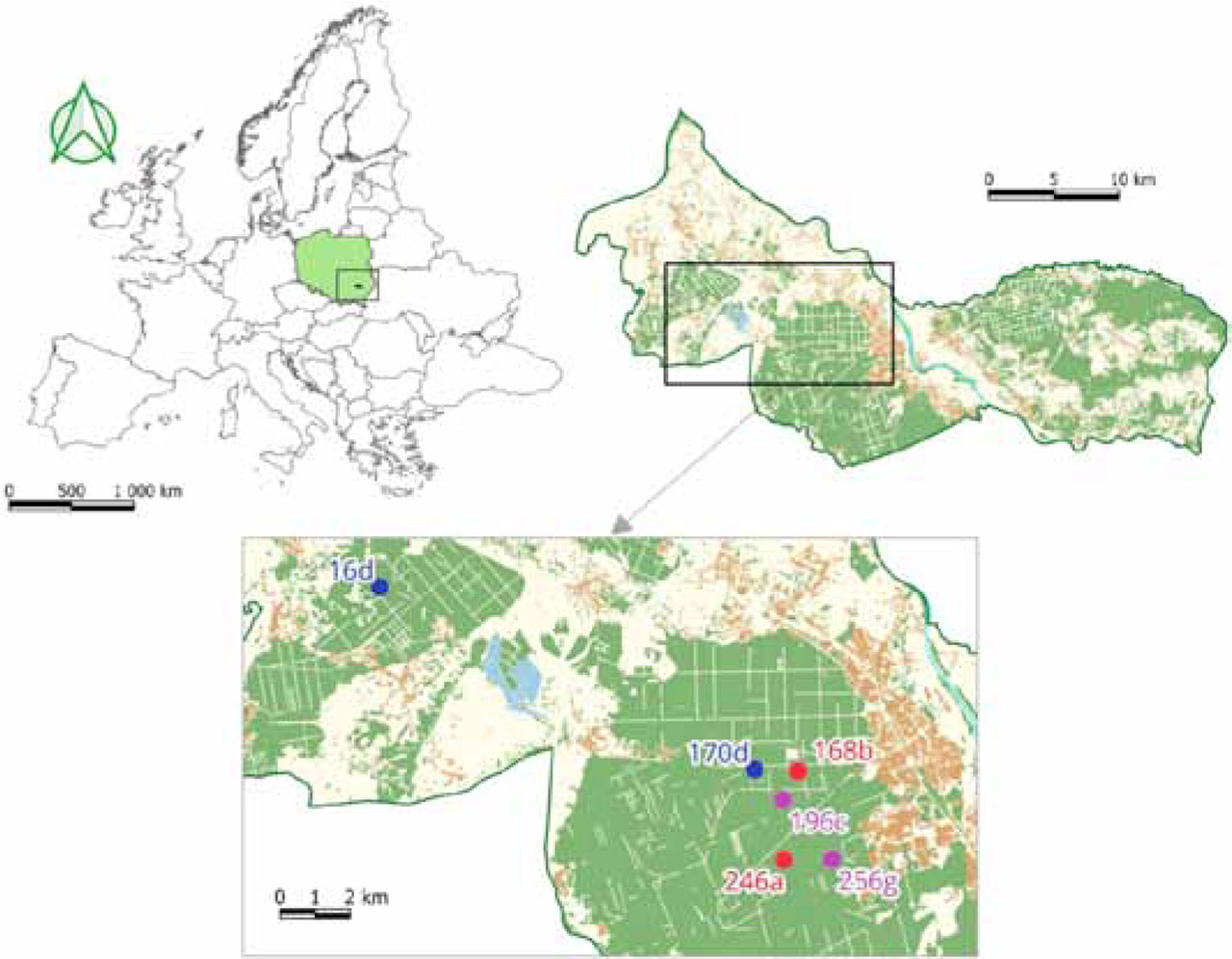
Figure 1.
Location of analysed stands (168b, 196c – crops from natural regeneration; 246a, 256g – crops from planting; 170d, 16d – seed stands for planted crops)
Ten randomly distributed sample plots were established in the natural regeneration crops, with the shape form and 25 m2 area. On each crop originating from regeneration by planting, 10 rows were randomly selected. Each of them had a length of 20 m. Pine regeneration was counted on each plot or row, and then their height (H) and diameter at the root collar (D) were measured. The density of seedlings per 1 ha was assessed. The sturdiness quotient (SQ) was determined for each seedling, indicating the adaptability of the trees in the early years after planting. It was calculated as the ratio of height to diameter at the root collar (Dickson et al. 1960). A coefficient >65 indicates slender individuals, which are characterised by lower resistance to abiotic factors (e.g. wind). However, pines, which are more resistant and better adapted to cultivation, are characterised by lower coefficient values (Haase 2007; Banach et al. 2020).
Laboratory data collection
Needles were collected from 30 pine seedlings, randomly distributed across each crop. DNA isolation was carried out using a modified version of the Rogers and Bendlich method (1988). DNA concentration was determined using a Nanodrop ND-1000 spectrophotometer, and subsequently, all samples were diluted to a concentration of 20 ng/µl. Amplification reactions were performed in a Biometra® T-Professional thermocycler. For analysis, seven primers generating polymorphic and reproducible reaction products were selected: (GT)8C, (CA)8GC, (TG)8G, (CA)8A, (AC)8YG, (GA)8C and (AC)8G, where Y represented T or C. The reaction mixture with a volume of 10 μl contained 1× polymerase chain reaction (PCR) buffer (10 mM Tris pH 8.8; 50 mM KCl; 0.08% Nonidet P40) (Thermo Fisher Scientific), 2.5 mM MgCl2, 0.2 mM of each deoxynucleotides (dNTP), 500 nM primer, 0.46 U Taq polymerase and 40 ng genomic DNA. The thermal profile was consists of 38 cycles: denaturation at 95°C for 30 s, annealing for 45 s at different temperatures and primer extension at 72°C for 2 min. In the first three cycles, the annealing temperature was 54°C, in the next three cycles 53°C and in the remaining 32 cycles – 52°C. The cycles were preceded by initial denaturation at 95°C for 7 min and ended by final elongation at 72°C for 7 min. The resulting products were separated on a 2% agarose gel with 0.01% ethidium bromide.
Data analysis
Using one-way analysis of variance (ANOVA), differences between the growth characteristics of pine from individual compartments were determined. Tukey’s test was used as a post hoc test. Calculations were performed using Statistica ver. 9.0 package (Stat Soft Inc. 2010). The frequency of individual alleles and the mean number of alleles at each locus (Na) were calculated based on the genetic analyses performed (Bergman and Gregorius 1979; Winter et al. 2004). Next, the effective number of alleles at each locus (Ne) (Bergman and Gregorius 1979), the Shannon index (I) (Brown and Weir 1983) and the expected heterozygosity (He) were determined (Nei and Roychoundry 1974). Principal component analysis (PCoA) was applied to visualise genetic diversity. The calculations were performed using GeneAlex ver. 6.41 (Peakall and Smouse 2006). The total genetic diversity (HT), intrapopulation differentiation (HS) and interpopulation differentiation (GST) (Nei 1987) were determined using PopGene ver. 1.3 (Yeh et al. 1999). The latter software was also used to estimate gene flow (Nm).
Results
Seedlings regenetated by planting were characterised by nearly three times higher growth parameters than pine seedlings located in crops resulting from natural regeneration. The post hoc test indicated that the observed differences were statistically significant. The first homogeneous group consisted of natural regeneration, with an average height of 11.5 cm and an average root collar diameter of 3.4 mm. The second group comprised pine trees from natural regeneration. Their average height was 33.0 cm, with an average root collar diameter of 9.3 mm. For SQ, no differences were observed among the pine seedlings from the respective crops. Regardless of the regeneration method, the value of the coefficient was low, almost half the value of 65, indicating sturdy individuals. The density of seedlings in crops from natural regeneration was 40 thousand units/ha and in crops from planting was 9.3 thousand units/ha (Tab. 1).
Table 1.
Growth traits and parameters of genetic variation on Scots pine crops in Rozwadów Forest District
| Compartment | Regeneration method | H (cm) | D (mm) | SQ | Density (thousand pcs/ha) | P (%) | Na | Ne | I | He |
|---|---|---|---|---|---|---|---|---|---|---|
| 168b | natural | 10.9a | 3.4a | 32.1 | 39.0a | 70.73 | 1.512 | 1.384 | 0.339 | 0.225 |
| 196c | 12.2a | 3.6a | 33.9 | 41.0a | 87.80 | 1.854 | 1.498 | 0.441 | 0.293 | |
| Mean | 11.5 | 3.5 | 33.0 | 40.0 | 79.26 | 1.683 | 1.441 | 0.390 | 0.259 | |
| 246a | planted | 32.1b | 9.3b | 34.5 | 9.2b | 71.95 | 1.524 | 1.423 | 0.372 | 0.248 |
| 256g | 33.9b | 9.9b | 34.2 | 9.5b | 71.95 | 1.610 | 1.410 | 0.360 | 0.239 | |
| Mean | 33.0 | 9.6 | 34.3 | 9.3 | 71.95 | 1.567 | 1.416 | 0.366 | 0.243 | |
For both naturally regenerated and planted pines, a total of 82 loci were identified, with one locus determined as private, unique only to the planted pine from compartment 246a. No rare alleles were detected in any population. Pines from stands regenerated through natural and artificial means exhibited similar levels of genetic variability. Among the analysed loci, 75.61% were polymorphic. The average number of alleles per locus was 1.683 for natural regenerations and 1.567 for artificial regenerations. The effective number of alleles per locus was 1.441 and 1.416, respectively. The difference between the mean and effective number of alleles reached 0.242 in natural regenerations and 0.151 in artificial plantation. The Shannon index averaged 0.378, and expected heterozygosity ranged from 0.225 to 0.293 (Tab. 1).
The genetic distance between the analysed pine regenerations was 0.189. PCoA divided the examined pines into three main groups. The first group consisted of pine tree from compartment 246a, which was established by planting. Pine trees from compartment 168b also formed a second separate group. High genetic similarity showed pines from compartments 196c and 256g, forming the third separated group on the PCoA plot (Fig. 2).
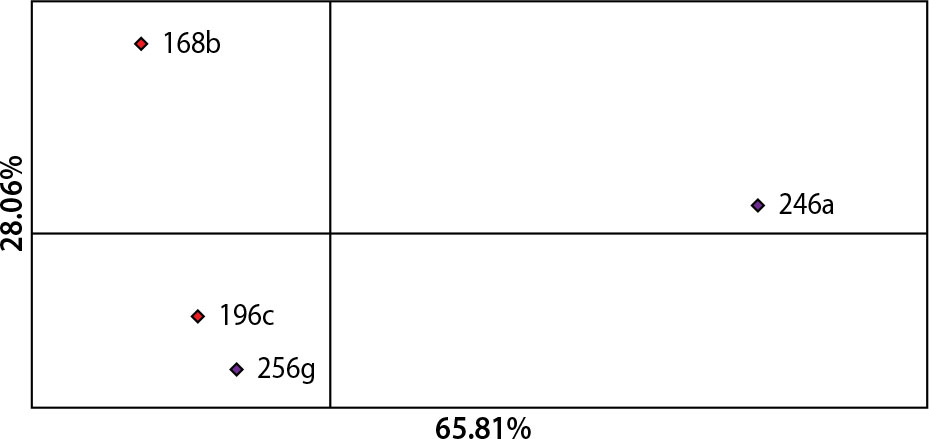
Figure 2.
Result of principal coordinate analysis based on genetic distance of natural and artificial regeneration of Scots pine (168b, 196c – crops from natural regeneration; 246a, 256g – crops from planting)
The total genetic diversity (HT) for natural pine regeneration was 0.3611 ± 0.0208, while the intrapopulation genetic diversity (HS) was 0.2522 ± 0.0177. The average heterozygosity (HT) of planted pine reached 0.3136 ± 0.0290, while within populations (HS) it was 0.2754 ± 0.0233. The combined analysis of pines from all divisions showed that their total genetic diversity (HT) was 0.3652 ± 0.0188, while the genetic diversity within subpopulations (HS) was 0.2636 ± 0.0157. The GST parameter reached a value of 0.2783, indicating that nearly 30% of the variability could be attributed to interpopulation differences. Gene flow (Nm) was calculated at 1.3, indicating more than one migrant per generation (Tab. 2).
Discussion
The initial growth stage occurs under different conditions in the nursery than in the stand. Natural selection dominates in natural regeneration stands, whereas artificial selection is the primary force in nurseries, especially during seedling sorting. Even if we assume that both selections eliminate genotypes randomly, there may still be differences in the genetic variability of trees regenerated using different methods. Scots pine is the main forest species in Poland. Maintaining its high genetic variability is essential for adapting forests to climate change. The methods of forest regeneration and management must adhere to the principles of sustainable forest management, ensuring the conservation of biodiversity and the productive and non-productive functions of forests. The selected cutting and the associated regeneration method must consider the free flow of genes between stands (Sabor 2003). Therefore, the applied methods of species regeneration should not narrow the genetic pool of subsequent generations.
In our study, we did not find any evidence that the regeneration method affected the genetic variability of the young generation of Scots pine, as the average values of genetic variability parameters were similar for both methods. Similar results were obtained by Konnert et al. (2000) for common beech based on the A allele of phosphoglucomutase (PGM-A) locus analysis. These authors found no differences in genetic variability between natural regeneration, seeds and seedlings in the greenhouse. Reports on many other species of forest trees compiled in the study of Ivetić et al. (2016) have also suggested that the regeneration method does not determine the level of genetic variability in the progeny. Kosinska et al. (2007) analysed 25 isozyme loci for Scots pine and found no differences between parent stands and their naturally and artificially regenerated progeny. Muona et al. (1987) compared the isoenzyme variability of natural and artificial regenerations and showed higher heterozygosity values in plantations than naturally regenerated stands. Similar results were obtained by Zukowska et al. (2023) based on the analysis of microsatellite loci. The latter authors demonstrated similar values of genetic variability parameters in parent stands, as well as their progeny, with the notable difference being the higher expected heterozygosity in artificially regenerated progeny.
The low proportion of gene flow and the value of the GST parameter suggests that the creation of a new Scots pine generation is primarily based on trees from the regenerated stand, while neighbouring stands are involved to a lesser extent. Therefore, the results results of our study indicated that the level of genetic variability in the new generation was more determined by the genetic structure of the parent stand than by the regeneration method. This was evidenced by the PCoA plot showing the distribution of populations based on genetic distance. The highest genetic similarity was observed among pines from compartments 196c and 256g. Although both crops were located at some distance from each other, the artificial crops in compartment 256g originated from seeds collected from compartment 170d, located near compartment 196c. Therefore, the natural regeneration in compartment 196c and the seed source for the establishment of crop 256g were in close proximity. This suggested that genetic similarity was due to their close location rather than the regeneration method. A study by Konnert and Hosius (2010) confirmed that the most significant factor in regeneration and afforestation is the origin of the reproductive material. Kosinska et al. (2007) also indicated that the similarity between parent stands and their progeny was much higher than between individual parent stands. In addition, Dzialuk and Burczyk (2006) found that seeds exhibited similar genetic variability to their parent stands. These authors recorded an excess of homozygosity only in the progeny generation. In coniferous species, this results from self-pollination or pollination between closely related individuals. The elimination of inbred in artificially regenerated populations begins at 3 years (Muona et al. 1987), while in naturally regenerated populations, it starts at the age of 10–20 years (Yazdani et al. 1985).
Many studies have indicated that rare alleles are associated with phenotypically weaker individuals (Williams 1999; Chen et al. 2001). Therefore, early selection at the stage of crop establishment can eliminate them in stands that will give rise to future generations. The results of our work have confirmed this theory. In the current study, rare alleles were not observed, while private alleles were only present in the crops originating from planted. Therefore, it can be assumed that selection has most likely eliminated all rare alleles and most private ones, leading to significant homogeneity within the studied populations. However, to confirm this, it would be necessary to assess the genetic variability of the parent stands as well. Perhaps the parental populations were already characterised by high genetic similarity, and this trait was passed on to subsequent generations. Konecka et al. (2018) argued that seedlings fully reflect the genetic variability of the parent stands, while Kosinska et al. (2007) believed that progeny populations share the same major alleles as the maternal populations. However, they differ in the number of rare alleles. Not all of them are passed on to subsequent generations or eliminated at the early stages of stand growth. In the present work, the difference between the mean and effective number of alleles in natural regenerations was higher than in planted ones, indicating that in artificial regenerations, a greater proportion of alleles are passed on to the next generations. Similar results were obtained by Konecka et al. (2019) when analysing rare and private alleles in different types of nurseries. The authors demonstrated a higher number of rare and private alleles in seedlings grown in containers than in bare root grown in traditional ground nurseries. Based on microsatellite DNA alleles, the authors determined a 37% proportion of rare alleles in the containerised seedling group, whereas an 8% share was observed in the ground-grown seedling group. These authors also attributed this phenomenon to differences in the intensity of selection. While growth conditions are better in containers, and selection is less intense, seedlings in traditional nurseries have a much harsher condition and stronger selection pressure. In addition, rare alleles and weaker individuals are eliminated in later stages of stand development (Rajora et al. 2000).
Two-year-old pines originating from regeneration by planting had almost three times higher growth parameters (H = 33.0 cm, D = 9.9 mm) than those from natural regeneration (H = 11.5 cm, D = 3.5 mm). Similar results were obtained by Masternak et al. (2020), who obtained an average tree height of 11.42 cm and a 3.5-mm diameter at the root collar for 2-year-old natural regeneration pines in the same habitat. The height of natural 2-year-old pines, obtained by Andrzejczyk and Drozdowski (2003), was 10 cm. Similar to the present work, a study by Wolski and Robakowski (2008) indicated that natural regenerations grew slower in the first years compared to artificial ones. However, in further years of growth, natural pine regeneration was able to outperform artificial regeneration in terms of biometric characteristics. However, not all studies confirm these observations (Długosiewicz et al. 2019). Wolski and Robakowski (2008) demonstrated a lower sturdiness quotient in natural regenerations, indicating their higher resistance to wind and snow damage. In our study, we did not confirm these results, as pines regenerated using both methods exhibited similar values of SQ.
Summary
In recent decades, rapid climate change may render adaptive strategies that rely solely on the self-regulation of forest ecosystems insufficient to maintain stand stability. Therefore, human intervention in certain processes is necessary to ensure the adaptive capacity of forests and reduce the risk of collapse. It is important to consider the genetic consequences of any silvicultural practices undertaken. The present research does not indicate that either method of forest regeneration (natural or by planting) is more valuable in establishing new generations of trees. It appears that it is not the regeneration method that determines the level of genetic variability in the new generation, but rather the genetic and breeding values of the parent stands. Therefore, when establishing a new generation, it is important to consider not only the phenotypic quality, but also the genetic variability of the regenerated stands. Any loss of alleles occurring during silvicultural activities poses a threat to the stability of forest stands. The rich gene pool of the parent stand increases the likelihood of favourable allelic combinations, increasing survival rates and facilitating adaptation to changing environmental conditions.