
A steady decline in forestry in British Columbia (BC) has occurred over the past 25 years. This has been manifested by large scale infestations of mountain pine beetle and spruce beetle leading to decreased timber supply, loss of wildlife habitat, mill closures, a decline in forest revenues and low investment in forest innovations. Undeniably, climate change has been a factor in this decline, however, other factors including deficient forest management may have played a significant role.
This review of the BC forestry decline is limited to an assessment of silviculture practices used in forest ecosystems management. The maintenance of healthy forest ecosystems is the foundation for a sustainable supply of timber, protection of biodiversity, wildlife and other forest values that benefit society.
The evolution of the BC silviculture approach to forest management differs from traditional European silviculture management. This may be a key factor influencing the present state of forests resulting in a decline in timber supply and forest revenues.
Silviculture is the science and art of growing and cultivating forest crops based on a knowledge of silvics (Nyland 1996). The focus on crop trees or timber production is a key element of this definition. Consequently, silviculture management covers the complete rotation age of tree species, the organisms with the longest lifespan in the forest ecosystem. This approach is ecologically reasonable as the entire cycle of successional changes is covered during a stand rotation.
In BC the term silviculture has lost its focus on the timber objective. ”Silviculture is often confused with managing stands and forests for timber, but silviculture practices are also used to manage forests for wildlife, water, recreation, aesthetics, or any combination of these or other forest uses” (Province of BC 2023). Although, this statement does not contradict proper silviculture practices encompassing all listed values, it also allows the interpretation that timber may not be the main goal for management.
The idea that we have the option to deemphasize timber production and narrow the management objectives to a specific value (e.g., partial cuts for winter deer habitat, variable retention system for aesthetics) is commonly accepted in BC.
This is also widely accepted by forest licensees. It is apparently considered as a small price to pay where licensees, driven by high volume/low-cost timber supply, are free to clearcut areas where other more costly forms of silviculture systems would be more ecologically suitable.
Also, in the late 1990s a new silvicultural system called “variable retention (VR) system” (Forest Practices Code 1999) was developed. This silvicultural system has three requirements: (1) retained trees are distributed over the area of the cutblock, (2) standing trees are left for the long term (at least one rotation) and (3) distribution of leave trees achieves > 50% ‘forest influence’ (i.e., the area surrounding a tree or forest edge with a radius equal to the tree height). This new silvicultural system accepts that retention of trees and other structural attributes of forests may be done for purposes other than tree regeneration and timber production. Consequently, there are no plans to utilize the timber left as retention trees nor to monitor the growth and survival of leave trees.
At the same time, “clearcut with reserves” – a modification of traditional clearcutting where trees are retained within or adjacent to the cutblock (Helms 1998) was introduced in BC (Photo). This is the most common harvesting system used in British Columbia. This cutblock of 21 ha (this may be considered as a small size, most of cutblocks in BC are larger) was harvested in 2019. The pre-harvest species composition was Douglas fir (Pseudotsuga menziesii) (40%) Lodgepole pine (Pinus contorta) (40%), White spruce (Picea glauca) (10%) and Western redcedar (Thuja plicata)/Western hemlock (Tsuga heterophylla) (10%). The timber reserved from harvesting composes of 3 patches (both in the interior and exterior of the cutblock) with area of 2.9 ha. There is no plan to harvest the reserved timber within next 80 years (full stand rotation). After the harvest the cutblock has been planted with Lodgepole pine and Douglas fir seedlings. This is a system like the VR system but lacking the spatial leave trees distribution condition. Also, in this silviculture system the reserve trees are not planned for utilization. In practice, the reserve trees are of lower economical value and quite often do not represent pre-harvest stand tree composition. Over the last 25 years the VR system and clearcut with reserves (CCRES) have been broadly adopted in BC with diminished used of traditional clearcutting (CLEAR). In 2022, of 119,470 ha harvested in BC (Province of BC 2022), 84% was CCRES and 9% CLEAR. Biodiversity and aesthetic values are only superficially addressed by VR and CCRES. The desired ecological outcomes would be achieved with the application of an uneven aged silviculture system such as shelterwood (Raymond et al. 2009).
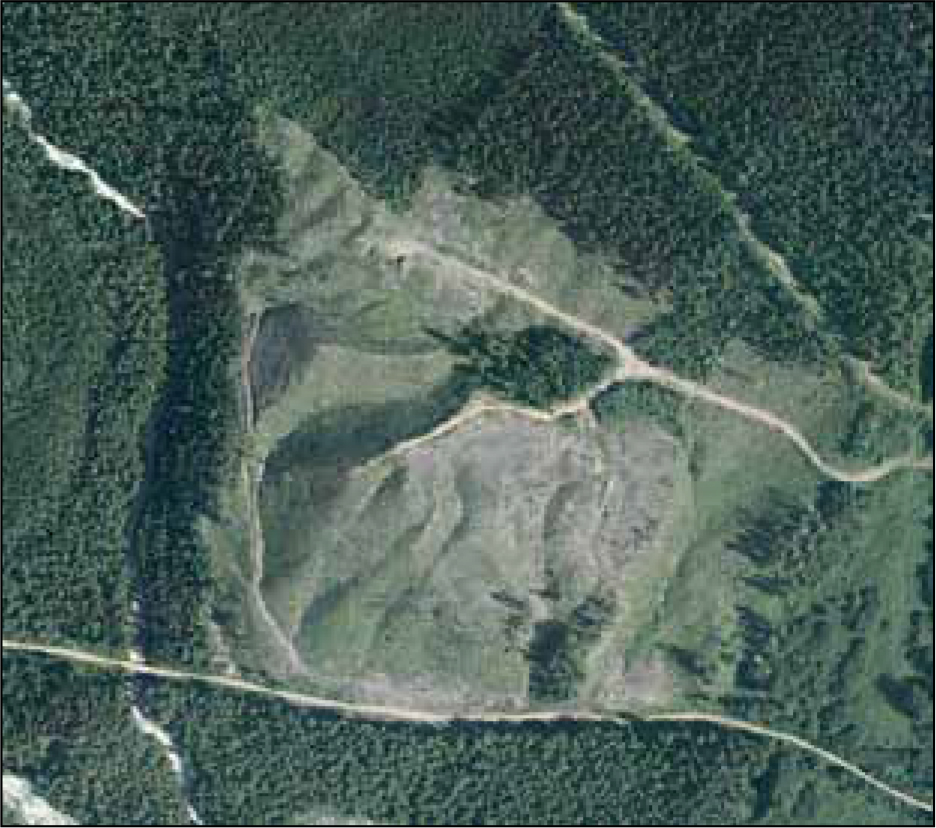
Photo.
An example of a clearcut with reserves harvesting system
Mixed-species forests cover significant portions of BC. The tree silvics variability is found in both mixed species coniferous forests and mixed forests of hardwood and softwood species defined as a mixedwoods, with neither component exceeding 75% to 80% of stocking based on basal area or canopy closure (Canadian National Vegetation Classification 2013). There is clearly potential for much greater application of uneven aged systems in British Columbia when only one-quarter to one-third of all BC forests are dominated by a single tree species (State of British Columbia’s Forests 2010).
As reported by the Province of BC, traditional retention systems comprised only 3% (136,504 ha) of the total area harvested over the last 20 years (4,431,028 million ha) (Province of BC 2022). For the purposes of this paper, the term traditional retention systems means silviculture systems other than a form of clearcut or variable retention where uneven aged or shelterwood systems are implemented. Specifically, the patch cut, selection and the shelterwood system may be considered as traditional retention systems (Nyland 1996).
Traditional retention systems maintain complex stand structure with heterogeneity of species composition, age and height and diameter classes resulting in addressing biodiversity objectives spatially and temporally. While the “new silviculture systems” (VR, CCRES) leave some residual trees on site and can provide short term habitat and contribute to minor structural variation in future stands (Beese et al.2019), these silviculture systems are often only a token variation from a clearcut. The “new silviculture systems” should not be used to replace traditional retention systems where conditions and objectives require a form of partial cut. A shelterwood or uneven aged silviculture system is the best ecological choice and ensures the biodiversity objectives are met during the stand rotation period. Consequently, the “new silviculture systems” are an inadequate choice on a significant portion of BC’s forests. The lack of monitoring and utilization plans for residual trees in such a system frequently leads to losses of these trees in the stand (e.g windthrow, mortality due to mechanical damage). Therefore, the achieved biodiversity objective in these “new systems” may not be long lasting.
The indiscriminate application of “new silviculture systems” in BC has allowed licensees to utilize the same low cost/large volume harvesting methods used in conventional clearcutting while claiming to address the public concerns about biodiversity and visual quality objectives. The alternative application of traditional retention systems (where ecologically applicable) may require more planning, changes to the tenure system and the most decisive factor of all, present a higher cost. The costs of traditional retention systems are shown to be higher in Quebec (Roy and Meek 2009), however, there is no equivalent cost analysis of these systems in BC.
Has the application of a form of clearcut on 93% of the harvested area in the province, and lack of the application of silviculture systems fitting ecosystem requirements, resulted in a trade-off to traditional forest management and financial losses to British Columbians? Does the current approach assure the sustainability of forest management?
Presently the mixed subalpine fir/spruce stands of interior BC are undergoing a spruce beetle infestation. The clearcut system applied in stands with a minor % of spruce beetle infestation concentrates harvest effort on a limited area extracting a large volume of healthy trees, while leaving extensive massive areas where significant dead spruce volume will not be recovered. Partial cut harvesting is ecologically suitable for this forest type to accomplish salvage and sanitation goals within spruce beetle affected stands. The application of partial cuts would be more effective at addressing the beetle infestation and at reducing non recoverable losses on a large portion of the timber supply area.
In areas where an appropriate partial harvesting silviculture system is applied, the average piece size harvested would be higher than if the area was clearcut (Roy and Meek 2009). As piece size has a large weight in the stumpage calculation formula in BC, the stumpage system would also reflect higher revenues to the crown with a partial harvesting system. (Interior Appraisal Manual 2022).
Maintaining tree species mixtures and more effective growing space utilization in partial cuts leads to an increase in site productivity (Pretzsch and Schutze 2021) and stem diameter growth (Jull and Griesbauer 2023). Planting a clearcut with a mixture of tree species seedlings does not create the stand structure and species compositions found in traditional retention systems using natural regeneration.
Over 20 years ago Burton et al. (1999) recommended using partial cut systems to maintain old growth stand characteristics. If partial cut systems were more broadly used in BC over the last few decades, more stands with old growth characteristics would be available and the timber supply may not have decreased so dramatically in BC. Today there is a shortage of old growth stands in BC. This resulted from prolonged utilization of clearcuts together with the outcome of a MPB infestation and wildfires in the Province. To address public and First Nations discontent with clearcuts and loss of biodiversity/wildlife habitat, the province has excluded stands from harvesting by designating Old Growth Areas and Biodiversity Management Areas. Practically all these areas are protected and there is no intention to manage them. A large area of Old Growth may increase the level of timber harvesting on the remainder of the Timber Harvesting Land Base area or contribute to a decline in forest industry operations.
The overuse of clearcuts is linked to excessive use of herbicides. The application of a form of partial harvesting system would dramatically reduce the vegetation competition and reduce the need for both chemical and mechanical brushing. (Prevost and Pothier 2003).
A good example is the clearcutting of deciduous/spruce stands in northeastern BC. The resulting sprouting of aspen after harvesting is so intensive that glyphosate is the only way to achieve a spruce free growing plantation. If instead, a form of shelterwood system is utilized, the need for herbicide use/manual brushing may be significantly reduced. Two options may be considered: planting spruce under aspen decades before harvesting the mature aspen or saving existing spruce regeneration during aspen removal (Grover et al. 2014).
Only forest management based on the full forest stand rotation, when done correctly, sustainably addresses other values listed in BC Forest and Range Practices Act such as soils, water, visual quality objectives, wildlife, and biodiversity.
Over the past 200 years, forest research (mainly in Europe) has resulted in the development of a variety of silviculture systems matching certain species composition, tree silvics, and ecological associations, which relies on the fact that longevity of tree species covers a full cycle of successional changes over the stand rotation. The “innovative” BC forest management cycle ends at the free growing stage of stand development. This may serve the BC tenure system but is not correlated with the full succession cycle of a forest ecosystem.
As traditional retention systems sometimes require multiple stand entries during the rotation, the BC tenure and “free growing” (FG) systems are additional barriers in the implementation of effective silviculture systems. The BC tenure system, which differentiates between coniferous and deciduous licensees and limits forest licensees’ liabilities to meeting FG obligations, does not support implementation of any silviculture system based on stand rotation and/or dealing with mixed uneven aged stands.
BC has experienced a dramatic decline in forestry over the last 20 years, due not only to climate change but possibly due to how BC’s forest resources are being managed. The current approach, which has almost completely relied on clearcut systems, may also have contributed to the decline of the timber supply and consequently to mill closures and diminishing provincial forest revenues. The issue has been further influenced by government relying too much on major licensees for leadership in forest management – an approach that has not served the people of BC well.
If the Province initiated comprehensive forest reform to the tenure system, introduced stumpage and forest practices regulations allowing for implementation of sound silviculture systems, we would see an across-the-board revitalization in many areas of forest management that government is currently struggling with.
Disclaimer
Any opinions included in this article represent my personal perspective, based on my education, knowledge, and experience as a professional forester in Europe, other parts of Canada, and British Columbia over more than 30 years and does not represent the views of the BC government.