
Introduction
The scientific achievements of specialists in the fields of forestry and horticulture, aimed at creating green spaces, are characterized by significant ecological, social and economic perspectives (Bakhmat et al. 2023; Didur et al. 2019; Pantsyreva et al. 2020; Petrichenko et al. 2017). However, in the conditions of urban landscapes, which are unnatural and stressful environments for plants, green spaces often encounter some difficulties in functioning and adapting to the urban ecosystem (Bulgakov et al. 2023; Petrychenko et al. 2018). Common Viburnum belongs to them – valued for its food, medicinal, soil-protecting and decorative properties. The genus Viburnum (Viburnum L.) comprises about 220 species of plants distributed across Eurasia, North America and North Africa. These are mostly evergreen and deciduous shrubs or small trees. The life expectancy of Viburnum is 50–60 years. All types of Viburnum are highly decorative and have a large number of cultivars. They can be used in all types of plantations. In addition to its decorative properties, Viburnum has other useful properties: it is a good honey plant and a medicinal and food plant (Maier 2019; Matusiak 2020). Furthermore, a new direction – medicinal horticulture – has developed worldwide (Puyu et al. 2021; Snitynskyi et al. 2023). Its tasks include breeding crops whose fruits can prevent or cure various diseases (Mazur et al. 2020; Pantsyreva et al. 2024). About 40% of the total number of medicinal products are herbal preparations. Raw materials for the production of almost half of them are wild plants, including Viburnum opulus (Desurmont et al. 2020).
Viburnum plants are among the oldest decorative and medicinal forest plants, used in gardening, medicine and decorative gardening. They are valued for their ecological plasticity and decorative qualities (the shape and architecture of the crown, the morphology of the leaves, etc.), which make them suitable for creating green landscapes in conditions of urbophytocenoses.
The cultivation of planting material involves using the seed method for Viburnum propagation to create understories and stabilize ravines and beams. Due to its high heterozygosity, seed propagation during the cultivation of seedlings does not preserve shape characteristics. Therefore, for Viburnum, valued as a fruit-bearing, medicinal, food and decorative species, it is important to use such breeding methods that ensure the production of genetically homogeneous seedlings that retain their form and do not differ from the mother individuals in terms of their economic and valuable characteristics. This condition is met by vegetative methods of reproduction, particularly vegetative reproduction (Konstantinov et al. 2018; Neyko et al. 2019).
Different types of Viburnum are used in landscaping of territories – as solitaires, in group plantings and as hedges. These plants are planted in various places of general, limited and special purpose: arboretums, botanical gardens, parks, squares, boulevards, territories of educational institutions, homesteads and private territories (Bulgakov et al. 2023; Didur et al. 2020).
In recent years, methods of green and woody cuttings for fruit and berry plants have been quite successfully used in many nurseries. This method makes it possible to intensify the process of growing Viburnum planting material. From both production and biological aspects, this method is highly promising as it enables mass cultivation of genetically homogeneous Viburnum planting material. Additionally, it has opened up greater opportunities for the mechanization of numerous production processes. The development of production equipment for the artificial creation of fog, the use of polyethylene films and synthetic growth regulators have made grafting one of the leading reproduction methods for the researched species in the decorative horticulture of Ukraine (Ivanyshyn et al. 2021; Maier 2019; Monarkh and Matusiak 2020).
Growing seedlings from green cuttings is a long-known method of vegetative propagation, but it has not yet gained sufficient popularity due to the markedly different abilities of cuttings to form roots, which vary not only between breeds but also between varieties. Therefore, in horticulture practice, seedlings are mostly grown this way selectively, taking into account their known properties in advance of rooting (Desurmont and Weston 2014; Pantsyreva 2019).
In recent years, the cultivation of tree and shrub plants has become increasingly important due to their relative ease of reproduction, capriciousness and abundance various species and varieties, which vary in crown shape and leaf color. One of the advantages of Viburnum is its wide range of uses (Desurmont et al. 2019; Vasylevskyi et al. 2021).
The process of obtaining standard planting material for fruit and berry crops using green cuttings technology involves several stages: rooting green cuttings under conditions of artificial fog, storing cuttings during the winter period and growing rooted cuttings. Currently, the technology for rooting green cuttings has been extensively developed, with optimal microclimatic conditions and methods for directed, deterministic influence on the process of adventitious rhizogenesis clearly defined. However, the aspect of growing rooted cuttings remains insufficiently studied and is one of the limiting factors in obtaining root-own planting material and in the wider introduction of green cuttings technology within fruit nursery practices (Pantsyreva et al. 2023).
After analyzing the works of scientists, it becomes evident that the processes of adventitious rhizogenesis in green cuttings are dependent on the type of cutting (Honcharuk et al. 2022; Mazur et al. 2019, 2020; Pantsyreva et al. 2020). In the practice of using green cuttings, it is customary to reduce the area of the leaf and the number of nodes on the cuttings to decrease the area of evaporation however, this practice can impair the supply of photosynthesis products to the cuttings. Therefore, a differentiated approach is necessary to determine the optimal type of cuttings, ensuring the provision of physiologically active and plastic substances for the regeneration of lost organs in green cuttings (Dubik et al. 2024; Hetman et al. 2024; Hnatiuk et al. 2019; Mazur et al. 2021; Neyko et al. 2021; Petrychenko et al. 2024; Titarenko 2022).
The rooting process of cuttings depends on many factors, including the season and location of collecting the source material, method of preparation and processing of the cuttings, composition of the substrate, microclimate in which root formation occurs, care of the planted cuttings and biological characteristics of the species being propagated by cuttings (Lutkovska 2020; Matusyak et al. 2021).
The purpose of the study was to investigate the effect of different types of cuttings on the rooting of Viburnum opulus during the researched period, noting that there was a high rooting rate among the cuttings.
To achieve this goal, the following tasks must be completed:
– Conduct an analysis of literary sources and summarize information on distribution and morphobiological features.
– Develop scientific foundations for the introduction to culture, studying its reproductive characteristics, assessing its productive potential and proposing practical applications.
Material and Methods
Scientific and experimental research was conducted during 2020–2022 at the architectural and exposition site of the Department of Forestry and Horticulture, Faculty of Ecology, Forestry and Horticulture of the Vinnytsia National Agrarian University. Cuttings were collected from native Viburnum mother plants under the conditions of the nebulizing installation of the winter garden of the «Podillia» Botanical Garden at Vinnytsia National Agrarian University. Shoots were selected during phases of flowering, intensive growth and slowing down of growth (Lutkovska 2020; Monarkh and Pantsyreva 2019; Tkach et al. 2024; Tkachuk et al. 2024). The lower section was made in the middle of the internode, and the upper one – directly above the node (Balabak 2003; Mazur et al. 2021; Neyko et al. 2023). Each experiment was repeated four times, with 48 cuttings in each repetition.
The study on the influence of cutting type (number of nodes) on the rooting and growth of green Viburnum cuttings of the Velikoplidna variety, depending on the metamerism of the shoot, was conducted according to the following scheme (Fig. 1):
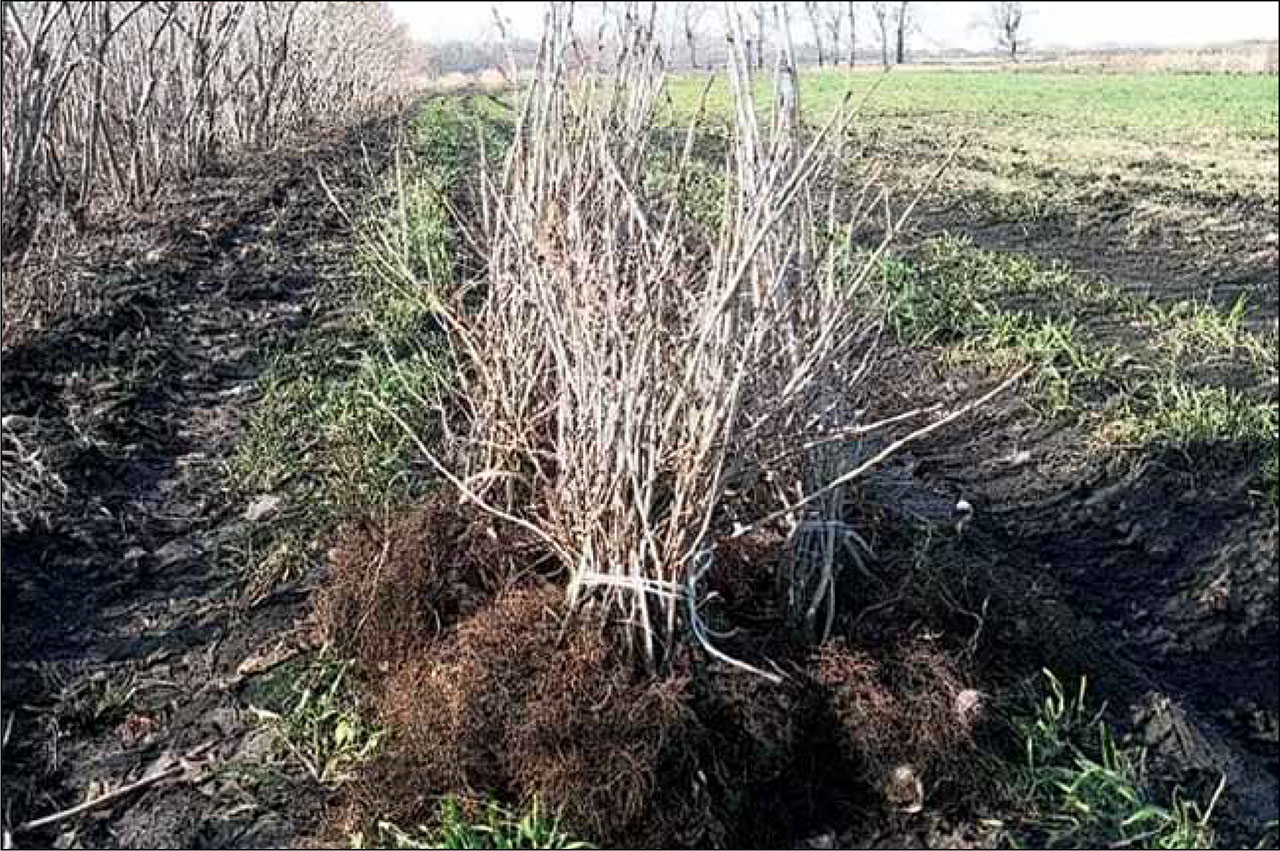
Figure 1.
A nursery of green cuttings in conditions botanical garden «Podillia» of the Vinnytsia National Agrarian University
Results
The rooting process of cuttings depends on many factors, including the season and location of collecting the source material, method of procurement and processing of cuttings, composition of the substrate, microclimate in which root formation occurs, care of the planted cuttings and biological characteristics of the species being propagated by cuttings. Analyzing the effect of different types of cuttings during the period of mass flowering on rooting, it should be noted that rooting increases with an increase in the number of nodes on the planted cuttings (Tab. 1).
Table 1.
Study of the rooting of green Viburnum cuttings of the ordinary Velikoplidna variety depending on the type of cutting, %
| Type of cutting (number of nodes) | 2020 | 2021 | 2022 | Average for 3 years |
|---|---|---|---|---|
| Apical part | ||||
| 1 | 34.2 | 33.1 | 30.1 | 32.4 |
| 2 | 50.1 | 49.6 | 49.7 | 49.7 |
| 3 (control) | 64.2 | 65.8 | 65.3 | 65.1 |
| Medial part | ||||
| 1 | 40.2 | 43.4 | 41.6 | 41.7 |
| 2 | 58.3 | 61.1 | 57.5 | 58.9 |
| 3 (control) | 70.3 | 74.1 | 72.6 | 72.3 |
| Basal part | ||||
| 1 | 54.1 | 55.2 | 53.2 | 54.1 |
| 2 | 72.1 | 72.5 | 70.5 | 71.7 |
| 3 (control) | 80.2 | 84.7 | 83.8 | 82.9 |
| LSD05 | 4.4 | 6.2 | 5,6 | |
The rooting rates of single-node cuttings harvested from different parts of the shoot averaged over three years were as follows: apical – 32.4%, medial – 41.7% and basal – 54.1%. Among single-node cuttings, those harvested from the basal part exhibited better rooting – 1.7 times higher than apical cuttings and 1.3 times more than medial cuttings. The rooting of two-node cuttings from the apical part during the period of research was 49.7%, which is 9.2% less than the rooting of similar cuttings from the medial part of the shoot and 22% less than two-node basal cuttings. Three-node cuttings had a significant advantage in rooting, regardless of the part of the shoot from which they were harvested. It should be noted that the rooting rate of three-noded cuttings from the apical part of the shoot averaged 65.1% during the research period, which is 15.4% more than two-noded ones and 32.7% more than similar one-noded ones. Rooting of three-node cuttings prepared from the medial parts is also significantly higher than that of two-node and one-node medial cuttings, by 13.4% and 30.6%, respectively. The rooting percentage of three-node basal cuttings was 82.9%, two-node 71.7% and one-node only 54.1%.
Common Viburnum cuttings that root better later form a more developed root system compared to cuttings where root formation occurred later (Tab. 2).
Table 2.
Study of the influence of the type of cutting on the number of roots in the cuttings of the Velyoplidna variety, pcs.
| Type of cutting (number of nodes) | 2020 | 2021 | 2022 | Average for 3 years | ||||
|---|---|---|---|---|---|---|---|---|
| root branching order | ||||||||
| 1 | 2 | 1 | 2 | 1 | 2 | 1 | 2 | |
| Apical part | ||||||||
| 1 | 13.6 | 100.2 | 15.0 | 101.4 | 15.5 | 142.4 | 14.7 | 114.6 |
| 2 | 19.2 | 154.6 | 19.5 | 175.4 | 22.1 | 182.6 | 20.2 | 170.8 |
| 3 (control) | 26.7 | 230.2 | 23.2 | 209.7 | 28.0 | 248.0 | 25.9 | 229.3 |
| Medial part | ||||||||
| 1 | 14.4 | 131.2 | 17.2 | 140.7 | 21,2 | 190.7 | 17.6 | 154.2 |
| 2 | 19.5 | 200.4 | 23.3 | 200.2 | 26,8 | 210.2 | 26.5 | 203.6 |
| 3 (control) | 24.7 | 244.5 | 29.7 | 260.8 | 34,7 | 276.7 | 29.7 | 261.6 |
| Basal part | ||||||||
| 1 | 20.1 | 200.2 | 23.4 | 214.3 | 27.1 | 219.6 | 23.5 | 211.3 |
| 2 | 30.9 | 273.4 | 29.6 | 241.7 | 32.2 | 271.5 | 30.9 | 262.2 |
| 3 (control) | 38.9 | 310.2 | 35.3 | 318.7 | 38.7 | 331.0 | 37.5 | 319.9 |
| LSD05 | 3.1 | 7.1 | 2.3 | 10.1 | 4.4 | 13.2 | ||
In the calculation per cutting, the total number of roots of the first- and second-order branching in one-node cuttings from the apical part of the shoot was 168.9 pieces, while in two-node apical cuttings this figure significantly increased to 223.8 pieces. The largest number of roots of the first- and second-order branching (255.2) was recorded in three-node cuttings. Analyzing the growth of the adventitious root system in different types of medial cuttings, it should be noted that three-node cuttings had a significant advantage in terms of this indicator. The total number of roots in this variant was 291.3 pieces, which is 61.2 pieces more than in two-knotted cuttings and 119.5 pieces more than in single-knotted cuttings. The total number of roots of three-node cuttings harvested from the basal part of the shoot is 357.4 pieces per cutting, while for two-node and one-node basal cuttings, it was 293.1 pieces and 234.8 pieces, respectively.
Depending on the type of scion, there was a difference in the length of the adventitious roots (Tab. 3).
The total length of the roots of the first- and second-order branching in single-node cuttings from the apical part was 287.7 cm, from the medial part – 341.4 cm, from the basal part – 477.5 cm. In two-node cuttings, this indicator was, 451.4 cm, 469.3 cm, 641.2 cm, respectively.
Three-node cuttings exhibited the most extensive root system. Cuttings of this type harvested from the apical part of the shoot had a total root length of 632.7 cm, while those from the basal part measured 790.2 cm.
It should be noted that the growth of the aerial part of the three-node cuttings significantly exceeded the one-node ones (Tab. 4). Over the three years of research, three-noded cuttings harvested from the apical part of the shoot exhibited an average growth of 5.8 cm, whereas two- and one-node cuttings showed growth of 3.3 and 0.3 cm, respectively. A significant advantage in length growth of three-node cuttings was also observed in those harvested from the medial and basal part of the shoot.
Table 4.
Growth biometry of rooted cuttings of the Velikoplidna variety, harvested during the period of mass flowering, depending on the type of cutting, cm
| Type of cutting (number of nodes) | 2020 | 2021 | 2022 | Average for 3 years |
|---|---|---|---|---|
| Apical part | ||||
| 1 | 0.0 | 1.0 | 0.1 | 0.3 |
| 2 | 2.8 | 4.0 | 3.1 | 3.3 |
| 3 (control) | 5.1 | 6.7 | 7.9 | 5.8 |
| Medial part | ||||
| 1 | 2.9 | 3.5 | 5.0 | 3.8 |
| 2 | 4.9 | 6.7 | 7.8 | 6.4 |
| 3 (control) | 8.0 | 9.2 | 10.5 | 9.2 |
| Basal part | ||||
| 1 | 5.9 | 7.7 | 7.7 | 7.1 |
| 2 | 8.2 | 10.1 | 10.1 | 9.4 |
| 3 (control) | 12.1 | 13.7 | 14.9 | 13.5 |
| LSD05 | 0.8 | 0.5 | 0.4 | |
Analyzing the rooting of cuttings harvested during the period of intensive growth and fading of shoot growth, it should be noted that the rooting of cuttings, as well as in the period of mass flowering, significantly increased with an increase in the number of nodes on the planted cuttings.
The rooting rate of single-node cuttings harvested during the period of intensive shoot growth from different parts of the shoot was 47.6–60.1% (Fig. 2).
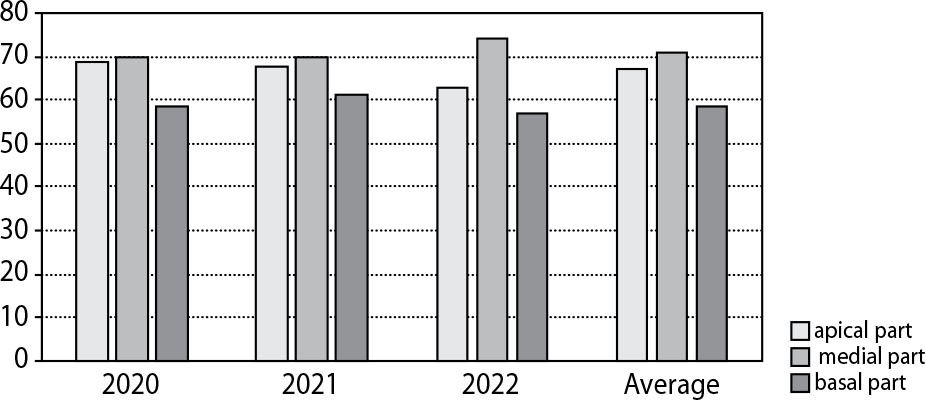
Figure 2.
The influence of the type of cutting on rooting in green Viburnum cuttings of the ordinary variety Velikoplidna, harvested from intensive growth of shoots, %
Among this type of cuttings, a significant advantage in rooting was observed in cuttings harvested from the medial part of the shoot. A significant advantage in rooting of two-node cuttings was recorded in cuttings harvested from the medial parts of the shoot compared to two-node apical and basal ones. During the period of mass flowering, three-node cuttings had a significantly higher rooting rate, regardless of the part of the shoot from which they were prepared, averaging 72.1–84.2% during the research period.
When analyzing the rooting of different types of cuttings selected during the period of slow growth of shoots, it should be noted that three-node cuttings showed a significant advantage over other cuttings in this period, achieving 45.9–53.5% depending on the shoot zone (Tab. 5).
Table 5.
Rooting of cuttings of the Velikoplidna variety harvested during the period of slow growth of shoots, depending on the type of cutting, %
| Type of cutting (number of nodes) | 2020 | 2021 | 2022 | Average for 3 years |
|---|---|---|---|---|
| Apical part | ||||
| 1 | 30.5 | 30.7 | 29.5 | 30.2 |
| 2 | 43.1 | 40.2 | 43.2 | 42.1 |
| 3 (control) | 53.5 | 51.1 | 55.9 | 53.5 |
| Medial part | ||||
| 1 | 21.2 | 20.2 | 20.4 | 20.6 |
| 2 | 37.1 | 34.1 | 37.5 | 36.2 |
| 3 (control) | 49.5 | 47.1 | 50.1 | 48.9 |
| Basal part | ||||
| 1 | 20.4 | 19.6 | 20.9 | 20.3 |
| 2 | 32.2 | 29.3 | 31.1 | 30.8 |
| 3 (control) | 44.9 | 45.2 | 47.8 | 45.9 |
| LSD05 | 6.3 | 6.1 | 5.7 | |
Three-node cuttings harvested from the apical part showed the best rooting – 53.5%, which is 11.4% more than two-node and 23.3% higher than single-node cuttings also harvested from the apical part of the shoot. Among the different types of cuttings harvested from the medial part, three-node cuttings were also noted for their better rooting – 48.9%, while single-node – 20.6% and two-node – 36.2%. The lowest percentage of rooted cuttings was observed in single-node cuttings harvested from the basal part of the shoot.
The total number of roots of the first- and second-order branching in three-noded cuttings harvested during the period of intensive shoot growth, depending on the shoot zone, was 190.4–235.9 pieces, whereas this indicator in two-noded cuttings was 130.4–215.1 pieces and in single-noded ones 95.9–143.7 pieces. Among cuttings harvested from different parts of the shoot, in this period, a significant advantage was recorded in medial cuttings. Three-node medial cuttings had 54.6 more pieces of roots compared to similar apical cuttings and 100.1 more pieces compared to basal ones. In two-noded medial cuttings, the total number of roots of the first- and second-order branching was 215.1 pieces, whereas for apical ones it was 179.8 pieces and for basal ones it was 130.4 pieces (Tab. 6).
Table 6.
The influence of the type of cutting on the number of roots in cuttings of the Velikoplidna variety harvested during the period of intensive growth of shoots, cm
| Type of cutting (number of nodes) | 2020 | 2021 | 2022 | Average for 3 years | ||||
|---|---|---|---|---|---|---|---|---|
| root branching order | ||||||||
| 1 | 2 | 1 | 2 | 1 | 2 | 1 | 2 | |
| Apical part | ||||||||
| 1 | 14.7 | 131.7 | 19.1 | 95.7 | 15.5 | 102.6 | 16.4 | 110.0 |
| 2 | 19.6 | 175.6 | 25.1 | 131.7 | 21.1 | 166.4 | 21.9 | 157.9 |
| 3 (control) | 24.2 | 206.5 | 31.2 | 203.5 | 27.2 | 215.2 | 27.5 | 208.4 |
| Medial part | ||||||||
| 1 | 16.5 | 120.4 | 21.1 | 133.6 | 16.1 | 123.6 | 17.9 | 125.8 |
| 2 | 22.1 | 181.7 | 27.1 | 200.1 | 23.1 | 191.2 | 24.1 | 191.0 |
| 3 (control) | 27.0 | 222.5 | 34.6 | 294.5 | 30.0 | 265.0 | 30.5 | 260.6 |
| Basal part | ||||||||
| 1 | 10.9 | 75.7 | 14.9 | 92.6 | 12.2 | 81.7 | 12.6 | 83.3 |
| 2 | 15.1 | 100.7 | 20.4 | 127.6 | 18.1 | 110.4 | 17.5 | 112.9 |
| 3 (control) | 18.7 | 150.5 | 26.2 | 180.7 | 24.2 | 170.7 | 23.1 | 167.3 |
| LSD05 | 2.3 | 9.6 | 3.3 | 9.5 | 2.4 | 11.5 | ||
The length of roots in cuttings increased significantly with an increase in the number of nodes. The length of the roots of the first order per cutting was 132.1 cm from the apical part of the shoot, 160.8 cm from the medial part and 109.8 cm from the basal part. An increase in the number of nodes to two caused a significant increase in the length of the roots of the first order: in apical ones – up to 200.6 cm, in medial ones – 229.8 cm, in basal ones – 70.8 cm compared to single-node ones. Throughout the research period, three-node cuttings had a significant advantage in terms of this indicator compared to both two-node and one-node cuttings (Tab. 7).
Table 7.
The influence of the type of cutting on the length of the roots in cuttings of the Velikoplidna variety harvested during the period of intensive growth of shoots, cm
| Type of cutting (number of nodes) | 2020 | 2021 | 2022 | Average for 3 years | ||||
|---|---|---|---|---|---|---|---|---|
| root branching order | ||||||||
| 1 | 2 | 1 | 2 | 1 | 2 | 1 | 2 | |
| Apical part | ||||||||
| 1 | 120.4 | 192.7 | 155.6 | 192.6 | 120.2 | 172.4 | 132.1 | 185.9 |
| 2 | 192.6 | 265.6 | 228.7 | 277.2 | 175.7 | 255.3 | 200.6 | 266.1 |
| 3 (control) | 260.6 | 321.6 | 321.9 | 343.8 | 264.6 | 312.1 | 282.3 | 325.8 |
| Medial part | ||||||||
| 1 | 155.2 | 175.5 | 200.5 | 215.6 | 126.9 | 192.4 | 160.8 | 194.5 |
| 2 | 210.5 | 260.1 | 277.4 | 301.7 | 201.5 | 281.4 | 229.8 | 281.1 |
| 3 (control) | 280.8 | 359.9 | 366.1 | 386,2 | 290.7 | 373.7 | 302.5 | 373.2 |
| Basal part | ||||||||
| 1 | 95.6 | 100.1 | 111.7 | 175.2 | 112.3 | 121.7 | 109.8 | 132.3 |
| 2 | 120.7 | 170.2 | 192.6 | 243.6 | 201.7 | 210.2 | 171.6 | 208.0 |
| 3 (control) | 195.8 | 260.4 | 273.8 | 325.2 | 295.7 | 295.1 | 254.9 | 302.8 |
| LSD05 | 9.8 | 8.5 | 8.3 | 8.1 | 7.2 | 7.5 | ||
The number of roots in the cuttings harvested from the apical part of the shoot during the period of slow growth of the shoots, regardless of the type of cutting, significantly outweighs the cuttings harvested from the medial and basal parts of the shoot (Tab. 8).
Table 8.
The influence of the type of cutting on the number of roots in cuttings of the Velikoplidna variety harvested during the period of slow growth of shoots, pcs.
| Type of cutting (number of nodes) | 2020 | 2021 | 2022 | Average for 3 years | ||||
|---|---|---|---|---|---|---|---|---|
| root branching order | ||||||||
| 1 | 2 | 1 | 2 | 1 | 2 | 1 | 2 | |
| Apical part | ||||||||
| 1 | 13.3 | 47.1 | 13.1 | 49.2 | 11.3 | 45.5 | 12.5 | 47.2 |
| 2 | 17.1 | 95.5 | 18.2 | 91.1 | 17.2 | 95.1 | 42.1 | 93.9 |
| 3 (control) | 21.7 | 139.5 | 21.2 | 125.7 | 23.7 | 136.7 | 53.5 | 133.9 |
| Medial part | ||||||||
| 1 | 8.4 | 40.2 | 8.8 | 30.2 | 8.2 | 32.2 | 8.4 | 34.2 |
| 2 | 12.1 | 60.1 | 13.8 | 50.1 | 12.1 | 51.4 | 12.6 | 53.8 |
| 3 (control) | 16.7 | 88.5 | 19.4 | 79.7 | 18.2 | 89.7 | 18.7 | 85.9 |
| Basal part | ||||||||
| 1 | 7.1 | 29.1 | 7.0 | 24.8 | 9.5 | 38.1 | 7.0 | 30.6 |
| 2 | 11.0 | 50.9 | 10.1 | 41.4 | 10.7 | 50,1 | 10.4 | 47.4 |
| 3 (control) | 15.2 | 71.2 | 16.2 | 70.7 | 15.5 | 72.5 | 15.6 | 71.4 |
| LSD05 | 3.2 | 6.1 | 4.1 | 5.2 | 3.7 | 8.1 | ||
The decrease in the number of nodes led to a significant decrease in the number of roots in two-node and one-node cuttings. Thus, in two-node apical cuttings, the number of roots of the first- and second-order branching was 111.4 pieces, in medial ones – 66.4 pieces, basal – 57.8 pieces.
In single-node cuttings, the largest number of roots was recorded in the apical ones – 59.7 pieces, the smallest in the basal ones – 37.6 pieces.
Apical cuttings significantly prevailed in the length of adventitious roots (Tab. 9).
Table 9.
The influence of the type of cutting on the total length of the roots in cuttings of the Velikoplidna variety harvested during the period of slow growth of shoots, cm
| Type of cutting (number of nodes) | 2020 | 2021 | 2022 | Average for 3 years | ||||
|---|---|---|---|---|---|---|---|---|
| root branching order | ||||||||
| 1 | 2 | 1 | 2 | 1 | 2 | 1 | 2 | |
| Apical part | ||||||||
| 1 | 63.5 | 121.4 | 72.1 | 100.9 | 55.4 | 80.7 | 63.6 | 101.0 |
| 2 | 120.4 | 172.2 | 110.7 | 172.4 | 110.3 | 140.2 | 113.8 | 161.6 |
| 3 (control) | 190.3 | 248.5 | 189.5 | 232.3 | 176.9 | 239.1 | 185.5 | 239.9 |
| Medial part | ||||||||
| 1 | 42.2 | 61.1 | 41.1 | 51.9 | 39.9 | 50.2 | 41.1 | 54.4 |
| 2 | 81.2 | 110.3 | 92.7 | 100.4 | 87.7 | 110.7 | 87.2 | 107.1 |
| 3 (control) | 106.7 | 171.2 | 148.8 | 198.1 | 135.8 | 189.9 | 130.4 | 186.4 |
| Basal part | ||||||||
| 1 | 29.2 | 49.4 | 30.4 | 59.9 | 40.2 | 55.4 | 33.2 | 54.9 |
| 2 | 52.4 | 82.6 | 71.2 | 110.7 | 71.3 | 92.3 | 64.9 | 95.2 |
| 3 (control) | 82.2 | 133.2 | 126.8 | 183.9 | 111.1 | 151.7 | 106.7 | 156.2 |
| LSD05 | 7.6 | 8.1 | 6.9 | 6.1 | 3.0 | 9.3 | ||
The total length of the roots of the first- and second-order branching in two-node cuttings harvested from the apical part of the shoot was 164.6 cm, the least branched among this type of cuttings was the adventitious root system of basal cuttings – 63.8 cm. The root system of two-node cuttings was more developed compared to single-node ones apical cuttings – 275.4 cm, which is 81.1 cm more than medial and 115.3 cm more than basal cuttings. In three-node apical cuttings, the total length of the roots was 425.4 cm, in medial – 316.8 cm, basal – 262.9 cm.
Among the different types of cuttings selected during the period of intensive growth of shoots, the growth of three-noded medial cuttings had a significant advantage. Over the three-year research period, the growth of three-node medial cuttings was 16.0 cm, which is 4.8 cm more than that of two-node medial cuttings by 7.7 cm – one-node. Three-node medial cuttings significantly prevailed over the same type of apical and basal cuttings throughout the study period. Analyzing the growth of the above-ground part of rooted single-node and two-node cuttings, it should be noted a significant advantage over the study period of two-node cuttings (Tab. 10).
Table 10.
The influence of the type of cutting on the growth of cuttings of the Velikoplidna variety harvested during the period of intensive growth of shoots, cm
| Type of cutting (number of nodes) | 2020 | 2021 | 2022 | Average for 3 years |
|---|---|---|---|---|
| Apical part | ||||
| 1 | 4.9 | 3.1 | 6.1 | 4.8 |
| 2 | 7.1 | 6.3 | 9.2 | 7.5 |
| 3 (control) | 11.9 | 10.1 | 12.4 | 11.4 |
| Medial part | ||||
| 1 | 7.7 | 7.1 | 10.2 | 8.3 |
| 2 | 10.5 | 10.2 | 13.0 | 11.2 |
| 3 (control) | 16.1 | 14.9 | 17.0 | 16.0 |
| Basal part | ||||
| 1 | 1.5 | 0.9 | 0.5 | 0.9 |
| 2 | 3.1 | 3.2 | 2.1 | 2.8 |
| 3 (control) | 6.1 | 5.8 | 5.6 | 5.8 |
| LSD05 | 2.7 | 0.7 | 0.6 | |
In the cuttings harvested during the period of slow growth of the shoots, the largest increase in three-node apical cuttings is 5.3 cm, which is 1.6 times more than in the medial cuttings and 1.9 times more than in the basal ones.
Therefore, the optimal type for green Viburnum cuttings is a three-node cutting. If there is a shortage of material for grafting, double-knotted cuttings can be used.
In cuttings harvested during the period of slow growth of shoots, the growth of three-noded apical cuttings significantly exceeded those of the same type from the medial and basal parts of the shoot. It should be noted that there is no significant difference between the growth of rooted three-node medial and basal cuttings in 2020. During the period of research in single-node basal cuttings (Fig. 3).
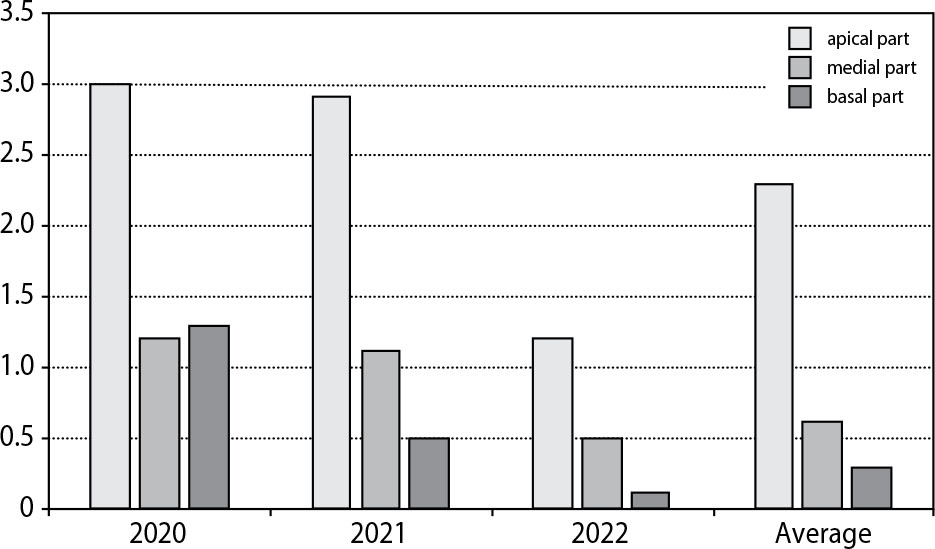
Figure 3.
The influence of the type of cutting on the growth of cuttings of the Velikoplidna variety harvested during the period of slow growth of shoots, cm
There was no increase; only in 2020 was a slight increase recorded in medial ones, while the largest and significantly higher increase among this type of cuttings was observed in apical cuttings. Therefore, the optimal type for Viburnum cuttings is a three-node cutting. If there is a shortage of material for grafting, double-knotted cuttings can be used.
Conclusions
A comparative analysis of the research data revealed that different methods of reproduction affect the rooting process of the Velikoplidna variety as follows:
The optimal type of scion for the Velikoplidna variety is three-noded.
The rooting and subsequent growth and development of rooted three-node cuttings of Viburnum of the ordinary Velikoplidna variety significantly outweigh similar indicators of two- and one-node cuttings.
If production requires, two-node cuttings can be used.
For the Velikoplidna variety, a single-node scion is insufficient for effective grafting.