
Introduction
The species of genus Ulmus L. are very ancient inhabitants of Earth: their pollen was found in the Miocene deposits of most European regions (Łańcucka-Środoniowa 1963). In the middle Holocene, the species of the genus Ulmus became permanent elements of the European non-native forests, spreading from Western Europe to the Urals from the refugia of the Portuguese mainland forests (Monteiro-Henriques et al. 2010). In the Carpathians, species of the genus Ulmus appeared during the Atlantic phase of the Holocene (Firbas 1949). In the 20s and 70s of the XX century, elms were practically eliminated from the broad-leaved forests of Europe due to two epidemics caused by the hypervirulent phytopathogenic fungi Ophiostoma ulmi (Buisman) Melin & Nannf (1934) (Syn. Graphium ulmi M.V. Shwarz (1922), Ceratocystis ulmi (Buisman) C. Moreau (1952), Ceratostomella ulmi Buisman (1932)) (Index Fungorum, 2023) and Ophiostoma novo-ulmi Brasier (1991) and O. himal-ulmi Brasier & Mehrotra (1995) (Caudullo and De Rigo 2016). This disease of elms was called either Dutch because of its widespread distribution in Holland or graphiosis after the old name of its causative agent Graphium ulmi M.V. Schwarz (Jernelöv and Jernelöv 2017; Thomas et al. 2018). The modern name of this disease Dutch elm disease (DED) accurately describes its typical symptoms: infected elm trees, preventing the progress of the phytopathogen along the upward (xylem) flow of substances in the trunk, clogging the vessels with gums, which eventually leads to a lack of water, wilting and dieback of the trees (Thomas et al. 2018; Bernier 2022). Agents of DED spread are elm bark beetles (Coleoptera, Curculionidae: Scolytinae) (Santini and Faccoli 2015; Jürisoo et al. 2021) and xylobiont nematodes (Polyanina et al. 2019). In addition to the causative agents of mycoses, other phytopathogens – phytoplasmas (Flower et al. 2018) and phytopathogenic bacteria – also affect the health condition of weakened elm trees (Alizadeh 2017; Ali et al. 2020). In particular, the bacterium Xylella fastidiosa Wells et al. causes bacterial burn of elm leaves (Ali et al. 2020). Large-scale studies are underway on potential biological control of DED spread (Büchel et al. 2016; Martín et al. 2019; Scheffer and Strobel 2020) and searching for resistant elm individuals (Domínguez et al. 2022). It has been researched that almost all European elm species are susceptible to infection, but only Ulmus glabra Huds. (IPNI ID: 856863-1, GBIF ID: 5361866, The PlantList ID: kew-2448690) is the most resistant to DED (Gravendeel et al. 2009).
Considering the features of the pathogenesis and the rapid spread of DED, the test use of a Geographic Information System (GIS) for the epidemiological examination of elm diseases, in particular, and the diagnosis and forecasting of the spread of bacterial wetwood has begun (Alizadeh et al. 2017), for which the symptoms are formation of cracks and wounds on the branches and trunks of elms, leakage of bacterial fluid from the affected organs in the spring and a strong smell of fermentation (Alizadeh 2017). Bacterial wetwood is one of the most common and dangerous diseases of forest trees, in particular, Quercus robur L. (Kulbanska et al. 2023; Alizadeh 2017; Alizadeh et al. 2017), Betula pendula Roth (Goychuk et al. 2020) and Abies alba Mill. (Kulbanska et al. 2022). According to the results of biochemical and molecular tests, the causative agents of this pathology were identified, namely, representatives of several genera of bacteria: Clostridium, Bacillus, Enterobacter, Klebsiella and Pseudomonas (Alizadeh 2017). In particular, some species were identified: Enterobacter nimipressuralis (Carter 1945) Brenner et al. 1988 (Khodaygan et al. 2012), Brevundimonas bullata (Gray and Thornton 1928) Kang et al. 2009, Paracoccus alcaliphilus Urakami et al. 1989, P. marcusii Harker et al. 1998 and Luteimonas aestuarii Roh et al. 2009 (Alizadeh et al. 2017).
Due to the complex impact of abiotic (Shvydenko et al. 2018) and biotic environmental factors, the Dutch disease pandemic has led to a decrease in the population density of U. glabra, a transformation in gene flow and pollination patterns, which poses a serious threat to its existence (Devetaković et al. 2019). That is why U. glabra received the status of Noble Hardwoods (uncommon valuable forest species) and is protected by the European Program of Forest Genetic Resources (EUFORGEN) and requires preservation of the evolutionary potential in situ through the cooperation of all countries within the range of its distribution (Aravanopoulos et al. 2015).
Ukraine joined the conservation programmes of the European population of U. glabra, giving it the status of a species with small populations and creating the only genetic reserve with an area of 2.5 ha on the territory of the Carpathian National Nature Park. Agricultural techniques have been developed to create artificial elm stands, including the use of local seed material and the natural regeneration of elm trees over 70 years old from DED lesions that have shown resistance to the disease (Debryniyuk and Skol’skyy 2012). The search for resistant age-old generative individuals of U. glabra is an extremely important scientific task that can be used in practical forestry to restore elm forests. After all, it is with the help of phytopathogen-resistant woody plants that European countries, in particular, Germany, are restoring lost elm forests and park stands. For example, single trees of U. glabra surviving the Dutch disease were found in the floodplain forests of Roztochchya (Pokutsky Carpathians) (Soroka 2008). A coenopopulation of this species is being studied, some trees of which are more than 100 years old. The U. glabra coenopopulation in the Pokutsky Carpathians is relict in nature, as it is a remnant of the wet forests of the Alno–Ulmion Br.-Bl union. et R. Tx. 1943, which, as a result of dynamic changes in vegetation and a drop in the groundwater level, are gradually transformed into forests of Tilio platyphyllis–Acerion pseudoplatani Klika 1955.
The examined coenopopulation does not belong to the complex of beech forests, as traditionally believed, but is an independent element of groups of rare mountain vegetation.
Although in recent decades the intensity of the spread of Dutch disease in the forests of Ukraine has decreased (Debryniyuk and Skol’skyy 2012), author’s research recorded a new wave of weakening and dieback of age-old generative individuals of U. glabra in the Pokutsky Carpathians due to the spread of another disease of bacterial aetiology.
If in the past the death of U. glabra individuals was mainly caused by mycoses, at the present stage, even trees resistant to mycoses are dying from bacterial infections. Therefore, special attention was needed to study the primary symptoms of infection and the features of pathogenesis of bacterial wetwood of U. glabra for early diagnosis and identification of individual plants with biotic resistance to it.
Methods
The aim of the research was to evaluate the current phytosanitary state of trees of the relict coenopopulation of U. glabra, identify the factors of their weakening and dieback, study the pathogenesis and aetiology of the disease and experimentally confirm its causative agent. The object of the research was old U. glabra trees. The subject of the study was the pathogenesis of bacterial wetwood as a leading factor in weakening and dieback of U. glabra trees.
The research was carried out during 2019–2023 in the forests of the ‘Kutske Forestry’ branch of the State Specialised Enterprise ‘Forests of Ukraine’. According to the geobotanical zoning of Ukraine, the study area belongs to the district of beech forests of the Ukrainian Carpathians, the subdistrict of dark coniferous–beech water-divided forests of the region of Pokuttia-Bukovina spruce-firbeech and spruce-beech-fir forests (Golubec 2003).
Based on a 5-year assessment of tree health condition, detailed field surveys and the collection of biotic material, with further laboratory analysis, the main threats that could lead to death of the old U. glabra trees were identified.
During the survey of the forests of the branch of ‘Kutske Forestry’ in the forest fund of the Kosivske Forestry (compartment 31, subcompartment 9) in the gorge of a forest stream on the slope of the southern exposure with a steepness of 5°, a coenopopulation of old U. glabra trees was found on an area of about 1 ha. The find is unique considering the epiphytotics of the Dutch disease in the last century, which caused the mass dieback of elms in the forests of Europe. The identified coenopopulation consists of 15 U. glabra trees about 100 years old and even includes many juvenile and virginal individuals, which can be a reserve for creating genetic stands.
Health condition of trees was estimated following the Sanitary Forest Regulations (Sanitary Forests Regulations in Ukraine 2016) in six categories – I (healthy), II (weakened), III (very weakened), IV (drying), V (recently died) and VІ (dead over a year ago). Crown defoliation was assessed visually in percentage: 0 – absent; 1 point – up to 10%; 2 points – 11%–50%; 3 points – 51%–75%; 4 points – more than 75%. The presence of epicormic shoots was assessed by points: 0 – absent; 1 – single; 2 – multiple; 3 – completely covered trunk.
To evaluate the biodiversity of the relict elm coenopopulation, an inventory of the flora of higher plants, phytosociological descriptions for biotope identification and sampling of fruiting body samples of xylodestructors and litter macromycetes were carried out.
Vegetation research was carried out on the basis of ecological and floristic classification using the method of J. Braun-Blanquet (1964). The structure and names of syntaxons were provided by W. Matuszkiewicz (2023).
Latin names of species are given according to electronic databases: higher plants – according to World Flora Online (http://www.worldfloraonline.org/), mycobiota – according to Index Fungorum (http://www.indexfungorum.org), microbiota – by: List of Prokaryotic names with Standing in Nomenclature (http://www.bacterio.cict.fr/e/erwinia.html).
Wood samples of U. glabra affected by bacteriosis were used for bacteriological research. The material for analysis was selected at the border of externally healthy and affected wood with signs of browning (Fig. 1).
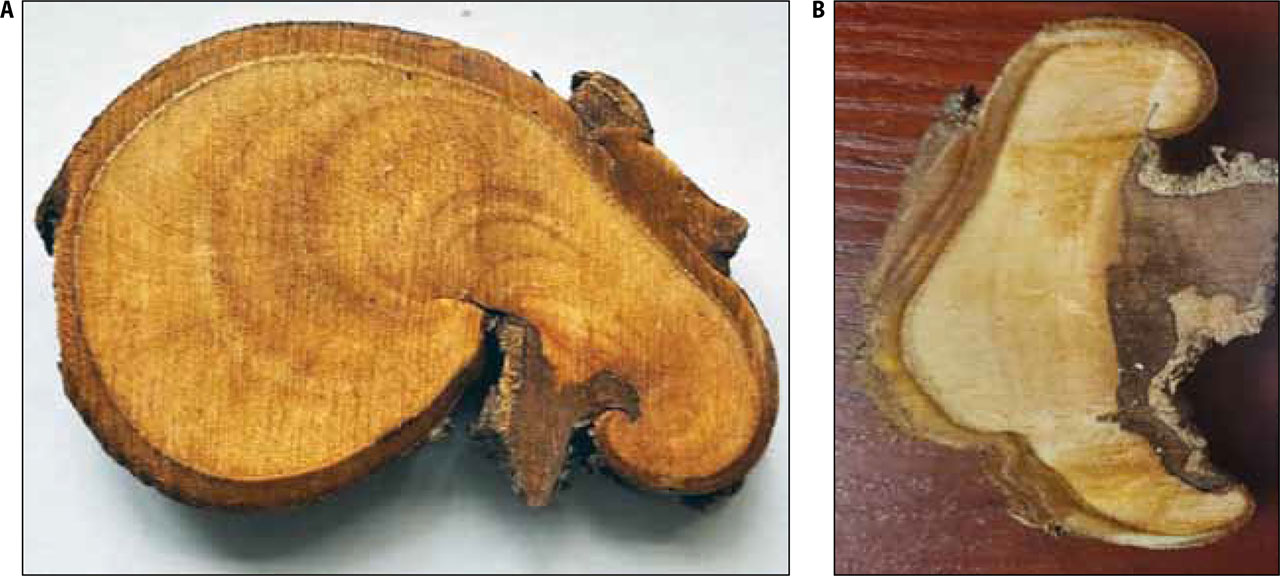
Figure 1.
Samples of U. glabra wood with typical browning of infected tissues: sample 1 (A) and sample 2 (B)
Bacteriological analysis was carried out in vitro at the laboratory of the Department of Phytopathogenic Bacteria of the D.K. Zabolotny Institute of Microbiology and Virology of the National Academy of Sciences of Ukraine (IMV NASU), Their diagnosis was carried out by comparing their characteristics with the characteristics of the collection strain Lelliottia nimipressuralis 8791 from the collection of phytopathogenic bacteria (Bergey 2005), namely, by homogenisation of plant material followed by sowing on agarised nutrient media in Petri dishes and growing for 4–5 days at +28 ºC under thermostat. The isolated bacteria were tested for the presence of oxidase and protopectinase, as well as stained by Gram staining. Isolates of oxidase-negative bacteria were identified by their anatomical–morphological and physiological–biochemical characteristics (Kovak’s test, Hugh–Leifson’s test, acid formation from carbohydrates, liquefaction of gelatin, formation of reducing sugars from sucrose, growth in 5% NaCl solution, etc.). Identification of bacterial isolates was also according to generally accepted methods (Patyka et al. 2017) and using the API 20E test system and the NEFERMtest24 test system MikroLaTEST®, Erba Lachema. The results were compared with the characteristics of the collection strain Lelliottia nimipressuralis 8791 and the characteristics of the bacteria given in Bergey’s Manual of Systematic Bacteriology (2006). The phytopathogenic properties of the isolates were tested by artificial infection with a bacterial suspension at a titre of 108–109 cl ml−1 in vivo and in vitro conditions of vegetative organs of U. glabra and test and indicator plants (Nicotiana tabacum L., Phaseolus vulgaris L., Kalanchoe laciniata L.).
Results
Detailed forestry and phytosociological studies have shown that a unique natural complex of mountain riparian forests has formed here, the taxa of which belong to three forest associations, rare on a European scale, which, due to climate changes, human economic activity and accompanying pathogenic processes in forests, have fallen into the zone of extinction risk. These are forest associations of the class Querco-Fagetea Br.-Bl. et Vlieg. 1937 – Stellario nemorum-Alnetum glutinosae Lohm., Ulmo glabrae-Aceretum pseudoplatani Issler 1926 and in the highest part of the slope – Dentario glandulosae-Fagetum W. Mat. 1964 et Guzikowa et Kornaś 1969 in three variants – Dentario glandulosae-Fagetum 1969 Picea abies, Dentario glandulosae-Fagetum 1969 Abies alba and Dentario glandulosae-Fagetum 1969 typicum. In the direction from the water flow upwards, they form a succession of hygrophilous vegetation in the altitudinal gradient of ravine forests. Syntaxon, within the phytocoenoses of which the U. glabra coenopopulation is registered, is diagnosed as a fragment of the Ulmo glabrae-Aceretum pseudoplatani association based on general phytocoenotic features. Individuals of U. glabra were preserved only on the first terrace of the riparian part of the water stream, forming a strip that follows Stellario nemorum-Alnetum glutinosae. In this biotope, the most important edifiers are individuals of U. glabra, among which 15 trees are old. General appearance of old U. glabra trees are shown in the figure (Fig. 2).
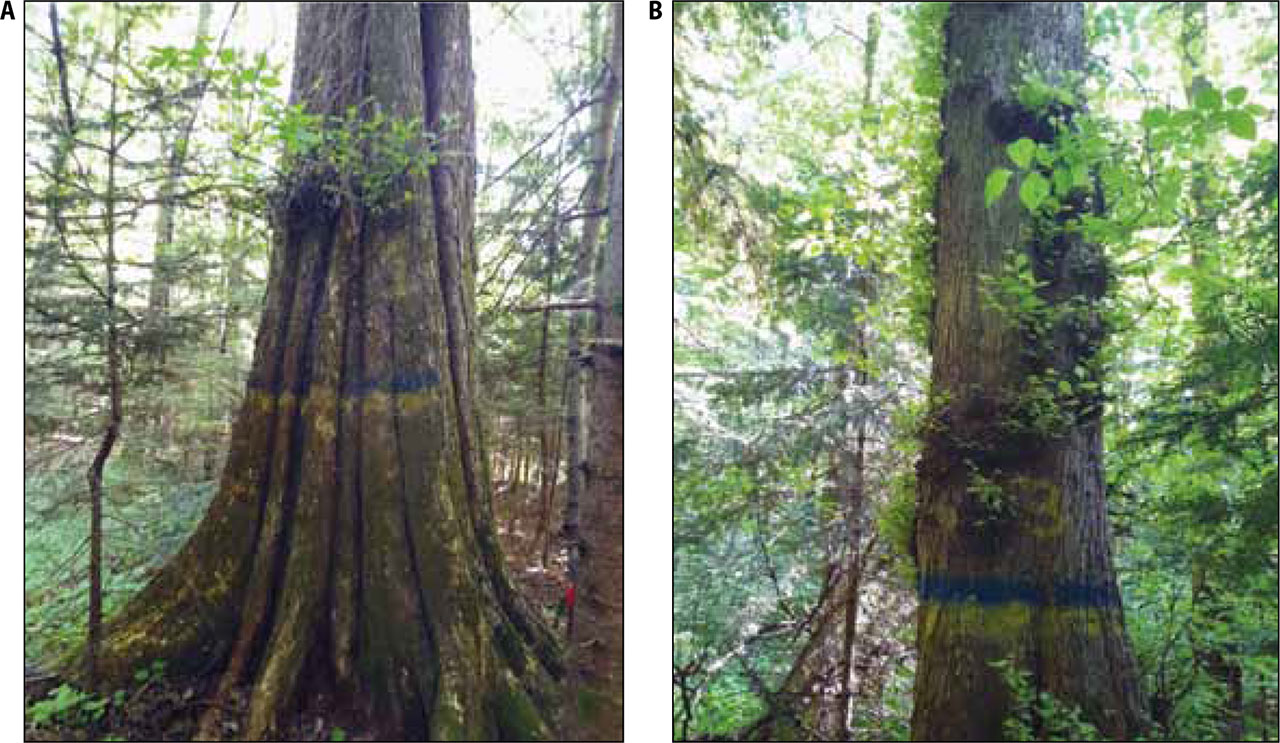
Figure 2.
General appearance of old U. glabra trees: accounting tree No 1 (A) and accounting tree No 3 (B)
The assessment took into account the category of sanitary condition, the degree of defoliation and the presence/absence of epicormic shoots and vegetative buds (Tab. 1).
Table 1.
Characteristics of the health condition of old U. glabra trees and causes of their weakening
| Numbers of trees | Forest measurement parameters | Category of health condition | Defoliation, points | Epicormic shoots and vegetative buds, points | Causes of weakening | |
|---|---|---|---|---|---|---|
| diameter, cm | height, m | |||||
| 1 | 52 | 30 | I | 0 | 0 | – |
| 2 | 52 | 29 | III | 2 | 2 | Bacterial wetwood |
| 3 | 32 | 27 | I | 0 | 0 | – |
| 4 | 40 | 28 | II | 1 | 1 | Dieback |
| 5 | 90 | 32 | II | 2 | 2 | Bacterial wetwood |
| 6 | 24 | 20 | I | 1 | 0 | – |
| 7 | 28 | 22 | I | 0 | 0 | – |
| 8 | 24 | 18 | II | 1 | 1 | Leaf deformation, brown leaf spot |
| 9 | 28 | 20 | I | 0 | 0 | – |
| 10 | 48 | 28 | I | 1 | 0 | – |
| 11 | 86 | 33 | III | 2 | 3 | Bacterial wetwood, Cerioporus squamosus |
| 12 | 56 | 30 | I | 0 | 0 | – |
| 13 | 36 | 28 | II | 1 | 1 | Leaf deformation |
| 14 | 68 | 32 | II | 1 | 1 | Cerioporus squamosus |
| 15 | 56 | 31 | I | 0 | 0 | – |
In recent years, the existence of this relict elm population, which has survived the epiphytotic Dutch disease, is threatened by a number of biotic factors, among which a symptom of a bacteriosis, a dangerous infectious disease, has been diagnosed based on typical macroscopic signs (Soroka 2008). In the lower part of the trunk, typical signs of damage by bacterial wetwood. The causative agent of wetwood is the phytopathogenic bacterium-polybiotroph Lelliottia nimipressuralis (Carter 1945) Brady et al. 2013 (confirmed experimentally).
Several associated phytopathogens of U. glabra were also identified. Thus, the assimilation organs are negatively affected by the spread of the fungi Taphrina ulmi (Fuckel) Johanson 1886 causes deformation, in particular, wrinkling and curling, as well as chlorotic leaves, Septogloeum ulmicolum (Biv.) Elenkin & Ohl 1912 and Septoria ulmi Ellis & Everh. 1897 cause leaf spotting, forming large 0.5–1.0 cm in diameter, rounded, dark brown spots with a light border. Withering of individual branches is caused by Nectria cinnabarina (Tode) Fr. 1849; as a result, water exchange is disturbed, leading to accelerated dieback of branches and leaves.
Single fruiting bodies of Cerioporus squamosus (Huds.) Quél., 1886 were recorded on the trunk. Even though Cerioporus squamosus is an edible mushroom of category 4 when young, it is a typical parasite that penetrates through mechanical damage to the trunk or branches of trees and causes white, finely fissured central rot. In the biotope of the Ulmo glabrae-Aceretum pseudoplatani coenosis, we described an accompanying non-pathogenic mycobiota that forms consortial relationships of various orders with elm trees.
Among epiphytic lichen biota, on the bark of the trunks, Flavoparmelia caperata (L.) Hale, Hypogymnia physodes (L.) Nyl., Parmelia sulcata Taylor and Lecanora carpinea (L.) Vain. were identified. Lichens are rare in these forests, as the bark of old elms does not allow them to grow. It is known (Asplund and Wardle 2017) that lichens almost do not harm trees, as they rarely penetrate to the living cells of the phellogen. However, by inhabiting the bark, they complicate gas exchange, delay the flow of precipitation and thereby promote the development of phytopathogenic myco- and microorganisms, as well as harmful insects. In recent years, lichens have been proposed to be used as indicators of the physiological condition of trees, in particular, focusing on their presence or absence, as well as the density of the substrate. Among the humus saprotrophs, large ‘witch rings’ of the fruiting bodies of Megacollybia platyphylla (Pers.) Kotl. & Pouzar, 1972 are most often found here and single specimens of Strobilomyces strobilaceus (Scop.) Berk, 1851 entered the Red Book of Ukraine (Didukh 2009).
A visual examination of old U. glabra trees revealed typical macroscopic symptoms of bacterial wetwood, which was confirmed during experimental research at the D.K. Zabolotny Institute of Microbiology and Virology of the National Academy of Sciences of Ukraine (IMV NASU). The registered signs are identical to the typical manifestations of bacteriosis of this type described in the special scientific literature (Meshkova et al. 2022), which confirms persistent signs of infection with bacterial wetwood regardless of the region of research and the type of woody plant.
Based on research and long-term observations in the elm forests of the Pokutsky Carpathians, the typical symptoms of U. glabra bacterial wetwood have been identified, which include the following morphological and anatomical signs and changes in the structures of infected trees:
Primary symptoms:
– sparse crown;
– accelerated wilting of leaves and shoots;
– change in colour (yellowing) and premature fall of the assimilation organs on individual shoots or in general the entire crown of the tree;
– wet basal part of the trunk and
– longitudinal cracks on the bark are a typical diagnostic sign of bacterial wetwood, which indicates the transition of the disease into the active phase.
The active phase of the disease
– Release of bacterial exudate from cracks, which is active in April–May, and later it dries on the surface of the bark, forming visible dark wetting spots, which flow down the trunk from the site of infection and later spread over the soil surface. Exudate is a liquid of viscous consistency, brownish-brown in colour, which is a mixture of bacterial cells and the sap of a woody plant, which has a typical unpleasant smell of fatty acid fermentation and is accompanied by the formation of bubbles (Fig. 3A).
– At the base of dieback branches, black wetting spots and ulcers form on the bark, sometimes depressed wounds of various shapes and sizes. Over time, the bark around these formations dies. When removing the surface layer of the periderm and a part of the primary bark, you can see brown or dark brown necrotic areas, sometimes with a purple tint, extending from the site of primary infection up and down for a length of 0.3–0.8 m and more (Fig. 3B).
– Massive formation of epicormic shoots on the trunks. Epicormic shoots are shortened, have chlorotic, pale or yellowish underdeveloped leaves and form very characteristic ‘witches’ brooms’ (Fig. 3C).
– A pathological or fault star-shaped core is visualised on the cross section of the trunk. The wood of this pathological core is moist, with a sharp sour smell.
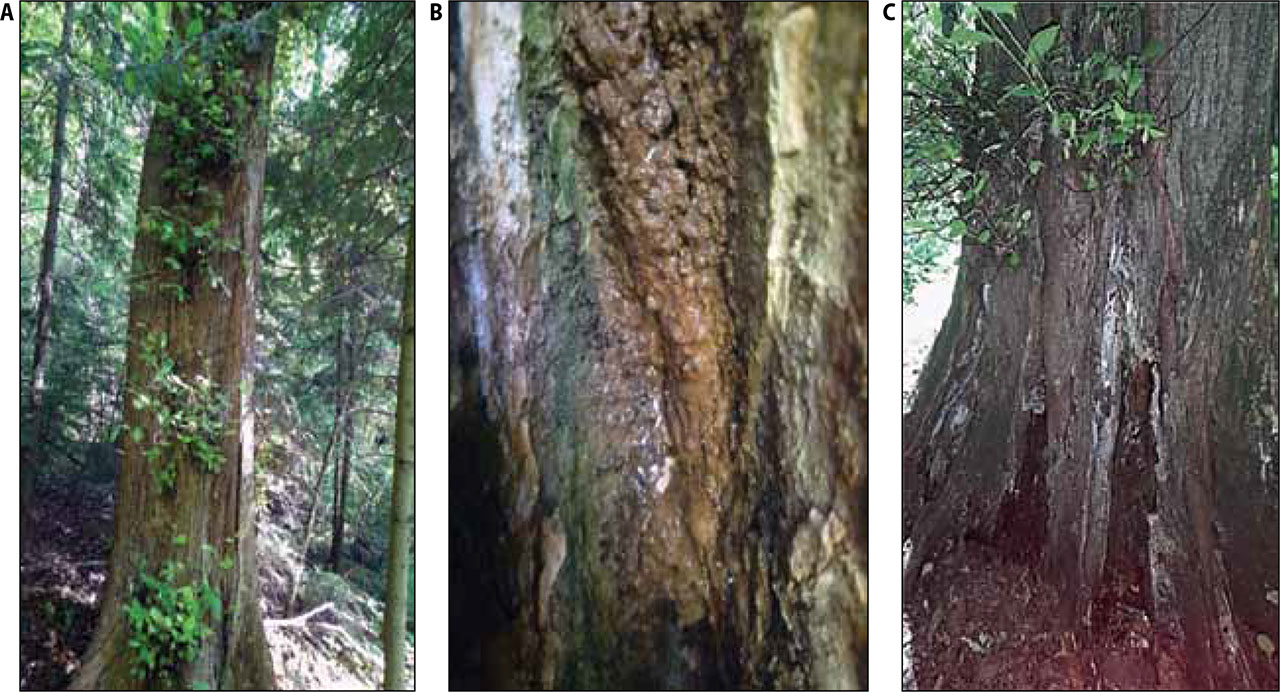
Figure 3.
Macro signs in the trunk of U. glabra infected with bacterial wetwood: A – leakage of bacterial exudate, B – longitudinal ulcers in the lower part of the trunk, C – mass formation of ‘witches’ brooms’
Secondary changes in the late stages of the disease
– At the final stage of bacterial wetwood, the pathogenesis is accompanied and enhanced by xylotrophs and wood-staining fungi. Under such conditions, blackening of the annual rings on the cross section of the trunk, deformation and curvature of the branches and tops are observed.
– The trees show dieback of the crown, damage to the roots and rapid dieback.
Based on the results of bacteriological analysis, isolates of oxidase-negative bacteria in grey colonies were isolated from the affected wood of U. glabra (Tab. 2).
Table 2.
Characterisation of bacteria isolated from U. glabra wood samples against collection strain and identifier
| Tests | Tested bacteria | Lelliottia nimipressuralis | |
|---|---|---|---|
| collection strain 8791 | Bergey, 2005 | ||
| Gram stain | − | − | − |
| Bacterial motility | + | + | + |
| Yellow pigment | − | − | − |
| Oxidase | − | − | − |
| Nitrate reduction | + | + | + |
| Protopectinase | − | − | − |
| Use of glucose (anaerobic) | + | + | + |
Isolates from elm wood, as well as the collection strain Lelliottia nimipressuralis 8791, were found to be motile Gram-negative rods with a ‘bacillus’ cell morphology. The studied bacteria are facultative anaerobes, use glucose both in aerobic and anaerobic conditions and reduce nitrates (Fig. 4).
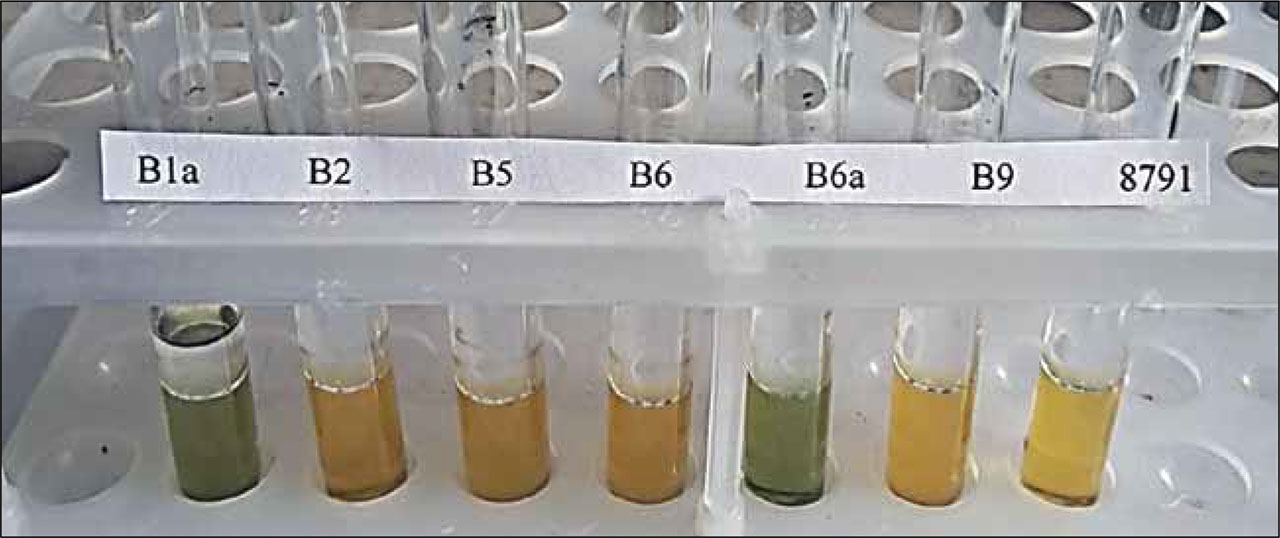
Figure 4.
Anaerobic growth of bacterial isolates from samples of infected U. glabra wood on Omelyansky medium with glucose (B1a, B2, B5, B6, B6a, B9 – conventional designations of bacterial isolates isolated from elm sample; 8791 – conventional designation of the collection strain)
Bacterial isolates do not produce gelatinase and protopectinase and give a positive Voges–Proskauer reaction. Bacteria use glucose, arabinose, sucrose, melibiose and amygdalin as the only source of carbon nutrition (Tab. 3). They do not use inositol and sorbitol and do not form indole and hydrogen sulphide. They also lack arginine hydrolase and lysine decarboxylase, but β-galactosidase and ornithine decarboxylase are present.
Table 3.
Properties of phytopathogenic bacteria isolated from U. glabra wood samples on API 20E strips
| Tests | Reaction/enzyme | Tested bacteria | Collection strain Lelliottia nimipressuralis 8791 |
|---|---|---|---|
| 1 | 2 | 3 | 4 |
| ONPG | β-galactosidase | + | + |
| ADH | arginine dihydrolase | − | − |
| LDC | lysine decarboxylase | − | − |
| ODC | ornithine decarboxylase | + | + |
| CIT | use of citrate | + | + |
| H2S | hydrogen sulphide production | − | − |
| URE | urease enzyme test | − | − |
| TDA | tryptophan deaminase | − | − |
| IND | indole test | − | − |
| VP | voges–proskauer test | + | + |
| GEL | gelatinase | − | − |
| GLU | glucose fermentation | + | + |
| MAN | fermentation of mannose | + | + |
| INO | fermentation of inositol | − | − |
| SOR | fermentation of sorbitol | − | − |
| SAC | fermentation of sucrose | + | + |
| MEL | fermentation of melibiose | + | + |
| AMY | fermentation of amygdalin | + | + |
| ARA | fermentation of arabinose | + | + |
Based on the conducted research and experiments, we can state that the lesions of U. glabra trees are caused by bacteria, which, based on their morphological, physiological and biochemical properties, are identified as Lelliottia nimipressuralis (Carter 1945) Brady et al. 2013 (Brady et al. 2013).
Discussion
A complex of biotopes of rare deciduous vegetation in the mountains of the Pokutsky Carpathians was studied, the specific conditions of which determined the preservation of old U. glabra trees, which survived the epiphytoty of the DED in the last century and could serve as donors of DED-resistant forms of elm to restore those lost due to DED of tree stands (Soroka 2008). In such conditions, the U. glabra coenopopulation has a relic character as a remnant of hygrophilous forests of the Alno-Ulmion Br.-Bl union. et R. Tx. 1943, which, as a result of global climate changes and subsequent vegetation dynamics, are transformed into forests of the union Tilia platyphyllis–Acerion pseudoplatani Klika 1955.
However, based on many years of research, it has been found that U. glabra trees resistant to mycosis and Dutch disease, in particular, have been damaged by a systemic vascular-parenchymal disease in recent years, which leads to the weakening and subsequent death of old trees. It has been studied that the drying of trees develops from the upper part of the crowns, and later longitudinal cracks are formed with the peeling of the bark, from which the exudate flows (Alizadeh 2017). In the lower part of the trunks, in deep folds, there are areas of wet rot with a typical sour smell. At this time, changes occur in the morphological structure of the trunk – numerous water shoots are formed and very characteristic ‘witches’ brooms’ are formed (Bernier 2022). In the anatomical structure, the browning of the xylem, the appearance of a sharp border between the areas of healthy and infected wood and the formation of a pathological core are noted. It was investigated and experimentally confirmed that the bacterial isolates isolated from the infected elm wood according to the studied characteristics are identical to the collection strain Lelliottia nimipressuralis 8791 from the collection of phytopathogenic bacteria of the Institute of Microbiology and Virology and fully correspond to the properties given in the Bacteria Identifier (Bergey 2005).
Thus, on the basis of natural and experimental studies, it was concluded that individuals of U. glabra, which survived the epiphytotics of the Dutch disease, in dieback due to infection with bacterial wetwood caused by the aggressive phytopathogenic bacterium-polybiotroph Lelliottia nimipressuralis (Carter 1945) Brady et al. 2013. It is also the causative agent of bacterial wetwood with similar symptomatic signs on other forest tree species (Goychuk et al. 2020).
Lelliottia nimipressuralis is the main and most dangerous agent of influence on the condition and viability of old U. glabra trees and in the coming years (given the intensity of reproduction and spread of phytopathogenic bacteria), may lead to their dieback. A prerequisite for the mass spread of bacterial wetwood within the relict coenopopulation of U. glabra in the conditions of the Pokutsky Carpathians is a decrease in plant resistance and immunity due to impact predictors, in particular, hydrothermal stress and climatic changes (Shvydenko et al. 2018; Zhang et al. 2018), as well as the development of destructive processes caused by less-aggressive infectious agents – pathogens of diseases of the assimilation organs, trunk rots, necrosis, phytophagous insects, etc.
Conclusions
In the mountains of the Pokutsky Carpathians, a complex of biotopes of rare deciduous vegetation was discovered, the specific conditions of which determined the preservation of old trees of Ulmus glabra, which survived the epiphytotic of the Dutch disease in the last century and could serve as donors of DED-resistant forms of elm.
It was established that individuals of Ulmus glabra resistant to mycoses, and Dutch disease, in particular, have been damaged by a systemic vascular-parenchymal disease in recent years, which leads to the weakening and death of old trees.
It has been investigated that the typical symptoms of the vascular-parenchymal disease of Ulmus glabra trees are the formation of longitudinal cracks with exfoliation, from which discharge of exudate with a sour smell occurs. Numerous water shoots and ‘witches’ brooms’ form on the trunk. In the anatomical structure, browning of the xylem and formation of a pathological core are noted.
It was experimentally confirmed that the causative agent of the disease identified is an aggressive phytopathogenic bacterium-polybiotroph Lelliottia nimipressuralis (Carter 1945) Brady et al. 2013, which causes similar symptoms of damage (typical symptoms of bacterial wetwood) on other species of forest woody plants.
Associated phytopathogens of elm trees are Taphrina ulmi (Fuckel) Johanson, Septogloeum ulmicolum (Biv.) Elenkin & Ohl, Septoria ulmi Ellis & Everh, Nectria cinnabarina (Tode) Fr. and Cerioporus squamosus (Huds.) Quél.
In the future, a promising direction of research is the development of specific methods and ways of protecting forest woody plants, in particular, using biological preparations based on Bacillus sp. and other myco- and microorganisms with available antagonistic properties to phytopathogens.