
Introduction
In global terms, humans have been the main driving force of change on the Earth’s surface for several hundred years (Vitousek et al. 1997). Landscape is the result of interactions between humans and nature (Hajto et al. 2020). Anthropogenic influence leads to major changes in the landscape, which represents the outcome of historical transformations in the natural and cultural environment, reflecting the efforts to satisfy societal needs (Zachariasz 2007), involved in the development of the economy, technology, or increased consumption (Hajto et al. 2020). Over the last few decades, these changes have intensified due to socioeconomic development, including transformations in forestry, agriculture, industry, and transport (Antrop 2004). They concern changes at the local and regional levels, directly and indirectly influencing decisions such as those related to forest management, and thus potentially shaping the landscape. Based on the available literature on the subject, the aim of this study was to identify the tasks and tools of forest management that can be/are implemented at the regional and local levels, and thus attempt to answer the question posed in the title of the study, that is, do these tasks affect the esthetic and ecologic values of the landscape in Poland?
Landscape
The landscape should be understood as a system of interrelated biotic, abiotic, and anthropogenic components which make up a spatial and temporal entirety. Its protection, shaping, and rational exploitation is in line with the premises of sustainable and balanced development (Degórski 2004), one of the priorities of the European Union, as evinced by, for example, the European Landscape Convention (Solon 2008). The latter instrument underscores the important role that landscape plays in preserving Europe’s natural and cultural heritage (Giedych 2004).
The landscape is the object of research in numerous sciences, with multiple definitions which elucidate it from general, geographic, natural, esthetic, and sociocultural standpoints (Senetra and Cieślak 2004). Landscape is conceived as a combination of natural and anthropogenic systems whose boundaries are clearly delimited. The landscape has a unique history and undergoes constant evolution (Hajto et al. 2020).
The most important international document is the European Landscape Convention, signed in 2000 in Florence (Hajto et al. 2020; Degórski et al. 2014). Its chief objective is to promote the protection and quality of landscapes through conservation, restoration, shaping, and planning (Giedych 2004; Janeczko 2012a). Regardless of the type, landscape should be a matter of interest for national law, which, in turn, is informed by the conventions in which the protection of biodiversity and cultural heritage is a key aspect (Hajto et al. 2020). The general principles governing spatial management are reflected in several important instruments of the European Community, such as the Pan-European Biodiversity and Landscape Strategy, the European Landscape Convention, and the European Spatial Development Perspective (Degórski 2004).
According to the Landscape Convention, landscape management means any action taken by human actors to tend to the environment, whether natural or cultural, at the local and regional levels as well as nationwide (Hajto et al. 2020). The implementation of the Convention made it necessary for all countries which ratified it (Chmielewski et al. 2015) to identify landscapes in a given area/country and determine their value (Balon and Krąż 2013). The first document in Poland to address the implementation of the aforementioned Convention was the National Spatial Development Concept 2030 (Janeczko 2016).
A landscape is a baseline space, an arrangement created by humans and nature, in which natural surroundings (Bobiec 2018), smells, sounds, tastes, and temperatures of nature (Degórski et al. 2014) are experienced through the senses. Since the sense of sight is responsible for approximately 85% of sensory perception (Janeczko et al. 2012; Janeczko 2016), in somewhat simplified terms, the landscape may be construed as the space that humans see. This is corroborated by the definition of landscape in the European Landscape Convention (The European Landscape Convention 2000): “an area, as perceived by people, whose character is the result of the action and interaction of natural and/or human factors.” Landscape boundaries are determined by human cognitive abilities, as opposed to administrative boundaries (Janeczko 2012a, 2016). Thus, there are no landscapes without value, and each is a unique result of the interaction between natural factors and human activity in a particular location (Gulinck et al. 2001). At the same time, all landscapes, including those that are considered natural today, possess their own distinct historical character owing to past human activity. The phenomena occurring in landscapes cannot be correctly interpreted without considering the current and historical role of the people who have been present there. This is the reason behind the increasing interest in multidisciplinary landscape research, which studies biological and ecologic aspects in conjunction with history, economics, anthropology, and forestry.
The ever-greater anthropopressure is accompanied by exacerbating destructive processes in landscapes, notably in terms of the decline and depletion of their diversity. The causes should be sought in mass tourism, intensification, and specialization of production processes or in economic and social modernization processes (Janeczko 2016). Anthropogenic fragmentation of the landscape is also a major problem (Pieńkowski and Kupiec 2015).
Forest Landscape
Forest landscape is the earliest landscape type in Poland (Stanowski 1983). It consists primarily of vegetation, which distinguishes it from other landscapes (Janeczko 2008). Forest landscape involves a spatial arrangement of natural assets, including vegetation (trees, shrubs, undergrowth), relief, and surface water, as well as elements resulting from human activity: roads, forest tracks, power lines, tourist and recreational infrastructure, religious sites, historical monuments, etc. (Janeczko 2008; Janeczko et al. 2012). The appearance of forest space depends, among other things, on the type of soil and forest habitat, species composition, age and depth of visibility in stands (Ważyński 1997), and architectural and cultural values (Janeczko 2016). The forest landscape also includes tree stands belonging to other natural spatial systems.
In scholarly inquiry, the esthetics of the forest became an object of interest in the late 19th century in Europe. At that time, Heinrich von Salisch published his Forstästhetik (Forest Aesthetics), in which he drew attention to the influence of forest management on landscape beautification. Previously, the notions of forest esthetics were informed by two approaches: according to one of them, one should intervene with cuts to highlight the beauty of the forest, whereas the other asserted that the absence of human interference is crucial if a forest is to be considered beautiful (Dudek 2017a).
The esthetic and landscape assets of the forest are determined by elements such as the course of the field–forest boundary, the diversity of the architecture of the forest interior (spatial structure, multiple layers, colors, tree dimensions, crown forms), the presence of water bodies, clearings, forest thinning, fauna and flora. These characteristics also bear on the assessment of the recreational potential of a forest (Stępień 2005). Other important factors include lighting, point of observation, or the composition of shapes and colors, which have a calming effect on the sensory structure and human psyche (Stanowski 1983). The spatial structure of the landscape of forested areas is altered when utilization of the mid-forest agricultural areas and forest management change (Nienartowicz et al. 2001; Tahvanainen et al. 2001; Radeloff et al. 2006; Shifley et al. 2006; Kunz and Nienartowicz 2006). Forest management should be carried out rationally, in harmony with nature (Stanowski 1983) and based on multifunctional and sustainable management of forest resources (Senetra 2015). Climate protection and rational use of water resources should also be taken into account in landscape planning (Degórski 2004). One of the key elements in forest management is timber harvesting (Pniewska and Janeczko 2020), which leads to forest transformation (Bobiec 2018). Other problems include uneven afforestation or high fragmentation of forest complexes. According to Janeczko (2016), this contributes to the deterioration of ecologic coherence of the space, reduces forest retention capacity, or generally undermines the functioning of ecosystems. Since the forest landscape has a considerable influence on the quality of human life, it is important to shape it properly (Janeczko 2012a).
Impact of forest management on the forest landscape
Forests are characterized by their peculiar layout, the percentage area of habitat, and the degree of fragmentation, which affects their landscape value (Solon 2002). The structure of a landscape determines its functions (Forman and Godron 1986), while varied landscape composition and configuration are important for its functioning (McGarigal et al. 2000).
Forest management has a number of tools at its disposal that influence the shaping of the landscape, its ecologic and esthetic values. Some of the basic tools are the applicable laws (e.g., the Forest Act, conventions ratified by Poland, such as the Biodiversity Convention, the European Landscape Convention) do mention the need for landscaping. The development of forested areas should be an integral effort in any given region as well as in the entire country. At present, however, forests and forest management do not really feature in regional planning in Poland (Kaliszewski et al. 2023), even though, according to Principles of Silviculture (2023), the functions of forests should be shaped at different decision-making tiers (including the regional level). In development planning, the determination of objectives and tasks should be informed by the premises of the region-specific land use policies, whereby regional development strategies and regional environmental programs are taken into account (Instruction of Forest Management 2012). However, this often presents a major formal as well as practical challenge (Kaliszewski et al. 2023).
Afforestation plans are an example of regional planning (but related to decisions taken at the local level). Their aim, in addition to increasing forest cover at the regional/national scale, is to ensure the appropriate size and location of new afforestation and to create appropriate conditions for the functioning of forest ecosystems in the landscape to optimally shape the structure of landscapes (Polityka leśna państwa 1997). In Europe, there has been an increase in forest area in the last three decades (up to 2020) (Global Forest Resources Assessment 2020). In Poland, the area of afforestation has decreased in recent years; in 2022, there were 109 ha less than in 2021, when afforestation was carried out on 518 ha of land of all forms of ownership. Between 2011 and 2022, a total of 28,400 ha were afforested. The largest amount of afforestation was carried out in the Łódzkie Voivodeship (60 ha) and the smallest in the Śląskie Voivodeship (less than 1 ha). The decrease in afforested area was undoubtedly influenced by the competitiveness of direct payments for agricultural production or changes in legislation (exclusion of permanent grassland from support for afforestation). However, for the State Forests, the reduction of the area designated for afforestation by the National Support Centre for Agriculture (Report on the State of Forests in Poland 2022) was a determining factor. The decrease in the rate of afforestation may continue in the following years. This may be counteracted, inter alia, by the Biodiversity Strategy 2030, as one of its objectives is to plant a minimum of 3 billion trees within the European Union. This aim is also included in the European Union’s Forest Strategy 2030. This is likely to have an impact on the emergence of new solutions (new programs, financial instruments to encourage the introduction of afforestation/reforestation), and thus on changes in the esthetic and ecologic perception of the landscape.
Elements combining tasks from the regional as well as the local levels, influencing the esthetic and ecologic values of the landscape, are the forms of nature protection present in forest areas. They have been established, inter alia, to protect/preserve areas with valuable landscape values (nature reserves), characterized by cultural landscape (landscape parks) or ecosystem-diverse landscape that meets the needs related to tourism and recreation (protected landscape areas). Their presence determines the undertaking of appropriate measures in the field of, inter alia, forest management, the aim of which is to ensure the achievement of tasks resulting from the provisions of the Law on Nature Protection (2004). On the territory of the State Forests, the following were identified: 1296 nature reserves in 2022, with an area of 125,000 ha (53% of the area were forest reserves); 126 landscape parks (1309 thousand hectares); 361 protected landscape areas (2592 thousand hectares); Natura 2000 areas (2896 thousand. ha, of which 38% was under the management of the State Forests); more than 12,000 nature monuments; 8313 ecologic sites (29,868 ha); 45 documentation sites (915 ha); and 179 nature and landscape complexes with an area of more than 40,000 ha (Report on the State of Forests in Poland 2022). The multiplicity of nature protection forms, their number, and the area they occupy have a significant impact on the forest management activities undertaken, thus shaping the landscape values (in terms of their esthetics and ecologic value). Most of the tasks and thus the tools at the disposal of forest management in creating appropriate landscape values take place from the local level, that is, from the forest district level. Here, on the basis of Forest Management Plans, sustainable forest management is carried out using continuously updated documents, for example, Principles of Silviculture, Instruction of Forest Management, Instruction of Forest Protection, as well as internal orders and decisions of the forester. This way of managing forests leads to the use of a number of silvicultural, utilization, or forest management methods, which significantly affect the current esthetics of forest stands (Gwiazdowicz and Wiśniewski 2014). Moreover, the increasing societal expectations with regards to forest ecosystems, and consequently toward forest landscapes, entail the necessity to modify the methods and techniques used so far or to implement new solutions, especially in terms of silviculture and forest use (Dudek 2016a). The size of the areas subjected to clear-cutting and silviculture is considered one of the most significant indicators in the anthropogenic transformation of forests (Faliński 1998). In fact, clear-cutting is one of the major anthropogenic disturbances in forests (Stefańska-Krzaczek and Fałtynowicz 2013). The removal of an entire stand leads to a complete change in the conditions on the surface, as well as the processes in the soil (Økland et al. 2003). The extent of the area where felling is carried out is one of the main factors which illustrate the impact of forest operations on the landscape (Radeloff et al. 2006). The area of clear-cutting in Poland, in 2022, amounted to 29.7 thousand hectares. Such a large area was caused by the need to remove the effects of hurricane winds, or to remove stands that were weakened due to water disturbances and insect infestations, as well as the colonization of stands by mistletoe and secondary pests (Report on the State of Forests in Poland 2022). Nowadays, the increasingly frequent violent weather phenomena caused by climate change will have a significant impact on the development of landscape values (especially esthetics). Hence, within the framework of the silvicultural works carried out, to make stands more resistant to unfavorable abiotic and biotic factors, and thus increase the ecologic values of the stands, it will be reasonable to introduce stands as diverse as possible in terms of species and age, with varied forms of mixing.
In Poland, the negative impact of clear-cutting on the esthetics of the forest landscape has been demonstrated in studies by Dudek (2017a, b). To conserve landscape esthetics, clear-cutting should be avoided in the vicinity of main transport routes (national, provincial, and district roads), in sites immediately next to watercourses and water bodies, places of religious worship, in the buffer zones of reserves and national parks, and in the sections directly adjacent to the latter (Principles of Silviculture 2023). Leaving trees in the vicinity of roads increases their attractiveness, for example, reducing accident rates (Janeczko 2012b). This is because the presence of trees diminishes drivers’ fatigue, promotes better mood, and relieves stress, which translates into driving safety (Marosz 2014; Suchocka and Niewierowska 2016; Kocur-Bera and Dudzińska 2013; Janeczko 2009). In addition, they facilitate spatial orientation (Podolska 2013), fulfilling a communicative and technical function (Jaszczak 2008). They contribute to the esthetic experience, enriching the monotonous agricultural landscape or the monotony of road views (Wolski 2009).
It is, therefore, particularly important to find an effective alternative to clear-cutting. These may be methods which have been opted for in forestry to a larger extent and include self-seeding and leaving fragments of the previous forest generation (Fig. 1) (Czacharowski and Drozdowski 2021; Zawadzka and Słupska 2022).
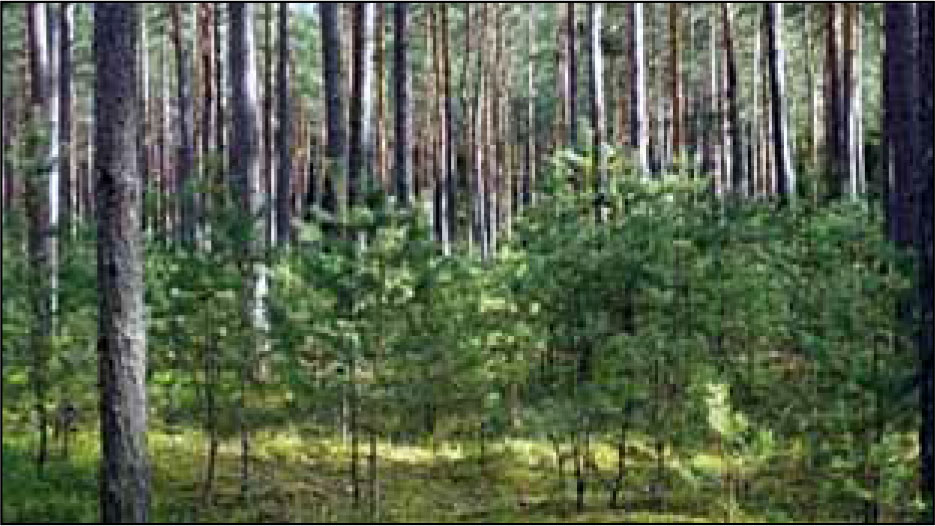
Figure 1.
Under-canopy natural regeneration of Scots pine (Phot. Anna Zawadzka)
One of the ways to avoid the negative impact of clear-cutting on the landscape is to use natural reforestation (Vitousek et al. 1997). Increasingly, different tree species are also being restored by means of complex felling, using differently sized patches, for instance. Here, the purpose is to diversify the age of the trees in a single stand and lend variety to the vertical structure, thus increasing the esthetic appeal of the stand, among other things. Stands where cutting is carried out on a small area or where selection and shelterwood methods are used are characterized by enhanced esthetics. Two important silvicultural principles may apply here, that is, reduction and dispersal of husbandry risk. If one adheres to their chief premises, for example, uses the most abundant species composition possible, aims at a diversified spatial structure, employs varied small-area mixing, natural regeneration, and tends to the stands and the habitats (Jaworski 2011), the esthetics of the forest landscape can be improved. A higher biodiversity index, that is, more numerous species and varied species composition in a stand combined with a rich undergrowth layer, has a positive impact on the esthetic and landscape assets of forests (Gołos 2010; Janeczko et al. 2011). The share of natural regeneration in the total area of regeneration in Poland deserves attention. In recent years, it has been systematically increasing: from 6.5% in 1991–1995, through 10.5% (1996–2000) 13.7% (2011–2020) to 19% in 2021–2022 (Report on the State of Forests in Poland 2022). In the coming years, a further increase in natural regeneration can be expected in stands, resulting from the management of stands with, inter alia, polycyclic harvesting systems.
Certain elements found in forested areas, such as forest boundaries, non-regenerated glades, mid-forest meadows, and clearings, require special attention due to ecologic as well as esthetic value. Forest edges are important in terms of esthetic experience and visual perception (Tahvanainen et al. 2001). When delineating logging plots, it is possible – or even necessary – to be flexible while routing the logging lines to take into account the diversity of microhabitats, stands, and terrain and ultimately create not only the most favorable conditions for forest establishment and development, but also to conserve the forest landscape. A well-designed forest boundary comprises a mixture of shrub and tree species that possess an esthetic value in addition to ecologic importance (Gustavsson and Ingelög 1994). This is particularly important near traffic routes. After all, the attractiveness of the forest landscape lining the transport routes is assessed more or less consciously by the people traveling along them and may become a source of conflict between the forestry authority and the public. Conspicuous, large patches of felled forest often cause concern among the public and provoke criticism and protests. Non-regenerated glades and excessively thinned areas (gaps resulting from natural causes or exploitation) are attractive to people staying temporarily in the forest due to the stronger sunlight. Single trees and clusters of trees left in forest clearings also harbor a particular esthetic value, notably when the crowns on such specimens are irregular. Seed trees that are left on clearings, often as groups, clusters, or den trees, also become elements that add to the esthetics of the forest.
The impact of forestry on the landscape is not only associated with silvicultural procedures and timber harvesting, but also with undertakings geared toward infrastructure and tourism (Janeczko 2008). The attractiveness of a given forest landscape, forest management operations carried out there, and the use of such areas for recreational purposes are all correlated (Dudek 2017a). The ability to determine societal expectations regarding, for example, the attractiveness of the landscape, may facilitate forest management. For this purpose, one may estimate the esthetic elements occurring in forest areas or appraise the functions that a forest performs (Janeczko et al. 2012); alternatively, the landscape may be evaluated using qualitative or quantitative methods, as suggested by Senetra (2015). The most desirable forest landscapes are those dominated by mature, mixed, or deciduous stands with a well-developed layer of second-growth trees and underwood (Janeczko 2008).
If a variety of forest ecosystem services are included in the planning processes, the risk of potential conflicts may be minimized while maximizing the benefits derived from forest ecosystems by different stakeholder groups. Forests provide a very broad range of ecosystem services that can be considered from different spatial standpoints: national, regional, and local. More than 100 distinct services are distinguished in pertinent European literature (Maes et al. 2016). According to Paschalis-Jakubowicz (2011), the list is still incomplete. However, one should remember that the provision of one type of service and benefits usually requires a trade-off with respect to other forest functions.
Public expectations with respect to forests
Landscape is a key element in societal well-being. Its quality has an influence on the development of an area, protects climate, yields economic benefits, and nurtures social bonds (Janeczko 2012a; Hajto et al. 2020). In public eyes, the forest is a symbol of nature, which embodies superior esthetic values, eliciting awe and admiration in the viewer (Stanowski 1983).
The functions of the forest have changed over the centuries (Ciesielski and Stereńczak 2018). Nonetheless, it is important to realize that the character of the forest economy, and the methods employed determine the scope and degree of functions a forest performs (Płotkowski 2008). Even so, the needs and expectations of the public – not infrequently its particular groups – always come to the fore (Płotkowski 2010). Still, the priorities derived from the premises of forest management are, in many cases, at odds with the complex needs of what is, after all, a diverse society (Małek and Szabla 2017). Reconciling multiple functions within a single forest is incredibly difficult (Przybylska and Zięba 2009). In recent years, the social importance of forests has increased, which inevitably translated into the growing relevance of nonproductive functions (Mandziuk and Janeczko 2009), since a forest is not only a space where economic activity takes place, but also an area which requires protection and offers space for recreation (Janeczko et al. 2011). As the public expects more and more in terms of the nonproductive functions of the forest, the approach to the principles of management and stewardship of natural resources changes (Dudek 2016a), both at regional and local levels.
Therefore, it is crucial to identify public preferences regarding the use of forest functions to the broadest extent possible and, on these grounds, make decisions on the rational management of forest resources and the development of recreational infrastructure in forested areas (Ciesielski and Stereńczak 2018). Increased participation of the public as well as local authorities in decision-making concerning the landscape, taking place at the regional level, but, above all, at the local level is in line with the so-called democratization of the landscape, asserted in the European Landscape Convention (Majchrowska 2006).
The range of expectations and various societal needs in relation to forest management is correlated with the urbanization index for a given area (Krokowska-Paluszak et al. 2018). Forests located close to large urban areas enjoy the greatest public interest (Cho et al. 2014). In such locations, the main objective of forest management should be to strive to meet the public needs for recreation. Forests with greater landscape appeal are also more attractive as sites of recreation and leisure (Janeczko 2008; Dudek 2017a), especially where their management prioritizes tourist utility (Dudek 2016b). The residents of urbanized areas often expect such areas to be provided with recreational and tourist infrastructure, but simultaneously would prefer them to be preserved in as natural a state as possible (De Meo et al. 2015). Given the increased interest in recreation in forest environments, the development of infrastructure should focus on the edges of forest complexes located in the peri-urban zone (Janeczko and Woźnicka 2009). In forests where the recreational function predominates, landscape assessment is recommended (Liao and Nogami 2000), using, for example, survey or interview questionnaires for that purpose (Janeczko et al. 2011). The beauty of the forest landscape is easier to assess than the recreational value of forest areas (Tahvanainen et al. 2001). Most visitors to forest areas go there to relax, and the most common form of an active stay in such an environment is walking (Skłodowski et al. 2013; Gołos et al. 2019). Deriving pleasure from attractive views is one of the main reasons for visiting forest areas in many parts of the world (Gołos et al. 2013; Hansson et al. 2012). In addition, the presence of natural components, such as varied terrain, numerous lakes, dense forest complexes with age-old trees, as well as diverse species and layers, enhances the landscape quality of the forest interior (Senetra 2015; Janeczko et al. 2011). Moreover, the popularity of recreation in forests can hardly do without promoting nonobvious and less-widespread recreation options, such as orienteering, geocaching, birdwatching, or forest therapy (Janeczko and Anderwald 2011; Skłodowski et al. 2013; Rutkiewicz and Hulewicz 2017). A stay in forest surroundings has a beneficial effect on the mental and physical state of the individual (Bielinis et al. 2016; Zawadzka and Bielinis 2019).
Conclusions
Forest landscapes comprise three constituents, that is, biotic, abiotic, and social elements (Degórski et al. 2014). They undergo dynamic transformations under the influence of natural forces and human activities. Visual attractiveness is often a factor in determining the function of a forest area (Hur et al. 2010). A space featuring a beautiful landscape usually readily becomes a site which performs functions that contribute to social well-being since the components that promote positive visual perception enable recreational activities at the same time. Varied terrain, lakes, and dense forest complexes are natural elements sought after by recreationists (Cho et al. 2008; Domon 2011). Indeed, the essential criterion in assessing the esthetics of a forest is its diversity (Janeczko 2008). In forest management, it is indispensable to acknowledge that among the many functions that forests perform, the landscape function is extremely important, and the landscape assets of a forest are affected by the actions undertaken as part of forest management (silviculture, utilization, forest development).
The authors answer to the question posed in the title of the paper in the affirmative – forest management has an impact on the esthetic and ecologic values of the landscape, at local, regional, and national levels. It has at its disposal a wide range of tools and both directly and indirectly influences landscape shaping. Among the most important instruments, according to the authors, are the principles of spatial planning resulting from national and European legislation (Principles of Silviculture 2023), which is reflected in afforestation plans or the establishment/maintenance of new/existing forms of nature conservation. The forest management tasks carried out at the regional level meet the objectives resulting from the established measures and respond to the expectations of society.
However, at a local level, silvicultural planning and subsequent management are important. Examples are/could be abandoning at least some of the planned clear-cutting and in the future designing stands with a more complex species composition, differentiated in age, with a varied mix, which will be managed with complex felling with a long or very long regeneration period. Another example is addition, increasing the use of natural regeneration in the total regeneration area, or the use of reforestation on a larger scale and the introduction of a second storey. This will undoubtedly have an impact on the esthetic and ecologic value of the landscape. Local landscape shaping can also be carried out by shaping ecotones, riparian zones, tending mid-forest open areas, or reconstruction of tree stands. These tasks not only have an important impact on the enrichment of biodiversity, but also contribute to making forest communities more sustainable (Principles of Silviculture 2023), thus contributing to the landscape value of the area, as well as fulfilling the expectations of the public with regard to carrying out of forest management tasks.
The public preferences and expectations with respect to the forest, as well as the ongoing forest management operations, are complex processes that require the contribution of various scientific disciplines, including social, economic, and forestry sciences (Gołos 2010). Utilization of forested areas should be an integral concern at local, regional, and national levels. Development planning should allow for varied forest ecosystem services, thus minimizing the risk of potential conflicts and maximizing the benefits derived from forest ecosystems by different stakeholder groups (Kaliszewski et al. 2023). The economic development of the country requires the role of the forest to be precisely defined, whereby it cannot be confined solely to ensuring the sustainability of forest production but, in a comprehensive fashion, take into account the nonproductive functions of forests as well (Przybylska and Zięba 2009).
Hence, research into landscape should continue, so that further changes taking place there can be better understood. The knowledge thus gained should be used to manage multifunctional landscapes, including forest landscapes, in a sustainable manner (Krajewski 2018).
Acknowledgement
The results presented in this paper were obtained as a part of comprehensive study financed by University of Warmia and Mazury in Olsztyn, Faculty of Agriculture and Forestry, Department of Forestry and Forest Ecology 30.610.018-110.