
Introduction
The efficiency of rational processing of wood into materials and products depends on complex production, technological and market factors. In the market conditions of European Union countries, there are for lumber products in, significant differences in terms of resulting from the volume of wood processing for wood plants, as well as production methods resulting from the efficiency of technological equipment. The situation of the sawmill industry in Poland is associated with the emergence of many new variables for lumber producers and operators with very different technical and technological levels. The dynamic development of sawmills is the result of the favourable market situation in 2019–2022 and the policy of timber sales by the State Forests. Changes in market policy have led to a significant shift in the cost intensity of production. As indicated by data from the Central Statistical Office (GUS 2023) according to the Polish Classification of Activities (PKD), the production of wood and wood products, including sawmill products, boards, plywood, veneers, carpentry, furniture, cork and wicker products (excluding furniture), stabilised at 37–42 million m3 of roundwood. According to an ongoing analysis (Jablonski 2000), and taking into account the amount of raw materials purchased from the State Forests, plants with a capacity of 50,000–400,000 m3/year play a dominant role in the Polish lumber industry. The group of small- (up to 5000 cubic meters/year) and medium-sized (from 5000 to 50,000 cubic metres/year) enterprises accounts for the dominant share of the number of Polish wood product-manufacturing plants, employing and presenting the highest growth dynamics (Mydlarz and Wieruszewski 2022).
The concentration of labour potential and its specialisation is due to the reduction in cost-intensive production processes. Examples include German, Austrian and Swedish sawmills that are oriented to the production of large-sized lumber mainly for construction (Krzosek 2003; Lis et al. 2000).
Material and Methods
Woodworking technologies
Technological factors, especially the productivity of raw materials obtained in medium-sized plants in Poland, particularly affect the efficiency of this production. The processes of roundwood processing for the production of lumber and sawmill products are related, on the one hand, to the diverse quality of the roundwood raw material and, on the other hand, depend on the range of products obtained (Kupčák 2015). Traditional processing processes are dominated by various products, enabling the realisation of the requirements of local markets. Examples of harvesting levels and management directions for large-sized round pine timber with a thickness at the thinner end of more than 14 cm (W0 So), large-sized logs up to 6 m (WK So) and medium-sized logs with a thickness at the thinner end without bark up to 5 cm (S2B So) processed at sawmills are shown in Figure 1.
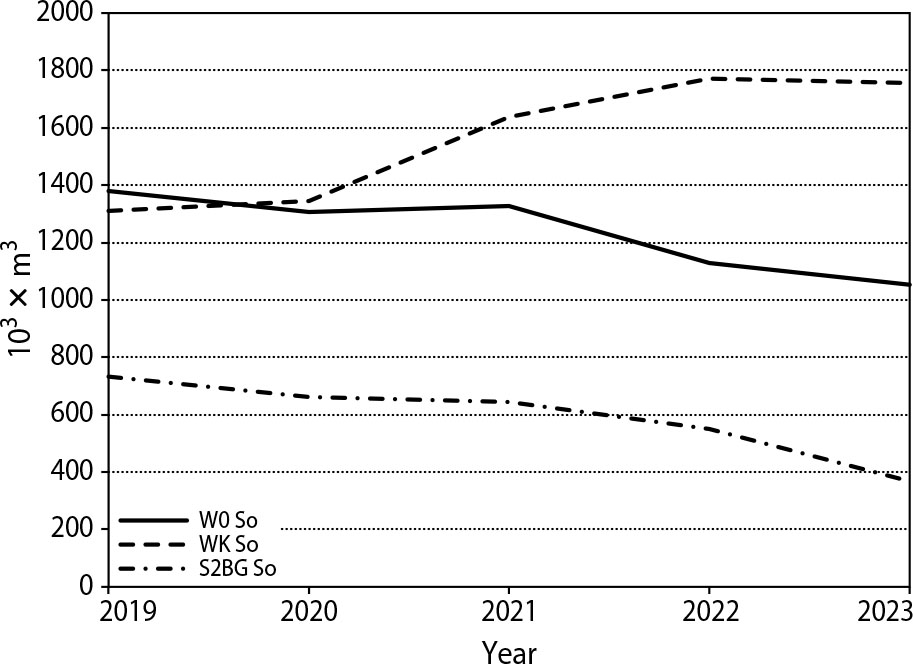
Figure 1.
Level of use of softwood processed into lumber (www.e-drewno.pl, GUS 2023)
The technologies and equipment used are closely related to the product mix. It is possible to separate the following groups: small plants (employment up to 50 people – income up to € 7 million), producing commodity lumber for various purposes; groups of small- and medium-sized sawmills (income up to € 40 million – employment up to 250 people) specialising in the production of lumber and general-purpose products for the construction industry (including factories producing roof trusses) using frame, circular and band saws, and performing pre-fabrication operations; groups of small- and medium-sized plants dominated by the production of products and elements of the so-called ‘garden and pallet programme’, which has developed in Poland in recent years and has great dynamism. It should be added that traditional sawing machines and tools, frame saws, and a set of multi-saw equipment are used. These factories use large-scale automation of the process and deep processing of components into final products.
Crisis processes in Europe have resulted in a variable dynamisation of production concentration processes in large wood processing plants (Bidzińska and Ratajczak 2003; Krzosek 2003). The specialisation of production is inextricably linked to the introduction of systemic principles of production quality assurance. This is served by standards that optimise technological processes, which, unlike subject and production standards, are organisational standards and principles of systemic assurance of high, site-independent quality (Cholewa 2000; Jabłoński 2000). Systemic assurance of product quality and guarantee of repeatability of products from certified raw material are implemented by many factories in Poland that use standards: ISO 9001 and PEFC (Programme for Endorsement of Forest Certification) and FSC (Forest Stewardship Council®) certificates. This standardisation of products and production allows for the standardisation of product quality and the effective competition of wood products not only in the domestic market but also in European markets (https://www.drewno.pl/, https://www.e-drewno.pl/stock/). The main products of roundwood processing with variable price ranges (Fig. 2) are sawn materials with varying market values (Tab. 1). By-products such as wood chips or sawdust and bark are also obtained as a result of sawmilling (Tab. 2). The share of these products is closely dependent on the processing technology used and the form of the main products (lumber). Both main products and by-products influence the efficiency index of the production process. Previous studies have confirmed a definite increase in the share of the production of chunk by-products (wood chips – up to 20–30%) with a significant share of sawdust, as a result of sawing (sawdust – 10–15%). In the overall structure, it is acceptable to take the economic effect obtained from the bark (up to 8%) as an additional group of by-products, called ‘waste’ of the process of preparation for sawing (Mydlarz and Wieruszewski 2022). Significant variability in the value of the product is due to local and global market changes. However, the main product, i.e. lumber and its semi-finished products, is the main indicator of the impact on the legitimacy of roundwood processing.
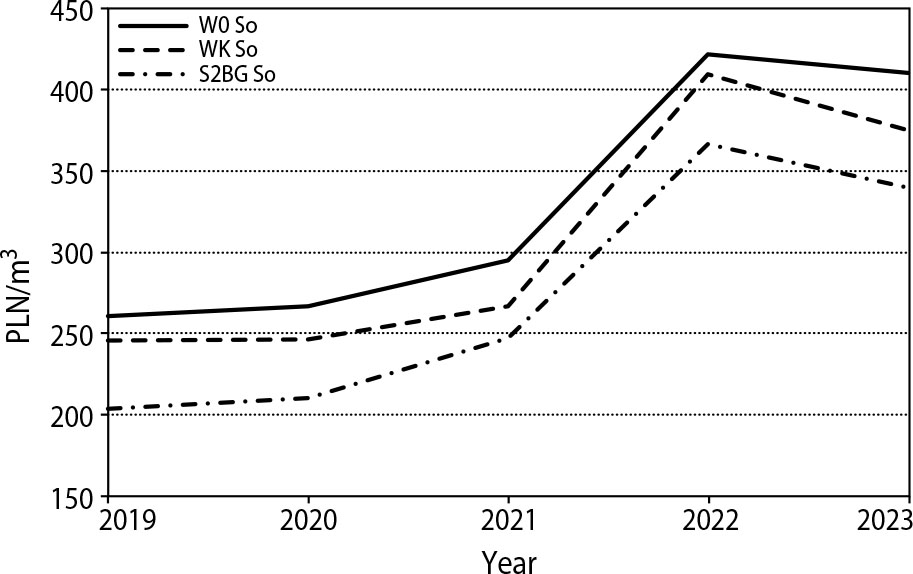
Figure 2.
Price level of softwood processed into lumber (www.e-drewno.pl, GUS 2023)
Table 1.
Summary of averaged prices for pine pallet lumber (https://www.drewno.pl/, https://www.e-drewno.pl/stock/, Górna et al. 2023)
| Period | Price of pine lumber (PLN/m3) | ||||
|---|---|---|---|---|---|
| 2019 | 2020 | 2021 | 2022 | 2023 | |
| I quarter | 440 | 450 | 480 | 1100 | 1000.0 |
| II quarter | 440 | 450 | 600 | 1300 | 800 |
| III quarter | 440 | 450 | 850 | 1400 | 700 |
| IV quarter | 450 | 460 | 1100 | 1100 | 600 |
| Mean | 442.5 | 452.5 | 757.5 | 1225.0 | 775.0 |
Table 2.
Summary of averaged prices of pine by-products in 2019–2023 (https://www.drewno.pl/, https://www.e-drewno.pl/stock/, Górna et al. 2023)
| Year | The by-product ‘falls off’ (PLN/m3) | |||
|---|---|---|---|---|
| paper chips | lumber chips | pine bark | sawdust | |
| 2019 | 218 | 163 | 116 | 149 |
| 2020 | 192 | 140 | 117 | 135 |
| 2021 | 187 | 146 | 121 | 155 |
| 2022 | 330 | 329 | 238 | 370 |
| 2023 | 288 | 288 | 307 | 318 |
| Participation in the process (%) | 20–30 | 8 | 10–15 | |
Influence of technological processes on the efficiency of woodworking
The technological processes of processing wood into lumber and sawmill products depend, in particular, on the conditions for the purchase of raw materials by various business entities. The analysis of the problem of cost and quality of wood raw material procurement in relation to the industry (Bidzińska and Ratajczak 2003; Jabłoński 2000; Krzosek 2003; Lis et al. 2000) cannot abstract from the current structure and size of sawmills in Poland.
Using the universal macro-indicator of technological efficiency of the processing of round raw material into lumber and sawmill products (Ep) formulated in natural units or as a percentage defined as the sum of the conformity of the value of the lumber raw material (main, accompanying or sawmill products) obtained from the lumber raw material, taking into account the cost of purchasing the raw material, which is necessary for its production, we describe formulas 1 and 2 (Hruzik et al. 2000):
where:Ep – technological efficiency of raw material processing,
– volume ‘q’ class sawnwood,
– volume ‘q’ class raw materials,
– prices of sawnwood,
– prices of raw materials,
Tr – prices of transport.
Epc – full technological efficiency of raw material processing.
Vpt – volume ‘q’ class sawnwood,
Vk – volume ‘q’ class raw materials,
– volume ‘q’ class sawnwood,
– volume ‘q’ class raw materials,
– prices of sawnwood,
– prices of raw materials,
Cpt – prices of wood waste and sawdust,
Ck – prices of bark,
Tr – prices of transport.
Results and Discussion
Taking into account technological conditions and canons of work, as well as the fact of dimensional and quality variation of roundwood and current price reports (https://www.drewno.pl/, https://www.e-drewno.pl/stock/), the average productivity (W) of processing pine wood (Fig. 3) into pallet lumber in small- and medium-sized general-purpose lumber plants was determined, and production efficiency was analysed based on the formulas presented (Fig. 4). The average volume of efficiency adopted for further analysis is 60% where the changes in the price of wood transportation determined, in 2019–2023 oscillated on average at 28, 30, 33, 38 and 35 PLN/m3 (own market research).
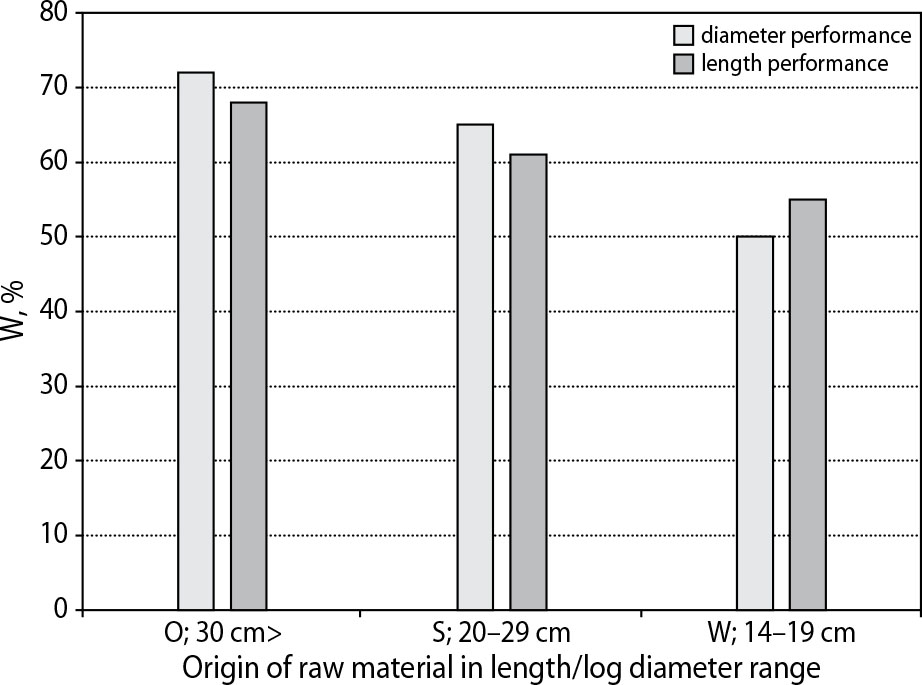
Figure 3.
Technological efficiency of processing coniferous wood into semi-finished lumber in sawmills (own elaboration, Hruzik et al. 2000, 2005; Mydlarz and Wieruszewski 2022; Wieruszewski et al. 2020, 2023)
It can be concluded that comparing the processing of timber in sawmills in plants that used log quality sorting (O – lower, S – medium and W – upper) with that in plants that used only log diameter category, regardless of the type of plant, the best productivity can be obtained processing lower logs with larger diameters (68–72%), but the lowest productivity was confirmed when processing upper logs with small diameters (50–55%). In general, this regularity shaped the price relations for raw material and lumber in the domestic market, but this is mainly what the source material (EN 1611-1:1999/A1:2002) is limited to.
The efficiency of wood processing (Fig. 4) can also be considered in the example of specific grades (elements) of finished pallet products. Examples of the production efficiency of selected pine elements for pallet products made in 2022 (Fig. 3) indicate that these assortments allow for achieving an average efficiency of Ep=101–168% with similar material and sawing efficiency in the range of W = 50–72% (assumed average 60%) (Hruzik et al. 2000, 2005).
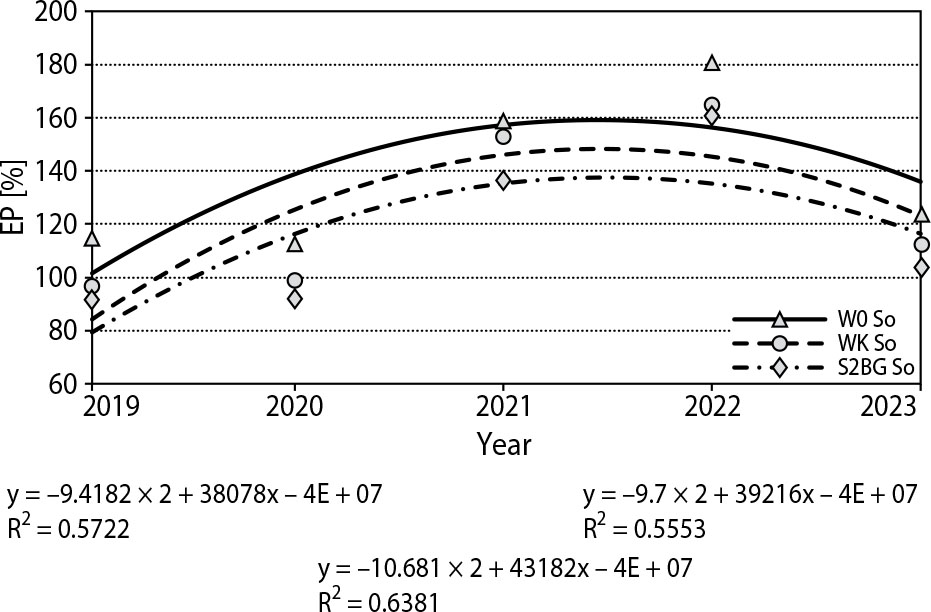
Figure 4.
Ep processing efficiency of selected grades for pallet lumber production (own elaboration)
The Ep variability curves show a good fit with the coefficient of determination R2>0.5. At the same time, there are no significant differences in the effect of the type of pine raw material on the change in Ep (p = 0.5).
It is worth noting the impact of market prices associated with by-products. They have recently gained in value due to the possibility of obtaining energy biomass from them. This is particularly true for chunk products (wood chips) and sawdust. This translates into an additional component of the economic impact indicator, as presented in Figure 5 in the form of the Epc total efficiency indicator. The ANOVA statistical test showed no significant statistical difference in the effect of the tested by-product forms on Epc (p=0.7). At the same time, the functions describing the variability of Epc have a good coefficient of determination R2>0.5 of matching results.
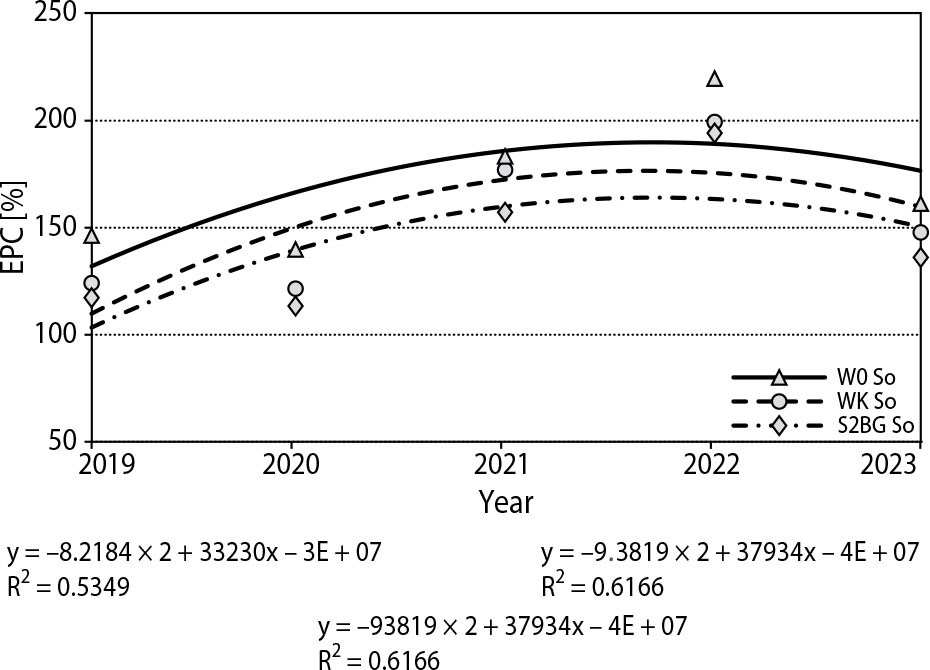
Figure 5.
Total Epc efficiency including by-products in pallet lumber production (own elaboration)
Plants producing components and pallet products are companies associated in a sphere dominated by production for the European market. Comparative spheres of sawmill production efficiency are supplemented by a potential indicator for large factories (using mainly compact technologies), but products and lumber are currently received by different technologies in sawmills. The potential range of average material efficiency in sawmilling, aligned with the economic indicator formed by the price relationship of raw materials and products, will not be different from the level of efficiency obtained in factories using traditional technologies because the relationship is not shaped by the local market but by the global market. The values of Ep production efficiency of selected pallet assortments in recent years gradually increased from a level of about 91% to 180% in 2022 to begin a sharp decline with the downturn in 2023. The added value of the process is the Epc efficiency effect of the use of by-products. As for lumber, it depends on market price fluctuations. In the structure of reference to the price of raw material, the highest increases in the indicator are obtained by S2BG wood processing where it fell from 31% to 25% in 2019–2021. An additional increase in the by-product efficiency ratio increased significantly in 2022 to a level of 33–38% to remain at a similar level in 2023. In sum, this allowed the efficiency of total Epc processing of pine raw material into pallet lumber to reach 194–220% in 2022 with a decrease in 2023 to 135–161%. This indicates how significant the rational management of by-products in the sawmilling process is.
The wood raw material offered by forest farms can be used in industrial processing for various wood materials and semi-finished products, leading to the manufacture of finished products. This depends mainly on the dimensional and quality structure of the roundwood of a given species. Different will be the shares of the various destiny grades of raw material from the division of arrows of higher classes of thickness and quality, while others from thinner arrows harvested during silvicultural operations in the forest. However, from a given arrow in a certain size group and height of trees, it is possible to manipulate different sorts according to demand, which is currently a topic of discussion among specialists. The direction of wood utilisation depends on a number of more or less important factors. The decisive one is the profitability of wood processing that can be quantified and analysed. It can be expected that, over time, the wood market will move towards the most efficient structure of its utilisation through the demand relations of individual wood industries determined by this profitability. The levels of customer demand exert an influence on the price levels of individual wood grades. They follow the individually shaped timber values accepted by individual entrepreneurs assuming expected levels of operational profitability of processing. Also important is the impact of the current market situation in a given phase of the economic cycle, as well as the technical and organisational levels of a particular wood-processing plant and the activities of sales and procurement services (Stanula et al. 2023a).
An attempt can be made to determine the structure of timber management, to which the market-shaped levels of demand from the wood processing industry for particular grades will follow over time. The most important of the expectations of entrepreneurs is the level of operational profitability in its technical and market conditions. The cost of bringing raw materials from forestry depots to the plant weighs significantly, especially in the recent period, on production costs (Stanula et al. 2023b). With their relatively high level, the value of timber in this case may be lower according to calculations based on the proposed formula. Recovery values from the sale or on-site processing of wood chips and sawdust are also noticeable (Hruzik et al. 2005). The calculated value of wood significantly determines the optimum management of the raw material.
The value added in economic activity achieved in wood processing is determined by subtracting the value of sales revenues from the value transferred, earned in other, preceding processes of processing raw materials and materials. The added values achieved in the considered phase of wood processing can also form the basis for determining the structure of roundwood utilisation, since in macro-scale analyses, these values make up this basic measure of the level of economic development. The high added value generated in the enterprise is distributed among employees, the budget, the financing of contributions charged to personnel costs, various mandatory benefits and, most importantly from the point of view of the economic entity, net profit. However, the inclusion of added value in the timber management account will not provide a fully accurate determination of the structure of the demand for particular grades, as opposed to the value of timber. The value of timber will certainly be influenced by the future structure of raw material prices, which, of course, would have to be determined in further work on the model.
Measures of roundwood value, value added in processing and efficiency indicators can therefore be used in the proposed method of raw material management account acting as functions of the econometric criterion.
Thus, it can be concluded that the timber value criterion will be the main factor shaping changes in demand for roundwood of various qualitative-dimensional grades and species limiting their growth. However, the maximisation of the objective function is limited by a number of more or less important conditions that can be described by relevant equations. Among the most important are:
– supply of individual wood grades and species,
– demand for wood.
The supply of roundwood is determined by the forest farms offering it, and in the case of Poland, mainly the State Forests, while demand is driven by the needs of the market for materials and semi-finished products and wood products. It is also related to the technological level and processing capacity of particular industries and enterprises.
The need for rational management of timber, also in terms of volume with forecasts, is indicated as the most important element of forest-timber cooperation by the timber circles, as well as central authorities. This implies the need for strict control of flows within the national economy.
It can be expected that the timber market will, to some extent, shape the profitable structure of timber utilisation, although the significant influence of the policy of the State Forests pursuing multiple objectives of maintaining stands cannot be overlooked.
Conclusions
Wood processing technology and the structure and size of sawmills at the current stage in Poland have little impact on the efficiency of lumber and wood product production.
Technological processes in the wood industry are directly related to the production mix, but the efficiency of its production, due to the dominant share of raw material costs, depends critically on the price relationship between raw material and products, as in between raw material and products, both in the local market and in the European market.
The efficiency of wood processing for lumber and sample lumber products is currently at about 60%. The efficiency of production of selected elements and sets (products) of pine pallet type is at Epc=135–161% in 2023, thanks to the added value of by-products.
Timber value accounting from the point of view of profitability of processing can be applied to determine the direction of changes in the demand structure for roundwood.
The criterion of added value in processing, as well as the efficiency relationship, can be used in the study of the management structure of a limited supply of wood, for example in multi-plant enterprises.