
Introduction
The genetic value of an individual tree is not the same as its phenotypic value. The most effective way to assess the genetic value of a provenance or a particular tree (referred to as seed sources) is to evaluate its progeny (Sabor 2002; White et al. 2007). Therefore, forest tree breeding programmes are being developed, in which selected seed sources are tested under different environmental conditions. The goal of these programmes is to evaluate the breeding (genetic) value of the tested material and to identify provenances or genotypes whose progenies have significantly better growth and quality traits and lower susceptibility to biotic and abiotic factors.
In Poland, a ‘Programme for Progeny Testing of Selected Seed Stands, Plus Trees, Clonal Seed Orchards, and Seedling Seed Orchards’ (hereafter referred to as the ‘Tree Improvement Programme’) was developed and approved in 2004 (Sabor et al. 2004). The implementation of the programme was started in 2005 by order of the State Forests National Forest Holding. Since then, genetic units (selected seed stands and plus trees) have been selected, seeds collected and seedlings produced, while sites for provenance and progeny testing have been selected and such trials established. From the beginning, the programme was coordinated by the Forest Research Institute (IBL) and implemented in cooperation with Institute of Dendrology of the Polish Academy of Sciences (ID PAN), Poznań University of Life Sciences (UP Poznan), University of Agriculture in Krakow (UR Kraków) and Warsaw University of Life Sciences (SGGW). The first set of provenance trials under the Tree Improvement Programme was established in 2006. By the end of 2023, a total of 209 provenance and progeny trials had been established. In particular, there are a series of trials for five species: Fagus sylvatica L., Pinus sylvestris L., Abies alba Mill., Picea abies (L.) H. Karst and Larix decidua Mill. However, activities for European larch (Larix decidua Mill.) did not begin until 2021. The goal of this paper is to present some aspects of the methodological approach in the Tree Improvement Programme for this species.
Studies on European larch
European larch is a coniferous tree species that currently accounts for 1.6% of the total wood supply in Polish forests. Its share has gradually increased in recent decades (FAO 2020). It is believed that its distribution was once more extensive, and some of its habitats were cleared for agricultural purposes (Tyszkiewicz 1972). European larch thrives in moderately fertile habitats with favourable water and air conditions; however, it is not well suited to dry or excessively wet sites (Leibundgut 1992; Bellon and Andrzejczyk 2000). This light-demanding species is well suited for introduction into open areas on post-agricultural lands and for forest tree plantations (Andrzejczyk et al. 2011). It exhibits rapid growth, with an early peak in both current (25 years) and average (55 years) volume increment (Burschel and Huss 2003). On fertile habitats (Lśw according to Święcicki 2012), the species can reach a volume of 350–400 m3 at the age of 40 years (Bellon and Andrzejczyk 2000). European larch wood is widely used for the production of wood-based materials, joinery, furniture, building facades and decking. In the past, it was highly valued in sacred buildings (Kozakiewicz 2020). Due to its fast growth and multiple possibilities for economic use of the wood, the species seems to be one of the most promising forest tree species in the Polish Tree Improvement Programme. The greatest difficulty in selecting suitable genetic material is that Japanese larch (Larix kaempferi Sarg., Larix leptolepis (Sieb. i Zucc.) Gord., Larix japonica Carr.) was previously introduced into Polish forests. Japanese larch has the ability to form hybrids with European larch, which can lead to the displacement of valuable native provenances (Filipiak 1996).
The first provenance test trials were set up in the early 19th century (Giertych 1991; Chałupka 2023). Since then, numerous trials have been conducted to evaluate both local provenances and provenances from different geographical regions of Europe. According to L. Pâques (2013), the most important milestones in larch breeding were the IUFRO (International Union of Forest Research Organizations) international trials, particularly the 1940/44 and 1956/58 series. In Poland, studies on European larch provenances have focused mainly on growth traits (DBH – diameter at breast height, height, volume), quality traits (stem straightness) and health traits (resistance to larch canker) (Bellon et al. 1983; Kowalczyk and Matras 1999; Barzdajn 2000; Kulej 2000; Szeligowski et al. 2010). The results show that Polish populations have good adaptation and growth characteristics. However, special attention should be paid to the qualitative traits, especially to the straightness of the stem (Pâques 2013). The most valuable populations come from a few seed regions (Md51, Md61, Md71; Fig. 1.; Rozporządzenie 2015) within the natural range of European larch. Unfortunately, little is known about the individual variability of this species in Poland and a few studies have been conducted but not yet published. Large-scale progeny testing did not begin until 2021.
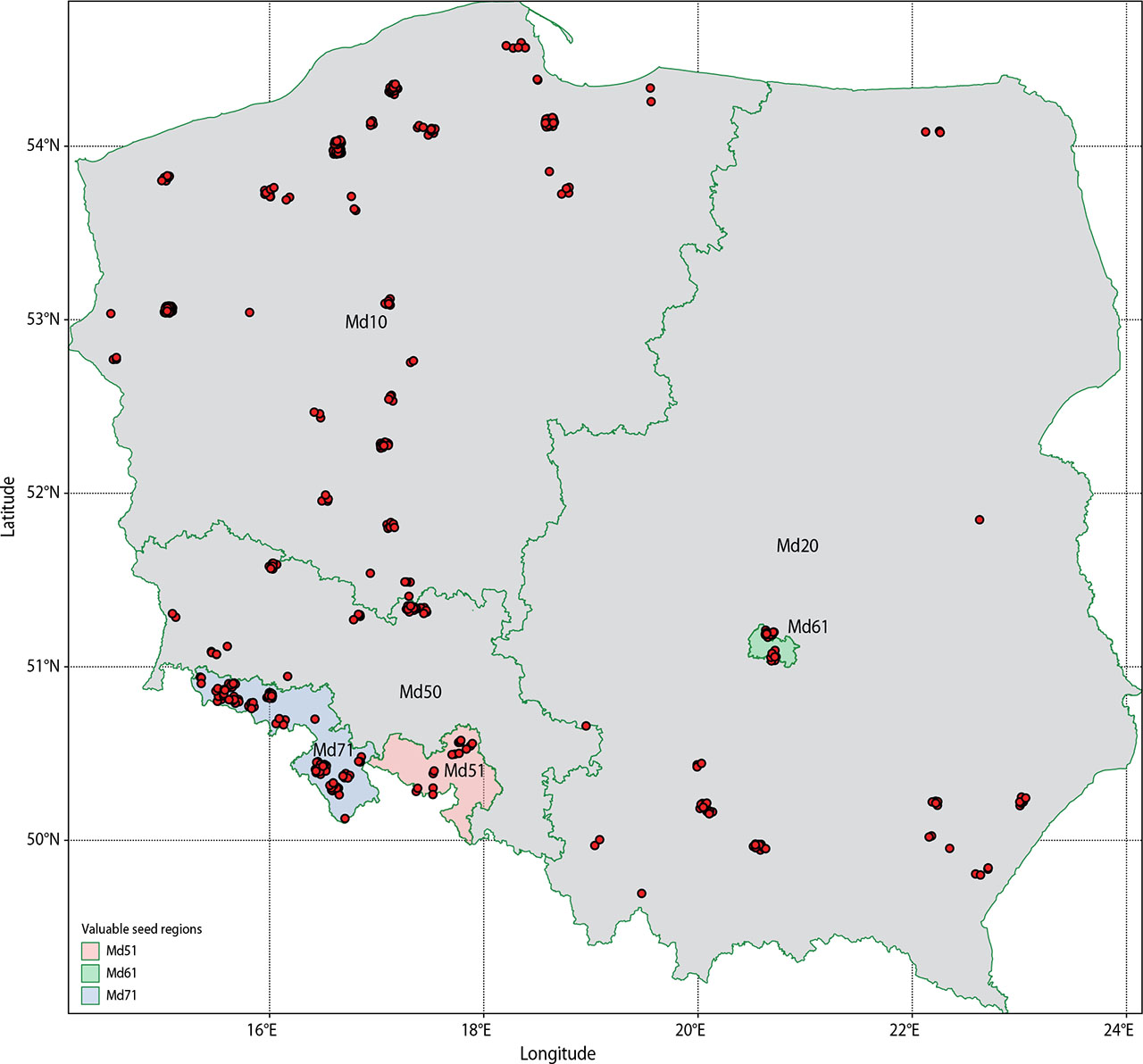
Figure 1.
Seed regions of European larch in Poland and the locations of plus trees (red dots) whose seeds were available in the Forest Gene Bank in Kostrzyca (data as of November 2021). Green lines indicate the boundaries of seed regions (Rozporządzenie 2015), and the most valuable seed regions are additionally filled with different colours.
Testing the progeny of European larch plus trees
In Poland, long-term storage of forest tree seeds is carried out by the Forest Gene Bank in Kostrzyca (Sobierajski 2004). In the initial phase of progeny testing for European larch, an analysis of seed collections available at the Forest Gene Bank in Kostrzyca was conducted. The analysis focused on European larch plus trees. The available seed collections, categorised by seed zone for this species, are listed in Table 1 and the distribution of plus trees is shown in Figure 1.
Table 1.
Description of the European larch seed stock available in the Forest Gene Bank in Kostrzyca (as of November 2021)
| Seed region | Md10 | Md20 | Md50 | Md51 | Md61 | Md71 | Total |
|---|---|---|---|---|---|---|---|
| Seed weight (kg) | 14.44 | 4.03 | 5.65 | 0.44 | 0.40 | 13.42 | 38.38 |
| Number of plus trees | 172 | 58 | 28 | 16 | 17 | 79 | 370 |
According to the Forest Gene Bank, a total of 370 seed collections obtained from the European larch plus trees were available. It is important to know that this species has a low germination rate. In some Polish provenances, the germination rate is often between 20–40% and the average weight of 1,000 seeds is typically between 4 and 5 g (Załęski 2002). The progeny tests required 10 g of seed from each plus tree, and most seed collections met this requirement; however, not all plus trees were included in the tests. Only the plus trees from the most valuable seed regions (Md51, Md61, Md71) and some other plus trees from areas below 52° N latitude were included in the tests (Fig. 1). This approach was determined by the existing knowledge about the variability of the European larch and the lower proportion of hybrids with Japanese larch in the forests of this region in Poland (Filipiak 1996; Pâques 2013). For this reason, a total of 130 plus trees were selected across three Regional Directorates of State Forests (RDLP): Katowice, Radom and Wrocław (Tab. 2). The largest number of plus trees (111) for the test was chosen from the area of RDLP Wrocław. These plus trees were selected from three seed regions: Md10 (four trees), Md50 (28 trees) and Md71 (79 trees). A total of 19 plus trees were chosen from two other RDLPs: Katowice (16 plus trees, all from seed region Md51) and Radom (three plus trees, all from seed region Md61).
Table 2.
Description of plus trees’ seed collections categorised by RDLP (Regional Directorates of State Forests), seed regions and the year when seeds were harvested
| Seed region | 1998 | 2000 | 2004 | 2005 | 2006 | 2007 | 2008 | 2010 | 2011 | 2012 | 2013 | 2014 | 2017 | Total |
|---|---|---|---|---|---|---|---|---|---|---|---|---|---|---|
| RDLP Katowice | 3 | 3 | 2 | 2 | 3 | 3 | 16 | |||||||
| Md51 | 3 | 3 | 2 | 2 | 3 | 3 | 16 | |||||||
| RDLP Radom | 3 | 3 | ||||||||||||
| Md61 | 3 | 3 | ||||||||||||
| RDLP Wrocław | 59 | 2 | 13 | 3 | 8 | 6 | 8 | 1 | 2 | 2 | 7 | 111 | ||
| Md10 | 4 | 4 | ||||||||||||
| Md50 | 11 | 1 | 2 | 1 | 4 | 4 | 3 | 1 | 1 | 28 | ||||
| Md71 | 44 | 1 | 11 | 2 | 4 | 2 | 5 | 1 | 2 | 7 | 79 | |||
| Total | 59 | 2 | 3 | 16 | 5 | 8 | 8 | 11 | 1 | 2 | 5 | 3 | 7 | 130 |
Seeds for a large group of plus trees (59) were collected in 1998, roughly 24 years before sowing took place. This is the only year when seeds were collected for such a large number of plus trees. For the other plus trees (71), the seeds were collected between 2000 and 2017 (Tab. 2).
The obtained seeds were planted in a container nursery in Jarocin Forest District (N: 51.9797; E: 17.4868) in the spring of 2022 (on May 10–11). During seeding, there were concerns about poor performance, primarily due to the long storage time of some seed collections (Tab. 2 and 3) and the limitations of small seed collections that prevented a standard germination test to assess seed viability (Tab. 3). However, the seed germination exceeded all fears, and the seedlings grew well, reaching satisfactory parameters by the end of the growing season. Furthermore, the root system of the seedlings developed well, which was very important for planting.
Table 3.
Description of plus trees and seed collections used for establishing European larch progeny test trials
| No. of plus tree | KRLMP ID1 | IBL ID2 | Seed region | Forest District3 | Seed collection ID | Date of seed collection | Seed weight (kg) |
|---|---|---|---|---|---|---|---|
| 1 | 2 | 3 | 4 | 5 | 6 | 7 | 8 |
| 1 | MP/3/39622/05 | 16 | Md61 | Suchedniów | 23/ZP/14-D16 | 23-10-2014 | 0.023 |
| 2 | MP/3/38699/05 | 112 | Md71 | Zdroje | 472/ZP/97-D112 | 25-05-1998 | 0.147 |
| 3 | MP/3/38698/05 | 113 | Md71 | Zdroje | 8/ZP/10-D113 | 26-11-2010 | 0.028 |
| 4 | MP/3/38697/05 | 114 | Md71 | Zdroje | 473/ZP/97-D114 | 25-05-1998 | 0.559 |
| 5 | MP/3/38693/05 | 115 | Md71 | Zdroje | 474/ZP/97-D115 | 25-05-1998 | 0.070 |
| 6 | MP/3/38692/05 | 116 | Md71 | Zdroje | 9/ZP/10-D116 | 26-11-2010 | 0.179 |
| 7 | MP/3/38696/05 | 117 | Md71 | Zdroje | 10/ZP/10-D117 | 26-11-2010 | 0.020 |
| 8 | MP/3/38691/05 | 118 | Md71 | Zdroje | 475/ZP/97-D118 | 25-05-1998 | 0.140 |
| 9 | MP/3/38695/05 | 119 | Md71 | Zdroje | 476/ZP/97-D119 | 25-05-1998 | 0.215 |
| 10 | MP/3/38694/05 | 120 | Md71 | Zdroje | 477/ZP/97-D120 | 25-05-1998 | 0.245 |
| 11 | MP/3/38704/05 | 121 | Md71 | Zdroje | 478/ZP/97-D121 | 25-05-1998 | 0.240 |
| 12 | MP/3/38705/05 | 122 | Md71 | Zdroje | 479/ZP/97-D122 | 25-05-1998 | 0.492 |
| 13 | MP/3/38706/05 | 124 | Md71 | Zdroje | 480/ZP/97-D124 | 25-05-1998 | 0.208 |
| 14 | MP/3/38707/05 | 125 | Md71 | Zdroje | 482/ZP/97-D125 | 25-05-1998 | 0.317 |
| 15 | MP/3/38711/05 | 126 | Md71 | Zdroje | 148/ZP/07-D126-TP | 17-10-2007 | 0.007 |
| 16 | MP/3/38639/05 | 127 | Md71 | Bystrzyca K. | 450/ZP/97-D127 | 25-05-1998 | 0.019 |
| 17 | MP/3/38640/05 | 128 | Md71 | Bystrzyca K. | 451/ZP/97-D128 | 25-05-1998 | 0.140 |
| 18 | MP/3/38646/05 | 129 | Md71 | Bystrzyca K. | 452/ZP/97-D129 | 25-05-1998 | 0.308 |
| 19 | MP/3/38644/05 | 130 | Md71 | Bystrzyca K. | 456/ZP/97-D130 | 25-05-1998 | 0.403 |
| 20 | MP/3/38645/05 | 131 | Md71 | Bystrzyca K. | 458/ZP/97-D131 | 25-05-1998 | 0.153 |
| 21 | MP/3/33379/05 | 477 | Md51 | Prószków | 154/ZP/13-D477 | 09-07-2013 | 0.021 |
| 22 | MP/3/33382/05 | 480 | Md51 | Prószków | 155/ZP/13-D480 | 09-07-2013 | 0.018 |
| 23 | MP/3/33371/05 | 496 | Md51 | Prószków | 133/ZP/05-D496 | 18-10-2006 | 0.026 |
| 24 | MP/3/33374/05 | 499 | Md51 | Prószków | 407/ZP/01-D499 | 03-08-2004 | 0.034 |
| 25 | MP/3/33375/05 | 500 | Md51 | Prószków | 408/ZP/01-D500 | 21-01-2004 | 0.034 |
| 26 | MP/3/33376/05 | 501 | Md51 | Prószków | 409/ZP/01-D501 | 21-01-2004 | 0.020 |
| 27 | MP/3/33306/05 | 512 | Md51 | Prószków | 841/ZP/10-D512 | 24-11-2010 | 0.027 |
| 28 | MP/3/33305/05 | 523 | Md51 | Prószków | 842/ZP/10-D523 | 24-11-2010 | 0.013 |
| 29 | MP/3/33277/05 | 540 | Md51 | Prudnik | 1448/ZP/07-D540-TP | 05-08-2008 | 0.004 |
| 30 | MP/3/33279/05 | 542 | Md51 | Prudnik | 1449/ZP/07-D542-TP | 05-08-2008 | 0.003 |
| 31 | MP/3/33262/05 | 545 | Md51 | Prudnik | 132/ZP/05-DD545 | 14-07-2005 | 0.090 |
| 32 | MP/3/33265/05 | 549 | Md51 | Prudnik | 134/ZP/05-DD549 | 20-06-2005 | 0.020 |
| 33 | MP/3/38854/05 | 1598 | Md50 | Lwówek Śl. | 499/ZP/97-D1598 | 10-04-1998 | 0.136 |
| 34 | MP/3/38855/05 | 1599 | Md50 | Lwówek Śl. | 500/ZP/97-D1599 | 10-04-1998 | 0.084 |
| 35 | MP/3/38856/05 | 1601 | Md50 | Lwówek Śl. | 501/ZP/97-D1601 | 10-04-1998 | 0.716 |
| 36 | MP/3/38956/05 | 1611 | Md71 | Śnieżka | 170/ZP/05-DD1611 | 27-05-2005 | 0.546 |
| 37 | MP/3/38955/05 | 1612 | Md71 | Śnieżka | 164/ZP/05-DD1612 | 20-06-2005 | 0.112 |
| 38 | MP/3/39644/05 | 1836 | Md61 | Suchedniów | 602/ZP/13-D1836 | 23-10-2014 | 0.043 |
| 39 | MP/3/33269/05 | 2047 | Md51 | Prudnik | 130/ZP/05-D2047 | 18-10-2006 | 0.085 |
| 40 | MP/3/33307/05 | 2049 | Md51 | Prószków | 840/ZP/10-D2049 | 24-11-2010 | 0.015 |
| 41 | MP/3/33378/05 | 2051 | Md51 | Prószków | 156/ZP/13-D2051 | 09-07-2013 | 0.016 |
| 42 | MP/3/38902/05 | 2488 | Md10 | Milicz | 407/ZP/97-D2488 | 20-03-1998 | 1.002 |
| 43 | MP/3/38904/05 | 2490 | Md10 | Milicz | 405/ZP/97-D2490 | 20-03-1998 | 0.687 |
| 44 | MP/3/38906/05 | 2492 | Md10 | Milicz | 403/ZP/97-D2492 | 20-03-1998 | 0.262 |
| 45 | MP/3/38743/05 | 2496 | Md50 | Oleśnica Śl. | 274/ZP/05-D2496 | 15-11-2007 | 0.082 |
| 46 | MP/3/38741/05 | 2497 | Md50 | Oleśnica Śl. | 424/ZP/97-D2497 | 20-03-1998 | 0.051 |
| 47 | MP/3/38742/05 | 2498 | Md50 | Oleśnica Śl. | 919/ZP/07-D2498-TP | 19-02-2008 | 0.018 |
| 48 | MP/3/38744/05 | 2502 | Md50 | Oleśnica Śl. | 267/ZP/05-D2502 | 23-08-2007 | 0.016 |
| 49 | MP/3/38725/05 | 2503 | Md50 | Oleśnica Śl. | 263/ZP/05-D2503 | 15-03-2006 | 0.594 |
| 50 | MP/3/38726/05 | 2504 | Md50 | Oleśnica Śl. | 270/ZP/05-D2504 | 23-08-2007 | 0.066 |
| 51 | MP/3/38864/05 | 2507 | Md50 | Lwówek Śl. | 180/ZP/10-D2507 | 23-11-2010 | 0.038 |
| 52 | MP/3/38596/05 | 2703 | Md71 | Bardo Śl. | 105/ZP/13-D2703 | 09-07-2013 | 0.025 |
| 53 | MP/3/38595/05 | 2704 | Md71 | Bardo Śl. | 504/ZP/09-D2704 | 26-11-2010 | 0.017 |
| 54 | MP/3/38642/05 | 2706 | Md71 | Bystrzyca K. | 460/ZP/97-D2706 | 25-05-1998 | 0.099 |
| 55 | MP/3/38641/05 | 2708 | Md71 | Bystrzyca K. | 463/ZP/97-D2708 | 25-05-1998 | 0.162 |
| 56 | MP/3/38635/05 | 2710 | Md71 | Bystrzyca K. | 466/ZP/97-D2710 | 25-05-1998 | 0.022 |
| 57 | MP/3/38634/05 | 2711 | Md71 | Bystrzyca K. | 467/ZP/97-D2711 | 25-05-1998 | 0.013 |
| 58 | MP/3/38638/05 | 2712 | Md71 | Bystrzyca K. | 468/ZP/97-D2712 | 25-05-1998 | 0.431 |
| 59 | MP/3/38637/05 | 2713 | Md71 | Bystrzyca K. | 470/ZP/97-D2713 | 25-05-1998 | 0.008 |
| 60 | MP/3/38636/05 | 2714 | Md71 | Bystrzyca K. | 471/ZP/97-D2714 | 25-05-1998 | 0.006 |
| 61 | MP/3/38871/05 | 2718 | Md71 | Międzylesie | 498/ZP/97-D2718 | 25-05-1998 | 0.292 |
| 62 | MP/3/38714/05 | 2719 | Md71 | Zdroje | 483/ZP/97-D2719 | 25-05-1998 | 0.218 |
| 63 | MP/3/38703/05 | 2720 | Md71 | Zdroje | 484/ZP/97-D2720 | 25-05-1998 | 0.544 |
| 64 | MP/3/38700/05 | 2721 | Md71 | Zdroje | 485/ZP/97-D2721 | 25-05-1998 | 0.162 |
| 65 | MP/3/38972/05 | 2752 | Md71 | Wałbrzych | 437/ZP/97-D2752 | 10-04-1998 | 0.013 |
| 66 | MP/3/38786/05 | 2754 | Md71 | Kamienna G. | 74/ZP/08-D2754-TP | 01-08-2008 | 0.010 |
| 67 | MP/3/38798/05 | 2755 | Md71 | Kamienna G. | 440/ZP/97-D2755 | 10-04-1998 | 0.168 |
| 68 | MP/3/38797/05 | 2756 | Md71 | Kamienna G. | 441/ZP/97-D2756 | 10-04-1998 | 0.092 |
| 69 | MP/3/38950/05 | 2757 | Md71 | Śnieżka | 171/ZP/05-DD2757 | 20-06-2005 | 0.429 |
| 70 | MP/3/38949/05 | 2758 | Md71 | Śnieżka | 172/ZP/05-DD2758 | 20-06-2005 | 0.324 |
| 71 | MP/3/38948/05 | 2760 | Md71 | Śnieżka | 173/ZP/05-DD2760 | 20-06-2005 | 0.435 |
| 72 | MP/3/38861/05 | 2763 | Md50 | Lwówek Śl. | 503/ZP/97-D2763 | 10-04-1998 | 0.551 |
| 73 | MP/3/38859/05 | 2765 | Md50 | Lwówek Śl. | 505/ZP/97-D2765 | 10-04-1998 | 0.353 |
| 74 | MP/3/38858/05 | 2766 | Md50 | Lwówek Śl. | 506/ZP/97-D2766 | 10-04-1998 | 0.123 |
| 75 | MP/3/38745/05 | 2769 | Md50 | Jawor | 240/ZP/10-D2769 | 21-12-2011 | 0.018 |
| 76 | MP/3/40494/05 | 2773 | Md50 | Pieńsk | 643/ZP/97-D2773 | 22-08-2000 | 0.075 |
| 77 | MP/3/38724/05 | 2780 | Md50 | Głogów | 416/ZP/97-D2780 | 20-03-1998 | 0.181 |
| 78 | MP/3/38720/05 | 2782 | Md50 | Głogów | 414/ZP/97-D2782 | 20-03-1998 | 0.165 |
| 79 | MP/3/38721/05 | 2783 | Md50 | Głogów | 412/ZP/97-D2783 | 20-03-1998 | 0.079 |
| 80 | MP/3/38722/05 | 2784 | Md50 | Głogów | 540/ZP/11-D2784 | 10-05-2012 | 0.017 |
| 81 | MP/3/38918/05 | 3018 | Md50 | Oborniki Śl. | 274/ZP/10-D3018 | 23-11-2010 | 0.009 |
| 82 | MP/3/38916/05 | 3020 | Md50 | Oborniki Śl. | 275/ZP/10-D3020 | 23-11-2010 | 0.052 |
| 83 | MP/3/38917/05 | 3021 | Md50 | Oborniki Śl. | 427/ZP/97-D3021 | 20-03-1998 | 0.672 |
| 84 | MP/3/38734/05 | 3029 | Md50 | Oleśnica Śl. | 261/ZP/05-D3029 | 23-08-2007 | 0.078 |
| 85 | MP/3/38733/05 | 3033 | Md50 | Oleśnica Śl. | 909/ZP/07-D3033-TP | 19-02-2008 | 0.056 |
| 86 | MP/3/38727/05 | 3034 | Md50 | Oleśnica Śl. | 910/ZP/07-D3034 | 19-02-2008 | 0.079 |
| 87 | MP/3/38730/05 | 3038 | Md50 | Oleśnica Śl. | 272/ZP/05-DD3038 | 14-07-2005 | 0.162 |
| 88 | MP/3/38731/05 | 3039 | Md50 | Oleśnica Śl. | 911/ZP/07-D3039-TP | 19-02-2008 | 0.046 |
| 89 | MP/3/38732/05 | 3040 | Md50 | Oleśnica Śl. | 262/ZP/05-DD3040 | 20-06-2005 | 0.322 |
| 90 | MP/3/38910/05 | 3045 | Md10 | Milicz | 400/ZP/97-D3045 | 20-03-1998 | 0.146 |
| 91 | MP/3/38784/05 | 3283 | Md71 | Kamienna G. | 442/ZP/97-D3283 | 10-04-1998 | 0.366 |
| 92 | MP/3/38795/05 | 3288 | Md71 | Kamienna G. | 443/ZP/97-D3288 | 10-04-1998 | 0.079 |
| 93 | MP/3/38796/05 | 3289 | Md71 | Kamienna G. | 445/ZP/97-D3289 | 10-04-1998 | 0.204 |
| 94 | MP/3/38690/05 | 3579 | Md71 | Zdroje | 11/ZP/10-D3579 | 26-11-2010 | 0.021 |
| 95 | MP/3/38702/05 | 3580 | Md71 | Zdroje | 487/ZP/97-D3580 | 25-05-1998 | 0.317 |
| 96 | MP/3/38701/05 | 3581 | Md71 | Zdroje | 488/ZP/97-D3581 | 25-05-1998 | 0.494 |
| 97 | MP/3/38708/05 | 3582 | Md71 | Zdroje | 489/ZP/97-D3582 | 25-05-1998 | 0.031 |
| 98 | MP/3/38709/05 | 3583 | Md71 | Zdroje | 490/ZP/97-D3583 | 25-05-1998 | 0.008 |
| 99 | MP/3/38713/05 | 3584 | Md71 | Zdroje | 491/ZP/97-D3584 | 25-05-1998 | 0.051 |
| 100 | MP/3/38710/05 | 3585 | Md71 | Zdroje | 492/ZP/97-D3585 | 25-05-1998 | 0.030 |
| 101 | MP/3/38712/05 | 3586 | Md71 | Zdroje | 493/ZP/97-D3586 | 25-05-1998 | 0.009 |
| 102 | MP/3/38689/05 | 3587 | Md71 | Zdroje | 494/ZP/97-D3587 | 25-05-1998 | 0.236 |
| 103 | MP/3/39635/05 | 4097 | Md61 | Suchedniów | 603/ZP/13-D4097 | 23-10-2014 | 0.050 |
| 104 | MP/3/33270/05 | 5635 | Md51 | Prudnik | 131/ZP/05-DD5635 | 14-07-2005 | 0.019 |
| 105 | MP/3/38931/05 | 6848 | Md71 | Szklarska P. | 197/ZP/17-D6848 | 26-04-2017 | 0.049 |
| 106 | MP/3/38924/05 | 6850 | Md71 | Szklarska P. | 642/ZP/97-D6850 | 22-08-2000 | 0.062 |
| 107 | MP/3/38936/05 | 6851 | Md71 | Szklarska P. | 821/ZP/07-D6851 | 24-02-2017 | 0.019 |
| 108 | MP/3/38933/05 | 6852 | Md71 | Szklarska P. | 160/ZP/07-D6852 | 24-02-2017 | 0.037 |
| 109 | MP/3/38935/05 | 6853 | Md71 | Szklarska P. | 34/ZP/12-D6853 | 10-05-2012 | 0.023 |
| 110 | MP/3/38934/05 | 6854 | Md71 | Szklarska P. | 26/ZP/05-D6854 | 12-04-2006 | 0.415 |
| 111 | MP/3/46964/06 | 6855 | Md71 | Świeradów | 815/ZP/07-D6855-TP | 27-08-2007 | 0.016 |
| 112 | MP/3/46965/06 | 6856 | Md71 | Świeradów | 816/ZP/07-D6856-TP | 27-08-2007 | 0.039 |
| 113 | MP/3/46966/06 | 6857 | Md71 | Świeradów | 817/ZP/07-D6857-TP | 27-08-2007 | 0.049 |
| 114 | MP/3/38783/05 | 6888 | Md71 | Kamienna G. | 446/ZP/97-D6888 | 10-04-1998 | 0.078 |
| 115 | MP/3/38782/05 | 6889 | Md71 | Kamienna G. | 447/ZP/97-D6889 | 10-04-1998 | 0.012 |
| 116 | MP/3/38779/05 | 6891 | Md71 | Kamienna G. | 448/ZP/97-D6891 | 10-04-1998 | 0.177 |
| 117 | MP/3/38780/05 | 6892 | Md71 | Kamienna G. | 449/ZP/97-D6892 | 10-04-1998 | 0.034 |
| 118 | MP/3/38781/05 | 6893 | Md71 | Kamienna G. | 69/ZP/08-D6893-TP | 18-09-2008 | 0.006 |
| 119 | MP/3/38957/05 | 6904 | Md71 | Śnieżka | 169/ZP/05-DD6904 | 20-06-2005 | 0.148 |
| 120 | MP/3/38946/05 | 6906 | Md71 | Śnieżka | 163/ZP/05-DD6906 | 25-05-2005 | 0.326 |
| 121 | MP/3/38945/05 | 6907 | Md71 | Śnieżka | 165/ZP/05-DD6907 | 25-05-2005 | 0.220 |
| 122 | MP/3/38944/05 | 6908 | Md71 | Śnieżka | 166/ZP/05-DD6908 | 14-07-2005 | 0.182 |
| 123 | MP/3/38926/05 | 6911 | Md71 | Szklarska P. | 163/ZP/07-D6911 | 24-02-2017 | 0.023 |
| 124 | MP/3/38932/05 | 6912 | Md71 | Szklarska P. | 198/ZP/17-D6912 | 26-04-2017 | 0.018 |
| 125 | MP/3/38928/05 | 6943 | Md71 | Szklarska P. | 199/ZP/17-D6943 | 26-04-2017 | 0.052 |
| 126 | MP/3/38930/05 | 6945 | Md71 | Szklarska P. | 67/ZP/12-D6945 | 10-01-2013 | 0.017 |
| 127 | MP/3/38929/05 | 6946 | Md71 | Szklarska P. | 823/ZP/07-D6946 | 24-02-2017 | 0.053 |
| 128 | MP/3/38958/05 | 6956 | Md71 | Śnieżka | 162/ZP/05-DD6956 | 20-06-2005 | 0.180 |
| 129 | MP/3/38942/05 | 6957 | Md71 | Śnieżka | 167/ZP/05-DD6957 | 13-07-2005 | 0.172 |
| 130 | MP/3/38943/05 | 6958 | Md71 | Śnieżka | 168/ZP/05-D6958 | 15-03-2006 | 0.034 |
1 KRLMP ID – plus tree ID number according to National Register of Forest Basic Material (https://bnl.gov.pl/krajowy_rejestr_lesnego_materialu_podstawowego,109.asp);
According to the general concept of the Tree Improvement Programme, the test trials are established in groups based on the seed zone requirements and seed transfer rules. Due to the small and scattered natural range of European larch in Poland (and numerous occurrences of hybrids with Japanese larch in the northern part of the country), the general concept of the Tree Improvement Programme for this species has been slightly modified. Specifically, the test regions were redefined to delineate the area where genetic material from the best Polish provenances could be used. As with other species, the trials were established under different site and climatic conditions, taking into account seed zones and seed transfer rules. The locations of the test trials were adapted to areas where the tested material can be effectively utilised, based on the results obtained and the relevant regulations for the transfer of forest reproductive material. In accordance with general assumption of the Tree Improvement Programme progeny test trials established with a single tree plot design. However, the spacing between planted trees was increased and changed from 1.5 × 1.5 to 2.0 × 2.0 m or 2.5 × 2.0 m to meet the principles of practical forestry and the requirements of the species.
The single tree plot design allows for consideration of microsite effects on planted seedlings that later grow into trees. For all progeny tests, we use the PLANTAGRAF program (Zajączkowski 1993) to define a spatial distribution design for seedlings at each site. PLANTAGRAF ensures that progeny of each plus tree is evenly distributed over the entire area of the experimental site. Next, all seedlings in the nursery are labelled according to their position in the row and column (Klisz and Jastrzębowski 2013).
In this series, seedlings were labelled in early spring 2023 under the supervision of the Department of Silviculture and Genetics of Forest Trees of Forest Research Institute. In accordance with the chosen design, an average of 50 seedlings from each open pollinated family were labelled and prepared for planting at each site. Seedlings were planted in April and May 2023 in six locations (Tab. 4 and Fig. 2) under the supervision of IBL (Kartuzy, Miastko, Bogdaniec and Wałbrzych Forest Districts), UP Poznań (Babki Forest District) and UR Kraków (Opole Forest District). Progeny test trials were set up in various forest site types (Tab. 4; Święcicki 2012). These included one trial each in a deciduous forest (Lśw), a mixed deciduous forest (LMśw), and a mixed deciduous mountain forest (LMGśw). Two trials were established in mixed coniferous forests (BMśw) and one trial was set up on former agricultural land. At five sites, a spacing of 2 × 2 m between seedlings was maintained, whereas in the Wałbrzych Forest District, a larger spacing of 2.5 × 2 m was chosen due to the complex terrain (higher elevation, uneven ground, and rocky soil).
Table 4.
Description of European larch progeny test trials established in spring 2023
| ID1 | 204/Md/D/I/1/DM1 | 205/Md/D/I/2/DM1 | 206/Md/D/I/3/DM1 | 207/Md/D/I/4/DM1 | 208/Md/D/I/5/DM1 | 209/Md/D/I/6/DM1 |
|---|---|---|---|---|---|---|
| Testing region | I | I | I | I | I | I |
| Regional Directorate | Gdańsk | Szczecinek | Szczecin | Poznań | Katowice | Wrocław |
| Forest District | Kartuzy | Miastko | Bogdaniec | Babki | Opole | Wałbrzych |
| Forest Range | Wieżyca | Biały Bór | Bogdaniec | Babki | Krasiejów | Wałbrzych |
| Forestry | Sikorzyno | Biały Bór | Białcz | Mieczewo | Dąbrowice | Stare Bogaczowice |
| Compartment | 167d | 714a | 559f | 132d | 24a | 61m |
| Latitude (N) | 54.1756 | 53.8878 | 52.6954 | 52.2531 | 50.7512 | 50.8231 |
| Longitude (E) | 18.0402 | 16.8133 | 14.9156 | 17.0161 | 18.3546 | 16.2121 |
| Altitude (masl)2 | 207 | 184 | 57 | 94 | 236 | 476 |
| Number of half-sib families | 130 | 130 | 130 | 130 | 130 | 130 |
| Total number of seedlings | 6267 | 7503 | 6272 | 6267 | 6267 | 5482 |
| Supervisor3 | IBL | IBL | IBL | UP Poznań | UR Kraków | IBL |
| Forest site type4 | R IV a | BMśw | BMśw | Lśw | LMśw | LMGśw |
| Land type | Agricultural land | Clear-cut | Clear-cut | Clear-cut | Clear-cut | Clear-cut |
| Spacing | 2 × 2 | 2 × 2 | 2 × 2 | 2 × 2 | 2 × 2 | 2.5 × 2 |
2 Altitude (meters above sea level) defined with FreeMapTools according to the coordinates of the sites (https://www.freemaptools.com/elevation-finder.htm);
3 IBL – Forest Research Institute, UP Poznań – Poznan University of Life Sciences, UR Kraków – University of Agriculture in Krakow;
4 R IVa – arable soils of average quality (Class IV a; Rozporządzenie 2012), BMśw – mixed coniferous forests, LMśw – mixed deciduous forest, LMGśw – mixed deciduous mountain forest, Lśw – deciduous forest (Święcicki 2012).
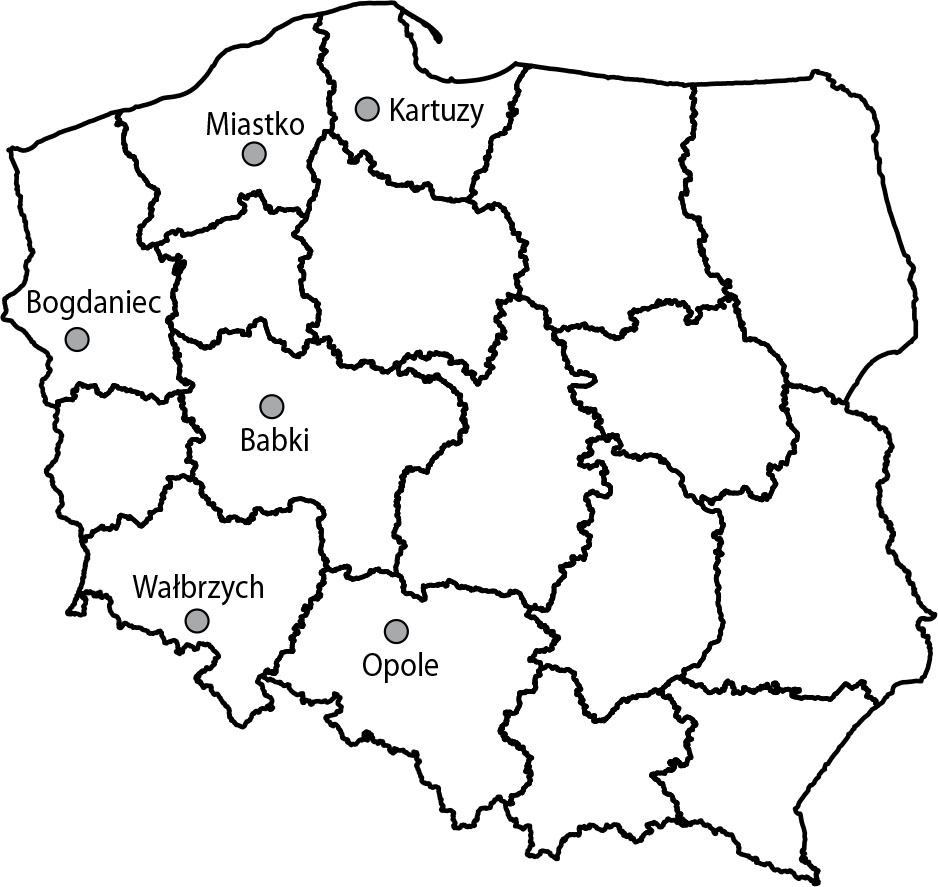
Figure 2.
Location of European larch progeny test trials (established spring 2023) with Forest District as labels (detailed trial descriptions in Tab. 4). Regional Directorates of State Forests (RDLP) boundaries in Poland indicated by gray lines
The tested genotypes will be utilised for the establishment of seed orchards, and the following characteristics will be considered in the evaluation of plus trees and their progenies:
– survival rate (defined as the percentage of live seedlings relative to seedlings planted in the trial; this trait will be analysed 1, 2, 5 and 10 years after planting);
– growth traits (total height 5 and 10 years after planting; DBH 10 years after planting) and
– qualitative traits (stem straightness, forking and multistems, branch thickness and crown width will be analysed 10 years after planting).
Notes
[8] Funding
This research was funded by the State Forests National Forest Holding (Poland), grant number 500475.