
Table 1.
Tree variables collected for ecosystem services analysis with description
| Variable | Description |
|---|---|
| 1 | 2 |
| 1. GPS Coordinates | The values of geographical longitude and latitude were determined by applying Garmin Etrex 22x and GPSMap64s receivers as well as using Samsung Galaxy M31 mobile phone geolocation function (GPS Point app) in order to compare the accuracy of the available methods of identifying the geographical coordinates of trees and bushes |
| 2. Land use | It was determined by such categories: Agriculture, Cemetery Commercial/ industrial, Golf course, Institutional, Multi-family residential, Park, Residential Transportation, Utility, Vacant, Water/ wetland and Other. The land use variable is used to adjust model biomass and decomposition rates |
| 3. Tree and shrub information | It was determined by the following indicators: |
| 3.1. Tree ID | Unique tree number |
| 3.2. Species | Scientific name |
| 3.3. Total height | Height to top of tree (m) |
| 3.4. Crown base | Height to crown base (m) |
| 3.5. Crown top | Crown top height (m) |
| 3.6. Crown width | Measured crown width (to nearest m) in two directions: north-south and east-west or as safety considerations or physical obstructions allow (m) |
| 3.7. Percent canopy missing | Measured as percent of the crown volume that is not occupied by branches and leaves. Two perpendicular measures of missing leaf mass are made and the average result is recorded to nearest 5% (%) |
| 3.8. Crown dieback | Percent dieback in crown area, does not include normal, natural branch dieback, i.e., self-pruning due to crown competition or shading in the lower portion of the crown. However, branch dieback on side(s) and top of crown area due to shading from a building or another tree was included (%) |
| 3.9. Crown light exposure | Measured as number of sides of the tree receiving sunlight from above (maximum of five). Top of tree is counted as one side (1–5) |
| 3.10. DBH | Measured as diameter at breast height (height at 1.37 metres or 4.5 feet) |
Table 2.
Most important species in Pryzamkovyi park
| No | Species name | Population (%) | Leaf area (%) | Importance values* |
|---|---|---|---|---|
| 1 | Aesculus hippocastanum L. | 18.4 | 21.9 | 40.3 |
| 2 | Fraxinus excelsior L. | 15.8 | 20.9 | 36.7 |
| 3 | Tilia cordata Mill. | 13.2 | 15.5 | 28.7 |
| 4 | Acer platanoides L. | 7.9 | 13.3 | 21.1 |
| 5 | Acer pseudoplatanus L. | 4.8 | 7.2 | 12.1 |
| 6 | Betula pendula Roth. | 4.8 | 2.2 | 7.0 |
| 7 | Acer saccharinum L. | 2.6 | 4.3 | 6.9 |
| 8 | Thuja occidentalis L. | 5.7 | 0.8 | 6.5 |
| 9 | Prunus cerasus L. | 5.3 | 0.4 | 5.6 |
| 10 | Quercus robur L. | 2.6 | 2.6 | 5.2 |
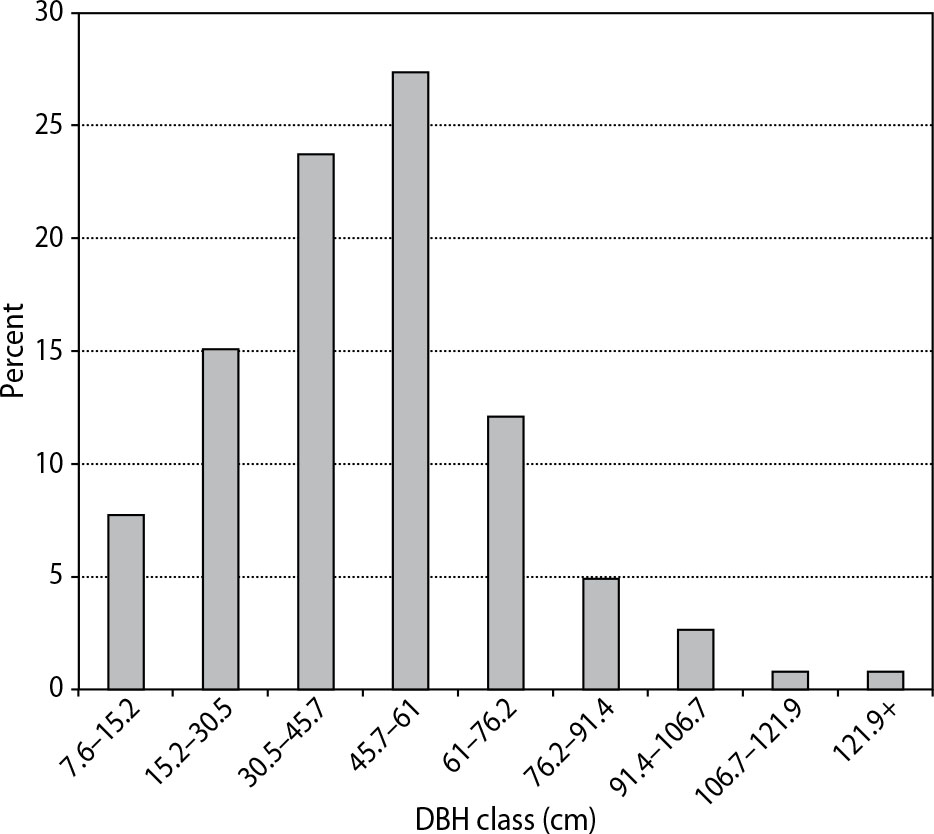
Figure 1.
Percent of tree population by diameter class (DBH–stem diameter at 1.37 metres)
Table 3.
Statistical indicators of the samples
| Statistical indicators | I (Garmin 22) | II (GPS 64s) | III (GPS point mobile) |
|---|---|---|---|
| Average value (arithmetical mean), m | 5.03 | 4.85 | 5.39 |
| Variation indices | |||
| Minimum value, m | 0.43 | 0.76 | 1.27 |
| Maximum value, m | 15.14 | 18.19 | 16.60 |
| Range of variation, m | 14.71 | 17.43 | 15.33 |
| Dispersion, m | 9.28 | 9.86 | 9.70 |
| Basic (standard) deviation, m | 3.05 | 3.14 | 3.11 |
| Coefficient of variation, % | 60.60 | 64.74 | 57.70 |
| Experiment accuracy, % | 3.88 | 4.16 | 5.89 |
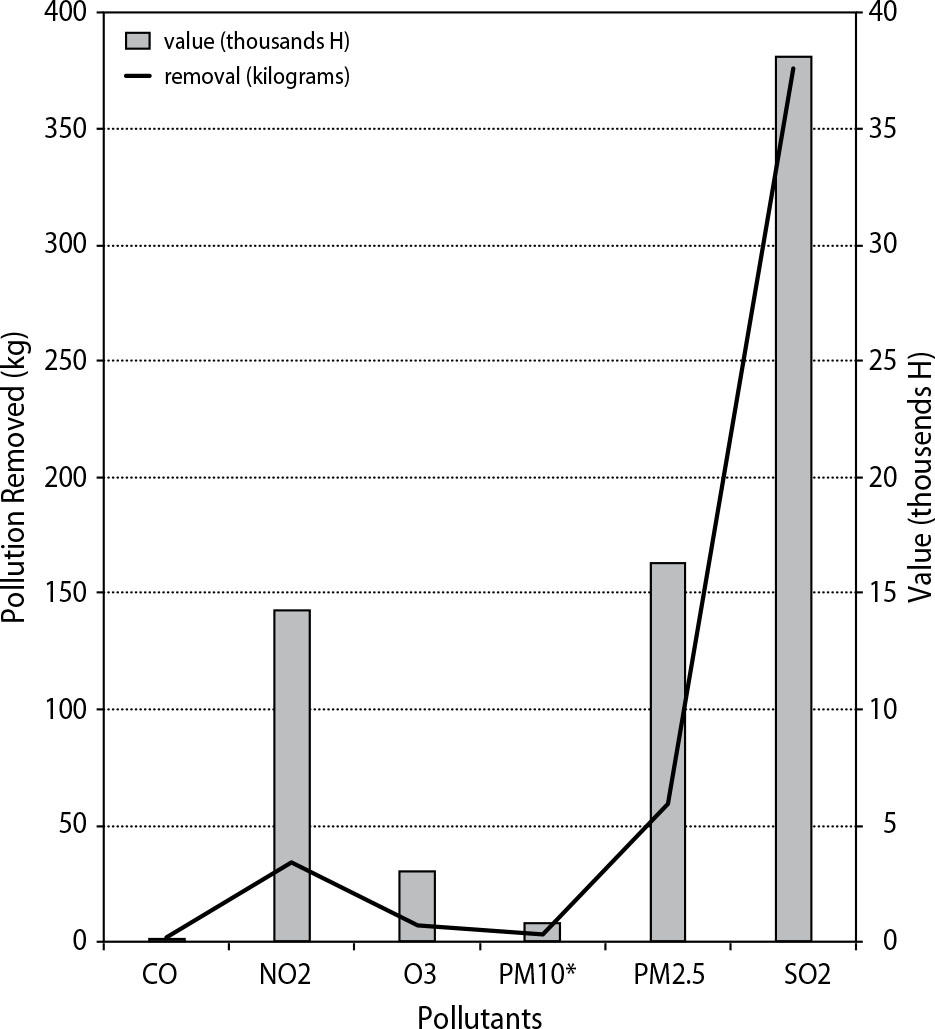
Figure 2.
Annual pollution removal (points) and value (bars) by trees of park
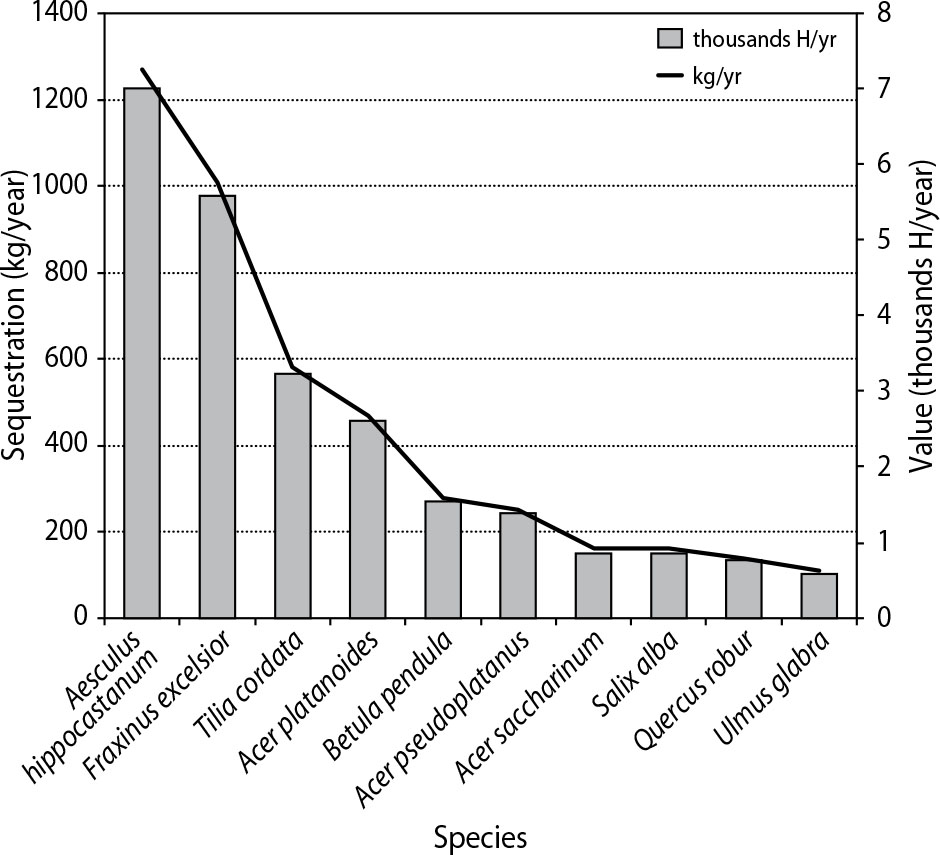
Figure 3.
Estimated gross carbon sequestration (points) and value (bars) for trees with the greatest sequestration, Pryzamkovyi park
Table 4.
The top 10 oxygen production species
| No | Species | Oxygen (kg) | Gross carbon sequestration (kg/yr) | Number of trees | Leaf area (ha) |
|---|---|---|---|---|---|
| 1 | Aesculus hippocastanum L. | 3380.40 | 1267.65 | 42 | 3.58 |
| 2 | Fraxinus excelsior L. | 2697.65 | 1011.62 | 36 | 3.41 |
| 3 | Tilia cordata Mill. | 1555.54 | 583.33 | 30 | 2.53 |
| 4 | Acer platanoides L. | 1258.02 | 471.76 | 18 | 2.16 |
| 5 | Betula pendula Roth. | 745.95 | 279.73 | 11 | 0.35 |
| 6 | Acer pseudoplatanus L. | 668.65 | 250.74 | 11 | 1.18 |
| 7 | Acer saccharinum L. | 414.34 | 155.38 | 6 | 0.70 |
| 8 | Salix alba L. | 413.68 | 155.13 | 6 | 0.28 |
| 9 | Quercus robur L. | 372.17 | 139.56 | 6 | 0.43 |
| 10 | Thuja occidentalis L. | 180.75 | 67.78 | 13 | 0.13 |
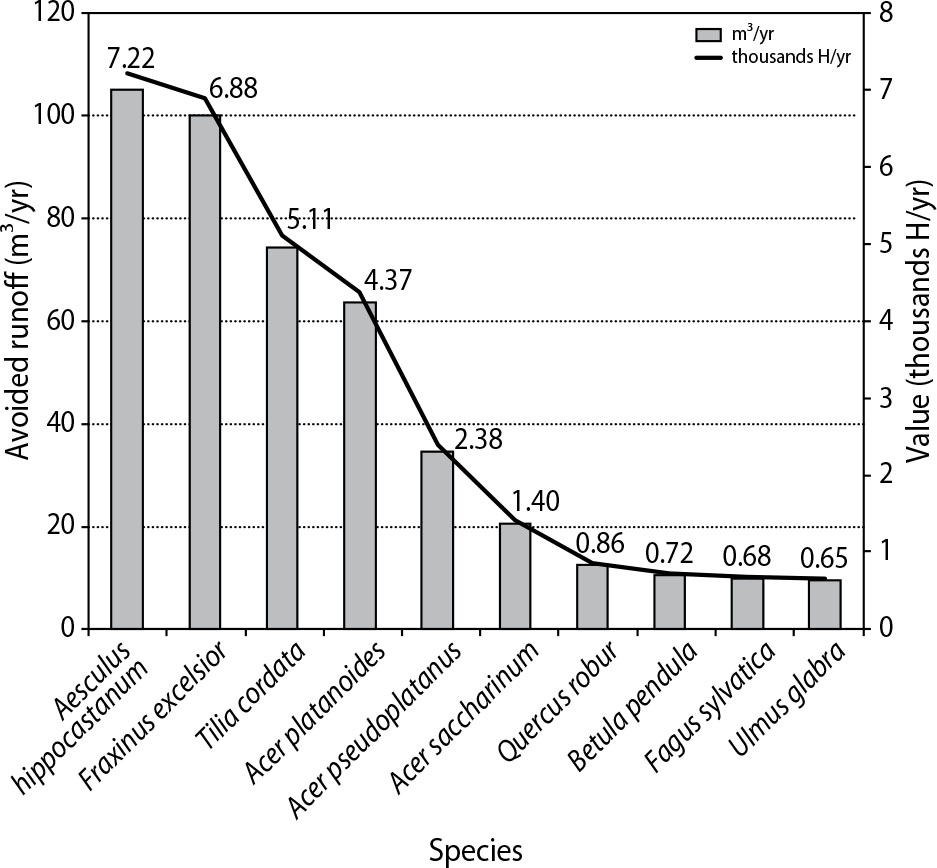
Figure 4.
Avoided runoff and value for species with greatest overall impact on runoff
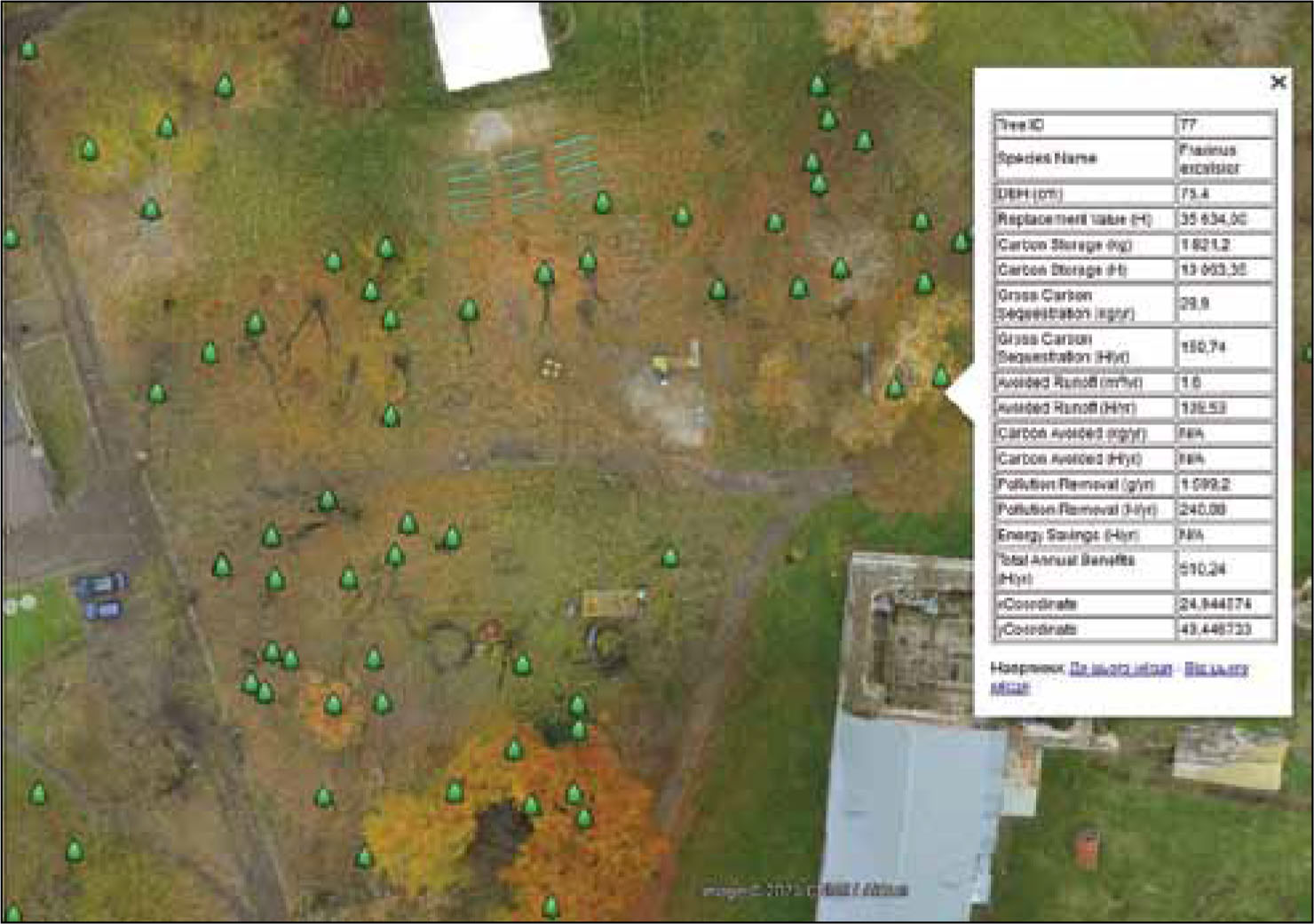
Figure 5.
A way of displaying a geographical information database of Pryzamkovyi park dendrocenosis on an orthophotomap
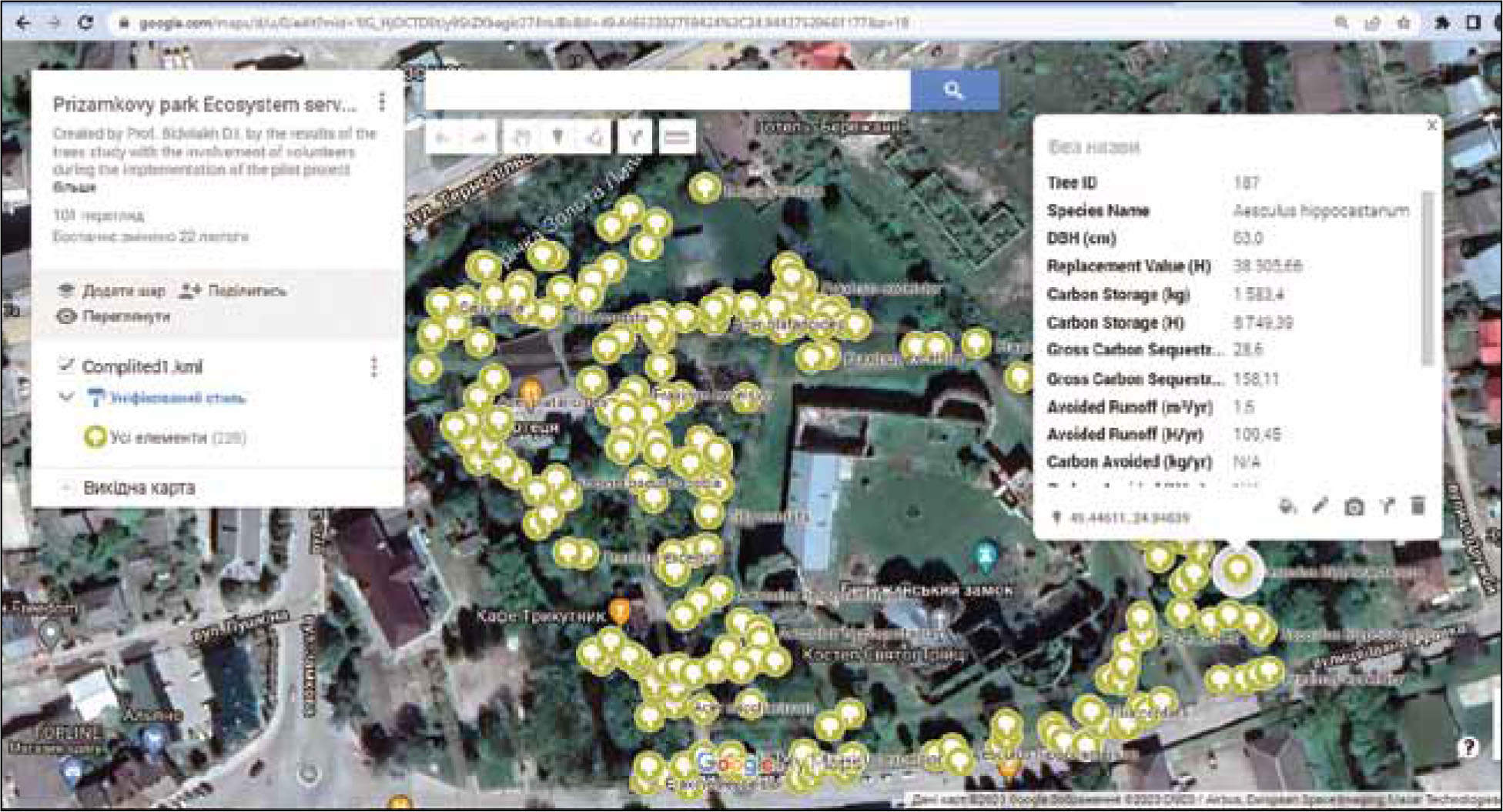
Figure 6.
A way of displaying a geographical information database of Pryzamkovyi park dendrocenosis in the system of Google MyMaps