
Table 1
Material characteristics
| Centuries-old trees nomenclature | Location | Age [years] | Geographical coordinates | |
|---|---|---|---|---|
| Quercus robur | ||||
| Q1 | Yuzefinskyy oak | Hlynne, Rivne region | nearly 1000 | 51°55′33″N 27°37′86″E |
| Q2 | Oak T. Shevchenko | Kyiv | more than 600 | 50°49′59″N 30°45′16″E |
| Q3 | M. Rylskyi oak | Kyiv | nearly 600 | 50°38′68″N 30°51′01″E |
| Q4 | Centuries-old oak in the NULES botanical garden | Kyiv | more than 200 | 50°38′16″N 30°50′28″E |
| Q5 | Oak Vitovta | Kyiv | more than 400 | 50°38′42″N 30°49′73″E |
| Q6 | Centuries-old oak 1 on the territory of NULES Ukraine | Kyiv | more than 400 | 50°38′38″N 30°50′53″E |
| Q7 | Centuries-old oak 2 on the territory of NULES Ukraine | Kyiv | more than 400 | 50°38′37″N 30°50′61″E |
| Tilia cordata | ||||
| L1 | Linden T. Shevchenko | Sedniv, Chernihiv region | more than 600 | 51°63′76″N 31°56′95″E |
| L2 | Linden P. Mohyla | Kyiv | more than 600 | 50°45′75″N 30°51′71″E |
| L3 | Centuries-old linden tree of the Feofaniia Monument Park | Kyiv | more than 400 | 50°43′25″N 50°43′25″E |
| L4 | Linden tree of St. Feodosiya Pechers′koho | Kyiv | more than 700 | 50°34′00″N 30°48′’68″E |
| L5 | Centuries-old linden tree in Holosiivskyi forest | Kyiv | more than 200 | 50°72′18″ N 29°44′92″E |
| L6 | Centuries-old linden tree | v. Irsha, Radomyshl district, Zhytomyr region | more than 200 | 50°38′29″ N 30°50′51″E |
[i] Note: NULES – National University of Life and Environmental Sciences.
Table 2
Characteristics of SSR markers for assessment of Quercus robur polymorphism
| SSR | Nucleotide sequences of primers, 5′→3′ | Motive | The expected size of the amplicons, bp |
|---|---|---|---|
| ssrQrZAG 7 | F: CAACTTGGTGTTCGGATCAA | (TC)17 | 150 |
| R: GTGCATTTCTTTTATAGCATTCAC | |||
| ssrQrZAG 11 | F: CCTTGAACTCGAAGGTGTCCTT | (TC)22 | 273 |
| R: GTAGGTCAAAACCATTGGTTGACT | |||
| ssrQrZAG 25 | F: GATATGAAAGATTCTTATTCCATCC | (GA)32 | 135 |
| R: GTTAGAACCAATGTACCAAAGTCC | |||
| ssrQrZAG 30 | F: TGCTCCGTCATAATCTTGCTCTGA | (GA)26 | 211 |
| R: GCAATCCTATCATGCACATGCACAT | |||
| ssrQrZAG 31 | F: CTTAGTTTGGTTGGGAAGAT | (GA)31 | 190 |
| R: GCAACCAAACAAATGAAAT | |||
| ssrQrZAG 44 | F: ACCCTTGTAGTCATGTTCGTTG | (GA)29 (TG)31 | 145 |
| R: GAAATCTCACCTGCTCCCTATC | |||
| ssrQrZAG 65 | F: CAGTGGTGTCAACTCCTCCCAG | (TC)21(TA)10 | 270 |
| R: GTCAGGTGACCATTCAAACCTAGAA |
[i] Note: F – forward primer, R – reverse primer, SSR – simple sequence repeat.
Table 3
Characteristics of SSR markers for assessment of Tilia cordata polymorphism
| SSR | Nucleotide sequences of primers, 5′→3′ | Motive | The expected size of the amplicons, bp |
|---|---|---|---|
| Tc5 | F: TTTTCATACATTTAGAGACTTTTAGCA | (AG)12 | 150 |
| R: TGCATGATTTGTATGTTTAGGG | |||
| Tc915 | F: ACATCGATTGTATTTCCCTTTAAC | (CT)16 | 165 |
| R: GTTGTATTTTGCCCTTAACATTG | |||
| Tc920 | F: AAATGTCTTCAGAGTGACTAGATGG | (GA)2(GT)15 (AG)4 | 232 |
| R: TGCCTCATTATTCTCCTAATTCTC | |||
| Tc927 | F: AGTCCTCCTGTCAAATGCTG | (AG)10 | 157 |
| R: ATCACACTCGTTTATGACATCTTG | |||
| Tc937 | F: AGCCAACCAACTTTTACAATACAG | (AG)13 | 162 |
| R: AGATAAAAGCACATAAATCGATGG | |||
| Tc963 | F: CTAACCCCATTCTCTTTAATTCTG | (CT)11 | 238 |
| R: GCTTTCATTTCAGTTTTCCTCTAC |
[i] Note: F – forward primer, R – reverse primer, SSR – simple sequence repeat.
Table 4
Composition of reaction mixture for PCR of Quercus robur and Tilia cordata
| Components | Final concentration | |
|---|---|---|
| Q. robur | T. cordata | |
| PCR buffer* | 1× | 1× |
| MgCl2 | 1.5 μM | 2 μM |
| dNTP (dATP, dTTP, dGTP, dCTP) | 100 μM | 200 μM |
| Polymerase Taq | 1 U | 0.5 U |
| Primer (F) | 1 μM | 0.2 μM |
| Primer (R) | 1 μM | 0.2 μM |
| DNA | 50 ng | 50 ng |
Table 5
PCR protocol for Quercus robur and Tilia cordata
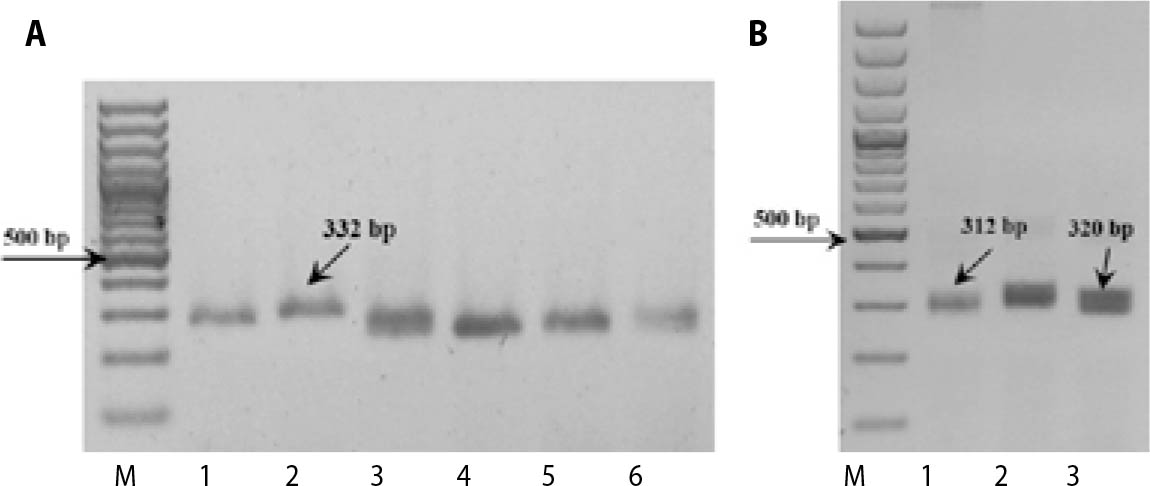
Figure 1
Results of PCR testing of samples of common oak with marker: A – ssrQrZAG 11: 1 – Yuzefin oak; 2 – Shevchenko oak; 3 – Rylskyi oak; 4 – centuries-old oak in the botanical garden of the NULES; 5 – Vytautas oak; 6 – centuries-old oak on the territory of NULES Ukraine; B – ssrQrZAG 65: 1 – Rylskyi oak; 2 – centuries-old oak in the NULES botanical garden; 3 – Vytautas oak
Note: M – molecular weight marker 100-bp DNA ladder O’GeneRuler (Thermo Scientific), NULES – National University of Life and Environmental Sciences, PCR – polymerase chain reaction.
Table 6
Sizes of obtained alleles for Quercus robur with SSR markers
| SSR | Allele size, bp | ||||||
|---|---|---|---|---|---|---|---|
| Q1* | Q2 | Q3 | Q4 | Q5 | Q6 | Q7 | |
| ssrQrZAG 7 | 132 | 120, 140 | 132 | 152 | 152 | 140 | 146 |
| ssrQrZAG 11 | 300 | 332 | 268, 300 | 290 | 290 | 268, 300 | 290 |
| ssrQrZAG 25 | 116 | 206 | 206 | 206 | 194 | 158, 206 | 112, 158 |
| ssrQrZAG 30 | 204, 226 | 212, 230 | 182 | 192 | 212 | 192, 212 | 204 |
| ssrQrZAG 31 | 146, 182 | 146, 182 | 140, 158 | 174 | 182 | 158 | 146, 182 |
| ssrQrZAG 44 | 116, 156 | 124, 180 | 144 | 144, 180 | 144 | 156, 216 | 156 |
| ssrQrZAG 65 | 272, 320 | 264, 312 | 312 | 312, 340 | 296, 320 | 396 | 388 |
Note:
* Q1 – Yuzefinskyy oak; Q2 – oak T. Shevchenko; Q3 – M. Rylskyi oak; Q4 – centuries-old oak in the NULES botanical garden; Q5 – oak Vitovta; Q6 – centuries-old oak 1 on the territory of NULES Ukraine; Q7 – centuries-old oak 2 on the territory of NULES Ukraine; NULES – National University of Life and Environmental Sciences, SSR – simple sequence repeat.
Table 7
Sizes of obtained alleles for Tilia cordata with SSR markers
| SSR | Allele size, bp | |||||
|---|---|---|---|---|---|---|
| L1* | L2 | L3 | L4 | L5 | L6 | |
| Tc927 | 152, 168 | 152 | 152 | 152, 168 | 152 | 152 |
| Tc5 | 154 | 154, 174, 180 | 154 | 158 | 154 | 154, 180 |
| Tc915 | 154 | 154, 168 | 154 | 154, 174 | 182 | 168 |
| Tc920 | 218, 232 | 224, 240 | 218, 232 | 232 | 232, 252 | 252 |
| Tc937 | 152 | 152 | 152 | 162 | 162 | 162 |
| Tc963 | 246 | 246 | 238 | 238 | 246 | 246 |
Note:
* L1 – T. H. Shevchenko T. cordata; L2 – P. Mohyla T. cordata; L3 – T. cordata of St. Theodosius of Pechersk; L4 – a centuries-old T. cordata of the Feofaniia Monument Park; L5 – a centuries-old T. cordata (the village of Irsha); L6 – a centuries-old T. cordata in the Holosiivskyi forest; SSR – simple sequence repeat.
Table 8
Characteristics of the obtained alleles by SSR markers for the samples of Quercus robur and Tilia cordata
| SSR | Number of alleles | Allele size range | Alleles’ frequency | PIC |
|---|---|---|---|---|
| Q. robur | ||||
| ssrQrZAG 7 | 5 | 120–152 | 0.07–0.29 | 0.77 |
| ssrQrZAG 11 | 4 | 268–332 | 0.14–0.43 | 0.69 |
| ssrQrZAG 25 | 5 | 112–206 | 0.07–0.50 | 0.68 |
| ssrQrZAG 30 | 6 | 182–230 | 0.07–0.29 | 0.80 |
| ssrQrZAG 31 | 5 | 140–182 | 0.07–0.36 | 0.76 |
| ssrQrZAG 44 | 6 | 116–216 | 0.07–0.36 | 0.76 |
| ssrQrZAG 65 | 8 | 264–396 | 0.07–0.29 | 0.84 |
| T. cordata | ||||
| Tc5 | 4 | 154–180 | 0.08–0.58 | 0.60 |
| Tc915 | 4 | 154–182 | 0.08–0.50 | 0.65 |
| Tc920 | 5 | 218–252 | 0.08–0.25 | 0.72 |
| Tc927 | 2 | 152–168 | 0.17–0.83 | 0.28 |
| Tc937 | 2 | 152–162 | 0.5 | 0.50 |
| Tc963 | 2 | 238–246 | 0.33–067 | 0.44 |
[i] Note: PIC – polymorphism information content, SSR – simple sequence repeat.
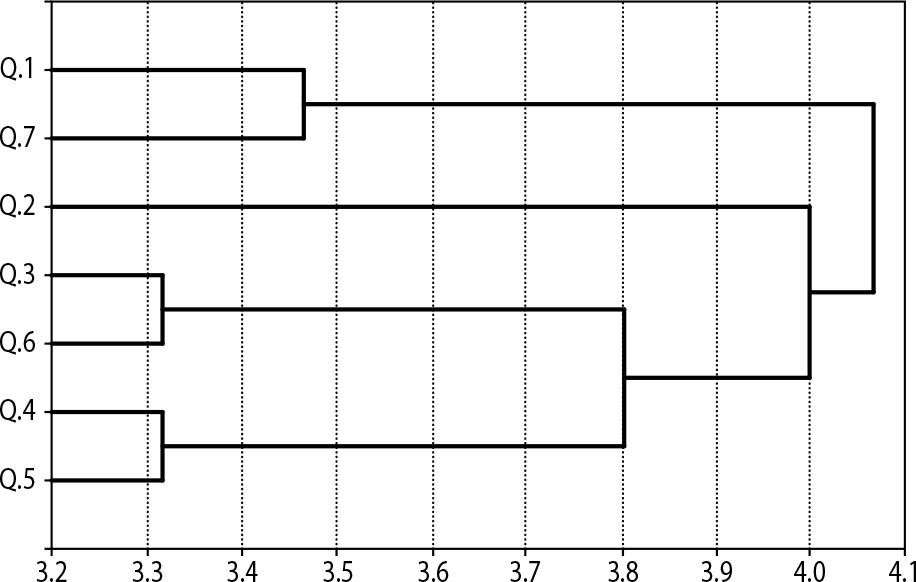
Figure 2
Cluster distribution of Quercus robur samples by SSR markers
Note: Q1 – Yuzefin oak; Q2 – Shevchenko oak; Q3 – Rylskyi oak; Q4 – centuries-old oak in the NULES botanical garden; Q5 – Vytautas oak; Q 6 and Q7 - centuries-old oak near the territory of NULES Ukraine; NULES – National University of Life and Environmental Sciences, SSR – simple sequence repeat.
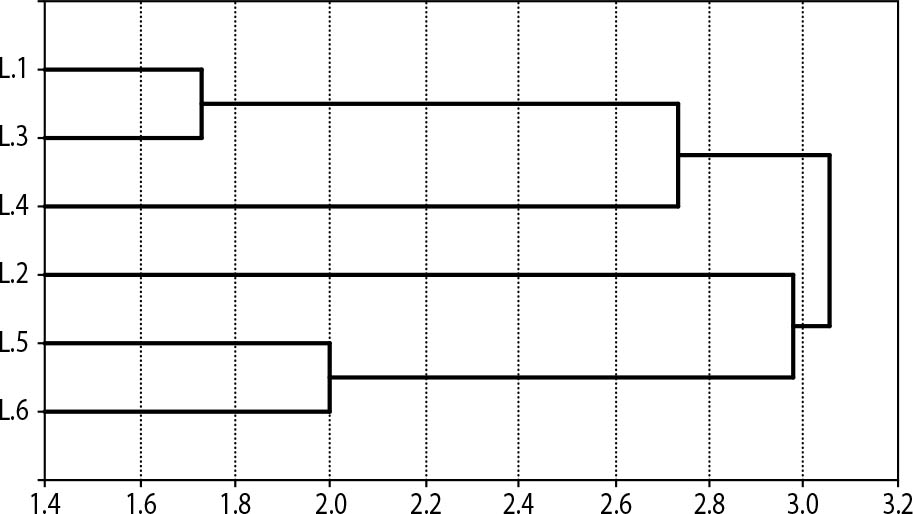
Figure 3
Cluster distribution of Tilia cordata samples by SSR markers
Note: L.1 T.H. Shevchenko Tilia cordata, L.2 – P. Mohyla Tilia cordata, L.3 Tilia cordata of St. Theodosius of Pechersk, L.4 a centuries-old Tilia cordata of the Feofaniia Monument Park, L.5 a centuries-old Tilia cordata (the village of Irsha), L.6 a centuries-old Tilia cordata in the Holosiivskyi forest.
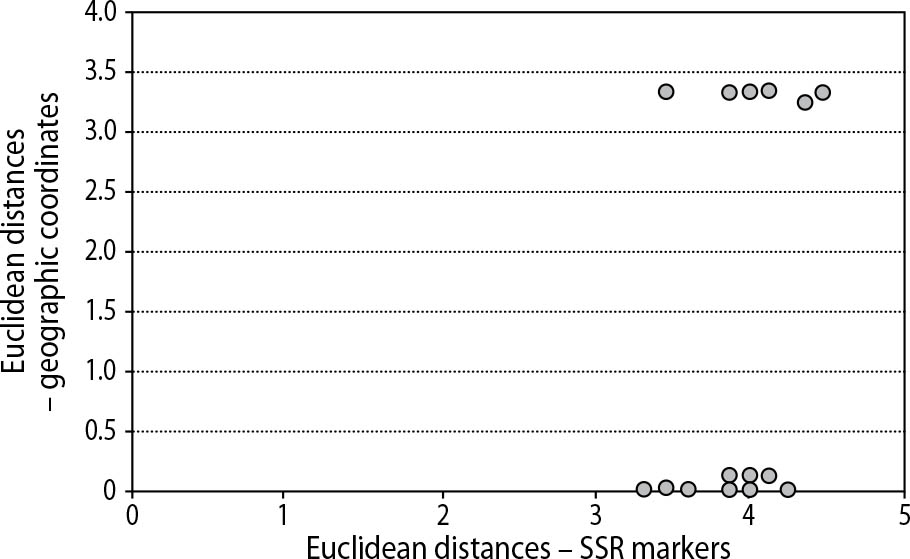
Figure 4
Relationship between genetic distances of Quercus robur samples according to geographical coordinates and SSR markers (SSR – simple sequence repeat)
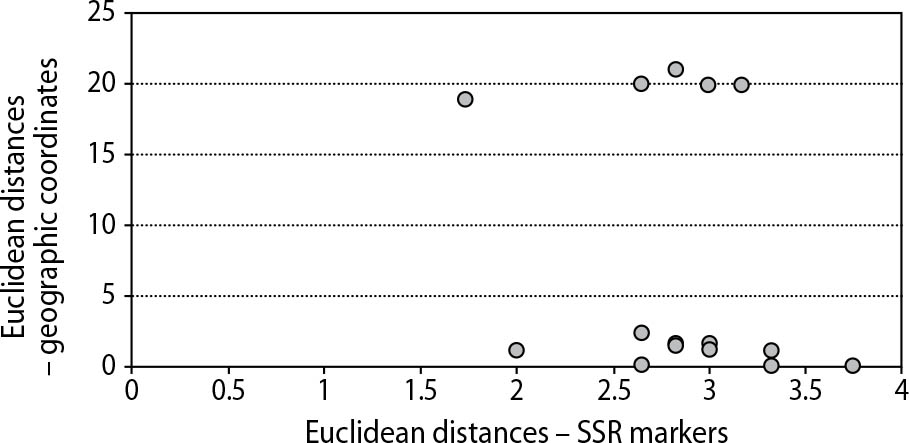
Figure 5
Relationship between genetic distances of Tilia cordata samples according to geographical coordinates and SSR markers (SSR – simple sequence repeat)