
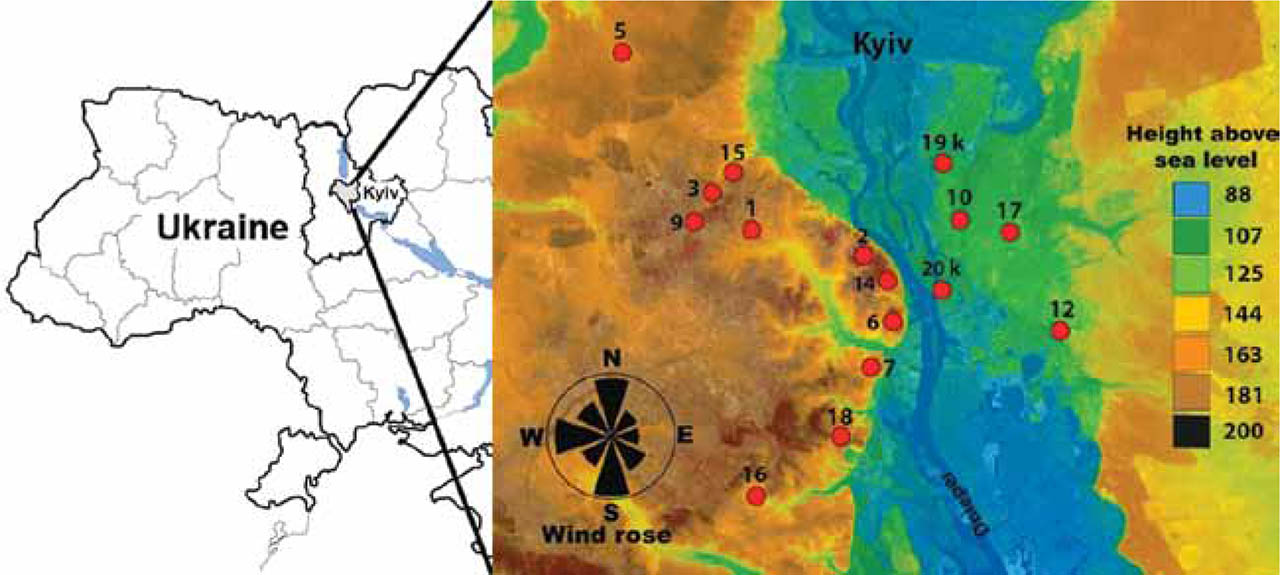
Figure 1
Location of observation and measurement points, relief and altitude, where: 1 – park named after Pushkin, 2 – Mariinsky park, 3 – Syretsky park, 5 – Pushcha-Vodytsya (park), 6 – NBG named after Hrishko, 7 – Lysa Mountain, 9 – Nyvky park, 10 – Peremoha park, 12 – park of Partisan Glory; 14 – Park of Eternal Glory, 15 – Babyn Yar, 16 – Feofania park, 17 – park DSHK, 18 – Holosiivskyi NNP, 19c – Camera 19, 20c – Camera 20. 4, 8, 11, 13, points did not have cameras; NNP – national nature park
Table 1
The value of integrated indices (environmental indicators) of the PE state
| Index | Hstr | W | Ic | Inv | Concentration NOx, mg/m3 | HI |
|---|---|---|---|---|---|---|
| Very good | >2.47 | 9.26–12.00 | 1.00–1.50 | >8.67 | <0.020 | <1.060 |
| Good | 2.21–2.46 | 6.51–9.25 | 1.51–2.50 | 5.79–8.67 | 0.021–0.040 | 1.061–2.121 |
| Satisfactory | 1.97–2.20 | 3.76–6.50 | 2.51–3.50 | 2.90–5.78 | 0.041–0.060 | 2.122–3.181 |
| Bad | <1.96 | 1.0–3.75 | 3.51–4.50 | <2.89 | 0.061–0.08 | 3.182–4.242 |
| Very bad | – | – | 4.51–6.00 | – | >0.081 | >4.242 |
Table 2
Integral assessment of the studied park ecosystems state in Kyiv
| Assessment indicators/No. PE | 1 | 2 | 3 | 5 | 6 | 7 | 9 | 10 | 12 | 14 | 15 | 16 | 17 | 18 | 19c | 20c |
|---|---|---|---|---|---|---|---|---|---|---|---|---|---|---|---|---|
| Park area [ha] | 19.5 | 8.9 | 6.5 | 11.7 | 130.0 | 137.0 | 120.0 | 66.1 | 112.0 | 18.4 | 11.7 | 150.0 | 13.9 | 4525.5 | – | – |
| Canopy density (P) | 0.70 | 0.50 | 0.82 | 0.53 | 0.90 | 0.70 | 0.64 | 0.52 | 0.50 | 0.81 | 0.80 | 0.77 | 0.41 | 0.95 | – | – |
| Index of stand state (Is) | 2.2 | 2.03 | 1.9 | 2.5 | 1.96 | 2.4 | 1.95 | 2.4 | 2.3 | 1.7 | 2.37 | 2.25 | 2.19 | 1.99 | – | – |
| Sanitary condition of plantations | weakened | weakened | weakened | severely weakened | weakened | weakened | weakened | weakened | weakened | weakened | weakened | weakened | weakened | weakened | – | – |
| Mortality of trees (Mt) [%] | 19.84 | 20.83 | 10.81 | 35.80 | 40.20 | 18.59 | 11.90 | 30.70 | 10.53 | 25.00 | 9.77 | 35.71 | 9.46 | 10.7 | – | – |
| Species saturation of grass tier, pieces/ha (L) | 92.86 | 42.50 | 67.57 | 202.27 | 55.88 | 34.62 | 117.86 | 171.05 | 126.32 | 42.31 | 39.66 | 80.43 | 3.24 | 30.3 | – | – |
| Nitrophils in grass tier (Nt) [%] | 51.43 | 56.25 | 65.22 | 41.46 | 64.71 | 50.00 | 42.86 | 43.28 | 46.81 | 52.38 | 63.64 | 58.97 | 53.49 | 50.00 | – | – |
| H′ | 2.86 | 1.97 | 2.51 | 3.60 | 2.01 | 2.23 | 2.15 | 3.30 | 3.11 | 2.37 | 2.46 | 3.07 | 3.65 | 2.22 | – | – |
| W | 2.6 | 2.3 | 3.1 | 4.25 | 6.5 | 4.8 | 4.8 | 3.5 | 3.8 | 1.5 | 7.19 | 5.63 | 1.25 | 5.50 | – | – |
| State of ecosystems by W | CD | CD | CD | TC | vulnerable | TC | TC | CD | CD | CD | vulnerable | TC | CD | TC | – | – |
| Hstr | 1.94 | 1.75 | 1.93 | 1.93 | 2.07 | 1.94 | 1.72 | 1.93 | 2.06 | 1.98 | 2.02 | 1.96 | 1.46 | 1.81 | – | – |
| Characteristic by Hstr | bad | STF | bad | bad | STF | bad | STF | bad | STF | STF | STF | bad | bad | bad | – | – |
| Inv | 2.29 | 1.98 | 3.15 | 3.28 | 6.86 | 3.88 | 4.23 | 2.81 | 3.40 | 1.75 | 6.13 | 4.90 | 5.00 | 5.00 | – | – |
| Characteristic by Inv | bad | bad | STF | STF | good | STF | STF | good | STF | bad | good | STF | STF | STF | ||
| Distance to the road, m | 10.0 | 0.5 | 393.0 | 1.0 | 50.0 | 0.2 | 0.2 | 0.2 | 330.0 | 0.2 | 0.2 | 540.0 | 150.0 | 238.0 | 0.2 | 0.2 |
| Number of lanes in one direction (D) | 4 | 2 | 4 | 1 | 3 | 3 | 4 | 3 | 3 | 2 | 3 | 3 | 3 | 3 | 3 | 3.5 |
| Number of cars per hour | 7161.0 | 2010.0 | 4605.0 | 859.5 | 6058.5 | 6058.5 | 7122.0 | 2356.5 | 1956.0 | 2314.5 | 4989.0 | 5085.0 | 3243.0 | 6058.5 | 3312.0 | 4315.0 |
| Transport speed, km/h (Qav) | 51.43 | 39.89 | 63.01 | 34.62 | 72.40 | 73.50 | 61.71 | 42.92 | 37.89 | 39.89 | 49.50 | 62.61 | 36.00 | 73.50 | 36.29 | 54.88 |
| C[mg/m3] | 0.2155 | 0.0861 | 0.0966 | 0.0513 | 0.2109 | 0.2109 | 0.1343 | 0.1161 | 0.1042 | 0.0970 | 0.1763 | 0.1137 | 0.2074 | 0.2109 | 0.1130 | 0.1330 |
Table 3
Average daily content of air pollutants in the Kyiv park ecosystems
| Contents [mg/m3/No. PE] | 5 | 10 | 2 | 3 | 12 | 14 | 16 | 19c | 9 | 20c | 15 | 1 | 6 | 7 | 17 | 18 | Average | HQi aver. | Share from MACa.d. |
|---|---|---|---|---|---|---|---|---|---|---|---|---|---|---|---|---|---|---|---|
| NOx | 0.0210 | 0.0475 | 0.0367 | 0.0378 | 0.0413 | 0.0420 | 0.0466 | 0.0468 | 0.0588 | 0.0550 | 0.0687 | 0.0901 | 0.08657 | 0.0866 | 0.0900 | 0.0866 | 0.0589 | 1.47 | 1.47 |
| Load characteristics by NOx | good | STF | good | good | STF | STF | STF | STF | STF | STF | bad | very bad | very bad | very bad | very bad | very bad | – | – | – |
| CnHm | 0.0283 | 0.0644 | 0.0469 | 0.0555 | 0.0591 | 0.0523 | 0.0621 | 0.0617 | 0.0699 | 0.0739 | 0.1017 | 0.1189 | 0.11454 | 0.1145 | 0.1066 | 0.1145 | 0.0778 | 0.08 | 1.560 |
| Soot (CnH) | 0.0002 | 0.0003 | 0.0001 | 0.0002 | 0.0003 | 0.0001 | 0.0005 | 0.0004 | 0.0005 | 0.0002 | 0.0004 | 0.0003 | 0.00110 | 0.0011 | 0.0012 | 0.0011 | 0.0005 | 0.01 | 0.010 |
| SO2 | 0.0014 | 0.0030 | 0.0018 | 0.0024 | 0.0028 | 0.0020 | 0.0036 | 0.0032 | 0.0040 | 0.0030 | 0.0043 | 0.0047 | 0.00705 | 0.0071 | 0.0077 | 0.0071 | 0.0041 | 0.08 | 0.081 |
| Formaldehyde | 0.0002 | 0.0004 | 0.0002 | 0.0003 | 0.0004 | 0.0002 | 0.0005 | 0.0005 | 0.0006 | 0.0004 | 0.0006 | 0.0006 | 0.00103 | 0.0010 | 0.0013 | 0.0010 | 0.0006 | 0.20 | 0.192 |
| Lead compounds | 0.0002 | 0.0004 | 0.0004 | 0.0003 | 0.0003 | 0.0004 | 0.0003 | 0.0004 | 0.0005 | 0.0005 | 0.0006 | 0.0008 | 0.00060 | 0.0006 | 0.0006 | 0.0006 | 0.0005 | 1.58 | 1.560 |
| Sum | 0.0513 | 0.1161 | 0.0861 | 0.0966 | 0.1042 | 0.0970 | 0.1137 | 0.1130 | 0.1343 | 0.1330 | 0.1763 | 0.2155 | 0.21090 | 0.2109 | 0.2074 | 0.2109 | 0.1423 | – | – |
| HI | 1.243 | 2.838 | 2.261 | 2.247 | 2.422 | 2.591 | 2.620 | 2.732 | 3.446 | 3.347 | 4.072 | 5.490 | 4.787 | 4.787 | 5.010 | 4.787 | – | – | – |
| Characteristic by HI | good | STF | STF | STF | STF | STF | STF | STF | bad | bad | bad | very bad | very bad | very bad | very bad | very bad | – | – | – |
Table 4
Assessment of air quality in Kyiv
| Air pollutants | Actual average annual concentrations for 20191 [mg/m3] | The average daily concentration, our calculations [mg/m3] | MACa.d. [mg/m3] for humans2 | MACa.d.3 for plants |
|---|---|---|---|---|
| NOx converted to NO2 | 0.14400 | 0.0570 | 0.0400 | 0.020 |
| SO2 | 0.07500 | 0.0039 | 0.0500 | 0.015 |
| Formaldehyde | 0.00560 | 0.0006 | 0.0030 | 0.003 |
| Saturated hydrocarbons (CnHm) | – | 0.0754 | 0.0500 | 0.140 |
| Soot (CnH) | 0.03500 | 0.0005 | 0.0500 | 0.050 |
| Inorganic lead compounds | 0.00003 | 0.0005 | 0.0003 | – |
Notes:
3 according to Furdychko et al. (2008).
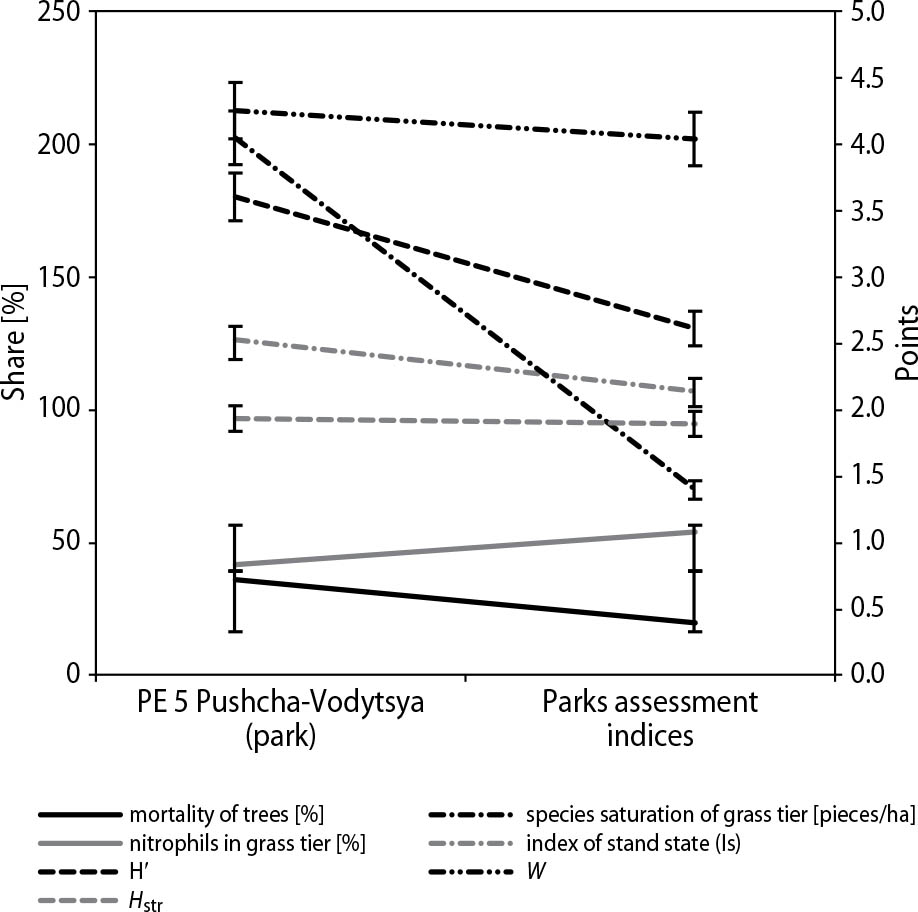
Figure 2
Assessment of the PE state compared to control (PE 5 – Pushcha-Vodytsya park)
Table 5
Correlation of the investigated PE parameters
| P | Is | Mt | L | Nt | W | Hstr | Inv | D | Number of cars per hour | C [mg/m3] | HI | |
|---|---|---|---|---|---|---|---|---|---|---|---|---|
| P | 1 | |||||||||||
| Is | −0.46 | 1 | ||||||||||
| Mt | 0.09 | 0.13 | 1 | |||||||||
| L | −0.37 | 0.46 | 0.41 | 1 | ||||||||
| Nt | 0.52 | −0.33 | −0.01 | −0.62 | 1 | |||||||
| W | 0.54 | 0.27 | 0.18 | 0.05 | 0.25 | 1 | ||||||
| Hstr | 0.46 | 0.13 | 0.40 | 0.31 | 0.21 | 0.48 | 1 | |||||
| Inv | 0.38 | 0.12 | 0.03 | −0.30 | 0.42 | 0.75 | 0.03 | 1 | ||||
| D | 0.26 | −0.21 | −0.46 | −0.21 | 0.24 | 0.12 | −0.06 | 0.20 | 1 | |||
| Number of cars per hour | 0.59 | −0.21 | −0.19 | −0.36 | 0.27 | 0.45 | 0.02 | 0.44 | 0.75 | 1 | ||
| C [mg/m3] | 0.34 | 0.00 | −0.24 | −0.58 | 0.23 | 0.26 | −0.16 | 0.54 | 0.49 | 0.72 | 1 | |
| HI | 0.29 | −0.04 | −0.26 | −0.57 | 0.19 | 0.16 | –0.21 | 0.45 | 0.51 | 0.72 | 0.99 | 1 |
[i] Note: medium and strong correlations are highlighted.
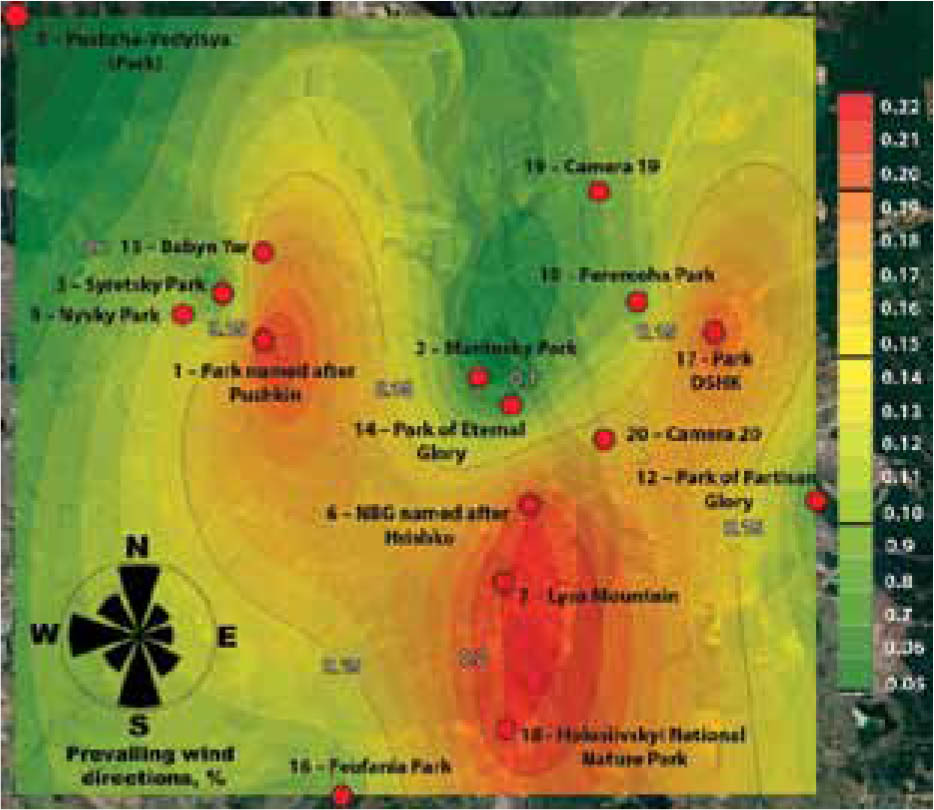
Figure 3
Amount of air pollutants’ emissions (mg/m3) from vehicles and distribution by prevailing wind directions,%
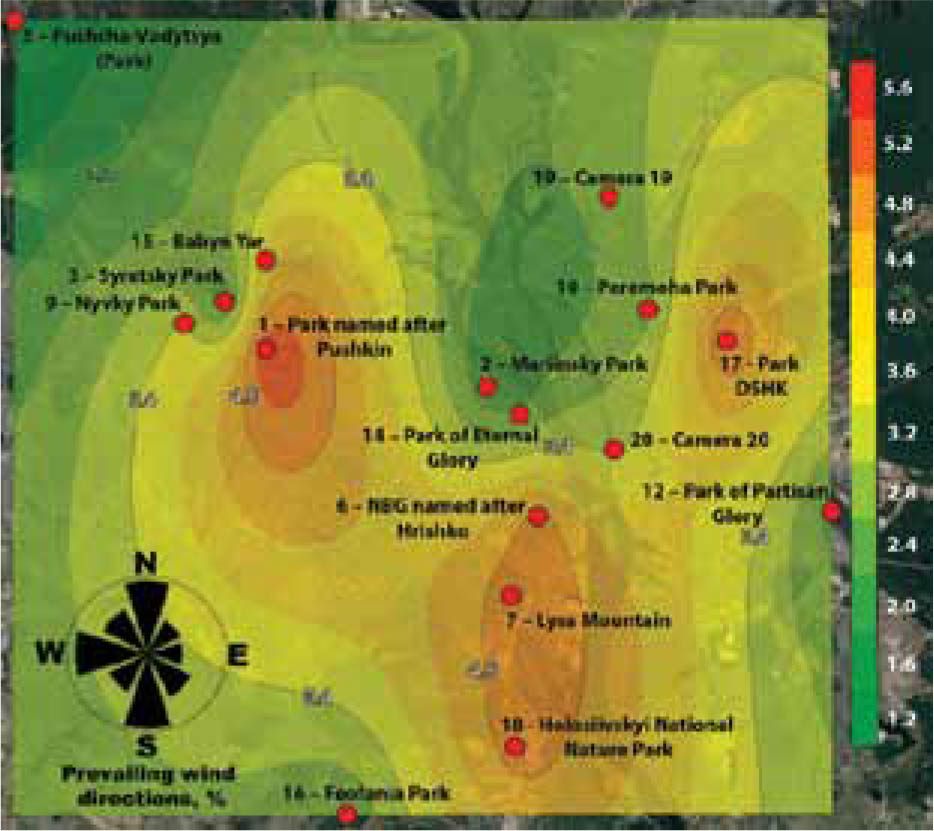
Figure 4
HI of air pollutants from vehicles (HI – hazard index)
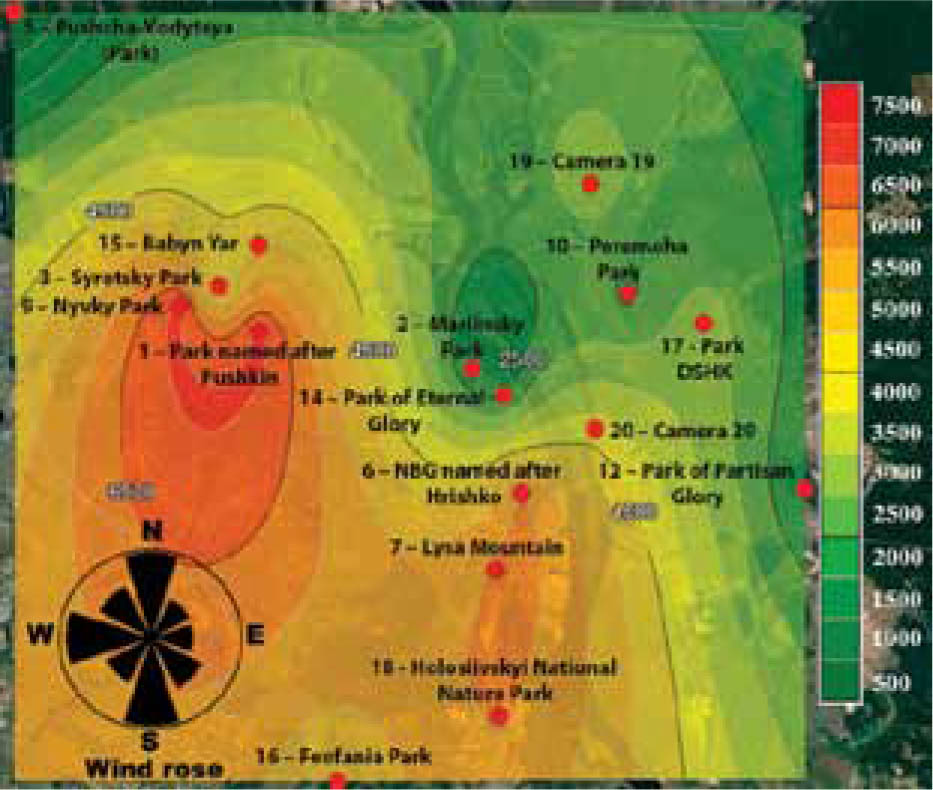
Figure 5
Number of cars per hour
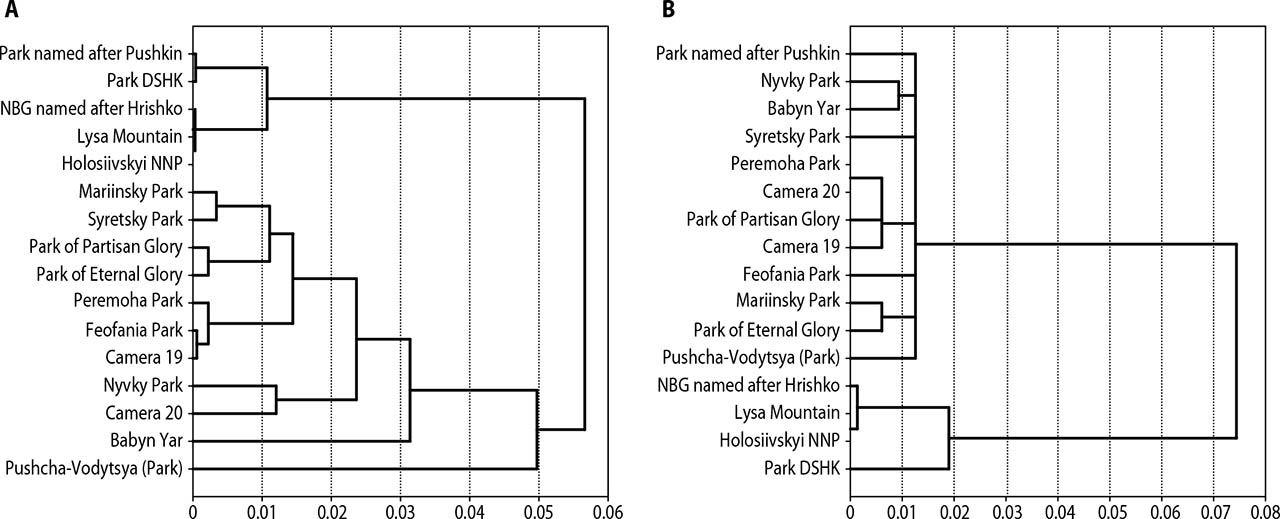
Figure 6
Clustering of PE in Kyiv by concentrations of air pollutants. A – NOx concentration in the air, mg/m3; B – concentration of SO2 in the air, mg/m3
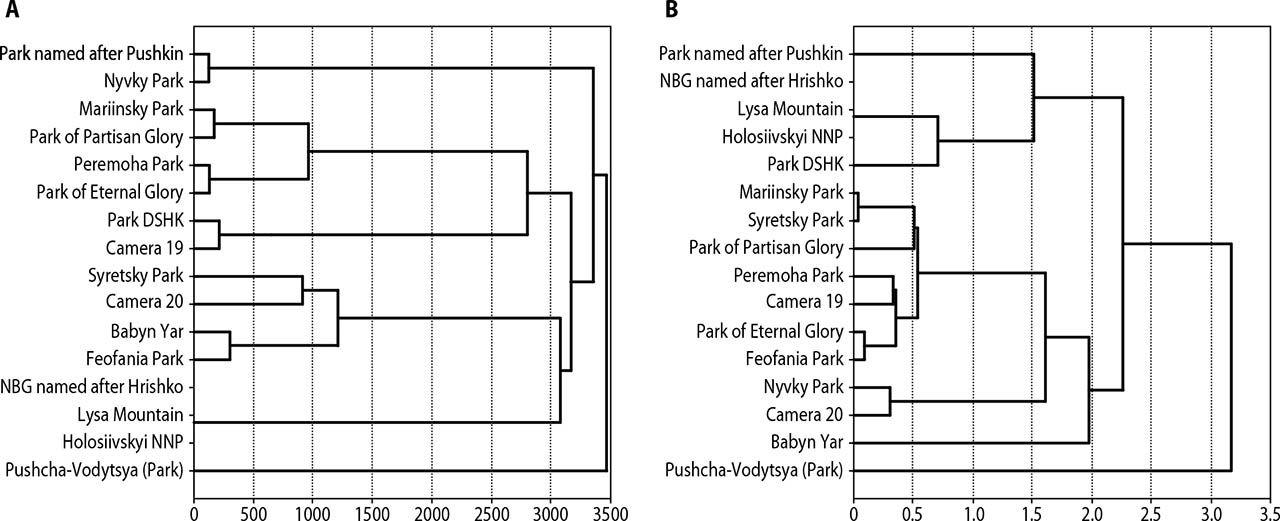
Figure 7
Clustering of PEs according to the parameters of air pollutants: A – cars per hour and B – HI (PE – park ecosystem, HI – hazard index)
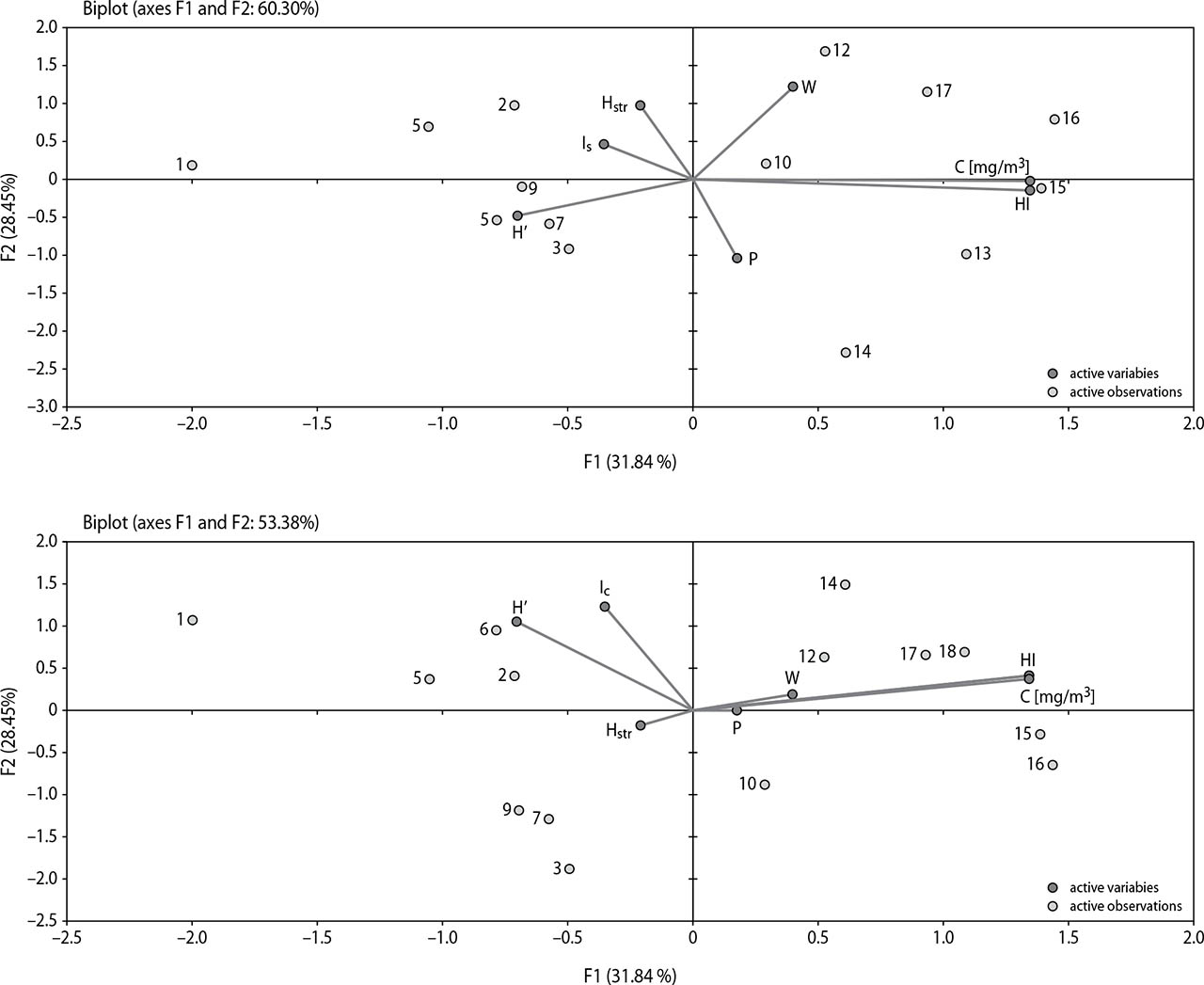
Figure 8
PCA using integrated indices for the PE state(PCA – principal component analysis, PE – park ecosystem)
Table 6
Sterility of Taraxacum officinale pollen in the conditions causing pollution in metropolis
| No PE | Distance to the road [m] | Number of cars per hour | Pollen grains (pieces) M ± m | V [%] | Number of sterile pollen (pieces) M ± m | V [%] | Share of a sterile pollen (S) [%] | CID |
|---|---|---|---|---|---|---|---|---|
| 5 | 238 | 860.0 | 1785 ± 8.86 | 34 | 236 ± 2.74 | 21 | 13.00 | 0.21 |
| 2 | 226 | 2010.0 | 1715 ± 9.26 | 33 | 342 ± 2.57 | 20 | 19.92 | 0.58 |
| 10 | 80 | 2357.0 | 1589 ± 6.68 | 28 | 344 ± 2.71 | 19 | 22.00 | 0.73 |
| 15 | 5 | 4989.0 | 1396 ± 11.26 | 44 | 361 ± 3.21 | 25 | 25.86 | 0.91 |
| 16 | 1000 | 5085.0 | 2035 ± 7.75 | 34 | 235 ± 4.53 | 27 | 11.55 | 0.17 |
| 7 | 143 | 6059.0 | 1506 ± 9.77 | 43 | 361 ± 3.27 | 24 | 23.97 | 0.86 |
[i] Notes: CID – conditional indicator of damage, PE – park ecosystem, V – coefficient of variation, M – average values of the sign, m is the mean error.
[ii] Mean values differ significantly in the Student's t-test (P < 0.05).
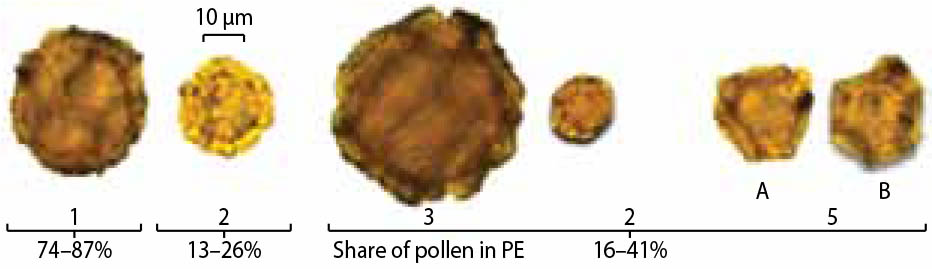
Figure 9
Pollen of Taraxacum officinale in the conditions of Kyiv: 1 – fertile pollen grain (38.2 μm); 2 – sterile pollen grain (24.8 μm); 3 – pollen gigantism (51.1 μm); 4 – pollen dwarfism (17.8 μm); 5 – anomalies of the shell (A – torn, B – crumpled)
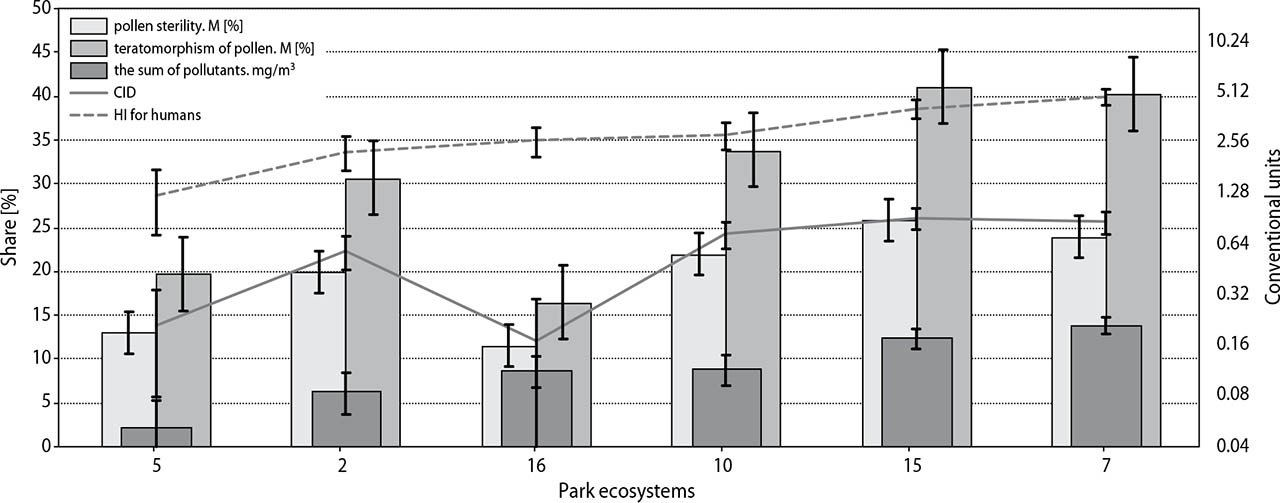
Figure 10
Indices of pollen variability in Kyiv by Taraxacum officinale (PEs are arranged in ascending order of air pollutant concentration, mg/m3). Mean values differ significantly in the Student's t-test (P < 0.05) (HI – hazard index, PE – park ecosystem)
Table 7
Correlation of air pollution and pollen indication
| Distance to the road [m] | Number of cars per hour | V by amount of S [%] | S [%] | T [%] | CID | Inv | C [mg/m3] | HI | |
|---|---|---|---|---|---|---|---|---|---|
| Distance to the road [m] | 1.00 | ||||||||
| Number of cars per hour | 0.21 | 1.00 | |||||||
| V by amount of S [%] | 0.57 | 0.80 | 1.00 | ||||||
| S [%] | −0.78 | 0.36 | −0.14 | 1.00 | |||||
| T [%] | −0.78 | 0.40 | −0.11 | 0.99 | 1.00 | ||||
| CID | −0.75 | 0.41 | −0.11 | 1.00 | 1.00 | 1.00 | |||
| Inv | 0.17 | 0.68 | 0.84 | 0.15 | 0.16 | 0.16 | 1.00 | ||
| C [mg/m3] | −0.25 | 0.89 | 0.48 | 0.72 | 0.76 | 0.76 | 0.53 | 1.00 | |
| HI | −0.29 | 0.86 | 0.44 | 0.76 | 0.80 | 0.80 | 0.49 | 1.00 | 1.00 |
[i] Note. A strong correlation is highlighted. CID – conditional indicator of damage, HI – hazard index.