
Table 1
Sampled populations of J. excelsa in Crimea
| Population | Geographical position | No. of specimens analyzed | Longitude N | Latitude E | Altitude | Collector | |
|---|---|---|---|---|---|---|---|
| biometry1 | genetics | ||||||
| Kara Dag | eastern coastal | 1/10 (4/4/56) | 5 | 44°54′52.97″ | 35°12′55.18″ | 234 | O. Kukushkin, Yu. Krasylenko |
| Sudak | 12 (36) | 5 | 44°50′32.92″ | 34°56′37.11″ | 139 | Yu. Krasylenko, O. Kukushkin | |
| Uzundza | montane | 10 (50) | 5 | 44°27′47.9″ | 33°52′09.4″ | 768–770 | Yu. Krasylenko, O. Kukushkin |
| Fiolent | southern coastal | 5 (25) | 5 | 44°30′15.3″ | 33°30′29.0″ | 55 | Yu. Krasylenko, O. Kukushkin |
| Nikita | 10 (50) | 10 | 44°30′25.09″ | 34°14′52.28″ | 50 | S. Sadogurska, Yu. Krasylenko | |
| Bogatoye Ushelye | montane | 4 (4) | 4 | 44°32′05.56″ | 33°51′23.24″ | 700–770 | O. Kukushkin |
| Laspy | southern coastal | 9 (36) | 10 | 44°25′09.25″ | 33°40′36.57″ | 50 | S. Sadogurska, Yu. Krasylenko |
| Chatyr Dag | montane | 4 (40) | 4 | 44°48′02.63″ | 34°19′16.36″ | 650–1000 | O. Kukuskin, Yu. Krasylenko |
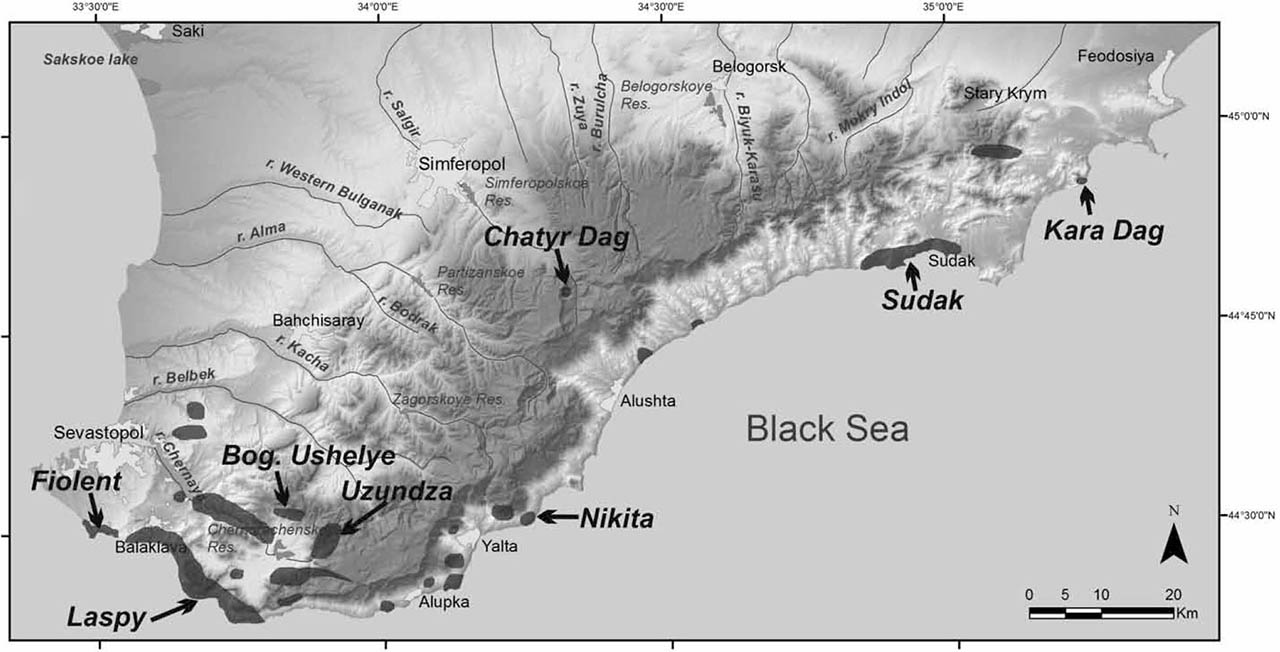
Figure 1
Geographical positions and names of sampled populations of J. excelsa s. str. in Crimea (arrows) against the ranges of communities where the species dominate [in grey; based on Didukh (1992) with O. Kukushkin’s corrections and additions].
Table 2
Morphological characteristics used for the evaluation of the Crimean J. excelsa populations: mean values (M) with standard deviation (SD), minima (Min) and maxima (Max), coefficient of variation (CV), and results of comparisons between populations performed data: Kruskal-Wallis (KW) test between all populations and U Mann-Whitney (UMW) test between montane (M) and coastal (C) population and between eastern (E) and southernmost (S) populations, and basing on the set of individuals means: ANOVA and Student’s t test, respectively based on all data: Kruskal-Wallis (KW) test between all populations and U Mann-Whitney (UMW) test between montane (M) and coastal (C) population and between eastern (E) and southernmost (S) populations, and basing on the set of individuals means: ANOVA and Student’s t test, respectively
| Code | Character | Mean ± SD | Min | Max | CV [%] | F ANOVA | KW P | comparison M-C | comparison E-S | ||
|---|---|---|---|---|---|---|---|---|---|---|---|
| F test t | UMW P | F test t | UMW P | ||||||||
| CL | Length of cone [mm] | 9.1 ± 1.08 | 6.45 | 12.71 | 11.86 | 3.57* | 0.00* | 2.32 | 0.29 | 1.03 | 0.25 |
| CD | Diameter of cone [mm] | 8.83 ± 1.15 | 6.31 | 13.23 | 13.04 | 3.60* | 0.00* | 2.11 | 0.46 | 1.21 | 0.09 |
| CSN | Number of cone scales | 7.59 ± 0.99 | 6.00 | 10.00 | 13.04 | 2.03 | 0.00* | 2.15 | 0.68 | 14.99* | 0.00* |
| SN | Number of seeds | 6.04 ± 1.66 | 2.00 | 11.00 | 27.46 | 1.12 | 0.10 | 1.23 | 0.02* | 1.30 | 0.74 |
| SL | Length of seed [mm] | 4.77 ± 0.59 | 3.19 | 6.37 | 12.32 | 1.86 | 0.00* | 1.04 | 0.08 | 1.34 | 0.19 |
| SW | Width of seed [mm] | 3.06 ± 0.50 | 1.81 | 4.54 | 16.38 | 3.64* | 0.00* | 2.13 | 0.03* | 1.55 | 0.00* |
| LN | Number of leaves | 20.33 ± 4.02 | 12.00 | 34.00 | 19.78 | 5.79* | 0.00* | 2.57* | 0.00* | 1.62 | 0.00* |
| ST | Thickness of the last ramification shoot with leaves [mm] | 0.76 ± 0.10 | 0.54 | 1.07 | 12.94 | 6.28* | 0.00* | 1.88 | 0.44 | 1.01 | 0.23 |
| CL/CD | Ratio of length of cone/diameter of cone | 1.04 ± 0.07 | 0.87 | 1.27 | 6.90 | 1.69 | 0.00* | 1.00 | 0.00* | 1.18 | 0.28 |
| SL/SW | Ratio of length of seed/width of seed | 1.59 ± 0.26 | 1.09 | 2.57 | 16.19 | 2.67* | 0.00* | 1.85* | 0.00* | 2.74 | 0.00* |
| CD/SN | Ratio of diameter of cone/number of seeds | 1.56 ± 0.43 | 0.84 | 3.29 | 27.53 | 0.96 | 0.01* | 1.14 | 0.00* | 1.12 | 0.16 |
| CD/SW | Ratio of diameter of cone/width of seed | 2.93 ± 0.44 | 1.94 | 4.35 | 15.12 | 0.80 | 0.07 | 1.03 | 0.03* | 1.02 | 0.10 |
| CL/SL | Ratio of length of cone/length of seed | 1.93 ± 0.23 | 1.51 | 2.71 | 11.95 | 0.54 | 0.04 | 1.57 | 0.18 | 2.17 | 0.03* |
| CSN/CD | Ratio of number of cone scales/diameter of cone | 0.87 ± 0.13 | 0.58 | 1.27 | 14.63 | 0.76 | 0.01* | 1.55 | 0.62 | 1.40 | 0.26 |
| CD/ST | Ratio of diameter of cone/number of seeds | 11.87 ± 6.85 | 6.85 | 18.77 | 20.48 | 7.54* | 0.00* | 3.55 | 0.36 | 2.89 | 0.02* |
| LN/ST | Ratio of number of leaves/thickness of the last ramification shoot with leaves | 27.27 ± 3.64 | 13.64 | 53.97 | 24.29 | 4.11* | 0.00* | 1.01* | 0.00* | 1.35* | 0.00* |
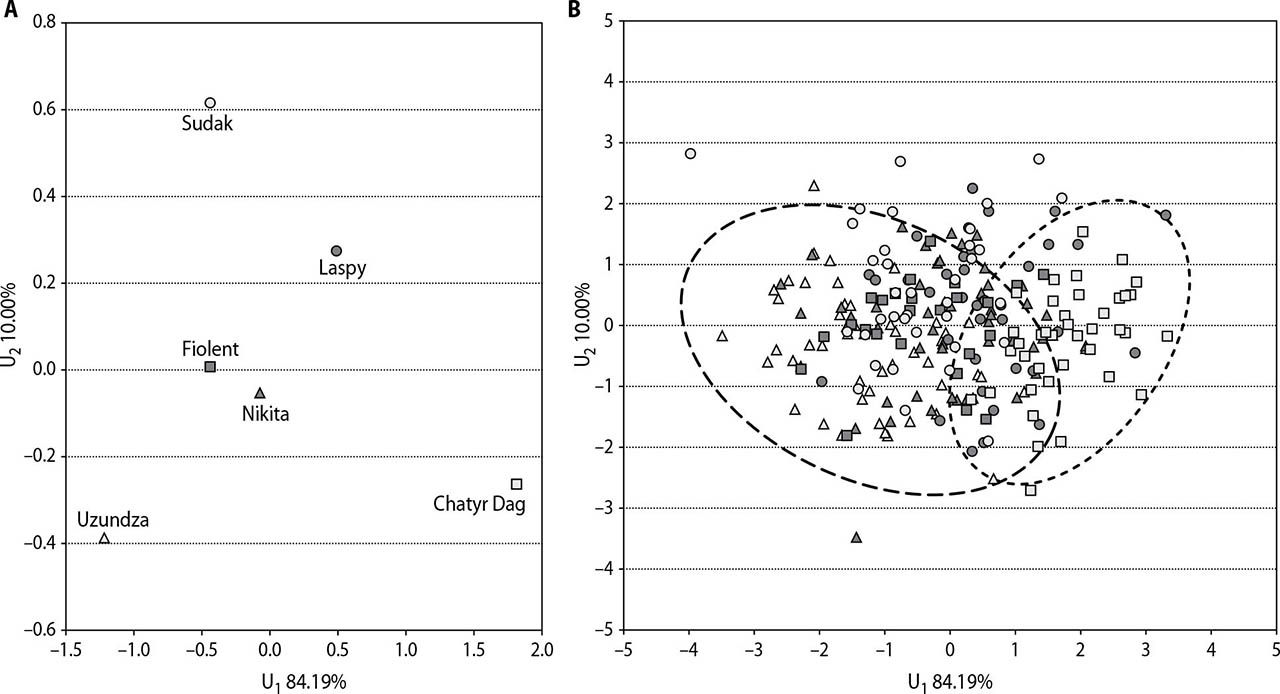
Figure 2
Results of discriminant analysis of six populations of J. excelsa from Crimea based on morphological traits. A – Scatterplot showing populations means, B – Scatter of all cases.
Table 3
Number of individuals (Nind), haplotypes of two polymorphic cpDNA sequences: trnD-trnT and trnH-psbA and haplotype diversity (Hd) in the populations of J. excelsa sampled in the Crimean Peninsula
| Population | Nind | Number of cpDNA haplotypes | Hd | |||||||||
|---|---|---|---|---|---|---|---|---|---|---|---|---|
| H1 | H2 | H3 | H4 | H5 | H6 | H7 | H8 | H9 | H10 | |||
| Kara Dag | 5 | 4 | – | 1 | – | – | – | – | – | – | – | 0.400 |
| Sudak | 5 | 3 | – | – | – | – | – | – | – | 1 | 1 | 0.700 |
| Uzundza | 5 | 3 | – | – | – | – | – | 1 | 1 | – | – | 0.700 |
| Fiolent | 5 | 2 | 1 | – | – | 1 | 1 | – | – | – | – | 0.900 |
| Nikita | 10 | 8 | 2 | – | – | – | – | – | – | – | – | 0.356 |
| Bogatoye Ushelye | 4 | 4 | – | – | – | – | – | – | – | – | 0.000 | |
| Laspy | 10 | 7 | 1 | 1 | 1 | – | – | – | – | – | – | 0.533 |
| Chatyr Dag | 4 | 4 | – | – | – | – | – | – | – | – | – | 0.000 |
| Total | 48 | 35 | 4 | 2 | 1 | 1 | 1 | 1 | 1 | 1 | 1 | |
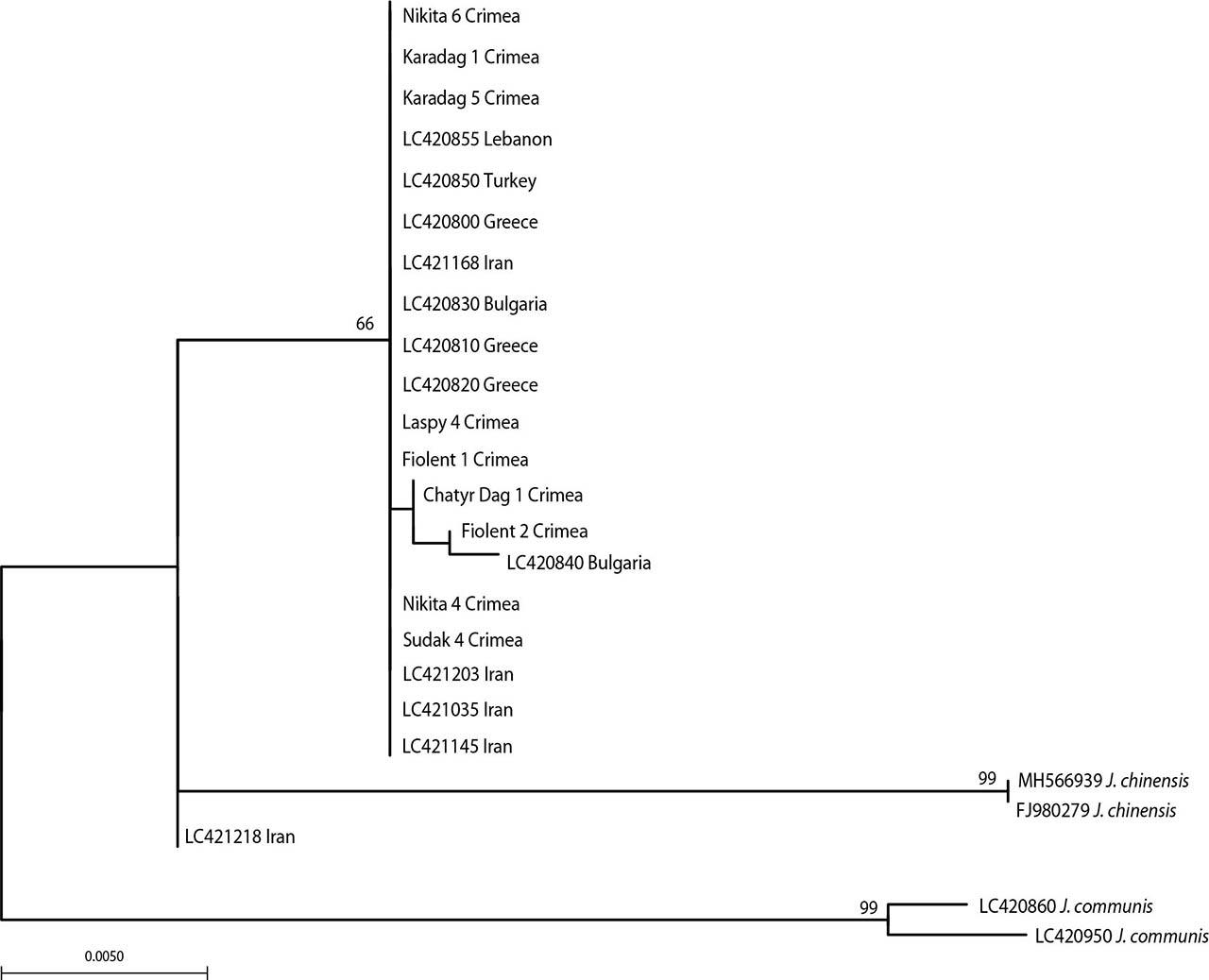
Figure 3
Maximum likelihood (ML) tree based on the nuclear ITS sequence of the J. excelsa individuals. Samples from the Crimean Peninsula are listed in Supplementary Tab. 1. GenBank accessions of other J. excelsa, J. chinensis and J. communis are included (Supplementary Tab. 2). The bootstrap values ≥ 50% are shown only (1,000 replicates)