
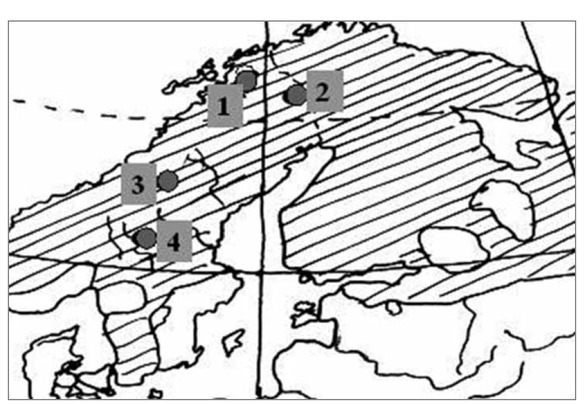
Figure 1
Geographical location of the Betula nana L. populations studied in this work: 1 – Abisko, 2 – Gällivare, 3 – Storlien, 4 – Malbo, 5 – The Linje Reserve. The grey area expresses the range of distribution of B. nana (Kruszelnicki and Fabiszewski 2001, modified)
Table 1
Range of length and number of DNA fragments of Betula nana determined by RAPD
| Primer name | Number of polymorphic DNA fragments | Size range of polymorphic DNA fragments (bp) |
|---|---|---|
| OPA09 | 14 | 90–900 |
| OPC14 | 12 | 90–1030 |
| OPC02 | 16 | 120–1200 |
Table 2
Genetic diversity within populations and genetic differentiation parameters of analysed populations of Betula nana
| Population | P (%) | Na | Ne | I | He |
|---|---|---|---|---|---|
| Abisko | 52.5 | 1.325 | 1.265 | 0.259 | 0.167 |
| Malbo | 72.5 | 1.675 | 1.458 | 0.396 | 0.265 |
| Storlien | 52.5 | 1.300 | 1.177 | 0.200 | 0.121 |
| Gällivare | 30.0 | 0.900 | 1.090 | 0.111 | 0.066 |
| Mean | 51.9 | 1.300 | 1.245 | 0.242 | 0.155 |
| Linje | 66.7 | 1.333 | 1.256 | 0.290 | 0.179 |
Table 3
Results of an AMOVA showing the distribution of genetic variation among Betula nana populations and within populations based on RAPD
| Source of variations | Degree of freedom | Sum of squares | Variance components | % of total variance | P value |
|---|---|---|---|---|---|
| Among populations | 3 | 126.738 | 1.912 | 32 | <0.001 |
| Within populations | 76 | 304.350 | 4.005 | 68 | <0.001 |
| Total | 79 | 431.088 | 5.917 | 100 |
Table 4
Summary of genetic diversity statistics for all loci in relation to the geographic location of Betula nana populations in the north and south of Sweden
| Ht | Hs | Gst | Nm | |
|---|---|---|---|---|
| All populations | 0.2240 | 0.1548 | 0.3171 | 1.100 |
| Abisko/Gällivare | 0.1428 | 0.1166 | 0.1800 | 2.220 |
| Malbo/Storlien | 0.2559 | 0.1930 | 0.2460 | 1.532 |
[i] Gst = (Ht – Hs)/Ht – heterozygosity level, Nei (1973); Ht – total genetic diversity in the pooled populations; Hs – mean diversity within each population; Nm = 0.5(1 – Gst)/Gst – migration rate.
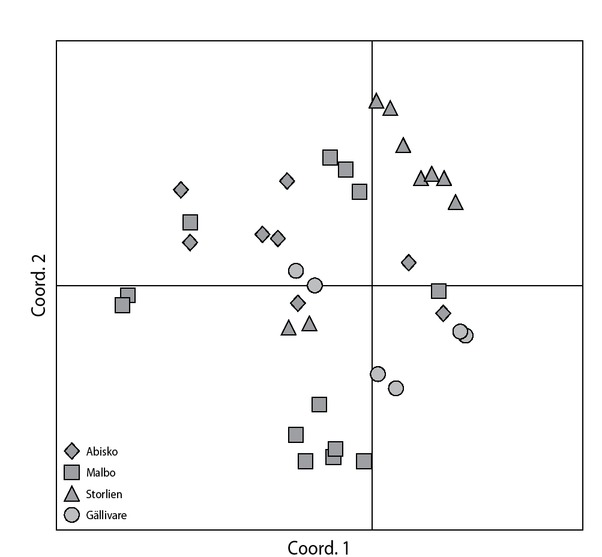
Figure 2
Principal coordinates analysis (PCoA) using random amplification of polymorphic DNA (RAPD) data of the studied populations of Betula nana
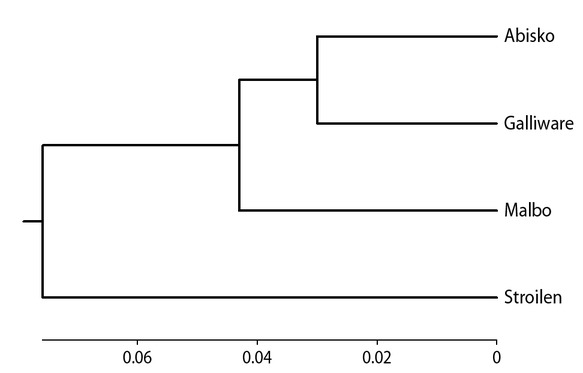
Figure 3
Dendrogram based on Unweighted Pair Group Method with Arithmetic average (UPGMA) of random amplification of polymorphic DNA (RAPD) profiles, showing the relationships among the four Swedish populations of Betula nana