
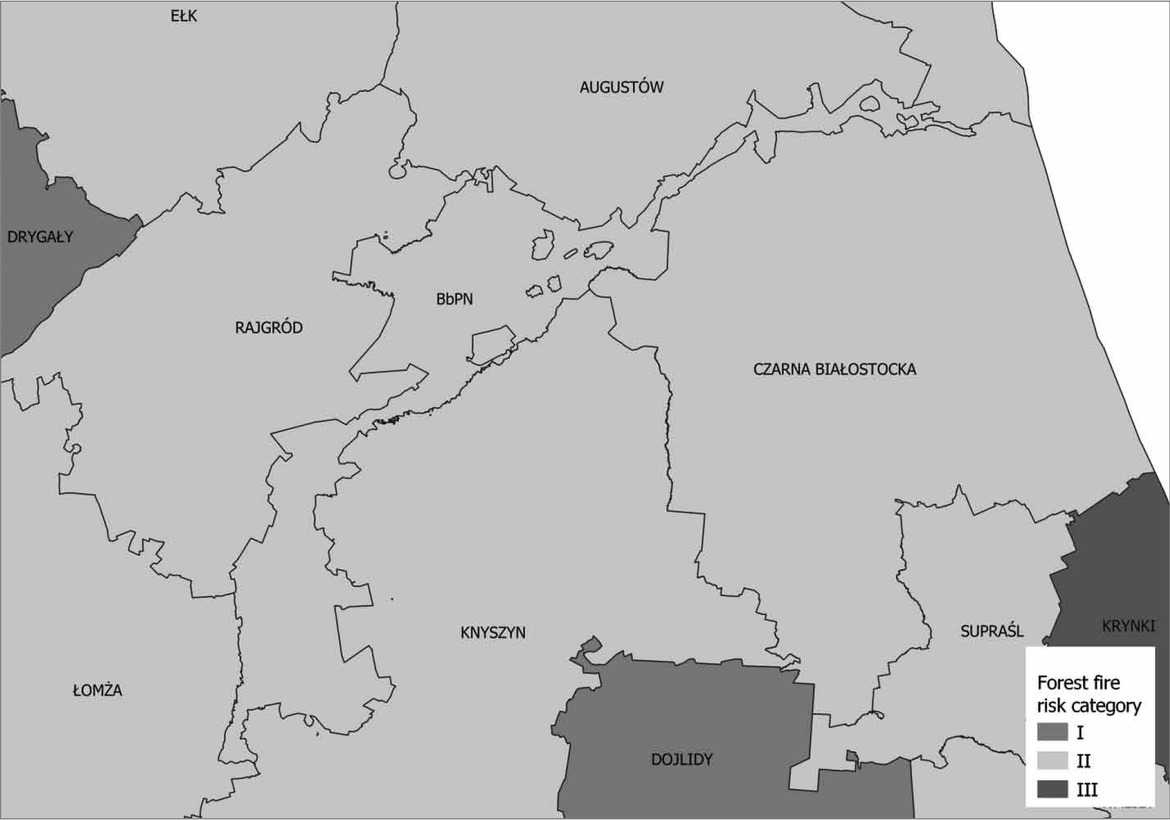
Figure 1
Forest fire risk category of Biebrza National Park and surrounding forest districts
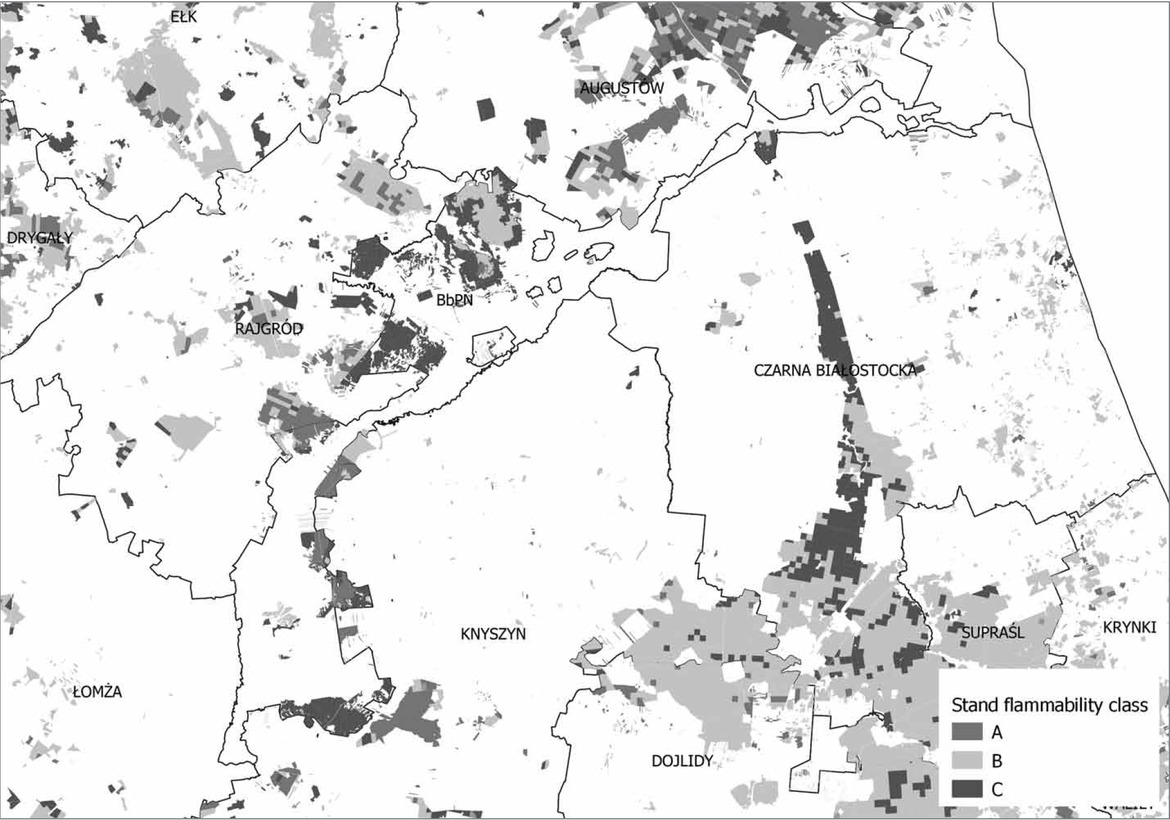
Figure 2
Stand flammability classification of Biebrza National Park and surrounding forest districts
Table 1
Fires of forests and non-forest ecosystems and in years 2010–2020
| Year | Number of fires – non-forest of ecosystem | Number fires – forest ecosystem | Share of forest fires in the total number of events [%] |
|---|---|---|---|
| 2010 | 43,542 | 2,975 | 6.40 |
| 2011 | 68,015 | 5,126 | 7.01 |
| 2012 | 84,952 | 5,752 | 6.34 |
| 2013 | 39,734 | 3,168 | 7.38 |
| 2014 | 57,501 | 3,603 | 5.90 |
| 2015 | 82,899 | 8,292 | 9.09 |
| 2016 | 36,407 | 3,545 | 8.87 |
| 2017 | 38,586 | 2,334 | 5.70 |
| 2018 | 48,765 | 5,947 | 10.87 |
| 2019 | 55,055 | 6,532 | 10.61 |
| 2020 | 47,922 | 6,250 | 11.43 |
| Total | 597,128 | 53,524 | 8.23 |
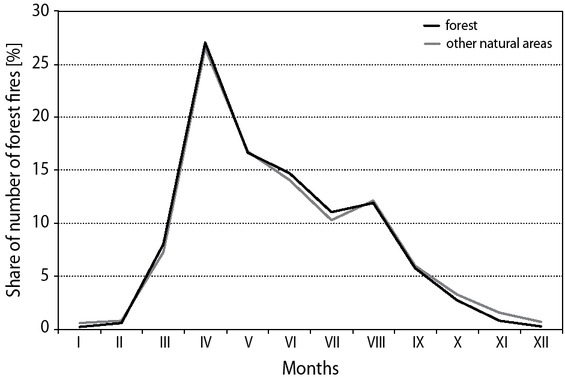
Figure 3
Temporal occurrence of forest and other natural surface fires in years 2007–2020 in Poland
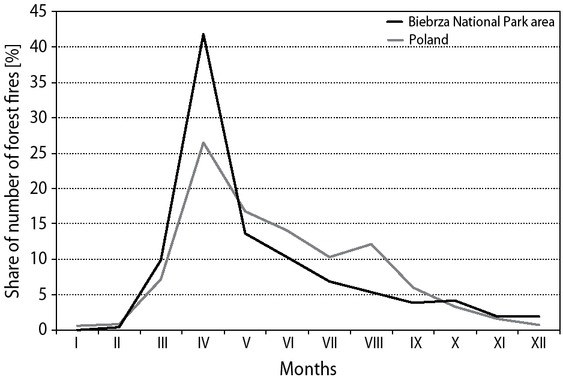
Figure 4
Temporal occurrence of wildfires in Poland and in the Biebrza National Park in years 2007–2020
Table 2
Numbers of fires by types of vegetation
| Aggregated type of vegetation | Number of fires |
|---|---|
| Aquatic vegetation | 2 |
| Forest | 15 |
| Dense bushes | 7 |
| Proper rushes | 19 |
| Grass and herbal rushes | 1 |
| Mosaic of rushes and sedges | 8 |
| Sedges | 48 |
| Moss-sedge communities | 46 |
| Moss-marshes | 3 |
| Changeable wet meadows | 12 |
| Herbs | 6 |
| Fertile moist meadows | 4 |
| Fresh meadows | 2 |
| Pastures | 3 |
| Dry grasslands | 1 |
| Synanthropic vegetation near buildings, ruderal and trodden | 1 |
| Intensively used meadows | 11 |
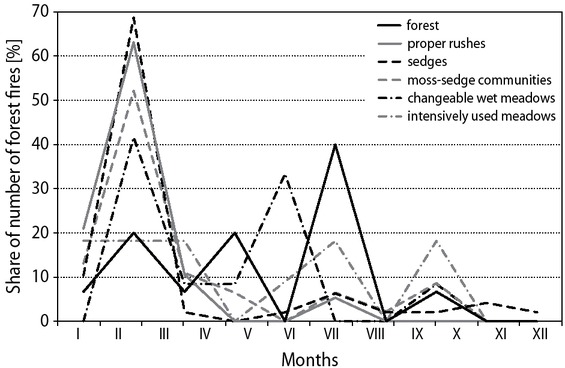
Figure 5
Temporal distribution of fires by types of vegetation in the Biebrza National Park in years 2007–2020
Table 3
Share of the area of aggregated types of vegetation, fire occurrence and flammability indexes and classes
| Aggregated types of vegetation | Area [ha] | Area share [%] | Number of fires | Share of the number of fires [%] | Flammability indexes | Flammability class | |
|---|---|---|---|---|---|---|---|
| no | name | ||||||
| 1 | Aquatic vegetation | 660.59 | 1.11 | 2 | 1.06 | 0.96 | b |
| 2 | Forest | 18,150.28 | 30.39 | 15 | 7.94 | 0.26 | - |
| 3 | Dense bushes | 1,836.83 | 3.08 | 7 | 3.70 | 1.20 | b |
| 4 | Thickets of low birch | 118.38 | 0.20 | 0.00 | 0.00 | c | |
| 5 | Proper rushes | 3,517.59 | 5.89 | 19 | 10.05 | 1.71 | a |
| 6 | Grass and herbal rushes | 91.59 | 0.15 | 1 | 0.53 | 3.45 | a |
| 7 | Mosaic of rushes and sedges | 1,126.93 | 1.89 | 8 | 4.23 | 2.24 | a |
| 8 | Sedges | 9,954.75 | 16.67 | 48 | 25.40 | 1.52 | a |
| 9 | Moss-sedge communities | 9,326.90 | 15.62 | 46 | 24.34 | 1.56 | a |
| 11 | Moss-marshes | 3,267.51 | 5.47 | 3 | 1.59 | 0.29 | c |
| 15 | Changeable wet meadows | 5,433.22 | 9.10 | 12 | 6.35 | 0.70 | b |
| 16 | Herbs | 991.59 | 1.66 | 6 | 3.17 | 1.91 | a |
| 17 | Fertile moist meadows | 530.83 | 0.89 | 4 | 2.12 | 2.38 | a |
| 18 | Fresh meadows | 219.52 | 0.37 | 2 | 1.06 | 2.88 | a |
| 19 | Pastures | 291.45 | 0.49 | 3 | 1.59 | 3.25 | a |
| 20 | Dry grasslands | 370.01 | 0.62 | 1 | 0.53 | 0.85 | b |
| 21 | Synanthropic ruderal and trodden vegetation near buildings, | 88.21 | 0.15 | 1 | 0.53 | 3.58 | a |
| 22 | Intensively used meadows | 1,896.66 | 3.18 | 11 | 5.82 | 1.83 | a |
| 23 | Communities of arable fields | 222.39 | 0.37 | 0.00 | 0.00 | c | |
| 24 | Post fire and post clear-cut communities | 1,346.82 | 2.26 | 0.00 | 0.00 | c | |
| 28 | Flooded grasslands | 136.79 | 0.23 | 0.00 | 0.00 | c | |
| 29 | Communities canescens of Calamagrostis | 143.71 | 0.24 | 0.00 | 0.00 | c | |
Table 4
Share of the area by the flammability classes of non-forest ecosystems in individual basins
| Flammability classes of non-forest ecosystems | Area share [%] | ||
|---|---|---|---|
| lower basin | middle basin | upper basin | |
| a | 75.78 | 60.31 | 73.80 |
| b | 10.62 | 28.54 | 13.41 |
| c | 13.60 | 11.15 | 12.79 |
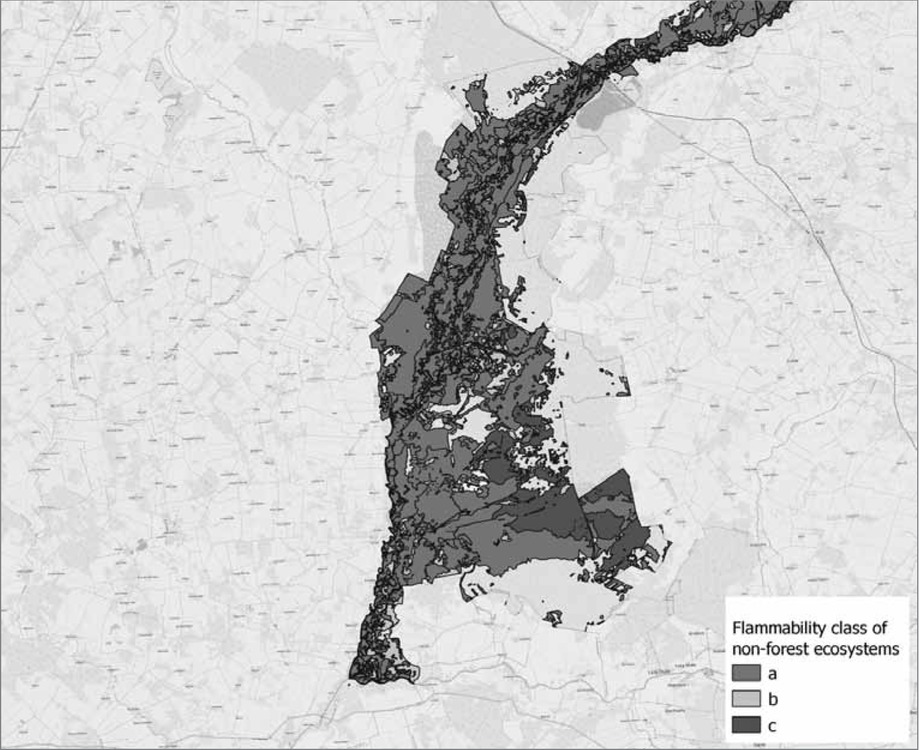
Figure 6
Flammability classification of non-forest ecosystems – lower basin
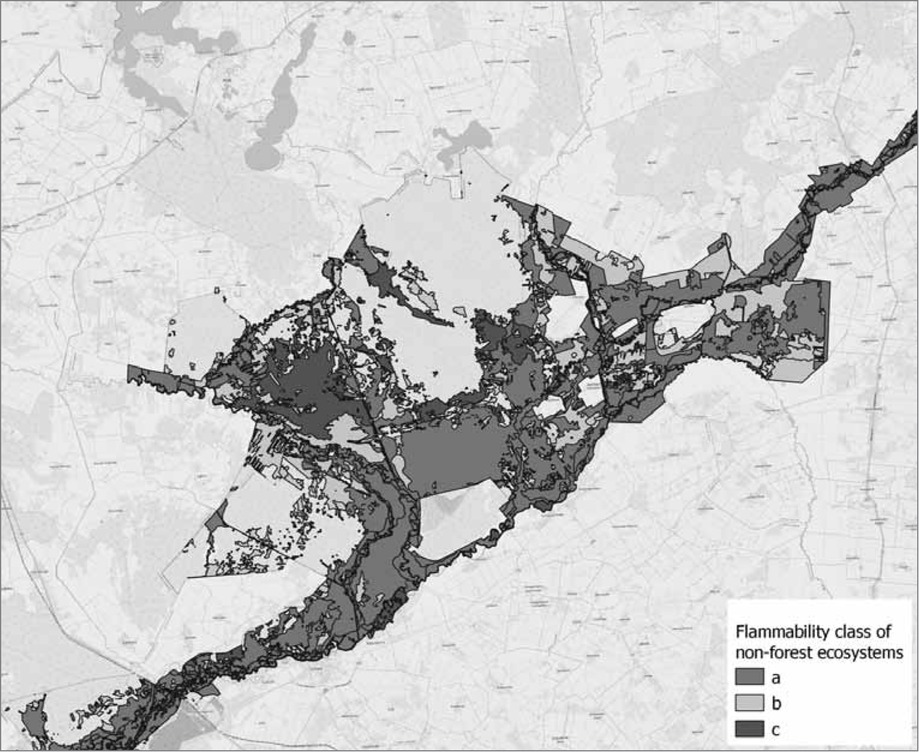
Figure 7
Flammability classification of non-forest ecosystems – middle basin
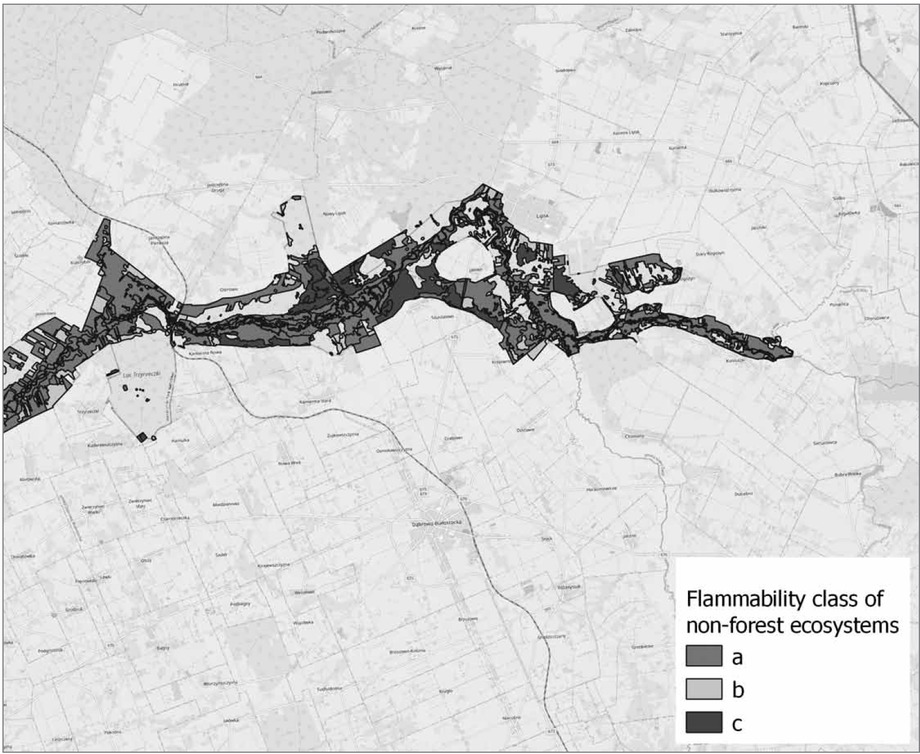
Figure 8
Flammability classification of non-forest ecosystems – upper basin